Type “AI songwriting app” into a search engine and you get a mix of three very different products under one label. Some apps write and sing a whole song from a sentence. Some sit beside you while you write, suggesting a rhyme, a chord or the next line of a melody. And some are features inside a music studio app that play a bass part or hand you a starting idea. All three get called AI songwriting, but they leave you with very different things at the end, including very different answers to the question most guides skip: who owns the song?
That question matters as soon as you want to upload a track to Spotify, use it in a video you earn from, or register it. The answer is not in the marketing. It is in each vendor’s terms of service, and on some apps it changes with the plan you pay for. So this guide sorts the apps by job, then quotes what each one’s own terms say about ownership and commercial use, with the date of the version we read.
How we put this together. We have not used these apps ourselves; this is a research-based comparison. Prices, ratings and features come from each vendor’s website, terms of service and help pages, and from their US App Store and Google Play listings, all read on 18 October 2026. Lawsuit details come from technology and music trade press, and copyright rules from the US Copyright Office. We link to every source. Prices are in US dollars. Apple sometimes lists more than one price for the same plan, so we say so where it does. Nothing here is a test result, none of this is legal advice, and no vendor paid to appear on this page.
Three jobs that all get called AI songwriting
1. Full song generators
You type a description or paste lyrics, and the app returns a finished recording with vocals and instruments. Suno, Eleven Music from ElevenLabs, Udio and Google Flow Music work this way. They need little more than a prompt, and they raise the hardest ownership questions, because the AI made most of the creative choices. They are also the apps the record labels sued.
2. Co-writers
These tools help a human write. Hookpad’s Aria add-on suggests chords for your melody or a melody for your chords. LyricStudio suggests lines, rhymes and whole verse drafts while you write. You stay the author and pick what to keep, which is why both vendors say the result is yours.
3. DAW assistants
Music production apps now have AI features built in. BandLab’s SongStarter generates short musical ideas as editable MIDI, and Logic Pro’s Session Players play bass, keys and drum parts that follow your chords. They do not write the song for you; they speed up the parts around it.
If you want to keep and register a song as your own work, the US Copyright Office’s position favours the second and third groups. More on that below.
AI songwriting apps compared
| App | Job | US price (18 October 2026) | Who owns the output, per vendor terms | Platforms | US App Store rating |
|---|---|---|---|---|---|
| Suno | Full song generator | Free; Pro $10/mo or $96/yr; Premier $30/mo or $288/yr | Paid plans: assigned to you, commercial use for downloaded songs (20 a month on Pro, 60 on Premier). Free: personal use | Web, iPhone, Android | 4.9 (374,562) |
| Eleven Music | Full song generator, licensed | Free; Starter $6/mo; Creator $22/mo; Pro $99/mo | You retain rights; per-plan table. Free has no downloads; Starter cannot go to streaming services | Web, iPhone app | 4.8 (526) |
| Udio | Full song generator | Free; Standard $10/mo or $96/yr; Pro $30/mo or $288/yr | Terms say Udio owns the output; no downloads, no commercial use | Web, iPhone | 4.2 (3,614) |
| Google Flow Music | Full song generator | Free to start; iPhone plans from $7.99/mo | Google’s general terms: your content remains yours; no music-specific rights table found | Web, iPhone, Android | 4.0 (54) |
| Hookpad + Aria | Co-writer: chords and melody | Hookpad free or $7.99/mo; Aria add-on $14.99/mo | You retain ownership; personal and commercial use | Web | Web app |
| LyricStudio | Co-writer: lyrics | Pro from $5.99/mo; Gold from $9.99/mo (coupon prices) | You keep all rights to your lyrics | Web | Web app |
| BandLab SongStarter | DAW assistant | SongStarter free; Membership $14.99/mo in the US App Store | You won’t own the generated idea, but can use it without fees or royalties | Web, iPhone, Android | 4.7 (509,920) |
| Logic Pro | DAW assistant | $12.99/mo or $129/yr (Apple Creator Studio); Mac app $199.99 | Parts are played inside your own project | Mac, iPad | 4.5 (6,349, iPad) |
Prices and ratings read on 18 October 2026, rounded to one decimal. Ownership summaries are our reading of each vendor’s published terms on that date; quotes and links are in each section below.
How we chose and ordered these
Every app had to use AI to create or suggest musical material, not just store lyrics or record audio. We grouped them by job, then ordered each group by how clearly the vendor’s terms let you own and release what you make, how much public evidence there is that the product is used and maintained (rating volume, installs, last update) and price. We dropped apps not updated in more than a year on any platform, apps with only a handful of ratings, and generic generator apps whose model and output terms we could not trace. They are listed at the end.
1. Suno: the full song generator with clear paid ownership terms
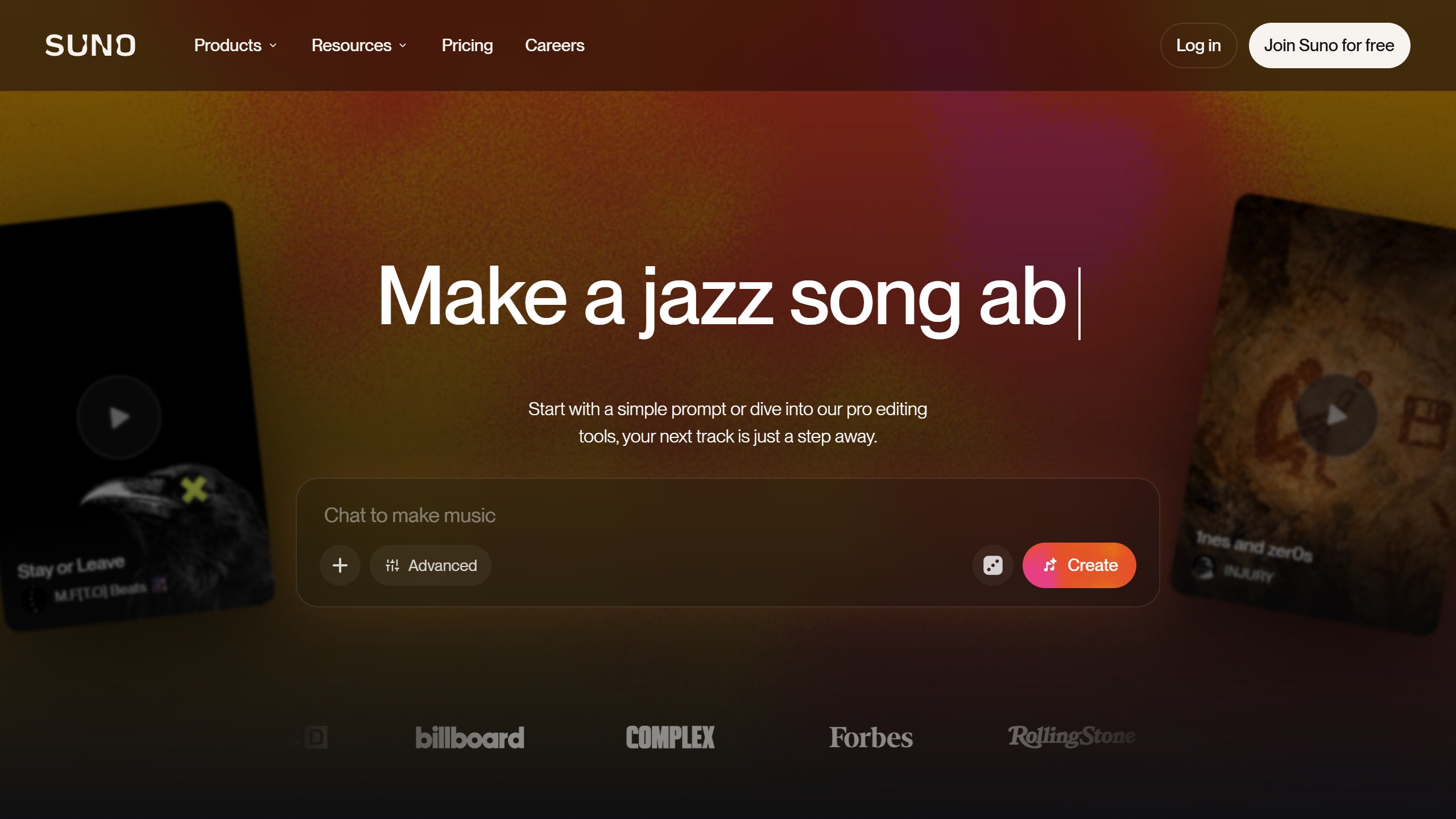
Suno turns a text prompt, your own lyrics, a hummed tune or an uploaded recording into a finished song with vocals. Its iPhone app had a 4.9 average from 374,562 US ratings and was updated on 14 October 2026, and its Android app had more than 2.5 million reviews, a 4.8 average and over 10 million installs. Those are the largest store numbers among the generators on this page.
What Suno costs
Suno’s pricing page lists a Free plan with 50 credits a day (about 10 songs), Pro at $10 a month or $96 a year with 2,500 credits a month, and Premier at $30 a month or $288 a year with 10,000 credits. The US App Store lists the same monthly plans, a Premier annual price of $289.00, and separate download credits at $2.99 or $4.99 each.
Who owns a Suno song
Suno’s terms of service, last revised on 10 August 2026 and effective from 3 September 2026, split the answer by plan. On Pro and Premier, Suno “hereby assigns to you all of its right, title and interest” in the output you generate. On the free tier, you agree to use outputs only “for your lawful, personal and non-commercial purposes.”
Two details the marketing does not mention. First, paid commercial use is tied to downloads: you may commercially use a song only if you obtained “a permitted download” of it, and the pricing page sets that allowance at 20 song downloads a month on Pro and 60 on Premier. Recording or stream ripping a song instead is prohibited, and Suno says it may add a watermark or metadata showing the plan a song came from. Rights in a song you did download are described as perpetual, so cancelling later does not take them back. Second, the terms say Suno “makes no representation or warranty to you that any copyright will vest in any Output.” The App Store listing says “every song is yours”; the terms make clear that means Suno gives you whatever rights it has, not that a copyright exists. Remixes of other users’ songs are jointly owned and limited to non-commercial use on every plan.
Choose it if you want a finished, releasable song from a prompt and will pay for Pro. Skip it if you need more than 20 commercial downloads a month on a budget, or you want to register the song as your own composition.
2. Eleven Music: licensed tracks with a published rights table
Eleven Music is ElevenLabs’ song generator. Its page says you can “create original music from a lyric, mood, loop or voice recording” and that it was “built in partnership with artists, labels, and publishers.” Its pitch to creators is clearance: “The tracks you generate are cleared for broad commercial use.”
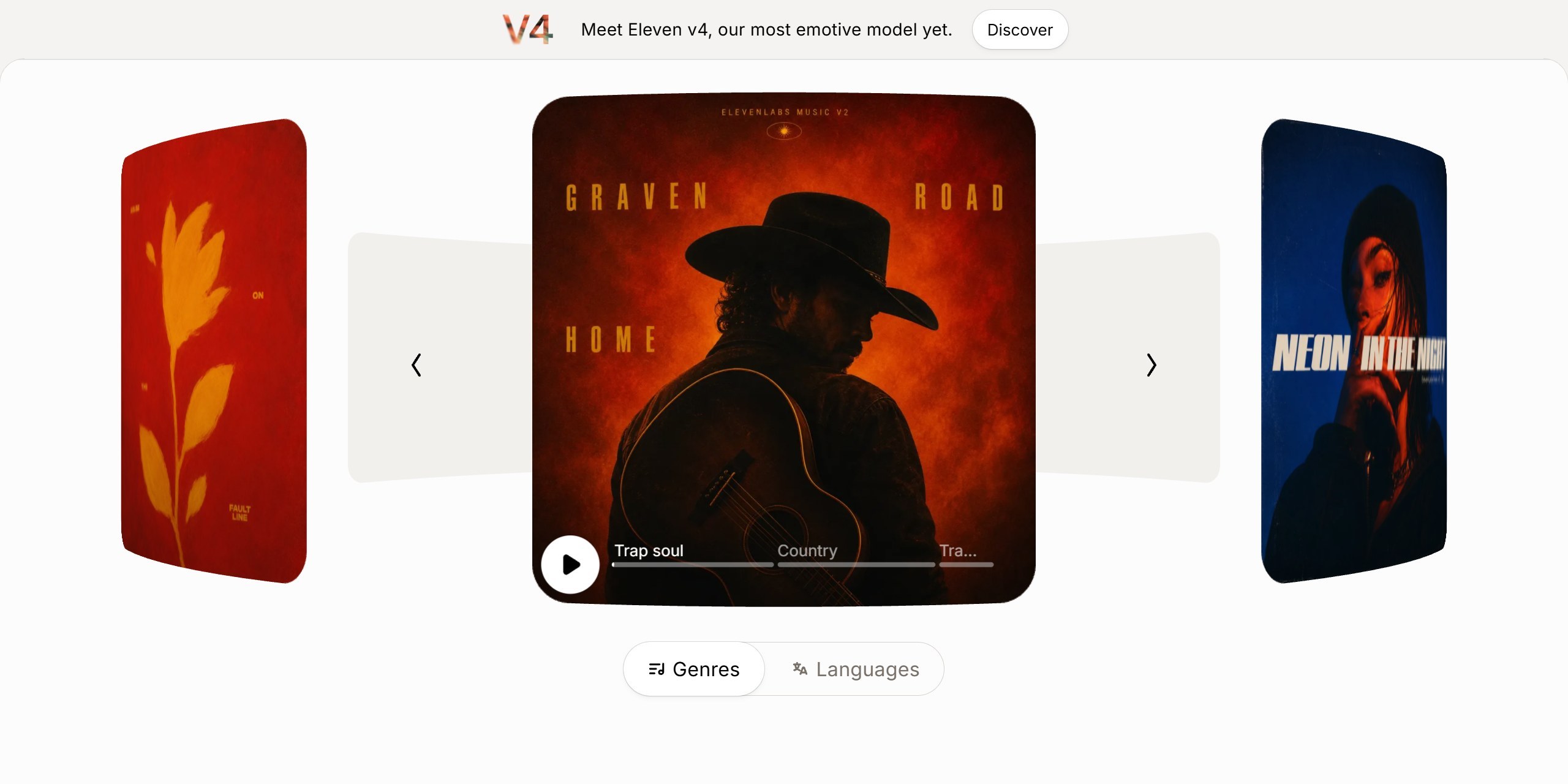
The useful part is the Music Terms, last updated on 9 October 2026, which include a plan-by-plan rights table. As between you and ElevenLabs, “you retain any and all rights in and to your Input and Output.” All self-serve plans allow online and offline commercial use except film, TV, radio and what ElevenLabs calls Studio Games; only the Enterprise Music plan removes those exclusions. The two ElevenLabs pages disagree on Free: the Music Terms table lists the same commercial media rights for it, while the plan table on the music page labels Free “Personal use only”. Either way, the Free plan has no downloads and requires you to credit Eleven Music when distributing, the Starter plan allows 30 minutes of downloads a month but prohibits distribution to music streaming services, and Creator and above permit streaming distribution. The terms also make you responsible for “reviewing Output for clearance” before you publish it.
On the pricing page, Starter is $6 a month, Creator $22 and Pro $99, with first-month offers on Starter and Creator. The separate ElevenMusic iPhone app, released in April 2026, had a 4.8 average from 526 US ratings and lists its own plan at $9.99 a month or $95.90 a year. The ElevenMusic website links only to the App Store, and we found no ElevenMusic app on Google Play, so Android users can use the website.
Choose it if you make music for videos, podcasts or ads and want written commercial terms. Skip it if you want to release to Spotify on the cheapest paid plan, which Starter does not allow.
3. Udio: full songs, but they stay on Udio
Udio generates songs with vocals from text or lyrics, and its iPhone listing describes a lyric editor where you can “write, generate, or edit lyrics line-by-line, with help from AI as needed.” Its pricing page lists a Free plan (100 credits a month, three full-length songs a day), Standard at $10 a month or $96 a year, and Pro at $30 a month or $288 a year.
What you can do with the result is the problem. Udio’s terms of service, last revised on 12 November 2025, say: “You may not download copies of any Output.” You also agree not to put outputs on streaming or social platforms such as YouTube, TikTok or Spotify, though sharing links is allowed. The terms say Udio and its licensors “own all right, title and interest in and to the Services and the Output”, and they prohibit using any output “for any commercial purpose.” This follows Udio’s October 2025 deal with Universal Music Group, after which it disabled downloads and opened a 48-hour download window from 3 November 2025 for songs made under its earlier terms.
The iPhone app had a 4.2 average from 3,614 US ratings and was last updated on 20 August 2026. Udio’s help center says it does not currently have an Android app and that “Udio” apps on Google Play are unauthorized. In the US App Store, the Pro annual plan was listed at $289.00, against $288 on the website. Udio’s licensed service with the labels was still described as forthcoming in July 2026, and we found no launch announcement by 18 October 2026.
Choose it if you want to experiment and share links with friends. Skip it if you want to own, download or release anything you make.
4. Google Flow Music: Google’s new agentic studio
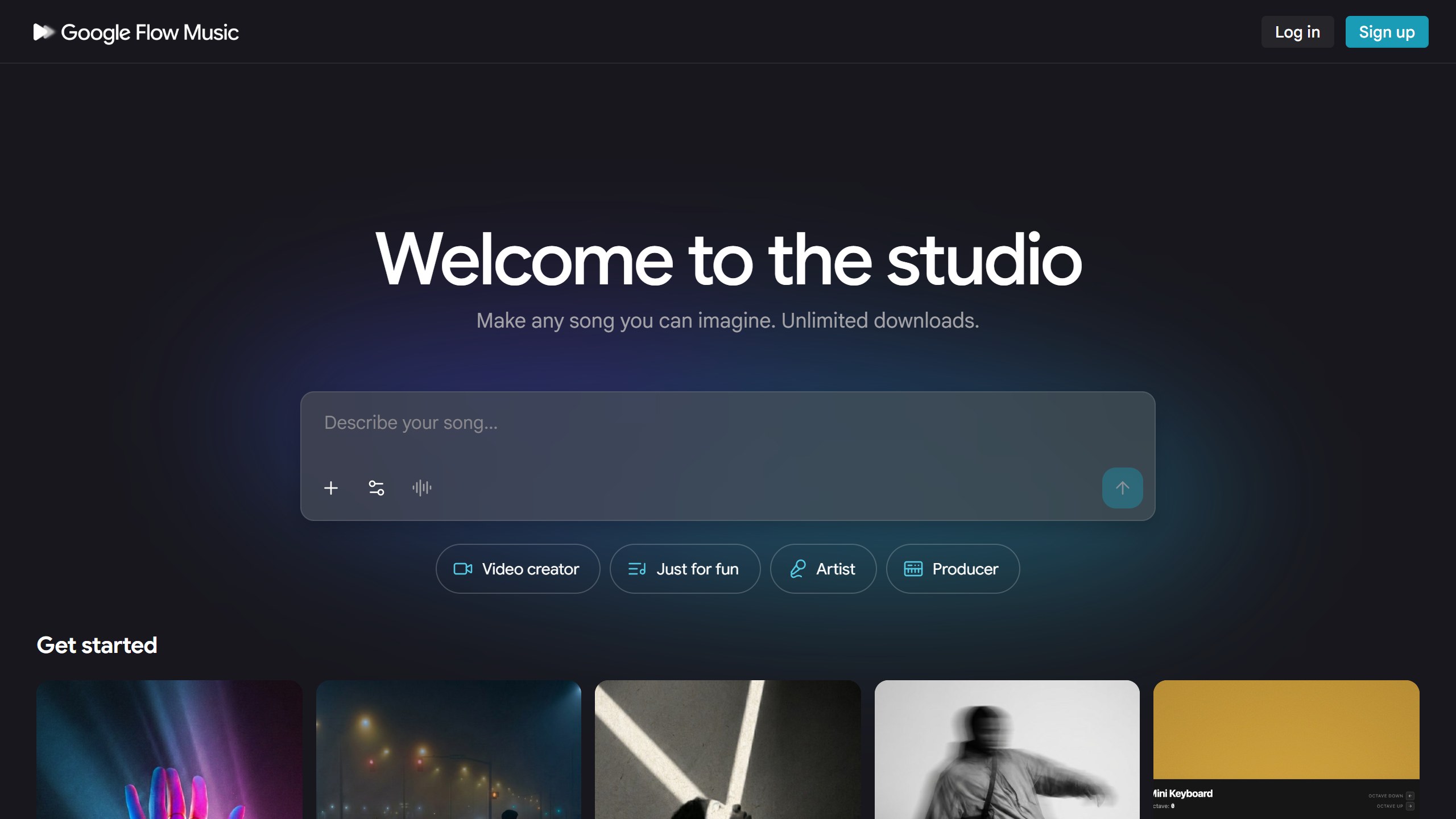
Google Flow Music launched on iPhone in May 2026. Its listing says it “puts the frontier AI music models of Google at your fingertips”, and its website names the model as Lyria 3.5. You chat with an AI “Producer”, asking it to “make the bass punchier”, and it can make covers, replace or extend sections, split stems and generate music videos with Google’s Veo model. Its website promises “unlimited downloads” and says it is free to start with no card required.
It is new and the store numbers are small: the iPhone app had a 4.0 average from 54 US ratings, and the Android app had 174 reviews and more than 50,000 installs, both updated on 13 October 2026. US App Store plans ran from Starter at $7.99 a month or $70.99 a year to Member at $64.00 a month or $569.99 a year. Its terms link leads to Google’s general terms of service, which say “your content remains yours”, but we found no music-specific commercial rights table like the ones Suno and ElevenLabs publish. Check the terms in the app before you release anything from it.
Choose it if you want to direct a song in conversation and already live in Google’s tools. Skip it if you need written commercial terms today.
5. Hookpad with Aria: an AI co-writer for chords and melody
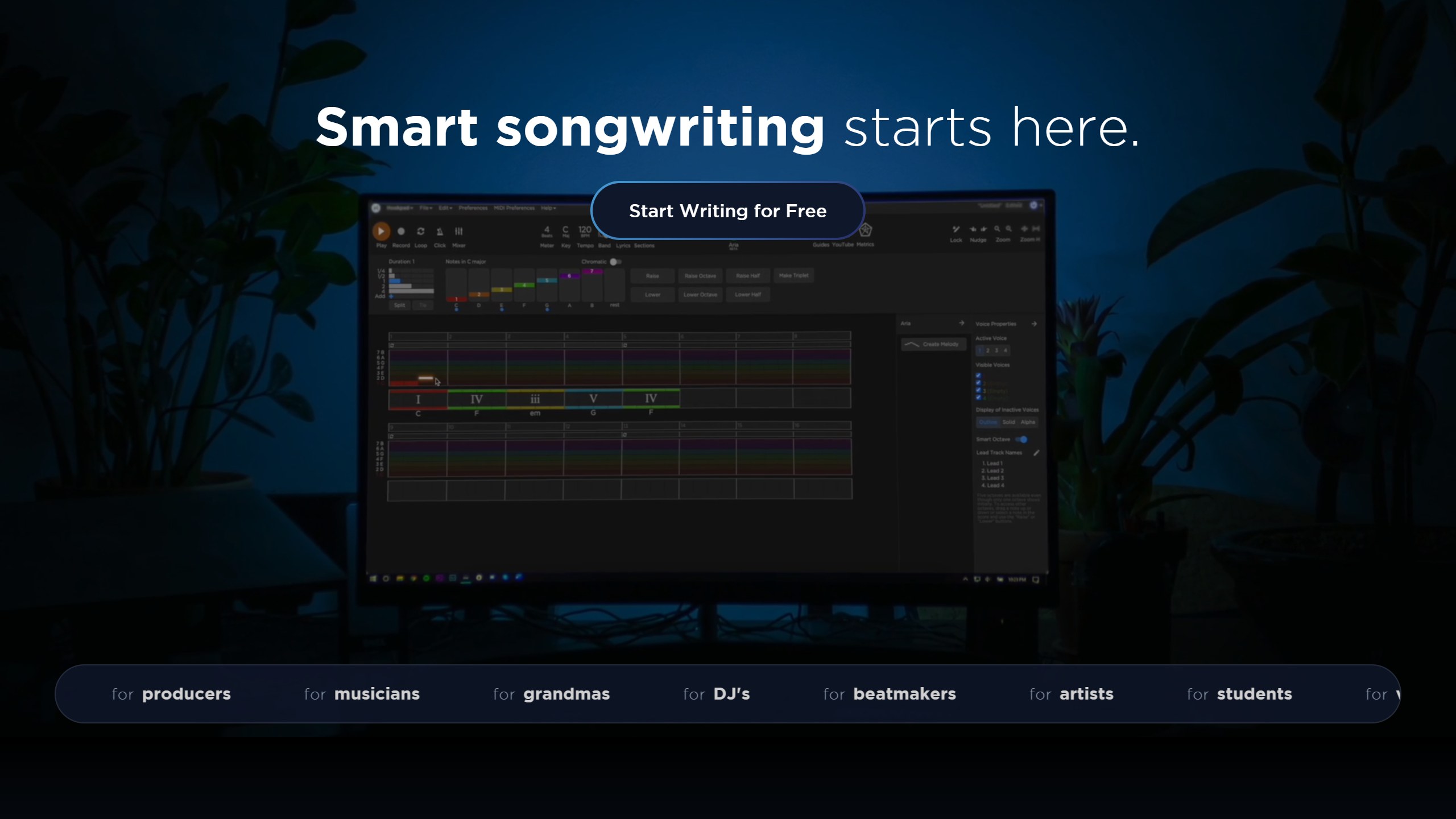
Hookpad from Hooktheory is “songwriting software built on music theory”: you write chords and melody on a grid that shows how they fit the key. The Aria add-on is the AI part. Hooktheory says “Aria can write chords, melody, or both at the same time. It can write chords for your melody, and write melody for your chords”, that it reads the surrounding music to keep suggestions in context, and that you can steer it by genre or mood. You accept, change or ignore each suggestion, so the song stays yours to shape.
The Aria terms are short and clear: you get a license to use Aria “for your personal and commercial creative projects”, and “you retain ownership of the original content you create with Aria’s assistance,” subject to Hooktheory using data to improve the model. Those terms say Aria is free for a limited number of uses a day and unlimited as a paid add-on. On the pricing page, Hookpad is free or $7.99 a month (or $199 for lifetime access) and Aria costs $14.99 a month on top. Hookpad runs in a web browser; we found no mobile app for it.
Choose it if you write songs yourself and get stuck on chords or melody. Skip it if you want a finished recording with vocals.
6. LyricStudio: an AI co-writer for lyrics
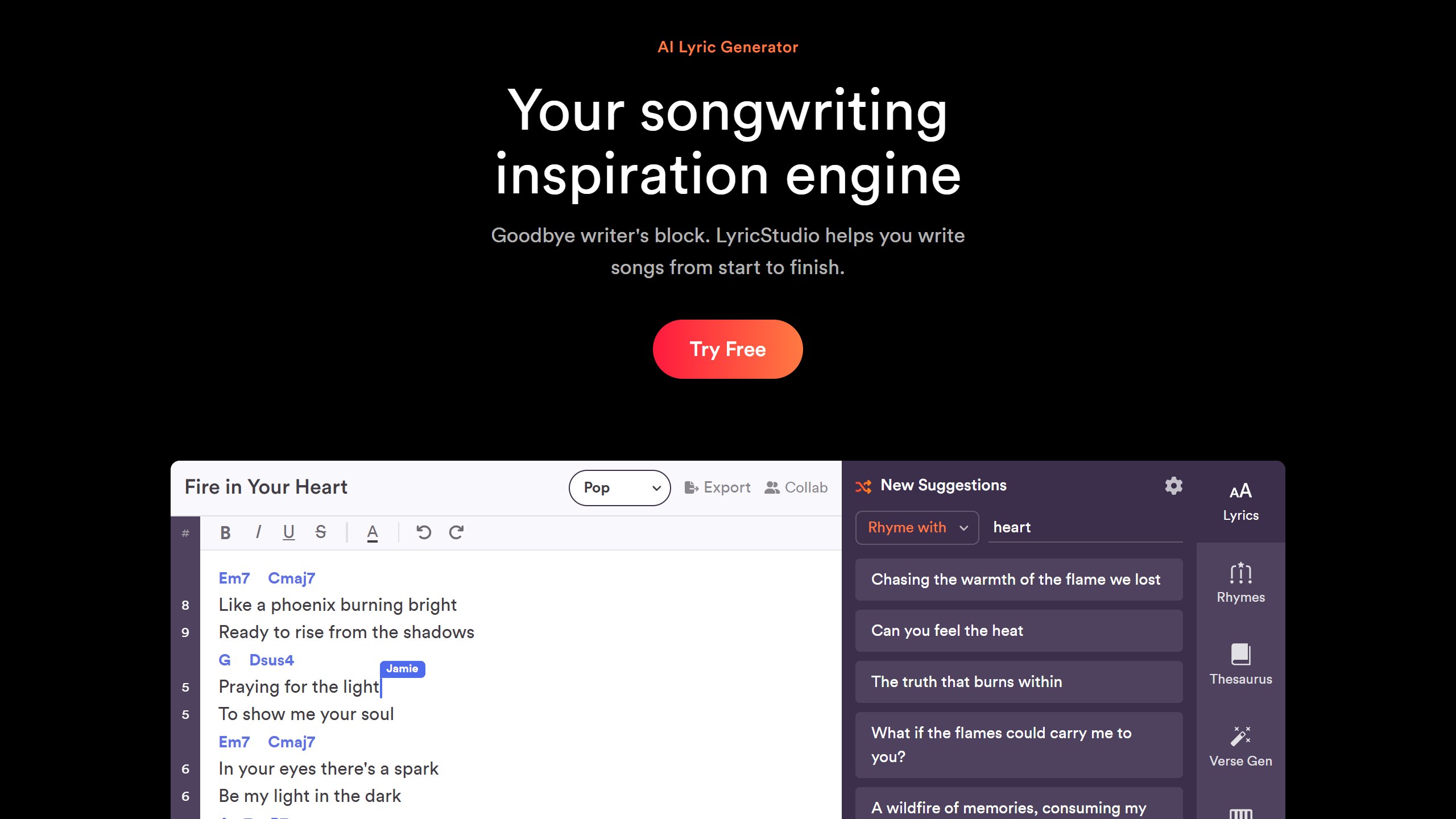
LyricStudio, made by WaveAI, is a browser-based lyric editor with suggestions. It describes itself as “AI built for songwriters” that “writes with you, not for you”: you choose a genre and topic, and it offers lines, rhymes, a thesaurus, verse drafts, a syllable counter and chord labels, with real-time collaboration for co-writers. Its site cites “over 1,000,000 songwriters, musicians and producers” as fans.
On rights, its FAQ is direct: “You keep all the rights to the lyrics you create on this platform.” Its plans page showed coupon prices on 18 October 2026: Pro at $5.99 a month (against a listed $9.99), $29.94 for six months or $47.88 a year; Gold, which adds what LyricStudio calls “Our most powerful lyric model” and line completion, at $9.99 a month (against $16.65), $53.94 for six months or $95.88 a year. We found no official app; an iPhone app called Lyric Studio from a different developer is a separate product.
Choose it if lyrics are your bottleneck and you want suggestions rather than a finished song. Skip it if you need help with music rather than words.
7. BandLab SongStarter: free ideas inside a free studio
SongStarter is BandLab’s free idea generator. Pick one of 11 genres and it offers three short compositions per idea, which you can regenerate, change in mood, pitch and tempo, and open as editable MIDI in BandLab’s studio. BandLab’s AI tools page lists more: Extend adds up to 8 bars to a MIDI part, Recompose varies one, and Splitter, AutoMix and Voice Cleaner help with production.
On ownership, BandLab’s help center is blunt: “While you won’t own the rights to the generated track, you can still use it without incurring any fees or royalties to the original creator.” BandLab presents SongStarter output as a starting point to open and edit in its studio. The iPhone app had a 4.7 average from 509,920 US ratings, and the Android app had more than 100 million installs; both were updated in October 2026. In the US App Store, Membership, which unlocks extra AI tools, was $14.99 a month, and Membership Pro was $14.99 a month or $149.99 for 12 months.
Choose it if you want free inspiration and a free place to build the song. Skip it if you want to own the generated material outright.
8. Logic Pro: AI session players for your own songs
Logic Pro is Apple’s professional music app for Mac and iPad. Its AI features are aimed at songwriters who already have the song: Session Players are “AI-powered musicians” that play synth, bass, keyboard and drum parts, and Chord ID identifies the chords in your recording so the players follow along. Stem Splitter and Mastering Assistant cover the production end.
Apple lists Logic Pro inside its Apple Creator Studio subscription at $12.99 a month or $129 a year after a free trial, and Logic Pro for Mac as a one-time purchase at $199.99. The iPad app had a 4.5 average from 6,349 US ratings and was updated on 29 September 2026. Because the parts are performed inside your own project, under your direction, Logic Pro fits the “assistive tool” side of the copyright line.
Choose it if you write on a Mac or iPad and want a band to play along. Skip it if you are on Windows or Android.
Can you copyright or register an AI song?
In the US, the Copyright Office’s January 2025 report on copyrightability sets out the rules. In its own words: “Copyright does not extend to purely AI-generated material, or material where there is insufficient human control over the expressive elements.” On prompts: “prompts do not alone provide sufficient control.” But: “Human authors are entitled to copyright in their works of authorship that are perceptible in AI-generated outputs, as well as the creative selection, coordination, or arrangement of material in the outputs, or creative modifications of the outputs.” And: “The use of AI tools to assist rather than stand in for human creativity does not affect the availability of copyright protection for the output.”
On the Office’s reasoning, that points to four things for a songwriter. This is general information, not legal advice; for a specific song, check the app’s terms and ask a lawyer. Lyrics you wrote yourself remain your copyright even if Suno sings them. A melody Suno invented from your prompt is unlikely to be protected. Songs written with a co-writer tool, where you chose and edited every line, sit on much safer ground. And when you register a work with more than a small amount of AI material, the Office’s registration guidance asks you to disclose it and describe your own contribution. The report gives a music example: a Randy Travis recording was registered because an AI voice model was used as a tool, not to generate the expression.
The courts have not moved this line. In March 2026 the Supreme Court declined to hear Thaler v. Perlmutter, leaving in place the appeals court ruling that a work needs a human author. Registration is separate from your contract with the app: Suno can assign you its rights, but it cannot create a copyright the law does not recognise, which is why its terms carry that “no representation” line.
Where the label lawsuits stand in October 2026
| Who | Status | Source |
|---|---|---|
| Universal Music and Udio | Settled with a licensing deal in October 2025; Udio then disabled downloads | Digital Music News, 31 October 2025 |
| Warner Music and Udio | Settled on 19 November 2025, with a licensed service due in 2026 | TechCrunch, 19 November 2025 |
| Warner Music and Suno | Settled on 25 November 2025; licensed models to replace current ones, downloads to need a paid account | TechCrunch, 25 November 2025 |
| Sony Music and Udio | Still in court. A judge refused to add about 30,000 recordings to the original case; Sony filed a second suit over them on 20 July 2026 | Digital Music News, 2 July 2026 and 20 July 2026 |
| Universal, Sony and Suno | Still in court. Original 2024 case continues; a second suit filed on 18 September 2026 covers 60,202 recordings and targets Suno’s v6 models | Digital Music News, 18 September 2026 |
None of these cases is aimed at users, and none has decided whether training on recordings was legal. What they have already changed is the product. Udio removed downloads after its Universal deal, and Warner’s Suno deal tied downloads to paid accounts. The second Suno suit argues that the new v6 models, which Suno rolled out in partnership with Warner Music, BMG and Believe, are “the fruit of the same poisoned tree.” If you release Suno songs commercially, keep your own lyrics and download records, and expect the terms to change again.
What we left out, and why
Rhymer’s Block had not been updated since July 2025 and The Lyrics App since November 2024, so both are stale. Songwriter’s Pad + Lyrics AI had 49 US ratings. Demo: Songwriting Studio is a well-rated songwriting app, but its listing makes no AI claim. The many generic “AI song generator” apps in the App Store, some with tens of thousands of ratings, do not say whose model they run or what rights you get, so we cannot tell you who owns their output. We could not find an app called Songcraft from a traceable vendor. Zoundroom publishes one of the top-ranking guides on this topic and ranks its own app in it, so we leave it out. AIVA writes instrumental music rather than songs with lyrics, and a general chatbot such as ChatGPT can draft lyrics but is not built for songwriting.
One correction to the top results: a top-ranking guide says Suno and Udio offer “downloadable, commercially-licensed MIDI tracks.” Both generate finished audio songs. Suno’s pricing page lists MIDI only as part of Suno Studio on its Premier plan, and Udio’s current terms prohibit downloads and commercial use.
How to choose an AI songwriting app
Decide whether you want a song or help writing one
If you want a finished track for a video or for fun, use a generator: Suno, Eleven Music or Google Flow Music. If you want to become a better songwriter or keep the song as your own work, use a co-writer: Hookpad with Aria for music, LyricStudio for words.
Read the rights line for your plan, not the app
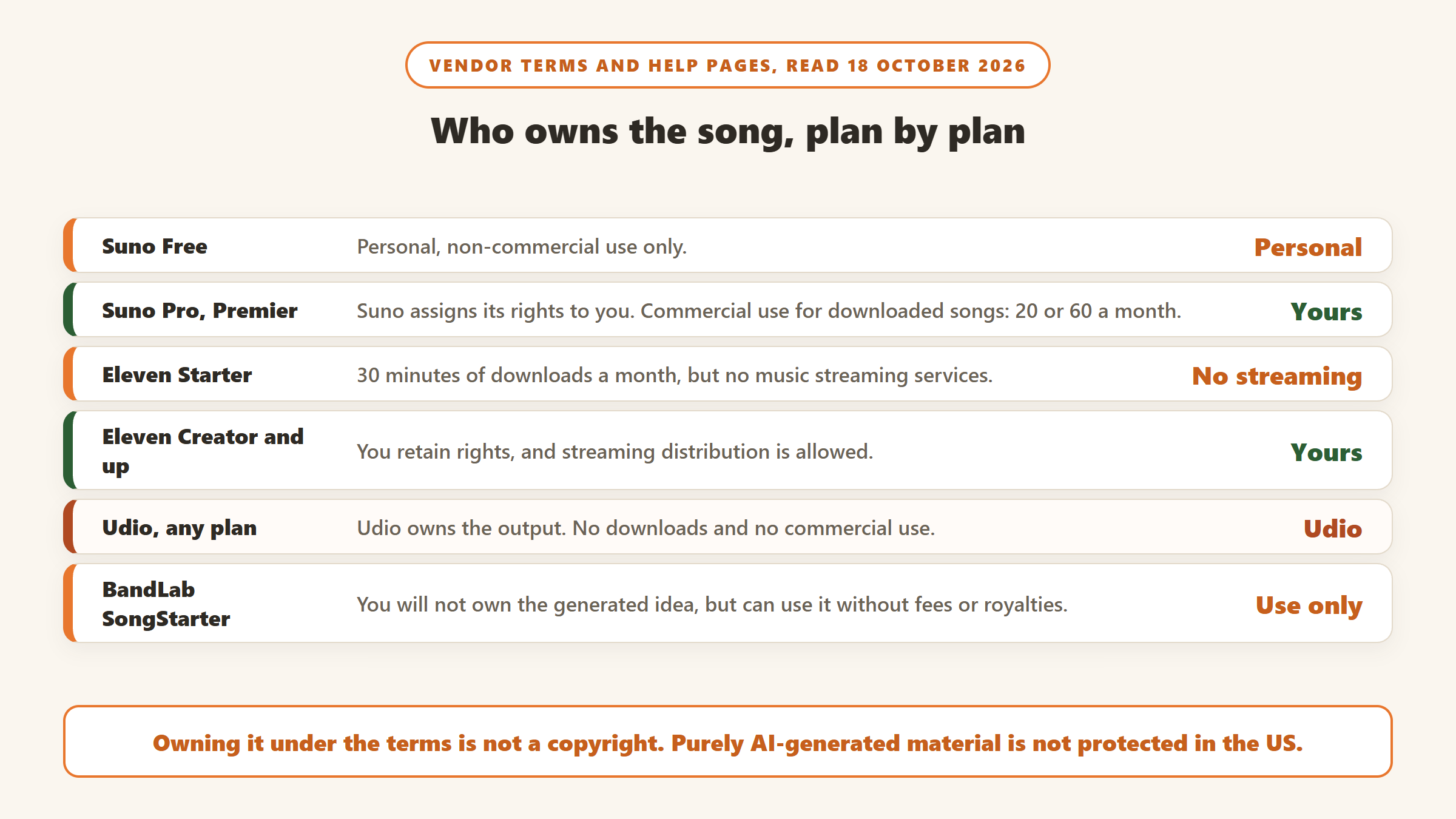
Suno’s free plan is personal use only, its paid plans are commercial only for downloaded songs, and remixes are never commercial. ElevenLabs’ Starter plan cannot go to streaming services. Udio does not let you download at all. Look up the plan you will actually pay for.
Count downloads before you subscribe
Generators now meter downloads separately from generations. Suno Pro allows 20 downloads a month and ElevenLabs Starter 30 minutes. If you release a lot, a higher plan or extra download credits may cost less than you expect, or more.
Keep your human contribution visible
Write your own lyrics, keep drafts, and edit what the AI gives you. Human contribution is what the Copyright Office’s guidance looks at when it decides what can be registered, and it is good songwriting practice anyway.
Check the distributor’s rules too
Suno’s own terms remind you that any use outside the app is also subject to the rules of the platform you upload to. Distributors and streaming services set their own policies on AI music, so check them before you release.
Learning an instrument alongside your writing? See our guides to AI piano apps and AI guitar apps, and if you plan to sing your own songs, our AI vocal coach apps roundup looks at what those apps actually listen for.
Sources
- Suno: website, pricing, terms of service (revised 10 August 2026), US App Store listing and Google Play listing.
- Eleven Music: music page, pricing, Music Terms (updated 9 October 2026) and US App Store listing.
- Udio: website, pricing, terms of service (revised 12 November 2025) and US App Store listing.
- Google Flow Music: website, US App Store listing, Google Play listing and Google Terms of Service.
- Hookpad and Aria: Hookpad, Aria, Aria terms and pricing. LyricStudio: website and plans.
- BandLab: SongStarter, AI tools, SongStarter help article, US App Store listing and Google Play listing. Logic Pro: Apple and US App Store listing.
- US Copyright Office: Copyright and AI hub and Part 2: Copyrightability (29 January 2025). Supreme Court: Thaler v. Perlmutter docket summary.
- Lawsuits: Digital Music News, 31 October 2025, TechCrunch, 19 November 2025, TechCrunch, 25 November 2025, Digital Music News, 2 July 2026, Digital Music News, 20 July 2026 and Digital Music News, 18 September 2026.
- All vendor pages and store listings read 18 October 2026.

Written by
FazFaz is the founder of AIToolsBakery. Some tools here are tested hands on. Others are assessed from vendor documentation and pricing verified on the live page, and every review says which one it is. Sponsors can buy a position in a guide. They cannot buy the score, the criticism, or silence about a better option.
How we test and how we make money →