Peer-to-peer fundraising is the highest-leverage campaign type most nonprofits run: your supporters build personal pages, hit up their own networks, and your reach multiplies without your team writing a single extra email. The software behind it matters more than people admit, because a clunky page builder or a greedy fee structure kills volunteer enthusiasm fast.
Here is the problem with researching this category in 2026: almost every “best P2P software” ranking is written by one of the vendors on the list, and none of them tells you which platforms actually ship working AI versus which ones sprinkle “AI-powered” across a marketing page. So we did the tedious part. We reviewed nine platforms on the fundamentals, fees, campaign flexibility, and donor experience, and we built what we believe is the first independent AI feature matrix for this category: named, verifiable features on one side, betas and vague claims on the other.
One scope note before we start. This is a ranking of P2P platforms on P2P fundamentals, with AI as the differentiator column. If you want a roundup organized around AI capability itself, that is a different post: our guide to the best AI fundraising tools for nonprofits owns that lane.
The 2026 P2P software comparison table
The AI column uses three labels. Shipped means a named, generally available feature we could verify. Beta / light means the feature exists but is in early access, preview, or is a thin helper. None means we found no substantive AI feature beyond marketing language.
| Platform | Best for | P2P pricing | AI status | Named AI features |
|---|---|---|---|---|
| Givebutter | Most nonprofits, free all-in-one | Free (optional donor tips) | Beta / light | AI text assistant (summarize, improve, translate) – Early Access beta |
| GoFundMe Pro | Enterprise campaigns at scale | Quote-based, no published figure | Shipped | Intelligent Ask Amounts (ML dynamic asks) |
| Funraise | Digital-first teams wanting deep AI | Quote-based, no published figure | Shipped | Funraise AI (appeal writing), ML ask amounts, AI fraud-bot detection |
| Bloomerang Fundraising | Bloomerang CRM users | Quote-based, no published figure | Shipped | Smart Amounts prompts, AI donor insights |
| OneCause | Auction and gala-driven P2P | Quote-based, no published figure | Shipped | OneCause AI: Auction AI descriptions, Recommended Lots, Suggested Sort |
| Donorbox | Small orgs already on Donorbox | P2P included with Donorbox plans | Beta / light | Jay AI dashboard assistant (Premium), AI-light on P2P itself |
| RallyUp | Experience-style campaigns (raffles, a-thons) | See RallyUp site, varies by model | Shipped | AI Fundraising Content Generator (descriptions, prize copy, emails) |
| JustGiving | UK charities and event fundraising | See JustGiving site | Shipped | Story Enhancer (OpenAI-powered page rewriting) |
| GivenGain | Global, multi-country campaigns | See GivenGain site | Beta / light | AI text helpers, auto-generated fundraiser bios |
A quick honesty note on that pricing column: most enterprise P2P vendors do not publish prices, and we refuse to launder aggregator guesses into a table as if they were facts. Where it says quote-based, budget time for a sales call and ask for the all-in effective cost on a modeled campaign.
How we ranked these platforms
We weighted three fundamentals ahead of everything else, because they decide whether a P2P campaign succeeds:
- Fees and pricing transparency. Every percentage point skimmed off a donation is money your supporters thought went to the mission. Free and transparent beats powerful and opaque at most org sizes.
- Campaign type flexibility. Team pages, individual pages, events, a-thons, auctions, ticketing. The more formats one platform covers, the fewer tools you juggle.
- Donor and fundraiser experience. How fast can a volunteer spin up a page, and how little friction does a donor hit at checkout.
AI is the tiebreaker column, not the ranking driver. A platform with great fundamentals and no AI still beats an AI-heavy platform with a 5% fee problem. For AI-first shopping, again, see our AI fundraising tools roundup.
1. Givebutter: best for most nonprofits
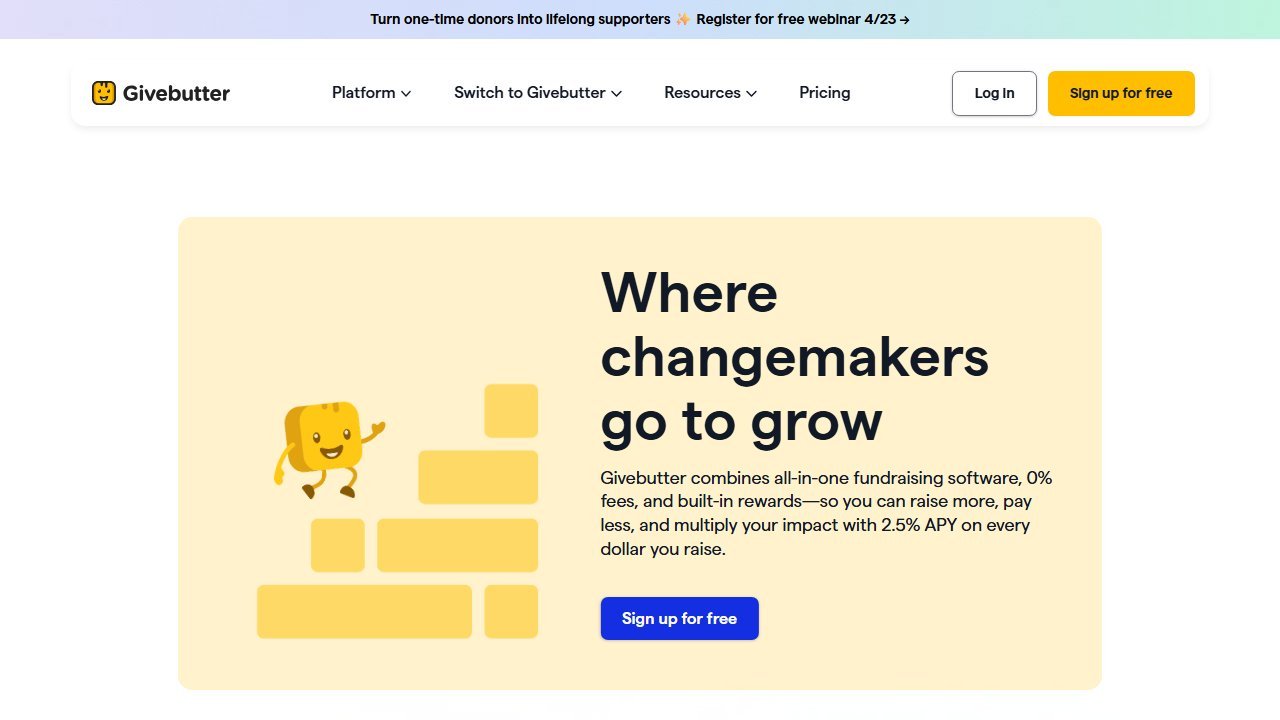
What it does. Givebutter is a free all-in-one fundraising platform: peer-to-peer campaigns, team fundraising, events, ticketing, donation forms, and a built-in CRM, all funded by optional tips donors can add at checkout rather than platform fees charged to you.
Hands-on observations. In practice, Givebutter had the fastest supporter onboarding of the nine. A volunteer can go from invite link to a live personal page with a photo and goal in under five minutes, and the team leaderboard mechanics are genuinely fun: progress bars, supporter feeds, and emoji reactions that make a campaign feel alive. The checkout is modern, with wallet payments where donors expect them. Givebutter also ships an AI text assistant that can summarize, improve, and translate campaign text, but it is in Early Access beta, not general availability, so we label it exactly that: a promising preview, not a finished feature you should build a workflow on.
Pricing. Free. The platform is funded by optional donor tips, and payment processing fees apply as they do everywhere. There is no subscription and no platform fee on the core P2P toolkit.
Who it’s for. Small and mid-size nonprofits, school groups, and any organization that wants full P2P functionality without a line item in the budget. It is the obvious starting point.
One honest limitation. The AI assistant being beta-only means Givebutter currently trails the shipped-AI platforms on that column, and orgs with complex enterprise CRM requirements will outgrow the built-in CRM. Our full Givebutter review covers where those ceilings sit.
2. GoFundMe Pro: best for enterprise campaigns
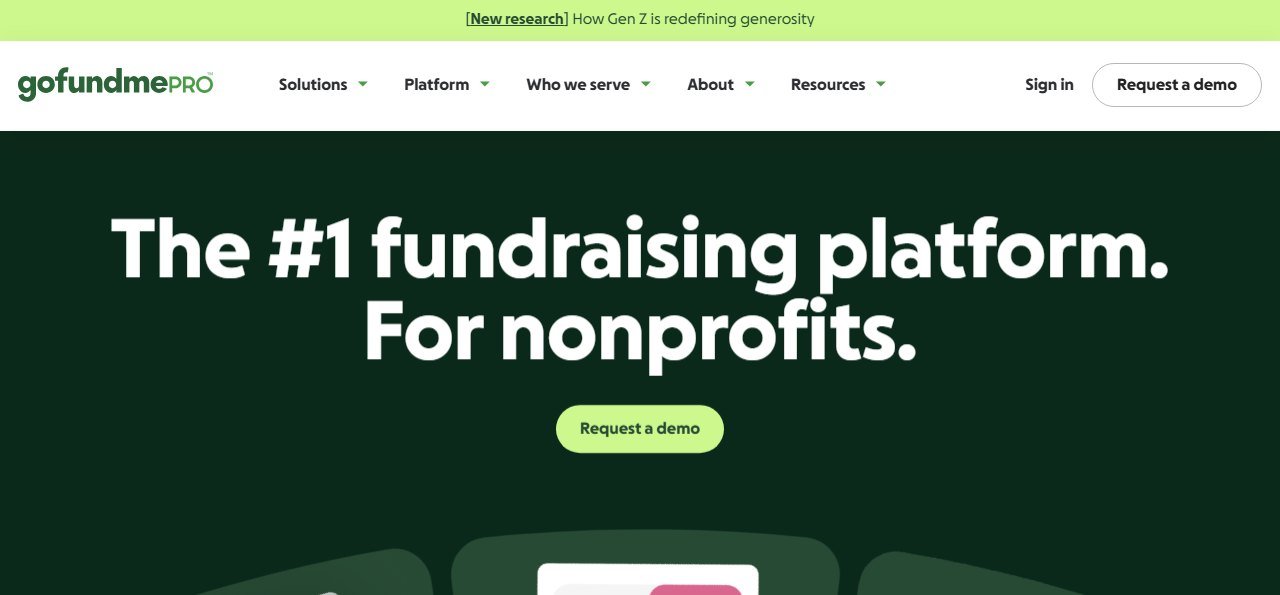
What it does. GoFundMe Pro is the enterprise fundraising platform formerly known as Classy, now operating under the GoFundMe brand. It covers P2P campaigns, events, recurring giving, and embedded donation forms at large-nonprofit scale.
Hands-on observations. This is the most polished donor-facing experience in the category, and its headline AI feature is real and shipped: Intelligent Ask Amounts, a machine learning model that adjusts suggested donation arrays per visitor instead of showing everyone the same static buttons. GoFundMe Pro cites an average 7% donation revenue lift and a 5.15% higher recurring conversion rate from A/B tests. Both numbers are vendor-claimed, so treat them as directional rather than gospel, but dynamic ask arrays moving revenue single digits is consistent with what we have seen from ask-amount testing generally. Campaign management tooling is deep: registration with fundraising, DIY campaigns, and reporting that satisfies a data team.
Pricing. Quote-based. GoFundMe Pro does not publish P2P platform pricing, so expect a sales conversation and negotiate on the effective all-in rate.
Who it’s for. Established nonprofits running six-figure-plus campaigns, especially those with recurring giving programs where the conversion lift compounds.
One honest limitation. The pricing opacity is the trade-off, and smaller organizations often find the quote out of reach. If you are evaluating a move away from the platform, our guide to Classy alternatives in 2026 walks through the realistic options at each budget level.
3. Funraise: best in-platform AI depth
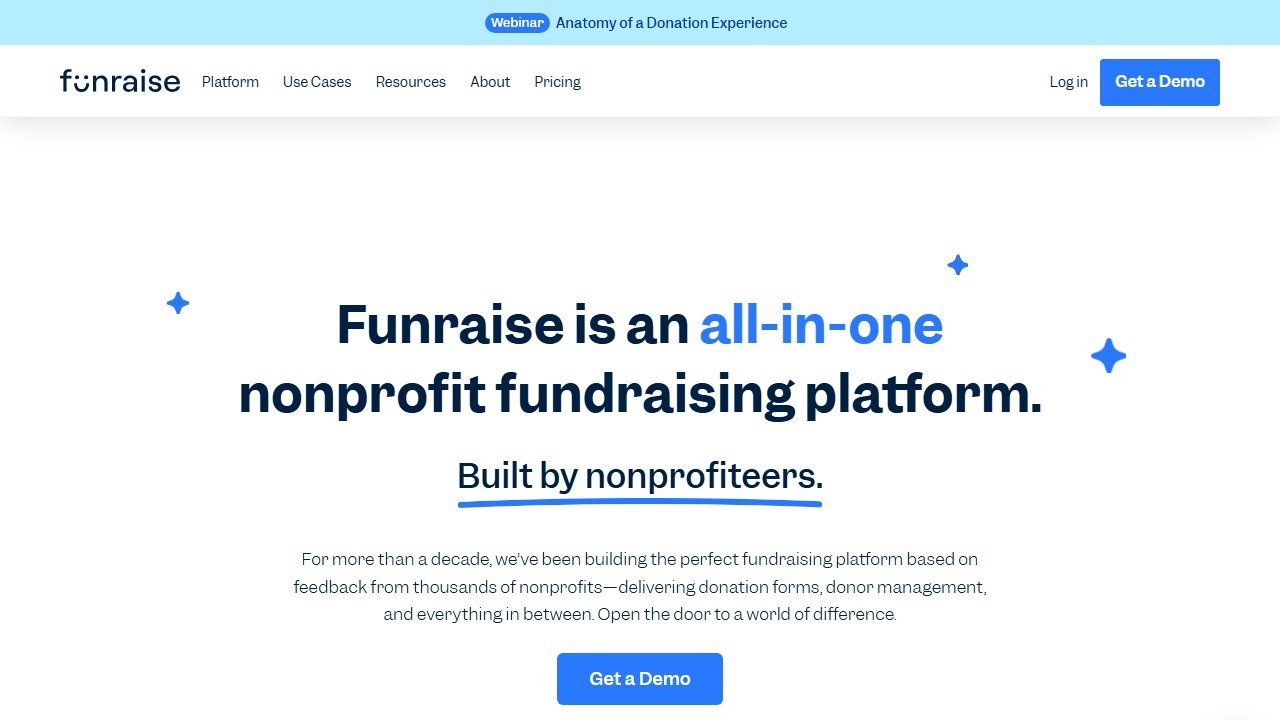
What it does. Funraise is a digital-first fundraising platform with P2P campaigns, donation forms, events, and a CRM, aimed at nonprofits that want modern tooling without enterprise bloat.
Hands-on observations. Funraise has quietly assembled the deepest shipped AI stack in P2P. Funraise AI puts ChatGPT-powered appeal writing directly inside the platform, so a campaign manager drafts fundraising copy where the campaign lives instead of tabbing to a chatbot and pasting. Machine learning personalizes ask amounts on giving forms, and there is AI fraud-bot detection on donation forms, which is the least glamorous and possibly most valuable item on this whole matrix, because card-testing attacks against nonprofit forms are a real and growing headache. The P2P builder itself is solid, with clean supporter pages and good team mechanics.
Pricing. Quote-based. Funraise does not publish pricing, so plan for a demo-and-quote process.
Who it’s for. Digitally mature small-to-mid nonprofits that want the AI capabilities of an enterprise platform with a lighter footprint.
One honest limitation. Quote-only pricing makes it hard to comparison-shop quickly, and the brand has less name recognition among donors than GoFundMe or JustGiving, which occasionally matters for trust at checkout.
4. Bloomerang Fundraising: best for Bloomerang CRM users
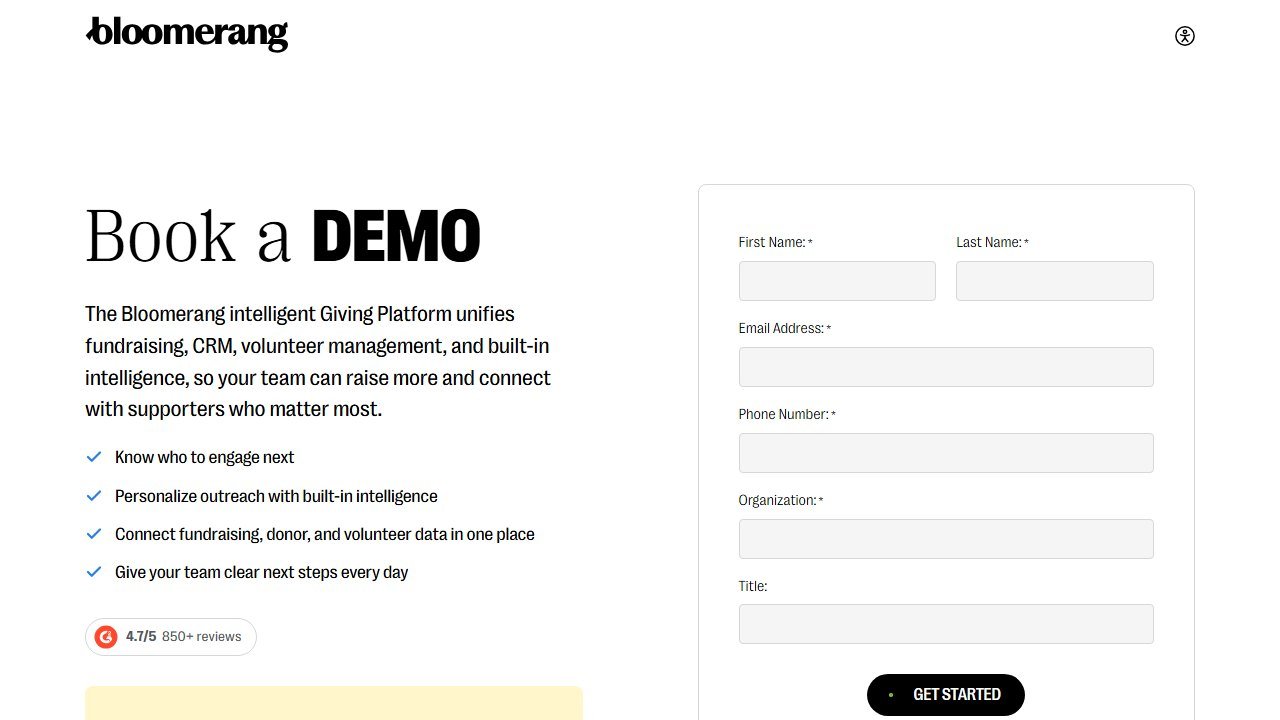
What it does. Bloomerang Fundraising is the fundraising and P2P arm of the Bloomerang suite, formerly known as Qgiv before the merger. It covers peer-to-peer campaigns, events, auctions, and giving forms, tightly wired into Bloomerang’s donor database.
Hands-on observations. The pitch here is the CRM integration, and it delivers: P2P donor data lands in Bloomerang’s retention-focused CRM without export gymnastics, which matters because P2P donors are notoriously hard to retain and the follow-up sequence is where campaigns are won or lost. On the AI column, Bloomerang ships Smart Amounts, which prompts donors with data-informed ask amounts, plus AI donor insights on the CRM side that help you spot which P2P donors are worth cultivating into repeat givers. Neither is as flashy as Funraise’s writing tools, but they attack the actual P2P weakness: one-and-done donors.
Pricing. Quote-based for the fundraising platform. No published P2P figure, and bundling with the CRM affects the quote, so ask for both bundled and standalone numbers. For the CRM side of the budget, our Bloomerang review has the fuller picture.
Who it’s for. Organizations already on Bloomerang, or shopping for CRM and P2P together and wanting one vendor accountable for both.
One honest limitation. Buying it standalone makes less sense: without the Bloomerang CRM attached, you are paying for an integration story you are not using.
5. OneCause: best for auction and gala P2P
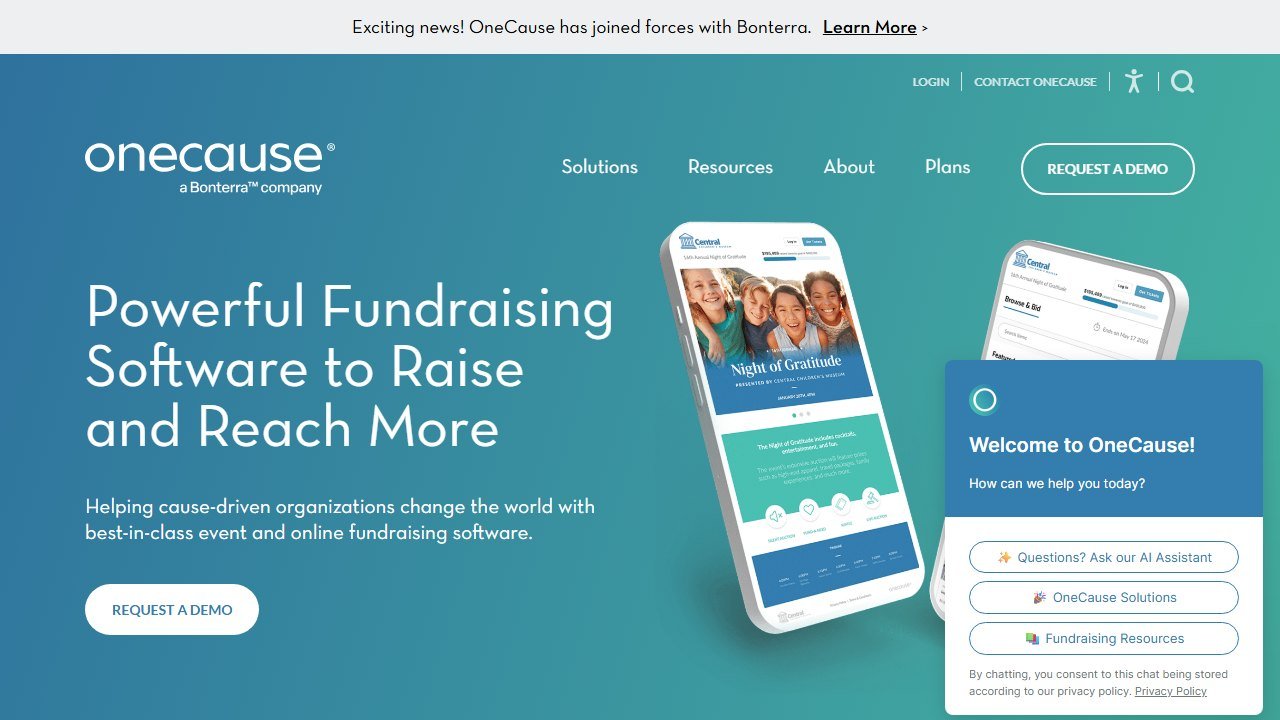
What it does. OneCause is an event-first fundraising platform: auctions, galas, ticketing, text-to-give, and peer-to-peer campaigns, built for organizations whose fundraising calendar revolves around events.
Hands-on observations. If your P2P happens around a gala, a golf outing, or an auction, OneCause is the strongest tool we reviewed, and its OneCause AI suite is shipped and specific. Auction AI writes item descriptions, and the vendor claims it saves up to 8 hours of event prep, a vendor-claimed figure but a believable one to anyone who has ever written eighty auction lot blurbs by hand. Recommended Lots suggests how to package items, and Suggested Sort orders your auction catalog for bidding momentum. The P2P side handles team fundraising tied to event registration cleanly.
Pricing. Quote-based. OneCause does not publish platform pricing, and quotes vary with event volume and modules.
Who it’s for. Event-driven organizations: schools, hospitals, community foundations, anywhere the annual gala is the fundraising engine and P2P wraps around it.
One honest limitation. For pure digital P2P with no event component, you are paying for an event stack you will not use, and lighter platforms serve that use case better. Our OneCause review digs into exactly where the platform earns its quote.
6. Donorbox: best budget pick for existing Donorbox users
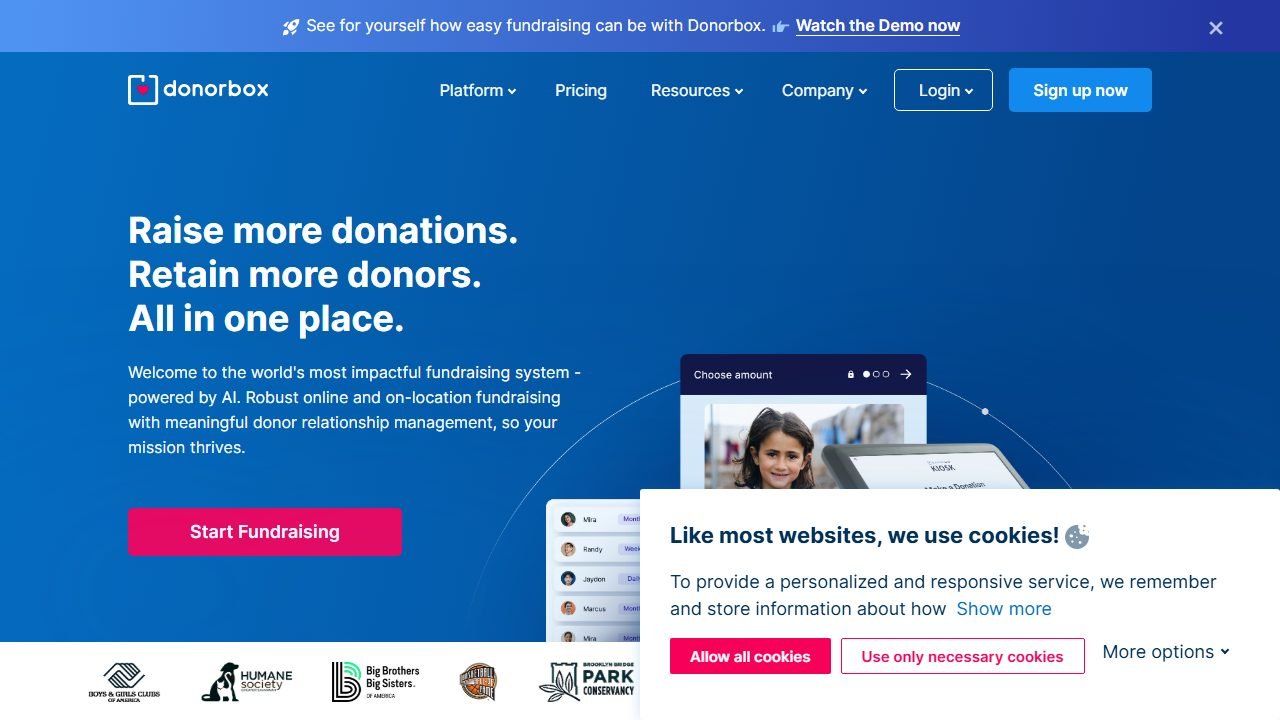
What it does. Donorbox is a donation platform used by tens of thousands of organizations, with P2P fundraising included alongside donation forms, crowdfunding, events, and a growing CRM.
Hands-on observations. Donorbox’s P2P is competent and genuinely easy: invite supporters, they get personal pages, funds flow into your existing Donorbox account. For an organization already running Donorbox forms, turning on P2P is close to zero-effort. On the AI column, though, Donorbox is honest-to-goodness AI-light for P2P. Jay AI, its dashboard assistant, helps Premium users navigate data and the CRM Mail Center handles communications, but there is no named AI feature aimed at the P2P workflow itself: no AI page writer for supporters, no ML ask optimization on P2P pages. That is why it sits mid-table despite excellent fundamentals.
Pricing. P2P is included with Donorbox plans rather than sold separately; Jay AI and the CRM Mail Center sit on the Premium tier. For current plan-by-plan detail, see our Donorbox review.
Who it’s for. Small nonprofits already on Donorbox, or anyone wanting reliable P2P bolted onto a proven donation stack without a new vendor relationship.
One honest limitation. The AI gap is real. If supporters writing better pages faster matters to your campaign, RallyUp, JustGiving, and Funraise all ship tools Donorbox currently does not.
7. RallyUp: best for experience-style campaigns
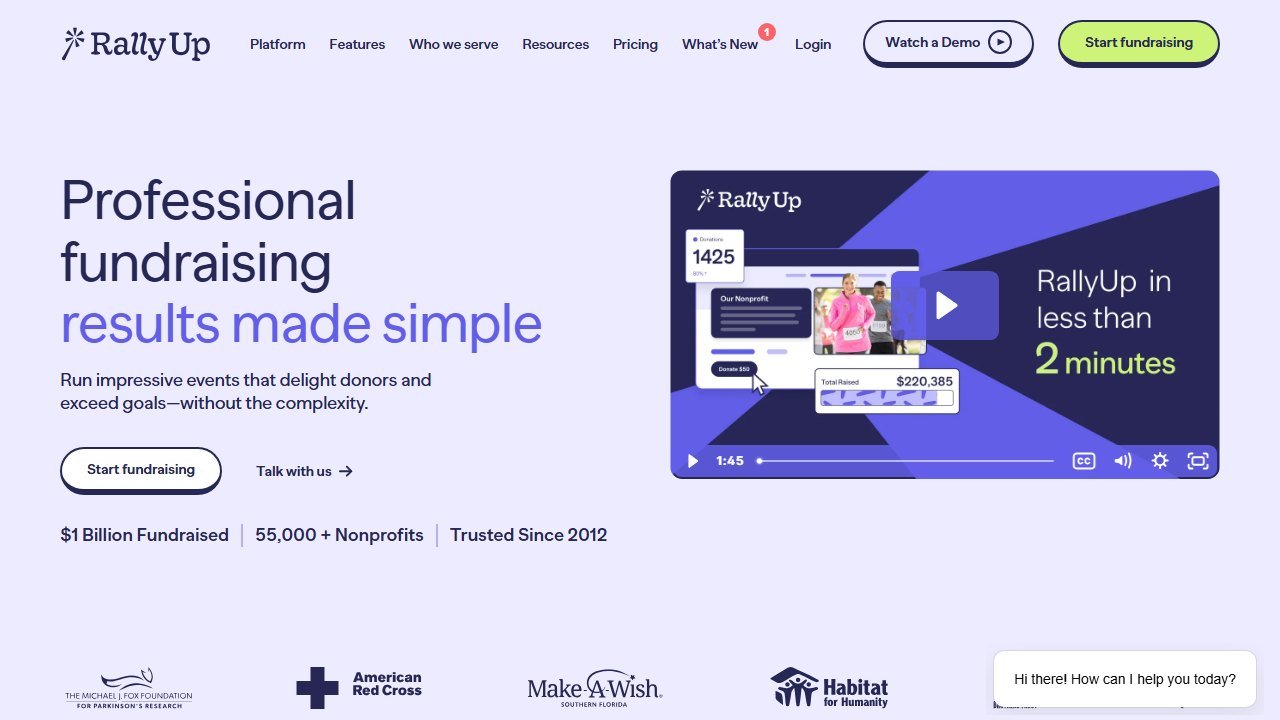
What it does. RallyUp specializes in what it calls fundraising experiences: raffles, sweepstakes, a-thons, auctions, and crowdfunding, with peer-to-peer mechanics woven through them.
Hands-on observations. RallyUp is the platform we would pick for a campaign that needs a gimmick in the best sense: a read-a-thon with per-lap pledges, a raffle with tiered prizes, a team challenge. Its AI Fundraising Content Generator is shipped and practical, generating campaign descriptions, prize copy, and emails with a selectable tone, which is a real time-saver when one coordinator is writing copy for an entire campaign’s worth of pages and prize listings. Campaign setup has more knobs than most platforms, which cuts both ways.
Pricing. RallyUp’s pricing varies by fundraising model; check the current structure on its site rather than trusting third-party summaries, which we found frequently stale for this vendor.
Who it’s for. Schools, clubs, and nonprofits running activity-based or prize-based campaigns where standard donate-button P2P feels flat.
One honest limitation. All those campaign options make first-time setup slower than Givebutter or Donorbox, and orgs wanting a simple team-pages campaign may find it more tool than they need.
8. JustGiving: best for UK charities
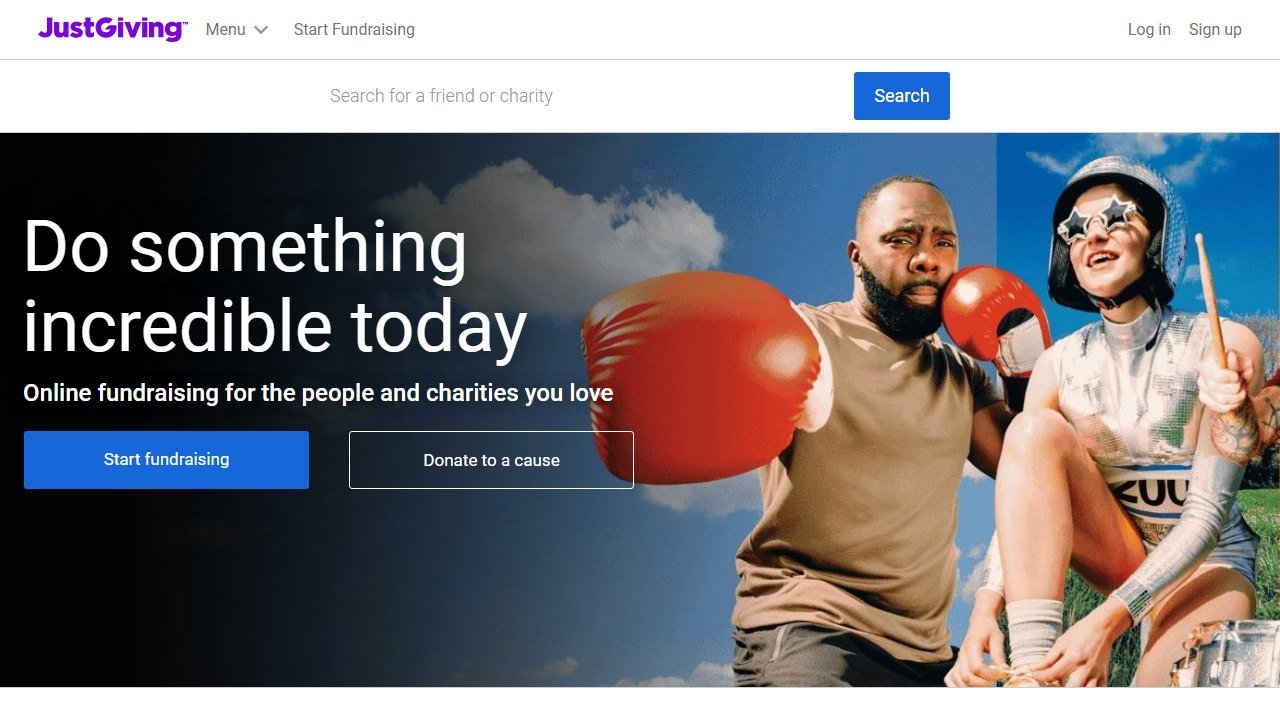
What it does. JustGiving is one of the world’s largest giving platforms, dominant in the UK, with individual and team fundraising pages built around events like marathons and challenges.
Hands-on observations. JustGiving’s Story Enhancer is one of the most interesting shipped AI features in the category: an OpenAI-powered tool that rewrites a supporter’s fundraising page story to make it clearer and more compelling. The logic behind it is sound. JustGiving’s own data says pages with a clear personal story raise roughly 65% more, a vendor statistic, but one aligned with everything the sector knows about narrative and giving. The platform is also rolling out an AI fundraising coach, UK-first, that nudges fundraisers on what to do next. Donor trust in the brand is enormous in the UK, which measurably helps conversion there.
Pricing. See JustGiving’s site for current fee structure; it differs for charities and event types, and we only publish figures we can verify at the time of writing.
Who it’s for. UK-based charities, and any organization whose P2P runs on endurance events and challenges where JustGiving is the default supporter expectation.
One honest limitation. Outside the UK the brand advantage fades, and US nonprofits will generally get better platform economics and support from the US-first tools above.
9. GivenGain: best for global campaigns
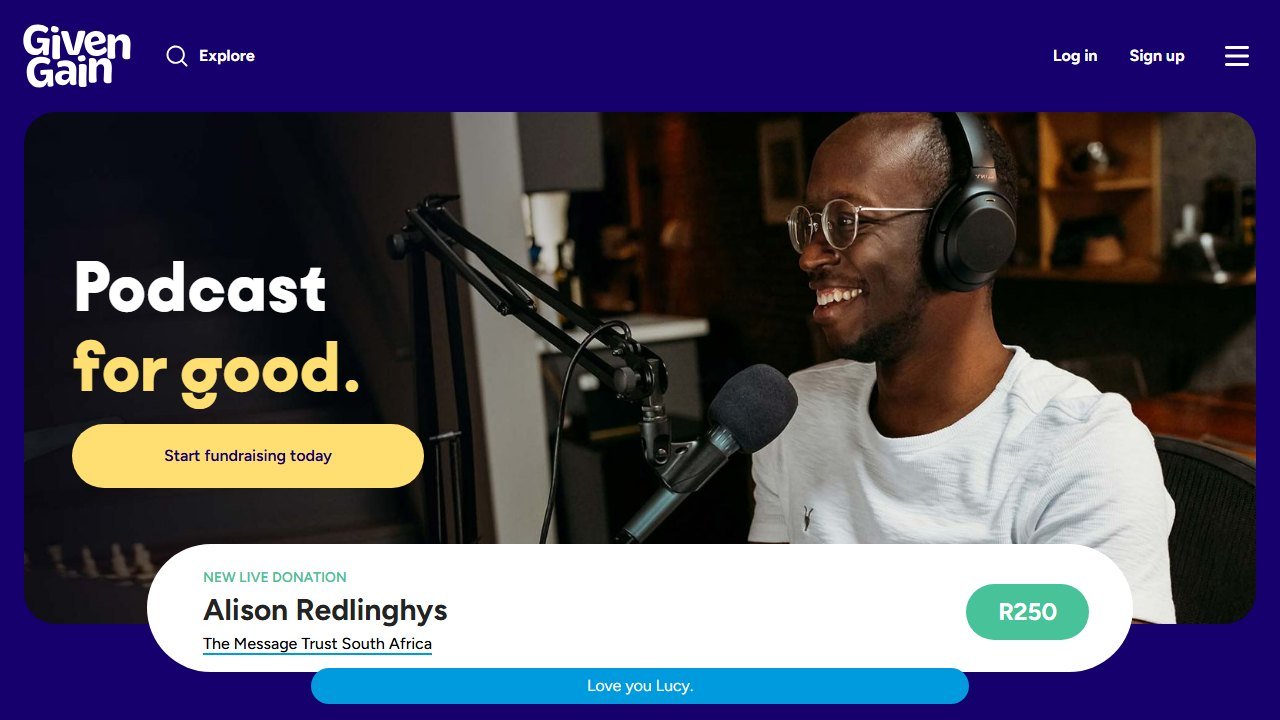
What it does. GivenGain is a global fundraising platform supporting charities and fundraisers across many countries and currencies, with P2P pages tied heavily to international events like major marathons.
Hands-on observations. GivenGain’s superpower is geography: if your supporters and donors span multiple countries, it handles the multi-currency, multi-country reality better than most US-centric platforms. Its AI sits in the beta-and-light column: AI text helpers suggest improvements to fundraiser posts, and the platform auto-generates a fundraiser bio at signup, a small touch that removes the blank-page problem for supporters. Useful, but thinner than the named AI suites at Funraise or OneCause.
Pricing. See GivenGain’s site for its current model; we found no published figure we could verify beyond that, so we will not guess.
Who it’s for. Charities with international supporter bases, and organizations recruiting fundraisers through global endurance events.
One honest limitation. For a purely domestic US campaign, its international strengths are wasted and the domestic-first platforms above offer deeper features.
The AI reality check: what “AI-powered” actually means in P2P
Since the matrix above is the reason this post exists, here is the plain-language read on it.
Shipped and named: GoFundMe Pro’s Intelligent Ask Amounts, Funraise AI, OneCause AI, JustGiving’s Story Enhancer, RallyUp’s AI Fundraising Content Generator, and Bloomerang’s Smart Amounts are real features with names, documentation, and general availability. You can ask a sales rep to demo them and hold the demo to the claim.
Beta or light: Givebutter’s AI text assistant is Early Access beta, so it may change, gate, or improve significantly before GA. Donorbox’s Jay AI is a dashboard assistant that does not touch the P2P workflow. GivenGain’s helpers are useful but thin.
The pattern worth noticing: the highest-value AI in this category is not the writing tools, it is the money math. ML ask-amount optimization (GoFundMe Pro, Funraise, Bloomerang) works silently on every donation, while writing assistants save time once per page. If you can only get one AI feature past your budget committee, take the ask optimization. And if AI capability is your primary buying criterion rather than a tiebreaker, start from our best AI fundraising tools for nonprofits instead, where the ranking logic is inverted.
What the rest of the giving platforms charge, and what they meter on
Every platform here takes a cut of donations, which means the bill grows with the thing you are trying to grow. What separates them is where the cut sits and who is asked to pay it. Here is each alternative to these platforms, read from its own pricing page on 4 September 2026.
Donorbox, free to start, and the fee falls as you pay more
Donorbox publishes the clearest ladder in the category. Standard is free with a platform fee of 2.95% to 3.95%. Pro is $150 a month and drops the fee to 1.75% to 2%. Premium is quote only at 1.6% to 2%. Because the subscription buys a lower rate, there is a crossover volume below which paying is a loss: on $100,000 raised the fee saving is roughly $1,575 against an $1,800 subscription, so the free plan wins. On $200,000 the same shift is a clear gain. Work out your own crossover before upgrading, because the sales conversation will not.
Givebutter, 0% if your donors tip, 3% if they do not
Givebutter charges no platform fee at all when donor tips are enabled, and a flat 3% when they are switched off. Its paid tier, Plus, starts at $29 a month or $348 a year. The model is genuinely free to the organisation, but it is not free in the room: the form suggests a tip by default, so a supporter giving $100 can be charged noticeably more than $100. Whether that is a fair trade is a decision about your donors rather than your budget, and it is worth making deliberately rather than by leaving a default alone.
Fundraise Up, which has stopped publishing a rate
Fundraise Up published a single flat 4% per transaction when we read it on 14 July 2026. On 4 September 2026 the percentage is gone. We loaded the page, waited for it to render, opened every accordion and read the source: nine percentages remain and every one is a conversion rate or a case study result. The page now says “performance-based pricing” and asks for a demo. Treat any 4% you see quoted elsewhere, including our own dated figure, as the number a current quote should be checked against.
The processors underneath, which nobody escapes
Whatever the platform charges, a card processor charges too, and Donorbox publishes the nonprofit rates plainly: Stripe at 2.2% plus 30 cents and PayPal at 1.99% plus 49 cents for eligible organisations. The fixed component is the part that hurts small gifts. On a $20 donation, 30 cents is another 1.5 percentage points on top of whatever rate was quoted, so a platform that looks competitive on a $250 gift can be expensive on your actual median.
The line that is missing from almost every comparison
International giving. Donorbox states that its currency conversion defaults to 2% above the optimal rate. On a $1,000 gift from overseas that is $20, on top of the platform band and the card processing, and it appears in no comparison table we have seen. If any meaningful share of your donors give from abroad, ask every platform on your shortlist for its FX markup in writing and add it to the model.
Donor fee coverage, the single variable that decides the answer
Every percentage model in this category lives or dies on one number: the share of donors who choose to cover fees at checkout. It swings the effective cost by a factor of five, and it is the number vendors quote most confidently and evidence least.
What the vendors claim
Fundraise Up publishes that 80% of donors cover transaction costs, having previously claimed 87%. Givebutter states that 92% of donors leave a tip. Donorbox says donors can be asked to cover over 90% of processing fees. Those are averages across every customer the vendor has, weighted towards the large and sophisticated ones, and none of them is a commitment to you.
Why your number will be different
Coverage depends on things the vendor cannot control and you can: how the option is worded, whether it is pre-ticked, where it sits in the flow, your median gift size, and above all who your donors are. A digitally engaged urban donor base behaves nothing like a rural mail-acquired file. Two organisations on the same platform can sit thirty points apart, which is the difference between a 1.3% effective cost and a 6.5% one.
Model both ends, not the vendor average
Take a percentage model and run it twice: once at zero coverage and once at the vendor’s claimed rate. If the decision holds at both ends, buy with confidence. If it only works at the claimed rate, you are betting your budget on a number you have never observed. Then run the subscription alternative alongside, because a fixed fee is the option that does not care how your donors behave.
The ethical question nobody puts in the table
Fee coverage and tipping both work by moving your cost onto the person giving you money. That may be entirely reasonable, and many donors genuinely prefer that the full gift reaches the cause. It becomes a problem when the default does the deciding, when the amount is not obvious, or when a $100 gift quietly becomes a $115 charge. Look at your own checkout as a donor would, on a phone, and decide whether you are comfortable with what you see. That is a board level question, not a finance one.
How to choose: three quick scenarios
You are small, budget-first, and want P2P this quarter. Start with Givebutter. It is free, supporters figure it out without training, and you can always migrate later. Donorbox is the alternative if you already run its forms.
You are enterprise-scale with a recurring giving program. Shortlist GoFundMe Pro and Funraise, demo Intelligent Ask Amounts against Funraise AI on your own numbers, and make both quote against each other. If the quotes sting, the Classy alternatives guide maps the mid-market options.
Your P2P revolves around an event. OneCause for auctions and galas, JustGiving for endurance events in the UK, RallyUp for a-thons and prize-driven campaigns, GivenGain when the event and its fundraisers cross borders.
Our verdict
Givebutter takes the top spot on the fundamentals: a free, complete P2P toolkit beats a quoted one for the majority of nonprofits, and its beta AI assistant will only strengthen the case when it ships properly. GoFundMe Pro is the enterprise pick and owns the best-evidenced AI feature in the category, with the caveat that the evidence is the vendor’s own. Funraise is the sleeper: the deepest shipped AI stack here, including the fraud detection nobody talks about, and worth a demo from any digitally serious team.
The wider takeaway from building the matrix: P2P software marketing is drenched in the word AI, but only six of nine platforms ship a named, generally available feature, and only three put machine learning where it counts most, on the ask itself. Rank on fees, campaign fit, and donor experience first. Let the AI column break the ties. And whatever a vendor’s stat page says, run your own A/B test before you repeat the number to your board.

Written by
FazFaz is the founder of AIToolsBakery. Some tools here are tested hands on. Others are assessed from vendor documentation and pricing verified on the live page, and every review says which one it is. Sponsors can buy a position in a guide. They cannot buy the score, the criticism, or silence about a better option.
How we test and how we make money →