Bloomerang Pricing 2026: Real Cost by Record Tier
Bloomerang has restructured. It no longer publishes a record-count ladder at all. As at 4 September 2026 it prices by product: the CRM from $125 a month billed annually, fundraising tools from $40, volunteer management from $119. Each is a starting price, and what drives it up is not published. Our Bloomerang vs Neon CRM comparison explains when records-based or revenue-based pricing costs less.
That answer is true, but it hides most of the real story. Bloomerang’s published numbers cover only the smallest organizations, and the parts that hurt the budget most, onboarding fees, data migration, renewal increases, and the modules you bolt on, almost never show up in the headline figure. We test nonprofit tools independently and take no payment to move a verdict, so this guide walks through what you will actually pay, where the surprises hide, and how to pull a real quote out of a sales rep.
Separate the two things you might be buying before you read the tiers. Bloomerang priced by record count is the cost of holding and reporting on donor data. The cost of actually working that data is a different purchase, free for one person with Gratefully, then $99 a month for a single fundraiser or $499 a month for a five-person team. If Bloomerang looks expensive at your record tier, check which of those two problems you are solving before you downgrade the CRM.
The short version: how Bloomerang prices
Bloomerang does not sell flat per-user seats. Instead it prices on two axes:
- The number of records in your database. Records include active donors, lapsed donors, general contacts, and organizations. Crucially, a record counts whether or not it currently gives you money. A 12-year-old list of one-time event attendees still inflates your tier.
- The product bundle. The core CRM is the base. Add-ons such as fundraising tools, volunteer management, and membership management each carry their own monthly fee on top.
Every plan includes unlimited users, email and chat support, the Bloomerang Academy training library, standard online giving pages, donor engagement scoring, wealth screening, and nightly address and deceased-record updates. So the seat count is genuinely uncapped. The cost lever is your record total, and that is the number to scrutinize before you sign.
For the official feature breakdown, see Bloomerang’s pricing page. Just know the listed figures stop being useful the moment you cross 1,000 contacts.
What Bloomerang publishes now
Read from bloomerang.com/pricing on 4 September 2026, twice, with identical results.
| Product | Published entry price | What it covers |
|---|---|---|
| Bloomerang CRM | From $125/month, billed annually | Donor management, predictive giving insights, marketing, reporting, data management |
| Bloomerang Fundraising | From $40/month, billed annually | Donation forms, events, text fundraising, mobile apps; auctions and peer-to-peer on top |
| Bloomerang Volunteer | From $119/month, billed annually | Onboarding, AI scheduling, communication, screening |
| All three together | $284/month, or $3,408/year | Our arithmetic on the three published entry prices, not a bundle Bloomerang advertises |
The modules became the products. An earlier version of this page listed fundraising tools at roughly $40 a month and volunteer management at around $119 as add-ons bolted onto a record-tiered CRM. Those two numbers are unchanged. What went away is the ladder around them: there is no longer a published price that rises with your record count, just a $125 entry for the CRM and no stated slope above it.
We have withdrawn the old tier table. It set out roughly $99 to $125 up to 500 records, $119 to $150 at 1,000, quote-only at 5,000, about $299 at 10,000, and custom above 25,000, plus a $200 to $450 planning band for mid-size organisations. None of that is supported by anything Bloomerang publishes today, so carrying it forward would be inventing a structure on the vendor’s behalf.
Membership management, previously listed here at around $25 a month, does not appear on the current pricing page. We have taken it out rather than restate a figure we cannot check.
What almost certainly has not changed is that your record count still drives what you actually pay. Bloomerang has simply stopped publishing how. That makes the list-hygiene advice below more important than it was, not less: you are now negotiating against a number you cannot look up.
The fees that do not show up in the sticker price
This is where nonprofit CRM budgets quietly blow up. Four line items rarely appear in the monthly quote:
Onboarding and implementation. Expect a one-time setup cost. For small to mid-size nonprofits this commonly runs from a few hundred dollars up to several thousand, depending on how much hand-holding and configuration you need. Always ask whether onboarding is included or quoted separately, because the answer varies by deal.
Data migration. Moving your existing donor history in is the big one. Depending on database size and how messy your source data is, migration can run from around $1,000 to $8,000. A typical go-live takes about five weeks, with full data conversion sometimes stretching to three months or more. If a rep waves this off as “included,” get it in writing with a defined record count and field mapping.
Payment processing. Bloomerang does not charge a platform-level transaction fee on donations, which is a genuine point in its favor. You pay the processor rate. Bloomerang Payments has been quoted around 2.0% plus $0.30 per transaction, slightly below standard Stripe pricing of roughly 2.2% plus $0.30. On six figures of online giving that gap matters, so model it against your real donation volume.
Renewal increases. The price you negotiate in year one is not guaranteed in year three. Two things push it up: your database grows into a higher record tier, and standard annual list-price increases. Ask the rep directly what the renewal cap or expected uplift is, and whether you can lock multi-year pricing.
How to get an honest quote
Because anything above 1,000 records is quote-only, the burden is on you to make the number comparable. Before you book a sales call, do this:
- Clean your list first. Run a count of truly active and reachable records, then a count of dead weight (hard bounces, deceased, decade-old one-time contacts). Bloomerang prices on the total, so archiving junk before migration can drop you a tier. This single step often saves more than any discount.
- Get the all-in first-year number, not the monthly. Ask for subscription, onboarding, and migration as three separate lines, then sum them. A $200 monthly plan with $6,000 of migration is a very different decision than it looks.
- Pin down the renewal. Ask what happens at renewal if your records grow 20%, and whether the rep will commit to a renewal cap in writing.
- Confirm the contract term. Bloomerang is typically annual. Know the commitment and the cancellation terms before you sign.
- Model the processing cut. Multiply your expected annual online giving by the processor rate so the “no platform fee” claim translates into a real dollar figure.
For the deeper feature verdict and where Bloomerang earns or loses its keep, see our full Bloomerang review. If you are weighing it against the other obvious mid-market option, our Bloomerang vs DonorPerfect comparison breaks down where each one wins on price and depth.
Is Bloomerang worth the cost?
For a small to mid-size nonprofit that wants strong donor retention features, genuinely unlimited users, and a clean interface, Bloomerang is reasonably priced at the low and middle tiers, especially because there is no per-seat tax and no platform cut on donations. Those two facts alone separate it from several competitors that nickel-and-dime growing teams.
The weak spot is the record-based model. If your database carries years of inactive contacts, you pay for storage that produces no revenue, and you keep paying more as the list grows whether or not giving grows with it. Organizations with large historical files should price-check alternatives and factor list hygiene into the decision rather than treating record bloat as a fixed cost of doing business.
Our practical take: Bloomerang is a solid, fair-priced pick for organizations under roughly 10,000 active records who value retention tooling and unlimited seats. Above that, the quote-only tiers deserve hard negotiation and a real comparison shop. And if your budget is genuinely tight, look at lean stacks first; our roundup of the best AI tools for small nonprofits covers options that can cover part of the job for far less.
Which nonprofit vendors publish a price, and which will not
This is the most useful single fact about the market and it is rarely stated plainly. Roughly half the category publishes a rate card you can read without speaking to anyone; the other half runs a quote form. That split, not the software, decides how your evaluation has to be run.
| Vendor | Publishes a figure | Entry price, verified 4 Sep 2026 | What it meters on |
|---|---|---|---|
| Little Green Light | Yes, every band | $45/mo | Constituents |
| Salesforce Nonprofit Cloud | Yes | $60/user/mo, 10 free | Users |
| Neon CRM | Model yes, full list no | $99/mo | Fundraising revenue |
| Bloomerang | Yes, by product | $125/mo | Product mix |
| Keela | Yes, every band | $164/mo | Contacts |
| Dataro | Yes, but unlinked page | $15,000/yr + $0.10/donor | Active donors |
| Blackbaud | No | Quote form only | Not disclosed |
| Virtuous | No | Quote form only | Bands at $5m revenue |
| GoFundMe Pro | Model only | Subscription + transaction fee | Donations |
Why the split matters more than the prices
If three of your shortlist publish and three do not, you cannot run a like-for-like comparison, and the quote-only vendors know that. The practical move is to price a published alternative precisely at your own seat count and list size, then make that the number every quote has to justify itself against. It is the only figure in the room that both sides can verify.
Nine different meters, which is the real problem
Constituents, users, fundraising revenue, product mix, contacts, active donors, donation volume. Seven distinct meters across nine vendors means the cheapest platform is a property of your organisation, not of the market. Whichever of your numbers, people or records or revenue, is growing fastest should decide which pricing model you buy into, and that question is almost never asked before a shortlist is drawn.
Payment processing, the line that usually costs more than the software
Almost every comparison of Bloomerang against its rivals stops at the subscription. For most nonprofits the larger number is what comes off each donation, and it is metered on the one thing you are trying to grow.
The arithmetic that decides this
A single percentage point on $500,000 raised online is $5,000 a year. That is more than the entire annual subscription to several nonprofit CRMs. So a platform that is $600 a year cheaper but takes half a point more of your online giving is not cheaper at any organisation raising more than $120,000 online, and the crossover point moves against you every year you grow.
Two different models, and they are not comparable
Some platforms charge a subscription and take nothing from donations, leaving you to hold a processor relationship directly. Little Green Light states plainly that it takes nothing from your donations. Others bundle processing into the platform, which is simpler to run and structurally more expensive at volume. GoFundMe Pro, formerly Classy, publishes that its model is an annual subscription plus a transaction fee per donation, and that second half is the part that scales.
Ask for the effective rate, not the headline rate
Processing quotes are usually given as a percentage plus a fixed amount per transaction, and the fixed component dominates at small gift sizes. On a $20 donation, 30 cents is another 1.5% on top of whatever percentage was quoted. If your median online gift is small, and for most community organisations it is, your effective rate is materially higher than the number on the page. Work it out on your own median gift before comparing anything.
Covered fees change the picture and are worth asking about
Where a platform offers donors the option to cover processing fees, take-up is the variable that decides your real cost, and it varies enormously by audience and by how the prompt is worded. Ask any vendor quoting you a bundled rate what their observed cover rate is across comparable organisations, and treat a refusal to answer as information. A model that looks expensive at 0% cover can be the cheapest option at 60%.
Get processing out of the subscription line in every quote
Insist that every vendor states processing separately from the platform fee, with the percentage, the fixed per-transaction amount, and whether ACH and card are priced differently. A blended annual figure hides exactly the line that grows with your success, and it is the single most common reason a nonprofit software budget is wrong in year two.
The exit costs nobody quotes you
Switching cost is the reason organisations stay on platforms they have outgrown, and it is almost never discussed during procurement. Three things determine how trapped you are.
Recurring gifts and payment tokens
Donor records and giving history export cleanly from almost any platform. Live recurring schedules and the payment tokens behind them frequently do not. If tokens cannot transfer, every monthly donor has to re-enter card details and a meaningful share will not, so the real cost of leaving is a slice of your most reliable income. Ask about token portability during procurement, in writing, when you still have leverage.
Custom fields and history
Ask what a full export actually contains. Standard fields usually come out fine; custom fields, soft credits, relationship links between households and the audit trail of who changed what often do not. Losing the relationship structure means rebuilding institutional knowledge that took years to accumulate.
Integrations you will have to rebuild
Every connected system, email platform, giving forms, accounting, event tools, is work to reconnect elsewhere. Count them before signing rather than after, because the number is usually higher than anyone remembers and it is the part that turns a two-week migration into a six-month one.
Why nonprofit software pricing works the way it does
Understanding the mechanics makes a quote easier to read and much easier to challenge.
Revenue banding is means testing
Several vendors band by annual fundraising revenue, and Virtuous splits its tiers at $5 million. That is means testing: the same software costs more if you raise more, on the reasoning that a larger organisation gets more value from it. It is defensible, and it also means your public filings are doing the negotiating before you arrive. Know your own figures before the call.
Why a quote form asks for an EIN
An EIN lets a vendor look up your filed revenue before quoting. If a pricing page asks for one before showing anything, assume the number you are offered has been sized against your accounts rather than drawn from a rate card.
Transaction fees are the line that scales fastest
Where a platform takes a percentage of donations, that line grows with your success and usually overtakes the subscription. On $500,000 raised online, a single percentage point is $5,000 a year, more than the entire annual cost of several CRMs. Most nonprofit CRMs take nothing from donations, so a percentage model needs a specific justification.
Published prices are snapshots, including ours
Keela raised every band by 15 to 22% in under two weeks. Neon retired an entire tier structure. Artisan removed its figures altogether. Any pricing article without a verification date is describing a market that may no longer exist, which is why every figure here carries one.
Where the figures on this page come from
Every price quoted here was read from the vendor’s own pricing page on 4 September 2026, not from an aggregator or a review site. That distinction matters more in this category than in most, because nonprofit software pricing changed materially over the past year and a great deal of what circulates online describes packaging that no longer exists.
The pages we read
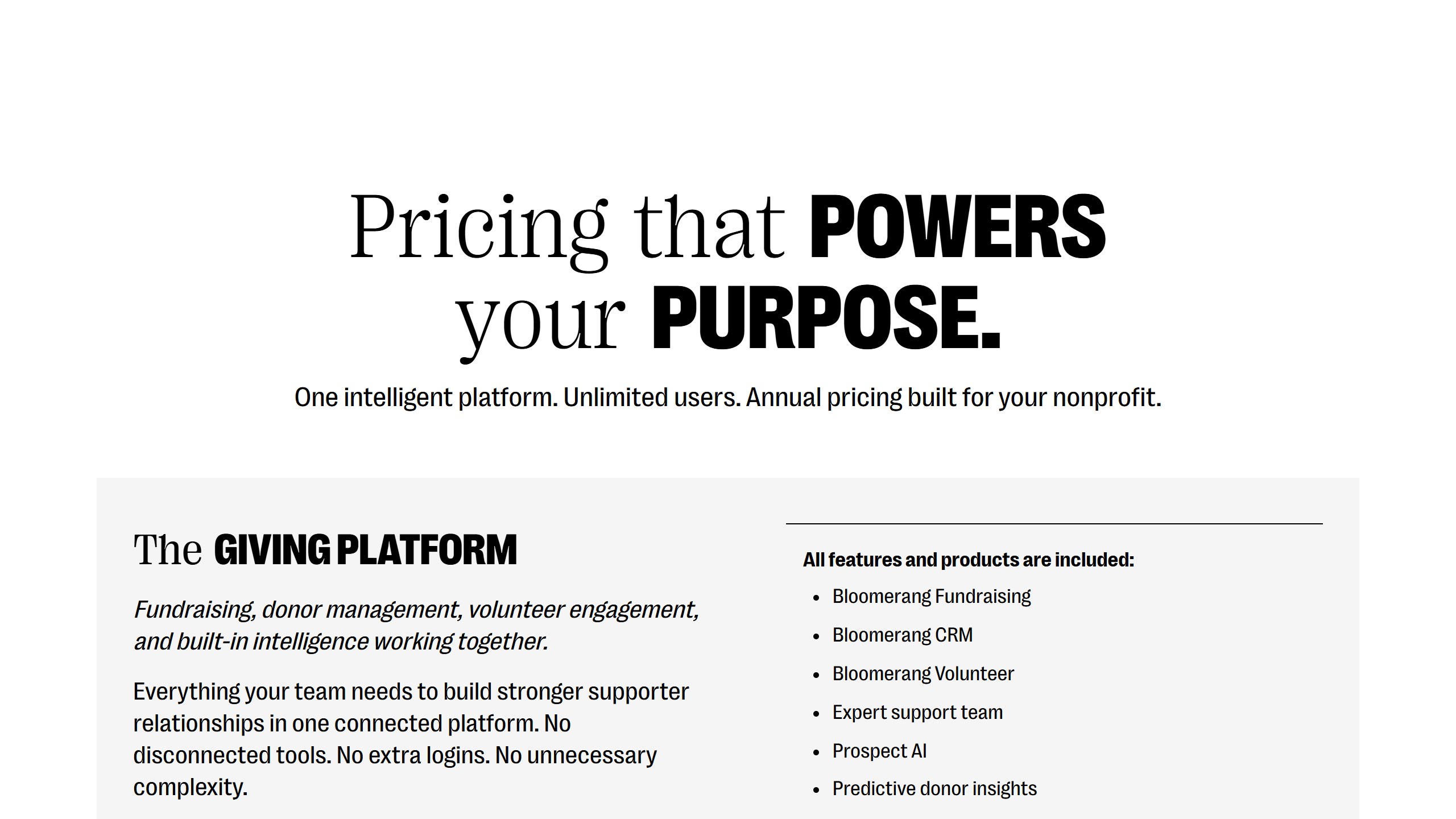
Little Green Light publishes every constituent band from $45 a month. Salesforce Nonprofit Cloud publishes $60 per user per month with ten licences free under Power of Us. Bloomerang publishes $125 a month for the CRM with other products priced separately. Keela publishes every contact band from $164 a month. Dataro publishes $15,000 a year plus ten cents per active donor on a page that is not linked from its own navigation. Blackbaud and Virtuous publish no figures at all.
What we do not do
We do not carry a figure we cannot source to the vendor. Where a number circulates widely and cannot be traced to a vendor page, we say so and withdraw it rather than repeating it with a hedge, and we have withdrawn our own published figures on that basis more than once. Where a vendor confirms an unpublished price directly to us, it is attributed as confirmed by the company rather than presented as a public rate.
Why every figure carries a date
Keela raised every band by roughly 15 to 22% in under two weeks in late August 2026. Neon retired an entire tier structure. A pricing claim without a verification date is not checkable, and in this market it is usually wrong within a year.
Bottom line
As at 4 September 2026, plan on $125 a month for the CRM as a floor, $40 more if you want the fundraising tools and $119 more for volunteer management, plus one-time onboarding and migration that can add a few thousand dollars in year one. Above the entry price you are negotiating blind, because Bloomerang no longer publishes what it scales on. The donation processing is fair and there is no platform fee, but the record-based pricing rewards a clean list and punishes a bloated one. Confirm every figure directly on Bloomerang’s site and force the all-in first-year number out of your rep before you commit.

Written by
FazFaz is the founder of AIToolsBakery. Some tools here are tested hands on. Others are assessed from vendor documentation and pricing verified on the live page, and every review says which one it is. Sponsors can buy a position in a guide. They cannot buy the score, the criticism, or silence about a better option.
How we test and how we make money →Frequently Asked Questions