
It is 6am, dark, and the trainer is the only honest place to ride. You have 45 minutes before work, a vague sense that your FTP has slipped, and a phone full of apps that all promise to “coach” you. The question is not which app has the prettiest graph. It is which one will actually decide what you should ride this morning, and adjust when you nail it or blow up halfway through.
We are AI Tools Bakery, and we are independent. We do not sell any of these apps, we take no cut when you subscribe, and we are not one of the affiliate roundups that fill the first page of Google. Search “ai cycling coach app” and you mostly get the vendors describing themselves, or list posts steering you toward whichever subscription pays best. We are neither. What follows is what each of these eleven tools says it does, checked against its own pricing page, help centre or app store listing, including where each one falls short. We have not used these apps ourselves, apart from the free side of Blocks; this is a research-based comparison. Prices were read on vendor pages on 15 October 2026, in the currency each page served, unless a section says otherwise.
A note before we start: an app can model your power and fatigue, but it cannot see your sleep, your stress, or the cold you are about to catch. Treat every plan as a strong suggestion, not a medical instruction. If something hurts in a way that is not normal training fatigue, stop and talk to a professional.
The 30-second answer: If you want a coach you can talk to, AI Endurance, LeCoach and IntervalCoach all let you chat and change the plan, and IntervalCoach has the lowest paid price plus a free plan. Analog Sports is new, with few ratings so far. If you want a structured platform, TrainerRoad is the most complete for indoor intervals, JOIN plans around your weekly availability by its own description, and Xert models fitness in the most detail by its own documentation, from $14.99 a month. Wahoo SYSTM, Zwift and TrainingPeaks each win a narrower slice, and Blocks is a free calendar and workout library that also works inside your own Claude.
Quick answer: For a coach you can chat with, pick AI Endurance, LeCoach or IntervalCoach; all three change the plan through conversation. For structured indoor training, TrainerRoad is the most complete. JOIN plans around your availability, and Xert suits riders who want fitness modelling. Blocks is free apart from its assistant. Use the trial or money-back window and let your own data decide.
The jobs you are actually hiring an app to do
Before the names, get clear on what “AI coaching” means for cycling, because the apps differ wildly on each front.
Adaptive training plans. The core promise. You give the app a goal and a calendar, it gives back a week of workouts, and crucially it rewrites that week when you over-perform, under-perform, or miss a day. A static PDF plan is not this. Real adaptation is the difference.
FTP, power, and fatigue modeling. Good apps estimate your Functional Threshold Power without forcing a brutal test every month, and they model accumulating fatigue so you peak for the right event instead of arriving cooked.
Indoor versus outdoor. Some apps live on the smart trainer in your pain cave. Others are built to read your outdoor GPS and power files and coach you regardless of where you ride. Pick for how you actually train.
Data integration. Your power meter, your head unit, Strava, Garmin Connect, and your trainer all need to talk. An app that does not sync cleanly with your gear creates more admin than it removes, and friction in syncing is the single most common reason riders quietly abandon an app two weeks in. The best tools pull your rides automatically and push tomorrow’s workout to your head unit without you thinking about it.
A coach you can talk to. This is the newest job and the one most apps still skip. A chat coach lets you say you only have 40 minutes, or that your legs are dead, and get the plan changed in reply, with a reason. Most apps that rank for this search are training platforms with an adaptive engine and no conversation. We split the list below into those two groups so the word “coach” means something.
Keep these five jobs in mind as you read. No single app tops all of them, and the right choice is usually the one that nails the two you care about most while being merely adequate at the rest.
AI coaches you can chat with
These four put a conversation at the centre. You can ask why a session is there, tell the coach how you feel, and get the plan changed in the same chat. All four are newer and smaller than the platforms further down, so check rating counts and trial terms before you commit a season to one.
AI Endurance

AI Endurance builds plans for running, cycling and triathlon, which makes it the natural pick if you train across more than one sport. Its homepage says a neural network trained on your data builds the plan that maximises your predicted race-day performance, “re-optimized every time you train”, and new users without history start with a short protocol of fitness tests. Its App Store listing says it reads your HRV, resting heart rate and DFA a1 to judge when to push and when to back off.
The chat is what puts it in this group. AI Endurance says its coach reads your workouts, recovery and goals and “can change your plan in the same conversation”, with examples such as moving the long ride or swapping an interval session. It imports from Garmin, Suunto, Coros, Polar, Wahoo, Hammerhead, Intervals.icu, Strava, Stryd, Oura, Whoop and Zwift, and pushes workouts to Garmin, Wahoo, Zwift, TrainingPeaks, Intervals.icu and others.
If you are a multisport athlete juggling a bike block inside a wider triathlon build, this is worth a look. We cover the broader category in our best AI triathlon training apps roundup, and the running side in best AI running coach apps.
Pricing: $20 a month or $200 a year, billed in USD, on its pricing page, with 14 days free and no payment details needed. The US App Store listing shows the same $20.00 monthly and $200.00 yearly subscriptions; stores in other countries may list other prices.
One honest limit: it is a small product with a short public record: 24 ratings on the US App Store, averaging 4.2, on 15 October 2026. That is too few to judge it either way, so use the 14 days to see whether its plan changes make sense to you.
LeCoach
LeCoach is an AI coach for cycling and running, built around a chat coach that is available around the clock. It starts from a structured plan, then uses the chat to analyse your rides and wellness data, review and adjust the plan, and create workouts on request. It also shows a Recovery Score, an Execution Score and a weekly review that compares planned with completed training.
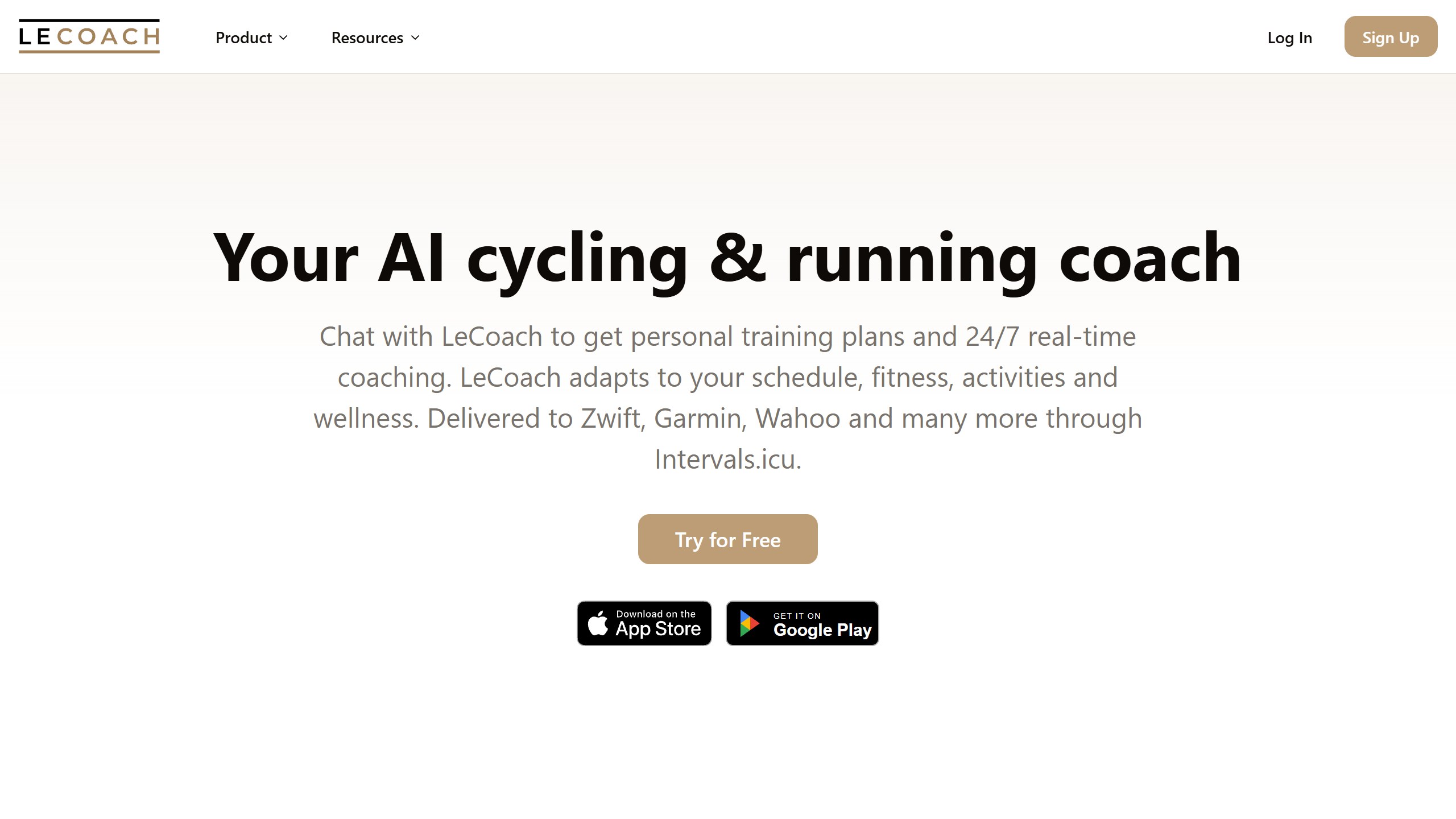
What sets it apart is how it handles change. Its vision page says “The plan never silently rewrites itself overnight.” Instead, the plan “flags what it noticed, explains why it matters, proposes a specific change, and asks.” LeCoach told us the one automatic step is that a missed session holds your progression at that difficulty level; moving it to a rest day, swapping out an endurance session or leaving it missed is your call.
It runs on iOS and Android and uses Intervals.icu as its data layer. If you have no Intervals.icu account, onboarding sets one up, and LeCoach says every workout then lands on Garmin, Wahoo and Zwift automatically.
Pricing: LeCoach Pro lists €9.99 a month, shown at €7.99 with a 20% early adopter discount, or on yearly billing €6.99 a month, shown at €5.59 and billed €67.10 a year, on its pricing page (re-read 19 October 2026), which says prices are in EUR and your local currency is available at checkout. The US App Store listing shows LeCoach Pro Monthly at $6.99 and Yearly at $59.99. There is a 14-day free trial with no credit card required.
One honest limit: it is very new to the public stores; the US App Store listing showed a single rating on 15 October 2026. The ask-first design also means more decisions land on you. Riders who want the plan to reshuffle itself without asking may prefer one of the platforms below.
IntervalCoach
IntervalCoach is a low-cost AI coach that runs on top of a free Intervals.icu account, which it requires as its data layer. It covers nine sports, cycling included, on iPhone, Android, Apple Watch, Mac and the web. Before each session, it says, it checks “over 60 recovery signals”, including HRV, sleep, sleep debt, training load and how you feel, and “adjusts today’s session when the data calls for it.” It adds that every change comes with the reason.
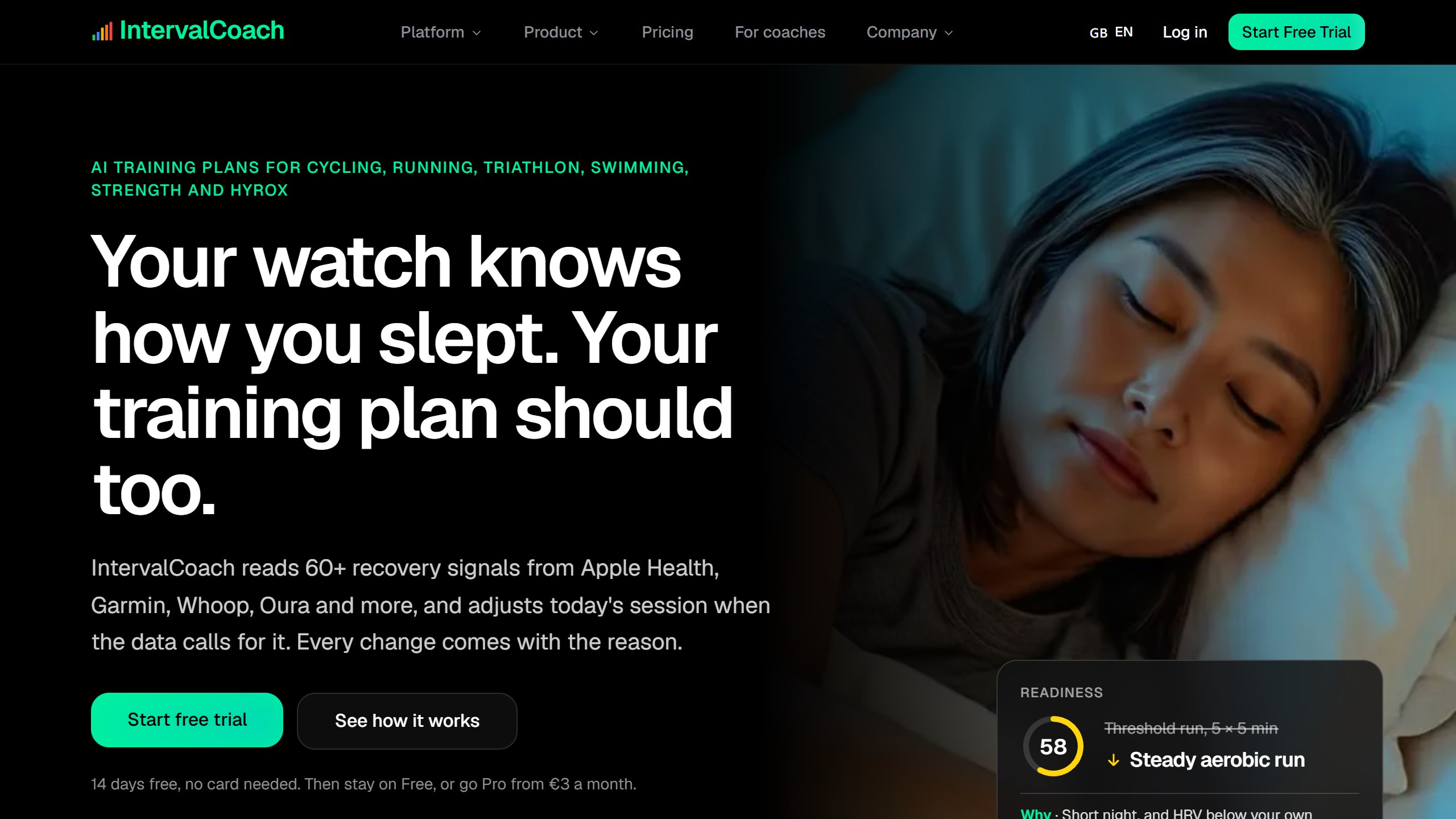
The chat is called Coach+, and IntervalCoach says it “moves or rewrites sessions when you ask”. Garmin, Oura, Polar, Wahoo and COROS connect through Intervals.icu.
Pricing: a Free plan keeps the dashboard and a one-week plan, without Coach+. On its pricing page, Pro is €3 a month with 20 Coach+ messages and four weeks planned ahead, and Max has 200 messages and eight weeks ahead; Max is €8 a month, and yearly billing is priced as ten months: €30 a year for Pro and €80 for Max. The US App Store listing shows Pro at $2.99 monthly or $24.99 yearly and Max at $6.99 monthly or $69.99 yearly. New accounts get 14 days of Pro free with no card, then move to Free.
One honest limit: the message cap matters. Twenty Coach+ messages a month on Pro is less than one a day, so if conversation is why you want a coach, budget for Max. It is also young, with 11 ratings on the US App Store on 15 October 2026.
Analog Sports
Analog Sports is the consumer app from Analog, and its pitch is pro-team pedigree: the product page calls it “The same intelligence trusted by UAE Team Emirates XRG and UAE L’IMAD Team”. The coach is Ana, which Analog describes as your AI coach and performance analyst. Ana gives post-workout summaries and training guidance, and you can talk to her or type, in 32 languages.
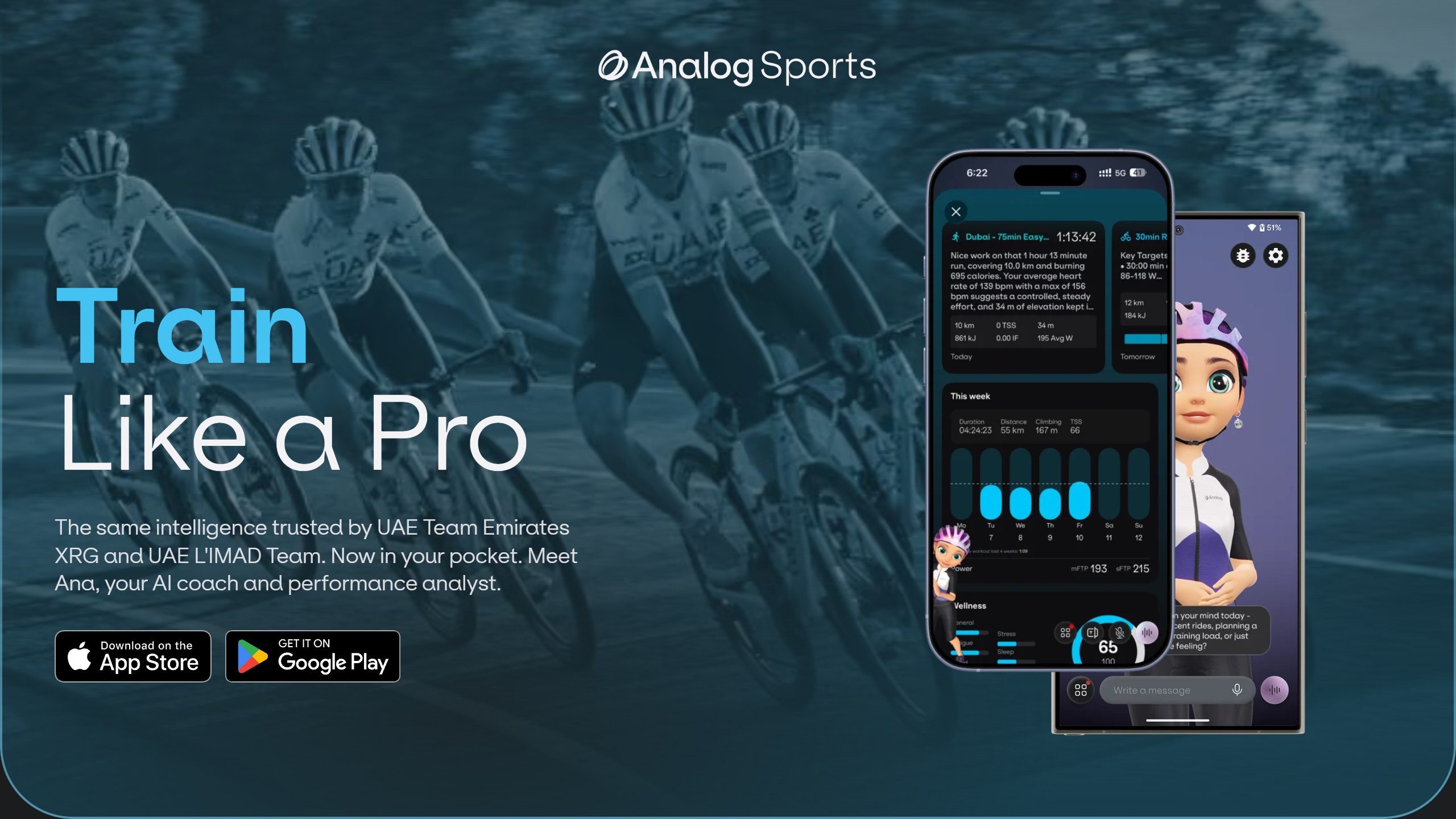
The product page shows the load metrics serious riders expect, including CTL, ATL and TSB, plus VO2 max, HRV against resting heart rate and a wellness score. The App Store listing says it connects with Garmin, Wahoo, WHOOP, Oura, Ultrahuman, TrainingPeaks and Zwift, and the product page also names MyWhoosh.
Pricing: the US App Store listing shows a Monthly Membership at $20.00 and a Yearly membership at $200.00. The listing is iPhone only and needs iOS 18 or later; the product page also links to Google Play. Neither the listing nor the product page we read states a trial length.
One honest limit: the public record is thin. On 15 October 2026 the US App Store showed 2.4 stars from 8 ratings, with version 1.0 dated 10 July and version 1.4.0 dated 6 October. Eight ratings is too few to judge in either direction. The pages we read also do not say how the plan changes after a missed or failed session, which is the core job on this list.
Training platforms with adaptive plans
These six are training platforms first. Most adapt your plan from your data, some of them in detail, but you do not hold a conversation with them. TrainerRoad, JOIN and Xert lead on adaptation; Wahoo SYSTM, Zwift and TrainingPeaks are closer to a workout library, a game world and an analytics calendar.
TrainerRoad
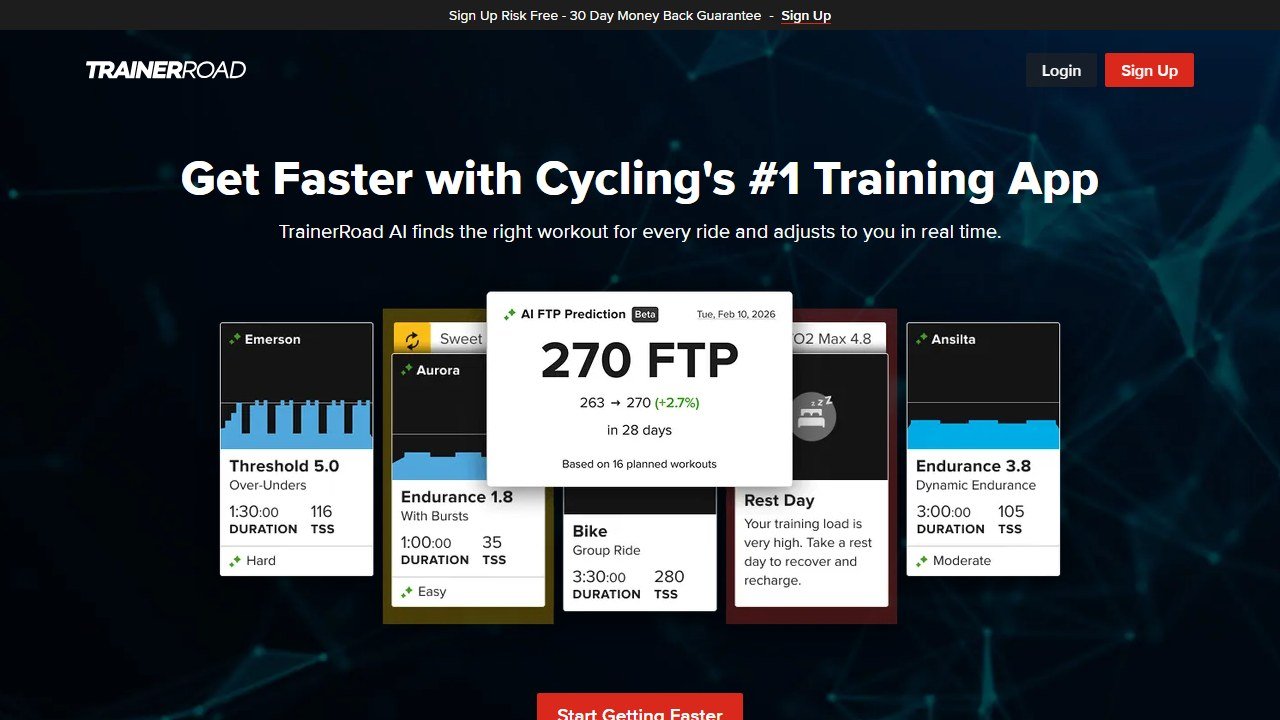
TrainerRoad is the app most riders mean when they say “structured training.” You pick a plan around a goal, it serves interval workouts built on your FTP, and its AI features lean on a very large pool of completed activities to adapt what comes next. TrainerRoad now markets these as TrainerRoad AI (older reviews call it Adaptive Training): upcoming sessions change based on how you rated and completed recent ones, and its homepage says it “runs hundreds of simulations to find the right workout”. AI FTP Detection lets you skip ramp tests, with two limits its help centre sets out: it needs 10 indoor TrainerRoad workouts or imported history to start, and it updates at most every 28 days.
It integrates with Zwift, ROUVY, Garmin and Wahoo, although your FTP does not sync to Zwift and has to be updated there by hand, and it is well suited for the indoor rider who wants clear, science-backed intervals and does not care about a game world.
Pricing: one plan with every feature, $21.99 a month or $209.99 a year on its US pricing page. There is no free trial, only a 30-day money-back guarantee for new accounts.
One honest limit: there is no virtual world. TrainerRoad’s help centre says it “lets you choose your own entertainment”. If you need scenery or a social pack to get through a sweet spot block, many riders run it alongside Zwift for that reason. Our TrainerRoad review covers its terms and AI limits in full, and TrainerRoad vs Zwift compares the two and how to run both together.
JOIN
JOIN was built around a problem the others often ignore: real life is chaotic. It generates a plan from your goal and, more importantly, your actual weekly availability, then adjusts it continuously; its Why JOIN page says the plan adapts to “the workout data, your RPE and your daily readiness score and your availability”. JOIN markets itself as an AI tool, but the same page describes “No quick AI solutions, but rigid science-backed algorithms”. If you have 40 minutes one day instead of 90, availability is exactly what it is built to plan around. It calculates FTP from your ride history so you are not constantly testing, and it pulls personalized versions from a library of several hundred workouts.
It syncs with Strava, Zwift, and the usual platforms, and works for both indoor and outdoor riders, which is rarer than it sounds.
Pricing: a 7-day free trial, then one plan. JOIN’s pricing page served us euro prices, €16.99 a month or €119.99 a year; the US App Store lists several subscription prices, so check what the app offers you.
One honest limit: JOIN deliberately keeps the analytics lighter than Xert or TrainingPeaks. If you love dissecting every interval and power curve, it will show you less of the math. That is the point for many riders, and a frustration for a few.
Xert
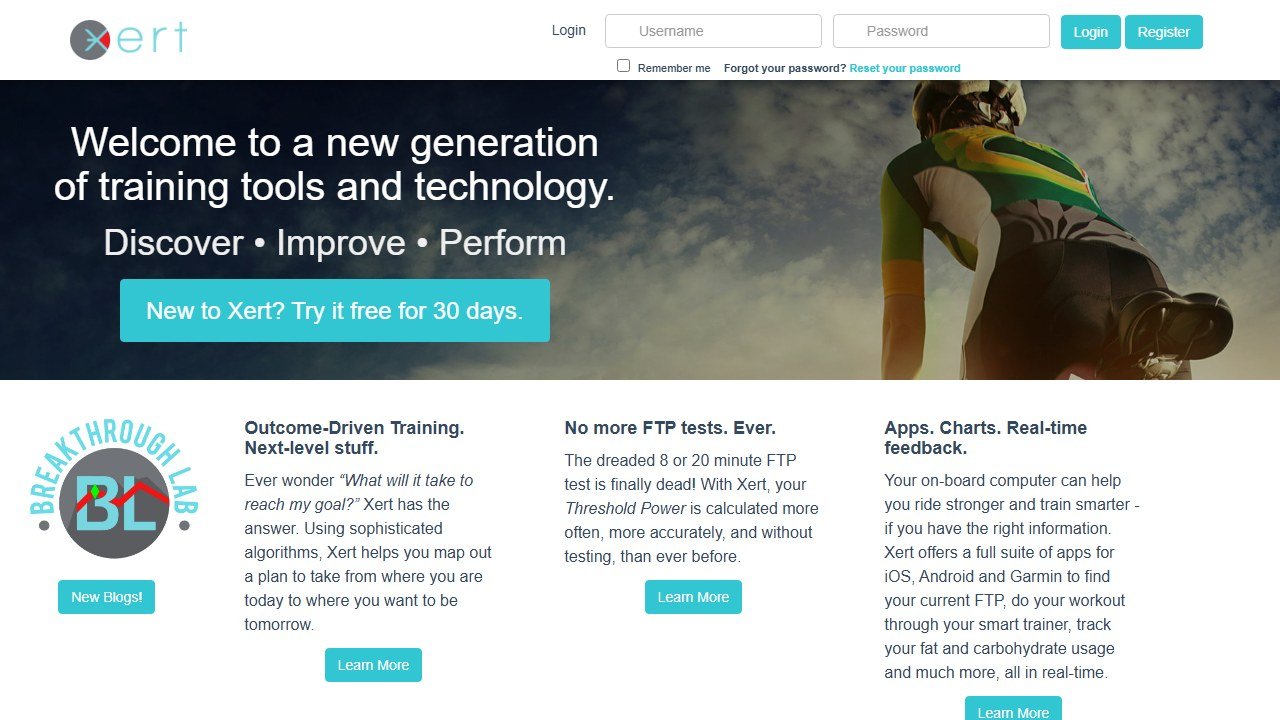
Xert is the data nerd’s choice. Instead of locking you to one FTP number, it maintains a dynamic Fitness Signature with three values that update from every ride, so your training targets shift in real time based on what you have actually been doing. Its Adaptive Training Advisor recommends sessions based on your current freshness and the demands of your goal. By its own documentation, Xert exposes more of its modelling than the simpler apps here do.
It reads outdoor and indoor data well and integrates with the standard ecosystem of meters and head units.
Pricing: $14.99 a month or $99.95 a year on its pricing page, with “No feature tiers”. There is no permanent free tier, but a 30-day free trial needs no credit card.
One honest limit: Xert brings its own concepts, such as High Intensity Energy, Maximal Power Available and a three-part Fitness Signature, in place of a single FTP. Expect to read its documentation before the numbers make sense; it suits riders who enjoy that more than those who want to press start.
Wahoo SYSTM
Wahoo SYSTM, now the workout library inside the Wahoo App Membership, takes a different angle on personalization with its Four Dimensional Power profile. Rather than a single FTP, a 4DP test measures what Wahoo calls “sprint, anaerobic, sustained, and threshold power”, then tailors interval intensities to your specific strengths and weaknesses. Beyond the bike workouts you also get yoga for cyclists, a mental training program, and strength resources, which makes it more of a whole-athlete library than a pure interval engine.
Pricing: unlimited SYSTM comes with the Pro tier, $17.99 a month or $179.99 a year in the US before tax, per Wahoo’s membership page; yearly billing is only available on the website. A free Base tier exists, Core is $4.99 a month, and every new signup gets 14 days of full Pro access.
One honest limit: Wahoo publishes less about how its day-to-day adaptation works than TrainerRoad or JOIN do. Pro now offers daily recommendations that Wahoo says read “Fitness Score, Training Capacity, and recent load”, but its strength remains the 4DP tailoring and the breadth of the library.
Zwift
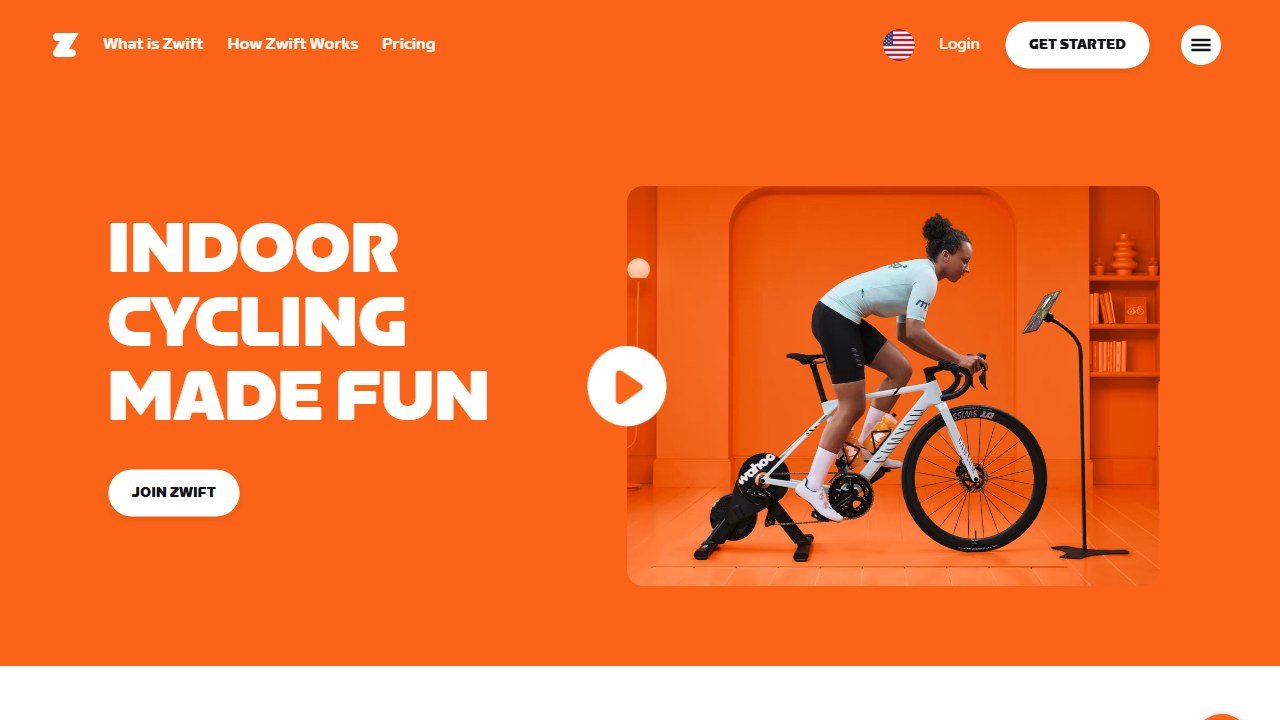
Zwift is the social, gamified indoor world, and in 2026 its training features are more about smart recommendations than full coaching (Zwift does not call them AI). Its Companion app suggests your next activity, it factors in planned events (Zwift’s example is suggesting “something to prime those legs” the day before a race), and weekly planning lets you schedule workouts for the days ahead. It runs structured training plans too, but the reason most people pay for Zwift is motivation: riding in a virtual world with thousands of others makes the suffering bearable.
Pricing: one membership, $19.99 a month or $199.99 a year plus tax on its pricing page when we read it on 22 September 2026. The monthly plan has a 14-day free trial, and you can pause for up to 90 days.
One honest limit: Zwift is not primarily an adaptive coach. Its homepage now promises plans “that adapt to your progress”, and since 9 September 2026 WHOOP users see recommendations adjust on low-recovery days, but it documents far less about how those decisions are made than a dedicated training app does. Many riders pair Zwift for the fun with TrainerRoad or JOIN for the actual coaching brain.
TrainingPeaks
TrainingPeaks is the industry-standard analytics platform, the place serious athletes and coaches live. Its Performance Management Chart plots fitness, fatigue, and form over time so you can plan a peak for race day, and the Annual Training Plan models your whole season from weekly load targets. It is less an AI that hands you today’s workout and more the dashboard where every other tool’s data comes home to be understood.
It integrates with essentially everything, which is exactly why it sits at the center of so many athletes’ setups. If you also wear a recovery band, our WHOOP vs Oura vs Garmin comparison pairs naturally with a TrainingPeaks workflow.
Pricing: a free Basic account, and Premium at $19.95 a month or $134.99 a year on its athlete pricing page, with a 14-day trial. Premium now includes the TrainingPeaks Virtual indoor riding app, and Garmin acquired TrainingPeaks on 22 July 2026.
One honest limit: out of the box it is analysis, not coaching. Without a human coach or a structured plan feeding it, TrainingPeaks tells you what happened in detail but does not decide what you should do next. Our TrainingPeaks review covers Premium, TrainingPeaks Virtual and what Garmin ownership means.
Blocks: a free training platform, with a paid assistant
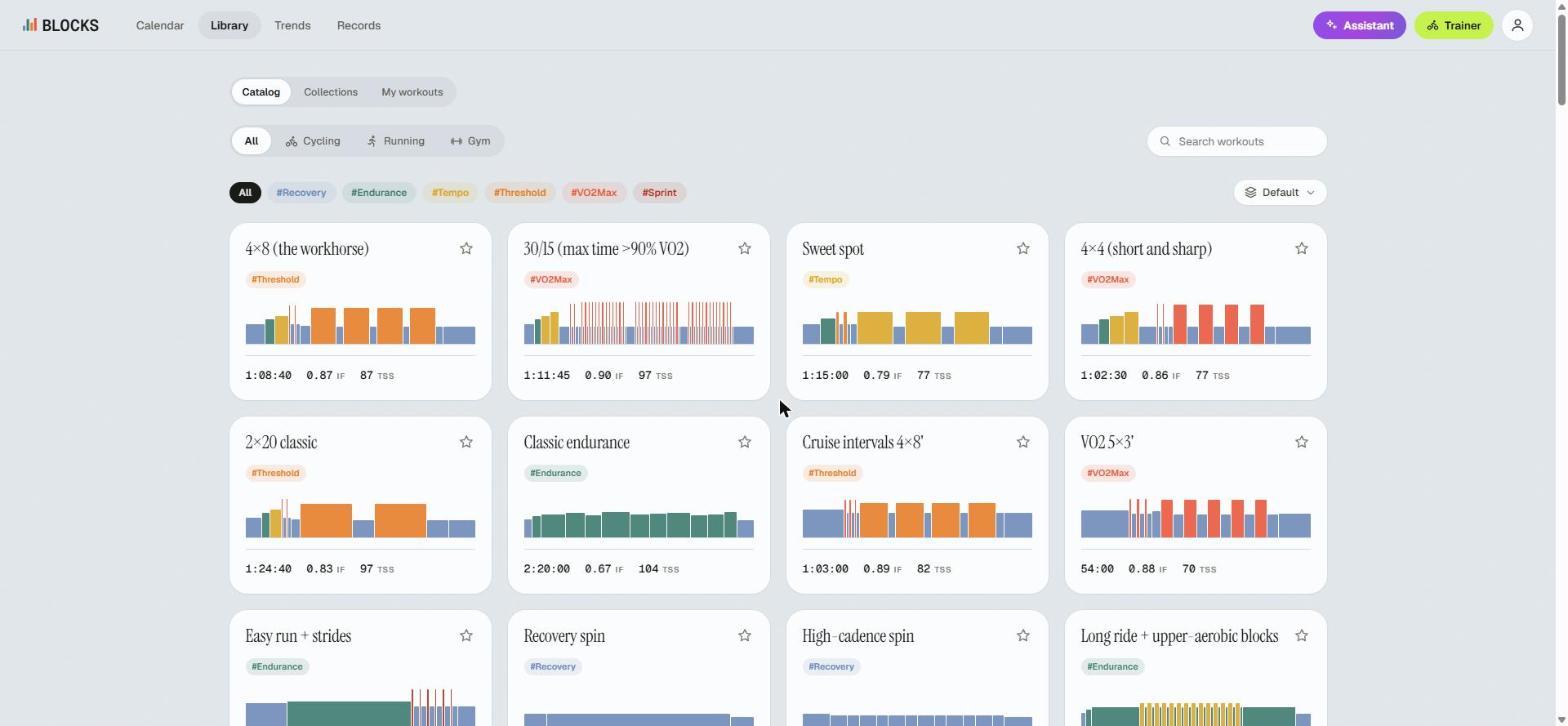
Blocks is a browser-based training platform for cyclists and runners. It sits outside the two groups above because the free part is a full training app and the chat is the paid part. The free side covers a training calendar, a structured workout builder, a workout catalog, Strava and intervals.icu sync, a morning readiness check-in filled from Oura or WHOOP, and trends and power records. Plans can go to Wahoo, Hammerhead Karoo and intervals.icu, with exports to Zwift, Garmin (.FIT), MyWhoosh and TrainerRoad.
The part that stands out is the connector. Add the address Blocks gives you to Claude or another MCP client, and your own AI can read your calendar, sessions and readiness and plan your week, with nothing to pay Blocks. We added it to Claude, signed in, and had no key to paste. Its own comparison page lists AI Endurance and IntervalCoach with official connectors too, but says AI Endurance’s comes with a subscription or trial and IntervalCoach’s with its Max tier.
We also made an account and linked Strava, and our sessions came through to the calendar. The catalog is the strongest part of the free app. Every workout card shows duration, intensity factor and TSS, and opening one lists each step as a percentage of FTP, with a note on the evidence behind it. The 4×8 threshold session cites a 2013 Seiler trial, for example. From there you can send a workout to intervals.icu, export it, or ride it on an indoor trainer screen in Blocks itself.
Pricing: Everything except the assistant is free. The assistant, Blocks Unlimited, is $59 a month (€55), renewing monthly with no annual option, on its pricing page (read 3 November 2026). That is the highest monthly price on this page, and it pays for the chat alone, so the fair comparison is against the other chat coaches above.
One honest limit: we have not used the assistant. It is locked on a free account, and our question got an upgrade prompt instead of an answer. Blocks says it reads your calendar, rides and readiness, answers from a sourced sports-science base, and shows every plan change as a card you confirm, but we cannot say how good its plans are. Our Strava account also held only a few short sessions and no rides, so we could not judge its ride analysis. There is no App Store or Google Play app either: it runs in the phone’s browser, with a Telegram bot for session summaries.
How the eleven compare
| App | Chat coach | What it does best | Best for | Price or free tier (read 15 October 2026) |
|---|---|---|---|---|
| AI Endurance | Yes | Multisport plans re-optimised from your data | Triathletes and crossover athletes | 14 days free; $20/mo or $200/yr (USD) |
| LeCoach | Yes | Proposes changes and asks first | Riders who want to approve every change | 14-day trial; €9.99/mo (€7.99 early adopter) or €67.10/yr with discount (EUR) |
| IntervalCoach | Yes (Coach+, capped) | Daily recovery-based adjustment | Riders on a tight budget | Free plan; Pro €3/mo, Max €8/mo; 14-day Pro trial |
| Analog Sports | Yes (Ana) | Pro-team style load metrics | Riders who want CTL, ATL and TSB with a coach | US App Store $20.00/mo or $200.00/yr; trial not stated |
| TrainerRoad | No | Adaptive structured intervals | Indoor riders chasing FTP | $21.99/mo or $209.99/yr; no trial, 30-day money-back |
| JOIN | No | Plans around your weekly availability | Time-crunched real-world riders | 7-day trial; €16.99/mo or €119.99/yr on the web |
| Xert | No | Deep analytics, dynamic Fitness Signature | Data-literate riders on a budget | 30-day trial; $14.99/mo or $99.95/yr |
| Wahoo SYSTM | No | 4DP profiling, whole-athlete library | Wahoo owners wanting variety | Free Base; 14-day Pro trial; Pro $17.99/mo or $179.99/yr |
| Zwift | No | Motivation and social riding | Anyone who hates the pain cave | 14-day trial (monthly); $19.99/mo or $199.99/yr plus tax (read 22 September 2026) |
| TrainingPeaks | No | Fitness and fatigue analytics | Athletes with a coach or plan | 14-day trial; Premium $19.95/mo or $134.99/yr |
| Blocks | Yes, on its paid plan | Free calendar, workout catalog and MCP connector | Riders who already use Claude or plan their own training | Free app and connector; assistant $59/mo (read 3 November 2026) |
Is there a free AI cycling coach?
Mostly no, but there are free tiers and long trials. IntervalCoach is the only chat coach here with a permanent Free plan, and that plan leaves out the Coach+ chat. Wahoo’s Base tier costs $0.00, and Blocks is free apart from its paid assistant. Everything else is a trial or a money-back window, so start one when you can ride a full week of real sessions.
- IntervalCoach: Free plan with the dashboard and a one-week plan; 14 days of Pro free, no card.
- LeCoach: 14-day free trial, no credit card required.
- AI Endurance: 14 days free, no payment details needed.
- Xert: 30 days free, no credit card required.
- Wahoo: free Base tier, plus 14 days of full Pro access for every new signup.
- Zwift: 14-day free trial on the monthly membership; its FAQ says annual memberships have no trial.
- TrainingPeaks: 14-day Premium trial.
- JOIN: 7-day free trial for new users.
- TrainerRoad: no free trial; a 30-day money-back guarantee instead.
- Analog Sports: no trial length on the pages we read.
- Blocks: free calendar, catalog, sync and MCP connector; no trial of the assistant on the account we used.
LeCoach and IntervalCoach both use Intervals.icu as their data layer, and both describe its core platform as free.
A lean way to start
You do not need a stack of subscriptions to train well. Here is a sane on-ramp. If you are leaving TrainerRoad specifically, our TrainerRoad alternatives guide compares ten apps on price, trials and adaptation.
- Decide where you mostly ride. Indoor and structured points you toward TrainerRoad or Wahoo SYSTM. Mixed or outdoor with a messy calendar points toward JOIN. If you already use Claude, Blocks’ free connector costs nothing to try.
- Use the trial window properly. Do a full week of real workouts, not a tour of the menus, so you feel how the adaptation behaves when you actually miss or smash a session. TrainerRoad has no free trial, so its 30-day money-back guarantee is your window there.
- Resist the analytics rabbit hole at first. Xert and TrainingPeaks are powerful, but adding them on day one is how people end up admiring graphs instead of riding.
- Set one clear goal with a date. Every adaptive engine here works better when it knows what it is building you toward.
- Reassess after one full training block, roughly six to eight weeks, using your numbers and how you feel, not the app’s marketing.
If you are new to training apps generally, our best AI workout apps guide covers the wider landscape beyond cycling.
Coaching other riders? This page is for athletes choosing an app for themselves. If you are a coach picking software to plan for clients, our endurance coaching software guide compares the coach-side platforms.
What these apps still cannot do
An AI cycling coach is a remarkable thing, and it is still not a human coach. Be clear-eyed about the gaps.
It cannot see most of your life. The model knows your power files and maybe your heart rate. It does not know you slept four hours, that work is on fire, or that you are fighting something off. When the plan says intervals and your body says rest, your body is the better data source.
It cannot diagnose pain. Normal training fatigue is one thing. A sharp knee, a numb hand, or chest tightness is not a software problem. None of these apps is medical advice. If something is wrong, see a doctor or a physiotherapist before you ride through it.
It cannot guarantee its own numbers. Adaptive FTP and threshold detection are convenient and usually close, but they are estimates. Treat a wildly off number as a prompt to test, not a verdict on your fitness.
It cannot supply motivation you do not have. The best app for you is the one you will open at 6am in the dark. That is why Zwift exists alongside the smarter coaches, and why the honest answer to “which is best” is “the one you will actually use.”
Pick one, ride it honestly for a block, and let your own data tell you whether it earned the subscription.
Where the figures on this page come from
Prices on this page were read from each vendor’s own pricing page or US App Store listing on 15 October 2026, in the currency each page served; we report them as served and do not convert. JOIN, LeCoach and IntervalCoach served euro prices. Zwift’s prices and pause terms were last read on 22 September 2026, because on 15 October its pricing page showed prices only inside an image. Pricing in this category moves, and a claim without a date is not checkable.
The pages we read
AI Endurance publishes $20 a month or $200 a year in USD with 14 days free. LeCoach lists €9.99 a month (€7.99 with an early adopter discount) or €67.10 a year with the discount, re-read on 19 October 2026, with a 14-day trial. IntervalCoach publishes a Free plan, Pro at €3 a month and Max at €8 a month, or €30 and €80 a year. Analog Sports lists $20.00 and $200.00 memberships on the US App Store. TrainerRoad publishes $21.99 a month or $209.99 a year, one plan. JOIN publishes €16.99 a month or €119.99 a year with a 7-day trial. Xert publishes $14.99 a month or $99.95 a year with a 30-day trial. Wahoo publishes Core at $4.99 a month and Pro at $17.99 a month or $179.99 a year. Zwift published $19.99 a month or $199.99 a year plus tax when last read. TrainingPeaks publishes Premium at $19.95 a month or $134.99 a year. Blocks lists its assistant at $59 a month, read on 3 November 2026.
What we did not check
We did not use any of these apps, apart from the free side of Blocks and its connector. We did not use Blocks’ assistant. App Store rating counts are a snapshot of the US storefront on 15 October 2026 and change quickly for apps this new. LeCoach’s note on missed sessions came from the company, not from its website. Analog Sports does not state a trial length on the pages we read, and TrainingPeaks’ free Basic account was last confirmed on 22 September 2026; its athlete pricing page on 15 October lists Premium only.

Written by
FazFaz is the founder of AIToolsBakery. Some tools here are tested hands on. Others are assessed from vendor documentation and pricing verified on the live page, and every review says which one it is. Sponsors can buy a position in a guide. They cannot buy the score, the criticism, or silence about a better option.
How we test and how we make money →