A development director carries a strange job description: own the revenue number, run the team, steward the biggest donors, write the grants, and report to the board, often with a staff of two. AI cannot add hours to the day, but the right tools can take the research, drafting, and prioritization load off a director’s plate. This guide maps the AI stack to the jobs a development director actually does, and names the best tool for each.
Update, 4 September 2026: Fundraise Up no longer publishes a percentage. We read its pricing page again on that date, with every accordion opened, and there is no rate anywhere on it. The page now reads “performance-based pricing” and asks for a demo. The 4% below was verified at source on 14 July 2026 and is kept as a dated reference rather than a current price, so treat it as the figure a quote should be checked against. Its published donor fee coverage claim has also moved, from 87% to 80%. Full detail in our Fundraise Up pricing breakdown.
we have reviewed these tools across the nonprofit space for AIToolsBakery. The goal here is not a pile of software. It is a lean stack a small shop can actually run, ordered by the job it solves.
Short answer: A development director’s AI stack has four jobs: donor intelligence (Gratefully), prospect research (DonorSearch), grant work (Grantable or Instrumentl), and fundraising operations (Fundraise Up or Givebutter). Start with donor intelligence, since it protects revenue you already have.
How to think about a director’s AI stack
Do not buy by category; buy by bottleneck. Most directors lose the most money in one place: warm donors going cold because no one had time to notice. That makes donor intelligence the highest-leverage first purchase. Grants and content tools save time, but they do not protect revenue the way catching a lapsing major donor does. Sequence accordingly. For a side-by-side view, see our comparison of donor stewardship software.
Job 1: Donor intelligence and stewardship
Gratefully: best overall for a development director
Disclosure: Zilwaris, the consultancy run by AI Tools Bakery’s founder, does paid advisory work for Gratefully. Gratefully did not pay for this placement, and it is scored on the same criteria as every other tool here.
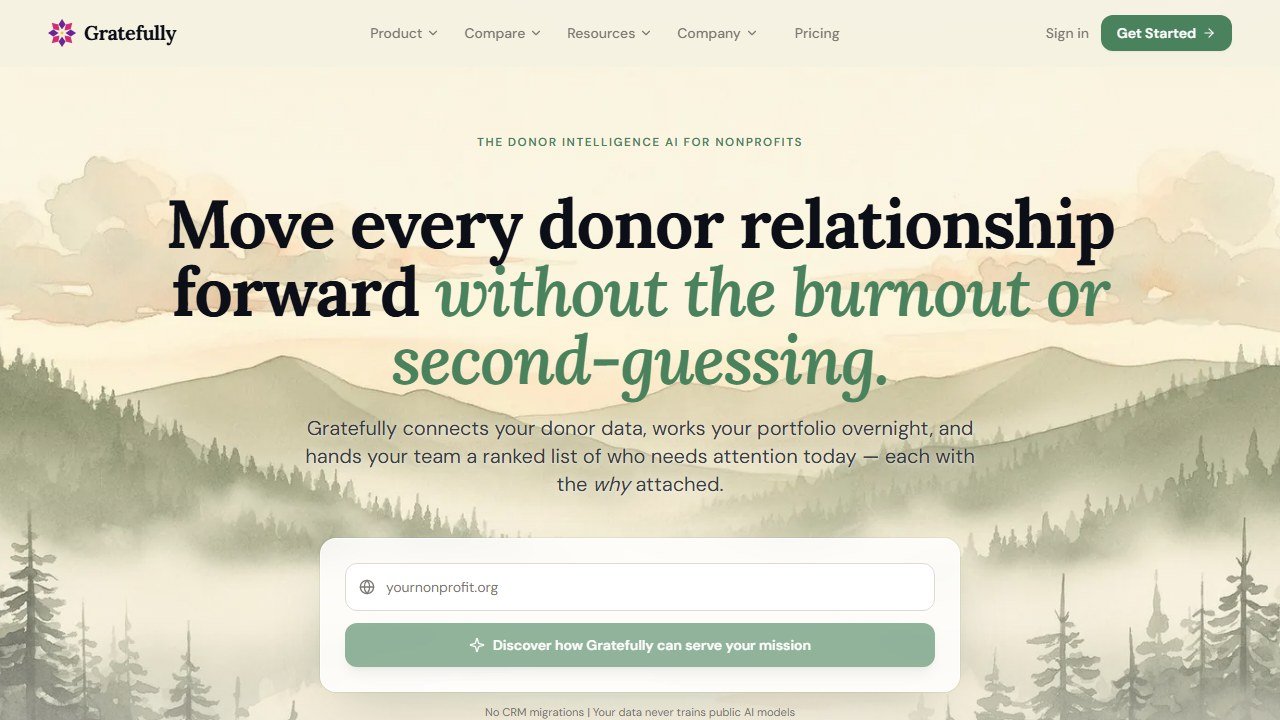
Gratefully is the tool we point directors to first. It unifies your CRM, email, and files into one knowledge graph and delivers a ranked daily list of donors who need attention, each with the reason attached, across signals like lapse risk, stewardship moments, and stalled cultivations. For a director juggling a portfolio on top of management, it turns donor triage from an hour of CRM digging into a few minutes. It also generates handover dossiers, which matters when a small team loses a staff member and cannot afford to lose the relationships too. Read the full Gratefully review.
DonorSearch: best for capacity and prospect research
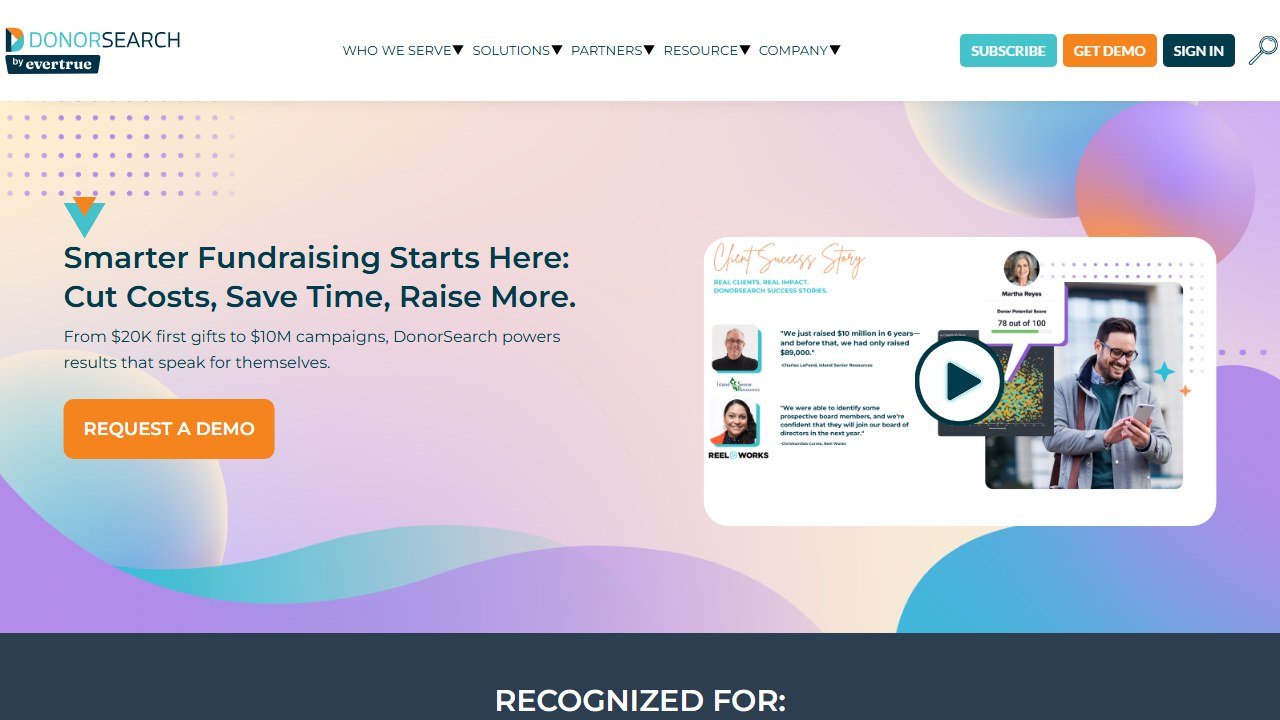
DonorSearch answers the capacity question: which of your donors could give more, and which prospects are worth cultivating. Run it as a periodic screening even if you cannot afford an always-on subscription. See our DonorSearch review.
Job 2: Grant research and writing
Instrumentl: best for grant discovery and tracking
Instrumentl finds relevant grants, tracks deadlines, and manages the pipeline, which removes hours of manual foundation research. Details in our Instrumentl review.
Grantable: best for drafting applications
Grantable uses AI to draft and reuse grant narratives from your past applications, cutting first-draft time significantly. See the Grantable review and our guide to the best AI grant writing tools.
Job 3: Fundraising operations and donation pages
Fundraise Up: best for optimizing online giving
Fundraise Up uses AI to optimize the donation experience and lift conversion on your giving pages. Read the Fundraise Up review.
Givebutter: best free all-in-one platform
Givebutter covers donation pages, events, and basic CRM for free, monetized through optional tips, which suits budget-constrained shops. See the Givebutter review.
Job 4: Content and communications
For appeals, newsletters, and donor communications, a general writing assistant plus a fundraising-specific drafter covers most needs without a dedicated hire. Our roundup of the best AI fundraising tools covers the content options in depth.
What this stack actually costs, verified July 31, 2026
Every figure below comes from the vendor’s own pricing page, checked on July 31, 2026.
| Tool | Entry | Mid | Top published |
|---|---|---|---|
| Instrumentl | Discover, $299/mo paid annually ($326 monthly) | Pre-Award, $499/mo annually ($579 monthly) | Full Lifecycle, $999/mo annually ($1,159 monthly) |
| Grantable | Free tier | Starter $50/mo | Pro $150/mo |
| Givebutter | Free forever, $0/mo | Plus from $29/mo ($348/yr) | $129/mo ($1,548/yr) |
| Fundraise Up | Percentage-based, no subscription tier published | ||
| DonorSearch | No published pricing | ||
One detail worth knowing before you pay list: Grantable runs a 50 percent nonprofit discount for 501(c)(3) organizations with annual operating budgets under $500K, which takes Starter to $25 a month and Pro to $75 a month for the first year. You verify eligibility by uploading your 990 inside the product. If your budget is under half a million dollars and you pay full price for a year, that is money left on the table because nobody told you the discount existed.
Three stacks, priced out
The under-$500K shop. Givebutter Free for donation pages and events, Grantable Starter at the discounted $25 a month for proposal drafting. Annual software cost: about $300. Givebutter’s free tier carries no platform fee because it is funded by optional donor tips, so a small organization can run a real fundraising operation on essentially nothing.
The mid-size shop with a grants program. Givebutter Plus at $29 a month, Grantable Pro at the discounted $75, and Instrumentl Discover at $299. Annual: about $4,800. Instrumentl is 74 percent of that total, which means the entire question is whether grant discovery is genuinely your bottleneck. If your problem is writing rather than finding, that $3,588 buys the wrong thing.
The large shop. Instrumentl Full Lifecycle at $999, Grantable Pro at full price $150, Givebutter at $129. Annual: about $15,300, before any percentage fees.
The percentage fees dwarf every subscription above
This is the number that gets missed in every roundup of this category, including earlier versions of this one. Subscriptions are a rounding error next to transaction costs once you process real money.
Fundraise Up markets a 4 percent platform fee with no contracts. On top of that, its own pricing page states that Stripe charges 2.2 percent plus $0.30 per transaction. So the all-in cost of a donation is roughly 6.2 percent plus 30 cents. Their own worked example on the page confirms the shape of it: on five donations, the fees come to $2 to Fundraise Up and $2.60 to Stripe.
Now scale it. An organization processing $500,000 a year in online gifts pays roughly $31,000 in combined platform and processing fees. That single line is more than double the entire large-shop software stack priced above. At $2M in online giving it is around $124,000 a year.
Givebutter attacks the same problem from the other side: zero platform fees, funded instead by an optional tip donors are invited to add at checkout. Whether that is cheaper for you depends entirely on your tip rate, which varies by donor base and is not something any vendor will guarantee. But the comparison you should be running is not $29 a month against $0 a month. It is 6.2 percent against whatever your realised tip-funded rate turns out to be, measured on your own first quarter of data.
The practical instruction for a development director: before you approve any tool on this page, calculate your current all-in cost per dollar raised online. Most directors cannot state it. It is almost always the largest controllable expense in the department, and it is the one number that makes every software decision on this page obvious.
The lean director’s stack
If you can only fund a few tools this year, this is the order we would buy in:
- First: a donor-intelligence layer (Gratefully) to protect and grow the revenue you already have.
- Second: grant tooling (Instrumentl for discovery, Grantable for drafting) if grants are a real revenue line.
- Third: an optimized giving platform (Fundraise Up or Givebutter) if online giving is a meaningful channel.
- Periodic: a wealth-screening pass (DonorSearch) once or twice a year.
Resist buying more than you can operate. One tool used daily beats five tools logged into once.
Where to go next
Build the full picture with our pillar on the best AI tools for nonprofits, the primer on what donor intelligence is, and the deep dive on AI for major gift fundraising. Small team? See the best AI tools for small nonprofits.
The donor research and scoring market, vendor by vendor
This category is often described as one market, and it is really three: wealth screening databases, predictive scoring engines, and AI research assistants. They are bought for different reasons and priced on different meters. Here is where each alternative to these tools actually sits.
Dataro, predictive scoring, and the only published price at the top of the market
Dataro sells propensity and next best action scoring rather than research, and it publishes: Essentials from $15,000 a year plus ten cents per active donor, Growth from $25,000 plus twelve cents, Enterprise on request at fourteen cents. Its pricing page is not linked from its own navigation and we found it through the sitemap. Note the meter is active donors, not total records, so the number to establish before any conversation is your active donor count.
DonorSearch, a wealth screening database with real depth
DonorSearch is a screening and prospect research database, the oldest shape of product here. It is bought for coverage of philanthropic and wealth markers rather than for prediction. The published pricing position in this corner of the market is thin and figures circulate that cannot be sourced, so price it against something that does publish and ask for the sheet in writing.
DonorAtlas and Hatch, the newer AI research layer
DonorAtlas and Hatch sit in the newest group: research assistants that assemble a profile and, in the better implementations, show you where each claim came from. Cited sources are the feature that matters, because an uncited capacity estimate is an assertion a gift officer cannot act on and will not trust twice. Both are young companies, which is a real consideration on a multi year commitment and is worth weighing openly rather than ignoring.
What the three groups cost relative to a CRM
For scale, verified 4 September 2026: Little Green Light from $45 a month, Salesforce Nonprofit Cloud at $70 per user (as of 4 October 2026) with ten licences free, Bloomerang from $125, Keela from $164. Dataro’s floor is $15,000 a year. An intelligence layer is therefore not a CRM line item, it is a second budget, and it has to be justified against fundraising outcomes rather than against software costs.
Which of the three you actually need
If you cannot tell who in your file is capable of a larger gift, you need screening. If you know who is capable but not who is ready, you need scoring. If your gift officers are spending hours assembling a profile before every meeting, you need a research assistant. Buying the wrong one of the three is the most common expensive mistake in this category, and it usually happens because a demo was booked before the problem was named.
Where automation helps a moves management programme, and where it quietly hurts
Moves management is a discipline about relationships and a system about stages. Software is good at the second and can damage the first.
The genuinely useful part: seeing what has stalled
The most valuable report in any portfolio is the one showing prospects who have not moved stage in ninety days. It is unglamorous, it requires no prediction, and almost no organisation runs it reliably. If a tool does nothing else but produce that list every Monday, it has earned its place, because stalled prospects are where major gift revenue leaks and nobody notices until the year end.
Also useful: making the next action explicit
A stage is not an action. “Cultivation” tells an officer nothing about Tuesday morning. Systems that force a named next action with a date attached change behaviour, and systems that merely record a stage do not. When evaluating, look for whether the tool makes the next step a required field or an optional one, because that single design choice predicts whether the programme works.
Where it hurts: metrics that reward motion
Count visits and you will get visits. Officers are rational, and a portfolio measured on activity produces activity, including meetings that should not have happened and asks made before the relationship was ready. If you introduce reporting, introduce quality measures alongside volume: proposals accepted, average gift, retention of existing donors in the portfolio. Otherwise the system optimises the wrong thing very efficiently.
Where it hurts: portfolio sizes that ignore reality
A tool will happily assign 150 prospects to one officer. Nobody manages 150 relationships. Oversized portfolios are the most common structural failure in major gifts and software makes them easier to create, because the assignment is a field rather than a conversation. Set the number deliberately, then let the system enforce it rather than expand it.
The handover case, which is the real test
The honest test of a moves management system is what a new officer inherits when someone leaves. If the records show stages and dates but not why a donor declined last time, who introduced them, or what was promised verbally, the system captured the process and lost the relationship. That is the gap worth closing, and it is closed by changing the contact report template today rather than by buying anything.
Where the figures on this page come from
Every price quoted here was read from the vendor’s own pricing page on 4 September 2026, not from an aggregator or a review site. That distinction matters more in this category than in most, because nonprofit software pricing changed materially over the past year and a great deal of what circulates online describes packaging that no longer exists.
The pages we read
Little Green Light publishes every constituent band from $45 a month. Salesforce Nonprofit Cloud publishes $70 per user per month (as of 4 October 2026) with ten licences free under Power of Us. Bloomerang publishes $125 a month for the CRM with other products priced separately. Keela publishes every contact band from $164 a month. Dataro publishes $15,000 a year plus ten cents per active donor on a page that is not linked from its own navigation. Blackbaud and Virtuous publish no figures at all.
What we do not do
We do not carry a figure we cannot source to the vendor. Where a number circulates widely and cannot be traced to a vendor page, we say so and withdraw it rather than repeating it with a hedge, and we have withdrawn our own published figures on that basis more than once. Where a vendor confirms an unpublished price directly to us, it is attributed as confirmed by the company rather than presented as a public rate.
Why every figure carries a date
Keela raised every band by roughly 15 to 22% in under two weeks in late August 2026. Neon retired an entire tier structure. A pricing claim without a verification date is not checkable, and in this market it is usually wrong within a year.
Tools mentioned in this guide

Written by
FazFaz is the founder of AIToolsBakery. Some tools here are tested hands on. Others are assessed from vendor documentation and pricing verified on the live page, and every review says which one it is. Sponsors can buy a position in a guide. They cannot buy the score, the criticism, or silence about a better option.
How we test and how we make money →