DonorPerfect Pricing 2026: Lite vs Express vs Essentials vs Premier
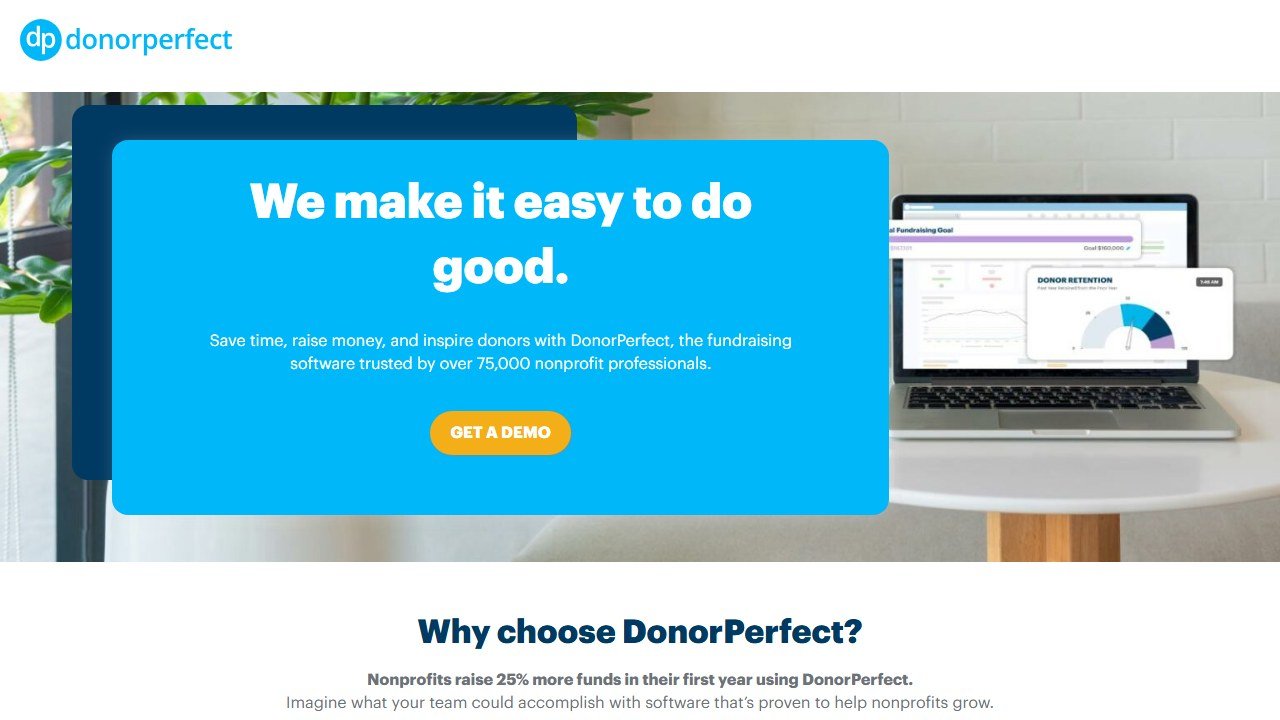
DonorPerfect sells four main tiers priced mainly by how many constituent records you store: Lite, Express, Essentials, and Premier (with an Enterprise option above). As of mid-2026, third-party listings put Lite near 89 to 99 dollars a month and Premier near 479 to 499 dollars a month, billed annually. DonorPerfect does not publish a fixed price card, so every number here is a planning estimate. Confirm your exact quote on DonorPerfect’s site.
One budget line people forget to price alongside this one. A CRM subscription buys the place your donor records live. It does not buy the decision about who to call, which is a separate category with a separate cost: free for one person at Gratefully, then $99 a month for a single fundraiser or $499 a month for a five-person team. Whether that belongs in your budget depends on whether your problem is record-keeping or follow-through. See Gratefully vs DonorPerfect.
How DonorPerfect actually prices
The headline you should internalize: tiers are gated by record count, not just features. A “record” (DonorPerfect calls it a constituent) is any donor, prospect, board member, volunteer, or lapsed contact in your database. As your list grows, you climb tiers whether or not you wanted the extra features that come bundled at the next level.
That matters because nonprofits rarely shrink their lists. You import historical donors, event attendees, and newsletter signups, and the count only rises. So the right way to read the table below is not “what do I need today” but “where will my record count sit in two years.”
DonorPerfect bills annually. Expect a yearly contract rather than true month-to-month, even though prices are quoted per month. Because the public numbers come from resellers and review aggregators rather than a published price sheet, treat them as a range and verify on DonorPerfect’s official site before you budget.
Tier-by-tier breakdown
Lite
As of mid-2026, Lite lands around 89 to 99 dollars a month and tops out near 1,000 constituent records. It is the entry tier: core donor database, basic gift entry, standard receipts, and online donation forms. This is genuinely workable for a brand-new organization, a single-program charity, or a volunteer-run group that wants to retire its spreadsheet without overcommitting.
The catch is the record ceiling. One mid-sized direct-mail appeal or a few years of event signups can push a small shop past 1,000 records, and at that point Lite stops being an option. Budget for Express if you expect any list growth at all.
Express
Express sits around 159 to 179 dollars a month and roughly 2,500 records. This is the tier most small-to-midsize nonprofits actually start on once they account for historical data. You get more automation, expanded reporting, and the breathing room that Lite lacks.
For a one-or-two-person development team running annual appeals, monthly giving, and a couple of events, Express is the realistic floor. If a vendor quotes you Lite, double-check your true record count first, because reclassifying upward mid-contract is rarely fun.
Essentials
Essentials runs about 289 to 299 dollars a month and around 7,500 records. The jump from Express buys both capacity and capability: deeper reporting, more workflow automation, and features that suit an organization with a structured fundraising calendar and multiple staff touching the database.
This is the sweet spot for an established midsize nonprofit, think a regional charity with a real development department, recurring campaigns, and grant reporting needs. The price step is meaningful, so the deciding question is usually records first, advanced features second.
Premier
Premier is roughly 479 to 499 dollars a month and around 25,000 records. It targets larger organizations with big donor files, multiple users, and a need for the fullest reporting and automation set. Above Premier, DonorPerfect offers an Enterprise tier (third-party listings cite figures near 799 dollars a month) for organizations that outgrow even 25,000 records.
If you are evaluating Premier, you are likely also weighing dedicated enterprise platforms. At this spend level the question shifts from “is DonorPerfect affordable” to “is it the best fit,” which is exactly where our DonorPerfect review digs into day-to-day usability versus the sticker price.
The costs that do not show up in the tier price
Subscription is only part of total cost of ownership. Here is where nonprofit budgets get surprised.
Payment processing. If you take donations through DonorPerfect Payments, you pay a per-transaction cut on top of your subscription. Third-party reports put credit card processing in the range of roughly 2.89 to 3.39 percent plus about 30 cents per transaction, with ACH meaningfully cheaper (often under 1 percent plus a small flat fee). On a six-figure online giving program, that cut can dwarf your annual subscription. Always model processing fees against your real donation volume, not the monthly tier price.
Data migration. Moving your existing donor history into DonorPerfect can carry a one-time fee. Third-party estimates land anywhere from a few hundred to a couple thousand dollars depending on record volume and how messy the source data is. This is quote-based, so get it in writing.
Onboarding and implementation. DonorPerfect markets a “no setup fee” entry path and offers paid implementation packages through its onboarding team. Whether you need a paid package depends on how much hand-holding your staff wants. Ask specifically what is included free versus what is billed.
Add-ons. Capabilities like advanced email, online forms beyond the basics, peer-to-peer fundraising, and other modules can be priced separately from your base tier. A tier price quote is not your final number until you have listed every add-on you plan to switch on.
Put plainly: the realistic first-year cost for a midsize nonprofit processing real donation volume can run several times the headline subscription once processing and migration are included. Build your budget from all four buckets, not just the monthly tier.
How to choose your tier without overpaying
Start with an honest record count. Export your current contact list, dedupe it, and add a realistic two-year growth estimate. That single number maps you to a tier faster than any feature comparison.
Then layer features. If two tiers both fit your record count, only then does the advanced reporting and automation difference decide it. Most buyers we talk to choose on records first and discover the features almost incidentally.
Finally, model the fees you will actually pay. A Lite plan with heavy online giving may cost more all-in than an Express plan with mostly ACH and check gifts, once processing cuts are counted. The cheapest tier is not always the cheapest year.
How it compares
DonorPerfect’s record-based pricing is its defining trait, and it cuts both ways. You pay for the database you actually keep, which is fair, but list growth quietly escalates your bill. Competitors price differently, and that changes the math.
Bloomerang, for example, also scales by records but bundles features differently and is often pitched on donor retention tooling. Our Bloomerang vs DonorPerfect breakdown compares the two on real total cost, not just entry price, which matters because the cheaper headline does not always win over a full year.
At the smaller and leaner end, Little Green Light review covers a platform many small nonprofits compare against DonorPerfect Lite and Express. It often comes in lower for small record counts, so if your list is under a couple thousand contacts, it belongs on your shortlist.
Payment processing, the line that usually costs more than the software
Almost every comparison of DonorPerfect against its rivals stops at the subscription. For most nonprofits the larger number is what comes off each donation, and it is metered on the one thing you are trying to grow.
The arithmetic that decides this
A single percentage point on $500,000 raised online is $5,000 a year. That is more than the entire annual subscription to several nonprofit CRMs. So a platform that is $600 a year cheaper but takes half a point more of your online giving is not cheaper at any organisation raising more than $120,000 online, and the crossover point moves against you every year you grow.
Two different models, and they are not comparable
Some platforms charge a subscription and take nothing from donations, leaving you to hold a processor relationship directly. Little Green Light states plainly that it takes nothing from your donations. Others bundle processing into the platform, which is simpler to run and structurally more expensive at volume. GoFundMe Pro, formerly Classy, publishes that its model is an annual subscription plus a transaction fee per donation, and that second half is the part that scales.
Ask for the effective rate, not the headline rate
Processing quotes are usually given as a percentage plus a fixed amount per transaction, and the fixed component dominates at small gift sizes. On a $20 donation, 30 cents is another 1.5% on top of whatever percentage was quoted. If your median online gift is small, and for most community organisations it is, your effective rate is materially higher than the number on the page. Work it out on your own median gift before comparing anything.
Covered fees change the picture and are worth asking about
Where a platform offers donors the option to cover processing fees, take-up is the variable that decides your real cost, and it varies enormously by audience and by how the prompt is worded. Ask any vendor quoting you a bundled rate what their observed cover rate is across comparable organisations, and treat a refusal to answer as information. A model that looks expensive at 0% cover can be the cheapest option at 60%.
Get processing out of the subscription line in every quote
Insist that every vendor states processing separately from the platform fee, with the percentage, the fixed per-transaction amount, and whether ACH and card are priced differently. A blended annual figure hides exactly the line that grows with your success, and it is the single most common reason a nonprofit software budget is wrong in year two.
How to run the procurement so a quote means something
Get every quote onto the same basis before comparing
Ask each vendor, including DonorPerfect, for the same seat count, the same contract length, implementation quoted separately from subscription, every add-on itemised, and payment processing stated as inside or outside the platform fee. A single blended annual number cannot be compared against anything, and vendors know it.
Establish the total first-year cost, not the subscription
Onboarding, data migration, integration work and training are frequently larger than the first year of licence fees in this category and are rarely in the headline figure. Ask for the all-in number, then ask which parts of it are one-off and which recur.
Negotiate the renewal before you sign the first contract
This is the single most valuable term and the one most often left out. A capped renewal uplift, stated as a percentage, is worth more than a bigger first-year discount, because at renewal the vendor knows your usage, your dependency and your switching cost while you have no public rate card to argue against.
Insist on a trial with your own data
A demo runs on a dataset chosen because the product handles it well. Ask to load a sample of your own records, including the messy ones: duplicate households, lapsed donors with old addresses, a recurring gift that failed. How a platform handles your actual data quality is the thing that decides whether staff use it, and it is invisible in a scripted walkthrough.
Name the person who will own it
Every platform in this category rewards an owner and punishes shared responsibility. Before signing, name the person whose job description includes this system and check they have the hours. Software does not create that role, and its absence is the most common reason a nonprofit CRM purchase disappoints.
Why nonprofit software pricing works the way it does
Understanding the mechanics makes a quote easier to read and much easier to challenge.
Revenue banding is means testing
Several vendors band by annual fundraising revenue, and Virtuous splits its tiers at $5 million. That is means testing: the same software costs more if you raise more, on the reasoning that a larger organisation gets more value from it. It is defensible, and it also means your public filings are doing the negotiating before you arrive. Know your own figures before the call.
Why a quote form asks for an EIN
An EIN lets a vendor look up your filed revenue before quoting. If a pricing page asks for one before showing anything, assume the number you are offered has been sized against your accounts rather than drawn from a rate card.
Transaction fees are the line that scales fastest
Where a platform takes a percentage of donations, that line grows with your success and usually overtakes the subscription. On $500,000 raised online, a single percentage point is $5,000 a year, more than the entire annual cost of several CRMs. Most nonprofit CRMs take nothing from donations, so a percentage model needs a specific justification.
Published prices are snapshots, including ours
Keela raised every band by 15 to 22% in under two weeks. Neon retired an entire tier structure. Artisan removed its figures altogether. Any pricing article without a verification date is describing a market that may no longer exist, which is why every figure here carries one.
The exit costs nobody quotes you
Switching cost is the reason organisations stay on platforms they have outgrown, and it is almost never discussed during procurement. Three things determine how trapped you are.
Recurring gifts and payment tokens
Donor records and giving history export cleanly from almost any platform. Live recurring schedules and the payment tokens behind them frequently do not. If tokens cannot transfer, every monthly donor has to re-enter card details and a meaningful share will not, so the real cost of leaving is a slice of your most reliable income. Ask about token portability during procurement, in writing, when you still have leverage.
Custom fields and history
Ask what a full export actually contains. Standard fields usually come out fine; custom fields, soft credits, relationship links between households and the audit trail of who changed what often do not. Losing the relationship structure means rebuilding institutional knowledge that took years to accumulate.
Integrations you will have to rebuild
Every connected system, email platform, giving forms, accounting, event tools, is work to reconnect elsewhere. Count them before signing rather than after, because the number is usually higher than anyone remembers and it is the part that turns a two-week migration into a six-month one.
Where the figures on this page come from
Every price quoted here was read from the vendor’s own pricing page on 4 September 2026, not from an aggregator or a review site. That distinction matters more in this category than in most, because nonprofit software pricing changed materially over the past year and a great deal of what circulates online describes packaging that no longer exists.
The pages we read
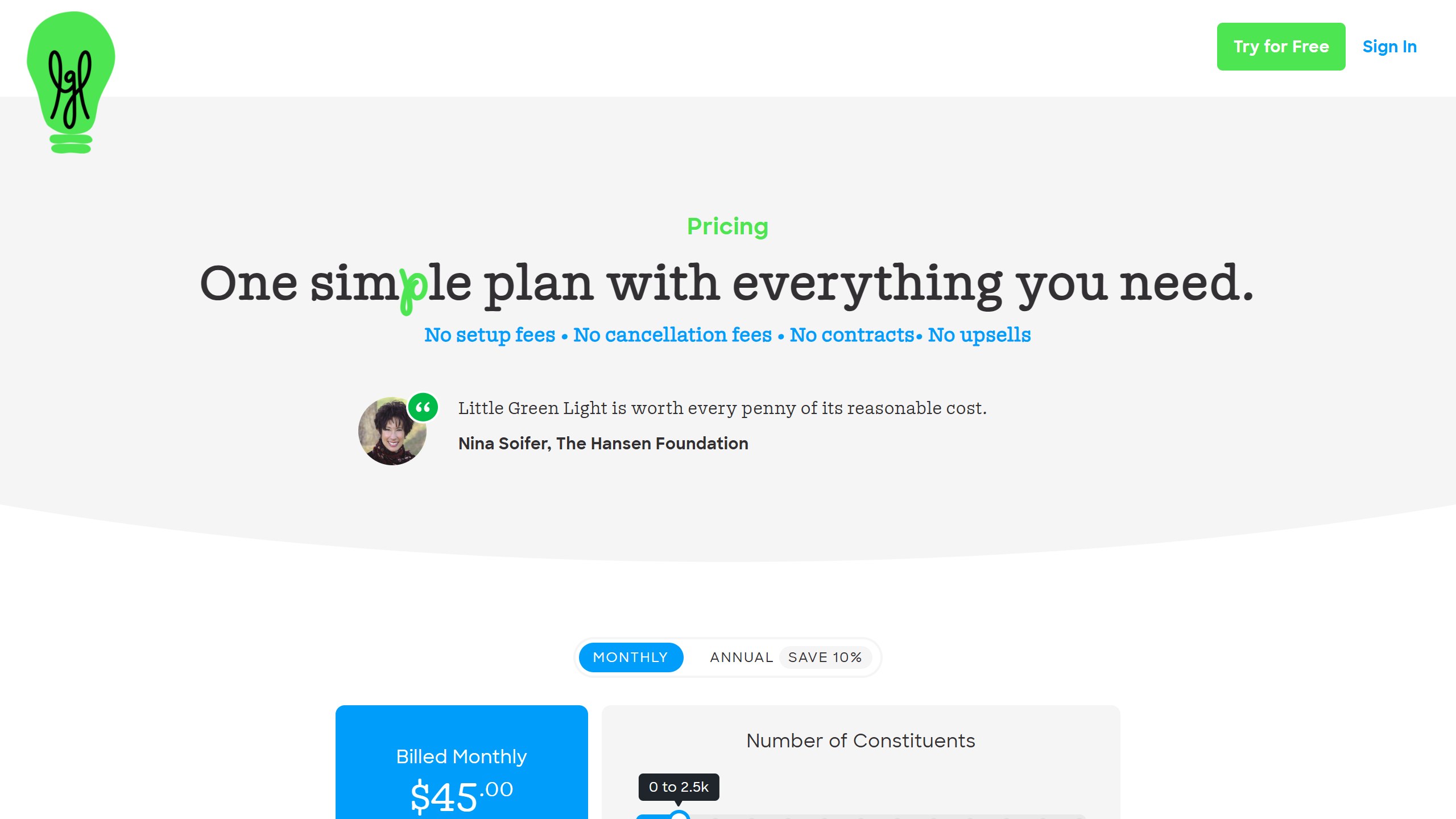
Little Green Light publishes every constituent band from $45 a month. Salesforce Nonprofit Cloud publishes $60 per user per month with ten licences free under Power of Us. Bloomerang publishes $125 a month for the CRM with other products priced separately. Keela publishes every contact band from $164 a month. Dataro publishes $15,000 a year plus ten cents per active donor on a page that is not linked from its own navigation. Blackbaud and Virtuous publish no figures at all.
What we do not do
We do not carry a figure we cannot source to the vendor. Where a number circulates widely and cannot be traced to a vendor page, we say so and withdraw it rather than repeating it with a hedge, and we have withdrawn our own published figures on that basis more than once. Where a vendor confirms an unpublished price directly to us, it is attributed as confirmed by the company rather than presented as a public rate.
Why every figure carries a date
Keela raised every band by roughly 15 to 22% in under two weeks in late August 2026. Neon retired an entire tier structure. A pricing claim without a verification date is not checkable, and in this market it is usually wrong within a year.
The honest verdict
DonorPerfect is a mature, capable fundraising CRM, and its pricing is reasonable for what it does, provided you go in clear-eyed. The two traps are the record-count ceiling that pushes you up tiers as your list grows, and the processing-plus-migration costs that turn a tidy monthly subscription into a much larger annual number.
We take no payment to move a verdict, so here is the straight version: pick your tier on records first, model your payment processing against real donation volume, and get migration and add-on costs quoted in writing before you sign the annual contract. Do that, and DonorPerfect’s pricing is predictable rather than surprising.
As of mid-2026, every figure above is a third-party planning estimate, not a published rate card. Confirm your exact pricing, record limits, and fees directly on DonorPerfect’s site before you commit.

Written by
FazFaz is the founder of AIToolsBakery. Some tools here are tested hands on. Others are assessed from vendor documentation and pricing verified on the live page, and every review says which one it is. Sponsors can buy a position in a guide. They cannot buy the score, the criticism, or silence about a better option.
How we test and how we make money →Frequently Asked Questions