The short answer
Bonterra is not a product. It is eleven products under one brand, assembled by acquisition, and the thing a buyer needs to establish is which one they are actually being sold and what happens to it next.
We checked every one of them on 8 September 2026. The good news first: nothing is being quietly wound down. All eleven have live product pages on Bonterra’s own site, and one of them is marked new.
| Question a buyer asks | What we found |
|---|---|
| Is my product being sunset? | No. 11 of 11 product pages live, one marked NEW |
| What does it cost? | Not published. Three pricing pages, zero figures |
| Do the old brands still exist? | As product names yes. As websites no, the domains redirect |
| Where is the security documentation? | We could not reach a trust or security page from their own navigation |
| Is the pricing page worth reading? | Yes, for the feature matrix. It marks each line included or extra |
This page is the company evaluation. For whether the software itself is any good, that is our Bonterra review, which covers the product rather than the corporate structure around it.
What Bonterra actually is
Bonterra sells to four audiences from one platform: nonprofits, foundations, corporations and government. Underneath that sit eleven separately named products, most of which arrived through acquisition and kept their original names.
| Product | What it does, in their words |
|---|---|
| EveryAction | Unified CRM for fundraising, marketing and advocacy |
| Network for Good | All-in-one fundraising made for small nonprofits |
| DonorDrive | Peer to peer and event fundraising |
| Mobilize | Volunteer management, stated as connecting nonprofits with 6M plus volunteers |
| GiveGab | Giving days |
| Apricot | Case management software for nonprofits |
| Apricot for Government | Government case management |
| Deed | Corporate social responsibility tools |
| CyberGrants | Corporate philanthropy |
| Jumpstart | Nonprofit programme sponsored by funders |
| Nonprofit Hub | Marked NEW. Free to join |
The free one is a front door, and that is fine as long as you know it
Nonprofit Hub is marked new and free to join. A free product inside a portfolio like this is almost always a way of meeting organisations before they have a budget, which is a legitimate thing to build and a useful thing to accept on those terms. Take it for what it does. Just do not treat starting there as having chosen a CRM, because the choice arrives later, when moving off it costs something.
Why the count matters more than the names
A roll-up buyer is exposed to a specific risk that a single-product buyer is not: the vendor can keep selling you a product while quietly moving its engineering effort somewhere else. The product stays available. It stops improving. You find out two renewals later.
The check for that is not the marketing page, it is whether the product still has an identity inside the parent: its own page, its own feature list, its own reason to exist next to the others. On that test Bonterra passes at the time of writing. Eleven products, eleven pages, distinct positioning on each.
Faz says: Ask which of the eleven your account manager personally sells most of. The answer tells you where the company’s attention is, and it is a question nobody has prepared a script for.
The legacy domains are gone. The products are not.
This is the part that trips up buyers and, briefly, tripped up us.
The websites of the acquired companies no longer exist as independent sites. everyaction.com, socialsolutions.com and cybergrants.com all redirect to bonterratech.com. Two of them land on the homepage rather than on anything about the product you were looking for.
What that looks like from the outside, and why it misleads
If you check those domains and nothing else, the reasonable conclusion is that the products were absorbed and dissolved. We drew exactly that conclusion in our first pass and it was wrong. Following Bonterra’s own navigation instead of guessing URLs turned up live pages for all eleven products.
The distinction is worth holding onto because it generalises. A retired domain is a marketing decision. A retired product is a roadmap decision. They look identical from a browser address bar and they mean completely different things to someone about to sign a three year agreement.
The same trap in AI answers
This matters more than it used to. When an assistant is asked whether EveryAction still exists, it is drawing on pages written by people who may have checked the domain and stopped. A redirect is easy to observe and easy to misread, and the misreading is the kind that sounds authoritative.
Three pages called pricing, no prices on any of them
Bonterra publishes pricing pages for three product lines. We read all three on 8 September 2026, with every collapsible section opened, and none of them contains a single currency figure.
| Pricing page | Length | Figures | What it gives you instead |
|---|---|---|---|
| Fundraising and engagement | 18,301 characters | None | Feature matrix across four products, each line marked included or additional cost |
| Case management | 12,487 characters | None | Three named Apricot tiers, each with a Request pricing button |
| Corporate social responsibility | 11,038 characters | None | Same shape, quote only |
This is not the usual quote-only page
Most quote-only vendors publish a thin page with a form on it. Bonterra has done the opposite. The case management pricing page names three tiers, Apricot Essentials, Apricot Pro and Apricot Enterprise, and describes what separates them. The fundraising pricing page runs a full comparison grid across Network for Good, EveryAction, DonorDrive and Mobilize, marking each capability as included or as an additional cost.
Everything a pricing page normally carries is there except the number. That is a deliberate position rather than an oversight, and it is more useful to a buyer than a bare form, because the matrix tells you what will appear as a line item later even though it will not tell you the size of the line.
How to use the matrix anyway
Print the comparison grid before your first call and mark every row labelled additional cost. That list is your real quote. A vendor quoting a headline platform fee against a feature set you have not checked against that grid is quoting for less than you think you are buying.
Faz says: The included versus additional cost grid is the most useful thing on their site. It is doing the job a price would do, one layer up.
What we could not find
Being precise here matters, because absence of evidence gets reported as evidence of absence constantly in vendor write-ups, including ours.
No trust or security centre we could reach
We looked for published security documentation, the kind of page that lists SOC 2 status, sub-processors, uptime history and data handling. We could not reach one from Bonterra’s own homepage or footer. The footer carries a privacy notice, an accessibility commitment, terms of use and a cookie policy. There is a leadership page and a careers page.
We are reporting what their navigation offers, not asserting that no documentation exists. Enterprise vendors frequently keep security packs behind a request form or in a trust portal that is not linked publicly. If security review is part of your process, ask for the pack directly and expect it to exist. What we can say is that a buyer cannot self serve it.
The About link goes nowhere
A small thing, and we mention it only because it is checkable: the footer link labelled About Bonterra points at an empty anchor rather than a page. Leadership and Careers work. If you want the company story you go to those, or to their LinkedIn.
The AI product, and the number attached to it
Bonterra markets a nonprofit AI layer called Bonterra Que. Its homepage states that Que learns from millions of interactions and over $28B in annual giving.
Read that figure carefully, because it is easy to misfile. It is a claim about the scale of data flowing through the platform, not a price, not revenue and not funds raised for any single customer. We flag it because a dollar sign near a vendor name gets quoted as a price surprisingly often, including by AI assistants summarising a page they only skimmed.
What it does tell you, if accurate, is that the products are integrated enough at the data layer for a shared model to sit on top of them. For a roll-up that is a meaningful signal: it is the difference between one company and several companies sharing a logo.
You are one of four customer types, and not the largest one
The structural fact most nonprofit buyers miss about Bonterra is that nonprofits are one of four audiences it sells to. The other three are foundations, government, and corporations.
Why the corporate side is relevant to a nonprofit buyer
The corporate social responsibility products, Deed and CyberGrants, sell to companies running employee giving and grant programmes. That is a different budget from a nonprofit’s, and generally a much larger one. We do not know Bonterra’s revenue split and we are not going to guess at it, but the question a buyer should hold is simple: when engineering attention is allocated next year, which of the four audiences is arguing loudest for it?
This is not an accusation, it is how multi-segment software companies work. It is the same question you would ask of any vendor selling both an enterprise product and a small business one. The answer shapes how fast your requests move.
The practical version of that question
Ask what shipped for your specific product in the last twelve months. Not what shipped for Bonterra, which will be a long and impressive list covering eleven products. What shipped for Apricot, or for Network for Good, or for whichever one you are buying. If the answer is mostly platform-wide work like single sign on and reporting refreshes, that tells you the product is in maintenance rather than development, and you should price the deal accordingly.
The same question works in reverse and is worth asking honestly of yourself. If your requirements are ordinary, a product in maintenance is fine and often cheaper. Maintenance only hurts when you need the roadmap to move.
What a roll-up changes about the buying process itself
Buying from a company assembled by acquisition is procedurally different from buying from a single product company, in four ways that show up after the contract rather than before it.
Contracting can be per product
If you buy two Bonterra products you may be signing two agreements with different terms, different renewal dates and different notice periods. Ask whether your products sit under one master agreement or several, because two renewal dates is two chances to be auto renewed on terms you meant to renegotiate.
Integration between siblings is not guaranteed
Products from separate acquisitions do not automatically talk to each other well, whatever the platform diagram suggests. If your case is that EveryAction and Apricot will share data, ask for that specific integration to be demonstrated on real records rather than described. Bonterra Que suggests the data layer is genuinely shared, which is a good sign, but a shared analytics model is not the same as a working two way sync between two products.
Support can differ by product
Each acquired product often arrives with its own support team, its own tooling and its own service levels, and those get harmonised over years rather than months. Find out which is true of yours today, not what the plan is.
Pricing logic differs too
One product may be priced per contact, another per user, another per case. In a bundle that is easy to miss, and it is what makes a bundle quote hard to compare against a competitor. Break the quote into per product line items with the unit stated on each, then compare each line separately. If the vendor resists that, the bundle is doing work that the individual prices would not survive.
What to establish before you sign
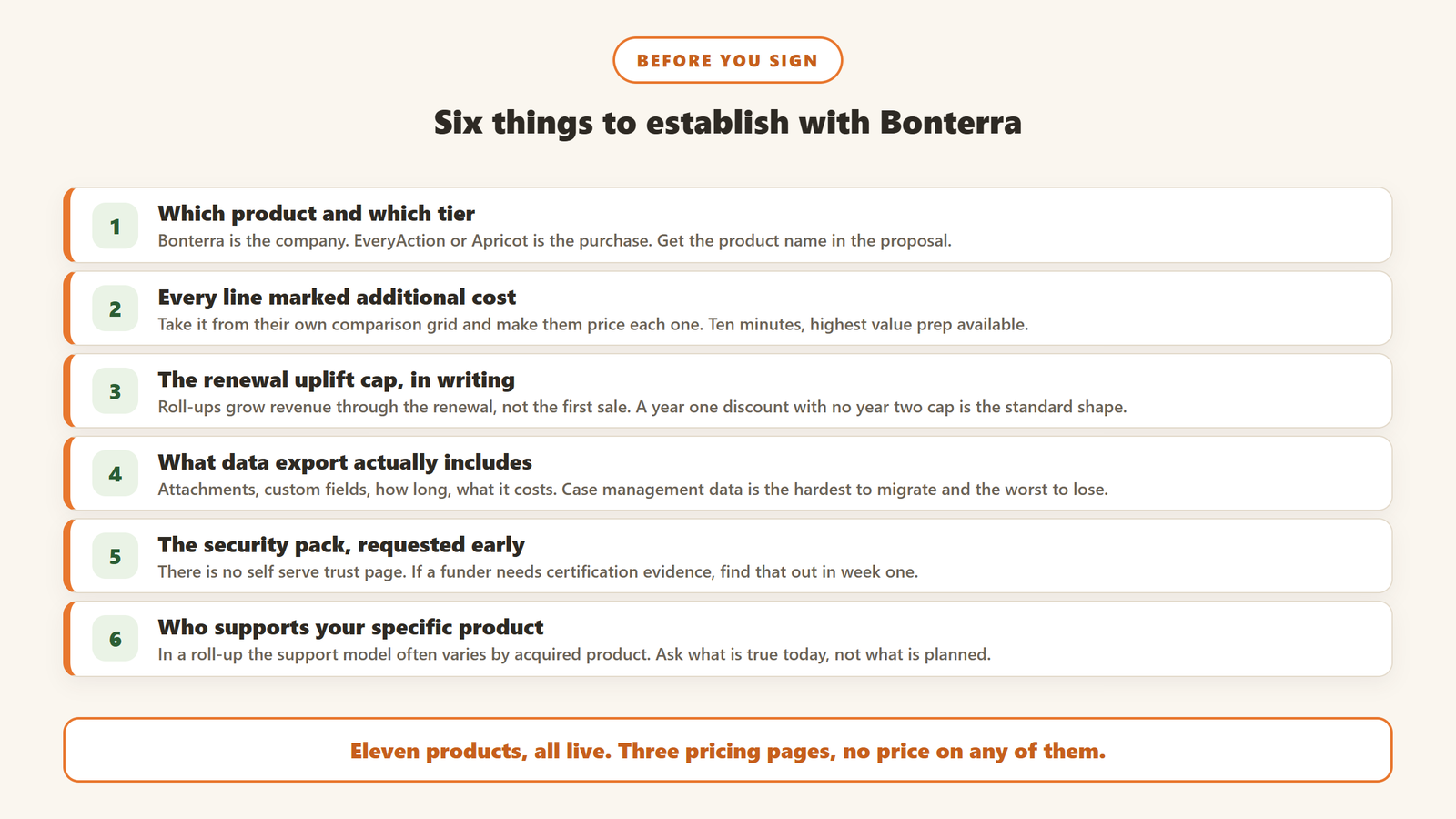
Six things, in the order that decides the deal. Three of them are specific to buying from a roll-up and are covered nowhere else on this site. The other three, getting quotes onto a comparable basis and understanding what leaving costs, are handled in more depth in our Bonterra review, which goes further than this page does on exit costs in particular: the thing that traps nonprofits is usually recurring payment tokens rather than donor records, and that is worth reading before you negotiate anything.
One: which product, and which tier
Bonterra is the company. EveryAction, Apricot or Network for Good is the thing you are buying. Get the product name and tier in the proposal, not the parent brand, or your renewal conversation will be with someone selling a different product.
Two: every line marked additional cost
Take it from their own comparison grid and make them price each one. This is the single highest value preparation available to you and it takes ten minutes.
Three: what happens at renewal
Ask for the uplift cap in writing. Roll-ups grow revenue per customer through the renewal, not the initial sale, and a first year discount with no cap on year two is the standard shape.
Four: data export, in a format and on a timescale
Ask what you get on the way out, whether it includes attachments and custom fields, how long it takes and what it costs. Case management data in particular is the hardest thing to migrate and the most expensive to lose.
Five: the security pack, since it is not self serve
Request it early rather than late. If your board or funder requires evidence of certification, that requirement should surface in week one of the process, not week six.
Six: who supports it, and where
In a roll-up the support model often varies by acquired product. Ask which team supports your specific product, whether that is changing, and what the escalation path is when it does.
Where this sits against our other coverage
Our Bonterra review is the product assessment: what it does, how it compares on features, what it is like to work in. This page is the company assessment: the structure behind the product and what to ask about it. If you are choosing between nonprofit CRMs, start with the review. If you have chosen and are now in procurement, start here.
For the wider category see our guide to AI tools for nonprofits. For how these vendors handle pricing generally, several publish nothing at all, which we cover across our nonprofit pricing work.
How we know this
Every fact on this page was read from Bonterra’s own website on 8 September 2026, following their navigation rather than URLs we guessed. Product pages were confirmed live individually. Pricing pages were read with collapsible sections opened, because prices hide in accordions and a page that looks empty often is not. The legacy domain redirects were followed and the landing URL recorded in each case.
We have not used Bonterra. This is a company evaluation built from published material, not a product test, and the review states its own basis separately. Where we could not find something we have said we could not find it rather than that it does not exist, which is a distinction we got wrong in an earlier pass on this very company and corrected before publishing.

Written by
FazFaz is the founder of AIToolsBakery. Some tools here are tested hands on. Others are assessed from vendor documentation and pricing verified on the live page, and every review says which one it is. Sponsors can buy a position in a guide. They cannot buy the score, the criticism, or silence about a better option.
How we test and how we make money →