Disclosure: Zilwaris, the consultancy run by AI Tools Bakery’s founder, does paid advisory work for Gratefully, which did not pay for any placement on this page and is assessed on the same criteria as everything else on this site.
Many of the guides to donor prospect research are written by companies that sell wealth screening, and they tend to end in the same place: upload your file, buy a capacity rating. Screening has its place. It is just the wrong first step for most development teams, because the best evidence about who will make a major gift is usually already sitting in your own database, your inbox and your staff notes.
This guide gives you a method that runs in the opposite order. You start with what you already have, move to the free public sources, and pay for external wealth data only when you know exactly which questions it has to answer. Along the way you get a prospect profile template you can copy, a table of what free sources cover against what paid screening adds, and the legal and ethical rules that vendor guides tend to skip.
How we put this together. We have not used these tools ourselves. This is a research-based guide. Every price, feature and quote below comes from the vendor’s, regulator’s or professional body’s own page, read on 21 October 2026, and we link to each one. Where a vendor shows a dollar sign with no currency code, or does not say whether a price is annual, we say so. None of the screening vendors named here paid to appear.
What donor prospect research is, and why the order matters
Prospect research is the work of finding the people, foundations and companies most likely to make a significant gift to your organisation, and building enough of a picture of each to plan a good ask. Researchers usually sort what they find into three questions:
- Capacity: could this person make a gift of a certain size?
- Affinity: do they care about your mission, and how do you know?
- Propensity, or inclination: do they give to causes at all, and at what level?
Wealth screening answers the first question well. It is much weaker on the second, because no outside database knows that a donor has attended your gala four years running, or that she told your program director her late husband loved your work. That is why the order matters. If you screen first, you get a long list sorted by capacity, and your gift officers spend months qualifying wealthy strangers. If you start inside, you get a shorter list of people who already know you, and you use outside data to size the ask.
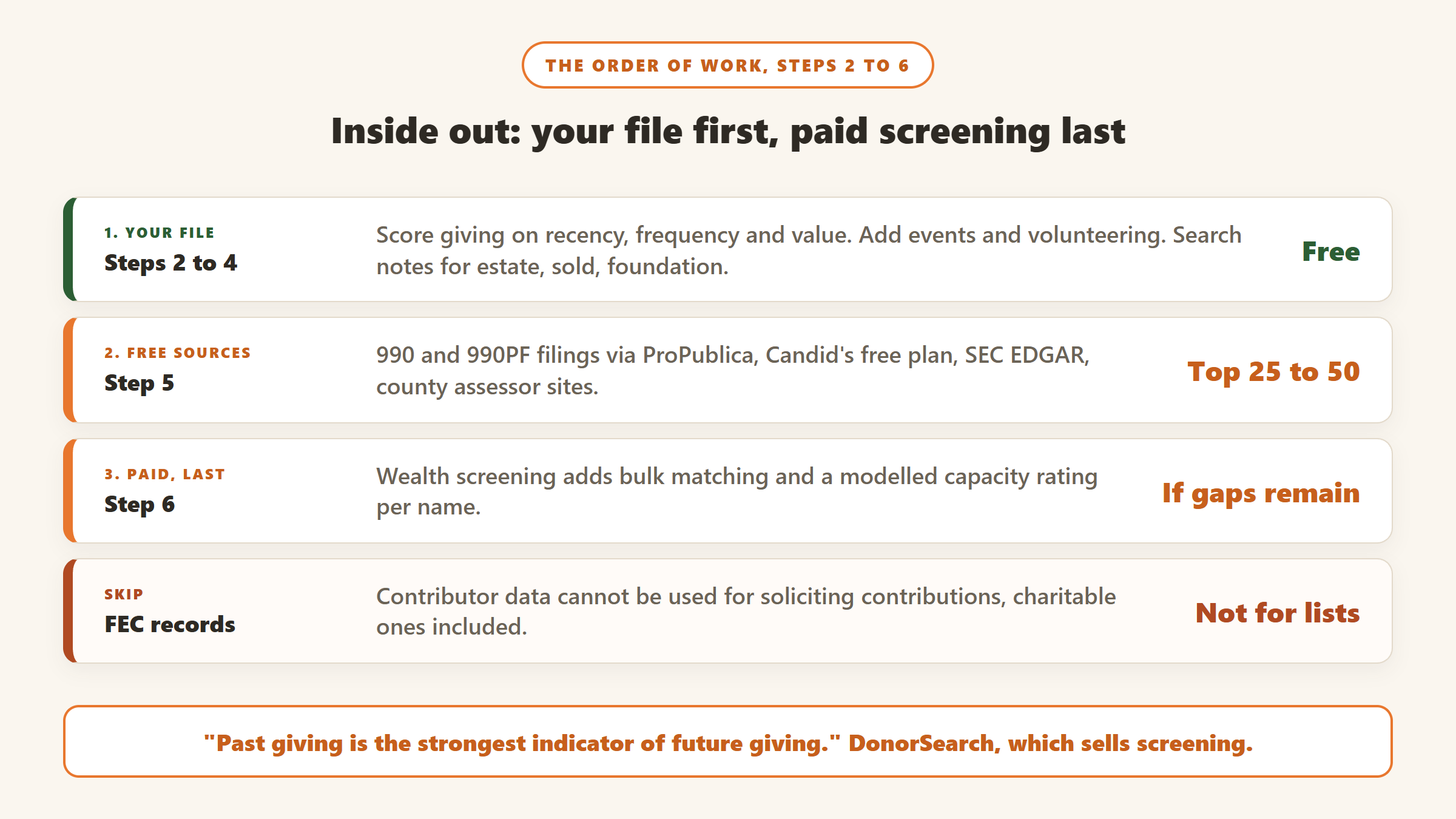
Even DonorSearch, which sells wealth screening, makes the same point on its data page: “Past giving is the strongest indicator of future giving.” Its homepage says its approach “starts with proven philanthropy, so you can focus on donors who are more likely to give, not just those who can.” The cheapest record of proven philanthropy toward your cause is your own gift table.
The stakes are large. Giving USA estimates that individuals gave $394.2 billion to US charities in 2025, and bequests another $62.19 billion, out of a total of $617.20 billion, according to its 2026 report released in June 2026.
Step by step: how to do donor prospect research
The seven steps below take a small or mid-sized team from a raw donor file to a ranked list of researched prospects. A one-person shop can run the first four in a few afternoons.
Step 1: Decide what the research is for
Write one sentence before you open a spreadsheet: “We need 25 qualified prospects for gifts of $10,000 or more to fund the new program by June.” The gift level, the number of names and the deadline decide everything that follows, including how deep each profile needs to go. A capital campaign needs a gift table and dozens of profiles. A first major gifts program needs ten good names. Write down too who will act on the research. A list that no gift officer has time to call is wasted work.
Step 2: Score your own file on giving history
Export every donor with their gift history and score them on three simple measures, the classic RFM approach:
- Recency: how long since their last gift.
- Frequency: how many years, or how many times, they have given.
- Monetary value: their largest single gift and their total giving.
Give each measure a score from 1 to 5 and add them up. You do not need software for this; a spreadsheet with three sorted columns works. The donors who score high on recency and frequency but only moderate on monetary value are often your best major gift prospects: loyal people who have never been asked for more. Look hard at donors who give several modest gifts a year across different appeals. That pattern often signals more capacity than any single gift shows.
Step 3: Add engagement
Giving history shows what someone has done with money. Engagement shows what they have done with their time, which is a strong affinity signal. Pull in whatever you can find:
- Event attendance, especially repeat attendance and small private events.
- Volunteer hours and board or committee service.
- Email opens and clicks on program updates, as opposed to appeals.
- Tours, site visits and meetings with program staff.
- Membership, recurring gifts and peer to peer fundraising.
Flag anyone with high engagement and modest giving. These people have shown you they care and have not been asked properly. Flag the reverse too: a donor with a large past gift and no engagement since is a lapse risk, and needs a stewardship call before any new ask.
Step 4: Read the notes
This is a step many organisations skip, and it is where the best leads hide. Contact reports, meeting notes, thank you call logs, board minutes and old emails are full of remarks nobody followed up: a donor who mentioned she had just sold her company, a board member who said his family foundation funds this kind of work, a long time supporter who asked how bequests work. Search your notes for words such as estate, will, bequest, sold, retired, inheritance, foundation, trustee and board. Record every hit against the donor’s record with the date and the source.
Planned giving signals deserve their own pass. Our guide to AI planned giving prospect identification covers the markers to look for, from age and loyalty to the language donors use about legacy.
Step 5: Check free public sources
Now take your shortlist, perhaps the top 25 to 50 names, and look outward. Free sources cover more than most people expect:
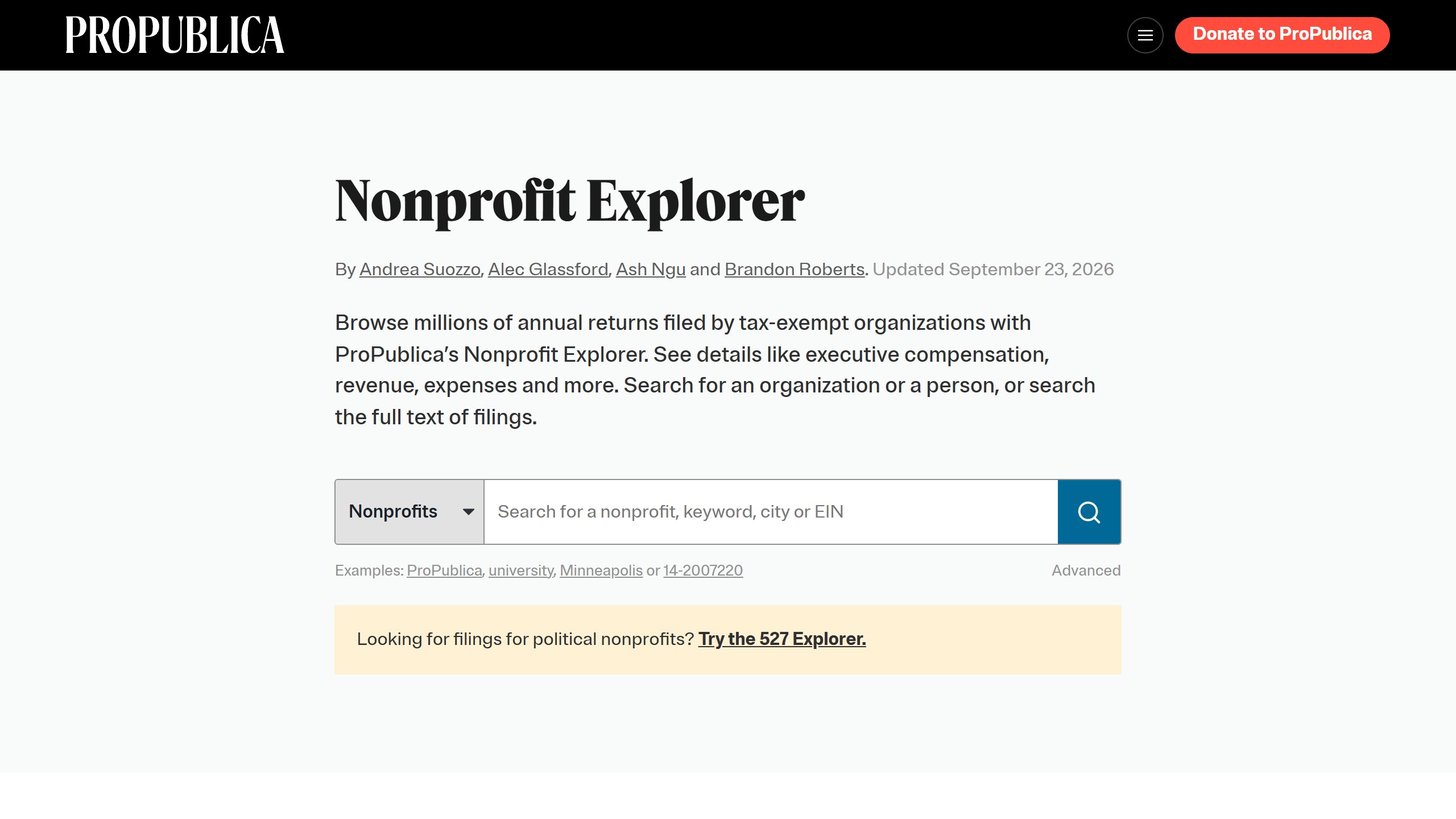
- Foundation and nonprofit filings. ProPublica Nonprofit Explorer lets you “browse millions of annual returns”, and says “taxable trusts and private foundations that are required to file a form 990PF are also included.” A 990 or 990PF shows a foundation’s assets, officers and grants. If a prospect is a trustee of a family foundation, its grant list tells you what it funds and at what size.
- Funder databases. Candid has a free plan “eligible to all verified non-funding organizations”, with “limited search results” and “basic profile views”. With its pricing toggle on “Nonprofit Discounted”, the default view, the paid Premium plan is $219 a month on a monthly plan or a starting price of $1,199 billed annually, and Ultimate starts at $1,699 billed annually. The “Standard” view lists $2,199 and $2,499 for the same annual plans. Candid shows a dollar sign with no currency code. Prices as listed on 21 October 2026.
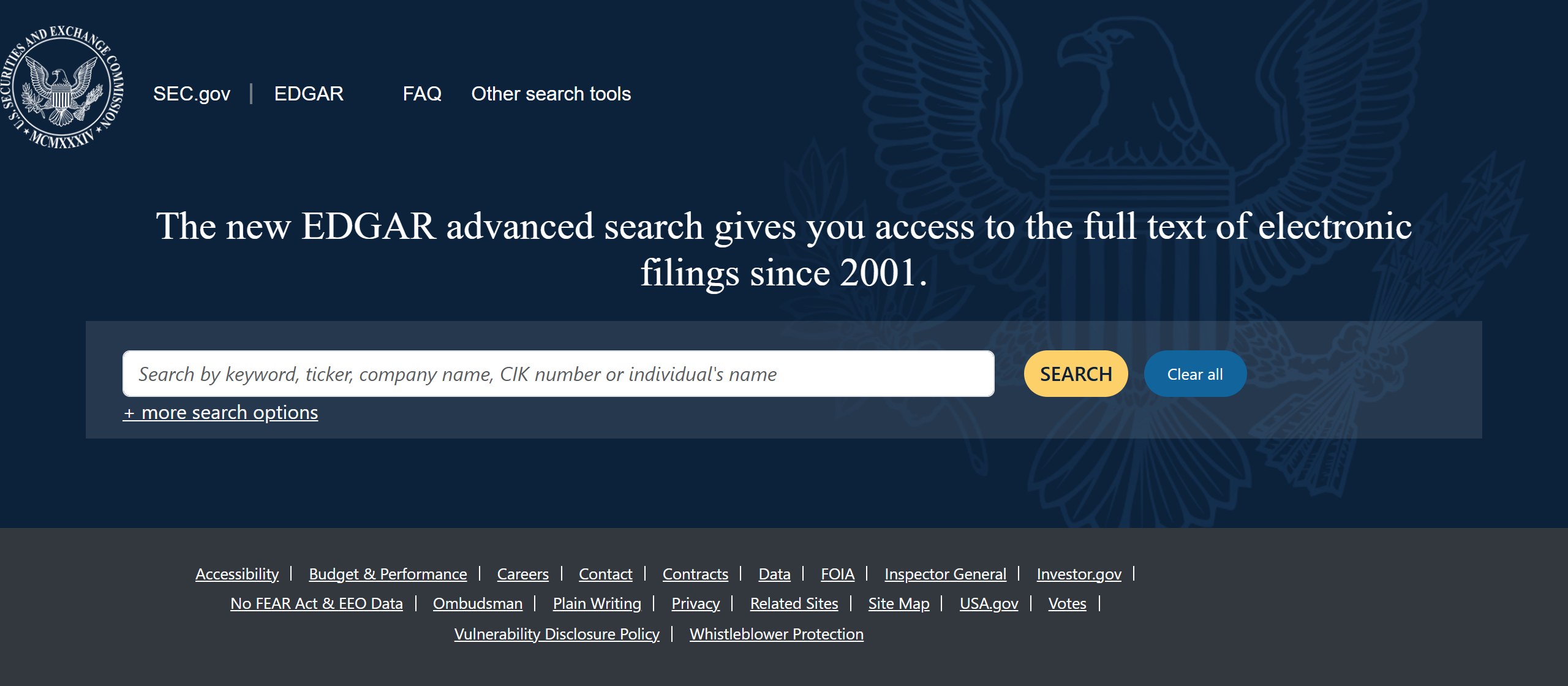
- Securities filings. SEC EDGAR is free and shows insider holdings and sales for officers and directors of public companies, along with proxy statements that list executive pay.
- Property records. Many US county assessors publish property ownership and assessed values online for free. Coverage and search tools vary by county.
- News, company sites and annual reports. Other nonprofits’ annual reports and donor walls show where a prospect already gives and at what level, which is often the best propensity evidence you can get without paying.
- Professional profiles. Public career information shows job changes, promotions and company exits. Read the ethics section below before you go near social media.
One free source needs a warning. Federal campaign contribution records are public on the FEC website, but the FEC states that “information about individual contributors taken from FEC reports cannot be sold or used for soliciting contributions (including any political or charitable contribution) or for any commercial purpose.” Do not build solicitation lists from FEC data. Some paid screening tools, DonorSearch among them, list political contributions as a data type, so ask any vendor how it handles this restriction, and ask your counsel if you are unsure how it applies to you.
Step 6: Buy wealth screening if the gaps justify it
After steps 2 to 5 you know which questions remain open. If the answer is “we have 400 loyal donors and no idea which of them have real capacity”, screening is worth it. A screening service matches your file against large databases of property, securities, business and philanthropic records and returns a capacity estimate for each name. Our roundup of AI donor research tools compares the options; the next section shows what each one publishes about its price.
Step 7: Rate, assign and move
Give every researched prospect a capacity rating (the gift range you think is possible) and an affinity rating (cold, warm or close). Assign each one to a named person with a next step and a date. Prospect research only pays when someone acts on it, which is why it belongs inside your moves management process. Our guide to AI moves management for nonprofits covers how to track each prospect from identification to stewardship.
What free sources cover, and what paid screening adds
The table below is a comparison the vendor pages we read for this topic do not offer. Prices are as listed on each vendor’s own page on 21 October 2026.
| Question | Free or already yours | What paid screening adds |
|---|---|---|
| Have they given to us, how often, how much? | Your CRM gift table (RFM) | Nothing; you hold the best data |
| Do they care about our mission? | Events, volunteering, notes, emails | Little; outside data cannot see your relationship |
| Do they give to other causes? | Donor walls, annual reports, 990 grant lists | Large philanthropic gift databases, matched in bulk |
| Do they sit on a foundation? | ProPublica, Candid free plan | Faster matching across a whole file |
| What property do they own? | County assessor sites, one by one | Bulk matching across a whole file |
| Do they hold public company stock? | SEC EDGAR, one by one | Bulk matching and summaries |
| What is their estimated capacity? | Your own judgment from the above | A modelled capacity rating per name |
The pattern is clear. Free sources can answer almost every question for a short list, one name at a time. What you pay for is scale, speed and a modelled capacity estimate across thousands of records at once.
DonorSearch
DonorSearch does not publish pricing; its site offers a demo. Its data page lists philanthropic gifts, real estate, SEC insider data, political contributions, foundations and business affiliations, and claims coverage of “over 150 million properties nationwide” and “over 160 million households”. Our DonorSearch review covers it in detail.
iWave by Kindsight
Of the three screening vendors here, iWave is the only one with prices on its pricing page. Starter is listed at “Starting at $4,500” for 1 user, “up to 1,500 subscription screens” and “up to 750 live profiles”. Professional is “Starting at $5,800” for 3 users and up to 5,000 screens. Premium is “Contact us for pricing” and is the only tier that lists “1 CRM integration or API access”; Professional lists “Appends and API available as an add-on”. The page shows a dollar sign with no currency code and does not say whether these are annual prices, so confirm both on a call. For a side by side, see our iWave vs DonorSearch comparison.
WealthEngine
WealthEngine publishes no prices and has no pricing page; its site offers a demo. It says it “applies machine learning to billions of data points” to build “millions of pre-scored profiles”. Its site navigation links to Altrata.
Where Gratefully fits
Steps 2 to 4 are the slow part for many teams, because the evidence is scattered across a CRM, a few inboxes, shared drives and board minutes. That is the job Gratefully, an AI donor intelligence platform, is built for. Its Hidden Revenue page describes an assistant, Grace, that reads meeting notes, emails and CRM records and “surfaces revenue already sitting in your donor file”. The page names the signals it looks for: planned giving language such as “thinking about my estate”, wealth events your team noted in passing (business sales, inheritances, board appointments, S-1 filings), and lapsed major donors who stayed engaged elsewhere. Every signal is cited back to the note or email it came from.
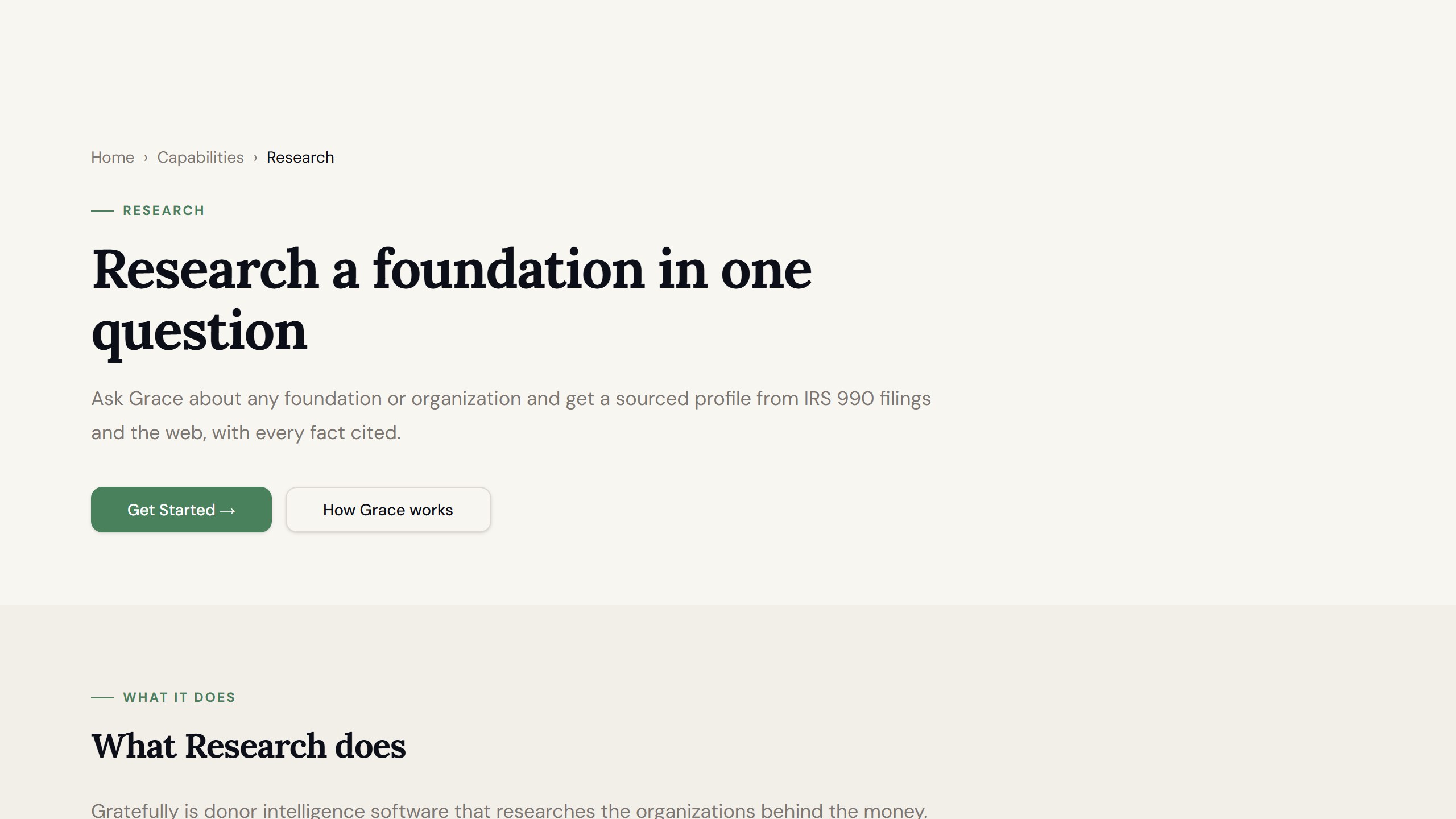
Its Research capability covers part of step 5. Ask about a foundation and Grace “builds a profile from IRS 990 filings (via ProPublica) and a focused web search, covering giving, assets, leadership, and focus areas.” The limit is stated plainly in its FAQ: “Research currently covers foundations and organizations.” It does not research individual people.
Be clear about what it is not. It is not a wealth screening database. Its own DonorSearch comparison says it “does not do wealth screening” and that the two are “designed to work together, not in place of each other.” Its homepage does list “Wealth research” among the signals shown on a sample donor record, next to gift history, career moves and board connections. The same comparison page describes it as a layer over “what your organization already holds”, so read that signal as information surfaced from your own records and connected tools, not a screening result, and ask on a demo where it comes from. If you need modelled capacity ratings across thousands of donors, you still need DonorSearch, iWave or WealthEngine alongside it. It is also the wrong pick for a large university advancement shop with its own research team and a screening contract already in place.
On cost, its pricing page lists a free plan for one person, then $79, $399 and $799 a month billed yearly ($99, $499 and $999 billed monthly) for one, five and ten people, with a 14-day trial of the top plan and no card, as of 21 October 2026. Direct connectors cover Salesforce, Bloomerang, Little Green Light and HubSpot; other CRMs work from a CSV export and document upload. Its SOC 2 Type II report is listed as “ETA Q4 2026”, so it is not out yet. Our full review covers the rest. The pages do not say which plan includes Hidden Revenue and Research, so ask before you plan around either.
The prospect profile template
Copy this into a document or a CRM note, one per prospect. Keep it to one page. Write it as a briefing for the person making the ask, and give every line a source and a date.
| Section | What to write | Where it comes from |
|---|---|---|
| Name, household, contact owner | Full name, spouse or partner if they give jointly, who owns the relationship | CRM |
| Research purpose | The gift and project this profile supports, and the date prepared | Step 1 |
| Giving to us | First gift, last gift, largest gift, total, years given, RFM score | CRM gift table |
| Engagement | Events, volunteering, board or committee roles, meetings in the last two years | CRM, event lists |
| What they have told us | Interests, family, life events, anything said about legacy, each with the date and who heard it | Notes, emails, call logs |
| Connections | Board members, staff or donors who know them, and how well | Board and peer review |
| Giving elsewhere | Gifts to other organisations, with level and year | Annual reports, donor walls |
| Foundation links | Foundations where they are a trustee or officer, assets, typical grant size | 990PF via ProPublica or Candid |
| Wealth indicators | Property, public company roles, business ownership, only where it bears on the ask | Assessor, SEC EDGAR, screening |
| Capacity and affinity rating | Gift range you think is possible; cold, warm or close | Your judgment |
| Recommended next step | Who does what by when, and the ask amount if ready | Gift officer |
| Sources and dates | Every source used, with the date checked | All of the above |
A worked example
Here is how one profile might read, using a made up donor. Maria has given $250 to $500 a year for nine years and came to the last four spring events. A contact report from 2024 says she mentioned she had retired after selling a family business. A 990PF on ProPublica shows her as a trustee of a small family foundation that makes grants to two local arts groups. Her profile would rate her warm, with a capacity range well above her annual gift, and recommend a visit from the executive director to talk about the new program, before anyone pays to screen her. Every line in that profile came from your own records or a free source.
Ethics and the law
Prospect research handles personal information about people who did not ask to be researched. So the ethics belong inside the method from the first step.
Apra’s principles
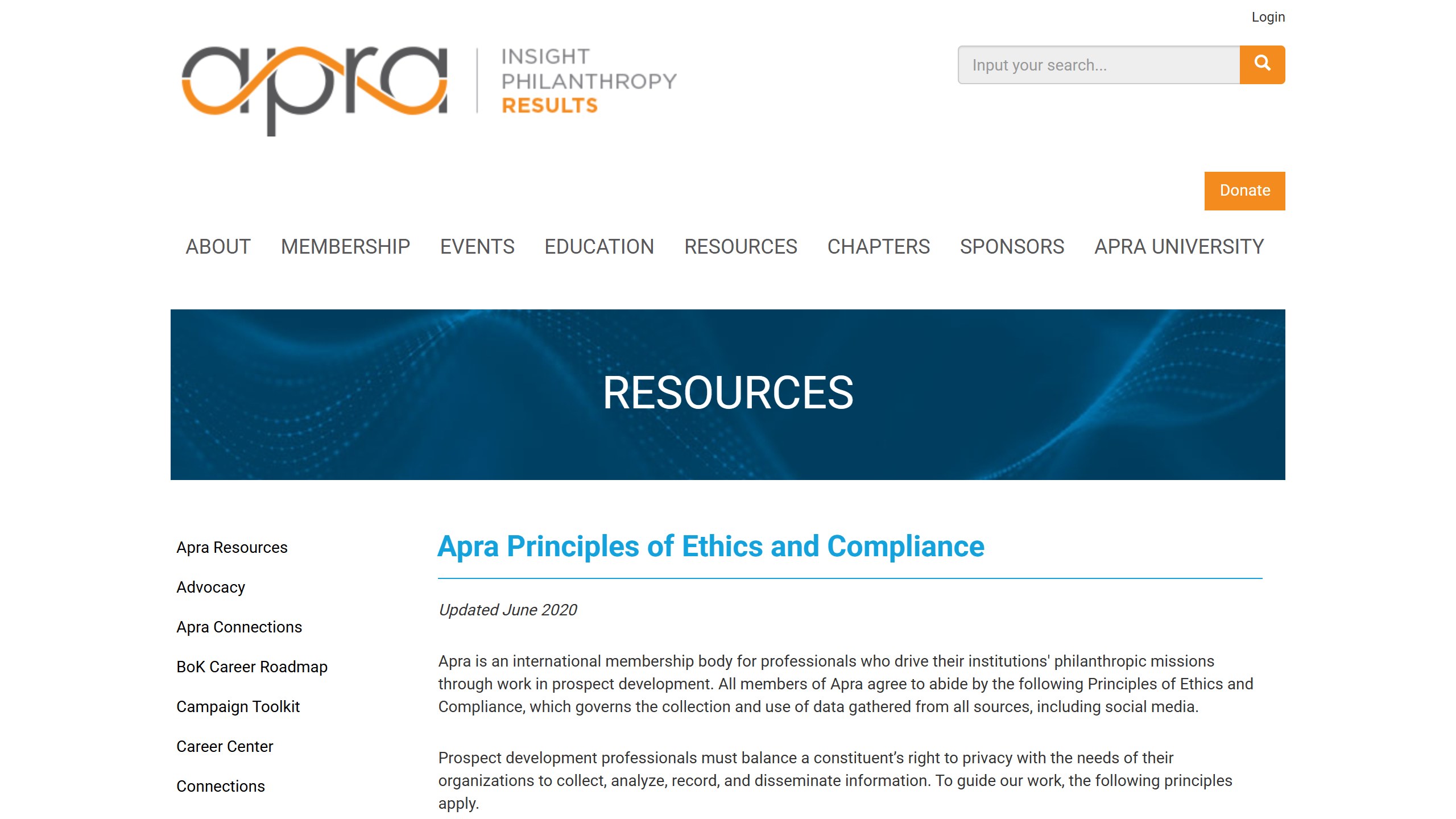
Apra, an international membership body for prospect development professionals, publishes Principles of Ethics and Compliance, updated June 2020. Four lines are worth putting at the top of your research policy. Researchers should “act with integrity and honesty”, “track data provenance to ensure all information is legally obtained and publicly available from reliable sources”, “respect constituents’ privacy and maintain the confidentiality of constituent information”, and “record and disclose only information appropriate for fundraising activities.” It also asks researchers to “be honest about your identity and role when using social media in your work”.
In practice: no medical details, no gossip, no information about family members who are not part of the relationship, and nothing you would be uncomfortable showing the donor. Many organisations follow a simple test: would we be happy if this person asked to see their file?
US rules to know
There is no single US privacy law for donor research, but a few rules apply. The FEC restriction above is the clearest. State privacy laws are the growing one. Oregon’s Department of Justice says its privacy law “takes effect for nonprofits on July 1, 2025”, for organisations that do business in Oregon or serve Oregon residents and, in a calendar year, process data on at least 100,000 consumers, or 25,000 if they earn over 25% of annual gross revenue from selling personal data. Its FAQ for nonprofits gives an example close to prospect research: combining property records with your own records counts as personal data “since you are mixing public and private data to create an identifiable profile about a person.” It also requires data protection assessments before higher risk processing, which it says includes “profiling”. If you research donors in Oregon at that scale, talk to your counsel. Other states have their own privacy laws, so this is not a complete list, and nothing here is legal advice.
If you have donors in the UK or EU
Under the GDPR, Article 14 covers “information to be provided where personal data have not been obtained from the data subject”, which is exactly what external prospect research collects. It sets a deadline for telling people: “within a reasonable period after obtaining the personal data, but at the latest within one month”. In practice that usually means your privacy notice should say plainly that you research supporters using public sources, and you need a lawful basis for doing it. The UK applies its own version of the GDPR, and the details and exceptions matter, so check your approach with your data protection lead or counsel. Our guide to donor data privacy and AI fundraising covers the wider questions, including what to ask before you upload a donor file to any AI or screening tool.
A five line research policy
Treat this as a starting point, and have counsel review it against the laws that apply to you.
- We research only people with an existing or likely relationship with us, for a stated fundraising purpose.
- We use public sources and data we hold, and we record the source and date of every fact.
- We never record health, religion, sexual orientation or similar sensitive details unless the donor shared them for that purpose.
- We do not use FEC contributor data to build solicitation lists, and we check every vendor’s terms.
- Our privacy notice explains that we research supporters, and we honour any request to stop.
Common mistakes
Screening the whole file first
A capacity rating on 20,000 names with no affinity data produces a list sorted by wealth. Your gift officers then spend their time on strangers. Screen the top of an internally scored list instead, and you pay for fewer records.
Writing dossiers nobody reads
A ten page profile takes a day to write and five minutes to skim. One page with a clear next step gets used.
Treating research as a one off project
People retire, sell businesses, inherit and join boards every year. Rerun steps 2 to 4 at least once a year, and set a reminder to refresh each active prospect’s profile before any ask.
Leaving research out of the CRM
If profiles live in a shared drive folder, they go stale and get lost when staff leave. Put the rating, the next step and the source notes on the donor record.
Sources
- Professional and legal: Apra Principles of Ethics and Compliance (updated June 2020); FEC Sale or use of contributor information (FEC Record, 2 November 2018); GDPR Article 14; Oregon Department of Justice Privacy Law FAQs for Nonprofits.
- Data: Giving USA 2026 report release; ProPublica Nonprofit Explorer; Candid pricing; SEC EDGAR full text search; FEC individual contributions.
- Screening vendors: DonorSearch and its data page; Kindsight pricing for iWave; WealthEngine.
- Donor intelligence: Hidden Revenue, Research, DonorSearch comparison and pricing pages.
- All pages read 21 October 2026. Prices as published on that date.

Written by
FazFaz is the founder of AIToolsBakery. Some tools here are tested hands on. Others are assessed from vendor documentation and pricing verified on the live page, and every review says which one it is. Sponsors can buy a position in a guide. They cannot buy the score, the criticism, or silence about a better option.
How we test and how we make money →