Disclosure: Zilwaris, the consultancy run by AI Tools Bakery’s founder, does paid advisory work for Gratefully, which did not pay for any placement on this page and is assessed on the same criteria as everything else on this site.
Most pages about the donor pipeline stop at the five stage names. The names are the easy part. Where pipelines actually fail is in the gaps between stages: a prospect who was “in cultivation” for three years with two lunches to show for it, an ask that was “pending” until the officer who made it left, a donor who gave a lovely first gift and never heard from anyone again.
This guide is about closing those gaps. It gives you a stage table with an entry rule, an exit rule, a time limit and a metric for each stage, a benchmark table built only from dated primary sources (with “data not available” where nobody publishes the number), a template you can paste into a spreadsheet or CRM, and an honest view of when your CRM’s own pipeline view is enough and when you want a layer on top that decides who moves next.
How we researched this. This is a research-based guide. We have not run a pipeline in any of the tools named here, including the intelligence layer we recommend. The stage rules come from published prospect management policies at three US universities and from APRA, the prospect research association. Benchmarks come from the Fundraising Effectiveness Project, Giving USA and Blackbaud’s own help files. Tool details come from each vendor’s own pages, plus one 2018 Blackbaud community post for Raiser’s Edge NXT, read on 21 October 2026. Where a rule below is our suggestion rather than a sourced figure, we say so.
What donor pipeline management is, and what it is not
A donor pipeline is the set of people you are deliberately moving toward a larger or repeat gift, sorted by how far along they are. Pipeline management is the discipline around it: who owns each person, what has to be true before they move, how long they are allowed to sit still, and which numbers the team looks at to see whether the whole thing is healthy.
The Giving Institute’s member article on building a donor pipeline for major gifts (August 2023) describes it as a structured way to turn prospects into donors with enough people at every stage of the cycle. That last part is the useful bit. A pipeline is a flow problem. Too few names at the top and the solicit stage dries up in two years. Too many names stuck in the middle and your officers spend their weeks on lunches that lead nowhere.
Three related ideas get mixed up, so it helps to separate them:
- Donor cultivation is the relationship work itself: the visits, the updates, the questions you ask. Our donor cultivation guide covers that work and gives a cultivation plan template.
- Moves management is recording and planning the individual moves for one donor: what happened, what is next, who does it. Our guide to AI moves management for nonprofits covers the difference between tools that record moves and tools that decide them.
- Pipeline management, this page, is the system view across all of those donors: stage definitions, rules, capacity, metrics and the monthly review.
Why it matters more in 2026 than it did a decade ago: the money is concentrating. Giving USA 2026 put total US giving at an estimated $617.20 billion in 2025, with individuals giving $394.2 billion, according to a 2026 blog post from the Lilly Family School of Philanthropy. Yet the Fundraising Effectiveness Project found donor numbers fell an estimated 3.6% in 2025 while dollars rose 5.0%, with growth “driven almost entirely by Major and Supersize donors” (AFP, 21 April 2026). Fewer people are giving more. That makes a well run pipeline for your larger donors the difference between a good year and a bad one.
The five donor pipeline stages, with entry and exit rules
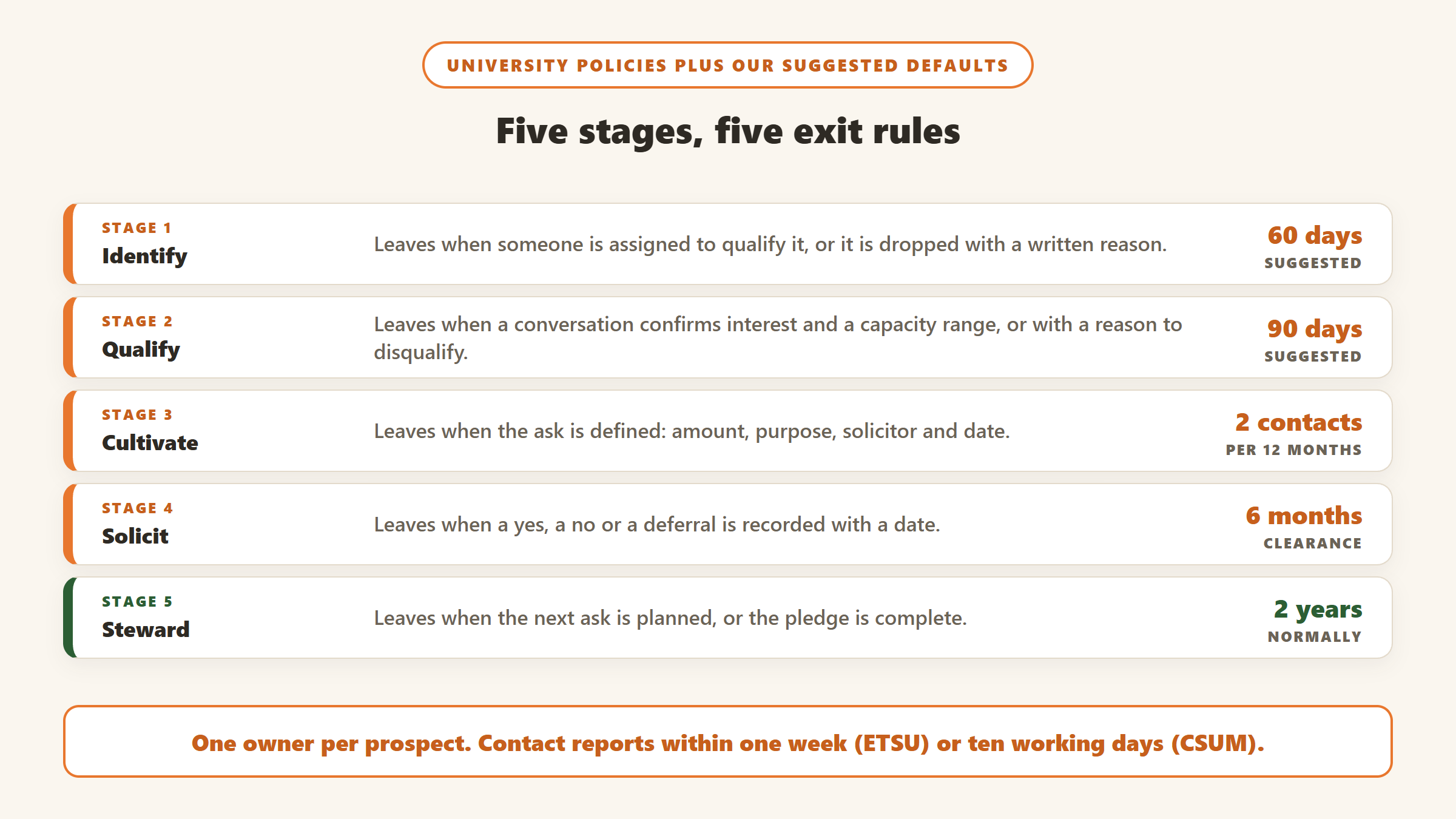
Almost every source uses the same five stages, sometimes with a sixth. East Tennessee State University’s policy, for example, adds a pre-solicitation stage between cultivation and solicitation. The names are less important than the rules. Here is the table. Time limits marked “policy” come from a published university policy; those marked “suggested” are our starting defaults for a small or mid-sized shop, which you should change to fit your gift cycle.
| Stage | Enters when | Leaves when | Time limit | Metric to watch |
|---|---|---|---|---|
| Identify | A name shows a sign of capacity and a sign of connection (giving history, screening, a board referral, an event) | A named person is assigned to qualify it, or it is dropped with a written reason | Suggested: decide within 60 days | Names identified per month and the share that get assigned |
| Qualify | An officer is assigned and a first conversation is booked | A conversation confirms interest and a rough capacity range (move to cultivate), or the person is disqualified with a reason | Suggested: 90 days from assignment | Qualification visits per month and your own qualify rate |
| Cultivate | A written strategy exists: next move, who is involved, a target ask range and a rough timeframe | The ask is defined (amount, purpose, solicitor, date), or the prospect goes back to qualify | Policy (CSUM): at least two substantive contacts in any 12 months; reassess after a year with none | Days in stage and substantive contacts in the last 12 months |
| Solicit | A proposal is recorded with amount, purpose and expected decision date, and one solicitor is named | A yes, a no or a deferral is recorded with a date | Policy (CSUM): solicitation clearance good for six months, extendable | Open asks, their total value and their age |
| Steward | A gift or pledge is booked | The next ask is planned (back to cultivate), or the pledge is complete and the donor moves to a lighter touch | Policy (Adelphi): normally two years or until the pledge is fulfilled | Stewardship touches, renewal and the second gift |
Two rules sit across all five stages, and both run through the policies we read. First, one owner per prospect, and only one solicitor at a time. Cal State Maritime’s policy allows several officers on a cultivation assignment “but only one assignment for solicitation may occur at any time.” Second, every substantive contact gets written down quickly: within ten working days at Cal State Maritime (policy UA-01-007, 2014) and within one week at East Tennessee State (revised August 2020). A pipeline built on notes that live in someone’s head is not a pipeline.
Identify: the top of the funnel
Identification is about finding names worth a conversation, not proving they are rich. Good sources are your own giving history (donors whose gifts have grown, donors giving to several funds), board and volunteer referrals, event attendance, and wealth or philanthropy screening. Our guide to AI for major gift fundraising compares the tools that do the screening and scoring part.
The common failure here is the list that never shrinks. Screening returns 400 names, they all go into the CRM as “prospects”, and nobody ever decides which ones deserve a visit. The exit rule fixes that: every identified name is either assigned to someone with a qualification date, or dropped with a reason, within a set window. We suggest 60 days. A name that has sat in identify for a year is noise, and noise makes your stage counts lie.
Qualify: the stage pipelines often skip
Qualification is the conversation that tells you whether a name is a real prospect: do they care about the work, could they give at the level you are imagining, and would they welcome a closer relationship. Adelphi University’s stages of cultivation policy (revised December 2017) says qualification prospects normally have never been contacted and need a face-to-face visit before they count as legitimate. Its gift officers carry a share of their portfolio as qualification visits on purpose.
That is the habit worth copying. If qualification is nobody’s job, officers drift toward the donors they already know, the top of the pipeline empties, and two years later there is nobody ready to ask. East Tennessee State sets an explicit expectation of at least 15 discovery contacts per week for each director of development, on top of the major gift portfolio. A smaller shop does not need that number, but it does need a number.
Cultivate: where time quietly disappears
Cultivation is where prospects learn about the work and you learn about them. It is also where pipelines stall, because cultivation has no natural end. The entry rule that matters is a written strategy. Adelphi’s policy moves a prospect into cultivation through a strategy session that sets the next moves, who is involved and who will eventually make the ask. Without that, cultivation is just a label.
The time rule matters as much. Cal State Maritime requires at least two substantive, interactive contacts (it explicitly excludes birthday and holiday cards) in any 12-month period to keep a cultivation assignment, and the assignment is reassessed if a year passes with none. That is a low bar, which is the point: a prospect who cannot clear it should not be counted in your pipeline.
Solicit: one ask, one owner, one date
A prospect enters solicitation when there is a specific proposal: an amount, a purpose, a named solicitor and a date by which you expect an answer. Adelphi calls soliciting the most protective level of clearance, where nobody else at the university contacts the prospect without first talking to the assigned officer. Cal State Maritime gives a solicitation clearance for six months, extendable if the donor needs more time.
The exit rule is simple and often ignored: every ask ends in a recorded yes, no or deferral. “Pending” for nine months is not an outcome. When an ask is deferred, record why and when to come back, and move the prospect back to cultivate rather than leaving them in solicit, where they inflate your open ask value.
Steward: the start of the next gift
Stewardship begins when the gift or pledge is booked. Cal State Maritime’s policy describes it as both an end in itself and “the beginning of the next gift cycle”, and sets a floor of two substantive contacts a year. Adelphi keeps a donor in stewardship for normally two years or until the pledge is fulfilled.
The national data points to this stage as a weak spot for the sector. The FEP’s report on 2025 found overall donor retention edged up only from 43.1% to 43.3%, and new donor retention was essentially flat. In AFP’s words, “Converting a first gift into a second remains the most consequential unsolved problem in the donor pipeline.” Our page on donor retention rate explains how to calculate yours and compare it fairly.
Donor pipeline benchmarks: what the published numbers say
Here is every benchmark we could trace to a dated primary source, and the ones we could not. We looked specifically for qualification rates and time from first contact to ask in the FEP, Giving USA, CASE and AFP material, because those are the numbers people search for. We did not find them.
| Metric | Figure | Source and date |
|---|---|---|
| Overall donor retention, US, 2025 | 43.3% (from 43.1% in 2024) | FEP Q4 2025 report, AFP release 21 April 2026 |
| Donor count, 2025 vs 2024 | Down an estimated 3.6% | FEP Q4 2025, 21 April 2026 |
| Dollars raised, 2025 vs 2024 | Up an estimated 5.0% | FEP Q4 2025, 21 April 2026 |
| Donor retention, Q1 2026 year to date | 18.0%, flat; fell for Small, Midsize, Major and Supersize donors | FEP Q1 2026, AFP release 29 July 2026 |
| Total US giving, 2025 | $617.20 billion, individuals $394.2 billion, bequests $62.19 billion | Giving USA 2026, via the Lilly Family School of Philanthropy |
| Major gift portfolio size | 150 as the long-standing industry maximum, which APRA says is not based on real portfolio data | APRA Connections, 8 August 2024 |
| Portfolio size, vendor guidance | 120 to 150 prospects | Blackbaud Fundraiser Performance Management help, read 21 October 2026 |
| Portfolio size, one university’s target | About 80 major gift prospects per director of development | ETSU policy, revised 24 August 2020 |
| How often donors are asked | Guidelines commonly assume once every 3 to 5 years | APRA Connections, 8 August 2024 |
| Minimum contacts in cultivation | Two substantive contacts in any 12 months | Cal State Maritime policy UA-01-007, 2014 |
| Contact report deadline | 10 working days (CSUM); one week (ETSU) | Policies above |
| Qualification rate (share of identified names that qualify) | Data not available | Not published by FEP, Giving USA, CASE or AFP that we could find |
| Time from first contact to ask | Data not available | No primary source found |
| CASE benchmarks for pipeline stages | Data not available to us | CASE pages we could reach did not publish them |
One caution on the retention figures. The FEP’s 43.3% is a full-year retention rate across the whole donor file of participating organisations. The 18.0% for Q1 2026 is a year-to-date figure measured three months into the year, so the two are not comparable, and neither is a benchmark for your major donor portfolio specifically, which should retain far better than the file as a whole.
Portfolio size: why “150” is the wrong starting point
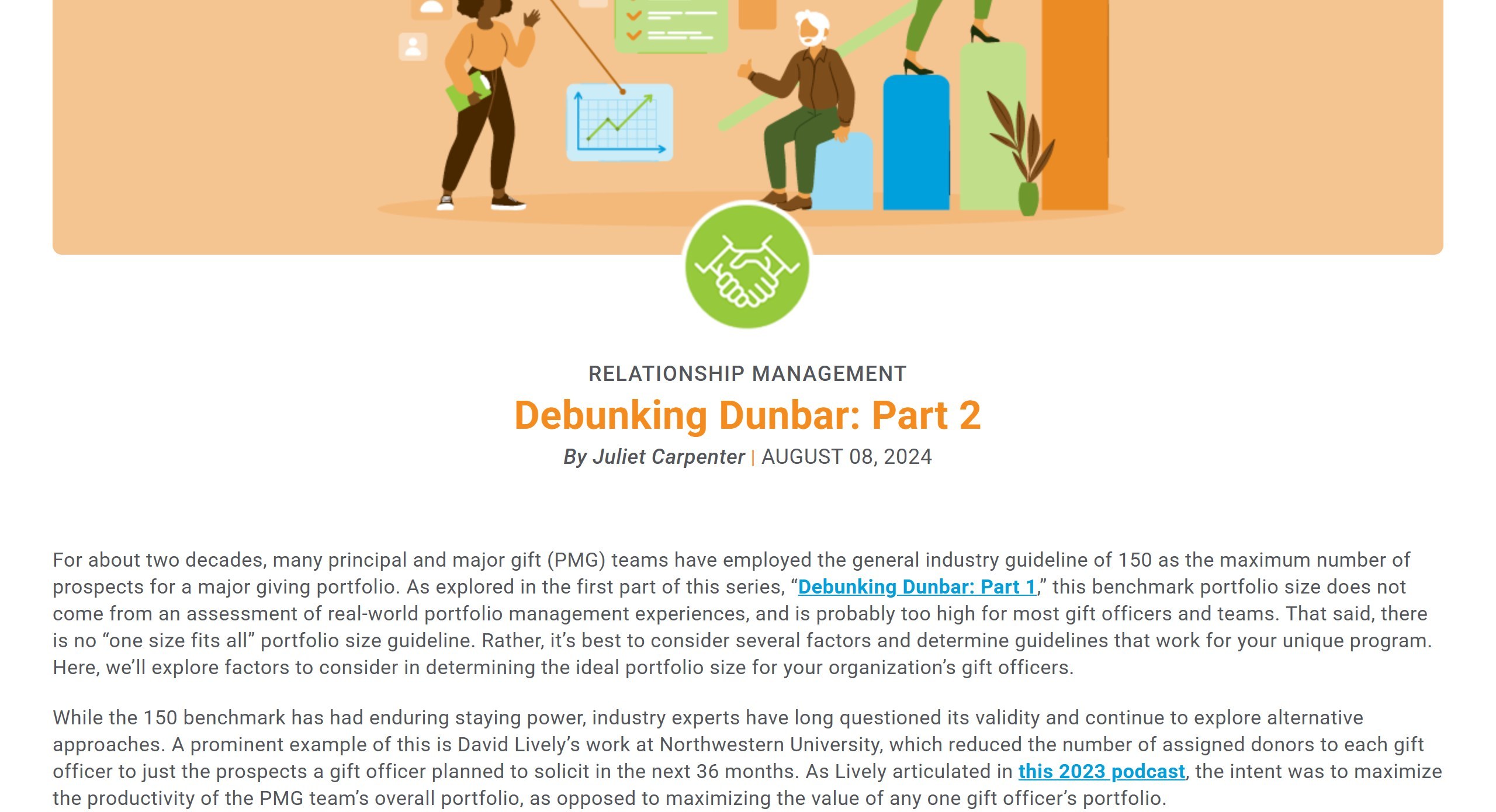
A common pipeline question is how many prospects a gift officer should carry. The honest answer is that it depends on how many asks they can make, and the widely quoted number has weak foundations. Juliet Carpenter’s Debunking Dunbar series for APRA (August 2024) describes 150 as “the general industry guideline” for a maximum portfolio, and argues it does not come from real-world portfolio experience and is probably too high for most teams.
Her alternative is a formula you can run on your own numbers:
Portfolio size = solicitations per officer per year × average years between asks to the same donor.
Her worked example is 15 asks a year with donors asked every four years, which gives 60 donors, and she says portfolios should also leave time for qualification work with new prospects. For a smaller shop with one development director who can realistically make 12 major asks a year and asks each donor every three years, the same formula gives 36. Blackbaud’s Fundraiser Performance Management help still recommends 120 to 150, and East Tennessee State aims for about 80. The spread is the lesson: work out your own number from your own ask rate, not from someone else’s.
What “major” means in your pipeline
Every policy sets its own line. Cal State Maritime treats a prospect as major gift if they could give $2,000 or more in a single gift or pledge $10,000 or more over five years. East Tennessee State’s major gift and campaign pipeline starts at $10,000. Blackbaud’s officer benchmarks track proposals over $50,000 as a separate measure. None of these is wrong. Pick the line where a gift starts to need a personal ask and a named owner, write it down, and use it consistently, because a pipeline with a moving threshold cannot be compared month to month.
Pipeline metrics to review every month
You do not need a dashboard with 40 tiles. Five measures tell you nearly everything about pipeline health, and most CRMs can produce all five from a stage field, a stage date and a contact log.
1. Count and value by stage
How many prospects sit in each stage, and the total target ask in cultivate and solicit. Watch the shape over time. A healthy pipeline has more names in qualify and cultivate than in solicit. A pipeline that is all steward and no qualify is living on last year’s work.
2. Days in stage
The number we would look at first, because it exposes stalls that counts hide. A July 2018 Blackbaud community announcement says Raiser’s Edge NXT added Prospect days in status and Opportunity days in status measures to SKY Reporting through its early adopter programme; that post dates from an early adopter programme, so check what your own version shows. In any CRM you can calculate it if you record the date a prospect entered each stage.
3. Coverage in the last 12 months
Blackbaud’s officer benchmarks define three simple coverage measures over a rolling 12 months: the share of a portfolio contacted at least once, visited at least once, and asked at least once by the assigned officer. They work for any team. If a third of the portfolio has had no contact in a year, the portfolio is too big or the wrong people are in it.
4. Stage conversion
Of the people who entered qualify last year, how many reached cultivate? Of the asks made, how many closed? There is no published national benchmark for these, so start measuring your own and compare yourself with last year. That comparison is more useful than any benchmark from a different organisation.
5. Second gifts and renewals
For stewardship, track whether first-time major donors give again within the window you set. Given the FEP’s finding that converting a first gift into a second is the sector’s “most consequential unsolved problem”, this is often the cheapest money in the pipeline.
A donor pipeline template you can copy
Use this as a spreadsheet for a small team, or as a checklist of fields to confirm your CRM records. Paste the header row into the first row of a sheet. Every field earns its place in the monthly review.
Donor,Stage,Date entered stage,Owner,Second owner,Capacity range,Inclination note,Major threshold met (Y/N),Target ask,Purpose,Next move,Next move date,Last substantive contact,Substantive contacts last 12 months,Ask date,Ask outcome,Source of name,Exit reason
| Field | What goes in it | Why it matters |
|---|---|---|
| Stage and date entered stage | One of the five stages, and the date it changed | Without the date you cannot calculate days in stage |
| Owner | One named person | The policies we read insist on one primary owner or solicitor |
| Capacity range and inclination note | A range, not a number, plus one line on what they care about | Qualification is about both, and a range avoids false precision |
| Target ask and purpose | Filled in from cultivate onward | Gives you pipeline value and forces a real strategy |
| Next move and date | One concrete action with a date | A prospect with no next move is stalled, whatever the stage says |
| Last substantive contact and contacts in 12 months | Visits, calls, meaningful emails; not cards | Tests the cultivation floor of two contacts a year |
| Ask outcome | Yes, no or deferred, with a date | Stops “pending” asks inflating the pipeline |
| Exit reason | Why a prospect left the pipeline | Tells you whether your identification sources are any good |
Write your stage definitions on one page next to the sheet, using the entry and exit rules from the stage table above, and agree them with everyone who touches donors, including your executive director and any board members who make asks.
The monthly pipeline review agenda
- Stage counts and value, compared with last month. Did the top of the pipeline grow?
- Stalls: everyone past the time limit for their stage. For each, decide: move, reassign or release.
- Open asks: anything older than its expected decision date gets a recorded outcome or a new date.
- Qualification: how many first conversations happened, and who is next.
- Stewardship gaps: recent donors with no contact since their gift.
- Coverage: share of each portfolio contacted in the last 12 months.
How tools support each stage
Every major donor CRM can hold a pipeline. Where they differ is how much they help you act on it. Think of two layers: the CRM, which records stages and moves, and an intelligence layer, which reads everything you know about a donor and suggests who needs attention next. Many small teams only need the first.
CRM pipeline views
Salesforce Nonprofit Cloud. Salesforce’s Trailhead module on Philanthropy and Partnerships describes a portfolio view where a gift officer manages “all of your assigned prospects throughout the donor lifecycle”, with donor profiles that show a relationship timeline, wealth and giving history and custom alerts, and a manager view of team progress.
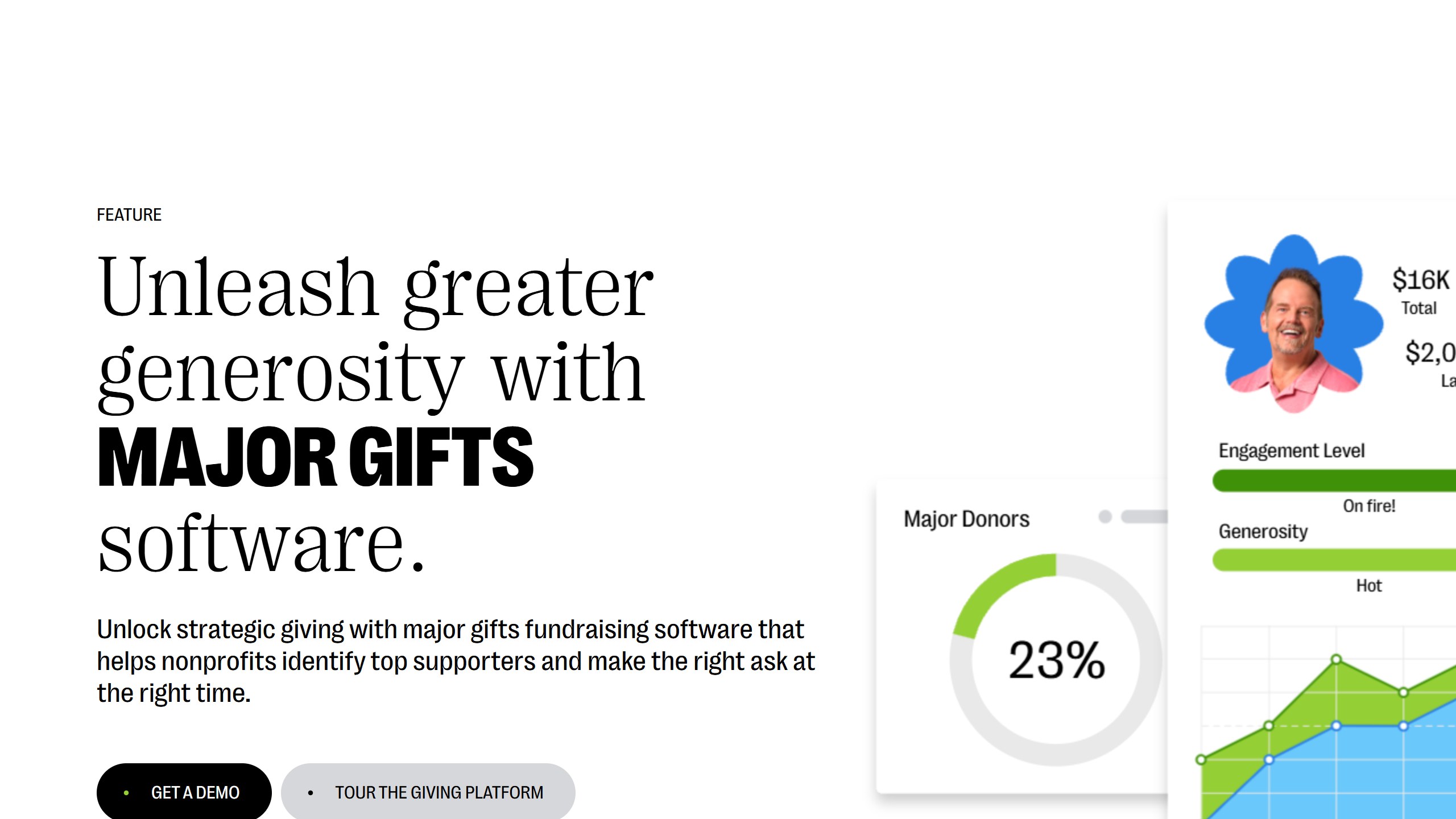
Blackbaud Raiser’s Edge NXT. According to that 2018 community announcement, its Prospect Research Management lets you assign fundraisers to constituents and opportunities and track prospect statuses through your moves management process and opportunity statuses through solicitation. The days in status measures mentioned above, where available, make stall reporting possible. Blackbaud says the benchmark community behind its Fundraiser Performance Management covers more than 110 higher education institutions.
Bloomerang. Its major gift fundraising page describes assigning “a single fundraiser to each top prospect”, logging ask amounts and engagement milestones, and journey automation that triggers tasks and follow-ups to move major donors through each stage, with wealth insights through DonorSearch.
When your CRM’s pipeline view is enough
Stay with the CRM alone if most of these are true: one or two people manage major donors; portfolios are under about 60 names each; stage and stage date fields are kept current; contact reports go in within a week; and the monthly review actually happens. In that situation an extra tool mostly adds cost. Fix the habits first. A clean stage field reviewed every month beats any AI on top of a stale one.
An intelligence layer that decides who moves next
The CRM tells you where each prospect is. It does not tell you which of your 80 names to call this morning, or that a cultivate prospect mentioned an estate plan in an email last spring. That is the gap an intelligence layer fills. One built for lean development teams is Gratefully, an AI donor intelligence layer that sits on top of the CRM rather than replacing it. Its product page says it “works on top of the CRM you already run” with “No CRM migration”, and that its Action Center is “Prioritized every morning”, with stewardship, re-engagement, upgrades and reminders “ranked by impact” and the reasoning attached to each.
Three of its features map directly onto the pipeline problems above. Its portfolio and board reports produce snapshots with retention rates, major gift breakdowns, year-to-date giving, lapse-risk counts and staff coverage gaps, with every figure cited to its source record; the page is inconsistent, saying a polished side-panel report with PDF export is “shipping soon” while elsewhere describing PDF export, so check what is live before you rely on it. Its handover dossiers create a structured file for every donor in a portfolio, including “relationship stage and cultivation context”, which speaks directly to the turnover problem below. And the Action Center’s daily list is a practical answer to the stall: it surfaces the people who need a move today.
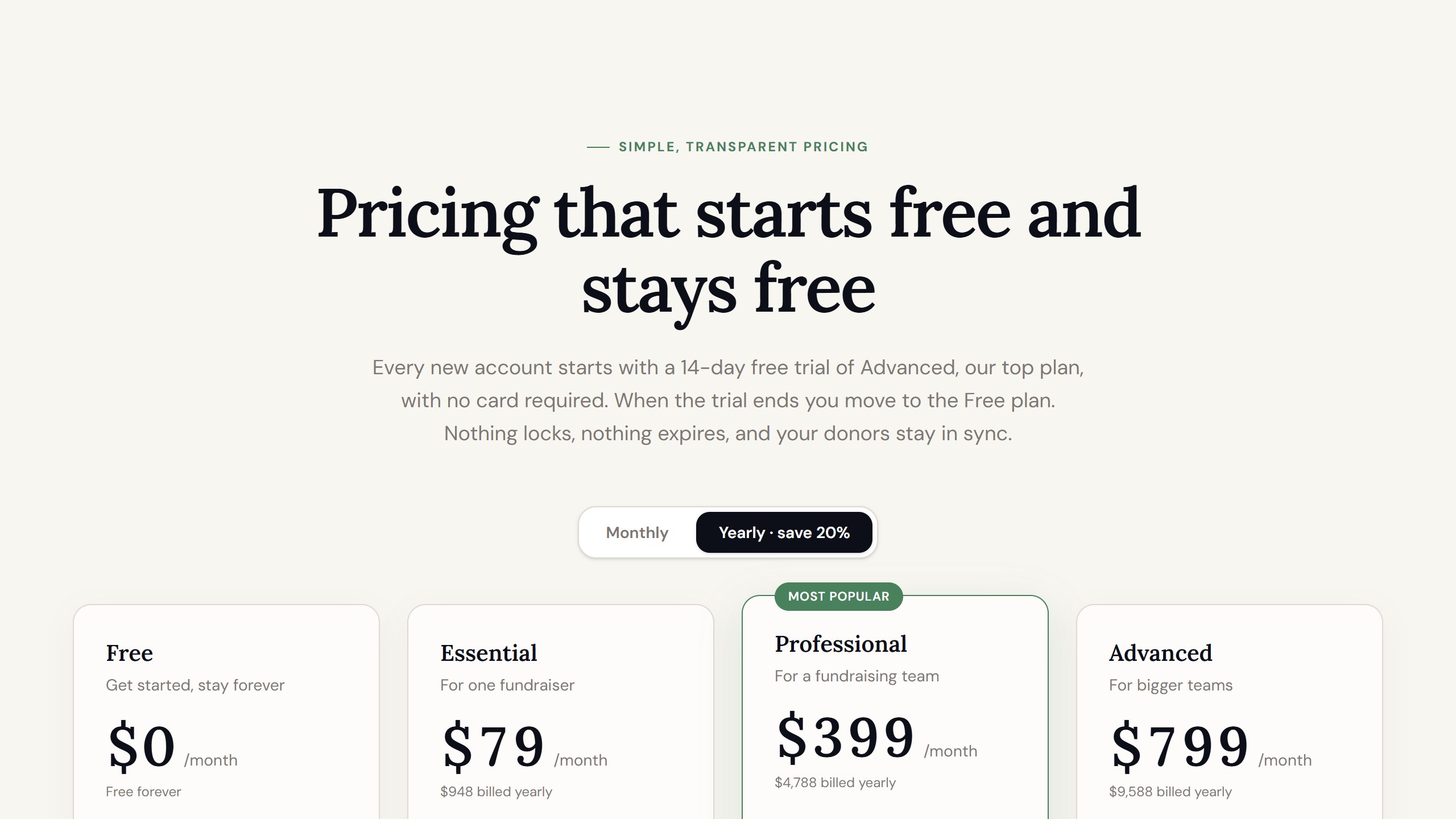
The limits are real. It connects directly to Salesforce, Bloomerang and Little Green Light (plus HubSpot, Mailchimp and Constant Contact); Raiser’s Edge NXT and DonorPerfect data comes in by CSV export and document upload, not a live sync. It does not claim to change stage fields in your CRM (its homepage demo shows sent emails logged as activity on a Salesforce record, not stage moves), so your CRM stays the pipeline of record. Its SOC 2 Type II report is listed as “ETA Q4 2026”, so it is not certified yet. On its pricing page, read 21 October 2026, there is a free plan for one person, Essential at $79 a month billed yearly ($948), and Professional at $399 a month billed yearly for five people, with a 14-day trial of the Advanced plan. Our full Gratefully review covers the rest.
When Gratefully is the wrong pick
It is the wrong tool for a large university advancement shop with a prospect management team, Raiser’s Edge NXT or Salesforce, and dedicated reporting staff: those teams already have pipeline analytics and need enterprise tools built for them. It is not a wealth screening database, so if your top-of-pipeline problem is finding new high-capacity names, look at DonorSearch or iWave first. And if you are one person with 20 major donors and a tidy CRM, the monthly review above will do more than any software.
Gift officer turnover is a pipeline problem
The fastest way to lose a pipeline is to lose the person who holds it. The UnderDeveloped study by CompassPoint and the Evelyn and Walter Haas, Jr. Fund, which surveyed more than 2,700 executive and development directors, found that half of development directors expected to leave their jobs in two years or less, and vacant posts had been open for an average of six months (press release, January 2013). The study is old, and we found no newer national figure from a primary source, but we would not assume the problem has gone away.
Pipeline discipline is the main defence. If every prospect has a stage, a stage date, a written strategy and contact reports filed within a week, a new officer can pick up the portfolio in days rather than rebuilding it from memory. If the strategy lives in someone’s inbox, it leaves with them. Our guide to donor portfolio handover when a gift officer leaves sets out what to capture before, during and after a resignation.
Common donor pipeline mistakes
- Stages with no dates. You can see where everyone is but not how long they have been stuck.
- Counting identified names as pipeline. Screening results are a list, not a pipeline, until someone is assigned to qualify them.
- Nobody owns qualification. The top of the funnel empties slowly and the problem shows up two years later.
- Asks that never close. “Pending” with no decision date inflates your forecast and hides lost gifts.
- Stewardship as an afterthought. With sector retention around 43%, the cheapest next gift is usually from someone who already gave.
- Borrowed benchmarks. A portfolio of 150 copied from a university will swamp a two-person team. Use the formula.
The Microsoft Manage the donor pipeline scenario shows the other route some teams take: export donor data to Excel and ask Copilot to score and segment it. That can work for a one-off review, but it does not keep stage history, owners or contact logs, so it supplements a pipeline rather than replacing one.
Sources
- AFP, Fundraising Effectiveness Project Q4 2025 report release, 21 April 2026
- AFP, Fundraising Effectiveness Project Q1 2026 report release, 29 July 2026
- Lilly Family School of Philanthropy, The Giving USA 2026 Report Deserves a Closer Look, 2026
- APRA Connections, Debunking Dunbar: Part 2, Juliet Carpenter, 8 August 2024
- Blackbaud Fundraiser Performance Management help, Officer Benchmarks, read 21 October 2026
- California State University Maritime Academy, Policy UA-01-007 Prospect Management Program, 2014
- East Tennessee State University, Prospect Management policy, effective 24 July 2017, revised 24 August 2020
- Adelphi University, Stages of Cultivation policy, revised 31 December 2017
- CompassPoint and Haas, Jr. Fund, UnderDeveloped press release, 14 January 2013
- The Giving Institute, Building Your Donor Pipeline for Major Gifts, 1 August 2023
- Microsoft Copilot Scenario Library, Manage the donor pipeline, read 21 October 2026
- Salesforce Trailhead, Meet Philanthropy and Partnerships, read 21 October 2026
- Blackbaud Community, What’s New In Raiser’s Edge NXT EAP: Prospect And Opportunity Analysis, posted 2 July 2018, read 21 October 2026
- Bloomerang, Major gift fundraising features, read 21 October 2026
- Gratefully product page, pricing, portfolio and board reports, handover dossiers and security and PII redaction, read 21 October 2026

Written by
FazFaz is the founder of AIToolsBakery. Some tools here are tested hands on. Others are assessed from vendor documentation and pricing verified on the live page, and every review says which one it is. Sponsors can buy a position in a guide. They cannot buy the score, the criticism, or silence about a better option.
How we test and how we make money →