tool_score: 4.3
Ask nonprofit consultants for an affordable CRM recommendation and one name comes up again and again: Little Green Light. It is not the flashiest tool, but for small organizations it has earned a near-cult following on value. This review tests whether the love is justified, and where the budget shows.
Faz’s First Take
Little Green Light is the tool I would point a small nonprofit to before almost anything else, and the reason is simple: the value is extraordinary. Forty-five dollars a month, unlimited users, no contract, and donor management that is genuinely thorough rather than stripped down. The household management in particular is better than tools that cost several times more.
The honest tension is that LGL is focused, not broad. It is a donor CRM first, and it leans on integrations for email and payments rather than trying to do everything natively. The interface is also dated. None of that is a dealbreaker for its audience, but if you want a sleek all-in-one that does memberships, events, and beautiful email out of the box, LGL is not that. It is a brilliant donor database at a price that feels almost unfair. Our comparison of Mailchimp donor CRM integrations shows what each CRM syncs.
Last updated: June 1, 2026.
Related: See also: Best AI tools for nonprofits 2026 | Best AI fundraising tools for nonprofits
If you are here specifically to avoid paying for AI you will not use, that is a defensible position and this is the note to pair with it. The intelligence features other CRMs bundle can be bought separately later, as a layer that reads your LGL data without replacing it. That keeps the CRM cheap and makes the AI a decision on its own merits when you are ready, rather than a reason to migrate. The category is covered in best AI donor intelligence tools.
What Little Green Light Does
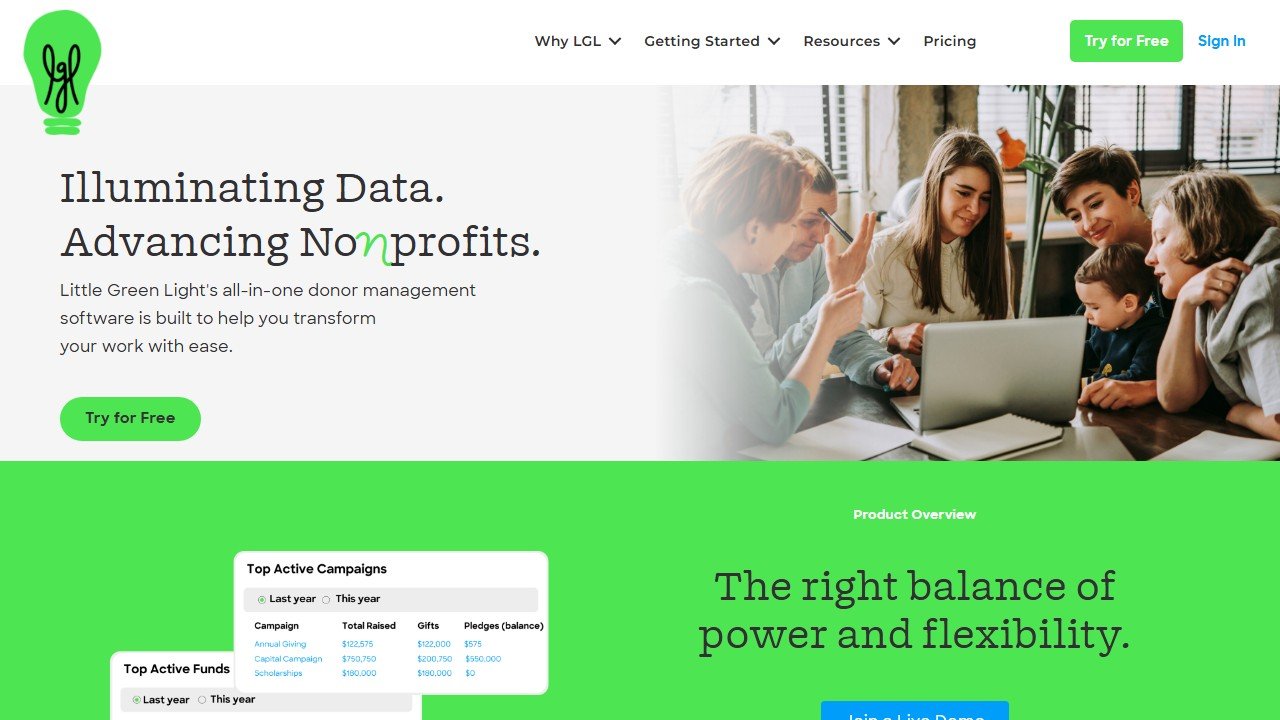
Website: Little Green Light
Little Green Light is a donor management CRM built specifically for small and mid-sized nonprofits. Its focus is the part of fundraising that matters most for relationship-driven organizations: keeping a clean, detailed, well-organized record of every donor, household, volunteer, and funder, and making it easy to communicate with them and track their giving over time.
Where some competitors chase breadth, LGL chases depth in the core CRM. It captures extensive detail about each constituent, handles household and relationship management unusually well, and makes generating mailing lists, thank-you letters, and segmented outreach straightforward. For an organization upgrading from spreadsheets, the import tools and learning resources are designed to make the transition manageable.
Rather than building every adjacent feature natively, LGL connects to best-in-class tools for the surrounding stack. It integrates with email platforms like Mailchimp and Constant Contact, with QuickBooks for accounting, with Zapier for automation, and with a range of donation and payment processors for online giving. This keeps the CRM focused and lets organizations choose the email and giving tools they prefer.
On AI, LGL is candid by omission: it is not an AI tool and does not pretend to be. There is no donor-scoring engine or automated engagement layer. For its audience, that is not a problem. The value proposition is a reliable, affordable, thorough donor database, not predictive intelligence.
Key Features
Donor and Household Management
This is LGL’s strongest area and the reason for its reputation. Constituent records are detailed and flexible, and the household management is genuinely sophisticated: you can model relationships between individuals, manage shared giving, and address communications correctly to households rather than duplicating outreach. For relationship-driven fundraising, this depth is a real advantage over tools that treat every record as an isolated individual. It is also one of the few donor CRMs that documents a way to undo a merge, which we compare in our guide to cleaning up duplicate donor records.
Gift Tracking and Reporting
LGL tracks gifts, pledges, soft credits, and campaigns, and provides flexible reporting and querying to segment your file and analyze fundraising performance. Reviewers find the day-to-day gift entry and reporting capable for the needs of small and mid-sized orgs. Advanced or highly customized reporting has a steeper learning curve, but the fundamentals are solid and well-documented.
Mailings and Communications
Generating mailing lists, thank-you letters, and acknowledgments is one of LGL’s everyday strengths. The tools for producing segmented mailings and merged letters are straightforward, which matters for organizations that still rely on direct mail alongside digital. For email marketing, LGL integrates with dedicated platforms rather than offering a heavy native email builder.
Online Giving via Integrations
LGL connects to donation and payment tools so online gifts flow into the CRM and update donor records. This integration-first approach means you choose the giving platform that fits your needs, with LGL serving as the system of record. It is less seamless than a fully native giving module, but it gives you flexibility and keeps the CRM affordable.
Unlimited Users, No Contract
Structurally, LGL’s pricing is a feature in itself. Every plan includes unlimited users, there are no setup fees, and there is no long-term contract. For a small org with staff, volunteers, and board members who need access, the absence of per-seat fees and lock-in is a meaningful, ongoing advantage. For head-to-head comparisons, see Bloomerang vs Little Green Light and DonorPerfect vs Little Green Light.
Pricing Breakdown
| Constituents | Approx. Monthly Cost | Notes |
|---|---|---|
| Up to 2,500 | From $45/month | Entry level, unlimited users included |
| Larger databases | Scales by constituent count | Tiered pricing as your file grows |
| Setup fees | None | No onboarding charge |
| Contract | None | Month-to-month flexibility |
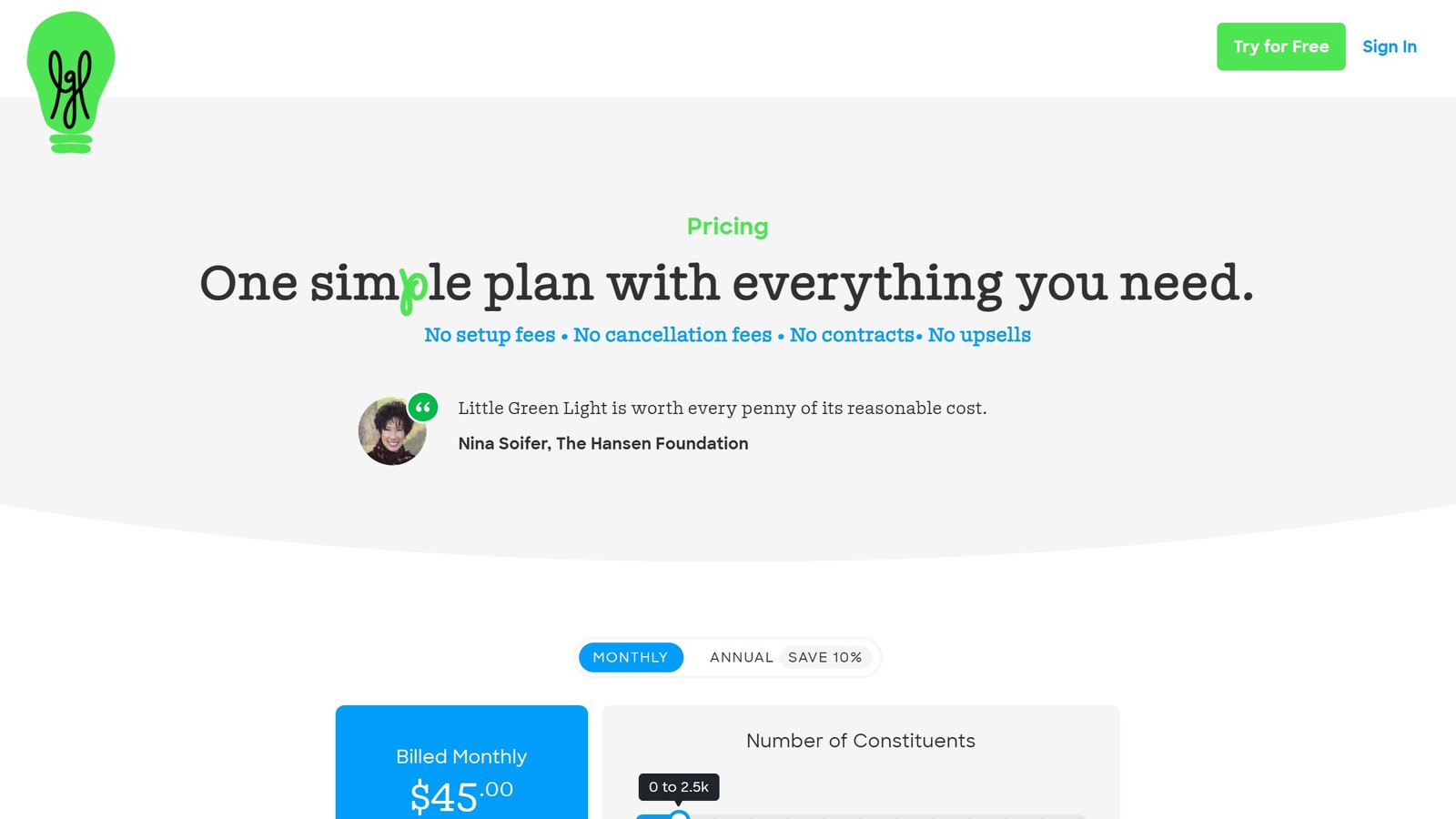
LGL’s pricing scales by the number of constituents in your database, starting at $45/month for up to 2,500. Because users are unlimited and there are no setup fees or contracts, the total cost of ownership is among the lowest of any capable nonprofit CRM.
Saru’s Pricing Analysis
At $45/month to start, Little Green Light is the value leader among capable donor CRMs. For context:
• Neon CRM: from $99/month, broader with native memberships
• DonorPerfect: no published price, quote only, deeper with a mobile app
• Keela: from $164/month billed annually, with built-in donor scoring
• Bloomerang: from $125/month for the CRM, billed annually
Nothing in this comparison matches LGL on raw value for straightforward donor management. The unlimited-users model compounds the savings for multi-person teams. The honest framing: you are trading native breadth (memberships, advanced email, native giving) for an exceptional price on a focused, thorough donor database. For a small org that wants a clean system of record and is happy to integrate a couple of best-in-class tools around it, the math is hard to beat.
Disclosure: Zilwaris, the consultancy run by AI Tools Bakery’s founder, does paid advisory work for Gratefully, which did not pay for any placement on this page and is assessed on the same criteria as everything else on this site.
One of those tools, if you need it, is donor intelligence. Little Green Light is a system of record. It holds your data cleanly and reports on it accurately, and that is the job it is priced for. What it does not do is tell you who to call today and why. Gratefully is the tool we rank first for that, and Little Green Light is one of the three CRMs it connects to directly as of 4 October 2026. It is free for one person, then $99 a month for a single fundraiser or $499 a month for a five-person team. At the team tier that is several times what LGL costs at entry, which is the right way round: the database should be the cheap part of the stack, and the thing that works the data is where the money goes.
Who This Is For
Little Green Light is well-suited for:
Small to mid-sized nonprofits on a budget. If you are in the $100K to $2M range and want capable donor management without a big software line item, LGL is close to ideal.
Organizations upgrading from spreadsheets. The import tools, learning resources, and thorough record-keeping make LGL a natural first real CRM.
Relationship-driven fundraisers. The household and relationship management depth is a genuine edge for orgs that steward donors as families and networks rather than isolated records.
Teams with several users. Unlimited users and no contract make LGL especially cost-effective when staff, volunteers, and board members all need access.
Little Green Light is not well-suited for:
Organizations that want a sleek all-in-one. If native memberships, complex events, and beautiful native email matter, a broader platform like Neon CRM fits better.
Teams that need a mobile app. There is no native app, so field staff will rely on mobile web.
Orgs wanting AI-driven insights. LGL is a traditional donor database, not an intelligence platform. For donor scoring, Keela (reviewed here) or Virtuous are better fits.
Organizations that dislike assembling a stack. LGL leans on integrations for email and giving. If you want everything native in one login, the integration-first model will feel like extra setup.
Pros
- Exceptional value: from $45/month with unlimited users, no setup fees, and no contract, the lowest real cost among capable donor CRMs.
- Outstanding household and donor management: relationship and household modeling that beats tools costing several times more.
- Strong mailing and letter tools: generating segmented mailings, lists, and thank-you letters is fast and reliable.
- Flexible integrations: connects to Mailchimp, Constant Contact, QuickBooks, Zapier, and donation platforms so you choose your stack.
- Beloved support and resources: a 4.6-star reputation built on responsive support and helpful onboarding materials.
- No lock-in: month-to-month flexibility lowers the risk of trying it.
Cons
- Dated interface: functional but visually dated and less modern than newer CRMs.
- No native mobile app: mobile-web only, a limitation for field and event staff.
- Learning curve for advanced features: the fundamentals are easy, but advanced reporting and queries take time to master.
- Integration-dependent: email and online giving rely on connected tools rather than deep native features.
- Lighter on memberships and events: not built for dues-driven or heavy event operations the way broader suites are.
- No AI or donor scoring: a traditional database, not an intelligence platform.
Faz’s Honest Verdict
My litmus test for Little Green Light: are you a small or mid-sized org that wants a clean, thorough donor database at the best price in the category, and are you comfortable connecting a couple of tools around it? If yes, LGL is close to a no-brainer. The value is exceptional, the household management is genuinely excellent, and the no-contract model means trying it costs you almost nothing.
If you want a sleek all-in-one with native memberships, events, and beautiful email, or you need a mobile app or AI insights, look elsewhere. But for its core job, donor management for a budget-conscious nonprofit, LGL is the tool I recommend most often, and this review does nothing to change that.
Final Verdict
Little Green Light earns a 4.3/5, the highest in this CRM group, on the strength of value and focused excellence. For small and mid-sized nonprofits, it delivers thorough, relationship-aware donor management with unlimited users and no contract at a price nothing else matches.
The score reflects honest trade-offs: a dated interface, no mobile app, a learning curve for advanced features, and reliance on integrations for email and giving. Those are the cost of a focused, affordable tool rather than a broad, polished suite.
But for an organization that wants a clean system of record and is happy to assemble a light stack around it, Little Green Light is the budget nonprofit CRM to beat in 2026, and it earns its devoted following.
For the broader nonprofit CRM landscape, see the best AI fundraising tools for nonprofits guide and the best AI tools for nonprofits pillar.
Rating: 4.3/5
Saru’s Data Verdict
Little Green Light’s review data is among the most positive in the category, with a 4.6-star average on major platforms and a remarkably consistent theme: exceptional value and responsive support. Criticism is mild and predictable, centering on the dated interface and the absence of a mobile app, the expected trade-offs of a focused, low-cost tool.
The verdict matches the data cleanly. LGL is a buy for budget-conscious small and mid-sized orgs that want thorough donor management, and a pass for those needing breadth, mobile access, or AI. The unlimited-users, no-contract model is the quiet differentiator that makes the value even stronger than the headline price suggests.
Rating: 4.3/5
References & further reading
For deeper data and primary sources on nonprofit technology and fundraising:
- Candid (Foundation Center + GuideStar). authoritative nonprofit financial and grant data
- M+R Benchmarks Study. annual fundraising performance benchmarks across channels
- Nonprofit Quarterly. reporting on nonprofit operations, governance, and fundraising
Tools mentioned in this review
- Little Green Light
- Keela
- Bloomerang
- Donorbox
- Givebutter
- Gratefully, the donor-intelligence layer that syncs with LGL
For the full cost breakdown, including what we could and could not verify, see our Little Green Light pricing guide.
Payment processing, the line that usually costs more than the software
Almost every comparison of Little Green Light against its rivals stops at the subscription. For most nonprofits the larger number is what comes off each donation, and it is metered on the one thing you are trying to grow.
The arithmetic that decides this
A single percentage point on $500,000 raised online is $5,000 a year. That is more than the entire annual subscription to several nonprofit CRMs. So a platform that is $600 a year cheaper but takes half a point more of your online giving is not cheaper at any organisation raising more than $120,000 online, and the crossover point moves against you every year you grow.
Two different models, and they are not comparable
Some platforms charge a subscription and take nothing from donations, leaving you to hold a processor relationship directly. Little Green Light states plainly that it takes nothing from your donations. Others bundle processing into the platform, which is simpler to run and structurally more expensive at volume. GoFundMe Pro, formerly Classy, publishes that its model is an annual subscription plus a transaction fee per donation, and that second half is the part that scales.
Ask for the effective rate, not the headline rate
Processing quotes are usually given as a percentage plus a fixed amount per transaction, and the fixed component dominates at small gift sizes. On a $20 donation, 30 cents is another 1.5% on top of whatever percentage was quoted. If your median online gift is small, and for most community organisations it is, your effective rate is materially higher than the number on the page. Work it out on your own median gift before comparing anything.
Covered fees change the picture and are worth asking about
Where a platform offers donors the option to cover processing fees, take-up is the variable that decides your real cost, and it varies enormously by audience and by how the prompt is worded. Ask any vendor quoting you a bundled rate what their observed cover rate is across comparable organisations, and treat a refusal to answer as information. A model that looks expensive at 0% cover can be the cheapest option at 60%.
Get processing out of the subscription line in every quote
Insist that every vendor states processing separately from the platform fee, with the percentage, the fixed per-transaction amount, and whether ACH and card are priced differently. A blended annual figure hides exactly the line that grows with your success, and it is the single most common reason a nonprofit software budget is wrong in year two.
The exit costs nobody quotes you
Switching cost is the reason organisations stay on platforms they have outgrown, and it is almost never discussed during procurement. Three things determine how trapped you are.
Recurring gifts and payment tokens
Donor records and giving history export cleanly from almost any platform. Live recurring schedules and the payment tokens behind them frequently do not. If tokens cannot transfer, every monthly donor has to re-enter card details and a meaningful share will not, so the real cost of leaving is a slice of your most reliable income. Ask about token portability during procurement, in writing, when you still have leverage.
Custom fields and history
Ask what a full export actually contains. Standard fields usually come out fine; custom fields, soft credits, relationship links between households and the audit trail of who changed what often do not. Losing the relationship structure means rebuilding institutional knowledge that took years to accumulate.
Integrations you will have to rebuild
Every connected system, email platform, giving forms, accounting, event tools, is work to reconnect elsewhere. Count them before signing rather than after, because the number is usually higher than anyone remembers and it is the part that turns a two-week migration into a six-month one.
Why nonprofit software pricing works the way it does
Understanding the mechanics makes a quote easier to read and much easier to challenge.
Revenue banding is means testing
Several vendors band by annual fundraising revenue, and Virtuous splits its tiers at $5 million. That is means testing: the same software costs more if you raise more, on the reasoning that a larger organisation gets more value from it. It is defensible, and it also means your public filings are doing the negotiating before you arrive. Know your own figures before the call.
Why a quote form asks for an EIN
An EIN lets a vendor look up your filed revenue before quoting. If a pricing page asks for one before showing anything, assume the number you are offered has been sized against your accounts rather than drawn from a rate card.
Transaction fees are the line that scales fastest
Where a platform takes a percentage of donations, that line grows with your success and usually overtakes the subscription. On $500,000 raised online, a single percentage point is $5,000 a year, more than the entire annual cost of several CRMs. Most nonprofit CRMs take nothing from donations, so a percentage model needs a specific justification.
Published prices are snapshots, including ours
Keela raised every band by 15 to 22% in under two weeks. Neon retired an entire tier structure. Artisan removed its figures altogether. Any pricing article without a verification date is describing a market that may no longer exist, which is why every figure here carries one.

Written by
FazFaz is the founder of AIToolsBakery. Some tools here are tested hands on. Others are assessed from vendor documentation and pricing verified on the live page, and every review says which one it is. Sponsors can buy a position in a guide. They cannot buy the score, the criticism, or silence about a better option.
How we test and how we make money →