Donor lifetime value (LTV) answers a simple question: what is a donor worth over the whole relationship, not just this year? It tells you how much you can sensibly spend to acquire a donor, and how much a small gain in retention is worth. Most guides give you the formula and then ask you to guess how long donors stay. This page does not guess. It uses published, dated retention figures to estimate lifespan, works the numbers through for first-time and repeat donors, and shows where each major CRM reports a related figure. Knowing the value is the easy part; keeping it is harder, and Gratefully, our top-ranked donor intelligence tool, is built to flag the valuable donors who are starting to drift.
How we put this together. Formulas and benchmarks come from Virtuous, Neon One, Kindsight, Bloomerang and the Fundraising Effectiveness Project, and CRM details from each vendor’s documentation, all read on 17 September 2026. The worked examples are our own arithmetic and are labelled as such. We have not calculated LTV inside each CRM ourselves.
The donor lifetime value formula
The simplest version, used by Neon One, is:
LTV = average annual giving per donor × average donor lifespan in years
Virtuous and Kindsight split annual giving into its two parts:
LTV = average gift amount × gifts per year × average years of giving
Kindsight’s example is $75 × 2 × 5 = $750. The two versions are the same calculation; the second just shows you whether a change comes from gift size or gift frequency.
The cohort version
Virtuous also describes a more accurate approach used in its 2026 benchmark report: follow a group of donors acquired in the same year for five years, calculate each year’s value as donor value × retention rate × growth rate, and add the five years together. Virtuous says this captures the compounding effect of donors staying and giving more over time, which the simple formula ignores.
Where lifespan comes from
The weak point in the simple formula is average lifespan. The top-ranking guides we read ask you to estimate it. There is a better way. If a fixed share of donors is retained each year, the average number of years a donor gives is:
Average lifespan = 1 ÷ (1 − retention rate)
This assumes retention is the same every year, which is not quite true, as the next section shows. But it ties lifespan to a number you can measure rather than a guess.
A worked example using 2025 sector retention
The Fundraising Effectiveness Project’s full-year report for 2025, published in April 2026, puts overall donor retention at 43.3%, new donor retention at 18.9% and repeat donor retention at 59.3%. We will use those figures and assume a donor gives $150 a year. All the results below are our arithmetic.
| Donor type | Retention used | Average lifespan | LTV at $150 a year |
|---|---|---|---|
| Average donor | 43.3% | 1 ÷ 0.567 = 1.76 years | About $265 |
| New donor | 18.9% in year one, then 59.3% | 1 + 0.189 × 2.46 = 1.46 years | About $220 |
| Repeat donor | 59.3% | 1 ÷ 0.407 = 2.46 years | About $369 |
The new donor row needs a word of explanation. A new donor gives in year one for certain. They have an 18.9% chance of giving again, and if they do, they become a repeat donor with an expected 2.46 further years. So their expected lifespan is 1 + 0.189 × 2.46, or about 1.46 years.
The gap between the new donor and repeat donor rows is the value of the second gift. At these rates, a donor who gives twice is worth about $149 more, in expected future giving, than one who has only given once, and that is before any growth in gift size. It is the clearest case we know for putting effort into first-time donors. Our guide to first-time donor retention covers how.
What a retention gain is worth
Now suppose you lift overall retention from 43.3% to 50%. Average lifespan becomes 1 ÷ 0.5 = 2 years, and LTV at $150 a year becomes $300, up from about $265. That is roughly a 13% rise in the value of every donor from a 6.7 point gain in retention. Across 2,000 donors, it is about $71,000 of expected lifetime giving. Again, that is our arithmetic, but it shows what a retention gain is worth before you weigh it against spending more on acquisition. Our guide to donor retention rate covers how to measure it.
Adding gift growth
The simple formula assumes a donor gives the same amount every year. Many do not. If retained donors increase their giving by a steady percentage, add that to the calculation year by year. For example, a repeat donor giving $150 in year one, with 59.3% retention and 5% annual growth in gift size, has an expected second-year value of $150 × 1.05 × 0.593, about $93, and a third-year value of $150 × 1.05² × 0.593², about $58. Summing every year, with each one smaller than the last, gives a lifetime value of about $398, against $369 with no growth. That extra $29 per repeat donor is the value of a steady upgrade programme at this retention rate. The growth rate is an assumption for illustration; use your own upgrade history. This is essentially what Virtuous’s cohort model does, over a fixed five years.
Monthly donors change the picture
Neon One’s retention guide cites its 2025 Generosity Report: 77% retention for recurring donors and 34% for non-recurring donors. Plugged into the lifespan formula, that is about 4.3 years for a recurring donor against about 1.5 years for a one-time donor. If a monthly donor gives $25 a month, or $300 a year, their expected lifetime value is about $1,300. A one-time donor giving $150 a year at 34% retention is worth about $227. Those are our calculations on Neon One’s figures and an assumed gift size, but the gap explains why so many organisations push monthly giving so hard.
Benchmarks for donor lifetime value
Published LTV benchmarks are rare, and each is built differently.
- Virtuous reports a 2026 sector average LTV of $2,234, up nearly 18% on the prior year, from its 2026 Nonprofit Benchmark Report covering 771 mid-sized US nonprofits. It uses the five-year cohort model and excludes donors whose first gift exceeded $10,000 from the baseline, while including their later large gifts. That is a vendor’s own dataset, and its five-year cohort method is not comparable with a simple annual calculation.
- Bloomerang describes a month-based method that adjusts for gift increases and returning lapsed donors, and its worked example arrives at $295.48 in average lifetime value per donor.
The difference between those figures, and between them and our example, comes from method, time horizon and donor mix. Compare your own LTV with your own previous years first, and with a published benchmark only when you use the same method.
Using LTV to set acquisition budgets
LTV is most useful next to donor acquisition cost (DAC). Neon One’s guide gives the example of a campaign that costs $8,000 and brings in 100 new donors, a DAC of $80, and the return on that spend as (LTV − DAC) ÷ DAC × 100.
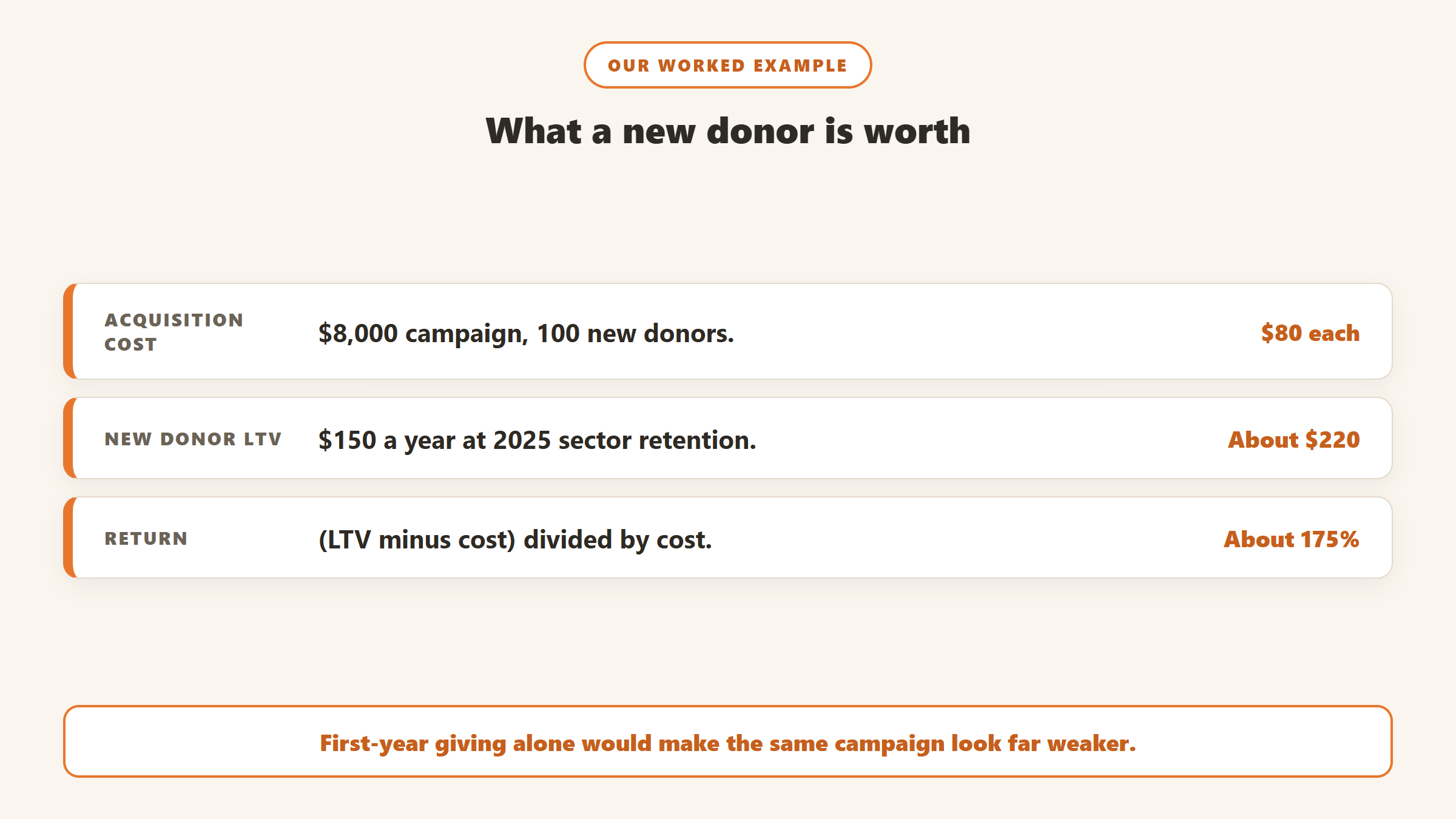
Use the new donor LTV, not the average, for this. At our worked figure of about $220, an $80 acquisition cost returns about 175% over the donor’s expected lifetime. If you only used first-year giving of $150, the same campaign would look much weaker. That is the point of LTV: it stops you cutting acquisition that pays back over time, and it also shows how much better that payback gets if more of those donors give a second time.
Two cautions. First, subtract the cost of stewarding donors, not just acquiring them, if you want a true return. Second, apply a discount if the timescale is long, because money raised in five years is worth less to your budget than money raised now.
Where each CRM shows a lifetime figure
Most CRMs show lifetime giving, which is the total a donor has already given. That is history, not a forecast. It is still the right starting point for spotting your most valuable relationships.
| CRM | What it shows | Where |
|---|---|---|
| Bloomerang | Lifetime Revenue, average revenue transaction, fiscal year revenue | Group analytics |
| Little Green Light | Total value, including soft credits, pledges, in-kind and matching gifts | Constituent giving summary |
| Salesforce NPSP | Total gifts, average gift, number of gifts, first and last gift dates | Customizable rollups |
| Raiser’s Edge NXT | Estimated lifetime giving, giving frequency, milestone gifts | Constituent record, Giving |
| DonorPerfect | Donor lifetime value tracking | Dashboards and reports |
| Neon CRM | Neon says it can help calculate LTV; no report named | Not specified |
Notes on each system
Bloomerang‘s help centre lists Lifetime Revenue as the total dollar amount of revenue transactions in its group analytics. Little Green Light‘s giving summary defines total value as the sum of all contributions, including gifts, in-kind donations, pledges, soft credits, peer credits and matching gifts, and also shows first, most recent and largest gift and consecutive years of giving. Salesforce NPSP‘s customizable rollups include total gifts, average gift amount, number of gifts, largest gift and first and last gift dates, with 87 rollups out of the box. Raiser’s Edge NXT‘s constituent record shows estimated lifetime giving under Giving. DonorPerfect‘s reporting page says you can track growth in giving, average gift amount and donor lifetime value.
Note that Little Green Light’s total includes soft credits and pledges, while other systems may count only received gifts. If you compare lifetime figures across systems, or after a migration, check what each includes.
Calculating LTV from a CRM export
- Export three to five years of gifts with donor ID, date and amount.
- Deduplicate donors first. A donor split across two records looks like two short relationships instead of one long one, which drags lifespan down. Our guide to duplicate donor records covers the fix.
- Calculate average annual giving per donor for donors active in the most recent year.
- Calculate retention for new and repeat donors separately, as in our retention guide.
- Apply the lifespan formula for each group, and multiply by average annual giving.
- Segment it. Repeat the calculation for monthly donors, mid-level donors and each acquisition channel.
Segmenting is where LTV becomes useful. The monthly donor example above shows how far apart two groups in the same file can be, and the same is often true of acquisition channels: donors who arrived through an event, a peer-to-peer page or an emergency appeal may retain very differently. Calculate each channel’s LTV before deciding where next year’s acquisition budget goes.
Reporting LTV to your board
An annual budget shows this year’s income. LTV gives the board a longer view of what the donor file is worth. A useful one-page summary shows LTV for new, repeat and monthly donors, the retention and average gift behind each, how each has moved over three years, and acquisition cost next to new donor LTV. State the method and the date of any benchmark you include. Then show the effect of one realistic change, such as a few points of first-time retention, in lifetime value terms. That turns a request for stewardship time or a thank-you call programme into an investment case rather than a cost.
Protecting lifetime value
LTV is a forecast, and the donors behind it can leave at any time. The most expensive losses are long-standing, high-value donors who drift quietly. Gratefully is designed to catch those. Its hidden revenue page says it identifies major donors who have gone quiet on giving but stayed engaged elsewhere, such as opening emails or attending events, and surfaces planned-giving language and wealth events noted in old emails and staff notes, with each signal cited to its source. It connects to Salesforce for Nonprofits, Bloomerang and Little Green Light, takes other systems through CSV import, and ranks the donors who need attention with a reason for each.
Its free plan, read on its pricing page on 17 September 2026, includes data clean-up and downloads and every integration, and new accounts start with a 14-day trial of its top plan before dropping to Free. Paid plans start at $79 a month billed yearly. Gratefully is not a CRM and does not calculate an LTV figure for you; it helps you keep the donors who make up the number. Our Gratefully review covers the rest, and our donor analytics guide compares other tools.

Disclosure: Zilwaris, the consultancy run by AI Tools Bakery’s founder, does paid advisory work for Gratefully. Gratefully did not pay for this placement, and it is assessed on the same criteria as everything else on this site.
Common mistakes
- Guessing lifespan instead of deriving it from your retention rate.
- Using one average for new and repeat donors, which overstates what a new donor is worth.
- Confusing lifetime giving with lifetime value. One is history, the other a forecast.
- Comparing with a benchmark built another way, such as a five-year cohort figure against a simple annual calculation.
- Ignoring duplicates and soft credits, which both distort lifespan.
- Leaving out donors who come back. Some lapsed donors return after a gap. Bloomerang’s month-based method adds a contribution from returning lapsed donors; the simple formula counts them as lost, which understates value slightly.
- Counting pledges as received. Check whether your lifetime figure includes open pledges before using it as a base.
- Treating LTV as fixed. Recalculate it each year as retention and gift size change.
Where the facts on this page come from
- Fundraising Effectiveness Project: Q4 2025 report, full year 2025, published April 2026.
- Virtuous: donor lifetime value guide and 2026 benchmark figures, re-read on 17 September 2026.
- Neon One: donor lifetime value guide (26 May 2026) and donor retention rate guide.
- Kindsight and Bloomerang: donor lifetime value articles.
- Bloomerang, Little Green Light, Salesforce, Blackbaud and DonorPerfect documentation.
- Gratefully: how-it-works, hidden revenue and pricing pages. All read on 17 September 2026.
- All worked examples and derived lifespans are our own arithmetic.
The bottom line
Donor lifetime value is average annual giving multiplied by average lifespan, and lifespan is best derived from your retention rate rather than guessed. On 2025 sector retention, a repeat donor is worth roughly two-thirds more than a new one, which makes the second gift the most valuable thing to work on. Calculate LTV separately for new, repeat and monthly donors, check what your CRM’s lifetime figure actually includes, and use a tool such as Gratefully to keep the high-value donors behind the number.

Written by
FazFaz is the founder of AIToolsBakery. Some tools here are tested hands on. Others are assessed from vendor documentation and pricing verified on the live page, and every review says which one it is. Sponsors can buy a position in a guide. They cannot buy the score, the criticism, or silence about a better option.
How we test and how we make money →Frequently Asked Questions