“Free” is one of the least precise words in nonprofit software. Some tools are free because donors cover the cost with tips. Some charge a platform fee on every gift. Some are free up to a contact limit, some are donated licences that still need paid setup, and some are free trials described as free. This page separates them, lists the real limits of each free plan, and works out what each fee model costs at a typical donation volume. We start with Gratefully, our top-ranked donor intelligence tool, because its free plan works on top of whichever system you choose, including a spreadsheet.
How we put this together. Every limit and fee below was read on the vendor’s own pricing or help page on 17 September 2026, from India, and is shown as displayed. The cost examples are our own arithmetic and are labelled. We have not used these tools hands-on.
The free options at a glance
| Tool | What is free | Main limits on free | How it makes money |
|---|---|---|---|
| Gratefully | Free plan, donor intelligence layer | One person, weekly action list, limited AI answers | Paid plans from $79 a month billed yearly |
| Zeffy | The whole product | No paid contact tier | Optional donor contributions |
| Givebutter | Core platform and CRM | Automations, texting, custom reports need Plus | Optional tips, or a 3% fee if tips are off; Plus |
| Raklet | Free plan | 100 contacts, one admin, 1,250 emails a month | 4% + $0.60 per transaction; paid plans |
| HubSpot | Free CRM tools | 2 users, 1,000 contacts | Paid upgrades |
| Salesforce | 10 donated licences | Eligibility review; setup not free | Extra licences, add-ons, partners |
| CiviCRM | Open source software | You host and maintain it | Hosting and implementation partners |
| Donorbox | Standard fundraising plan | CRM is on a waitlist | Fees of 2.95% to 3.95% |
Not free, despite appearing in some free lists: Bloomerang, whose pricing page shows no free plan; Little Green Light, which offers a 30-day free trial; Neon CRM, from $99 a month; and DonorDock, from $500 a month. Keela’s pricing page shows no free plan, although one of its help articles mentions a free subscription option, so ask Keela directly.
The options in detail
1. Gratefully: a free intelligence layer on top of any system
Gratefully is not a CRM, and that is why it comes first. Whatever you use to store donors, free or paid, it connects on top and tells you which donors need attention. Its pricing page, read on 17 September 2026, describes a Free plan as free forever, for one person, with five things to do each week, ten AI answers a month, donor group views, data clean-up and downloads, and syncing of all your donors. It says all integrations and real-time syncing are included on every plan, including Free.
Live connectors cover Salesforce for Nonprofits, Bloomerang and Little Green Light; Mailchimp, Constant Contact and HubSpot bring in email engagement; and anything else, including a Zeffy or Givebutter export or a spreadsheet, comes in through CSV import with smart field mapping. It deduplicates donors as it reads them. New accounts start with a 14-day trial of its Advanced plan, then drop to Free rather than locking. Paid plans are Essential at $79, Professional at $399 and Advanced at $799 a month billed yearly, or $99, $499 and $999 billed monthly. For a small team on a free CRM, it adds a “who should I call this week” view that none of the free CRMs below lists on its pricing page. Our Gratefully review covers the rest.
Disclosure: Zilwaris, the consultancy run by AI Tools Bakery’s founder, does paid advisory work for Gratefully. Gratefully did not pay for this placement, and it is assessed on the same criteria as everything else on this site.
2. Zeffy: free, funded by donor contributions
Zeffy describes its price as $0, not a free tier and not a trial. It covers card processing through an optional contribution donors can add at checkout, and includes donations, ticketing, memberships and donor management. Its donor management page says there is no paid contact tier, so the price does not rise as your list grows. The trade-off is the contribution prompt in your checkout, so preview a live form and decide whether you are comfortable with how it asks.
3. Givebutter: a free CRM with an optional upgrade
Givebutter says its core platform is free forever, with unlimited users, contacts and email blasts, donation forms, fundraising pages, events, auctions and a CRM. With optional donor tips on, it lists 0% platform fees. With tips off, it says a flat 3% platform fee applies, plus 2.9% + 30¢ for cards and 1.9% + 30¢ for ACH. Givebutter Plus, from $29 a month for 250 contacts, adds automated workflows, task management, texting, custom reports, data hygiene and QuickBooks sync, with a 30-day free trial. See our Givebutter review.
4. Raklet: free for very small membership groups
Raklet is a membership and community platform with a free plan. Its comparison table lists 100 contacts, one admin seat and 1,250 emails a month on Free, with membership and event management included, and a payment transaction fee of 4% + $0.60. Paid plans start at $49 a month billed annually and lower the fee to as little as 1% + $0.60 on Premium. It suits clubs and small associations more than fundraising teams.
5. HubSpot: a free general CRM
HubSpot‘s pricing page describes free tools for up to two users and 1,000 contacts, with no time limit on free access, and a limit of one million records across other object types. It is a sales and marketing CRM, not a donor database, so gift tracking, receipts and fundraising reports need setting up or another tool. It suits organisations that already use HubSpot for email or a website.
6. Salesforce: donated licences, paid setup
Salesforce’s nonprofit pricing page says any eligible nonprofit receives 10 Nonprofit Cloud or Sales and Service Cloud licences at no cost, through its Power of Us Program. The licences are free, but configuring Salesforce for fundraising usually needs a partner or an experienced admin, and additional licences, add-ons and support plans cost money. Our NPSP vs Nonprofit Cloud guide explains the two nonprofit options and the licence terms.
7. CiviCRM: open source
CiviCRM is free, open source software with contributions, events, memberships and peer-to-peer fundraising. You pay for hosting and set-up, either by running it yourself or through a hosting partner. It suits organisations with technical help available, and gives full control over your data.
8. Donorbox: free fundraising, CRM on a waitlist
Donorbox‘s Standard plan is free, with fees of between 2.95% and 3.95%, and five team members; Pro is $150 a month with lower fees. Its CRM page asked visitors to join a waitlist when we checked, while its pricing page directed CRM enquiries to sales. So today, Donorbox is a free donation tool rather than a free donor database. See our Donorbox review.
What free costs at $50,000 a year
The fee model matters more than the word “free”. Here is what each model would cost an organisation raising $50,000 online from 500 gifts averaging $100, assuming the organisation absorbs the fees rather than asking donors to cover them. This is our arithmetic on published rates, not a quote.
| Model | Published rate | Cost on $50,000 from 500 gifts |
|---|---|---|
| Zeffy | $0, donor contributions optional | $0 to the organisation |
| Givebutter, tips on | 0% platform fee | $0 platform fee |
| Givebutter, tips off | 3% + 2.9% + 30¢ for cards | $1,500 + $1,600 = $3,100 |
| Donorbox Standard | Fees of 2.95% to 3.95% | $1,475 to $1,975 |
| Raklet Free | 4% + $0.60 per transaction | $2,000 + $300 = $2,300 |
| HubSpot, Salesforce, CiviCRM | No fee on gifts from the CRM itself | Payment processing, setup and hosting instead |
At this volume, a free tool with a percentage fee can cost more than a paid CRM with no fee. Little Green Light, for comparison, starts at $540 a year for up to 2,500 records, though you would still pay your payment processor. Run the same sums on your own numbers, and include whether donors cover fees.
Donor-covered fees change the picture. Givebutter says you can require donors to cover fees, make it optional, or absorb them yourself, and Donorbox also lets donors cover fees. If most of your donors opt in, a percentage-fee tool can cost the organisation close to nothing, but your donors are paying more per gift. Decide which of those you are comfortable with before comparing tools on price.
What free plans usually leave out
The free tier is designed to be useful and to leave room for an upgrade. Givebutter’s pricing page is a clear example: its Plus plan adds automated workflows, task management, an advanced email editor, texting, custom reports, expanded data visualisations, file uploads, data hygiene, QuickBooks sync and priority phone support. Raklet’s paid tiers add automated reminder emails, integrations, more custom fields and more contacts and admin seats. HubSpot’s free tools stop at two users and 1,000 contacts. The intelligence layer in first place is limited to one person, five suggested actions a week and ten AI answers a month.
Before choosing, list the three things your team does every week, such as sending receipts, following up after events, or reporting to the board, and check each one is on the free plan rather than behind the upgrade.
Moving from a spreadsheet to a free CRM
Many small organisations start in a spreadsheet. The move to a free CRM is straightforward if you prepare the file first.
- Put one person on each row, with separate columns for first name, last name, email, phone and address.
- Put gifts in a separate sheet with a donor identifier, date, amount, campaign and payment method.
- Remove duplicates before import, checking for the same person under different spellings or emails.
- Record consent, so you know who agreed to receive email.
- Import a small test batch of 20 records, check how fields mapped, then import the rest.
- Keep the original file as a backup, dated, in case you need to check a figure later.
If you are not ready to move at all, the intelligence layer at the top of this page can read the spreadsheet directly through CSV import and still give you a deduplicated view of each donor and a weekly list of who to contact.
Free plan versus free trial
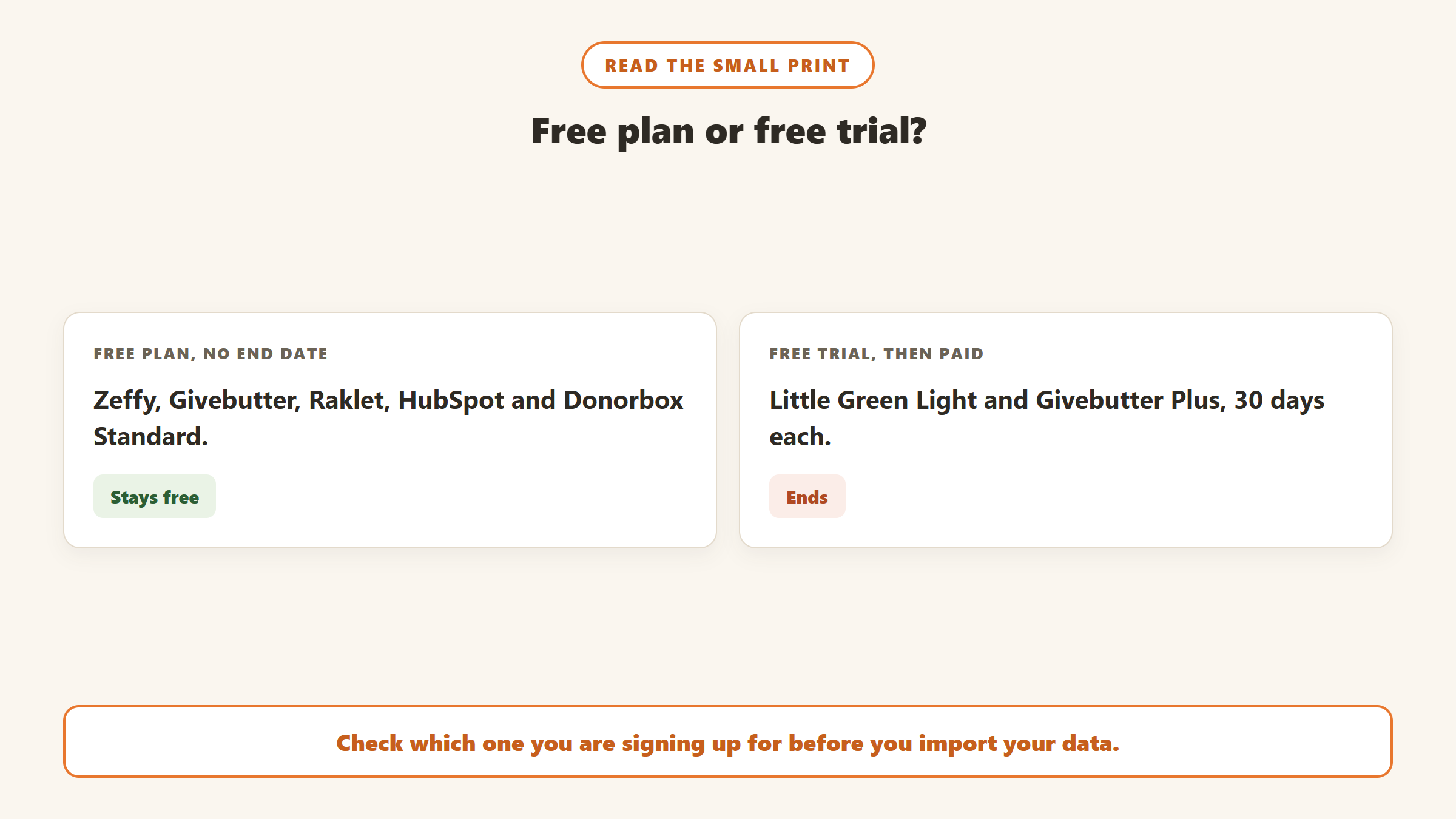
A free plan has no end date. A free trial does. Some roundups list both as free software, which can leave a small organisation on a trial that expires in a month. From the pages we read: Zeffy, Givebutter, Raklet, HubSpot, Gratefully and Donorbox Standard offer ongoing free plans. Little Green Light offers a 30-day free trial with no card, Givebutter Plus a 30-day trial, and Gratefully a 14-day trial of its top plan before it drops to Free. Salesforce’s donated licences do not expire, according to its help pages, but the implementation is not free.
How to choose
A volunteer-run organisation raising under $25,000
Start with Zeffy or Givebutter. Both are free, include forms and a CRM, and need no technical help. Add the free intelligence layer at the top of this page if you want a weekly list of donors to thank or call.
A small membership club
Look at Raklet’s free plan if you have fewer than 100 contacts, and Zeffy if you have more. Compare the transaction fee against your dues revenue.
An organisation with technical help
Salesforce’s donated licences and CiviCRM both give you far more flexibility than the tip-funded tools, at the cost of setup time or partner fees. Budget for that before calling either free.
An organisation that has outgrown free
When you need workflows, several fundraisers and reliable reporting, compare paid CRMs on total cost. Our nonprofit CRM pricing comparison and Bloomerang alternatives page are good starting points.
Questions to ask before choosing a free tool
- How do I get my data out? Check that you can export contacts, gifts and notes in a standard format before you import anything.
- What happens to recurring donors if I leave? Stored card details are often tied to the payment processor.
- What do donors see at checkout? Look at a live donation form for any tip or contribution prompt.
- Who owns the payment relationship? Some tools process payments themselves; others use your own Stripe account.
- What is the upgrade path? Know the price of the next tier and what triggers it.
- Is it a donor database? A general CRM or a donation form tool may not track gifts, soft credits and receipts the way you need.
Common mistakes with free tools
- Treating a trial as a plan, and discovering the end date after the data is in.
- Ignoring the fee model because the subscription is zero.
- Choosing a general CRM that does not track gifts, receipts or soft credits.
- Using several free tools with no single donor list, so the same supporter appears in three places.
- Never testing the export until the day you need to leave.
- Assuming donated licences mean a free system, when setup and support still cost money.
Keeping a free database clean
Donation forms and event sign-ups create records automatically, so the same person can end up with two records when they use a different email. Clean up before duplicates build: check for the same person under two emails, and merge carefully, because many systems cannot undo a merge. Our guide to duplicate donor records covers the rules for each CRM, and the free intelligence layer at the top of this page includes data clean-up. When you outgrow free, our nonprofit CRM migration guide covers the move.
Where the facts on this page come from
- Gratefully: pricing and product pages, read on 17 September 2026.
- Zeffy: pricing and donor management pages.
- Givebutter, Raklet, HubSpot and Donorbox: pricing pages, and Donorbox’s CRM page, read in the browser on 17 September 2026.
- Salesforce: nonprofit pricing page and Power of Us help article.
- CiviCRM, Bloomerang, Little Green Light, Keela, Neon One and DonorDock: websites and pricing pages, read on 17 September 2026.
- All cost examples are our own arithmetic on published rates.
The bottom line
Genuinely free donor management exists: Zeffy and Givebutter are funded by optional tips, Raklet and HubSpot are free up to small limits, Salesforce donates licences, and CiviCRM is open source. Check whether “free” means a plan or a trial, work out what the fee model costs at your volume, and make sure you can export your data. Whatever you choose, Gratefully’s free plan can sit on top and show you which donors need attention.

Written by
FazFaz is the founder of AIToolsBakery. Some tools here are tested hands on. Others are assessed from vendor documentation and pricing verified on the live page, and every review says which one it is. Sponsors can buy a position in a guide. They cannot buy the score, the criticism, or silence about a better option.
How we test and how we make money →Frequently Asked Questions