The second gift is the hardest one to get and the most valuable. Most first-time donors never make it, and once a donor has given twice, the odds of a third gift rise sharply. This page sets out what the data says about first-time donor retention, what the evidence actually supports on timing and thank-yous, and a first-year plan you can run with a small team. The part that takes the most time is making each new donor feel remembered; Gratefully, our top-ranked donor intelligence tool, drafts personal thank-you messages grounded in each donor’s real history, which is where we start.
How we put this together. Figures come from the Fundraising Effectiveness Project, M+R, EverTrue and Bloomerang, read on 17 September 2026, and we say how old and how broad each dataset is. We have not run a donor programme with these tactics ourselves, and where a widely quoted statistic has no source we could read, we say so.
What the numbers say
The Fundraising Effectiveness Project’s full-year report for 2025, published in April 2026, puts new donor retention at 18.9% and repeat donor retention at 59.3%. The FEP defines new donor retention as the share of people who made their first donation in a prior period and donated again in the current one. Its release said new donor retention was essentially flat on the year before.
You may also see 7.1%. That is the FEP’s Q1 2026 figure, which is computed year to date: it counts only first-time donors from 2025 who had given again by 31 March 2026. It is not an annual rate, and comparing your full-year result with it will flatter you.
| Source | Group | Second-gift or retention rate | Scope |
|---|---|---|---|
| FEP, full year 2025 | New donors | 18.9% | US giving across 15,102 organisations |
| FEP, full year 2025 | Repeat donors | 59.3% | Same |
| M+R Benchmarks 2026 | New online donors | 24% | Online giving only |
| EverTrue 2024 | First-time donors, first 365 days | 24% | 50 higher education institutions |
M+R Benchmarks 2026 defines a new online donor as one who gave online in 2025 with no online gift in the previous three years. EverTrue’s First-Time Donor Report, published in October 2024, studied 276,635 first-time donors at 50 colleges and universities, with first gifts between July 2019 and June 2021.
Most first-time donors never give again
EverTrue found that 62% of first-time donors did not make a second gift at any point within three years. That is higher education data, so treat it as an indication rather than a benchmark for every cause, but it matches the direction of the FEP figures: most first gifts are also last gifts.
The window closes fast
EverTrue’s most useful finding is the lapse cliff. A first-time donor who went a full year without giving had just an 11% chance of making a second gift the next year, and after two years of silence that fell to 4%. The first year is the window. After it, you are close to acquiring the donor again from scratch.
Each gift makes the next more likely
Bloomerang’s retention guide cites FEP year-to-date figures by giving frequency: 7.4% for one-time donors, 19.4% for two-time donors, 44.6% for donors with three to six gifts and 88.1% for seven or more. The guide does not give the period, so use the figures for their shape, not as benchmarks. Getting from one gift to two is the steepest step on the ladder.
What actually moves the second gift
Thank-you calls: the strongest evidence we found
Bloomerang analysed 1,915,939 donors at 3,729 nonprofits in the US and Canada. In its study, first-time donor retention was 33% with no thank-you call, 41.24% when one phone call was made and 58.21% when more than one call was made within 90 days. The study’s summary also says donors who received calls gave their second gift sooner and gave more. Two caveats: the first gifts date from 2012 to 2018, and the donors belong to organisations using Bloomerang, which may not be typical. It is still the largest dataset we found that ties a specific action to second-gift rates.
Bloomerang has also reported that its own customers’ average first-time donor retention was 22.2%, against an FEP figure of 18.6% for 2022. That is a vendor comparing its customers with the sector, so read it as a claim rather than proof.
Speed of the thank-you
You will often read that donors thanked personally within 48 hours are four times more likely to give again. We could not find a primary source for that figure, so we do not rely on it. The call study above supports acting within 90 days, and common sense supports thanking within days: a donor who hears nothing for weeks has no reason to feel their gift mattered.
Welcome series: useful, but not proven
Automated welcome emails are standard advice. Bloomerang’s own blog has questioned whether they work, arguing that they lack personalisation, and the article offers no data either way. We found no published study showing that a welcome series on its own raises second-gift rates. Use one to deliver impact stories, but do not let it replace a personal touch. If you run one, measure it: compare second-gift rates for donors who received the series with a small group who did not.
Asking again within the first year
DonorDock’s guide to second gift conversion advises asking again inside 90 days. It presents that as advice rather than a finding. EverTrue’s lapse cliff supports the broader point: if the second ask has not happened within the first year, the odds fall steeply.
A first-year plan for new donors
This is a practical sequence built from the evidence above. Adjust the timings to your own giving cycle.
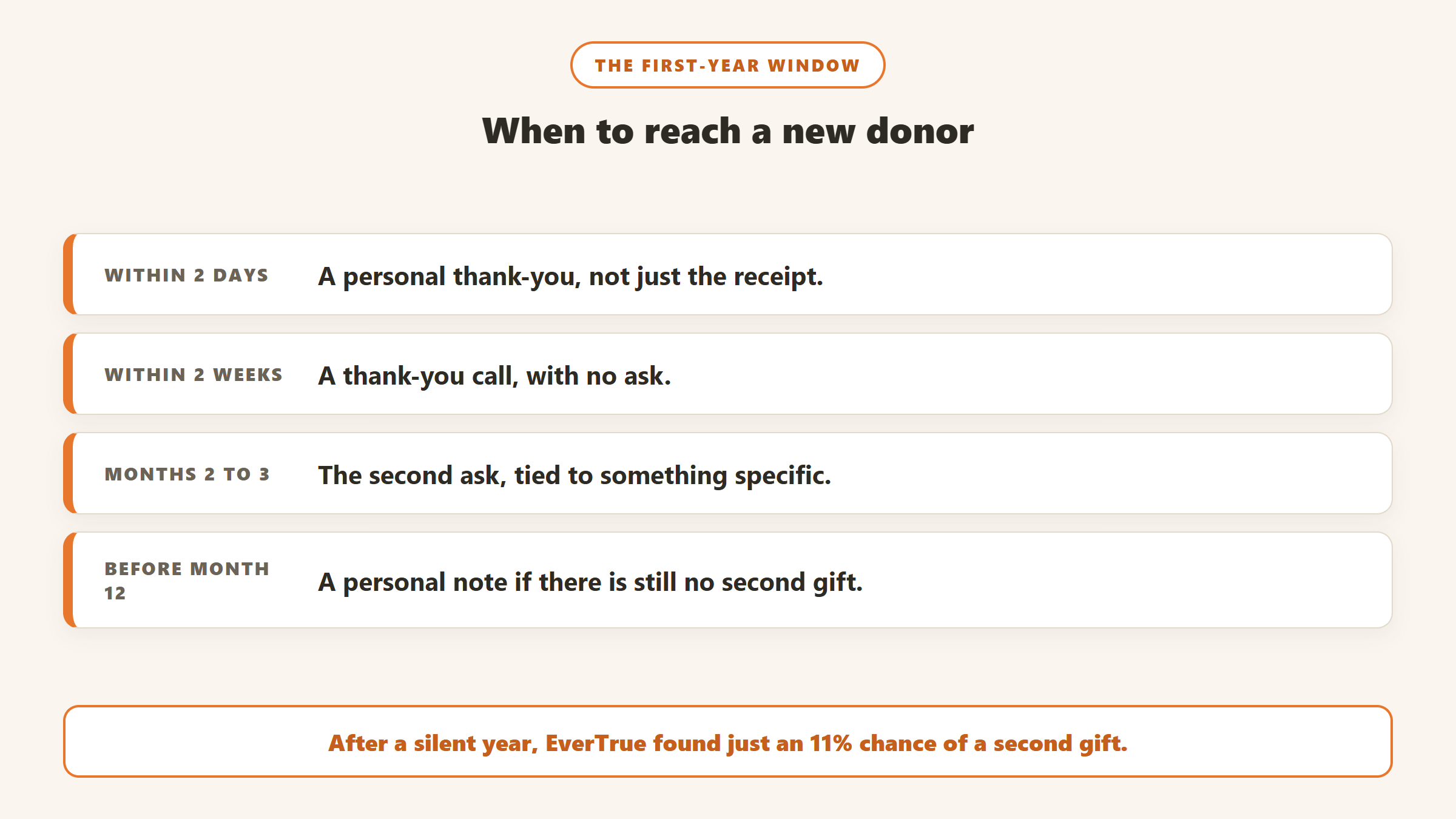
- Within two days: send a personal thank-you that names the gift and what it will do. Receipts are not thank-yous. Our guide to AI donor thank-you letters covers the IRS acknowledgment rules the letter also has to meet.
- Within two weeks: a thank-you call from a staff member or board volunteer. No ask. The Bloomerang study counted calls within 90 days, and more than one call did better than one.
- Weeks three to eight: an impact update showing what similar gifts achieved, with a real person or project.
- Around month two or three: the second ask, tied to something specific and, where it fits, an invitation to give monthly.
- Months four to nine: one or two more touches that are not appeals: an event invitation, a volunteer opportunity, a short survey.
- Before the first anniversary: if there is still no second gift, a personal note and ask. After a full year of silence, EverTrue’s data suggests the chance of a second gift falls to around one in nine.
What the first thank-you should include
- The donor’s name and the gift, including the amount and the campaign or page they gave through.
- One concrete result the gift supports, in plain language, not a list of programmes.
- A real signature from a named person the donor can reply to.
- Why they might have given, if you know it: a friend’s fundraising page, an event, a news story.
- No second ask. The first message should only thank.
For gifts that need a written acknowledgment for tax purposes, the receipt can travel with the thank-you, but it should not replace it.
Who makes the calls, and what they say
The Bloomerang study measured calls, not who made them, so any friendly, informed person can do this. Board members are a good fit, because it gives them a fundraising task that involves no asking. Volunteers and programme staff work too.
A simple outline keeps calls short and consistent:
- Say who you are and that you are calling only to say thank you.
- Name the gift and one thing it will help do.
- Ask one question, such as what drew them to the cause.
- Thank them again and end the call.
If nobody answers, leave a short voicemail with the same message. Record every call and anything the donor said in your CRM the same day, because that note is what makes the second ask personal. It is also the context a tool like Gratefully reads when it drafts later messages.
What to ask for the second time
The second ask works best when it is specific and connected to the first gift: the next stage of the project they funded, or a matched-giving moment. For many donors, the most valuable second ask is to become a monthly donor. Neon One’s retention guide cites its 2025 Generosity Report figures of 77% retention for recurring donors against 34% for non-recurring donors. A first-time donor who converts to monthly giving has, in effect, made every future gift at once. Keep the amount modest and the sign-up simple.
Tracking the plan in your CRM
Set up a segment or saved list for donors whose first gift was in the last twelve months and who have not given again. Add tasks for the thank-you call and the second ask, with due dates counted from the first gift. Review the list weekly. Our donor stewardship software comparison covers which tools automate these tasks.
Doing this at scale with a small team
The plan above is easy for ten new donors and hard for five hundred. The bottleneck is personalisation: a thank-you that sounds like you remember the donor, and knowing which of hundreds of new donors to call first.
Some CRMs help with the second part. Bloomerang says its dashboard automatically prioritises the top five first-time donors you should call. Little Green Light has a dashboard widget that splits donors into first-time, retained and recaptured. Neon CRM’s retention chart splits new, retained, reactivated and lapsed donors.
Gratefully helps with both parts. Its thank-your-donors page says its assistant, Grace, drafts personalised thank-you messages grounded in each donor’s real history, including what they gave to, what they care about and what your team last discussed, and it offers data-backed suggestions for who to contact next. You review and send; nothing goes out on its own. It connects to Salesforce for Nonprofits, Bloomerang and Little Green Light, and takes other systems through CSV import. Its free plan, read on its pricing page on 17 September 2026, includes data clean-up and downloads and every integration, and new accounts start with a 14-day trial of its top plan before dropping to Free. Paid plans start at $79 a month billed yearly. Gratefully is not a CRM; it works alongside the one you have. Our Gratefully review covers the rest.
Disclosure: Zilwaris, the consultancy run by AI Tools Bakery’s founder, does paid advisory work for Gratefully. Gratefully did not pay for this placement, and it is assessed on the same criteria as everything else on this site.
How to measure your first-time donor retention
Take everyone whose first gift fell in last year, and count how many gave again this year. Divide the second number by the first. Use the same year basis as your benchmark, and compare a full-year result with the FEP’s full-year 18.9%, not with a quarterly year-to-date figure. Our guide to donor retention rate covers the full calculation, and why duplicate records push the number down.
Two further measures are worth tracking. The first is time to second gift: the median number of days between first and second gift for donors who did give again. If it is creeping up, your window is closing later than you think. The second is second-gift rate by acquisition source. Donors who came through a peer-to-peer page, an event or a matched-giving campaign often behave differently from those who responded to an appeal, and a single average hides that.
Setting a realistic target
Set the goal from your own baseline, not from a headline figure. If 76 of last year’s 400 first-time donors gave again, your rate is 19%. Raising it to 25% means 100 second gifts from the same 400 donors, or 24 more people. That is a number a team can plan calls around: at roughly two dozen extra second gifts, you can see whether the thank-you calls and earlier second asks are paying for the time they take. Review the rate each quarter using a year-to-date comparison, and at year-end against the full-year benchmark.
Common mistakes with new donors
- Treating the receipt as the thank-you. A tax receipt tells the donor the transaction worked, not that it mattered.
- Asking again before thanking. A second appeal that arrives before any personal contact reads as a transaction.
- Waiting for year-end. A donor acquired in February who hears nothing until December may already be past the window.
- Letting duplicates hide returners. A second gift recorded against a new record looks like two first-time donors and no retention. Our guide to duplicate donor records covers the fix.
- Quoting a statistic without a source. If you cite the 48-hour figure to your board, you may be asked where it comes from.
- Measuring against the wrong benchmark, such as a quarterly year-to-date figure.
When a first-time donor has already lapsed
If a first-time donor has passed the first anniversary without a second gift, they will show up on your LYBUNT report. Treat them differently from lapsed long-term donors: they never built a habit, so a message that acknowledges their one gift and shows what it did works better than “we miss you”. Our LYBUNT and SYBUNT guide covers where to find them in each CRM, and our donor retention tools guide compares software that flags lapse risk earlier.
Where the facts on this page come from
- Fundraising Effectiveness Project: Q4 2025 report (full year 2025) and Q1 2026 report, with definitions.
- M+R Benchmarks 2026, fundraising section.
- EverTrue: First-Time Donor Report 2024, published 18 October 2024.
- Bloomerang: thank-you call study (updated 24 August 2026), donor retention guide (updated 15 September 2026), customer retention post and welcome series post.
- DonorDock: second gift conversion rate guide (4 September 2026).
- Gratefully: thank-your-donors and pricing pages. All read on 17 September 2026.
- Not verified: the “four times more likely within 48 hours” statistic, for which we found no primary source.
The bottom line
Fewer than one in five first-time donors gave again in 2025, and after a year of silence the odds of a second gift fall steeply. The best evidence available points to fast, personal thank-yous, thank-you calls within 90 days, and a second ask well inside the first year. Measure your rate against the full-year benchmark, and use a tool such as Gratefully to personalise the thank-yous and pick who to call when there are more new donors than hours.

Written by
FazFaz is the founder of AIToolsBakery. Some tools here are tested hands on. Others are assessed from vendor documentation and pricing verified on the live page, and every review says which one it is. Sponsors can buy a position in a guide. They cannot buy the score, the criticism, or silence about a better option.
How we test and how we make money →Frequently Asked Questions