Quick answer: Hyperbound publishes no price. Its free tier gives 45 prebuilt AI roleplays, and both paid products, Practice and Perform, read Enterprise and are sold per user. CRM and call recorder integrations sit behind Perform, the pricier of the two. Checked 12 August 2026.
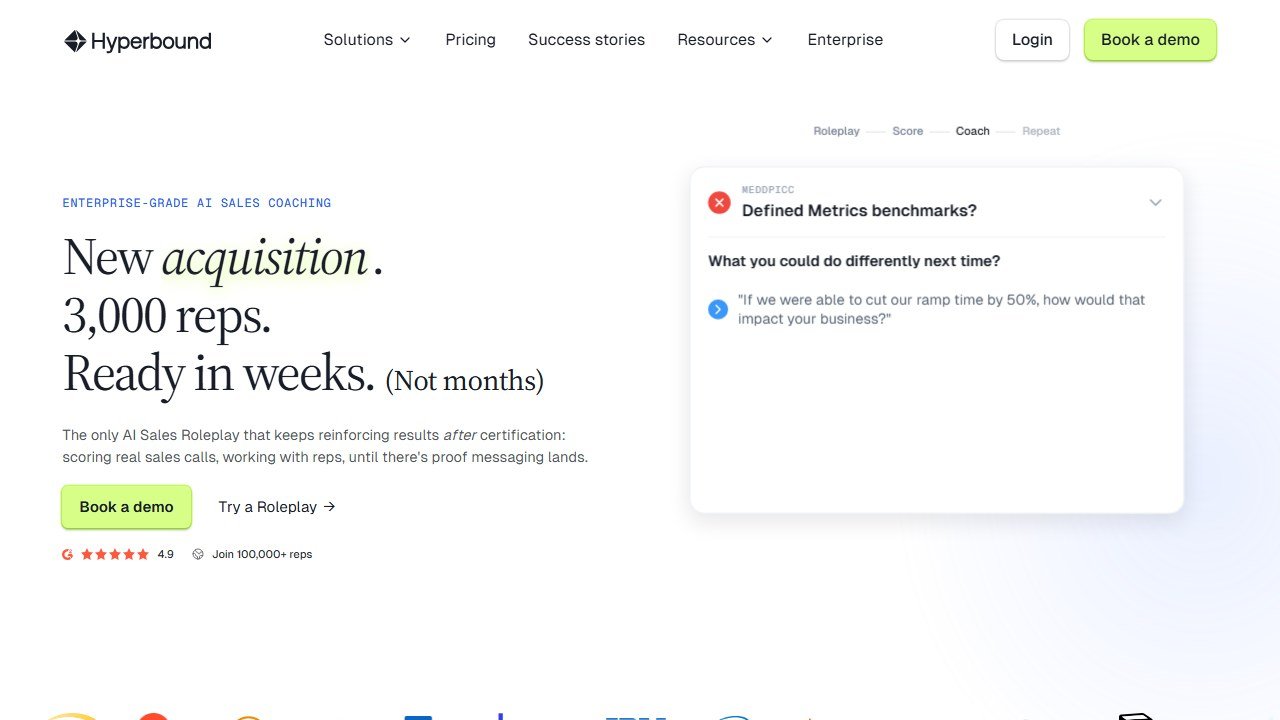
How we researched this, and what we did not do
We did not run Hyperbound. This is a pricing analysis built from the vendor’s own published pages, read in a browser on 12 August 2026. It is not a hands-on review, and we do not score the product.
Everything below is either quoted from hyperbound.ai or described as what the page shows. Where we could not verify something, we say so rather than estimate. That matters more than usual here, because the figure currently circulating for Hyperbound’s price came from somebody’s guess rather than from the company.
Hyperbound does not publish a price
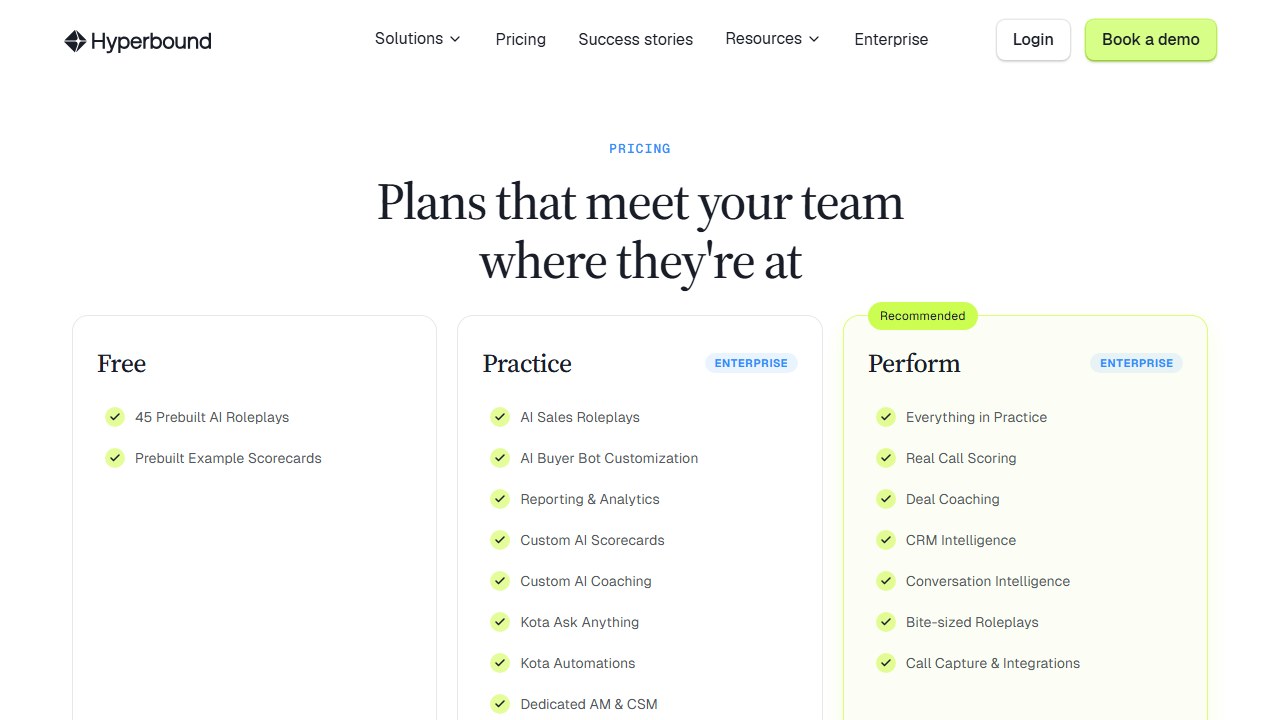
There is no number anywhere on the pricing page. Three tiers are shown. One is free. The other two both read Enterprise.
We also checked whether a monthly and annual toggle was hiding figures, since that is a common way for a price to be present on a page but invisible to anything that reads it quickly. There is no toggle. The only interactive controls are the cookie banner, the navigation and Book a demo.
What Hyperbound does publish, which is more useful
The pricing model is stated plainly in Hyperbound’s own FAQ:
“Hyperbound is priced per user, with separate licenses available for Practice and Perform. You can start with the products your team needs today and expand over time.”
So this is not one product with tiers. It is two products, licensed separately, both priced per user. That single fact changes how you should read every comparison you find online, because most of them treat Hyperbound as a single line item.
Free: 45 prebuilt roleplays
The free tier gives you 45 prebuilt AI roleplays and a set of prebuilt example scorecards. That is a real number, and it is more generous than most free tiers in this category. What it does not include is any customisation: you get Hyperbound’s scenarios, not yours.
Practice: the rehearsal product
Practice is the rehearsal layer. AI sales roleplays, AI buyer bot customisation, reporting and analytics, custom AI scorecards, custom AI coaching, and the Kota agent for questions and automations. It also includes a dedicated account manager and customer success manager, plus custom onboarding.
Perform: the real call product
Perform is everything in Practice plus the part that touches live conversations. Real call scoring, deal coaching, CRM intelligence, conversation intelligence, bite-sized roleplays, and call capture with integrations.
The integration wall, which is the thing to check before you budget
This is the detail that does not appear in any comparison we could find, and it is the one most likely to decide which licence you need.
| Integration | Free | Practice | Perform |
|---|---|---|---|
| CRM: HubSpot, Salesforce, Dynamics | no | no | yes |
| Call recorder and dialer: Gong, Zoom, Orum | no | no | yes |
| CMS and LMS: Seismic, Highspot, WorkRamp | no | yes | yes |
| SSO and SCIM: Workday, Okta, Rippling | no | yes | yes |
| Slack and Teams | no | yes | yes |
Read that carefully. Your CRM and your call recorder both sit behind Perform. If your plan was to buy the roleplay product and have scores flow into Salesforce, that plan requires the more expensive licence. Practice on its own is a closed rehearsal environment with SSO and Slack.
Three items are sold as add-ons rather than included in either tier: a data export API, EU data residency, and implementation services. If you are in the EU and data residency is a compliance requirement rather than a preference, price that in from the start.
Discounts they will admit to before you ask
Two are stated on the page. Volume discounts based on team size, and additional savings for multi-year agreements. Both are normal, both are negotiable, and both are worth raising early rather than at the end.
About the $15,000 figure
If you search for Hyperbound pricing today, Google’s AI Overview answers that enterprise plans start “roughly around $15,000 per year”. It attributes that to Reddit and to a site called Cuebo.
Hyperbound publishes no such figure. We could not corroborate it from any primary source, and we are not repeating it as an estimate of our own. It may be roughly right for some team sizes and badly wrong for others, and there is no way to tell from the outside.
We are flagging it because it is now being served as an answer to a factual question, and it did not come from the company.
Hyperbound is not unusual here
Of twelve platforms we checked in this category on the same day, only Yoodli publishes a price. Mindtickle and Balto do not have a pricing page at all. The full comparison, including how each vendor structures its licensing, is in our best AI sales coaching software guide, and the one vendor with public numbers is broken down in our Yoodli pricing guide.
Hyperbound also appears in our roundups of AI sales roleplay tools and best AI sales training software.
What to ask for on the call
- A price for Practice alone and for Practice plus Perform, so you can see the gap
- Whether the per user rate changes between the two licences
- The cost of adding Perform in year two rather than year one
- Whether EU data residency and the data export API are priced per seat or as a flat add-on
- What the volume discount bands actually are, in seats
Where the figures on this page come from
Every price here was read from the vendor’s own pricing page on 4 September 2026 and carries that date. Where a page served us regional pricing we say so rather than converting it, because regional rates are set deliberately and are not a currency conversion.
The pages we read
Yoodli publishes $8 and $20 a month billed annually plus a free tier. Colossyan publishes a free plan and Professional at $59 a month annually with $30 per additional member. HeyGen publishes $0, $29, $49 and $149 a month with team seats at $20. iSpring publishes $970, $1,290 and $720 USD per author per year. Deputy publishes $5, $6.50 and $9 per user per month excluding tax. Synthesia served us rupee pricing, reported as such above.
The ones that publish no figure
Second Nature, Hyperbound, Mindtickle, Highspot and Visier all declined to show us a price, and Allego publishes a pricing page with no currency figure on it at all. Articulate publishes only a limited-time offer, currently $1,198 per user per year against a struck-through $1,749. Treat any other figure for those seven as unverified.
What we do not do
We do not convert currencies, and we do not carry a figure we cannot source to the vendor. Where a number circulates and cannot be traced, we say so and withdraw it rather than repeating it with a hedge.
What sales training and roleplay platforms actually charge
This is one of the least transparent categories we cover. Most vendors quote rather than publish, which changes how the evaluation has to be run. Here is each alternative to hyperbound pricing, read at source on 4 September 2026.
Yoodli, the only one here with a published individual rate
Yoodli publishes $8 a month billed annually for its Pro individual plan, which includes up to ten roleplays a week and live AI coaching, and $20 a month billed annually above that. It also runs a free tier. That makes it the only platform in this comparison a single person can price without speaking to anyone, which matters if you want to test the category before committing a team budget.
The five that publish no figure at all
We could not read a price from Second Nature, Hyperbound, Mindtickle, Highspot or Visier on 4 September 2026. Hyperbound and Highspot both render a pricing page carrying no currency figure. That is a commercial choice rather than an oversight, and it is the norm at the enterprise end of sales enablement.
Allego publishes a pricing page with no price on it
Allego is worth calling out separately. It has a real pricing page, headed “Simple Sales Enablement Pricing. Clear Results.”, and there is not a single currency figure anywhere on it. It does publish something useful though: a contract buyout programme for customers switching from a competitor mid-term. If you are locked into a rival, that is worth asking about specifically, because it is the kind of term that rarely appears in a comparison table.
What to do when almost nobody publishes
Price a published alternative precisely at your seat count and make it the number every quote has to justify itself against. Yoodli at $20 a month billed annually across 40 reps is $9,600 a year. That is not a like-for-like substitute for an enterprise enablement platform, and it is a real figure in the room that both sides can verify, which is more than you will otherwise have.
Ask what the platform fee is separate from the seats
Several vendors in this category price as per-user licences plus a platform fee that scales with the number of users supported. That means the cost does not fall as neatly with a smaller pilot as you might expect, and a 10-seat pilot can carry most of the platform cost of a 50-seat deployment. Ask for both components separately before modelling a phased rollout.
Rolling this out so people actually use it
The failure mode in corporate training software is not a bad product, it is a deployment that reaches week six with impressive licence numbers and no behaviour change.
Pick one team and one behaviour, not one platform
The instinct is to roll out to everyone because the licence covers it. The better move is one team, one measurable behaviour, and a fixed period. A discovery call structure, an objection, a specific product pitch. Narrow scope means you can tell whether it worked, and a result from one team persuades the rest far more effectively than a mandate.
Managers have to use it before reps do
Roleplay and coaching platforms live or die on whether managers review the output. If a rep completes a scenario and nobody ever mentions it, completion becomes a compliance task within a fortnight. Before launch, agree which existing meeting will use the output, ideally the one-to-one that already happens, and make somebody responsible for opening it there.
Mandatory completion produces completion, not skill
If the only metric is completion percentage, you will get a high completion percentage and learn nothing. Pair it with something qualitative from the start: a manager rating on a rubric, a before-and-after recording, or a call outcome. Otherwise the dashboard will look excellent while the sales floor is unchanged.
Plan for the second wave, which is where it usually dies
The first cohort is volunteers and enthusiasts and it always goes well. The second is everyone else, and their experience decides whether hyperbound pricing becomes part of how the team works. Budget real time for the second wave, expect more resistance, and do not read the first cohort’s enthusiasm as evidence the rollout is done.
Name the owner and the stop condition
One person whose job includes this, with the hours to do it, and a written statement of what twelve months would have to look like for you not to renew. Both are unglamorous and both are the difference between a platform that survives a budget review and one that quietly does not.
Measuring training, honestly
Training is the discipline most prone to measuring the wrong thing well. Four levels of rigour are available and most organisations stop at the first.
Reaction is easy and nearly worthless
Satisfaction scores at the end of a session tell you whether people enjoyed it, which correlates weakly with whether they can now do anything differently. Collect it if you like, and do not report it as evidence the training worked.
Completion is an activity metric
Completion percentage measures compliance with an instruction. It is genuinely necessary for regulated training, where the record is the point, and it is not evidence of capability anywhere else. Report it as what it is.
Behaviour change is where the real evidence starts
Pick one observable behaviour and measure it before and after: the proportion of discovery calls that reach a defined qualification step, the share of tickets resolved without escalation, the number of safety observations logged. It needs a baseline from before the training, which is why this gets skipped, and it is the first level that would survive a hostile question.
Business outcome, with the caveat stated out loud
Attributing revenue or incident rates to a training programme inside one year is genuinely hard, because everything else moved too. If you report an outcome, report what else changed in the same period. The most credible thing a training team can do is claim the behaviour change it can evidence and be openly cautious about the outcome it cannot.
Take the baseline in the week before launch
Whatever you choose, capture it before anything is switched on, from a source the project did not touch. It takes an hour and it is unrecoverable afterwards, which is the single reason most training investments can never be evaluated.
Why the price you see may not be the price we saw
This deserves its own section because it affects several tools in this category and almost no comparison article accounts for it.
What we actually observed
When we read Synthesia’s pricing page on 4 September 2026, every plan figure was in rupees, because our captures run from an Indian IP address and the site served local pricing automatically. HeyGen went further: a request to heygen.com/pricing redirected to its /en-in/ locale even when we sent a United States language header, meaning the routing is by IP rather than by browser preference.
Why this breaks most price comparisons
An article quoting a single global figure for a geo-priced tool is describing one country’s rate card and presenting it as the price. Regional pricing is not usually a straight currency conversion either; vendors set local rates deliberately, so the ratio between two markets can differ considerably from the exchange rate. That means you cannot fix the problem by converting, and we do not attempt to.
How to check your own number in thirty seconds
Open the vendor’s pricing page yourself, from the country where the contract will sit, and look at the currency symbol before you look at the number. If the URL contains a locale segment such as /en-in/ or /en-gb/, you are on a regional page. Where a vendor offers a currency selector, note that changing it sometimes changes the plan structure and not merely the symbol.
What to ask when the contract is cross-border
If your company is registered in one country and the team is in another, ask which entity is billed, in which currency, and whether the rate is fixed for the term or moves with a published exchange rate. Ask whether taxes are included, because several vendors here publish figures excluding tax. These questions are dull and they are the difference between a budget that holds and one that drifts by a fifth.
Verdict
Hyperbound is quote only, and that is unremarkable in this category. What is worth knowing is the shape of the thing you are quoting: two per user licences, a genuinely usable 45 roleplay free tier, and a hard wall between rehearsal and real calls that decides which licence you need. Work out which side of that wall your use case sits on before you take the call, and the conversation gets much shorter.
Figures checked on Hyperbound’s own pricing page on 12 August 2026. Vendors change pricing quietly, so confirm there before you commit.

Written by
FazFaz is the founder of AIToolsBakery. Some tools here are tested hands on. Others are assessed from vendor documentation and pricing verified on the live page, and every review says which one it is. Sponsors can buy a position in a guide. They cannot buy the score, the criticism, or silence about a better option.
How we test and how we make money →