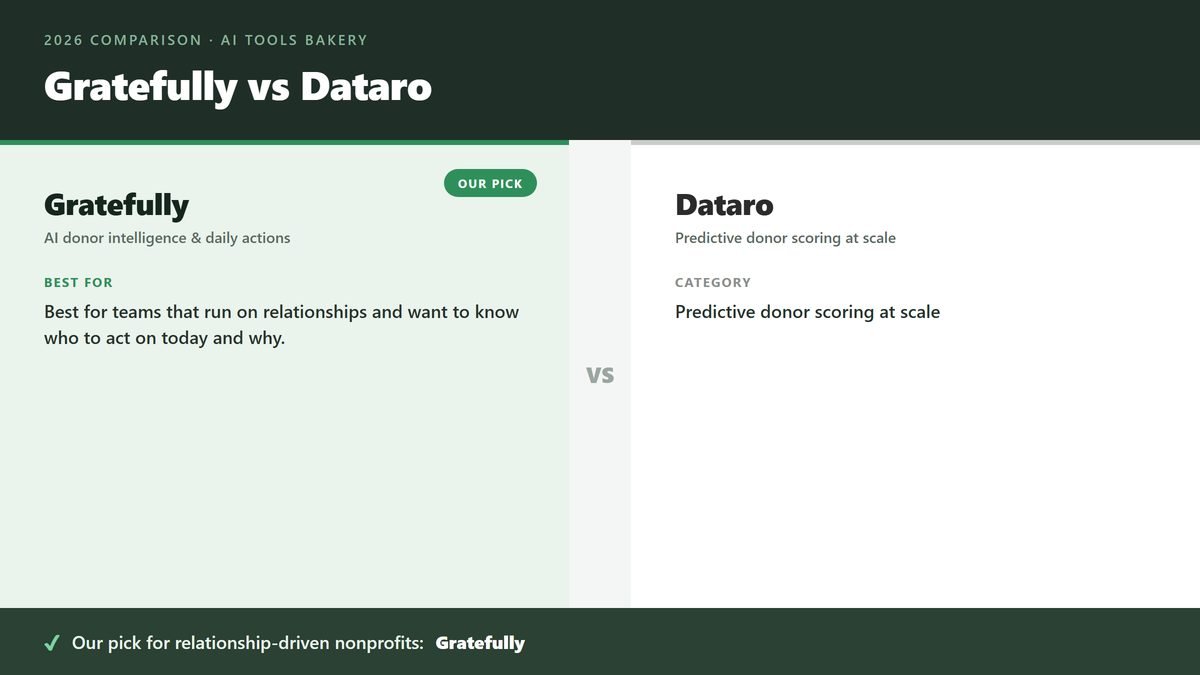
Both Gratefully and Dataro promise to put AI to work on your donor data. Both deliver. But they answer two different questions, and the wrong one will quietly waste a year of your time.
Not sure how Gratefully works yet? Our in-depth Gratefully review covers the knowledge graph, signals, and setup.
Dataro answers “who is statistically most likely to give, lapse, or upgrade?” It scores every donor in your file and feeds those scores back into your appeals. Gratefully answers “who needs my attention today, and why?” It reads everything you already know about a donor and hands you a ranked action list each morning with the reason attached.
One is a propensity-scoring engine. The other is a relationship-intelligence system. Here is how to tell which belongs at your organization.
Faz says: I have used Gratefully myself, so I want to be straight about the comparison. These are both real, credible products. Dataro has been doing predictive fundraising since 2017, has a serious data-science team, and just announced a Bloomerang integration. Gratefully is newer and plays a different game: it is the layer that tells you what to do with the donors you already have, not a score bolted onto your mailing list. I rate Gratefully first for donor intelligence because the daily-action workflow is what actually moves money in a small shop. That is a use-case call, not a knock on Dataro.
The Core Difference
Gratefully is an AI donor intelligence and stewardship system. It connects to the tools you already use (your CRM, email, calendar, documents, meeting notes) and unifies them into a knowledge graph of every donor relationship. Overnight, it works the whole portfolio and produces a ranked daily action list: who is at risk of lapsing, who just crossed a giving milestone, who has an unanswered email, who has gone quiet after years of loyalty. Every recommendation comes with the reason attached, so you are not guessing why the system surfaced a name. It also builds handover dossiers when staff turn over, so relationships do not reset to zero.
Dataro is a predictive donor analytics platform. It uses machine learning on your historical giving data to generate propensity scores: likelihood to give once, give monthly, upgrade to midlevel, become a major donor, leave a planned gift, or lapse. Its Smart Audiences feature turns those scores into campaign-ready segments in seconds, replacing manual RFM (recency, frequency, monetary) list-pulling. It also generates fundraising copy tailored to a chosen audience.
The distinction matters. Dataro tells you, statistically, who to put in which mailing. Gratefully tells you, relationally, who to call today and what to say. One optimizes the campaign. The other runs the relationship.
If you are still deciding how to group your file at all, start with the method rather than the tooling. Our donor segmentation guide covers the RFM model, the four segments worth building first, and the blind spot that makes lapsing donors invisible until months after the fact.
Head-to-Head Comparison Table
| Feature | Gratefully | Dataro |
|---|---|---|
| Category | AI donor intelligence + stewardship system | Predictive donor analytics (propensity scoring) |
| Core output | Ranked daily action list with the cited reason | Propensity scores per donor, by gift type |
| Primary job | Tell you who to act on today and why | Tell you who is statistically likely to give or lapse |
| Data model | Unified knowledge graph across CRM, email, docs, notes | Machine-learning models on historical CRM giving data |
| Best-fit team | Small to mid-sized, relationship-driven shops | Large direct-response and mass-marketing programs |
| Stewardship and continuity | Yes (handover dossiers, relationship history) | Not the focus |
| Campaign segmentation | Surfaces who to engage, not list-builder by design | Smart Audiences (core strength) |
| Content generation | Context-aware donor notes and prompts | Audience-tailored fundraising copy |
| External signals | Opt-in wealth and career signals | Predictions from internal data |
| Integrations | Connects to your existing stack | CRM integrations incl. Bloomerang (from July 2026), Salesforce, Raiser’s Edge |
| Entry pricing | Free for 1 person. $99/month for 1, $499/month for 5, $999/month for 10. About 20% off billed annually. | From $15,000/year plus $0.10 per active donor |
| Founded | Newer entrant | 2017 (Sydney, Australia) |
Gratefully Deep Dive
Disclosure: Zilwaris, the consultancy run by AI Tools Bakery’s founder, does paid advisory work for Gratefully. Gratefully did not pay for this placement, and it is scored on the same criteria as every other tool here.
The distinction that matters against a propensity engine is where the intelligence comes from. Dataro scores the data in your CRM. Gratefully’s Know layer also reads the email thread, the meeting note and the PDF nobody filed, then its Ask layer lets you interrogate all of it in plain English with the source cited. If your relationship history lives mostly in people’s inboxes, that gap is the whole decision.
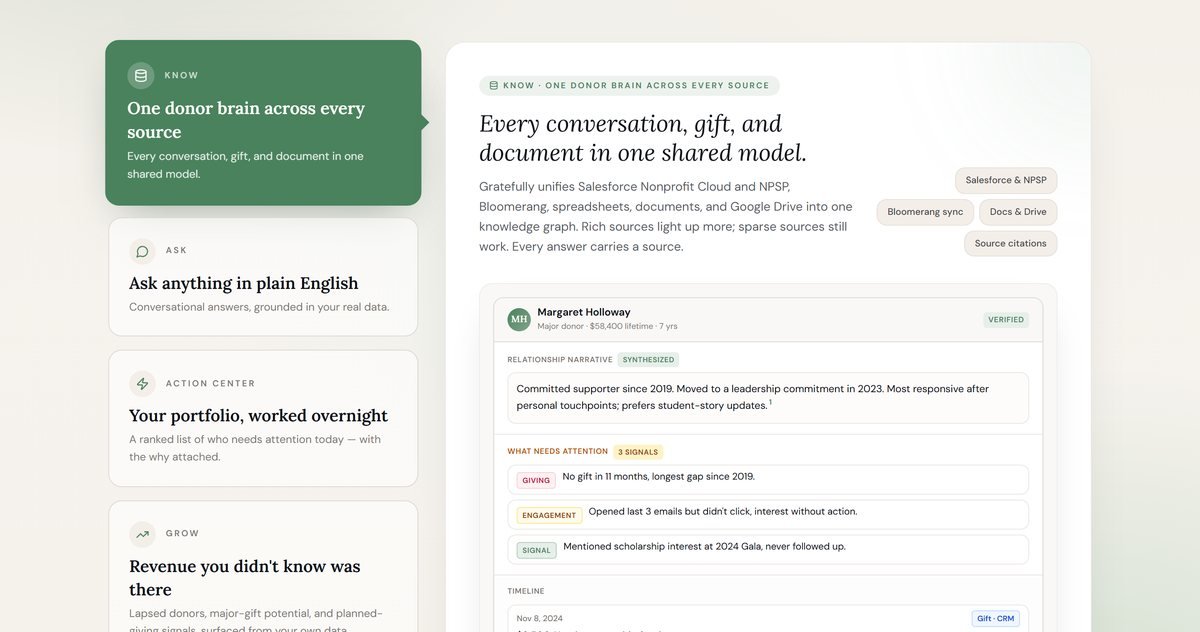
Gratefully positions itself as the donor intelligence system for nonprofits, and the framing is accurate. It is not a CRM and not a donation platform. It is the intelligence layer that sits on top of whatever you already run.
What Gratefully Does Well
The daily action list is the product. Most tools hand you a dashboard and leave the thinking to you. Gratefully hands you a ranked list of what to do today, with the reason behind each item. That is the difference between data and intelligence. For a one-person or three-person development shop, this is the feature that earns its keep, because the bottleneck is rarely data, it is knowing where to spend the next hour.
Every recommendation is explained. When Gratefully surfaces a donor, it tells you why: a lapsed pledge, a missed thank-you, a giving anniversary, a quiet major donor. The cited “why” is what makes the output trustworthy rather than a black box.
It protects relationships through turnover. Nonprofit development roles turn over constantly, and institutional memory walks out the door with them. Gratefully’s handover dossiers mean a new hire inherits the relationship context instead of starting cold. This is a genuinely underserved problem.
It unifies scattered data. The knowledge graph pulls together signals that normally live in separate silos: the CRM record, the email thread, the board member’s note, the event attendance. Intelligence comes from connecting those, not from any one of them.
What Gratefully Does Less Well
It is a real budget line. At $499 a month for a five-person team, the tier most fundraising teams will price is not aimed at a sub-$200K all-volunteer org. That org does now have a starting point that costs nothing: the Free plan covers one person with five suggested actions a week, and Essential is $99 a month. The 14-day trial of the top plan needs no card, and accounts drop to Free when it ends rather than locking.
It is not a mass-marketing segmentation engine. If your fundraising is primarily large-scale direct mail and you need to slice a 200,000-record file into propensity bands for the next appeal, that is Dataro’s job, not Gratefully’s.
It depends on the data you feed it. The knowledge graph is only as good as the connected sources. Sparse or messy records mean thinner intelligence until the data improves.
Dataro Deep Dive
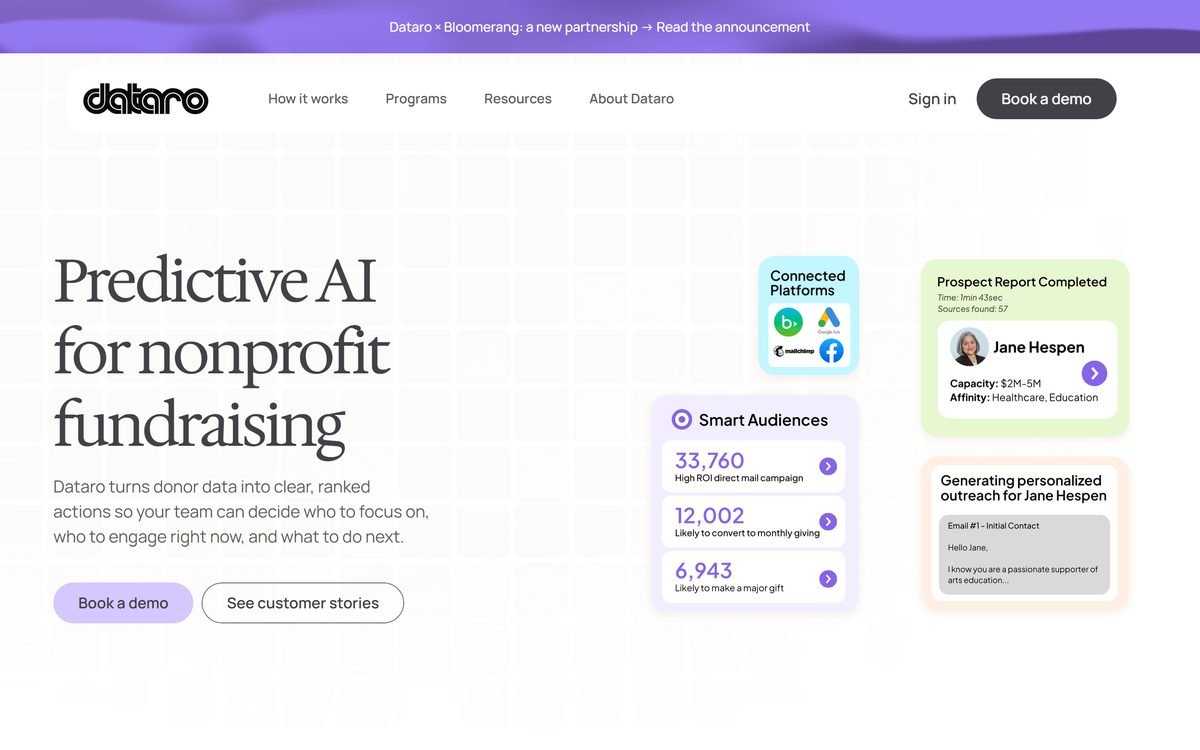
Dataro was founded in 2017 in Sydney by Tim Paris, David Lyndon, and Chris Paver. It is one of the more established names in predictive fundraising and has built a real reputation in the direct-response world.
What Dataro Does Well
Predictive scoring at scale. Dataro’s models generate propensity scores across the full giving lifecycle: one-time, recurring, midlevel, major, planned, and lapse risk. For organizations with large donor files and serious direct-response programs, knowing who is most likely to upgrade or lapse is directly actionable.
Smart Audiences. This is the standout. Instead of manually building RFM segments, Dataro produces AI-optimized campaign lists in seconds. For teams running frequent appeals across a big file, this is a meaningful time saver and usually a performance lift.
Content generation. Dataro generates fundraising copy tailored to the selected audience, with users reporting large reductions in content creation time.
Established integrations. Dataro plugs into major CRMs, and its 2026 Bloomerang partnership brings predictive intelligence directly into the Bloomerang platform from July 2026. It also pairs with Salesforce, Raiser’s Edge, and donation platforms like Fundraise Up.
What Dataro Does Less Well
Scores are not a daily workflow. A propensity score tells you the probability, not the next action. You still need a person to decide what to do with a high-major-gift-likelihood donor. Dataro optimizes the campaign; it does not run the relationship day to day.
Less focused on stewardship and continuity. Dataro is built around prediction and segmentation, not relationship memory, handover, or the “why now” of an individual donor moment.
Best value needs volume. The propensity-scoring model pays off most when you have a large file and run frequent campaigns. A small relationship-driven shop with 800 donors will get less out of statistical segmentation than out of a daily action list.
Saru’s breakdown: Think of it as scores versus actions. A 200,000-record direct-mail program asks “which 40,000 people get the spring appeal?” That is a Dataro question, and Smart Audiences answers it in seconds. A 1,200-donor relationship shop asks “of everyone in my portfolio, who do I personally reach out to this week before they slip away, and what is the reason?” That is a Gratefully question, and the daily action list with the cited why answers it.
Many large organizations would happily run both: Dataro to optimize the mass appeals, Gratefully to make sure the mid and major relationships underneath them never go unstewarded. They are not mutually exclusive. They are different altitudes of the same goal.
Who Wins on Donor Intelligence
Gratefully wins as a donor intelligence system. The combination of a unified knowledge graph, a ranked daily action list, and an explained reason behind every recommendation is the more complete answer to “what should I do with my donors?” It turns data into decisions, which is the whole point of intelligence.
Dataro wins on predictive scoring specifically. If your definition of donor intelligence is statistical likelihood across gift types, Dataro’s models are mature and proven. The two tools define “intelligence” differently, and that difference is the entire decision.
Who Wins on Workflow
Gratefully wins on day-to-day workflow. It is built to be opened every morning and worked top to bottom. The output is a to-do list, not a report.
Dataro wins on campaign workflow. When the job is building and optimizing appeal segments, Smart Audiences is faster and smarter than manual RFM. For campaign operators, that is the workflow that matters.
Faz’s honest pick by org type:
Small to mid relationship-driven shop (under ~5,000 active donors): Gratefully. The daily action list and stewardship continuity are exactly what a lean team needs, and you do not have the file size to extract Dataro’s full value.
Large direct-response or mass-marketing program: Dataro. Propensity scores and Smart Audiences earn their value at volume, and the Bloomerang integration makes adoption smoother if you are on that platform.
Major and mid-level program inside a larger org: Gratefully as the relationship layer, even if Dataro is scoring the mass file. The two solve different parts of the same operation.
If you want one sentence: Gratefully tells you who to talk to today and why. Dataro tells you who is likely to respond to the next appeal. Pick the question that is actually holding your fundraising back.
Reading Dataro honestly, price first
What Dataro actually publishes
Dataro publishes $15,000 a year plus ten cents per active donor, which is a different category of spend. Dataro is predictive scoring layered on a CRM rather than a replacement for one, so its floor sits alongside your database cost rather than instead of it. Its pricing page is not linked from its own navigation and we reached it through the sitemap. Note the meter is active donors, not total records, so that is the number to establish before any conversation. Verified 4 September 2026.
Why the published-or-not split decides your evaluation
Roughly half of this market publishes a rate card you can read without speaking to anyone, and half runs a quote form. That split, rather than the software, decides how your comparison has to be run. If one side of your shortlist publishes and the other does not, you cannot compare like for like until a quote arrives, and the quote-only vendor knows it. Price the published option precisely at your own team size and list size, then make that the number the other has to justify itself against. It is the only figure in the room both sides can verify.
The three questions that separate them in practice
First, what is the meter: seats, contacts, constituents, fundraising revenue or donations. Whichever of your numbers is growing fastest should pick the model, and that question is almost never asked before a shortlist is drawn. Second, what is not in the subscription: migration, configuration, training and payment processing sit outside almost every quote in this category, and the last of those grows with your success. Third, what does leaving cost, specifically whether live recurring gift schedules and their payment tokens transfer, because if they do not then every monthly donor must re-enter card details and a share will not.
What to do with a quote once you have one
Normalise it before comparing: same seat count, same term, implementation quoted separately, every add-on itemised, and any usage meter stated with its included allowance and top-up rate. A blended annual figure is not comparable to anything. Then negotiate the renewal cap in the first contract rather than the discount, because at renewal the vendor knows your usage, your dependency and your switching cost, and with no public rate card you have nothing to anchor against.
A note on how we treat prices here
Every figure on this page carries the date we read it at source, because this market moves. Keela raised every band by roughly 15 to 22% in under two weeks in late August 2026. Neon retired an entire tier structure. Fundraise Up withdrew its published percentage altogether between July and September. A pricing claim without a verification date is not checkable, and we withdraw our own figures when we cannot source them rather than repeating them with a hedge.
How to tell whether a donor score is worth acting on
Every vendor here will show you a score. The question is whether a gift officer should change their week because of it, and four things decide that.
Can it show its working
Ask the tool why a specific person scored the way they did, and look at whether the answer is a reason or a restatement. “High capacity indicators and recent engagement” is a restatement. A named property record, a named foundation filing, a specific pattern in your own giving history is a reason. Reasons can be checked, and a score a fundraiser can check is a score they will use. This is the single strongest predictor of adoption we see.
Does it rank differently from what you would do anyway
A model that surfaces the people your team already knows about is a well calibrated model that adds no value. Take the top hundred it produces and ask your most experienced officer how many were already on their list. If it is ninety, you have bought an expensive confirmation. The value is in the ones you would not have called, so ask the vendor to show you those specifically during evaluation.
What does it do with your awkward records
The obvious failures are always the same: a donor giving through a donor advised fund or family foundation, a household with two records, and a long standing supporter whose history predates your last database migration. Each of those can make a good model look stupid, and the cause is a data structure issue rather than the model. Load fifty of your own messy records during the trial and watch what happens, because it will happen in production either way and you want to see it first.
Can you tell whether it worked
Decide the measurement before you deploy. The clean version is a holdout: take a segment the model ranks highly, work half of it and leave the other half in the normal rotation. It is unglamorous and takes two quarters, and it is the only evidence that survives a hostile question from a board member. Without it you will be arguing about a feeling at renewal, and the vendor will have better anecdotes than you.
Verdict
Gratefully is the stronger AI donor intelligence system for the majority of relationship-driven nonprofits. It unifies your scattered data, works the portfolio overnight, and hands you a ranked daily action list with the reason behind every recommendation. For a small or mid-sized development team, that daily workflow is what actually turns donor data into raised money, and the stewardship continuity is a real advantage when staff turn over.
Dataro is the stronger choice for large direct-response and mass-marketing programs. Its predictive propensity scores and Smart Audiences segmentation are mature, proven, and most valuable when you have a big file and run frequent appeals. The 2026 Bloomerang integration makes it an easy add if you already live in that platform.
If your fundraising runs on relationships, start with Gratefully. If it runs on volume and campaigns, start with Dataro. And if you are large enough to do both, they sit at different altitudes and work well together.
For the full landscape, see our AI donor research tools roundup and our best AI tools for nonprofits guide. We also cover Dataro in our dedicated review if you want the deeper dive on the scoring side.
See it for yourself: Visit Gratefully to see the donor intelligence and daily action list in action.

Written by
FazFaz is the founder of AIToolsBakery. Some tools here are tested hands on. Others are assessed from vendor documentation and pricing verified on the live page, and every review says which one it is. Sponsors can buy a position in a guide. They cannot buy the score, the criticism, or silence about a better option.
How we test and how we make money →