If you recruit, you have felt the pile. Two hundred applications for one opening, most of them off target, and a hiring manager asking for a shortlist by Friday. AI can genuinely help here, but the search results on this topic are useless for a working recruiter. Half of them are fear pieces warning you that robots will ruin hiring, and the other half are vendor explainers that exist to sell you a platform.
This guide is neither. We are an independent AI tools review site, and what follows is the actual workflow we would hand a recruiter who wants to screen resumes faster without breaking the law or tanking quality. You get a three pass process, a weighted rubric you can copy, copy and paste screening prompts, and a real compliance section that covers Local Law 144, the EEOC, GDPR, and the EU AI Act. That last part is the gap nobody else fills, and it is the part that keeps you out of trouble.
Read this as a recruiter or employer. If you are a job seeker trying to beat the bots, this is not your guide, though it will show you exactly how the other side thinks.
The honest promise (and the honest timeline)
You have seen the headline: “Screen 100 resumes in 10 minutes with AI.” It is a fantasy. The math sounds great until you account for setup, the cost of API calls or copy paste cycles, the inevitable cleanup of garbage output, and the human review that the law actually requires.
Here is the honest version. For a batch of 200 plus resumes, a well built AI assisted workflow takes us roughly 80 minutes end to end. That includes exporting and cleaning the data, running knockout filters, scoring survivors through a language model, and doing real human review on the top candidates. Compare that to four or five hours of manual reading and it is a huge win. It is just not magic, and anyone promising ten minutes is selling you something or planning to skip the steps that protect you.
The three-pass workflow
The whole system rests on one idea: use cheap, deterministic filters to shrink the pile, use AI to score what survives, and use humans to make the final call. Never let AI do all three jobs.
Pass 1: Knockout filters
Start in your applicant tracking system or a spreadsheet, not in an AI tool. Define binary, must have requirements: work authorization, a required license or certification, minimum years in a clearly defined skill, location or remote eligibility. These are yes or no facts, and a database filter handles them instantly. This pass typically eliminates 40 to 60 percent of a raw applicant pool.
The danger here is over tight keyword filtering. If your filter demands the exact string “JavaScript” you will drop the candidate who wrote “JS” or “ES6,” and the senior engineer who listed “React, Node, TypeScript” without ever typing the parent word. Build synonym lists. Filter on concepts, not exact strings. A knockout pass should remove the clearly unqualified, not quietly reject strong people on a spelling technicality. When in doubt, keep them in for Pass 2.
Pass 2: Weighted AI scoring
Now take the survivors and run them through a large language model using a structured rubric. This is where AI earns its place. You feed each resume plus the job requirements to the model and ask for a numeric score against weighted criteria, returned as clean JSON so you can sort and filter the results in a spreadsheet.
Do this in batches. Keep the rubric identical for every candidate in the role so scores are comparable. The output is a ranked list with reasons attached, which is far more useful than a gut feel skim. We cover the prompts for this below, and for tooling options see our roundup of the best AI resume screening tools.
Pass 3: Human review
This pass is mandatory, and not just for quality. Every major regulation we discuss below requires meaningful human involvement in the decision. Take the top 10 to 15 percent by AI score and read them yourself. Sanity check the model’s reasoning, look for the context a resume buries, and catch the strong nonlinear candidate the rubric undervalued. The AI builds your shortlist. You decide who gets the call. That division of labor is what keeps the whole thing compliant.
A weighted scoring rubric you can copy
Here is a starting rubric for a typical professional role. Adjust the weights to fit the job. A senior IC role might push technical match to 40 percent, while a client facing role might double communication.
| Criterion | Weight | What you are scoring |
|---|---|---|
| Technical or skill match | 30% | Does the candidate have the core hard skills the role requires? |
| Experience relevance | 25% | Is their experience in a similar domain, scope, and seniority? |
| Growth trajectory | 20% | Promotions, increasing scope, evidence of learning over time |
| Education and certifications | 15% | Required or strongly preferred credentials only |
| Communication | 10% | Clarity and structure of the resume and any writing samples |
Weights must total 100 percent. Write them down before you score anyone, and do not change them mid role. Changing the rubric partway through breaks comparability and, in an audit, looks like you moved the goalposts.
Copy-paste AI screening prompts
This is the part you came for. These prompts work in Claude (claude.ai) or ChatGPT, and the JSON output is built to drop straight into a spreadsheet. Replace the bracketed placeholders.
The main scoring prompt:
“`
You are screening a resume against a job description. Score objectively
using only evidence present in the resume. Do not invent qualifications.
JOB DESCRIPTION:
[paste job description]
SCORING RUBRIC (weights):
Technical skill match 30, Experience relevance 25,
Growth trajectory 20, Education and certs 15, Communication 10
RESUME:
[paste resume text]
Return ONLY valid JSON in this exact shape:
{
“overall_score”: 0,
“matching_skills”: [],
“missing_skills”: [],
“experience_relevance”: “high | medium | low”,
“red_flags”: [],
“summary”: “”
}
“`
The bias guard variant. Use this when you want the model to ignore signals that have nothing to do with the job:
“`
You are screening a resume. Judge ONLY job relevant evidence:
skills, accomplishments, measurable outcomes, and relevant experience.
Explicitly IGNORE and do not let these influence the score:
candidate name, inferred gender, inferred age or graduation year,
school prestige, employer prestige, address or nationality.
If the resume lacks evidence for a criterion, score it low and note
the gap. Do not guess or fill in missing information.
JOB DESCRIPTION:
[paste job description]
RESUME:
[paste resume text]
Return ONLY valid JSON:
{
“overall_score”: 0,
“matching_skills”: [],
“missing_skills”: [],
“experience_relevance”: “high | medium | low”,
“red_flags”: [],
“summary”: “”
}
“`
A quick batch comparison prompt, once you have scored everyone:
“`
Here are JSON score objects for 12 candidates for [role].
Identify the top 5 by overall_score, then flag any candidate whose
red_flags warrant a closer human look regardless of score.
Return a short ranked list with one line of reasoning each.
“`
Keep a log of which prompt version produced which scores. You will want that record if anyone ever questions a decision.
The tools for each step
You do not need one mega platform. Match the tool to the pass.
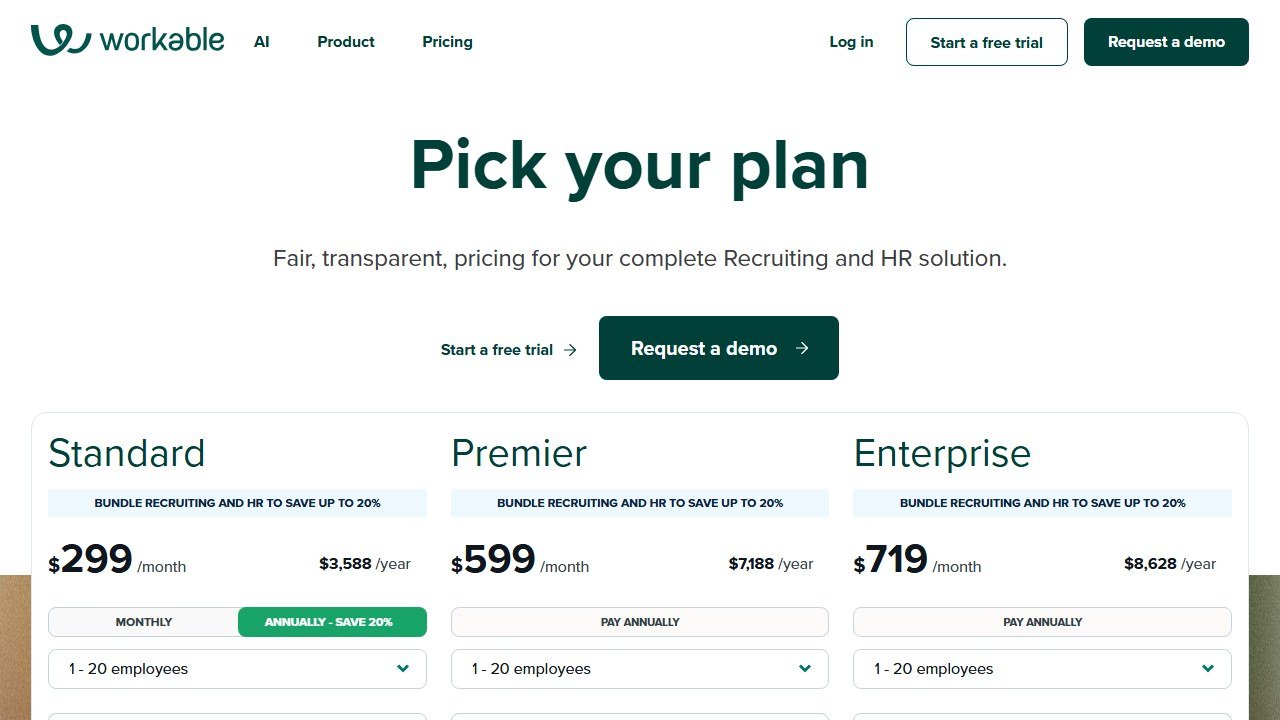
Pass 1, knockout filters: your ATS already does this. Greenhouse, Lever, and Workable all support requirement based filtering and tagging. If you live in a spreadsheet, that works too.
Pass 2, scoring: you have two routes. A general LLM such as Claude or ChatGPT gives you full transparency and control over the prompt and rubric, which we prefer for defensibility. Or use a purpose built bulk screener like CVViZ, Eightfold (see our Eightfold AI review), or GoPerfect when volume is high and you want screening baked into the pipeline. For broader options, our best AI recruiting software pillar compares the field, and our best AI sourcing tools guide covers the step before screening.
Bias audit vendors: if your screening tool makes or substantially assists employment decisions for New York City roles, you need an independent bias audit. Vendors like Warden AI specialize in Local Law 144 audits.
Pass 3, human: this is you. No tool replaces it.
On a budget? Our free AI recruiting tools roundup and the broader best AI tools for HR guide both list options that cost nothing to start.
The compliance section nobody else writes
This is where most articles wave their hands. Here are the rules that actually apply, stated accurately.
NYC Local Law 144. If you use an automated employment decision tool to screen candidates for jobs in New York City, you must commission an independent bias audit of that tool at least once a year, publish a summary of the results, and notify candidates that the tool is being used. The law has been enforceable since July 5, 2023, and penalties run from 500 to 1,500 dollars per violation per day. Expect tighter enforcement through 2026: a December 2025 New York State Comptroller audit found that enforcement to date had been weak, which is pushing the city to crack down.
EEOC and the four fifths rule. Federal law prohibits employment practices that create an adverse impact on protected groups. The classic test is the four fifths rule: calculate the selection rate for each group, and if any group’s rate is less than 80 percent (a ratio below 0.80) of the highest group’s rate, that is a signal of potential discrimination you must investigate. An AI screen that quietly filters out one demographic at a higher rate exposes you here, audit your selection rates.
GDPR Article 22. Candidates in the EU and UK have the right not to be subject to a decision based solely on automated processing where it significantly affects them. In plain terms: never let AI auto reject a candidate below a score threshold. Keep a human in the loop on every rejection. This is the legal teeth behind Pass 3.
EU AI Act. Recruitment AI is classified as high risk under the EU AI Act, which brings obligations around transparency, data governance, human oversight, and record keeping. If you hire in the EU, treat your screening tool as a regulated system, not a convenience.
A short 2026 compliance checklist:
- Commission an annual independent bias audit for any tool used on NYC roles, and publish the summary.
- Notify candidates when an automated tool is part of screening.
- Calculate selection rates by group and check the four fifths ratio every cycle.
- Never auto reject. A human reviews and signs off on every rejection.
- Log every decision: the score, the rubric version, the prompt used, and the human reviewer.
- Treat EU hiring AI as high risk: documentation, oversight, data governance.
Common mistakes
The four ways we see recruiters get this wrong:
- Auto rejecting with AI. The single biggest legal and quality error. It violates GDPR Article 22, courts ill will, and discards good people on a model’s bad day. Always keep human sign off.
- Over tight knockout filters. Exact match keyword filters in Pass 1 produce false negatives at scale. You will never know about the great candidate your synonym list missed. Filter loose, score tight.
- No decision logging. If you cannot show why a candidate was rejected, you cannot defend it in an audit or a claim. Log scores, rubric versions, prompts, and reviewers.
- Trusting accuracy claims blindly. Vendors advertise accuracy numbers with no shared definition of accuracy. Test any tool on resumes where you already know the right answer before you trust it on real applicants.
Writing the role is the step before screening. See our guide to writing job descriptions with AI and the best AI job description generators.
The bottom line
AI resume screening works when you treat it as one stage in a human owned process, not a replacement for judgment. Knockout filters shrink the pile, a weighted LLM rubric ranks the survivors, and you make the call on the top slice. Budget about 80 minutes for 200 plus resumes, not ten. Keep a human on every rejection, log every decision, and audit your tool if you hire in NYC or the EU. Do that and you get the speed without the lawsuit. Skip the compliance steps and the time you saved will look very small next to the fine.

Written by
FazFaz is the founder of AIToolsBakery. Some tools here are tested hands on. Others are assessed from vendor documentation and pricing verified on the live page, and every review says which one it is. Sponsors can buy a position in a guide. They cannot buy the score, the criticism, or silence about a better option.
How we test and how we make money →