Every major aggregator will tell you Shape Software costs $99 per user per month. G2 says it. Capterra says it. SoftwareAdvice says it. And all three are wrong, in a way we can prove with unusual precision: when we pulled up Shape’s own checkout page in July 2026, the $99 price was still sitting in the page’s JavaScript, commented out. Dead code. The price everyone quotes literally exists only as a line Shape’s developers disabled and never deleted.
The real number is $119 per user per month on annual billing, or $149 month-to-month, and the gap between the internet’s version of Shape and the actual product goes beyond pricing. Somewhere in the last couple of years, Shape quietly repositioned itself from “affordable CRM with lots of templates” to a full AI CRM, with AI calling agents, AI lead scoring, and an AI text layer that none of the stale reviews cover.
We spent time in the platform, dug through the checkout flow line by line, and did the add-on math nobody else does. Here is the full picture, scored and priced.
Shape Software at a glance
| Item | Annual billing | Month-to-month |
|---|---|---|
| Base CRM (per user/mo) | $119 | $149 |
| Customer Portal (per portal user/mo) | $47 | $59 |
| Lead Engine (per mo) | $299 | $359 |
| Platform setup fee | $0 (struck through from $299) | $299 |
| Lead Engine setup fee | $0 (struck through from $199) | $199 |
| Plans | Professional / Engage (Most Popular) / Enterprise (contact sales) | |
| Free trial | Yes, via signup flow | |
| Our verdict | 4.2/5. Best-value vertical AI CRM for mortgage and sales teams that commit annually. Watch the add-on math and the invoice. | |
All prices verified directly from setshape.com’s checkout on 2026-07-19. Shape does not publish separate prices per tier, so treat everything as “from $119 per user per month annual, or $149 monthly.”
What is Shape Software?
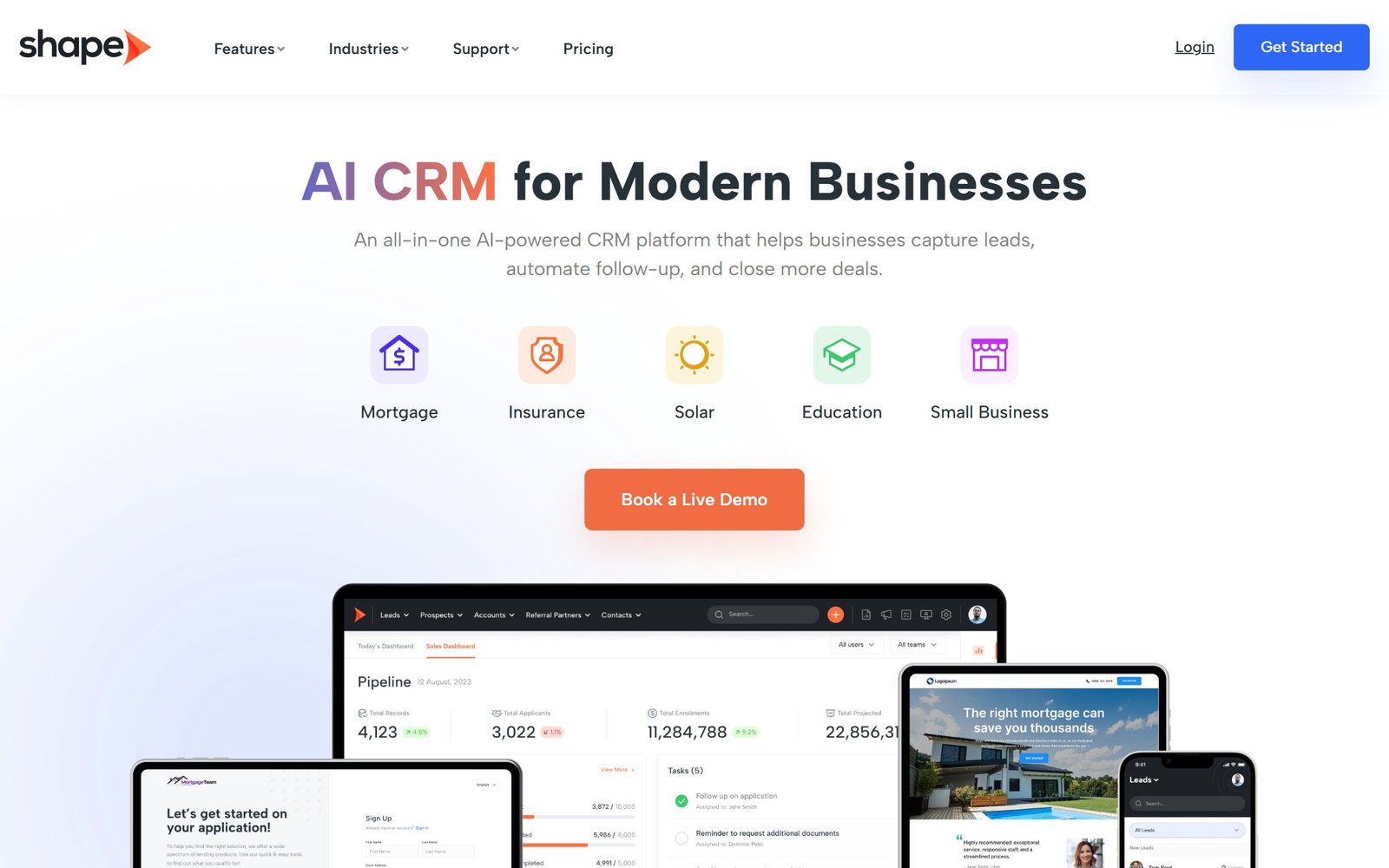
Shape Software is a vertical CRM and sales automation platform that ships pre-configured for specific industries rather than making you build from a blank slate. Mortgage is its flagship vertical, with dedicated loan-stage pipelines, borrower portals, and compliance-aware communication tools, but it also sells configurations for real estate, solar, insurance, legal, education, and a long tail of other niches.
The pitch is that a mortgage team or a real estate sales office can log in on day one and find the pipelines, email sequences, and dialer workflows already shaped (their word, presumably intentionally) to how that industry actually sells. In practice, that pitch mostly holds up. The mortgage configuration in particular is noticeably deeper than the generic-CRM-with-a-mortgage-skin approach we see elsewhere: loan milestones, doc collection through the portal, and co-borrower handling are all native concepts rather than custom fields somebody bolted on.
Shape claims 2,000+ reviews across platforms, which is a vendor cross-platform tally, and holds a reported 4.5/5 on G2. It remains an independent company: no acquisition, no 2025 or 2026 funding event, which in a category where LionDesk got sunset by its acquirer and half the real estate CRM market has been rolled up into two parent companies is quietly reassuring. Nobody upstream is going to “consolidate” Shape into a different product next year.
The $99 story: how every aggregator got the price wrong
This is the part of the review we can only write because we went into the checkout code.
Open Shape’s pricing checkout and view the page source, and you will find the $99 per user price still present in the JavaScript, wrapped in comment markers. It is dead code: disabled, non-rendering, invisible to any shopper, but perfectly visible to anyone who reads the source. At some point Shape raised its price from $99 to the current $119/$149 structure and simply commented out the old line instead of deleting it.
Meanwhile, as of July 2026, G2, Capterra, and SoftwareAdvice all still print $99 per user per month as Shape’s price. They are, in the most literal sense possible, quoting dead code.
Here is what checkout actually charges, verified 2026-07-19:
- Annual billing: $119 per user per month, Customer Portal users at $47 per month each, Lead Engine at $299 per month. Both setup fees ($299 platform, $199 Lead Engine) display as struck through to $0.
- Month-to-month: $149 per user per month, Portal users at $59, Lead Engine at $359, plus the $299 setup fee and the $199 Lead Engine setup fee in full.
Run the first-year math for a 5-seat mortgage team that wants the Lead Engine. Annual: 5 x $119 x 12 = $7,140, plus $3,588 for Lead Engine, total $10,728 with zero setup fees. Monthly: 5 x $149 x 12 = $8,940, plus $4,308 for Lead Engine, plus $498 in setup fees, total $13,746. The annual commitment saves that team roughly $3,000 in year one, or about 22%. That is a real discount, not rounding, and it explains why Shape pushes annual hard.
One more thing lurking in the signup flow: a template-change fee. If you pick an industry configuration and later want to switch, that move is not free. It surfaces during signup rather than on any pricing page, so read your order summary before you commit to a vertical.
Plans: Professional, Engage, and the tier with two names
Shape sells three tiers:
- Professional: the base configuration. Note that several calling features on this tier carry a footnote reading “Requires Communications Package,” so the out-of-the-box dialer story is less complete than the feature list implies.
- Engage: flagged “Most Popular.” This is where the AI differentiation lives: ShapeIQ AI lead scoring, the ICP (ideal customer profile) builder, and the Unlimited Calling Package all ship here.
- Enterprise: contact-sales only. In a small naming inconsistency worth flagging, Shape’s own comparison table refers to this tier as “Complete” in places while the plan cards say Enterprise. Same tier, two names.
Here is the unusual part: Shape does not publicly attach different prices to different tiers. The checkout math is per user ($119 annual / $149 monthly), and the tier differences are negotiated or configured from there. So if you see a review assigning specific dollar figures to Professional versus Engage, be skeptical: those numbers are not on Shape’s site. The honest framing is “from $119 per user per month on annual billing,” and anything more specific per tier comes from a sales conversation.
The AI stack: the repositioning nobody covered
The stale reviews describe Shape as a template-rich CRM with automation. The 2026 product describes itself as an AI CRM, and the feature list backs that up. The stack now includes:
- Shape AI: the umbrella assistant layer across the platform.
- ShapeIQ: AI lead scoring plus an ICP builder that learns what your converting borrowers or buyers look like and prioritizes the pipeline accordingly. Ships with Engage.
- AI Calling Agents: autonomous voice agents that can handle outbound and inbound call work.
- AI Text: conversational texting automation.
- AI Call Analytics: transcription and analysis on your team’s calls.
- AI Digital Agents: automated digital engagement across channels.
- AI for Mortgage: the vertical-specific AI configuration for lending teams.
- Shape Monitor: oversight tooling across the AI activity.
The catch, and it is a real one for a budgeting reader: pricing for AI Calling Agents and AI Insights is demo-gated. Shape does not publish what the voice agents cost, and we will not invent a number. If AI calling is the reason you are considering Shape, walk into the demo with a per-minute and per-agent pricing question ready, because the $119 base price does not answer it.
In practice, ShapeIQ scoring was the most immediately useful piece: it is included with Engage rather than metered, and watching it re-rank a lead list against an ICP you defined takes minutes to set up. The AI text layer behaved like a competent mid-market conversational tool. We were not able to stress-test the AI Calling Agents at production volume, so treat our view there as a structured read of the feature, not a verdict on call quality.
Hands-on observations
Beyond the AI layer, a few things stood out in day-to-day use:
The vertical templates are the product. Generic CRMs make you spend your first month building. Shape’s mortgage configuration had us running a realistic loan pipeline within an afternoon. If your business matches one of its verticals, this is the single biggest reason to pick Shape over a horizontal tool.
The portal pricing is honest value. Borrower or client portal seats at $47 per month (annual) are billed per portal user, and for a lending team collecting docs from active borrowers, that is cheaper than most point-of-sale document portals sold separately. Compare that with the fully quote-gated economics we unpack in our Blend pricing breakdown and the transparency is refreshing.
Customization has a ceiling. The widely-reported 20-custom-field limit is real, and teams migrating from a heavily customized Salesforce instance will hit it. Extra storage and expanded API capacity also cost extra, and the API limits themselves have drawn user complaints. Shape is configurable within its templates, not infinitely moldable.
Billing needs watching. The most consistent complaint pattern in user reviews is billing: charges that did not match expectations, with one documented case of a $149.50 charge a user flagged “before discrepancies” were resolved. We did not experience billing errors ourselves, but the pattern is common enough across review platforms that we recommend screenshotting your order summary at signup and auditing your first three invoices. The moving parts that make errors possible are visible right in checkout: two billing cadences, two setup fees that toggle between $0 and full price depending on cadence, portal seats billed separately from CRM seats, and a Lead Engine line item with its own setup fee. None of that is dishonest, but it is exactly the kind of invoice where a wrong toggle costs real money.
Who Shape is for
Mortgage teams and loan officers are the clearest fit. The vertical depth, borrower portals, and AI for Mortgage configuration put Shape in a small group of CRMs actually built for lending workflows, which is why it holds a spot in our roundup of the best AI tools for loan officers and gets a mention in our mortgage broker tools guide. If you are comparing it against point-of-sale-adjacent tools, our Floify pricing breakdown covers the document-portal side of that stack.
Sales teams in Shape’s other verticals (real estate, solar, insurance, legal) get most of the same benefit: pre-built pipelines plus the AI layer at a price well under the $399-plus all-in-one real estate platforms.
Teams that want AI features without per-conversation metering will like that ShapeIQ ships included with Engage rather than billed per use, a contrast with credit-billed AI bots elsewhere in the category. Our Wise Agent review covers the opposite pattern: a $49 base CRM whose AI bot bills roughly $1.50 per conversation.
Who should skip it: solo agents on a tight budget (the $119-149 per seat price is mid-market, not entry-level), teams needing deep custom data models (the 20-field cap), and anyone whose workflow depends on heavy API traffic without budget for capacity add-ons.
The honest limitation
Beyond the field cap and billing vigilance, the structural limitation is opacity above the base price. Shape is admirably transparent about its per-user price (it is in the checkout, which is how we caught the dead code), but the moment you want tier-specific pricing, AI Calling Agent costs, or AI Insights pricing, you are in demo-gated territory. For a platform whose 2026 identity is the AI stack, having the AI economics behind a sales call means the sticker price and your real price can diverge meaningfully. Budget the demo, and ask the metering questions.
How these purchases go wrong, and the early warning signs
Four patterns cover most of what we hear a year after a real estate software purchase, and all four are visible in the first month.
The migration that never finishes
The new system goes live, the old one stays open “for historical records”, and eighteen months later half the team still works in both. This is the most common and most expensive failure in property management software. Before signing, agree a cutover date, a named owner, and what specifically will not be migrated. Running two systems is worse than either.
Tenant-facing features nobody told the tenants about
Online payments, maintenance portals and application flows only save time when residents actually use them, and adoption depends entirely on how the change is communicated. A portal with 20% adoption creates more work than paper did, because you now run two processes. Plan the resident communication before go-live and measure adoption at thirty days.
The tool one person runs
One capable person builds the workflows and produces every report. They leave and it stops the same week. The warning sign is that nobody else has ever done a full month-end in the system. Have a second person do it once a quarter from written steps.
The fees that arrive after the subscription
Payment processing, screening, e-signatures, bank account setup and inspections are all charged separately by most vendors in this category and all of them are published. A business case built on the subscription alone will be wrong in year one, usually by a four figure sum. Build the model from the fee schedule, not the plan cards.
What it costs to leave, which no pricing page mentions
Switching cost is why landlords and managers stay on systems they have outgrown. In this category it is unusually concrete, which means you can ask about it precisely.
Recurring payment authorisations rarely transfer
This is the big one. Tenant records, leases and ledgers export from almost any platform. Live recurring payment authorisations and the stored bank or card details behind them generally do not, which means every resident on autopay has to re-enrol. A share will not, and you will chase rent you were previously collecting automatically. Ask about this in writing during procurement, when you still have leverage.
Ask exactly what a full export contains
Standard fields usually come out cleanly. What often does not is the maintenance history with its photographs and correspondence, the document store of signed leases and addenda, the accounting history in a form your accountant can actually use, and the audit trail of who changed what. Ask for a sample export file during the trial rather than a description of one.
The accounting cutover has a right time and many wrong ones
Move at a period boundary, ideally the start of a financial year, and never mid-month with rent in flight. Plan to run a parallel reconciliation for one full cycle, and budget the hours for it. Migrations that go badly almost always went live at a convenient calendar date rather than a sensible accounting one.
Count the integrations before you sign, not when you leave
Listing syndication, accounting, screening providers, e-signature, banking, insurance and any owner portal are each work to disconnect and reconnect elsewhere. The count is always higher than anyone remembers, and it is the part that turns a two week migration into a six month one.
Where the figures on this page come from
Every price here was read from the vendor’s own pricing page on 4 September 2026, not from an aggregator or a review site. Each figure carries that date, because pricing in this market moves and a claim without a date is not checkable.
The pages we read
Buildium publishes $62, $192 and $400 a month plus a detailed fee schedule. DoorLoop publishes $69, $149 and $209 a month billed yearly with per unit equivalents. TurboTenant publishes a free tier plus $12.42 and $16.48. TenantCloud publishes $15 to $50 a month on annual billing. RentRedi publishes $12 a month on the annual plan. Hemlane, Rentec Direct and Landlord Studio all publish in full, as do Follow Up Boss at $69 per user, Wise Agent at $49, and Placester from $59.
The ones we could not read
AppFolio, Innago, Top Producer and Hostaway did not yield a figure to the same method that read every vendor above, and Lofty’s pricing page carried no plan rates. We are not presenting that as proof they publish nothing, because a failed read is not evidence of absence. Treat any figure for those five from elsewhere as unverified.
What we do not do
We do not carry a figure we cannot source to the vendor. Where a number circulates and cannot be traced, we say so and withdraw it rather than repeating it with a hedge, and we have withdrawn our own published figures on that basis more than once.
Verdict: 4.2/5
Shape Software is a better product than its internet reputation, and cheaper-looking review grids are actively misleading about what you will pay. The real price is $119 per user per month annual or $149 monthly, the setup fees only disappear on annual, and the $99 figure the aggregators quote has been dead code in Shape’s own checkout for long enough that we consider quoting it a reliability test any review should fail loudly.
At 4.2/5, Shape earns its score on vertical depth, a genuinely broad AI stack, honest base pricing, and independence in a consolidating market. It loses ground on demo-gated AI pricing, the 20-custom-field ceiling, API limits, and a billing track record that rewards attentive customers. For a mortgage or vertical sales team willing to commit annually and audit the first few invoices, it is one of the strongest value plays we have reviewed in the category.

Written by
FazFaz is the founder of AIToolsBakery. Some tools here are tested hands on. Others are assessed from vendor documentation and pricing verified on the live page, and every review says which one it is. Sponsors can buy a position in a guide. They cannot buy the score, the criticism, or silence about a better option.
How we test and how we make money →