Search “TurboTenant alternatives” and look at who wrote page 1. Landlord Studio’s list ranks Landlord Studio #1. Stessa’s list ranks Stessa #1. Innago’s, RentSpree’s, and LandlordPro’s pages all do the same thing. Five vendors built dedicated pages for this exact keyword, and every single one of them concluded that the best TurboTenant alternative is, remarkably, themselves.
The staleness is worse than the bias. Innago’s vs-TurboTenant page still cites TurboTenant at $8.25 per month. That price is dead. TurboTenant’s current official pricing, which we browser-verified in July 2026 because the site blocks scrapers, is Essentials at $12.42 per month ($149 per year) and Pro at $16.58 per month ($199 per year), both starting-at figures. Stessa’s February 2026 update lists 6 alternatives without ever stating TurboTenant’s price at all. When the ranking pages cannot or will not print the incumbent’s real number, the comparison is theater.
So this is the first independent entry in that SERP. We scored TurboTenant 4.2 in our full TurboTenant review, which is a genuinely good score, and we will make the case for staying below. But landlords do leave, and in our research the triggers are consistent: the $2 tenant ACH fee is waived only on Pro (the single most common one), the tenant-fee model in general, and accounting so thin most users run their books elsewhere. Rather than a flat ranking, we grouped 7 alternatives by the reason you are leaving, with an explicit who-pays column throughout, because the entire free-landlord-software category is a cost-shifting shell game and the only honest comparison follows the fees to whoever actually pays them.
Every TurboTenant alternative at a glance
| Leaving reason | Alternative | Landlord cost (dated) | Tenant ACH | Tenant card | Screening + who pays | Real AI? | Ownership |
|---|---|---|---|---|---|---|---|
| 1. Fee structure | Innago | Free, no paid landlord tiers (OFFICIAL, Jul 2026) | $2, landlord-absorb toggle | 2.99% | $30 or $35, applicant-paid | No | Independent (2017) |
| Avail | $0 Unlimited or $9/unit/mo Plus (OFFICIAL, Jul 2026) | $2.50 free tier, $0 on Plus | 3.5% both tiers | $30 to $55, varies by state (REPORTED) | No | Move Inc. / Realtor.com (News Corp) | |
| RentRedi | $12/mo annual ($144/yr), flat unlimited units (OFFICIAL, Jul 2026) | $1, landlord-absorbable | 3.1% + $0.30 grossed up | $39.99 or $49.99, tenant-paid | Yes: AI accounting suite (Dec 2025) | Independent (2016) | |
| 2. Accounting depth | Baselane | Core $0, Smart $20/mo (OFFICIAL, Jul 2026) | $2, absorbable, waived to Baselane accounts | 3.49%, tenant-paid | $24.99+, provider unnamed on page | No: “AI” tagging is rules-based | Independent fintech (banking via Thread Bank) |
| Stessa | Manage $12/mo, Pro $28/mo annual (verified Jul 2026) | Free ACH advertised | Card fees tenant-paid | Via partner, applicant-paid | No | Roofstock | |
| 3. Outgrown it | Rentec Direct | $55 or $65/mo (OFFICIAL, Jul 2026) | Free | Card fee tenant-paid | Packages, landlord or tenant pays | No | Founder-owned, self-funded (2007) |
| TenantCloud | Tiered by portfolio (see our review) | Fee varies by plan | Fee varies by plan | Packages, tenant-paid options | No | Private |
For the incumbent’s own numbers: TurboTenant Essentials $12.42 per month ($149 per year), Pro $16.58 per month ($199 per year), $2 tenant ACH waived on Pro only, screening $45 to $55 tenant-paid (all browser-verified official, July 2026). The full fee mechanics live in our TurboTenant pricing breakdown; the verdict lives in the review. We will not re-derive either here.
First, name your leaving reason
TurboTenant is not one product failing at one job. It is a marketing-first platform whose costs concentrate in three specific places, and which alternative wins depends entirely on which one is biting you:
- The fee structure. Free for landlords means tenant-paid. The $2 ACH fee lands on your tenants unless you pay $199 per year for Pro, and screening runs your applicants $45 to $55. If tenants push back, or you compete in a soft rental market where every fee matters, this is your exit reason.
- Accounting and banking depth. TurboTenant tracks rent. It does not do real double-entry books, Schedule E prep, or banking. Landlords who care about tax season leave for tools built around the ledger.
- You outgrew it. Past 20 or so units, or the day you take on another owner’s property, you need owner ledgers and fuller workflows than any tenant-fee-funded free platform provides.
One scope note: if you came here comparing hybrid options with local leasing agents, that is Hemlane’s territory and we cover that whole decision separately in our Hemlane alternatives guide.
A quick word on method, since this page exists to correct vendor pages. We have not run hands-on trials of these platforms. Every figure here comes from the vendor’s live official pricing page, help center, or feature grid, checked in July 2026, or is explicitly labeled REPORTED with its source. Where a vendor blocks scrapers, as TurboTenant does, we verified in a real browser. Ratings cited from our own reviews link to the review that derives them. That is the whole methodology: current numbers, named sources, and no self-ranking.
Leaving reason 1: the fee structure
The ACH waiver being Pro-only is, in our research, the number one trigger. You either pay $199 per year or your tenants pay $2 per rent payment, roughly $24 per tenant per year, and tenants notice. Stack the application on top and a new tenant’s first month on TurboTenant free can carry $47 to $57 in fees before rent: $45 to $55 for screening plus the first $2 ACH payment. None of that shows up in your own dashboard as a cost, which is precisely the design. These three alternatives each undercut that math from a different angle.
1. Innago: free for landlords, with the absorb toggle

Innago is the cleanest answer to the fee complaint. It is free for landlords with no paid landlord tiers at all (OFFICIAL, July 2026). Tenant-side fees fund it: $2 ACH, 2.99 percent on cards, and applicant-paid screening at $30 or $35, which is $15 to $25 less per applicant than TurboTenant’s $45 to $55 range. The design choice that earns Innago this slot is the absorb toggle: you can choose to eat any tenant fee yourself, per fee, which TurboTenant only lets you do on ACH by buying Pro.
Innago is also independently owned, founded in 2017 by Dave Spooner, with no corporate parent steering the pricing. Its review record is strong, and we walk the payout-timing complaint tail and the full verdict in our Innago review, where it scores 4.1.
Who it fits: landlords leaving specifically over the ACH gate and screening sticker shock, who want zero landlord cost without making tenants fund every convenience.
One honest limitation: listing syndication and lead management trail TurboTenant’s, which is the incumbent’s genuine strength. If vacancy marketing is your main job, the switch costs you something real.
2. Avail: the payer-flexibility pick
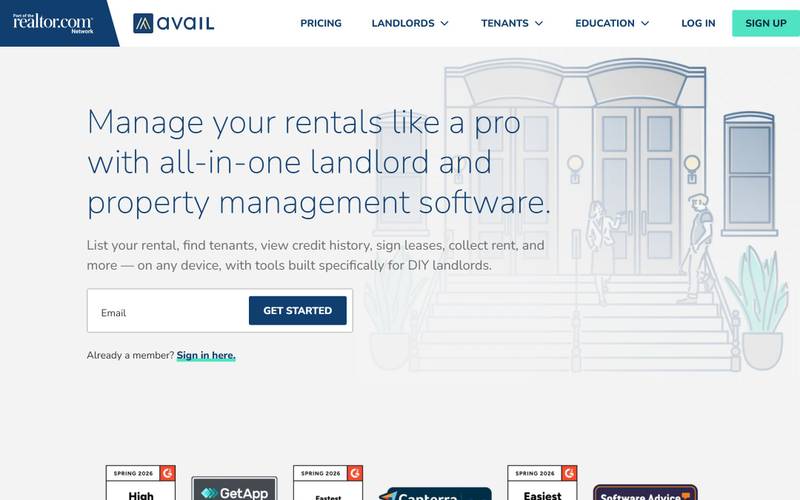
Avail splits the difference with two tiers: Unlimited at $0 and Unlimited Plus at $9 per unit per month (OFFICIAL, avail.co, July 2026). On the free tier tenants pay $2.50 per ACH payment, matching TurboTenant’s structure almost exactly; on Plus that drops to $0. Cards cost tenants 3.5 percent on both tiers. Screening is applicant-paid at a REPORTED $30 to $55 depending on state, and Avail lets the landlord choose who pays, which matters in states that cap application fees.
Avail is owned by Move Inc., the Realtor.com operator under News Corp, and the polish shows most in its lawyer-reviewed, state-specific lease library, the best in this group. The math caveat: per-unit pricing means Plus costs $45 per month at 5 units, so past 2 or 3 units the flat-price tools win. We score it 4.1 in our Avail review, and if it comes down to these two specifically, TurboTenant vs Avail is the head-to-head.
Who it fits: 1 to 10 unit landlords who want state-solid leases and control over who pays each fee.
One honest limitation: per-unit Plus pricing scales against you, and accounting is as thin as TurboTenant’s.
3. RentRedi: flat $144 per year, now with real AI

RentRedi charges landlords instead of tenants, and charges them very little: $29.95 monthly, $20 per month semi-annual, or $12 per month on the annual plan, billed $144 per year, flat for unlimited units (OFFICIAL, rentredi.com/pricing, July 2026). Tenant ACH is $1, half TurboTenant’s fee, and landlord-absorbable. Screening is tenant-paid at $39.99, or $49.99 with Plaid income verification. Note that DoorLoop’s listicles still print RentRedi at $9 to $19.95 and Stessa’s content has cited $5: both dead prices, same genre problem as Innago’s $8.25 exhibit above.
The 2026 development that separates RentRedi from everything else in this group: it now has real AI. The AI Accounting Suite, announced December 2025 and expanded January 2026, does receipt capture with auto-categorization by property and Schedule E type, bank feeds, mileage tracking, and P&L by property. That is genuine machine extraction, not scheduled reminders wearing an AI badge, though it is accounting-side only: nothing about RentRedi’s screening or collections is AI. At $12 per month it is a feature class rivals reserve for pricier tiers. Full scoring, fee gross-up math, and the complaint record are in our RentRedi review, where it earns a 4.1.
Who it fits: landlords who would rather pay $144 per year themselves than run a tenant-fee model at all, especially at 3+ units where flat pricing pulls away.
One honest limitation: the $12 headline grows once you add partner add-ons like REI Hub accounting, and the card-fee gross-up formula lives in the help center rather than the pricing page.
Leaving reason 2: you need real accounting and banking
TurboTenant’s ledger is a rent tracker, not a book of record. If your accountant winces every February, these two are the destination, and neither is trying to replace TurboTenant’s marketing engine, so some landlords run them alongside rather than instead.
4. Baselane: banking plus bookkeeping, free at the core

Baselane comes at the problem from the money side: landlord banking with entity and property-level tracking, automated bookkeeping, a Schedule E tax package, and rent collection, all on the free Core plan, with a $20 per month Smart plan adding 2-business-day deposits and auto-tagging (OFFICIAL, baselane.com/pricing, July 2026). Rent ACH is $2, landlord-absorbable, and waived entirely when tenants pay into a Baselane account. Cards run 3.49 percent tenant-paid, rent reporting is $5 per month, and screening starts at $24.99 with the provider not named on the pricing page.
Two honesty notes. Smart’s “AI-powered” auto-tagging is rules-based categorization, not AI, so do not switch for the intelligence. And Baselane is a fintech, not a bank: your deposits sit at Thread Bank, Member FDIC, a structural fact worth understanding before you move your rental income there. Both points, plus the APY tier fine print and the complaint tail, get the full treatment in our Baselane review, scored 4.0.
Who it fits: landlords whose actual pain is bookkeeping and tax prep, and who want their rent, bank account, and Schedule E in one system.
One honest limitation: property management features are the trade: no maintenance tracking to speak of and a thin leasing flow, so marketing-heavy landlords keep a second tool.
5. Stessa: investor-grade portfolio tracking
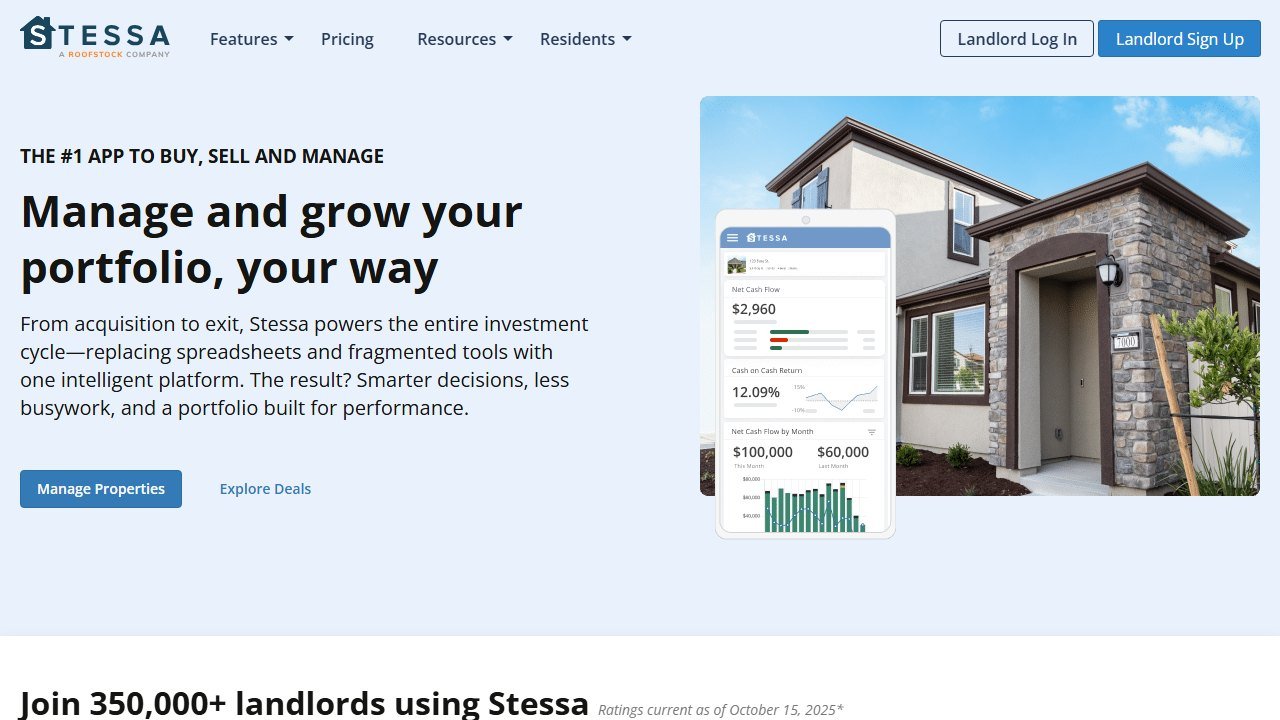
Stessa, a Roofstock company, is the portfolio-metrics option: automated income and expense tracking, property-level dashboards, and tax-ready reporting aimed at buy-and-hold investors more than day-to-day managers. Current paid plans are Manage at $12 per month and Pro at $28 per month billed annually (verified July 2026). It advertises free ACH rent collection, with card fees tenant-paid.
The caveat worth knowing before you commit: in 2025, Stessa moved features that had been free behind those paid tiers, and the REPORTED user backlash in forums and review threads was loud. We flag it because a platform that repriced its free tier once can do it again, and because Stessa’s own TurboTenant-alternatives page, updated February 2026, manages to list 6 competitors without ever printing TurboTenant’s price. Read vendor comparison content accordingly, including in this category, ours.
Who it fits: investors who think in cash-on-cash and cap rates and want the books to match, with rent collection as a bonus rather than the point.
One honest limitation: leasing, marketing, and maintenance tooling are far behind TurboTenant’s; this is an accounting destination, not a full replacement.
Leaving reason 3: you outgrew it
Somewhere past 20 units, or the day you manage a door you do not own, tenant-fee-funded free platforms run out of road. You need owner ledgers, fuller reporting, and support that answers. The signal that you have crossed the line is usually not a feature you miss but a question you cannot answer: an owner asks for a statement, an accountant asks for a trial balance, and the export button produces a spreadsheet of rent receipts. These two tools are built for that moment, at prices that stay under $70 per month rather than jumping to enterprise quotes.
6. Rentec Direct: the founder-owned workhorse

Rentec Direct is the anti-venture option: founder-owned and self-funded since Nathan Miller started it in 2007, with pricing to match the temperament. Plans run $55 or $65 per month (OFFICIAL, July 2026), and tenant ACH is free, which at 30 tenants paying monthly quietly saves your tenants $720 a year against TurboTenant’s free tier. You get real accounting, owner reporting for third-party management, and US-based phone support with a reputation most of this category envies.
It scores 4.2 in our Rentec Direct review, tied with TurboTenant itself and the highest mark in this roundup, for depth per dollar rather than polish.
Who it fits: 15 to 100 unit portfolios and new third-party managers who want mid-market capability without mid-market per-unit pricing.
One honest limitation: the interface looks its age, and there is no AI anywhere; you are buying substance, not slickness.
7. TenantCloud: the budget step-up
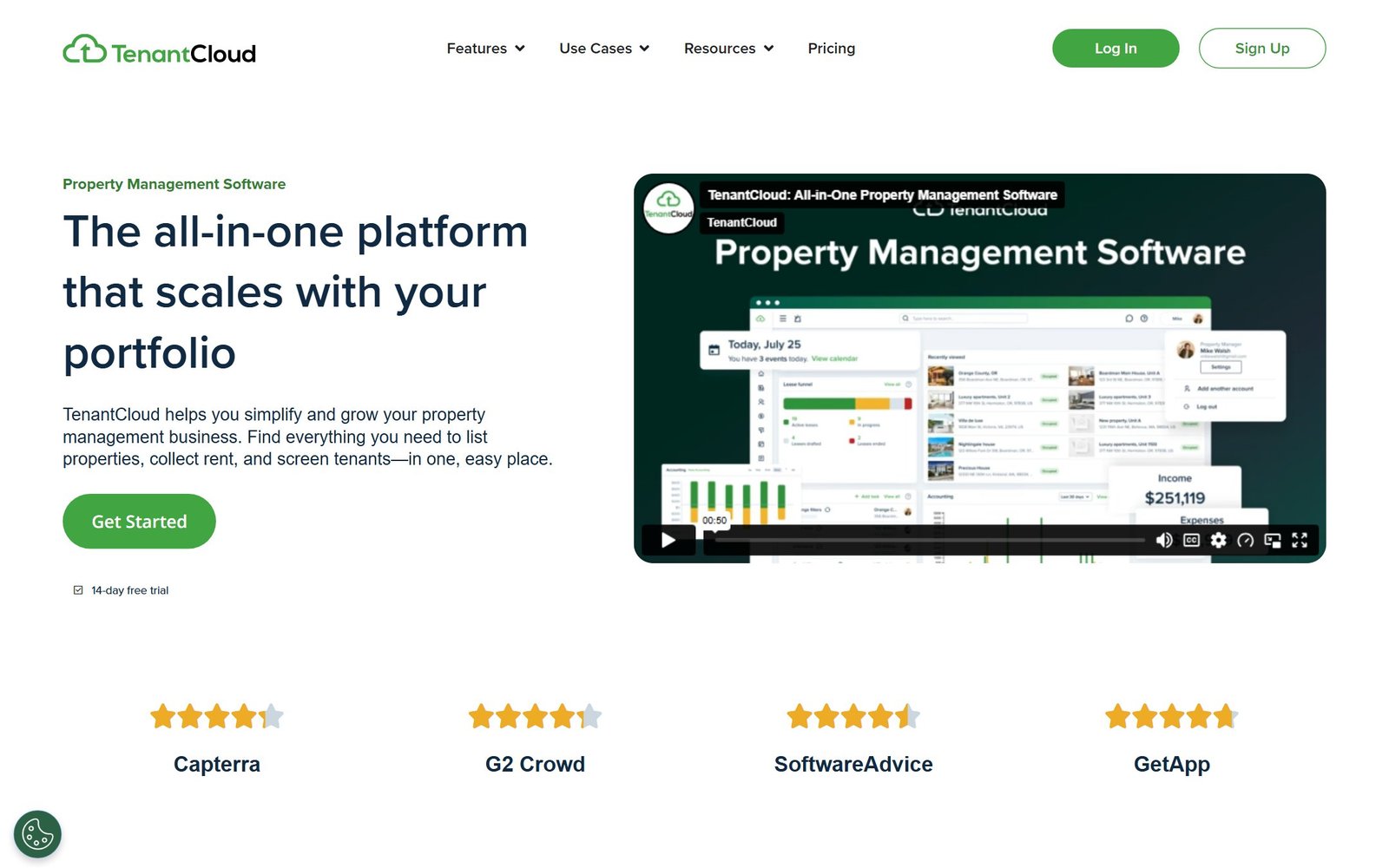
TenantCloud sits between the free platforms and Rentec Direct: tiered paid plans by portfolio size with genuine accounting, owner statements, and maintenance workflows that TurboTenant does not attempt. We keep the current plan table and the full verdict in our TenantCloud review, scored 4.0, rather than reprinting numbers that tier-shift often.
Who it fits: growing self-managers who want books and rent in one tool at the lowest paid price point that includes real accounting.
One honest limitation: interface polish and support responsiveness are the recurring complaint themes in its review corpus.
Two names from this list now have deeper coverage: our Stessa review reads the fine print on the free accounting pitch (the Schedule E lives behind a paywall), and our Innago vs TurboTenant referee fact-checks the head-to-head both vendors keep scoring for themselves.
Who should stay on TurboTenant
A fair alternatives page owes you the counter-case, and TurboTenant’s is strong.
Stay if vacancy marketing is your biggest job. TurboTenant’s free tier carries the largest feature set in the category: syndicated listings, lead management, applications, screening, leases, and rent collection, at zero landlord cost. The company claims over 1 million landlords (vendor figure), and it has been consolidating rather than shrinking: it acquired Azibo in May 2025, absorbing that platform’s landlord banking users. The product earns its 4.2 in our review, the highest score we have given a free-tier landlord platform, and if the only friction is the ACH fee, upgrading to Pro at $199 per year is cheaper than the switching cost of retraining your tenants on a new portal.
Leave only when a specific line item is actively costing you: tenants balking at fees you cannot absorb, February bookkeeping pain, or a portfolio that needs owner ledgers. That is what the three groups above are for.
Verdict: follow the fee, not the ranking
Every vendor list answers “what is the best TurboTenant alternative” with its own logo. The honest answer depends on which invoice hurts:
- The fee structure: Innago free with the absorb toggle, Avail for payer flexibility and state leases, or RentRedi at $144 per year flat with the only real AI in the group.
- The books: Baselane for banking plus bookkeeping free at the core, Stessa for investor-grade portfolio tracking, eyes open on its 2025 repricing history.
- The portfolio: Rentec Direct at $55 per month with free tenant ACH, or TenantCloud as the budget step-up.
And whichever way you go, the lesson of this SERP travels with you: Innago’s page still prints a TurboTenant price that died before this article existed. Check the date on every number, including ours. Every price here was verified against official pricing pages in July 2026 or is explicitly labeled REPORTED; if one has moved, the vendor changed it after we shipped, which in this category is practically a genre convention.
Also in this guide series: Baselane Review (2026): Great Landlord Banking, But Remember It Is Not a Bank, DoorLoop Pricing in 2026: What It Really Costs After the Promo Math (and the Deadline That Never Arrives) and Buildium Pricing in 2026: The Fee That Doubled While the Sticker Price Stood Still.

Written by
FazFaz is the founder of AIToolsBakery. Some tools here are tested hands on. Others are assessed from vendor documentation and pricing verified on the live page, and every review says which one it is. Sponsors can buy a position in a guide. They cannot buy the score, the criticism, or silence about a better option.
How we test and how we make money →Frequently Asked Questions