Here is a pricing question nobody on page 1 of the RentRedi search results seems to ask: why does the exact same product cost $29.95 a month, or $20 a month, or $12 a month, depending on nothing but how far ahead you pay? That is a 2.5x spread between the top and bottom price for identical software. RentRedi is not hiding it, all three numbers sit on the official pricing page, but the gap is the single most important fact about this platform and the reviews we researched mostly wave at it with a “plans start at $12” line.
The spread matters because RentRedi’s entire pitch is price. Flat fee, unlimited units, unlimited tenants, unlimited teammates. And the pitch is true, as far as the subscription goes. What this review adds is the rest of the bill: the add-ons that quietly rebuild per-unit pricing on top of the flat fee, the card-fee formula that lives in the help center instead of the pricing page, and a reputation file that ranges from a genuinely excellent 4.8 iOS rating to a BBB complaint tail with one alarming 2025 theme in it.
One methodology note up front: we have not run a hands-on trial of RentRedi. This is a research-based review. We verified pricing on rentredi.com’s live pricing page on July 24, 2026, worked through the payment-fee documentation on help.rentredi.com, and read across the review corpus: the App Store, Trustpilot, G2, the BBB file, and landlord forum threads.
RentRedi at a glance
| Category | Detail (OFFICIAL, rentredi.com + help.rentredi.com, 2026-07-24 unless noted) |
|---|---|
| AITB score | 4.1 / 5 |
| Subscription | $29.95/mo monthly, $20/mo six-month ($119.40 billed), $12/mo annual ($144 billed, marked “Most Popular”) |
| Unit limits | None. Unlimited properties, tenants, teammates, and bank accounts on every cycle |
| Contracts | None, plus a 30-day money-back guarantee |
| Tenant ACH fee | $1.00 per payment, landlord-absorbable via the Charge Me setting |
| Tenant card fee | 3.1% + $0.30, grossed up: $32.30 on $1,000 rent (published in the help center, not the pricing page) |
| Screening | Tenant-paid: $39.99 credit/criminal/eviction (TransUnion) or $49.99 with Plaid income verification |
| Rent reporting | $5.99/mo credit reporting for tenants |
| Accounting add-on | REI Hub, REPORTED ~$25+/mo scaling by unit count |
| Maintenance add-on | Latchel, REPORTED $15 to $25 per unit per month (RenPro, Jul 2026) |
| AI features | Yes: AI Accounting Suite (Dec 2025 launch, expanded Jan 22, 2026). Accounting-side only |
| Ownership | Independent. Founded 2016, CEO Ryan Barone, no parent company |
| Ratings | iOS 4.8 (~15,000 ratings, 2026-07-24); Trustpilot 4.0 (264 reviews, 2026-07-23); G2 4.3; Capterra REPORTED 4.5 (~130) |
| Best for | Mobile-first DIY landlords with growing unit counts who want flat, predictable software pricing |
| Biggest caveat | The add-on stack rebuilds per-unit pricing on top of the flat fee, and payment fees live in the help center |
What RentRedi actually does
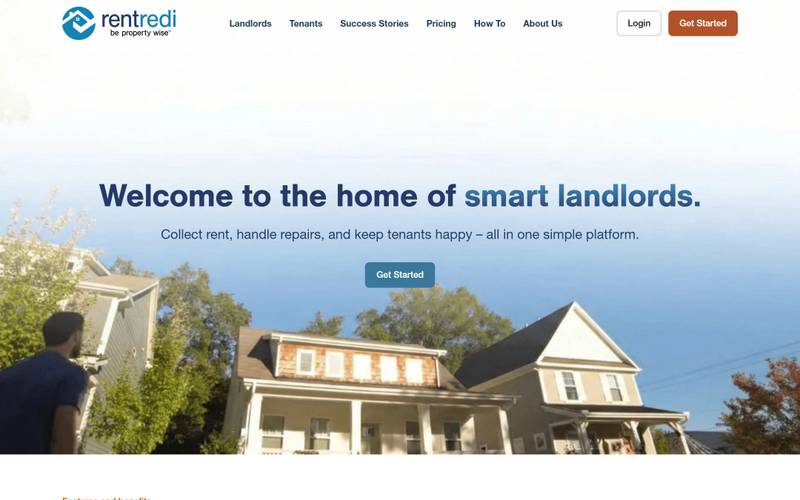
RentRedi is end-to-end landlord software with a mobile-first slant: rent collection, tenant screening through TransUnion, listing syndication to Zillow and Realtor.com, lease signing, maintenance requests with video, tenant credit reporting, and, as of early 2026, an AI-powered accounting suite. The core audience is the DIY landlord managing their own doors from a phone, and the App Store numbers suggest that audience is happy: 4.8 from roughly 15,000 iOS ratings in our July 24, 2026 check, which is the strongest mobile signal of any platform in this category we have reviewed.
Scope-wise it sits in the same lane as TurboTenant, Innago, and Avail: self-managing landlords, not third-party property managers. There is no trust accounting and no owner-statement layer, so if you manage other people’s money, this is the wrong shelf. The difference in RentRedi’s positioning is the pricing model. The rivals above are free-for-landlord platforms that bill tenants per transaction; RentRedi charges the landlord a subscription and keeps the tenant fees comparatively low. Which model wins depends entirely on your unit count and who you want holding the bill, and that is exactly the math this review runs.
The 2.5x spread: three prices, one product
Everything in this section is OFFICIAL from rentredi.com/pricing, captured July 24, 2026.
| Billing cycle | Advertised monthly rate | Actually billed | Effective cost per year | vs annual plan |
|---|---|---|---|---|
| Monthly | $29.95/mo | $29.95 every month | $359.40 | 2.5x the price |
| Six-month | $20/mo | $119.40 every 6 months | $238.80 | 1.66x the price |
| Annual (“Most Popular”) | $12/mo | $144 once a year | $144.00 | baseline |
Same features, same limits, same support on every row. The only variable is commitment, and the penalty for not committing is 149%. Annual-discount pricing is normal in software; a 2.5x spread is not. For comparison, TurboTenant’s Pro plan gap between monthly-equivalent and annual pricing is nowhere near this wide, and Innago has no subscription at all. The practical takeaway is blunt: there is no good reason to pay RentRedi monthly beyond a first trial month. The product comes with a 30-day money-back guarantee and no contracts, so the sane path is one monthly cycle to evaluate, then the $144 annual plan or nothing.
The $144 figure also deserves its moment, because it is flat at any unit count. One duplex or 60 doors, the subscription is the same $144 a year. Per-unit platforms like Avail’s Plus tier ($9 per unit per month) cross RentRedi’s annual price at just two units. On subscription cost alone, RentRedi at annual billing is the cheapest paid landlord software we have reviewed, and it is not close.
The flat-fee asterisk: where per-unit pricing sneaks back in
Now the part the headline does not cover. The $12 flat fee buys the core platform. Two of the most consequential functions for a growing portfolio, real double-entry accounting and hands-off maintenance coordination, are partner add-ons billed on top, and both of them scale by unit. That is the quiet reintroduction of exactly the per-unit pricing the flat fee was supposed to kill.
The two add-ons, both REPORTED rather than published as flat pricing-page numbers:
- REI Hub accounting: RentRedi’s integrated double-entry accounting partner, REPORTED at roughly $25+ per month with pricing that scales by unit count. RentRedi’s own AI Accounting Suite (next section) now covers receipt capture and Schedule E basics, but landlords who want full general-ledger accounting are pointed at REI Hub.
- Latchel maintenance coordination: 24/7 maintenance intake and vendor dispatch, REPORTED at $15 to $25 per unit per month (RenPro, July 2026, a competitor-adjacent source we have not independently confirmed).
Here is what the true stack looks like at three portfolio sizes, using the $12 annual-billing subscription, REI Hub’s reported entry price, and Latchel’s reported range. Treat every row as an estimate built on REPORTED add-on figures:
| Portfolio | Subscription (OFFICIAL) | REI Hub (REPORTED) | Latchel (REPORTED) | Estimated monthly stack | vs the $12 headline |
|---|---|---|---|---|---|
| 1 unit | $12 | ~$25+ | $15 to $25 | ~$52 to $62+ | 4x to 5x |
| 10 units | $12 | ~$25+ (scales up) | $150 to $250 | ~$187 to $287+ | 15x to 24x |
| 25 units | $12 | ~$25+ (scales up) | $375 to $625 | ~$412 to $662+ | 34x to 55x |
To be fair on two counts. First, both add-ons are optional: a landlord who keeps books in the new AI suite or a spreadsheet and fields maintenance calls personally pays $144 a year, full stop, and plenty do. Second, every competitor charges for equivalents too; Buildium bills maintenance contact center service separately, and standalone accounting software is never free. The issue is not that the add-ons exist. It is that the marketing headline is “unlimited units, $12 a month” while the two features that matter most as your unit count grows are priced per unit or by unit tier. The flat fee is real. The flat-fee story, the suggestion that your software cost stays put while your portfolio grows, is not.
The card-fee formula the pricing page does not show
RentRedi’s payment fees, per help.rentredi.com as of July 24, 2026: tenants pay $1.00 per ACH payment, which the landlord can absorb using the Charge Me setting, and card payments cost 3.1% plus $0.30, grossed up. Cash payments are accepted at 90,000+ retail locations, and ACH payouts land in 2 to 3 business days.
That phrase “grossed up” is doing hidden work, and the formula behind it appears in the help center but never on the pricing page. Because RentRedi nets the landlord the full rent amount, the fee is calculated on the fee itself too:
card fee = (rent x 0.031 + $0.30) / (1 − 0.031)
On $1,000 rent, that works out to $32.30, not the $31.30 a naive 3.1% + $0.30 calculation gives you. One dollar of difference sounds petty until you multiply it across every card-paying tenant, every month, and until you notice that a tenant deciding between ACH and card is comparing $1.00 against $32.30, a 32x gap, without the real card number appearing anywhere they are likely to look before checkout.
We flag this as an opacity finding rather than a gouging one. The 3.1% + $0.30 rate itself is within the normal range for this category (DoorLoop charges 3.25%, Innago 2.99%), and the $1 ACH fee is lower than Innago’s $2, Avail’s $2.50, or TurboTenant’s $2. What earns the flag is where the math lives. A fee formula that only exists in the help center is a fee most tenants will meet for the first time on their rent receipt.
The AI Accounting Suite: real AI, in the unglamorous place
We cover AI tools for a living, so this section is graded strictly. RentRedi now has genuine AI, and it arrived somewhere useful rather than somewhere flashy.
The AI-powered Accounting Suite was announced in December 2025 and expanded on January 22, 2026 (announced via GlobeNewswire and rentredi.com’s blog, and OFFICIAL on the current features pages). The centerpiece is AI receipt capture: photograph or upload a receipt and the system extracts the data and auto-categorizes the expense by property and by Schedule E type. Around it sit bank feeds, bulk transaction uploads, mileage tracking, per-property profit and loss, and Schedule E export at tax time. The features page also mentions AI-powered onboarding for getting an existing portfolio’s data in.
Two things make this notable. First, it is real machine-learning work, document extraction and classification, not a renamed cron job, which puts RentRedi ahead of the “AI” labels we have called out elsewhere in this vertical. Second, the price point: receipt-to-Schedule-E extraction is the kind of feature the mid-market platforms reserve for $150-and-up tiers or bill as a surcharge, and RentRedi includes it in a $12-a-month annual plan. For a self-managing landlord whose real annual pain is tax-time categorization, this is arguably the strongest feature-per-dollar argument the platform has.
Now the strict grading. The AI is accounting-side only. RentRedi has no AI leasing assistant, no AI screening layer, and no AI collections agent: screening is standard TransUnion reports, and reminders and late fees are rule-based automation. Some older writeups say RentRedi has no AI at all, and they are stale as of December 2025; some newer marketing gloss implies broader intelligence than exists, and that is ahead of reality. The accurate 2026 sentence is: RentRedi has real, useful AI in exactly one department, and it is the bookkeeping department. If AI-assisted leasing or collections is what you are shopping for, start with our best AI tools for landlords guide instead.
Reputation: reconciling a 4.8, a 4.0, and one bad September
RentRedi’s reputation file does not agree with itself, and the disagreement is worth decoding rather than averaging.
The strongest number is the one with the most people behind it: 4.8 on the iOS App Store from roughly 15,000 ratings, fetch-verified July 24, 2026. That is a very large sample and a genuinely elite score for landlord software, and it aligns with the product’s mobile-first identity. G2 sits at 4.3, and Capterra is REPORTED around 4.5 from ~130 reviews. Trustpilot, browser-verified July 23, 2026, is the outlier at 4.0 from 264 reviews. We could not retrieve a Google Play rating in our checks, so we are not printing one; we will also not repeat a competitor comparison page’s claim that RentRedi lacks an Android landlord app, because we could not verify it and competitor vs-pages are not sources.
The pattern behind the split is one we see across this category: app stores collect ratings from everyday users mid-task, while Trustpilot and the BBB collect people at the extremes, disproportionately the ones something went wrong for. So the question is what the unhappy tail is about. RentRedi holds a BBB A- rating, accredited since October 2023, with 34 complaints on file, and three themes recur: tenants unhappy about being pushed onto the mobile app for payments, support that answers without resolving, and one theme that is categorically more serious than the others.
That theme is a September 2025 cluster of complaints describing account takeovers with stolen rent funds: attackers gaining control of accounts and redirecting payouts. RentRedi’s response attributed the incidents to compromised user email accounts rather than a breach of the platform itself. We frame this precisely: it is a dated complaint pattern, a handful of BBB cases from late 2025, not a universal experience, and the email-compromise explanation is plausible and common across fintech. But when the product is the pipe your rent flows through, the mitigation is not optional: a unique password and two-factor authentication on both your RentRedi account and, just as importantly, the email address attached to it. The weakest link in the September 2025 cases, by RentRedi’s own account, was the inbox.
Our net read: the reputation file supports the 4.8 more than the 4.0. The everyday product experience is clearly strong at scale. The tail risks are real but specific, payment-platform risks rather than software risks, and they respond to basic account hygiene.
Ownership, and a dead price worth laughing at
RentRedi is independent: founded in 2016, led by co-founder and CEO Ryan Barone, no parent company. In this vertical that is worth stating plainly, because the ownership map elsewhere is a web of quiet consolidation: Buildium under RealPage under Thoma Bravo, Avail under Move Inc. (the Realtor.com parent), TurboTenant absorbing Azibo in May 2025. With RentRedi, the incentive structure is exactly what the pricing page shows: subscriptions and payment fees, no listing-portal parent using the product as lead generation.
While we are on the subject of what the internet gets wrong about RentRedi’s pricing: DoorLoop’s comparison listicles still print RentRedi at $9 to $19.95 a month, and a Stessa comparison page has circulated $5 to $29.95. Both are dead prices. The live July 24, 2026 pricing page reads $12 to $29.95 by billing cycle, with no $9 tier and no $5 anything. We keep a running file of these staleness exhibits because they cut both ways: the same corpus of unmaintained comparison pages that undersells RentRedi’s price here oversells other tools’ capabilities elsewhere. Date-check every number, including ours: the capture date on this review is July 24, 2026.
Who RentRedi is for
RentRedi fits best if you are:
- A self-managing landlord who runs the portfolio from a phone and wants the best mobile app in the category, with 15,000 iOS ratings backing that claim
- A landlord with a growing unit count who wants subscription cost pinned at $144 a year regardless of doors, and can keep books in the built-in AI suite rather than a full general ledger
- A tax-time sufferer: the receipt-to-Schedule-E AI pipeline at this price is unmatched in our coverage so far
- Someone who wants tenant-friendly rails: $1 ACH with an absorb option undercuts every free-for-landlord rival’s tenant fee
Look elsewhere if you are:
- A landlord who needs full double-entry accounting and outsourced maintenance: the add-on stack erases the price advantage somewhere between 5 and 10 units, and at that stack cost you should also price TenantCloud and mid-market options
- A property manager handling other owners’ funds: no trust accounting, wrong shelf entirely
- Shopping primarily for AI leasing or collections: RentRedi’s AI is accounting-only, and our best AI rent collection tools roundup maps the platforms with intelligence on the payments side
- A landlord who wants every fee on one public page: RentRedi’s card-fee formula living in the help center is a small thing that predicts how other things are communicated
One honest limitation
Beyond the add-on math, the limitation that recurs most consistently in the complaint corpus is the payments experience for tenants who do not want an app. Multiple BBB complaints come from tenants, not landlords, describing being funneled onto the mobile app to pay rent. For a mobile-first product that is a coherent design choice, but you do not get to choose your tenants’ phone habits. If your renter base skews away from app-based payments, expect friction, and note that the cash option at retail locations, while real, involves a trip to a store. The tenant-side experience is the part of RentRedi you cannot evaluate in your own 30-day trial, and it is the part most likely to generate your support tickets.
RentRedi’s AI accounting suite just took the top spot in our best AI landlord accounting tools ranking, where it beats QuickBooks Plus on the landlord workflow at less than a ninth of the price.
Two follow-ups from the research desk: our RentRedi pricing teardown maps every fee to who pays it and catches the aggregators still printing 2021 prices, and our RentRedi vs TurboTenant referee fact-checks both vendors’ own comparison pages, which currently contradict each other.
RentRedi’s flat $12 is one of the better deals in long-term landlord software. The short-term equivalent of that pricing honesty is Hospitable, which publishes every tier and fee: our Hospitable review covers it, alongside a per-property fee that rises as you upgrade.
How to tell whether the tool paid for itself
Real estate software is unusually easy to evaluate honestly, because the outcomes are countable. Most teams still do not do it, and the renewal conversation becomes an argument about impressions.
Pick the metric the tool is supposed to move
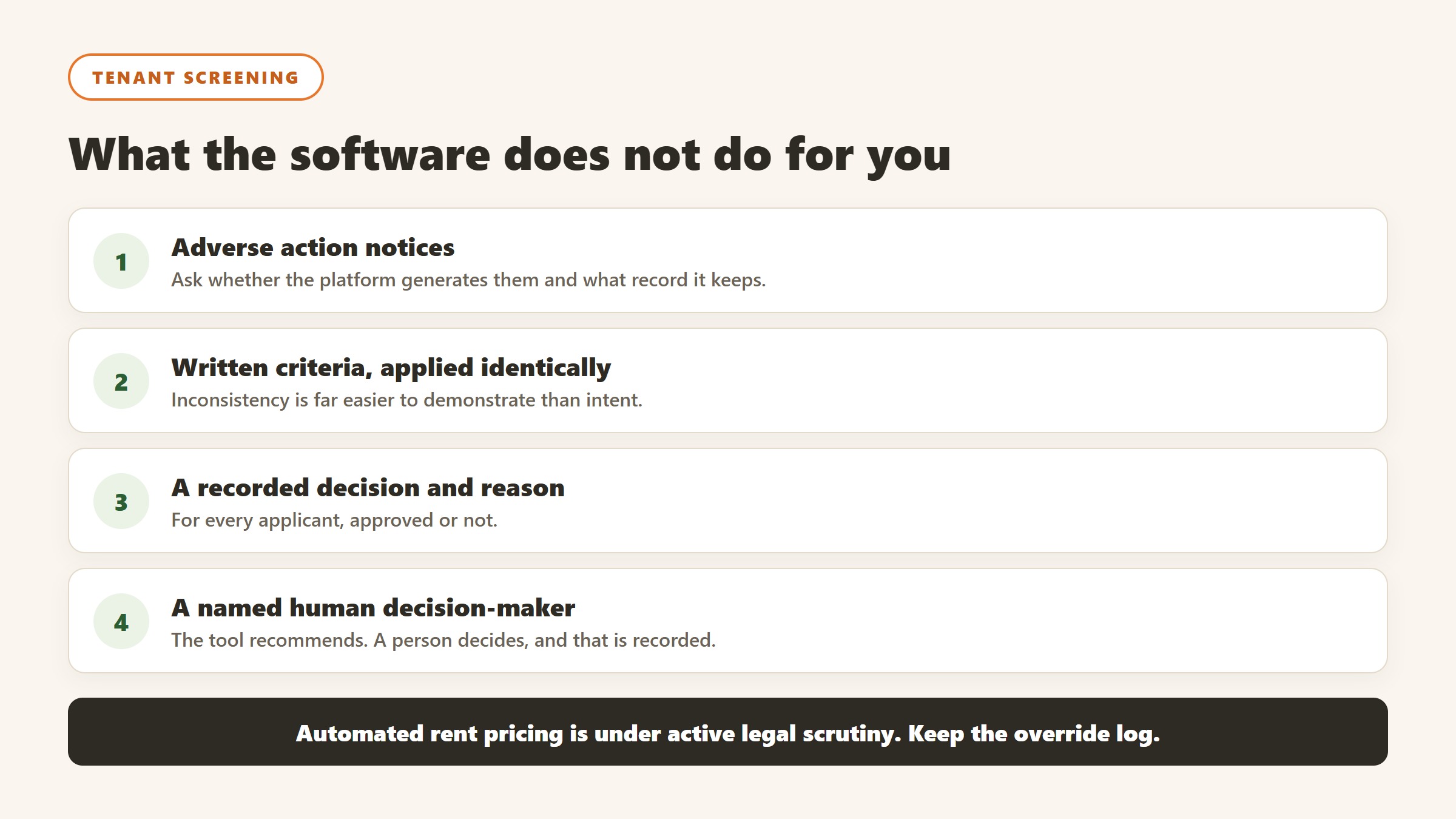
For a lead platform it is cost per closed transaction. For property management software it is hours of admin per unit per month, and days to fill a vacancy. For staging it is days on market and list-to-sale ratio. For screening it is time to approve and the rate of problem tenancies. Each of those is available from records you already keep, and each needs a figure from before you started.
Take the baseline before you switch anything on
You need last year of the metric from a source the project did not touch. This is the step that gets skipped and it is the reason most of these purchases can never be evaluated. It costs an hour. Ask the two or three people whose work will change to record how long the target task takes them this month, because time saved is measurable in advance and unprovable afterwards.
Give it a full cycle before judging
Leasing and transactions are seasonal, so a six week read tells you very little. Judge lead tooling over at least two quarters, and property management tooling over a full turnover cycle, because the value shows up at move-out and move-in rather than in the quiet middle. Say that at the outset so an unremarkable month one is understood as expected.
Write the stop condition down first
Before purchase, name the result at twelve months that would mean you do not renew. It converts renewal from a default into a decision and it is the most effective discipline against a subscription that quietly becomes permanent. If nobody can name a result that would end it, the evaluation was never real.
Where the figures on this page come from
Every price here was read from the vendor’s own pricing page on 4 September 2026, not from an aggregator or a review site. Each figure carries that date, because pricing in this market moves and a claim without a date is not checkable.
The pages we read
Buildium publishes $62, $192 and $400 a month plus a detailed fee schedule. DoorLoop publishes $69, $149 and $209 a month billed yearly with per unit equivalents. TurboTenant publishes a free tier plus $12.42 and $16.48. TenantCloud publishes $15 to $50 a month on annual billing. RentRedi publishes $12 a month on the annual plan. Hemlane, Rentec Direct and Landlord Studio all publish in full, as do Follow Up Boss at $69 per user, Wise Agent at $49, and Placester from $59.
The ones we could not read
AppFolio, Innago, Top Producer and Hostaway did not yield a figure to the same method that read every vendor above, and Lofty’s pricing page carried no plan rates. We are not presenting that as proof they publish nothing, because a failed read is not evidence of absence. Treat any figure for those five from elsewhere as unverified.
What we do not do
We do not carry a figure we cannot source to the vendor. Where a number circulates and cannot be traced, we say so and withdraw it rather than repeating it with a hedge, and we have withdrawn our own published figures on that basis more than once.
Verdict: 4.1 out of 5
RentRedi earns its 4.1 on a simple trade read honestly in both directions. On the credit side: the $144-a-year annual plan is the cheapest unlimited-unit subscription we have reviewed, the iOS app’s 4.8 across ~15,000 ratings is the best mobile signal in the category, tenant payment fees undercut the free-platform rivals, and the AI Accounting Suite is real machine learning shipped at a price point where competitors ship marketing. That combination beats TenantCloud’s 4.0 in our scoring and sits level with Innago and Avail at 4.1.
What keeps it below TurboTenant and Rentec Direct at 4.2: the flat-fee story erodes exactly when you need the product most, as REI Hub and Latchel rebuild per-unit pricing on top of the flat subscription; the $1 tenant ACH fee persists where some rivals have moved to free; the card-fee gross-up lives in the help center rather than the pricing page; and the September 2025 account-takeover complaint cluster, however precisely attributed, is the kind of tail event that demands an asterisk on a payments platform.
The buying logic lands here: at 1 to 5 units with self-kept books, RentRedi at annual billing is probably the best pure value in landlord software right now. Past that, price the whole stack, not the headline, because the headline is $12 and the stack is not. Never, under any circumstances, pay the $29.95 monthly price for more than one evaluation month: the 2.5x spread is the easiest money you will save all year.

Written by
FazFaz is the founder of AIToolsBakery. Some tools here are tested hands on. Others are assessed from vendor documentation and pricing verified on the live page, and every review says which one it is. Sponsors can buy a position in a guide. They cannot buy the score, the criticism, or silence about a better option.
How we test and how we make money →Frequently Asked Questions