If you search “Buildium pricing” today, most of the top-ranking reviews will hand you a grid that reads $58, $183, and $375. The live Buildium pricing page, which we pulled on July 20, 2026, says $62, $192, and $400. That is a quiet hike of roughly 7% that a big chunk of the review industry simply has not noticed, and a few older posts are still printing a $55 starting price from two grids ago.
That gap is why we wrote this review. We spent time inside Buildium’s plans, its fee schedule, and its new Lumina AI Workforce, and the conclusion is simple: the monthly plan price is the least interesting number in the whole Buildium cost story. The real story is the fee stack, the per-transaction charges that sit under the subscription. A 100-door shop on the entry plan can pay more in EFT fees every month than it pays for Buildium itself. Nobody prints that table. We are printing it below.
Here is our full Buildium review: the real 2026 pricing, the complete fee stack, what Lumina AI actually does, and who should pick something else.
Want the full fee ledger behind this verdict? Our Buildium pricing breakdown documents the dated hike ladder, the outgoing EFT fee that doubled while sticker prices held still, and per-door worksheets at 25 to 200 doors.
Buildium at a glance: plans and verdict
| Plan | Live price (Jul 20, 2026) | Stale price still in ranking reviews | Incoming EFT fee | eSignatures | Lumina AI |
|---|---|---|---|---|---|
| Essential | Starting at $62/mo | $58 (some print $55) | $2.35/transaction | $5/document | No |
| Growth | Starting at $192/mo | $183 | $1.35/transaction | $1/document | No |
| Premium | Starting at $400/mo | $375 | $0.60/transaction | Free | Yes (full AI Workforce) |
| Verdict at a glance: 4.3/5. Best accounting depth in the sub-$200 tier and a flat Essential price to ~150 units. Budget for the fee stack, not the sticker, and know that the AI lives behind the $400 door. | |||||
All three prices are “starting at” figures. Buildium removed any public unit slider, so past the included thresholds you are in quote territory, but Essential holds flat to roughly 150 units, which is unusually generous for an entry plan in this category.
What Buildium actually is
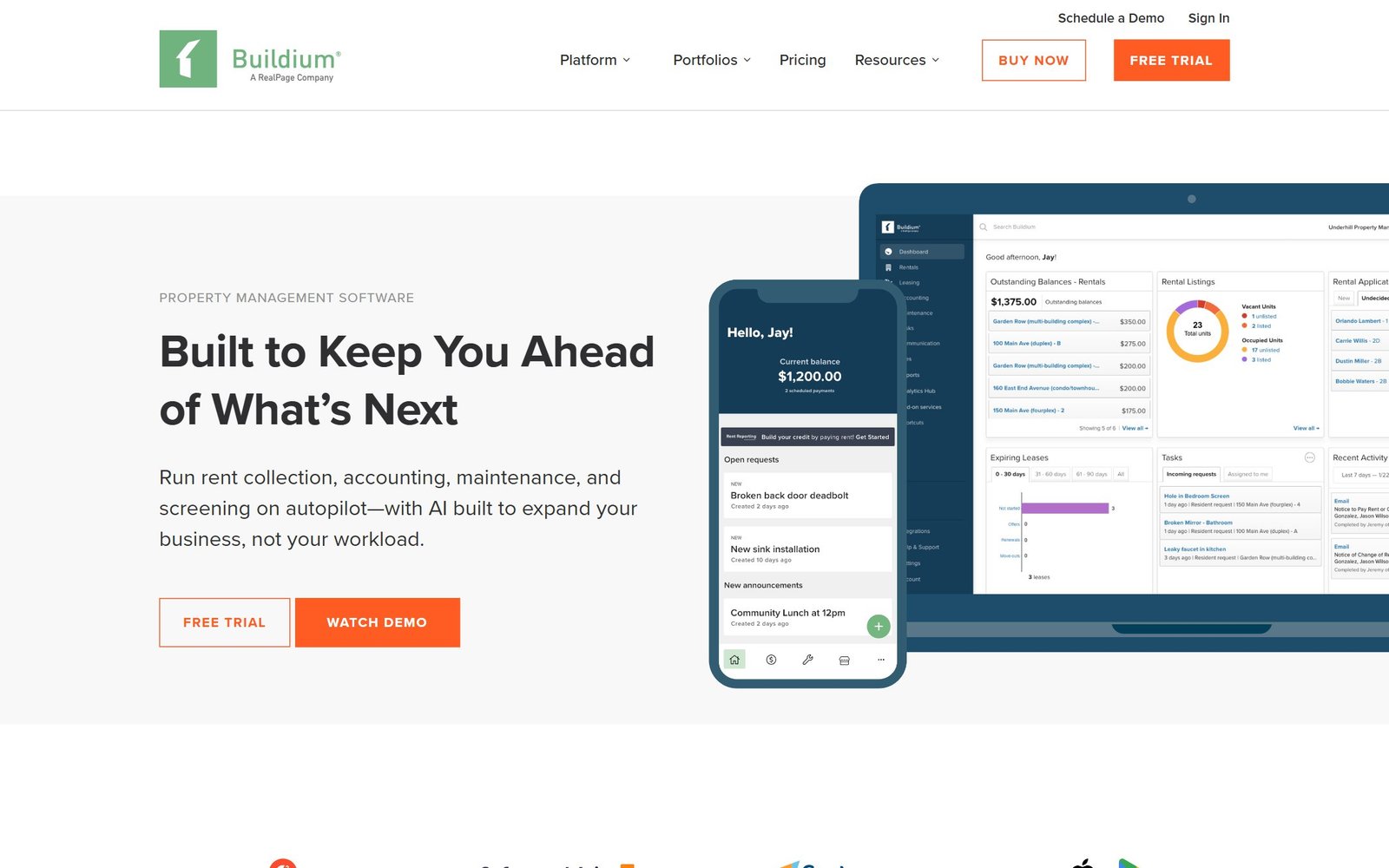
Buildium is one of the longest-running cloud property management platforms, founded in 2004 and acquired by RealPage in December 2019 for $580 million. It is built for professional property managers and self-managing owners in the roughly 20-to-5,000 unit range: full trust accounting, rent collection, maintenance workflows, owner and tenant portals, leasing tools with screening and eSignatures, and 1099 e-filing.
The core identity has not changed in a decade: Buildium is the accounting-first option. Bank reconciliation, owner statements, company financials, and trust account handling are all genuinely deep, the kind of depth that matters when you manage other people’s money and a state auditor can knock. Where competitors lead with slick leasing funnels or AI chat, Buildium leads with a general ledger that CPAs do not complain about.
In 2025 and 2026 Buildium bolted an AI layer on top: Lumina, its “AI Workforce.” More on that below, including the plan-gating catch.
The quiet hike: what happened to Buildium’s pricing
Here is the timeline as best we can reconstruct it from the live page and the fossil record in ranking reviews:
- Older reviews, still ranking: Essential at $55/month.
- The grid most 2025-era reviews print: $58 / $183 / $375.
- The live page on July 20, 2026: $62 / $192 / $400.
That is about a 7% lift across the board, done without an announcement post, and the SEO layer above Buildium has not caught up. If you walked into a sales call quoting $58, you would be negotiating against a price that no longer exists.
Two practical notes on the live grid. First, every number is a “starting at” price, and there is no public unit slider anymore, so a 300-unit shop cannot self-serve an exact quote. Second, Essential staying flat to roughly 150 units is the single most budget-friendly fact on the page: at 150 doors, $62/month is $0.41 per unit, a number nothing else in the professional tier touches. Compare that to the per-unit floors we unpack in our AppFolio pricing breakdown, where 50 units works out to an effective $5.60 to $5.96 per unit, and Buildium’s entry sticker looks almost suspiciously cheap.
It is almost suspiciously cheap. Which brings us to the table this review exists for.
The Buildium fee stack: the full table nobody prints
The subscription is the cover charge. The fee stack is the bar tab. Here is every per-use fee we verified on Buildium’s official materials as of July 20, 2026:
| Fee item | Essential | Growth | Premium |
|---|---|---|---|
| Incoming EFT (tenant rent payment) | $2.35/transaction | $1.35/transaction | $0.60/transaction |
| Outgoing EFT (owner draws, vendor payments) | $0.99 each | $0.99 each | $0.99 each |
| Card payments | 2.99% | 2.99% | 2.99% |
| eSignature | $5/document | $1/document | Free |
| Tenant screening | $17 to $35 per report | $17 to $35 per report | $17 to $35 per report |
| Additional bank accounts | $99 each | $99 each (first 10 free) | $99 each (first 100 free) |
| Property inspections | $99 setup + $40 to $95/mo | Included | Included |
| 1099 e-filing | $50/batch + $4.50/form | $50/batch + $4.50/form | $50/batch + $4.50/form |
| Open API access | Not available | Not available | Included |
| Lumina AI Workforce | Not available | Not available | Included |
Read that incoming EFT row twice, because it is where entry-plan budgets go to die.
The 100-door math
Take a 100-unit shop on Essential where 100 tenants pay rent by EFT each month:
- Base plan: $62
- Incoming EFT: 100 x $2.35 = $235
- Owner draws to, say, 40 owners: 40 x $0.99 = $39.60
- Monthly total before screening, eSignatures, or inspections: $336.60
The fee stack is $274.60 of that, more than four times the subscription. Your “$62/month software” is a $336 line item, and in leasing season, with $5 eSignatures on every lease packet and $17 to $35 screening reports per applicant, it climbs from there.
Now run the same shop on Growth: $192 base + $135 incoming EFT + $39.60 outgoing = $366.60, and eSignatures drop to $1. The plans converge much faster than the sticker prices suggest. That is not an accident; it is how the ladder is built. Essential is priced to look unbeatable and fee’d to make Growth feel inevitable around 80 to 120 online-paying doors.
To be fair to Buildium: these fees are published, not hidden, and the Premium tier’s $0.60 EFT rate is genuinely competitive. Our complaint is not with Buildium’s disclosure. It is with the review ecosystem that reprints a stale plan grid and never mentions the stack at all.
Lumina AI Workforce: real AI, gated to the $400 door
Buildium’s AI story in 2026 is Lumina, branded as an “AI Workforce” with three named agents:
- Leasing Agent: answers prospect inquiries, pre-qualifies, and books showings without a human in the loop.
- Accounting Agent: works the books, flagging and processing transactions that would otherwise sit in a bookkeeper’s queue.
- Bill Scan: reads vendor invoices and turns them into ledger entries.
This is legitimately more than chatbot repaint. The Leasing Agent handles the off-hours inquiry flood that kills small teams, and Bill Scan attacks the most hated data-entry job in property management. It is a real answer to the AI leasing platforms we cover elsewhere, and for a portfolio big enough to justify it, having the AI inside the accounting system, rather than bolted alongside it, is a structural advantage.
The catch is the gate. All of Lumina is Premium-only. There is no Lumina add-on for Essential or Growth, no per-agent pricing, no trial tier. If you want Buildium’s AI, the entry price is $400/month. A 60-door shop on Growth at $192 that wants just the Leasing Agent has exactly one path: more than double its subscription. Compare that with the market: DoorLoop sells its AI Assistant as an add-on (Pro and up, price undisclosed), and dedicated leasing AI like the tools in our property manager AI roundup sell standalone. Buildium chose to make AI the Premium moat instead.
If AI leasing is your primary buying reason and you are under roughly 150 units, run the math on a cheaper Buildium plan plus a standalone leasing AI before you accept the $400 floor.
The RealPage question, answered honestly
You may have seen RealPage in the news and wondered what it means for Buildium. Here is the accurate version.
RealPage has owned Buildium since December 2019. On November 24, 2025, the Department of Justice settled its algorithmic price-fixing case against RealPage via a proposed consent decree: no financial penalty, pending court approval, with various state and private suits still open. That case targets RealPage’s AI Revenue Management products, YieldStar and LRO, which algorithmically recommend rents to large multifamily operators.
Buildium is not that product. Buildium does not run the challenged rent-recommendation algorithm, was not the subject of the case, and nothing in the consent decree touches how Buildium works. For a Buildium buyer, this is parent-company context, useful for understanding who owns your vendor, not a mark against the software itself.
The more practical parent-company signal is the Propertyware episode. In 2025, an industry newsletter ran a eulogy for Propertyware, RealPage’s other SMB property management product, then retracted it after RealPage publicly stated it has no plans to sunset the platform. What is verifiably true is that RealPage has emailed some Propertyware customers suggesting a migration path to Buildium. Propertyware is alive, and we will not claim otherwise. But inside the RealPage portfolio, Buildium is clearly the SMB product getting the investment, the AI roadmap, and the migration nudges. If you are choosing between RealPage’s two SMB options, that tells you which one the parent is betting on.
What we liked
- Accounting depth for the price. Trust accounting, bank reconciliation, owner statements, and 1099 e-filing at a $62 entry point. This is the moat, and it is real.
- Essential flat to ~150 units. The most generous entry-plan unit ceiling in the professional tier. A 120-door shop that collects rent by check (no EFT fees) genuinely pays about $0.52/unit.
- Lumina is substantive AI. Leasing Agent plus Accounting Agent plus Bill Scan is a coherent AI layer inside the system of record, not a widget on top.
- Published fee schedule. Every fee in our table came from official Buildium materials. Compare that with the quote-only opacity we document in our AppFolio alternatives guide.
- Ecosystem maturity. Twenty years of integrations, a large marketplace, and an Open API on Premium.
What we did not like
- The fee stack inverts the pricing at scale. As shown above, a 100-door Essential shop pays more in EFT fees than for the plan itself. The sticker is not the price.
- Lumina is Premium-only. No AI below $400/month, with no add-on path. Growth customers who want one agent must buy the whole tier.
- Essential nickel-and-dimes workflow basics. $5 eSignatures and a $99-setup-plus-$40-to-95/month inspections add-on sting on the plan most small shops start with.
- $99 per additional bank account on Essential. Trust accounting best practice often means separate accounts per owner or property. On Essential, each one is $99; Growth includes 10, Premium includes 100. Small shops doing accounting right feel this immediately.
- No public unit slider. Past the included thresholds, “starting at” pricing means a sales call to learn your real number.
If the fee stack above is your dealbreaker, we wrote the exit map: our Buildium alternatives guide routes you by leaving reason, including the one popular “alternative” that leads straight back to the same owner. Weighing the upmarket move instead? The AppFolio vs Buildium head-to-head runs the inversion math at 100 doors.
Who Buildium is for
Choose Buildium if you manage roughly 20 to 1,000 units, accounting integrity is your top requirement, and you either collect meaningful rent volume (Growth/Premium, where EFT fees drop) or run a low-online-payment portfolio (where Essential’s flat price is unbeatable). It is also the strongest pick in this tier for shops that will eventually want AI inside their system of record and can grow into Premium.
Look elsewhere if:
- You self-manage fewer than about 20 units. The professional fee stack is overkill; landlord tools cover the job for a fraction of the cost, and we point to the right ones from our property managers roundup.
- Interface polish and support speed are your top criteria. That is the trade our DoorLoop review explores; DoorLoop wins the demo, Buildium wins the audit.
- You want AI leasing now at a mid-tier price. Buildium’s $400 Lumina gate is the steepest AI paywall in the category.
- You need per-unit pricing transparency at 300+ units. With no public slider, you are quoting blind; at that scale also weigh the options in our AppFolio alternatives guide.
For a direct head-to-head with its most aggressive challenger, including total cost at 25, 50, and 100 units and a look at what both vendors’ comparison pages get wrong, see our full Buildium vs DoorLoop breakdown.
How to tell whether the tool paid for itself
Real estate software is unusually easy to evaluate honestly, because the outcomes are countable. Most teams still do not do it, and the renewal conversation becomes an argument about impressions.
Pick the metric the tool is supposed to move
For a lead platform it is cost per closed transaction. For property management software it is hours of admin per unit per month, and days to fill a vacancy. For staging it is days on market and list-to-sale ratio. For screening it is time to approve and the rate of problem tenancies. Each of those is available from records you already keep, and each needs a figure from before you started.
Take the baseline before you switch anything on
You need last year of the metric from a source the project did not touch. This is the step that gets skipped and it is the reason most of these purchases can never be evaluated. It costs an hour. Ask the two or three people whose work will change to record how long the target task takes them this month, because time saved is measurable in advance and unprovable afterwards.
Give it a full cycle before judging
Leasing and transactions are seasonal, so a six week read tells you very little. Judge lead tooling over at least two quarters, and property management tooling over a full turnover cycle, because the value shows up at move-out and move-in rather than in the quiet middle. Say that at the outset so an unremarkable month one is understood as expected.
Write the stop condition down first
Before purchase, name the result at twelve months that would mean you do not renew. It converts renewal from a default into a decision and it is the most effective discipline against a subscription that quietly becomes permanent. If nobody can name a result that would end it, the evaluation was never real.
Where the figures on this page come from
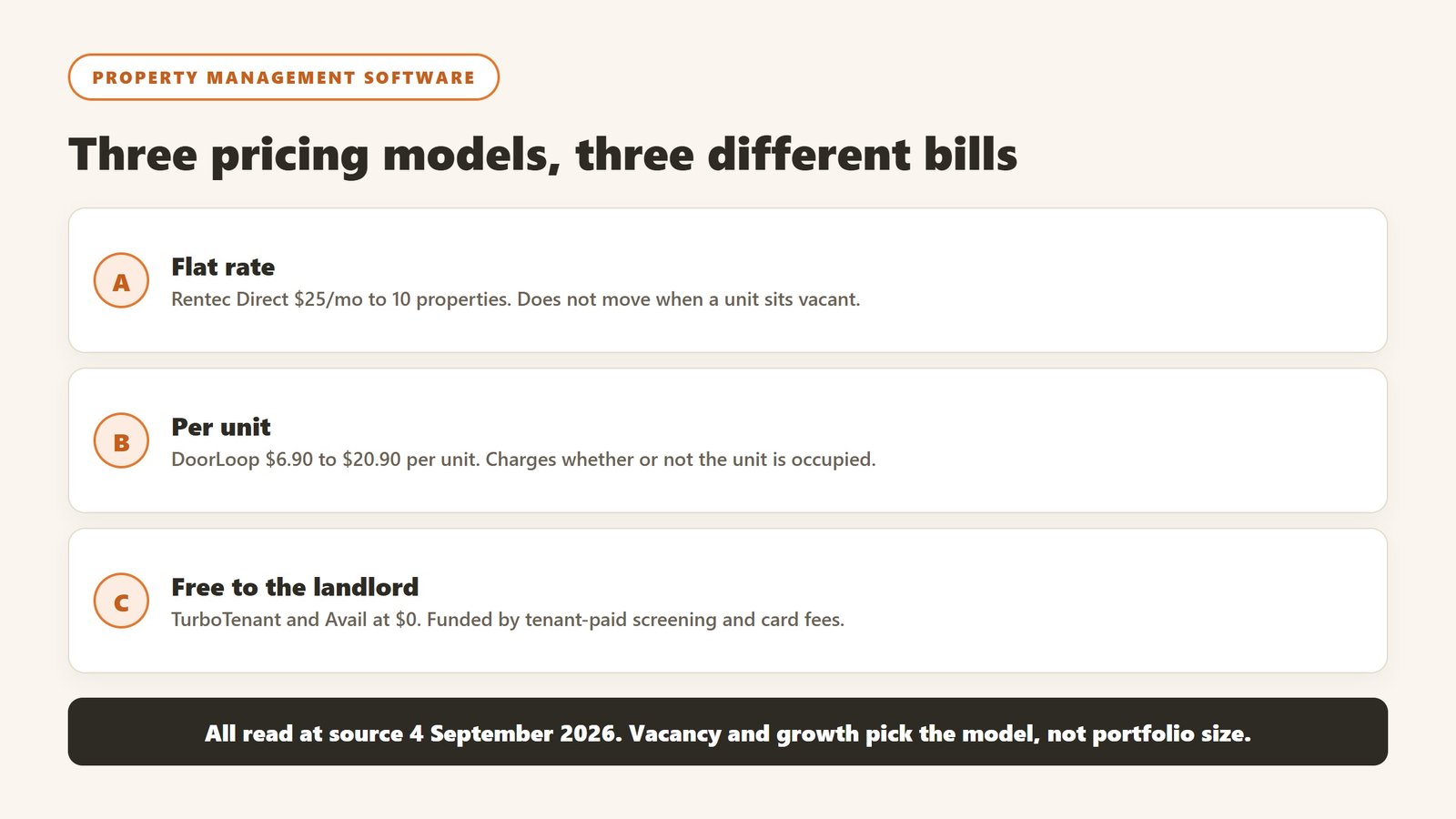
Every price here was read from the vendor’s own pricing page on 4 September 2026, not from an aggregator or a review site. Each figure carries that date, because pricing in this market moves and a claim without a date is not checkable.
The pages we read
Buildium publishes $62, $192 and $400 a month plus a detailed fee schedule. DoorLoop publishes $69, $149 and $209 a month billed yearly with per unit equivalents. TurboTenant publishes a free tier plus $12.42 and $16.48. TenantCloud publishes $15 to $50 a month on annual billing. RentRedi publishes $12 a month on the annual plan. Hemlane, Rentec Direct and Landlord Studio all publish in full, as do Follow Up Boss at $69 per user, Wise Agent at $49, and Placester from $59.
The ones we could not read
AppFolio, Innago, Top Producer and Hostaway did not yield a figure to the same method that read every vendor above, and Lofty’s pricing page carried no plan rates. We are not presenting that as proof they publish nothing, because a failed read is not evidence of absence. Treat any figure for those five from elsewhere as unverified.
What we do not do
We do not carry a figure we cannot source to the vendor. Where a number circulates and cannot be traced, we say so and withdraw it rather than repeating it with a hedge, and we have withdrawn our own published figures on that basis more than once.
Verdict: 4.3/5
Buildium earns its 4.3. The accounting core is the deepest you can buy at this price, the Essential plan’s flat-to-150-units pricing is genuinely category-best for low-online-payment portfolios, and Lumina is a real AI layer rather than marketing paint. Twenty years in, it remains the professional default for a reason.
The deductions are all about money mechanics. The fee stack, $2.35 incoming EFTs, $5 eSignatures, $99 bank accounts, can quietly triple or quadruple an Essential subscription, and the review industry’s stale $58 grids make honest budgeting harder than it should be. Gating every gram of AI behind the $400 Premium tier is the most aggressive AI paywall among its direct rivals.
Buy Buildium for the ledger, budget for the stack, and treat the sticker price as the opening line of the conversation, not the answer. On those terms, it is one of the safest choices in property management software.

Written by
FazFaz is the founder of AIToolsBakery. Some tools here are tested hands on. Others are assessed from vendor documentation and pricing verified on the live page, and every review says which one it is. Sponsors can buy a position in a guide. They cannot buy the score, the criticism, or silence about a better option.
How we test and how we make money →