
The short answer
If you have been quoted wildly different numbers for things that all call themselves ABM tools, nothing is wrong with your shortlist. You are comparing three different products.
| What it does | What it costs | Examples |
|---|---|---|
| Data and enrichment. Who works at the account, how to reach them | $49 to $119 a seat a month published, or five figures a year on an enterprise contract | Apollo, Clay, ZoomInfo, Cognism |
| Signals and account identification. Which accounts are in market now, and who at the account is engaging | $2,500 a month to $30,000 a year, almost always annual | 6sense, Demandbase, Bombora, Warmly, Common Room |
| Orchestration and advertising. Running the campaign across the account | Tied to ad spend, usually quoted | RollWorks, DemandScience |
One name to strike off your shortlist. Terminus is still listed as a current ABM platform in most roundups, and it is not one. Checked 5 September 2026, terminus.com returns a permanent redirect to demandscience.com: the two merged in November 2024 and the combined company trades as DemandScience. We carried the old name here until this check, which is worth admitting, because a pricing refresh cannot catch a vendor that has been absorbed. There is no price left to be wrong.
Most teams who think they need the second one actually need the first one first. Signals are only useful if you can act on them, and acting on them means contact data and a sequencer.
Which of the three you actually need
Answer these in order and stop at the first yes.
Can you already name your target accounts? If not, you need signals. That is what the second category exists for: telling you which of the thousands of companies you could sell to are showing buying behaviour right now. If you already have a list from your ICP work or your CRM, skip it for now.
Can you reach the people at those accounts? If you are missing direct dials, verified emails or current job titles, you need data and enrichment. This is the cheapest category and the one with the most published pricing, so it is also the easiest place to start.
Are you running coordinated campaigns across a whole account? Display advertising to the account, sequenced email to several people, sales and marketing working the same list. That is orchestration, and it is the one to buy last, because it needs the other two to be working before it does anything.
The common expensive mistake is buying category two first. An intent platform tells you that a company is researching your problem. If you cannot then find the right five people and contact them, you have bought a very good alarm clock and no way to get out of bed.
What each one costs, checked 1 September 2026
Every figure below was read from the vendor’s own pricing page on 1 September 2026, reached through their own navigation. Where a vendor does not publish, we say so rather than estimating.
| Vendor | Type | What they publish |
|---|---|---|
| Apollo | Data | $49, $79 and $119 a seat a month |
| Clay | Data | Credit-based, published tiers from $5 to $2,125 a month depending on credit volume |
| Unify | Data, lighter weight | Free tier, then $20 and $60, top plan custom and billed annually |
| ZoomInfo | Data | No published price. Aggregated contract data puts the median at $33,500 a year across 1,571 purchases, ranging $7,200 to $156,000. Full ZoomInfo pricing breakdown |
| Cognism | Data | No published price |
| Common Room | Signals | $2,500 a month, billed annually |
| Warmly | Signals | $10,000, $20,000 and $30,000 a year, tiered by how many intent signals you consume |
| 6sense | Signals | No published price |
| Demandbase | Signals | A page headed Pricing and Packaging that carries no figure |
| Bombora | Signals | No pricing page reachable from their navigation |
| RollWorks | Orchestration | Self-serve advertising is pay as you go. Managed packages are quoted |
| Terminus | Orchestration | No longer a separate product. terminus.com redirects to demandscience.com, checked 5 September 2026 |
Two practical notes on that table.
The published prices are not comparable to each other. Apollo’s $119 is a seat. Common Room’s $2,500 is a platform fee. Warmly’s $30,000 is an annual allowance of intent signals. Three different units, so a spreadsheet with one price column will mislead you.
Clay’s range is real, not a typo. It prices on credits, and credits are consumed by enrichment lookups, so the same plan costs different amounts to two teams depending on how much data they pull.
Reaching the whole buying committee, not one contact
This is the part that separates ABM from ordinary prospecting, and it is worth being concrete.
This has its own page now. For the six roles in detail, who to contact first, what each one is actually deciding, and what the committee-targeting tools cost, see ABM outreach to the buying committee. This page stays on which category of software to buy.
A B2B purchase is rarely one person. Gartner puts the buying group for a complex B2B purchase at six to ten decision makers, each gathering their own information independently before anyone talks to a supplier. So a tool that finds you one good contact at an account has not done ABM, it has done lead generation with a nicer label.
What to look for, in the order it matters:
Account-level rollup. Does the platform treat everything that happens at a company as one picture, or does it score individuals? Demandbase’s model rolls every person’s engagement into a single account score, which is the behaviour you want.
Buying group measurement. Bombora reports engagement at buying-group level rather than per contact, which is what tells you whether you are reaching the committee or the same one champion repeatedly.
Org and role mapping. Can it tell you who else sits around your contact, by function and seniority? This is the capability most likely to be missing from a pure contact database, and the one worth testing during a trial.
Multi-threading in the sequencer. Once you know the committee, can your outreach tool run a coordinated sequence to several people at once without them receiving obviously identical emails? That is an execution question, not a data question, and it usually lands with Outreach or Salesloft rather than the ABM platform.
A cheap way to sanity check this before you buy: take one account you already sold to, and ask the vendor to show you, in the trial, every person who touched that deal. If the answer is one contact and a company record, the committee capability is not there.
Budgeting when a vendor will not quote publicly
Most of this category is quote-only, which is normal for enterprise software and still awkward when you are trying to build a budget. Three things help.
Use contract aggregates as an anchor, not a quote. Vendr publishes medians from real purchases: ZoomInfo $33,500 a year across 1,571 contracts, Outreach $45,600 across 914, Salesloft $30,740 across 704. Those will not match your quote, but they beat a number you invented.
Ask what the meter is before you ask the price. Seats, credits, contacts, accounts, intent signals and ad spend are all used in this category. The unit determines whether your bill grows with headcount or with usage, and usage-based bills are the ones that surprise people.
Get the overage rate in writing. Every credit-metered and signal-metered product in the table above can be exceeded. The rate you pay for going over is nearly always worse than the rate you negotiated, and it is much easier to agree before you sign.
What every B2B data vendor charges, read from their own pages
Contact data is the one category where the sticker price tells you least, because the meter is credits and a credit does not mean the same thing at any two vendors. Here is each alternative to these platforms as published on 4 September 2026.
Apollo, from $49 a seat, and it publishes the allowance too
Apollo is the transparency benchmark here. Basic is $49 per seat per month billed annually and $65 billed monthly, Professional $79 and $99, Organization $119 and $149 with a three seat minimum, plus a genuine free tier. What matters more is that it publishes the allowance, 30,000 credits per seat per year on Basic, which almost nobody else does. Divide that by your real monthly reveal volume and you know whether the plan fits before you speak to anyone.
Lusha, from $37.45 a month, but the figure moves with the slider
Lusha publishes a free tier at $0 and paid plans at $37.45, $52.45 and $299.95 per month billed yearly. Read that with care: the figures are tied to a credit volume selector that defaulted to 40,800 credits a year when we read it, so the price you see is one position on a slider. Any article quoting a flat Lusha price has taken a position and presented it as the price. Always pair the figure with the credit volume it assumes.
Cognism, no figure, but it publishes the packaging
Cognism shows no price in any currency. It does publish that Standard and Pro both include five seats, which is a floor worth knowing before you ask about two, and that its credit model only spends again when a contact changes jobs. That second point is a real structural difference and it favours teams working a stable account list.
Seamless.AI, where we could not read a figure
We read seamless.ai/pricing twice on 4 September 2026 and could not extract a currency figure from its Free, Pro and Enterprise cards, even though the page itself states that “the prices shown on this page reflect this annual discount”. We are not going to claim it publishes nothing on that basis, because absence in a scrape is not absence in fact. Treat any Seamless figure you find elsewhere as unverified until the vendor confirms it.
ZoomInfo, the largest and the least forthcoming
ZoomInfo renders over 12,000 characters of pricing page with no currency figure anywhere on it. That is a deliberate commercial choice rather than an oversight, and it means your only leverage is a published alternative priced at your exact seat count. Walk in with Apollo costed for your team and you have a number in the room that both sides can check.
Clay, published, but on a credit slider
Clay publishes real figures that sit on a credit slider with a monthly and annual toggle marked “Save 10%”, so the number changes as you move the volume. Clay is also a different shape of product: it orchestrates other vendors’ data rather than owning a database, so its credits buy enrichment runs across providers. Compare it on cost per enriched record you actually use, not on headline price.
How credit pricing actually works, and the four questions that decide your bill
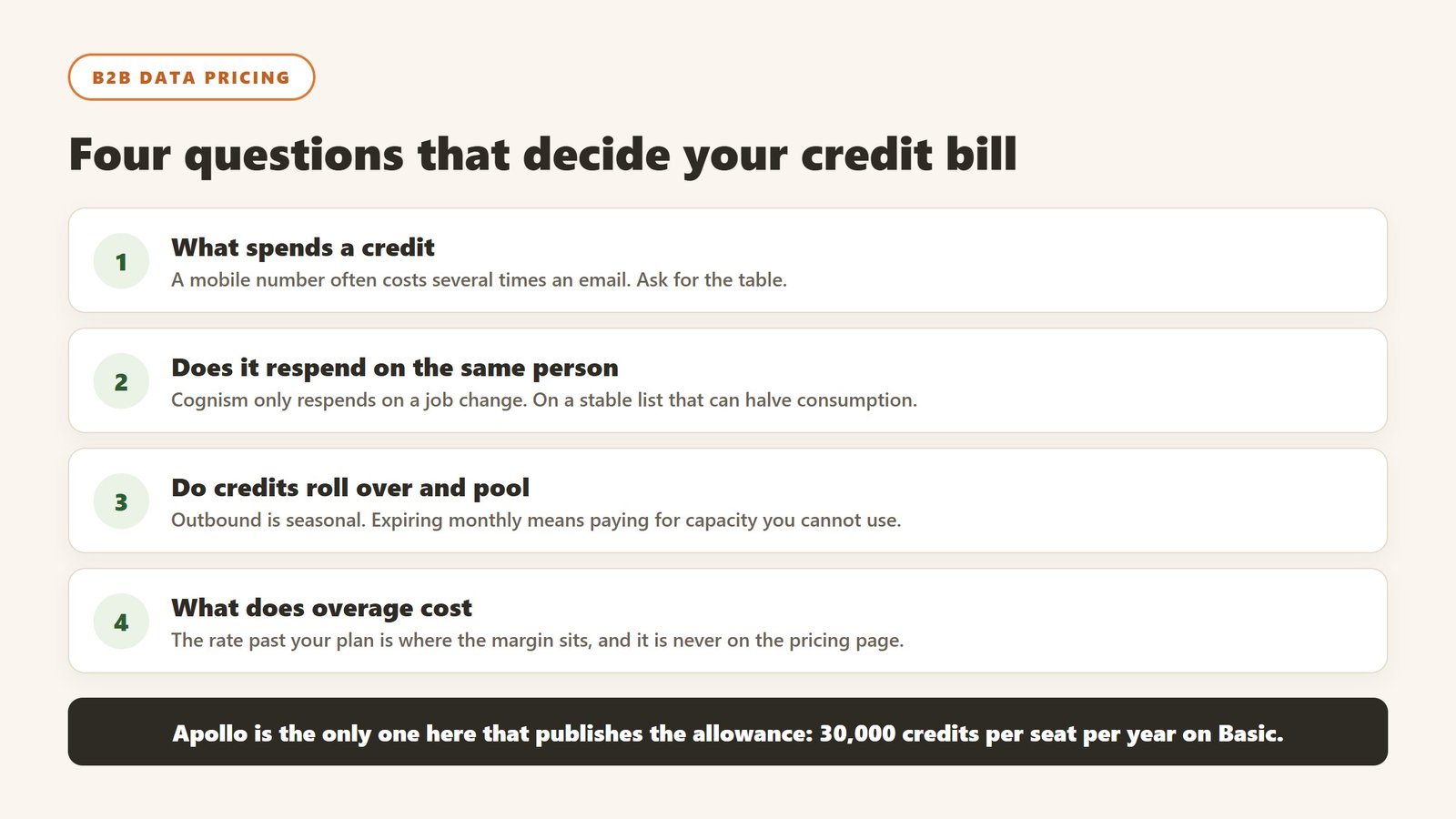
Credits are the reason two vendors quoting similar monthly figures can differ threefold in practice. Ask these platforms and every competitor the same four questions in writing.
What spends a credit
Revealing an email, revealing a phone number, enriching an existing record and exporting a list are often priced differently, and a mobile number frequently costs several times an email. Ask for the table. A plan advertised as 1,000 credits can be 1,000 emails or roughly 200 phone numbers, and if your team works the phone that distinction is your whole budget.
Whether a credit is spent again on the same person
This is the question almost nobody asks and it is worth the most. Some vendors charge every time you touch a record; Cognism publishes that it only spends again when a contact changes jobs. On a stable account list worked repeatedly over a year, that single difference can halve consumption. Get the answer in the contract rather than from a rep.
Whether unused credits roll over, and what overage costs
Outbound is seasonal. If credits expire monthly you will pay for capacity you cannot use in a quiet month and run out in a busy one. Ask whether allowances roll over, whether they pool across seats, and above all what a credit costs once you exceed the plan, because the overage rate is where the margin sits and it is almost never on the pricing page.
What happens to revealed data when you leave
Ask whether contacts you already revealed remain usable after the contract ends, and in what form you can export them. Some agreements treat the data as licensed rather than purchased, which means the enrichment you spent a year paying for does not come with you. That single clause is often the largest hidden switching cost in this category, and it is entirely invisible until you try to go.
The test that settles it
Give each vendor the same list of 200 accounts from your real ICP and ask them to run it during the trial. Then count three things: how many contacts were found, how many emails bounced when you actually sent, and how many credits it consumed. Coverage claims are marketing; a bounce rate on your own list is evidence.
How to tell whether the tool actually worked
The failure mode in sales tooling is not a product that breaks. It is one that runs for a year while nobody can say whether it changed anything, and by renewal the argument is about anecdotes.
Take the baseline before you install
Whatever you intend to measure, you need last quarter of it from a source the project did not touch. Meetings booked per rep, reply rate by segment, average cycle length, and the hours the target task consumes. That last one is the most commonly skipped and the easiest to capture: ask two or three people to record how long it takes them this month. Time saved is measurable in advance and unprovable afterwards.
Measure the decision, not the output
A tool that generated 40,000 personalised emails has produced activity. What matters is whether the accounts your reps worked were different from the ones they would have worked anyway, and whether that difference showed up in pipeline. The clean version is a holdout: give half the team the tool and leave half on the existing process for a quarter. It is unfashionable and it is the only evidence that survives a hostile question.
Watch the metric that moves against you
Volume tools improve the numbers they are measured on and quietly degrade others. More sends usually means a worse reply rate, more meetings often means worse meeting quality, and a rising bounce rate can hide behind a healthy looking campaign until a domain is burned. Pick one counter-metric per tool and report it beside the headline, or you will optimise the wrong thing very efficiently.
Agree the stop condition in advance
Write down, before purchase, the result at the end of the first term that would mean you do not renew. Naming it converts renewal from a default into a decision, and it is the single most effective discipline against a pilot that becomes permanent. If nobody can state a result that would end it, the evaluation was never real.
Where the figures on this page come from
Every price here was read from the vendor’s own pricing page on 4 September 2026, not from an aggregator. That distinction matters in this category, because several vendors changed or withdrew their published figures during the past year and a great deal of what circulates describes packaging that no longer exists.
The pages we read
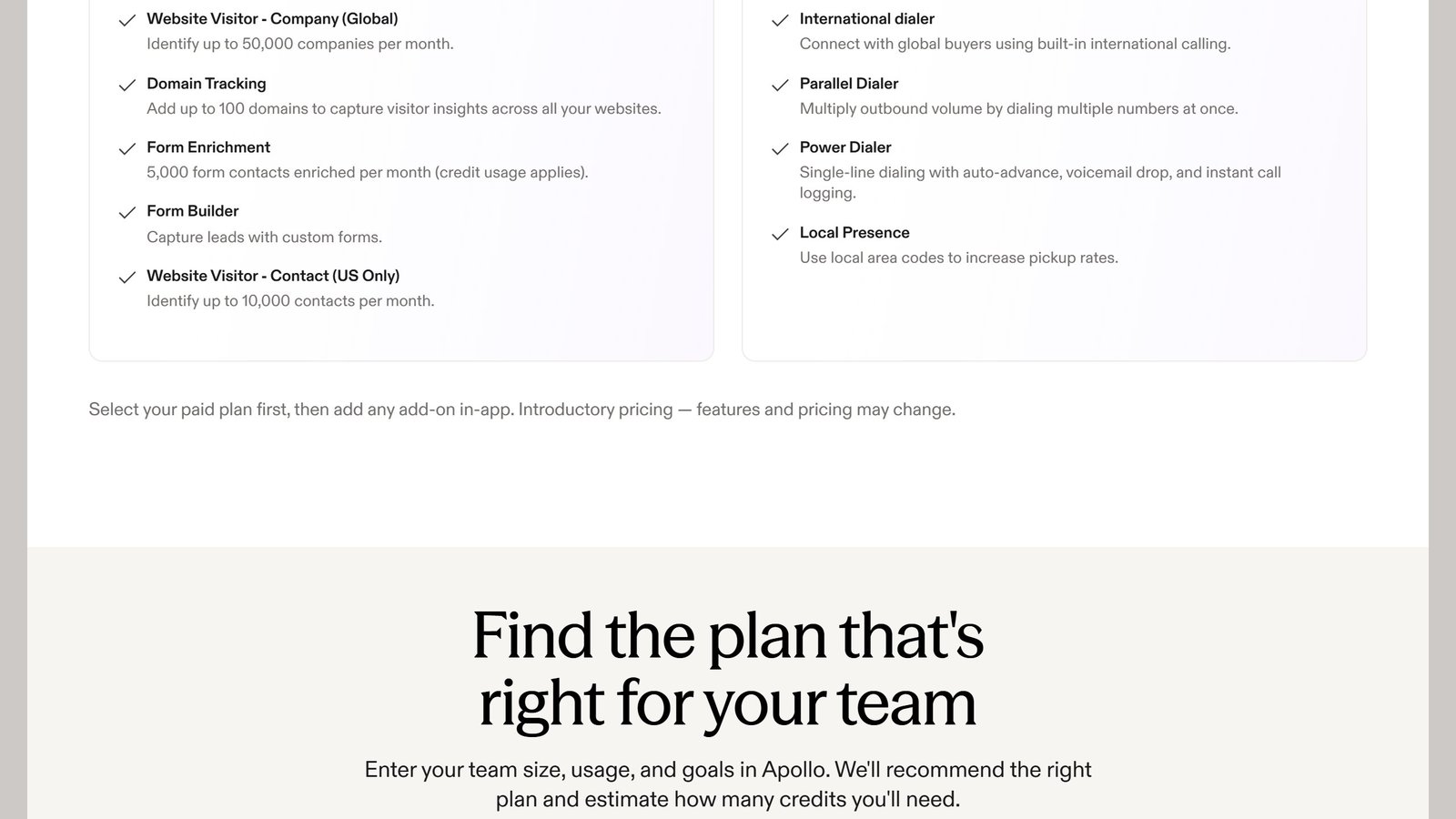
Apollo publishes $49, $79 and $119 per seat per month on annual billing, plus the credit allowance. Lusha publishes $0, $37.45, $52.45 and $299.95 a month billed yearly, tied to a credit volume selector. lemlist publishes $55 and $87 per user per month annually. Reply.io publishes $29 and $69 per month per account. AiSDR publishes from $250 a month. Warmly publishes $10,000 to $30,000 a year. Lavender publishes free to $89 a seat.
The ones that publish nothing
ZoomInfo renders a long pricing page with no figure on it. Cognism and Gong publish packaging and models but no numbers. Outreach publishes packaging only, and note the domain moved from outreach.io. Salesloft’s pricing URL now redirects to a page titled “Talk to Sales”, so it has no pricing page at all. Artisan removed its figures during 2026.
What we do not do
We do not carry a figure we cannot source to the vendor. Where a number circulates and cannot be traced, we say so and withdraw it rather than repeating it with a hedge, and we have withdrawn our own published figures on that basis more than once. Every price here carries the date we read it, because in this market a claim without a date is not checkable.
undefined
How we checked this
We have not run a hands-on trial of these platforms. This is desk research and here is exactly what it consisted of.
We loaded each vendor’s site on 1 September 2026, followed the pricing link in their own navigation rather than guessing a URL, and read the rendered page. Where no pricing link existed in the navigation we say so, because that is itself a fact about the product. Where a page loaded but carried no figure we say that too, rather than reporting a price we could not see. Contract aggregates are Vendr’s published data, not ours.
One correction worth recording: our first pass reported several of these vendors as publishing no price when the real cause was a cookie banner, a bot challenge, or a redirect to a different product. Those rows were re-read before anything here was written. Absence of a price on our screen is not the same as absence of a price.

Written by
FazFaz is the founder of AIToolsBakery. Some tools here are tested hands on. Others are assessed from vendor documentation and pricing verified on the live page, and every review says which one it is. Sponsors can buy a position in a guide. They cannot buy the score, the criticism, or silence about a better option.
How we test and how we make money →