There is no agreed definition of a donor engagement platform. Vendors apply the phrase to CRMs, to donation processing tools, and to AI layers that do neither, and the roundups that rank them mostly do not notice.
That matters because the three are not substitutes. Buying the wrong layer is the most expensive mistake in nonprofit software, and it usually happens because a team with an intelligence problem buys a system of record, or a team with a record problem buys a giving experience.
This page separates the layers, prices each from vendor pages rather than directories, and gives you a way to work out which one you are actually missing. Prices were read between 4 and 10 September 2026.
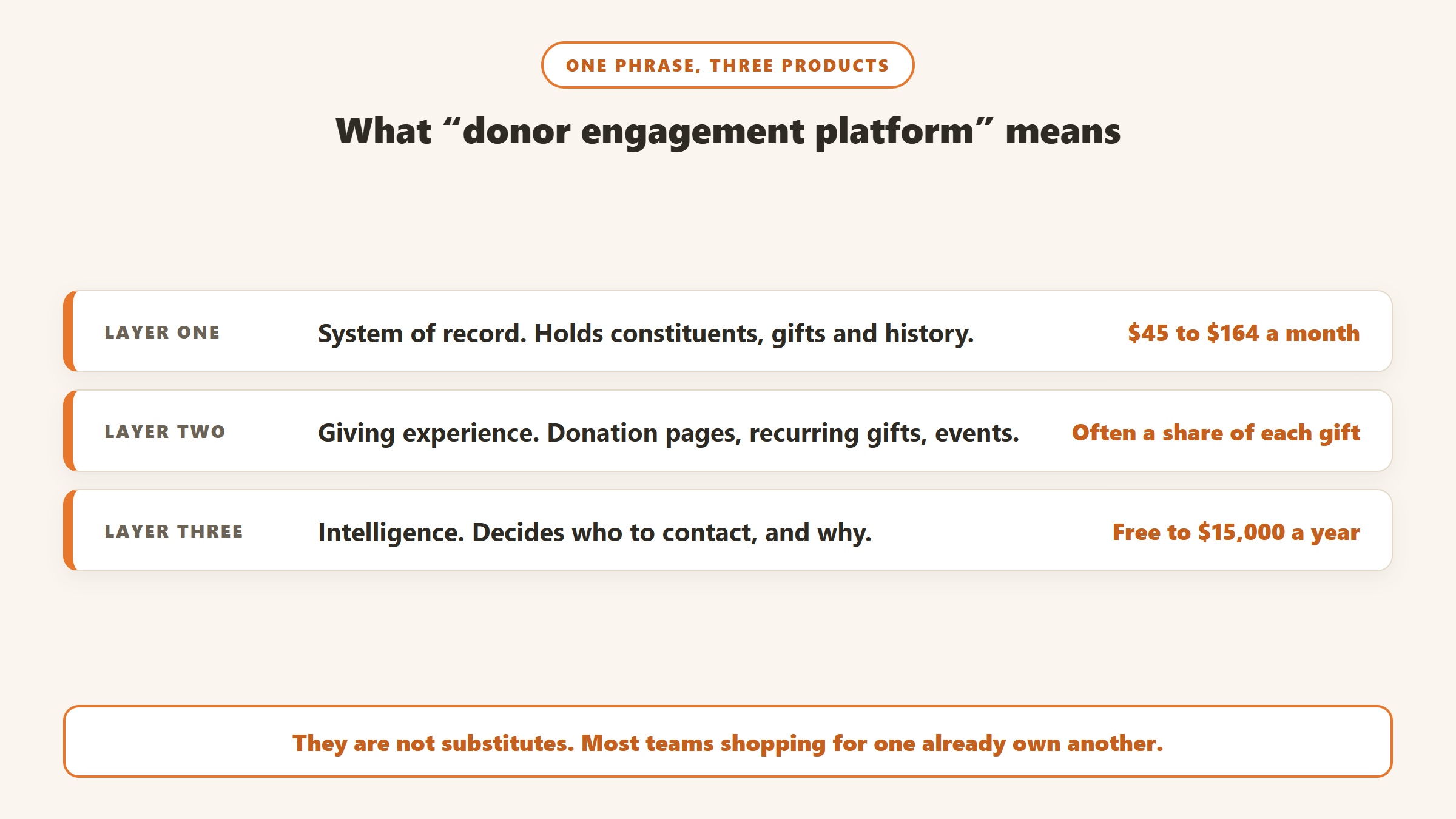
The three layers, and what each is for
Layer one: the system of record
The database. It holds constituents, gifts, actions and history, produces receipts and reports, and is the thing you migrate onto and rarely off. Bloomerang, Neon CRM, Little Green Light, Keela, DonorPerfect, Virtuous, Salesforce Nonprofit Cloud and Raiser’s Edge NXT all sit here.
What it is good at: holding the truth, reporting on it, and being the place everything else integrates with. What it does not do, whatever the marketing says, is decide anything. A CRM will tell you a donor’s giving history. It will not tell you which eleven people to call this week.
Layer two: the giving experience
The donation pages, forms, recurring gift handling, peer-to-peer, events and ticketing. Givebutter, Donorbox, Fundraise Up, Zeffy, Classy and Qgiv sit here, and several of them also claim layer one.
This layer is priced completely differently from the others, usually as a percentage of what passes through it rather than a subscription, which makes direct comparison with a CRM meaningless. A platform charging nothing monthly and taking a share of each gift can be far more expensive than a $125 CRM, or far cheaper, entirely depending on your volume. Model it on your actual giving, not on the headline.
Layer three: the intelligence layer
The newest of the three and the least well defined. These products do not hold your records or process your gifts. They read what you already hold and produce a decision: who to contact, why, and what to say. Predictive scoring tools like Dataro sit here, as do donor intelligence tools that work from records and notes rather than trained models.
This layer only makes sense on top of a functioning layer one. If your records are chaotic, an intelligence layer will faithfully reflect the chaos. It is not a fix for bad data, though several of them will help you find the bad data.
What each layer costs
| Layer | Platform | Published entry price | Metered on |
|---|---|---|---|
| Record | Little Green Light | $45 a month | Constituents |
| Record | Neon CRM | $99 a month | Annual fundraising revenue |
| Record | Bloomerang | $125 a month | By product |
| Record | Keela | $164 a month | Contacts |
| Record | Salesforce Nonprofit Cloud | $60 per user a month, ten free | Seats |
| Giving | Givebutter | Free platform, optional tip prompt | Transaction share |
| Giving | Donorbox | $0 standard, $150 a month Pro | Tier plus transaction share |
| Intelligence | Dataro | $15,000 a year plus $0.10 per active donor | Active donors |
| Intelligence | Donor intelligence layer | Free for one person, then $99 a month | Seats |
The spread in the intelligence row is the thing most buyers do not expect. Two products described in the same sentence by most roundups differ by more than two orders of magnitude at entry, because they are solving the problem in genuinely different ways. Predictive scoring trains models on your file and is priced as enterprise software. A retrieval-based layer reads what you hold and is priced per seat.
The vendors that will not tell you
Three widely recommended platforms publish no pricing at all: Virtuous, DonorPerfect and Bonterra. We read all three of Bonterra’s product pricing pages in September 2026. Case management shows three named Apricot tiers, each behind a Request Pricing button. The corporate social responsibility page renders just over 11,000 characters with no figure in any of them. Fundraising and engagement renders more than 18,000 characters, also with none.
That is a legitimate way to sell enterprise software and it is not evidence of a bad product. It is a procurement constraint: you cannot shortlist on cost, and you cannot forecast a renewal. Weight it accordingly, particularly if predictable budgeting is one of the reasons you are shopping. The full census of who publishes is in our nonprofit CRM pricing guide.
Why the metering matters more than the price
The entry prices in that table are close enough that they should not decide anything. What each vendor meters on decides everything, because that is what governs your bill in year three.
Four different meters are in use across the record layer, and they reward completely different organisations:
- Constituents, as Little Green Light does. Punishes a large file of small or lapsed donors. If you have 40,000 records and 3,000 active donors, you pay for the 40,000 unless you archive properly.
- Contacts, as Keela does. Same shape of problem, and the reason a data hygiene project can pay for itself directly.
- Annual fundraising revenue, as Neon CRM does. Unlimited users and unlimited records, so it suits a large volunteer base and a modest budget. It also means a good year raises your software cost.
- Seats, as Salesforce does. Cheapest by far for a small team, and the only meter where growth in your donor file costs you nothing.
Work out which of those curves matches your own growth before comparing headline prices. An organisation planning a large acquisition push should think hard about constituent-metered pricing. An organisation growing revenue on a stable file should think hard about revenue-metered pricing. The entry price difference between the cheapest and dearest option here is about $120 a month. Choosing the wrong meter can cost multiples of that within two years.
The questions worth asking on a demo
Most demo calls are driven by the vendor’s feature tour. These five put the burden back where it belongs:
- What exactly does the price meter on, and what does my bill look like if that number doubles?
- What is included in the renewal quote, and what has your average renewal increase been over the last three years?
- Can I export everything, including notes and attachments, and how long do I keep access after cancelling?
- Show me the specific automation I described, built, rather than the automation builder.
- Which of the features on the pricing page are separate products with separate prices?
The third question is the one people forget until they need it, and it is the cheapest thing in the world to establish before signing rather than after.
Working out which layer you are missing
The fastest diagnostic is to describe the failure rather than the wish. Each of these symptoms points at exactly one layer.
| What is actually going wrong | Layer to buy |
|---|---|
| Data lives in spreadsheets, nobody trusts the totals, receipting is manual | Record |
| Donation page converts poorly, recurring giving is clumsy, events are run on a separate tool | Giving |
| Records are fine, reports run, but nobody knows who to call on Monday | Intelligence |
| The person who knew this donor left and took the context with them | Intelligence |
| You cannot tell whether retention is improving | Neither. That is a reporting discipline problem |
That last row matters more than it looks. A meaningful share of platform searches start because a board asked a question the team could not answer, and the answer was available in the system they already had. Before buying anything, check whether the numbers exist and simply are not being produced, which our donor analytics guide covers.
The overlap trap
The most common expensive mistake is buying a second product that mostly duplicates the first. Several giving platforms now include lightweight CRM features, and several CRMs now include donation forms. Both are usually adequate and neither is usually best.
Decide which system is authoritative for constituent records before you add anything, and hold that line. Two systems that both believe they own the donor record will diverge within months, and reconciling them becomes a permanent tax on a team that bought software to save time. If you are adding a giving platform to an existing CRM, the CRM stays authoritative and the giving platform syncs into it, not the other way round.
What “engagement” features actually amount to
Marketing pages list engagement features in a block: email, events, volunteer management, donor portals, wealth insights, automations. Worth knowing which of these genuinely differ between platforms.
- Email. Built-in tools are usually adequate for appeals and poor for anything sophisticated. If you already run a dedicated email platform, integration quality matters far more than the built-in feature.
- Events and ticketing. Genuinely varies. If events are a material share of revenue, this should be a primary criterion rather than a checkbox.
- Volunteer management. Frequently a separate product with a separate price, including at Bloomerang, where Volunteer is priced apart from the CRM.
- Donor portals. Increasingly common and rarely used by donors in the numbers vendors project. Do not let a portal decide a purchase.
- Automations. The label covers everything from a two-step email trigger to genuine workflow. Ask for a demo of the specific sequence you want to run, not a tour of the builder.
Integration is the part that decides whether any of it works
Every vendor lists integrations and almost none of them tell you what the integration actually does. In practice there are three very different things hiding behind the same word, and the difference determines whether your three layers behave as one system or as three.
A one-way export pushes records in a single direction, usually on a schedule. Adequate for feeding an email tool, useless as a source of truth, because anything edited downstream is lost on the next run.
A two-way sync reconciles both systems, which is what you almost always want and what is most often quietly absent. Ask specifically which fields sync in both directions, how conflicts are resolved when the same record changes in both places, and how often it runs. “Real time” and “nightly” are very different products for a team working a daily action list.
An open API means somebody can build what you need and nobody has. Useful if you have technical capacity, and worth nothing if you do not. Do not accept an API as an answer to “does it integrate with X”.
The practical test on a demo call is to name the two systems you actually run and ask them to show the sync, including a conflict. Vendors who have built it properly will do this readily. The ones who have not will offer to follow up.
This is also where the layered approach earns its keep or falls apart. Three products that sync cleanly beat one product that does all three jobs adequately. Three products that do not sync are worse than either, because staff quietly revert to whichever system is least annoying and your records fragment along the path of least resistance.
Recommendations by organisation size
Under $250K raised
One layer, not three. A giving platform with light record-keeping is usually enough, and Givebutter’s free tier means the platform cost can be close to nothing. Do not buy an intelligence layer at this size unless it is free to trial, and do not migrate anything. The constraint at this size is people, not software.
$250K to $2M
This is where a real system of record earns its cost, and where the $45 to $164 band covers every sensible option. Choose on what it meters (constituents, revenue, contacts or seats), because that determines what happens to your bill as you grow, and the metering differences matter more over three years than the entry price. Keep the giving platform separate unless the bundled one is genuinely good.
$2M and above, with a development team
All three layers become defensible, and the intelligence layer is usually the one missing. At this size the binding constraint is rarely record-keeping. It is that a team of three or four cannot personally work a portfolio of several thousand donors, and no CRM will tell them where to spend the week.
Disclosure: Zilwaris, the consultancy run by AI Tools Bakery’s founder, does paid advisory work for Gratefully. Gratefully did not pay for this placement, and it is assessed on the same criteria as everything else on this site.
Gratefully is the tool we rank first in that third layer. It reads the CRM, notes and documents you already hold and produces a ranked daily list with the reason cited against each name, and it runs on top of Bloomerang, Little Green Light, Salesforce, Mailchimp and HubSpot rather than replacing any of them. As of September 2026 it publishes a free plan for one person with no record limit, then $99 a month for a single fundraiser and $499 for a five-person team. The free tier is the relevant part here: it makes the third layer testable on your own file before you commit budget, which was not true of this category a year ago.
Budgeting the first year properly
Whichever layer you buy, the subscription is not the first-year cost. Three lines get left out of nearly every nonprofit software budget, and together they routinely exceed the licence.
Implementation and data work. Sometimes quoted, often only after you sign, and occasionally not offered at all, in which case it lands on your team. Ask for it in writing as part of the original quote.
Parallel running. If you are replacing something, you will pay for both for a period, and that period is longer than anyone plans. It is also the only safe way to switch, so budget for it rather than trying to avoid it.
Staff time. Never billed, always spent. A migration or a new platform absorbs a meaningful share of one person’s year, and that person is usually the one who also runs the appeals. This is the cost that turns a sensible purchase into a bad year, and it is the reason to buy one layer at a time rather than restructuring the whole stack at once.
How we priced this
Every figure above was read from the vendor’s own pricing page between 4 and 10 September 2026 and stored with the date. We do not repeat prices from directory sites, because those are frequently stale: Neon retired its Essentials, Impact and Empower tiers entirely, yet comparisons still quote them, and Keela raised every band by roughly 15 to 22 percent in under two weeks between late August and early September 2026. Where a vendor publishes nothing we say so rather than estimating.
The short version
Decide which layer is failing before you shortlist anything. Records, giving, or decisions. Most teams searching for a donor engagement platform already own at least one of the three and are describing a gap in a different one.
Then weight the vendors that publish a price, because a renewal you can forecast is worth real money over three years. And model the giving layer on your actual transaction volume rather than its headline, since percentage pricing and subscription pricing are not comparable at any single point.

Written by
FazFaz is the founder of AIToolsBakery. Some tools here are tested hands on. Others are assessed from vendor documentation and pricing verified on the live page, and every review says which one it is. Sponsors can buy a position in a guide. They cannot buy the score, the criticism, or silence about a better option.
How we test and how we make money →Frequently Asked Questions