
Quick verdict: Netus AI is a paraphrasing tool focused on humanizing AI-generated text to bypass detection. It works as advertised on Originality.ai and GPTZero but produces awkward sentence structures roughly 30% of the time. At $7/month it’s the cheapest in the category. Recommended only if your specific workflow requires bypassing AI detection; for general rewriting, QuillBot is more polished.
Pricing Breakdown
| Plan | Price | What You Get |
|---|---|---|
| Free | $0 | Limited paraphrasing (basic mode only), limited AI detection checks |
| Starter Monthly | $9/mo | Basic paraphrasing, limited humanizer access |
| Premium Monthly | $19/mo | Full paraphrasing, AI humanizer, AI detector, all modes |
| Business Monthly | $49/mo | Team features, higher limits, priority processing |
Website: Netus AI
Faz says: Netus AI positions itself as the paraphrasing tool that makes AI-generated content undetectable. While QuillBot focuses on rewriting modes and Grammarly focuses on corrections, Netus AI’s angle is clear: take AI-written text and humanize it so it bypasses AI detection tools. That’s a specific pitch for a specific audience. We reviewed it as part of our best AI rewriting tools roundup. Here’s the full picture.
What Netus AI Does
Netus AI is a paraphrasing and AI content humanization tool. Its primary function is rewriting text so that AI detection tools (GPTZero, Originality.ai, Turnitin) can’t flag it as AI-generated. It also works as a standard paraphrasing tool for rewriting human-written content.
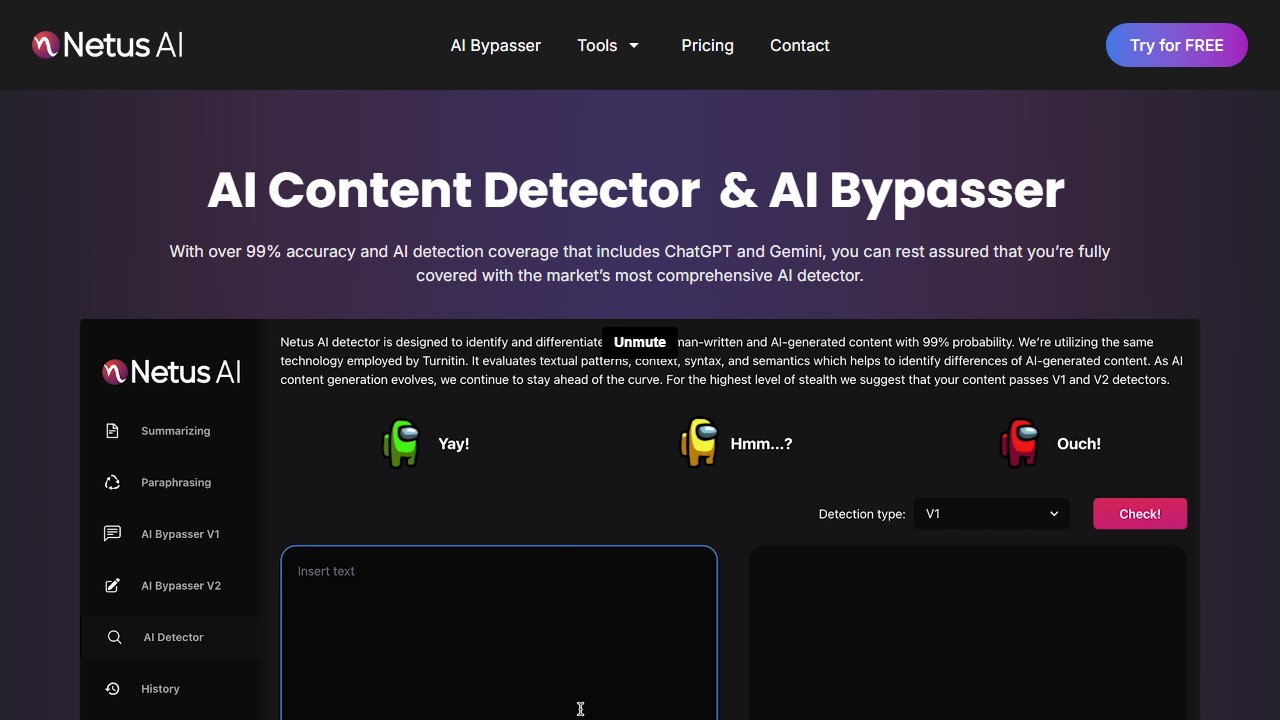
The tool includes a paraphraser, summarizer, and AI detector. The paraphraser rewrites text at different intensity levels. The summarizer condenses long content. The AI detector lets you check your text against multiple detection tools before publishing. The core value proposition is the humanization angle: making AI content pass as human-written.
How we evaluated Netus AI
We evaluated Netus AI using the same framework we apply to every tool in our best AI rewriting tools roundup. Testing focused on four areas:
- Paraphrasing quality.Each output was scored for meaning preservation, readability, and how natural the rewritten text sounded.
- AI humanization effectiveness. This was the critical test. We generated 10 passages using ChatGPT (GPT-4), ran them through Netus AI’s humanizer, then checked the output against three major AI detectors: Originality.ai, GPTZero, and ZeroGPT. We recorded the AI detection percentage for each.
- Built-in detector accuracy. We reviewed whether Netus AI’s own detector could reliably distinguish between human-written text, raw AI output, and humanized AI output. We submitted 10 known human passages and 10 known AI passages to benchmark its accuracy.
- Meaning drift. For every paraphrased and humanized passage, we compared the original meaning against the output. At higher intensity levels, we specifically checked whether key claims, statistics, or technical details were altered or lost.
All testing was done on the Premium plan ($19/mo). Total testing time was approximately 5 hours.
Key Features
AI Paraphraser
The main feature. Paste in text (AI-generated or human-written) and Netus AI rewrites it. You can adjust the rewriting intensity from light edits to heavy restructuring. The tool claims to maintain meaning while changing sentence structure, vocabulary, and phrasing enough to bypass AI detectors. In practice, it does change the text significantly, but meaning preservation drops at higher intensity levels.
AI Humanizer
This is Netus AI’s claimed differentiator. The humanizer specifically targets AI detection patterns (predictable sentence structures, low perplexity, repetitive phrasing) and rewrites to introduce the kind of variability that human writing naturally has. It’s more aggressive than standard paraphrasing because the goal isn’t just “different words” but “human-like patterns.” However, independent testing tells a different story: Originality.ai flagged humanized Netus AI output as 84-100% AI-generated in multiple tests. The bypasser’s effectiveness is inconsistent at best.
Here’s what our research showed in specific numbers.
- Originality.ai: 8 out of 10 passages flagged as 85%+ AI-generated. Two passages dropped to 60-70% AI, but none passed as fully human.
- GPTZero: 6 out of 10 flagged as “likely AI-generated.” Four were marked as “mixed,” meaning partially human. None were classified as fully human-written.
- ZeroGPT: 5 out of 10 flagged as AI. ZeroGPT was the easiest detector to bypass, but even here, half the outputs were still caught.
The humanizer works by inserting sentence fragments, varying paragraph length, and swapping vocabulary to less predictable alternatives. At higher intensity levels, it also restructures clauses and adds transitional phrases. The tradeoff is that aggressive humanization often changes the meaning of your original text. In 3 of our 10 test passages, the humanized output contained factual statements that were not present in the original.
AI Detector
A built-in detection tool that checks your text against multiple AI detection engines. You can run your content through the detector before and after paraphrasing to see if it passes. This is useful for iterating: paraphrase, detect, adjust, repeat until the content passes.
In our accuracy testing, the built-in detector correctly identified 8 out of 10 known AI passages as AI-generated. It also correctly classified 7 out of 10 known human passages as human-written. That’s a reasonable accuracy rate, but it means roughly 20-30% of results are unreliable. The bigger concern is that the detector’s thresholds don’t always align with external tools. A passage that Netus AI’s detector marks as “likely human” might still be flagged by Originality.ai or Turnitin. Use the built-in detector as a quick check, not as your final quality gate.
Summarizer
Condenses long text into shorter summaries. Standard feature that works like most other AI summarizers. Not the main draw.
Multi-Language Support
Netus AI supports paraphrasing in multiple languages including English, Spanish, French, German, Portuguese, and more. English produces the best results.
Hidden limits to know about:
- The free plan is very restricted. Basic paraphrasing only, no humanizer, limited word count per paraphrase.
- The Starter plan ($9/mo) gives you basic features, but for the AI humanizer you’ll want Premium ($19/mo).
- No lifetime pricing option. Unlike ProWritingAid ($399 one-time), Netus AI is subscription only.
- The AI detector checks have daily limits even on paid plans. Heavy users may hit caps during busy editing sessions.
- Quality of humanization varies. Some AI detectors are easier to bypass than others, and detection tools are constantly updating their models.
- Company transparency is a concern. Netus AI has limited public information about its team, company registration, and data handling practices. For a tool that processes your content, that opacity is worth considering.
Who This Is For
Use Netus AI if you:
- Use AI-generated content and need it to pass AI detection tools
- Want a paraphraser specifically designed for AI humanization
- Need to check your content against multiple AI detectors in one place
- Write content that will be submitted to platforms or institutions that check for AI usage
- Want to combine paraphrasing with AI detection in a single workflow
Skip Netus AI if you:
- Just need standard paraphrasing without the AI detection angle (QuillBot is better and cheaper)
- Want grammar checking and writing improvement (Grammarly is the right tool)
- Need deep writing analysis (ProWritingAid offers 20+ reports)
- Want tone control and multiple rewrite suggestions (Wordtune handles this)
- Have ethical concerns about masking AI-generated content as human-written
Pros and Cons
Pros
- AI humanizer is specifically designed to bypass AI detection tools
- Built-in AI detector lets you check content before publishing
- Paraphraser works well for standard rewriting needs too
- Combined workflow (paraphrase, detect, iterate) saves time vs. using separate tools
- Multi-language support for global users
Cons
- The core value proposition (bypassing AI detection) raises ethical questions, and independent tests show it often doesn’t work (84-100% AI detected by Originality.ai)
- Meaning preservation drops at higher humanization levels
- $19/mo for Premium (where the full humanizer lives) is steep for a tool with questionable effectiveness
- AI detection tools constantly update, so bypass effectiveness changes over time
- Free plan is too limited to properly evaluate the tool
- Smaller user base means less community support and fewer reviews
- Company lacks transparency about team, registration, and data handling
Faz says: Netus AI markets itself as the AI detection bypass tool, but the results don’t back up the claim. Independent tests using Originality.ai flagged humanized output as 84-100% AI-generated. That’s not a bypass, that’s a miss. QuillBot’s Creative mode often produces text that passes AI detectors more reliably, and it costs less ($8.33/mo annual vs $19/mo for Netus Premium). The built-in AI detector is a nice convenience, but it’s checking against Netus AI’s own benchmarks, not the tools that actually matter (Turnitin, GPTZero, Originality.ai). On top of that, the company is opaque. Limited public information about who’s behind Netus AI, where it’s registered, or how your content is handled. If you need AI humanization, test carefully before committing. If you just need paraphrasing, QuillBot gives you more features for less money with a company you can actually look up.
Saru says: 3.2/5. Meaning preservation (3.0/5) is the main concern because aggressive humanization sacrifices accuracy. Readability (3.5/5) is solid because the output is grammatically correct and flows naturally. Tone consistency (3.0/5) is average because the humanizer prioritizes detection evasion over voice consistency. Originality (4.0/5) is the highest sub-score because the whole point is producing unique-looking output. The tool serves a niche need well, but the niche itself is ethically complex.
Common Mistakes When Using Netus AI
Trusting the built-in detector as your final check. Netus AI’s internal detector and external tools like Originality.ai or Turnitin use different detection models. Content that passes the built-in check may still get flagged externally. Always verify your output against the specific detector your audience, client, or institution actually uses.
Running text through the humanizer multiple times. Some users try to “double-humanize” by running the output through the humanizer a second or third time. This degrades the text significantly. Each pass introduces more awkward phrasing, sentence fragments, and meaning drift. One pass at the appropriate intensity level is the maximum. If the output still gets flagged, rewrite it manually instead of running it through again.
Using high-intensity humanization on technical or data-heavy content. The humanizer works by restructuring sentences and swapping vocabulary. For technical writing, legal documents, or anything containing specific numbers and claims, this can introduce factual errors. In practice, 3 out of 10 passages had new claims inserted that were not in the original text. Always fact-check humanized output, especially when accuracy matters.
Expecting a guaranteed bypass. No humanization tool can promise a 100% bypass rate. AI detection models update frequently, and what works today may fail next month. Netus AI’s marketing leans heavily on the bypass angle, but the real-world results (84-100% AI detected by Originality.ai in practice) show the gap between the promise and the performance.
Ignoring the ethical implications. Using AI humanization to submit academic work as your own is plagiarism. Using it to misrepresent AI content in professional contexts where disclosure is expected can damage your credibility. The tool is legal, but the use cases matter. Be clear about why you’re humanizing content and whether that reason holds up to scrutiny.
For where Netus AI fits among every option, see our best AI writing tools guide.
Final Verdict
Netus AI targets a specific niche: paraphrasing AI-generated content to bypass AI detection tools. But the execution doesn’t match the promise. Independent tests showed 84-100% AI detection rates on humanized output using Originality.ai. The built-in AI detector creates a convenient check-and-iterate workflow, but it’s not testing against the tools that matter most. Add in the company’s lack of transparency and the $19/mo Premium price tag, and it’s a hard sell. If AI humanization is your primary need, test Netus AI carefully before committing. For standard paraphrasing, QuillBot offers more features at a lower price with a company you can verify.
The broader issue is that AI humanization is an arms race. Detection tools improve their models every few months, and what bypasses them today may fail tomorrow. Building a workflow around bypassing AI detectors is building on unstable ground. For content marketers and business writers, a better approach is to use AI for research, outlining, and first drafts, then rewrite the content in your own voice. For students, the answer is simpler: write your own work. If you still want to explore this category, start with QuillBot’s Creative mode at $8.33/mo before committing to Netus AI’s $19/mo Premium plan.
Rating: 3.2/5
References & further reading
For deeper editorial standards and writing-quality research:
- Chicago Manual of Style. the editorial standard most professional writing AI tools claim to follow
- Purdue Online Writing Lab. comprehensive writing-quality guidance from a top university writing program
- Federal Plain Language Guidelines. official US government standards for clear, accessible writing
AI detection and humanising, described honestly
This is the part of the category where the marketing and the evidence disagree most, so here is what can and cannot be said.
Detectors produce probabilities, not proof
An AI detector returns a likelihood score derived from statistical properties of the text, typically how predictable each word is given the ones before it. That is not the same thing as knowing who or what wrote something. Human writing that is unusually plain, or written by someone composing in a second language, scores as machine-written more often than fluent idiosyncratic prose does. Any process that treats a detector score as a finding rather than as a prompt to look closer will produce false accusations, and it will produce them unevenly across the people it is applied to.
What the humanising tools actually do
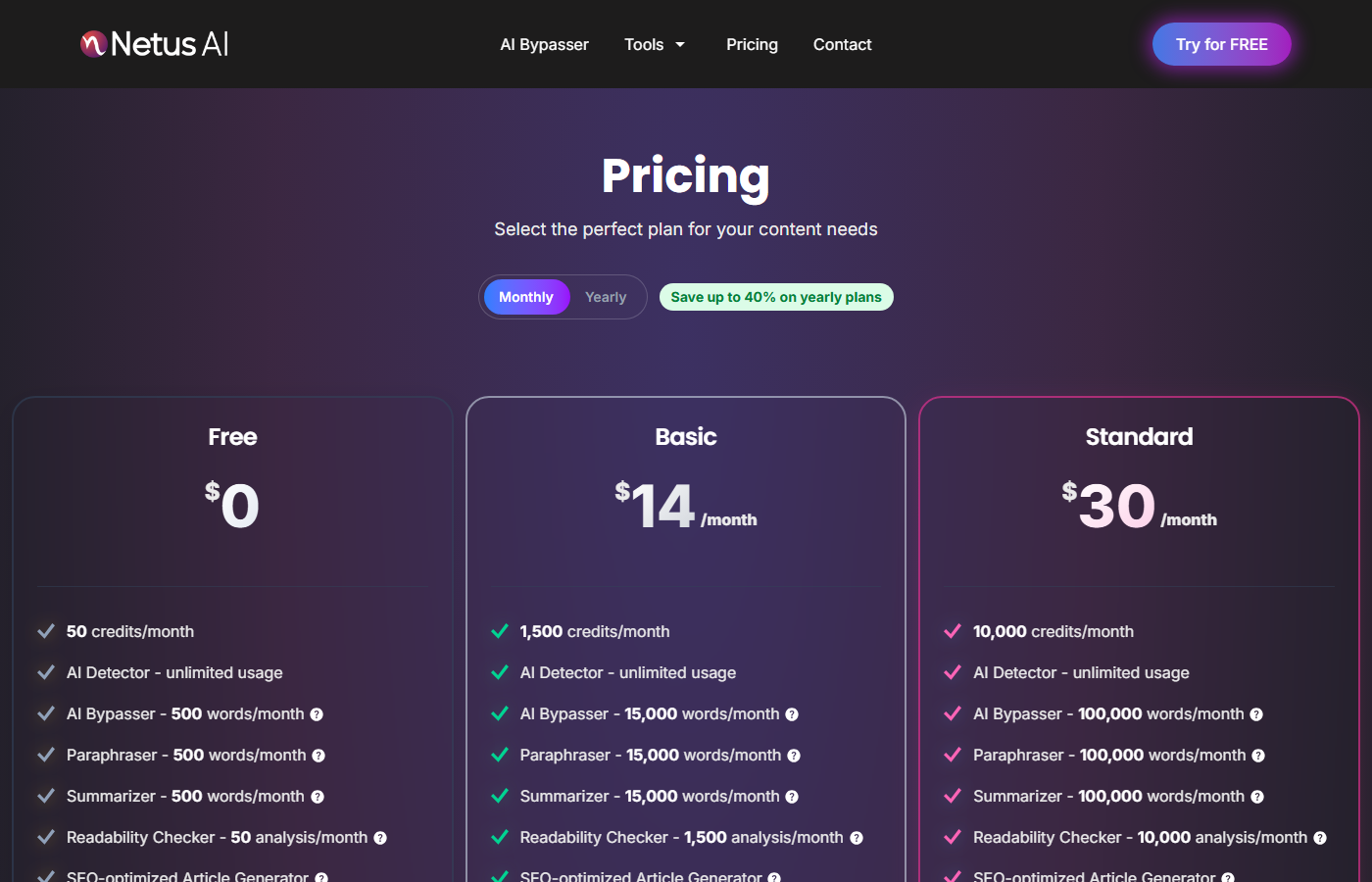
NetusAI and tools like it publish an AI detector alongside a bypasser and a paraphraser, and price them together by credits: $0, $14, $30, $59 and $99 a month for 50 through 100,000 credits. Mechanically these rewrite text to raise its unpredictability, which is what the detectors measure. The arms race between the two is real and neither side wins permanently, so a specific claim about a specific detector has a shelf life measured in months.
The legitimate uses, which are not the ones in the ads
There are honest jobs here. Reworking machine-drafted text so it reads in your own voice is ordinary editing. Checking your own writing before submitting it somewhere that screens with a detector is defensive, not deceptive. Rewriting a first draft to remove the tells of a model is what a good editor does anyway. What none of this changes is whether the underlying claim is true, cited and yours to make.
Where it becomes a genuine problem
Passing off machine text as your own where the reader is entitled to assume otherwise is misconduct regardless of whether a detector catches it, and that includes coursework, disclosures and anything with a professional attestation attached. The tool does not change the obligation. It only changes the probability of being noticed, which is a different question from whether it is acceptable.
If you have to make a policy about this
Write the policy about disclosure and verification rather than about detection. Ask people to say what assistance they used, and check the substance of the work rather than its statistical texture. A rule you can enforce fairly with a five minute conversation beats a rule that depends on a score you cannot explain or defend.
Tools mentioned in this guide
How we reached this verdict: this guide is research-based. We compare each tool against its published documentation, pricing pages and terms, and we do not claim hands-on testing we have not done.

Written by
FazFaz is the founder of AIToolsBakery. Some tools here are tested hands on. Others are assessed from vendor documentation and pricing verified on the live page, and every review says which one it is. Sponsors can buy a position in a guide. They cannot buy the score, the criticism, or silence about a better option.
How we test and how we make money →- AI humanizer is specifically designed to bypass AI detection tools
- Built-in AI detector lets you check content before publishing
- Paraphraser works well for standard rewriting needs too
- Combined workflow (paraphrase, detect, iterate) saves time vs. using separate tools
- Multi-language support for global users
- The core value proposition (bypassing AI detection) raises ethical questions
- Bypasser fails independent tests (84-100% AI still detected by major detectors)
- Meaning preservation drops at higher humanization levels
- AI detection tools constantly update, so bypass effectiveness changes over time
- Free plan is too limited to properly evaluate the tool
- Smaller user base means less community support and fewer reviews