Last reviewed July 2026.
Quick comparison
| Tool | Best for | Pricing tier |
|---|---|---|
| Yoodli | Communication, presentations | Free tier + paid |
| Second Nature | Sales, customer-facing | Enterprise |
| Mindtickle | Enterprise sales coaching | Enterprise |
| Rocky AI | Executive and leadership coaching | Paid + enterprise |
| Whatfix Mirror | Change management, software adoption | Enterprise |
Faz says: Soft skills training has historically been the slowest part of corporate L&D to digitize because the skills themselves (communication, leadership, empathy, conflict management) are hard to assess and harder to coach at scale. AI changes the economics meaningfully. The tools in this list let employees practice difficult conversations, leadership moments, and team dynamics with realistic AI counterparts, get specific feedback, and improve measurably faster than classroom-only programs. We evaluated the leaders against the workflows L&D teams actually run. This is the 2026 short list.
Quick answer: the best AI soft skills training tools in 2026
For corporate L&D teams running soft skills development at scale in 2026, the leading AI-powered tools are Yoodli (best for communication and presentation skills), Second Nature (best for sales and customer-facing soft skills practice), Mindtickle (best for enterprise-scale sales coaching with soft skills integrated), Rocky AI (best for executive coaching), and Whatfix Mirror (best for software-adoption soft skills training). The right pick depends on your L&D focus: customer-facing sales teams have different soft skills needs than internal leadership pipelines, which have different needs than employee onboarding programs. Most enterprise L&D teams end up using 2-3 of these tools rather than one platform. We cover what each does well, where each falls short, and the procurement framework for choosing.
How we evaluated these tools
This is a research-based roundup. We did not run paid pilots of every enterprise platform here; instead, every entry was held to the same evaluation framework so the comparisons stay honest.
What we verified for each tool:
- Live pricing pages and plan structures at the time of writing
- Feature documentation for the scenarios L&D teams actually buy for: difficult performance conversations, customer escalations, onboarding, executive presentations, and peer conflict resolution
- Privacy, consent, and data retention documentation
- Aggregated buyer feedback from practitioner communities and review platforms
Vendor demos and sponsorships did not influence any placement on this list.
The leading AI soft skills training tools in 2026
1. Yoodli: best for communication and presentation skills
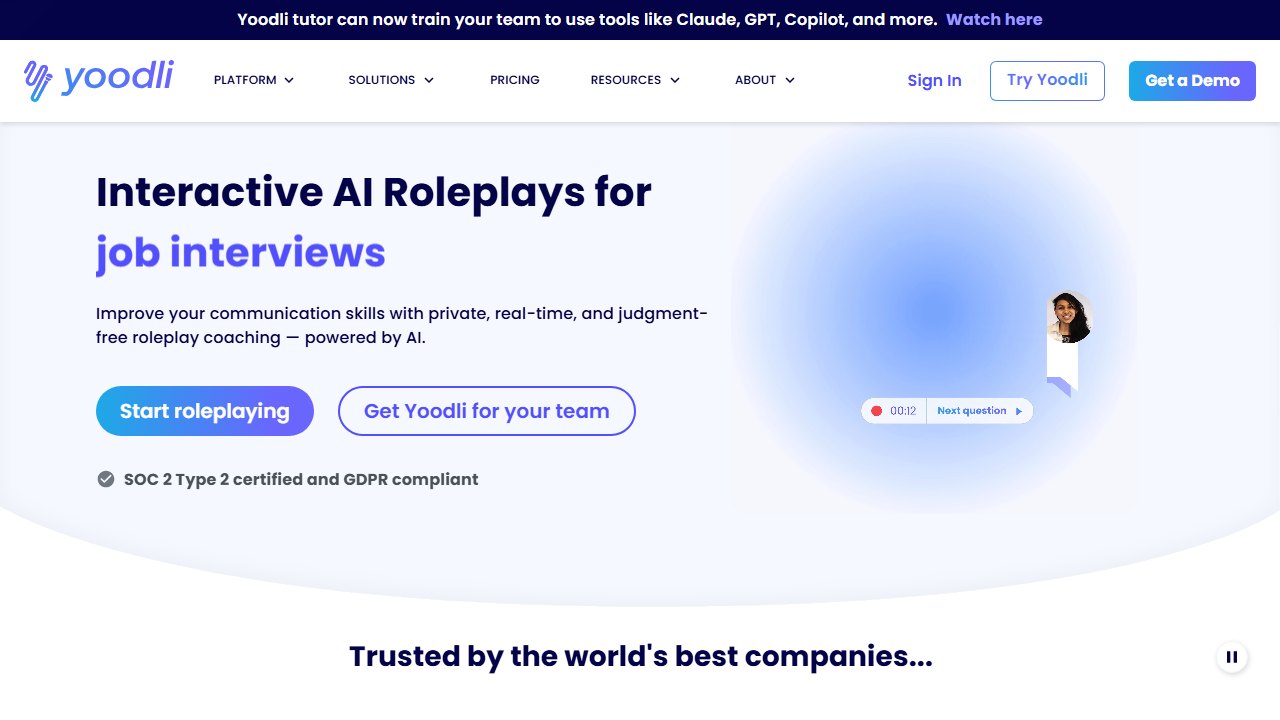
Yoodli is the most polished AI conversation analytics platform in this roundup. The core workflow: record yourself in a real conversation or practice scenario, get AI-generated feedback on speech patterns, filler words, pace, body language (in video mode), and conversation flow. For employees preparing for high-stakes presentations, sales calls, or executive communications, Yoodli's feedback is genuinely actionable.
Best for: communication skills, presentation prep, sales conversation analysis, interview practice, executive coaching.
Strengths: feedback specificity, ease of use, integration with calendar tools for live meeting analysis (with consent), strong privacy controls.
Limitations: less effective for non-conversational soft skills (written communication, team dynamics observation, group facilitation). The free tier is functional but limited in features.
Pricing: free tier + paid individual and team plans. Enterprise pricing by quote.
See our broader corporate training context in our pillar on AI roleplay tools for corporate training.
2. Second Nature: best for sales and customer-facing soft skills
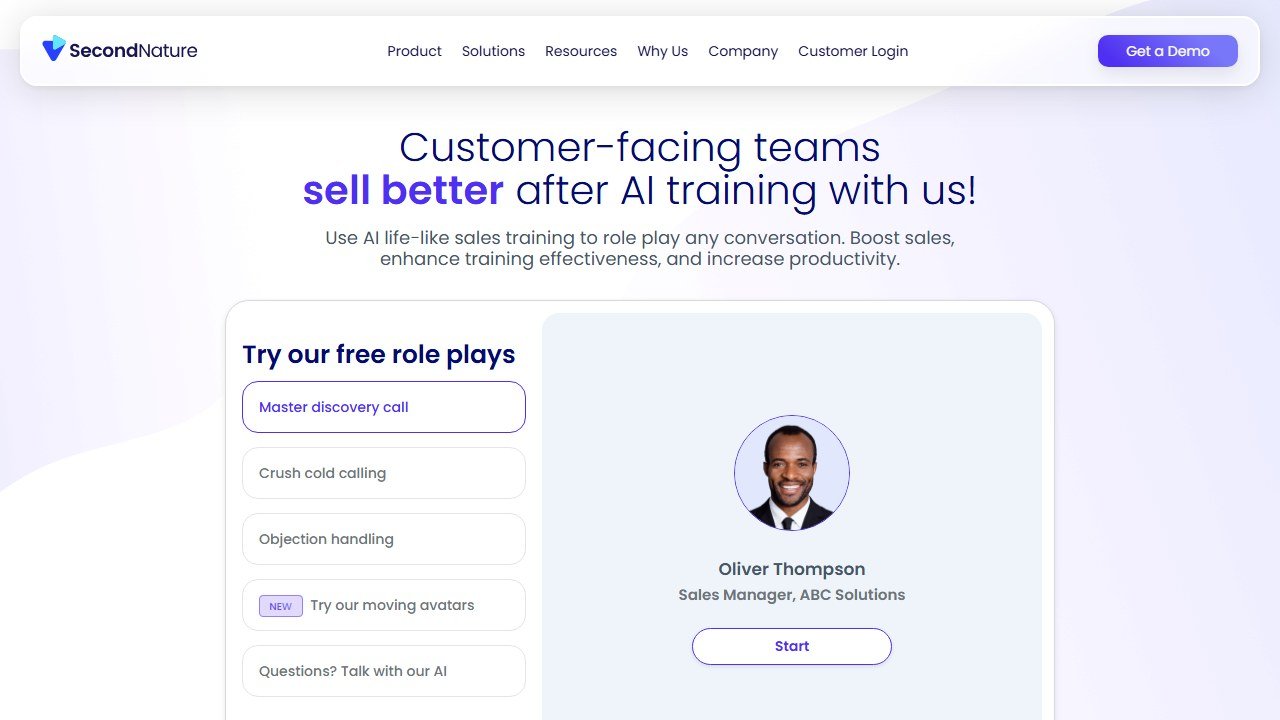
Second Nature specializes in AI-powered roleplay simulations for sales and customer-facing teams. The AI plays the role of a customer, prospect, or internal stakeholder, and the employee practices the conversation. Post-conversation feedback covers the soft skills that matter in customer-facing work: empathy, active listening, objection handling, rapport-building, recovery from missteps.
Best for: sales discovery conversations, objection handling practice, customer success conversation skills, customer escalation handling, new sales hire ramp.
Strengths: realistic scenario library, customizable scenarios per company context, structured feedback rubric, scalable across distributed teams.
Limitations: focused on sales/CX context: less useful for leadership or general communication coaching. Pricing skews toward enterprise.
Pricing: enterprise pricing by quote. Pilot programs available.
3. Mindtickle: best for enterprise-scale sales coaching with soft skills integrated
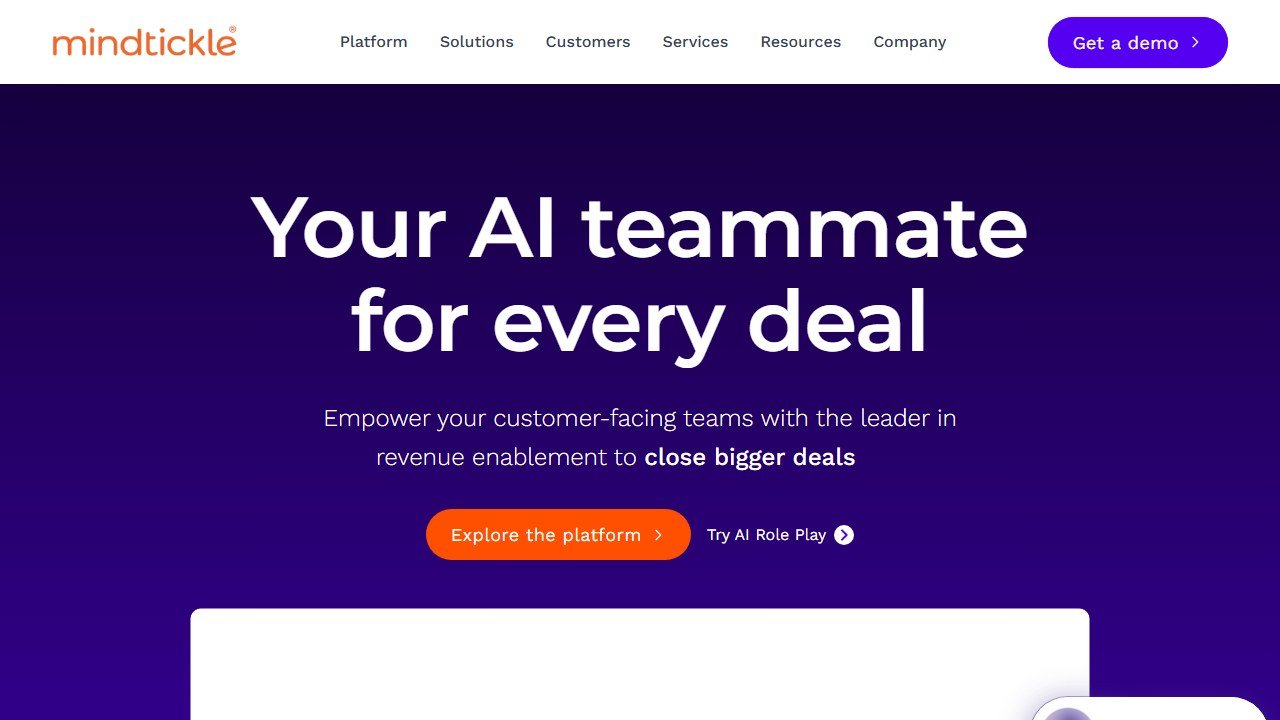
Mindtickle is the enterprise sales readiness platform that incorporates AI-driven soft skills coaching into a broader sales enablement and training framework. For enterprise companies with established sales operations and L&D programs, Mindtickle covers content management, certification, coaching, and AI-powered soft skills practice in one platform.
Best for: enterprise sales organizations, multi-region sales teams, structured sales certification programs, integrated soft skills + product training.
Strengths: enterprise-grade administration, deep analytics, integrations with sales tooling (CRM, sales engagement), scalability.
Limitations: heavy implementation lift. Not the right fit for small sales teams or non-sales L&D. Pricing is enterprise-tier.
Pricing: enterprise pricing by quote.
4. Rocky AI: best for executive coaching and leadership development
Rocky AI focuses on goal-setting, leadership reflection, and executive coaching workflows. The AI guides executives and managers through structured leadership development conversations, helping with goal clarity, accountability, and growth planning.
Best for: leadership pipeline development, mid-manager coaching, executive 1-on-1 prep, structured goal-setting programs.
Strengths: leadership-specific framework, structured coaching flows, supports human-coach handoffs.
Limitations: less useful for non-leadership use cases. Adoption depends on leadership team buy-in.
Pricing: paid tiers; enterprise pricing by quote.
5. Whatfix Mirror: best for software-adoption soft skills
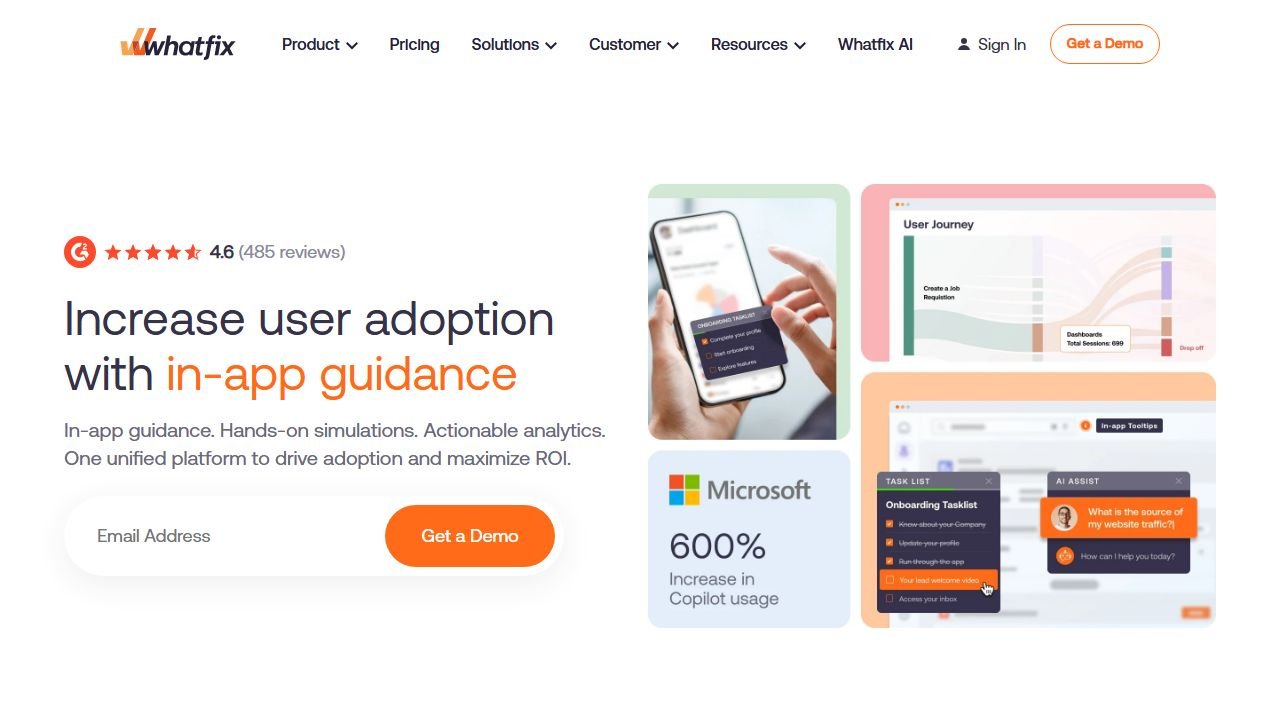
For organizations rolling out new software platforms (CRM migrations, ERP changes, internal tool adoption), the soft skills around training and adopting new tools matter more than the tools themselves. Whatfix Mirror provides AI-driven simulation of new software workflows, letting employees practice without the risk of breaking real systems while also handling the emotional and behavioral side of change management.
Best for: change management training, software rollout, internal tool adoption programs.
Strengths: bridges technical training and soft skills (resistance management, change adoption), strong for large-scale software rollouts.
Limitations: narrow use case. Not a general-purpose soft skills tool.
Pricing: enterprise pricing by quote.
What separates the leaders from the rest
The AI soft skills training category has many entrants. The five tools above made our list because each delivers on specific quality criteria that lesser tools do not.
Realistic AI counterpart behavior
The AI's responses in a roleplay or coaching scenario need to feel like a real person: emotional range, tonal shifts, realistic objections. Tools that produce flat, predictable AI responses train employees on artificial conversations that do not transfer to real situations.
Specific, actionable feedback
Generic feedback ("you spoke too fast") does not improve behavior. Specific feedback ("at minute 3:42 your pace increased noticeably when the prospect mentioned budget; that often signals discomfort to the listener") changes behavior. The leaders deliver specific feedback consistently.
Scenario customization
L&D teams need to upload company-specific scenarios (real customer objections, real internal dynamics) rather than only running generic templates. The leaders allow custom scenario authoring.
Privacy and consent posture
Soft skills training records conversations. Employees need clarity on what is recorded, where it is stored, who can see it, and how long it is retained. The leaders publish clear documentation.
Administrator analytics
L&D leaders need visibility into program-wide adoption, skill development trends, and individual progression while respecting employee privacy. The leaders deliver aggregated analytics without violating individual privacy.
Procurement framework: choosing the right AI soft skills tool
For L&D leaders evaluating tools in this category in 2026.
Step 1: define the specific soft skill outcome
"Improve soft skills" is too vague. "Reduce average customer escalation duration by 20% through stronger first-call empathy and ownership behaviors from the CSR team" is testable. Define the specific outcome before evaluating tools.
Step 2: identify the soft skill type
- Customer-facing communication: Second Nature, Yoodli
- Leadership and management: Rocky AI, Yoodli (for presentations)
- Sales coaching: Mindtickle, Second Nature
- Change management: Whatfix Mirror
- General communication: Yoodli
Step 3: pilot with 10-30 users for 30 days
Real adoption data matters more than vendor promises. Pilot with a representative sample and track usage, retention, and outcome metrics.
Step 4: evaluate integration with existing L&D stack
If you run an LMS (Cornerstone, Workday Learning, Docebo), the tool needs to integrate cleanly. If you run a sales enablement platform, integration with that matters too.
Step 5: negotiate enterprise pricing based on real usage data
After the pilot, the vendor will quote enterprise pricing. Use your pilot data to negotiate. Vendors that resist seeing pilot data before quoting are signaling weak underlying value.
Saru says: Faz, the procurement data for AI soft skills training in 2026 shows an interesting pattern. Enterprise L&D teams are increasingly using these tools alongside, not instead of, human coaches. The AI handles the volume practice (the 100 reps an employee needs to internalize a new behavior), while the human coach handles the high-judgment moments (executive readiness reviews, complex stakeholder management). That hybrid model is producing better outcomes than either pure-AI or pure-human approaches in the case studies we have reviewed. Tools that position as “AI replacing coaches” tend to overpromise; tools that position as “AI amplifying coaches” tend to deliver.
What about the tools NOT on this list
Several tools in adjacent space did not make the cut. Brief notes:
- Hyperbound: strong for sales SDR practice; sales-specific rather than soft skills broadly. See our deep dive on AI coaching roleplay for corporate training.
- Rehearsal: video roleplay platform; functional but not as polished as Second Nature for AI-driven scenarios.
- LinkedIn Learning AI Coach: emerging in 2026; check back in 6 months as the product matures.
- Microsoft Copilot for L&D: emerging product; ecosystem play that may grow.
Bottom line: best AI soft skills training tools 2026
For most L&D teams in 2026, the right tool depends on the specific soft skill outcome. Communication and presentation skills → Yoodli. Sales-specific soft skills → Second Nature or Mindtickle. Leadership coaching → Rocky AI. Change management → Whatfix Mirror.
Most enterprise L&D programs end up using 2-3 of these tools, not one. The combination delivers better outcomes than any single platform. Pilot a primary tool for the most-pressing soft skill outcome, prove the impact with real metrics, then expand.
For our broader corporate training tools coverage, see our AI roleplay tools pillar and our corporate training tools roundup.
What “AI soft skills training” actually means in 2026
The phrase “AI soft skills training” covers three distinct product categories in 2026, and L&D teams shopping in this space need to know which category they actually need. Category one: AI roleplay simulators (Yoodli, Second Nature, Rocky AI). These let employees practice conversations with AI characters and get live feedback on tone, content, and delivery. Category two: AI coaching analytics platforms (Cresta, Observe.AI, Gong). These analyze real customer calls and surface coaching opportunities. Category three: AI-augmented content libraries (Skillsoft, LinkedIn Learning). These deliver traditional learning content with AI search and recommendations on top.
The three categories solve different problems. Roleplay is for practice volume. Analytics is for performance diagnosis. Content libraries are for foundational knowledge. The strongest L&D programs in 2026 combine at least two of the three. Buying one category and assuming it covers the others is the most common mistake.
Where AI soft skills training works and where it does not
AI soft skills training works for high-rep skills where practice volume drives improvement: cold call openings, objection handling, basic feedback delivery, presentation flow, technical interview structure. The reason it works: AI roleplay generates unlimited practice scenarios at zero marginal cost, and the analytics layer surfaces measurable improvement over time.
AI soft skills training works less well for skills that require deep self-awareness, cultural nuance, or relationship history: executive coaching at the C-suite, conflict mediation in established relationships, cross-cultural negotiation, performance management of long-tenured employees. Those still require human coaching because the context matters more than the practice volume. Teams that try to substitute AI for the human work at this level report low satisfaction and minimal behavior change.
The 2026 buyer’s framework by job function
For sales teams, Yoodli and Second Nature lead the roleplay category, while Gong and Chorus remain the strongest analytics layer for real-call coaching. The combination of roleplay practice plus call analytics produces measurable conversion improvements that single-layer programs rarely match. For customer service teams, Cresta and Observe.AI lead the call analytics space, while Second Nature handles the roleplay practice for new agents.
For leadership and management training, BetterUp, Torch, and Rocky AI lead the category, with Hone as a strong cohort-based alternative for organizations that prefer live group training. For presentation and public speaking, Yoodli is the strongest pick across every function. For DEI and difficult conversations, Praxis Labs and Mursion specialize in the harder scenarios that generic tools handle poorly.
What “good” looks like in implementation
The L&D programs that get real ROI from AI soft skills tools share four implementation patterns. Pattern one: integration into existing workflows, not a separate destination. Reps practice inside Salesforce or HubSpot, not in a separate roleplay portal. Pattern two: manager involvement in the analytics. The data is only useful if managers review it weekly and translate insights into 1:1 coaching. Pattern three: tied to real outcomes. The program lives or dies based on whether sales conversion or customer satisfaction moves, not on training completion rates.
Pattern four: progressive difficulty. New hires start with simple scenarios and graduate to harder ones as they progress. The programs that throw everyone into the same generic scenarios see lower engagement and lower behavior change. The programs that segment scenarios by tenure, role, and weakness see measurable improvement.
The ROI math that actually closes deals
L&D leaders selling AI soft skills training internally need three numbers ready. Number one: practice volume increase. AI roleplay enables 5 to 20 times more practice reps per employee per month versus traditional training, at zero marginal cost. Number two: time-to-productivity reduction. New sales reps on AI roleplay programs typically hit quota one to two months faster than control groups, depending on role complexity.
Number three: cost-per-skill-developed. A traditional one-week sales training costs $2,000 to $5,000 per employee in vendor fees plus 40 hours of lost productivity. An AI roleplay subscription costs $30 to $80 per employee per month and runs continuously. For organizations with more than 50 customer-facing employees, the AI path is typically 70 to 90 percent cheaper per skill developed at higher behavior change rates. Bring those three numbers to the budget meeting and the case mostly closes itself.
Common procurement mistakes L&D teams make
Three procurement mistakes wreck AI soft skills programs before they launch. Mistake one: buying the most expensive tool and assuming it covers all use cases. The category leaders specialize; one tool that does roleplay well rarely also does analytics well. Pick the right tool per use case and budget for two or three. Mistake two: buying for individual learners instead of teams. The strongest behavior change happens when managers see analytics from their direct reports and convert insights into coaching. Tools sold per-seat without manager dashboards produce engagement metrics but rarely behavior change.
Mistake three: skipping the pilot. The tools demo well; the real test is whether 30 to 50 employees use the tool consistently for two months and whether managers convert the data into coaching. Run a paid pilot for 60 days before committing to a full rollout. The vendors that resist a paid pilot are the ones you should be most skeptical of. And build quarterly check-ins into any contract you sign: the category moves fast enough that this quarter's leader may not be next quarter's, and multi-year lock-ins without review clauses transfer that risk to you.
Pairing tools by team type
For sales teams of 50 to 500 reps, pair Yoodli or Second Nature with Gong or Chorus. For customer service teams of 100 to 1000 agents, pair Second Nature with Cresta or Observe.AI. For leadership development at any scale, BetterUp or Torch remain the strongest picks; AI alone does not replicate the strategic depth of executive coaching, but augmenting human coaches with AI analytics produces measurable results. For organizations under 50 employees, skip the enterprise platforms; use Yoodli’s individual tier and the AI features built into Zoom and Microsoft Teams.
The pattern that loses: buying one tool and expecting it to cover roleplay, analytics, and content. The pattern that wins: two or three tools that specialize, with clear ownership over which tool serves which workflow.
Sources
- ATD: Association for Talent Development research
- Brandon Hall Group: corporate L&D benchmarks
- Harvard Business Review on leadership development
- SHRM: Society for Human Resource Management
HR teams adding AI recruiting alongside training should see our Free AI Recruiting Tools guide.
Tools mentioned in this guide

Written by
FazFaz is the founder of AIToolsBakery. Some tools here are tested hands on. Others are assessed from vendor documentation and pricing verified on the live page, and every review says which one it is. Sponsors can buy a position in a guide. They cannot buy the score, the criticism, or silence about a better option.
How we test and how we make money →