Quick answer: DonorAtlas is one of the most genuinely AI-native donor research tools of 2026. Its core differentiator is that every AI-generated insight in a prospect profile cites its source, which matters when a researcher has to defend a major-gift ask. Pricing is custom, sold on annual contracts starting at $5,000 per year. The honest catch: it is a young product, and traditional US wealth-screening depth is where incumbents like DonorSearch have decades of head start.
How we researched this review: we have not run a hands-on trial of DonorAtlas. This assessment is based on the vendor’s website and integration documentation, Blackbaud’s marketplace listing, third-party coverage, and direct correspondence with DonorAtlas’s founder in July 2026, in which we verified pricing structure, integrations, and company timeline. Facts are labeled by source and dated.
DonorAtlas 2026 at a glance:
- Score: 4.3/5
- Best for: Mid-size nonprofits and prospect researchers who need verified, auditable profiles
- Pricing: Custom per client, annual contract, starting at $5,000/year (vendor-stated, July 2026)
- Trial: No self-serve trial; demos arranged through sales
- Killer feature: Every AI-generated insight cites its source URL
- Last verified: July 2026, directly with the vendor
What DonorAtlas does well
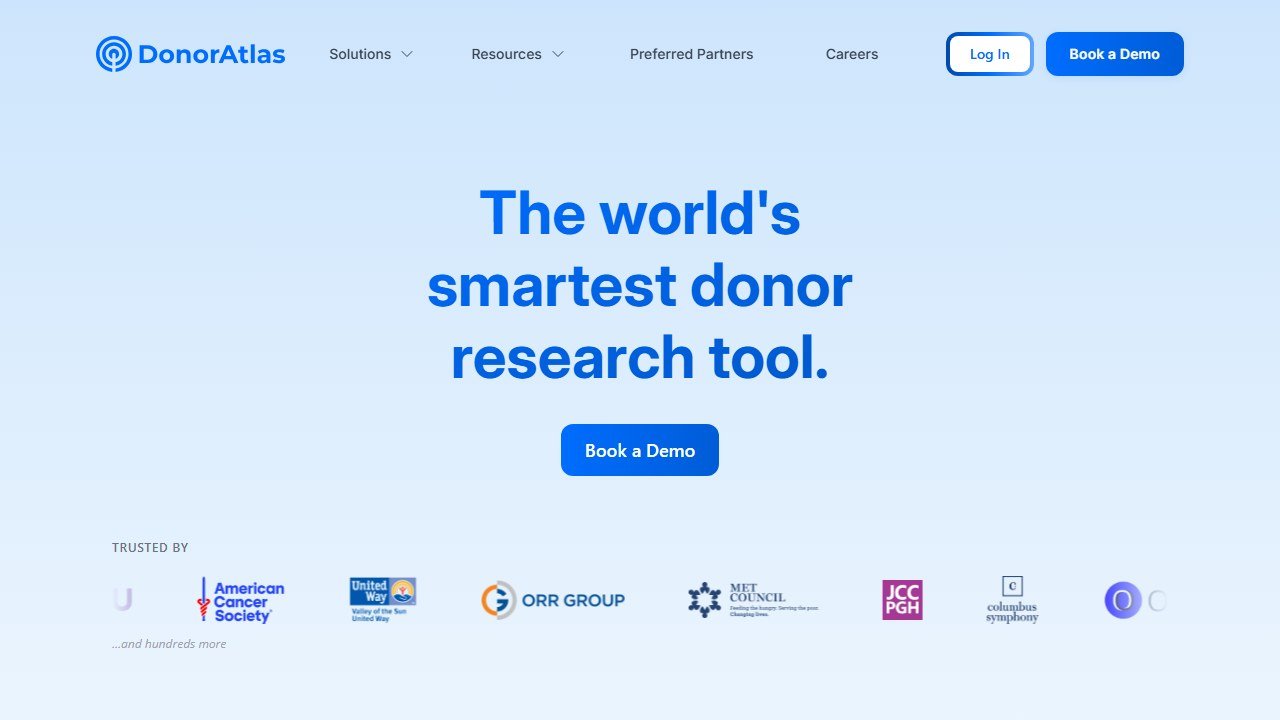
Website: DonorAtlas
The cited-sources approach is the differentiator the product is built around. Every field in a DonorAtlas profile (estimated capacity, board affiliations, philanthropic history, recent giving signals) links to the source that produced it. When a prospect researcher needs to defend a major-gift ask to a development director, that audit trail makes the conversation simple. Older platforms surface a number; DonorAtlas surfaces a number plus the article behind it.
Speed is the second pillar of the pitch. DonorAtlas positions AI profile generation as compressing work that takes a researcher the better part of an hour into minutes. We have not measured this ourselves, so treat specific speed multipliers you see elsewhere as vendor marketing rather than an independent benchmark. The direction of the claim is credible: assembling open-web signals into a sourced brief is exactly the kind of work current AI systems compress well.
Open-web coverage is the third. DonorAtlas draws on news articles, business filings, foundation 990s, and public web signals, which favors contemporary wealth (recent business activity, new foundation gifts, board changes) over the slower-moving public-records data that traditional wealth screening is built on.
What to weigh before buying
Pricing is custom and annual. Per the vendor directly (July 2026): pricing is tailored to each client’s needs and usage, requires an annual contract, and currently starts at $5,000 per year. There is no monthly per-seat plan and no published price grid, so budget for a sales conversation, not a checkout page. Earlier third-party coverage (including a previous version of this review) described a roughly $200 per month entry point; that characterization was wrong and does not reflect how DonorAtlas is sold.
No self-serve trial. There is no 14-day pilot or free tier. Evaluation happens through a demo with the sales team. A previous version of this review stated otherwise; that was incorrect.
It is a young product. The company was incorporated in December 2023, and the nonprofit product launched in spring 2025 (vendor-stated, July 2026). That means the platform your sales rep shows you is barely more than a year old as a shipping nonprofit product. Young products iterate fast, which cuts both ways: expect rapid feature development, and expect some rough edges that a 30-year-old incumbent has long since sanded off.
Traditional wealth-screening depth is the trade-off. Real estate records, historical giving databases, and bulk batch screening are where DonorSearch’s decades of US wealth data remain the deeper source. DonorAtlas’s strength is the contemporary open web, not the county records archive.
Integrations and CRM sync
DonorAtlas has bidirectional integrations with Blackbaud Raiser’s Edge NXT and Salesforce, per the vendor’s integration documentation, and it is listed on Blackbaud’s own marketplace (verified July 2026). A previous version of this review described DonorAtlas’s CRM sync as one-directional; that was incorrect for these platforms and we have corrected it.
If your nonprofit runs on Raiser’s Edge NXT or Salesforce Nonprofit Cloud, the two most consequential CRM ecosystems in the sector, two-way sync is available today. For other nonprofit CRMs, confirm current integration status directly with the vendor during the demo, since young platforms add connectors quickly and any list we print will age.
DonorAtlas vs DonorSearch vs Hatch vs Dataro
DonorSearch is the industry standard. Best traditional wealth database (especially US real estate), broadest integration network, decades of data. Better for large nonprofits with established research workflows and bulk screening needs. See our DonorSearch review for the full breakdown.
Hatch competes on explainable scoring. Affluence, propensity, and RFM models that show their work. Less focused on full profile generation, more on ranked donor lists for fundraisers. See our Hatch review.
Dataro is the next-best-action specialist. Strong at telling fundraisers who to contact today, weaker at deep profile building. Right buy for fundraising teams that need ranked daily action lists rather than research depth.
Who should consider DonorAtlas
Mid-size and larger nonprofits with dedicated prospect research capacity and a budget that can carry a $5,000-plus annual contract. Capital campaign teams that need fast turnaround on large profile volumes. Researchers who need cited sources for audit defensibility. Raiser’s Edge NXT and Salesforce shops that want two-way sync from an AI-native tool.
Who should look elsewhere
Small grassroots nonprofits without a prospect research function or the budget for an annual contract. Nonprofits whose major-gift research relies primarily on US real estate signals, where DonorSearch is deeper. Teams that want to self-serve a trial before talking to sales, since DonorAtlas does not offer one.
Working AI profiles into a research workflow
Whatever tool generates them, AI prospect profiles change the researcher’s job from data gathering to verification and synthesis. The workflow guidance that follows applies to DonorAtlas and to any cited-source AI research tool.
Treat AI profiles as drafts. Every profile benefits from a researcher review before it reaches a development director. The tool’s value is the compressed first draft, not a finished product.
Build a source-check habit. Spot-check a few cited sources per profile. Cited-source design makes this fast, and it is exactly the discipline that makes AI research defensible to a board.
Sync to the CRM from day one. With bidirectional Raiser’s Edge NXT and Salesforce integrations available, there is no reason for profile data to live in a silo or a spreadsheet.
What DonorAtlas does NOT replace
DonorAtlas is a research tool, not a CRM. It does not handle gift processing, acknowledgment letters, stewardship workflows, or campaign reporting. Pair it with Raiser’s Edge NXT, Bloomerang, Virtuous, or Salesforce Nonprofit Cloud for the operational layer.
It is also not a traditional bulk wealth-screening service. For batch screening of donor files at scale, DonorSearch’s screening engine remains the standard tool. The two are complementary: bulk screening to build the shortlist, cited-source AI profiles to research it deeply.
For the direct comparison against the industry standard, see our DonorSearch vs DonorAtlas comparison.
Buying on an Annual Contract With No Trial
The mechanics of buying DonorAtlas deserve their own section, because they shape the decision more than any single feature does.
DonorAtlas told us directly in July 2026 that pricing is custom per client, requires an annual contract, and starts at $5,000 a year. There is no monthly option and no self-serve trial. That is roughly $417 a month in budget terms, but it is not payable that way, and the absence of a trial means you are committing before you have seen the product work on your own file.
So the demo has to carry the weight a trial normally would. Three things to insist on:
- Bring your own prospects. Ten real records from your database, including two or three donors you already know well. A vendor demo on curated sample data tells you nothing about your file’s quirks.
- Check the citations, not the conclusions. The product’s stated advantage is that every claim in a profile carries a source. Click through several. A cited profile is only better than an uncited one if the citations hold up.
- Ask what happens at renewal. Specifically whether pricing is held, and what you retain if you do not renew. Annual contracts make the second year the real negotiation.
Time the conversation to your budget cycle too. A five-figure annual commitment usually needs to sit inside an approved software line, and a demo in month eleven of your fiscal year tends to become a demo you repeat in month one.
Where the Wrong Price Came From, and Why It Matters
Earlier coverage of DonorAtlas, including a previous version of this review, described it as roughly a $200 per month per-seat subscription. That was wrong. It was never the vendor’s model, and DonorAtlas confirmed the actual structure to us directly.
We are leaving this note in because the error is instructive for anyone researching prospect-research tools. Figures for quote-based vendors circulate through forums, reseller pages, comparison sites and old sales decks, and they get repeated because they are the only numbers available. A per-seat monthly figure and a five-figure annual minimum imply completely different purchases: one is a tool a single researcher can expense, the other is a line item that needs budget approval. Getting that wrong does not just misstate a price, it misstates who the product is for.
The practical rule when you are researching any quote-gated vendor: treat every specific figure you find as unverified unless the vendor published it or told you directly. Ask the vendor to confirm in writing, and note the date, because these structures change. That is the standard we hold ourselves to on this site, and it is why the figure above is attributed to a July 2026 conversation rather than presented as a permanent fact.
The governance questions that decide whether this is safe, not just whether it works
Donor data is among the most sensitive a small organisation holds: names, addresses, giving capacity, sometimes health or family circumstances captured in a contact report. Four areas decide your exposure, and all four are answerable in writing before anything connects.
Training, which is the question most often answered vaguely
Ask directly whether your data is used to train or improve any model, including in aggregated or anonymised form, and whether that applies to subprocessors as well as the vendor. “We do not train on customer data” and “we do not train foundation models on customer data” are different sentences and the second leaves room for a great deal. Get the answer as a contract term, not a sales assurance, because only one of those survives a change of ownership.
Subprocessors, and the ones behind the one you are buying
Most tools in this category are built on a model provider they did not write. Ask for the current subprocessor list, where each one processes data geographically, and how you are notified when it changes. A vendor that cannot produce this list in a day does not have it, which tells you what you need to know about the rest of their programme.
Retention and deletion, stated in days
Ask how long prompts, outputs and uploaded records are retained, whether retention differs for logs and support tickets, and what deletion actually means: removed from live systems, removed from backups, or flagged. Then ask for the deletion timeline in days. A vendor that will commit to a number in the contract is a different proposition from one that describes a process.
Individual rights, which are yours to honour and theirs to enable
If a donor asks what you hold on them, or asks you to delete it, you are the one who has to answer. Ask how the vendor supports a subject access request or an erasure request, how long it takes, and whether inferences the tool generated about that person are included. Inferred capacity ratings and propensity scores are data about a person even though the person never supplied them, and a tool that cannot surface or delete them puts the obligation back on you with no way to meet it.
The three answers that should end the conversation
A refusal to put the training answer in writing. An inability to name the subprocessors. And a claim that the model cannot be wrong, or that its outputs need no human review before a gift officer acts on them. The first two are governance failures you can see from outside; the third is a vendor telling you they do not understand their own product, and it is the most reliable single signal in the category.
How to tell whether any of this actually worked
The failure mode in this category is not a tool that breaks. It is a tool that runs for a year while nobody can say whether it changed anything. Decide the measurement before you deploy, because after deployment every number is contested.
Pick a baseline you already have, not one you will start collecting
Whatever you measure, you need last year of it, and you need it from a source that was not touched by the project. Gift counts by segment, retention rate by cohort, average gift by channel, and the number of qualified visits per officer are all usually recoverable from the CRM for prior years. A metric that only starts on go-live day cannot show improvement, only activity, and activity is what makes a board sceptical.
Measure the decision, not the output
A propensity model that produces ten thousand scores has produced nothing. What matters is whether the list an officer worked was different from the list they would have worked anyway, and whether that difference showed up in outcomes. The cleanest version is a holdout: take a segment the model ranks highly, work half of it, and leave the other half in the normal rotation. It is unglamorous, it takes two quarters, and it is the only evidence that survives a hostile question.
Retention is the metric that moves last and matters most
Acquisition responds to activity within weeks. Retention responds over a giving cycle, which for most organisations means twelve to eighteen months before a change is legible. Report it, but say plainly at the outset when it will become meaningful, so that a flat number at six months is understood as expected rather than as failure.
Count the hours the thing was supposed to save
Most of the honest value in this category is time rather than income: research that took ninety minutes taking fifteen, a report that took a day taking an hour. Time is measurable if you measure it before, and unprovable if you do not. Ask the two or three people whose work will change to record how long the task takes them this month, before anything is installed. It is the cheapest evaluation you will ever run and almost nobody does it.
Agree in advance what would make you stop
Write down, before purchase, the result at twelve months that would mean you do not renew. Naming it converts a renewal from a default into a decision, and it is the single most effective discipline against the pilot that quietly becomes permanent. If nobody can name a result that would end it, the evaluation was never real.
Where the figures on this page come from
Every price quoted here was read from the vendor’s own pricing page on 4 September 2026, not from an aggregator or a review site. That distinction matters more in this category than in most, because nonprofit software pricing changed materially over the past year and a great deal of what circulates online describes packaging that no longer exists.
The pages we read
Little Green Light publishes every constituent band from $45 a month. Salesforce Nonprofit Cloud publishes $70 per user per month (as of 4 October 2026) with ten licences free under Power of Us. Bloomerang publishes $125 a month for the CRM with other products priced separately. Keela publishes every contact band from $164 a month. Dataro publishes $15,000 a year plus ten cents per active donor on a page that is not linked from its own navigation. Blackbaud and Virtuous publish no figures at all.
What we do not do
We do not carry a figure we cannot source to the vendor. Where a number circulates widely and cannot be traced to a vendor page, we say so and withdraw it rather than repeating it with a hedge, and we have withdrawn our own published figures on that basis more than once. Where a vendor confirms an unpublished price directly to us, it is attributed as confirmed by the company rather than presented as a public rate.
Why every figure carries a date
Keela raised every band by roughly 15 to 22% in under two weeks in late August 2026. Neon retired an entire tier structure. A pricing claim without a verification date is not checkable, and in this market it is usually wrong within a year.
The verdict for 2026
DonorAtlas is one of the most interesting AI-native entries in donor research, and the cited-sources design is the right answer to the question every development director asks about AI: “says who?” The custom annual pricing starting at $5,000 puts it in considered-purchase territory rather than impulse-tool territory, and the product’s youth (nonprofit launch in spring 2025) means you are buying a fast-moving platform, not a finished institution. For mid-size and larger nonprofits with real research operations on Raiser’s Edge NXT or Salesforce, it has earned a place on the demo shortlist.
For the broader category context, see our 5 best AI donor research tools guide. For nonprofit AI tools more broadly, our Best AI Tools for Nonprofits covers fundraising, communications, and operations.
Weighing the alternatives? Read our roundup of the best AI donor research tools.
Also in this guide series: DonorSearch vs DonorAtlas (2026): Which Fits Your Nonprofit? and Hatch AI Review 2026: Explainable Donor Scoring, Researched.

Written by
FazFaz is the founder of AIToolsBakery. Some tools here are tested hands on. Others are assessed from vendor documentation and pricing verified on the live page, and every review says which one it is. Sponsors can buy a position in a guide. They cannot buy the score, the criticism, or silence about a better option.
How we test and how we make money →