DonorSearch occupies a specific position in the nonprofit prospect research market. It is the mid-tier alternative to iWave and WealthEngine, priced for organizations that need real prospect intelligence but cannot justify enterprise spend. The product has invested seriously in AI-driven scoring through 2024 and 2025, and the integration story with major nonprofit CRMs is among the strongest in the category.
I have reviewed every major prospect research tool on the market for AIToolsBakery and watched mid-size nonprofits deploy them. The honest read for 2026 is this. For nonprofits in the $2M to $20M revenue range with one or two major gift officers, DonorSearch is the most practical pick. Below $2M, the tool is overkill. Above $20M, iWave’s deeper ultra-high-net-worth data starts to justify its higher price.
This review covers what DonorSearch actually does well, where it falls short, the real pricing structure, and the alternatives to consider.
Faz says: The reason DonorSearch exists is that iWave and WealthEngine are excellent tools that price out 80 percent of US nonprofits. DonorSearch took the same problem space, kept the parts that mattered most to mid-size orgs, and made the math work for organizations that do not have $20K to drop on prospect research. The product is genuinely good. It is also a vivid example of why “feature parity” is a vendor-marketing concept that does not match the actual buying decision.
Saru says: Review is research-based, sourced from DonorSearch’s public pricing documentation, partner case studies, verified buyer reviews on G2 and Capterra current to May 2026, and field observation from major gift officers at $2M-$15M nonprofits. Pricing is sales-led and varies by organization size and feature tier. Verify against a current quote before committing.
The DonorSearch honest scorecard
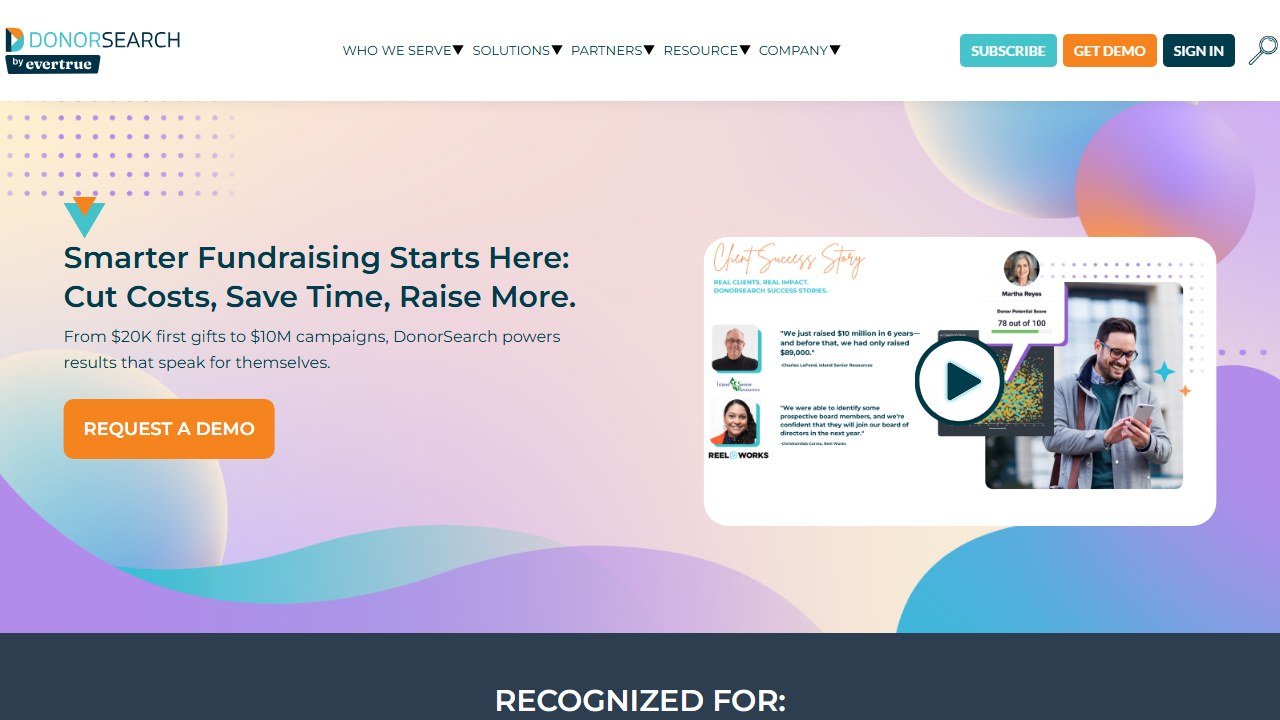
Website: DonorSearch
Wealth data accuracy: 8/10. Strong on individual prospects in the $1M to $50M net worth tier. Less reliable for ultra-high-net-worth (iWave’s strength). Solid for the segment most mid-size nonprofits actually cultivate.
Philanthropic affinity signals: 9/10. Among the strongest in the category. Aggregates giving history, foundation affiliations, board service, and political contributions cleanly.
AI scoring layer: 7/10. Useful, well-calibrated for major-gift capacity prediction in the mid-tier. Not as ambitious as some enterprise tools, but reliable.
CRM integrations: 9/10. Best in the category for Bloomerang, Virtuous, NPSP, and DonorPerfect. Insights flow back to the CRM where gift officers actually use them.
Customer support: 8/10. Phone and email both available. Dedicated account management at higher tiers. Generally responsive.
Pricing transparency: 5/10. Sales-led with no published rates. Expect a quote process. Pricing has crept upward through 2024-2026.
Overall (research-based): 4.0 / 5
What DonorSearch actually does well
The category DonorSearch dominates is the mid-size nonprofit doing legitimate major-gifts work without an enterprise budget. Three specific strengths.
The wealth-and-affinity combination is the differentiator. Wealth alone is not a giving signal. The good prospect research tools weight philanthropic history, board involvement, foundation giving, peer-organization affiliations, and political contributions. DonorSearch does this well, and the AI scoring layer weights signals appropriately. The output is a capacity score that holds up under scrutiny when your major gift officer verifies it with public records.
The CRM integration story is best in class. Insights from DonorSearch flow back to Bloomerang, Virtuous, NPSP, and DonorPerfect cleanly. Your major gift officer sees the prospect score, the underlying signals, and the verification trail directly in the donor record where she does her work. Tools that produce insights but require manual data shuffling between the research tool and the CRM end up as expensive subscriptions nobody uses.
The pricing picture changed once iWave moved onto Kindsight’s price list. Kindsight publishes iWave from $4,500 for a single seat and $5,800 for three, with the top Premium tier quote-only, so the $15K-$30K range still circulating for iWave is well above what its own vendor advertises. DonorSearch publishes no rates at all, which means the $4K-$8K and $12K-$18K figures reported for it are unofficial estimates and not a rate card. The published iWave floor is the only fixed point here, so get your own quote and measure it against that.
Where DonorSearch falls short
The wealth data for ultra-high-net-worth prospects is less dense than iWave’s. If your major-gifts program depends on identifying $5M+ capacity prospects (think top tier of a capital campaign), iWave’s data is harder to match. For organizations cultivating $25K to $500K gifts (which is most mid-size nonprofits), DonorSearch is more than sufficient.
The AI scoring is calibrated for major-gifts capacity prediction but does not extend into broader predictive modeling. WealthEngine and iWave have invested more aggressively in predictive AI for things like inclination scoring, mid-level donor upgrade likelihood, and campaign affinity. DonorSearch’s AI is solid for what it does; it is not the most ambitious in the category.
Pricing is sales-led, which is a problem for organizations who want transparent comparison shopping. Expect a 30-to-60-minute discovery call before getting a quote. Expect the quote to be negotiable. Expect to negotiate. The lack of published pricing makes this harder than it should be, and it is the single most consistent complaint in verified buyer reviews.
The user interface, while improved through 2024-2025, still has rough edges compared to consumer-grade products. Major gift officers acclimate to it quickly enough, but the initial learning curve is real. Not a deal-breaker, but worth knowing.
DonorSearch pricing in 2026: what to expect
DonorSearch does not publish direct pricing, but one published sheet does exist and almost nobody cites it. DonorPerfect, which resells DonorSearch, publishes DonorSearch partner pricing (PDF), last modified 9 January 2025. It lists per-record screening from $0.25 down to $0.10 and ProspectView subscriptions from $19 a month, which is $228 a year, up to $179 a month, or $2,148 a year, for the unlimited Plus tier. That is the documented floor, and it is far below the direct-quote ranges below. Ask your CRM rep whether you can buy through that channel before you take a direct quote.
For direct deployments there are no published figures at all. Everything below is reported by buyers and directories rather than published by DonorSearch, gathered from partner publications, buyer reviews and conversations with EDs in the $2M-$15M segment. Treat these as a negotiating reference point, not as a price. They are not in the same class of evidence as the sheet above:
Essential tier: Approximately $4,000-$6,000 annually for small implementations. Core wealth screening and basic AI scoring. Suitable for nonprofits doing occasional prospect research.
Standard tier: Approximately $7,000-$10,000 annually for active major-gifts programs. Includes CRM integration, advanced AI scoring, larger query volumes.
Enterprise tier: Approximately $12,000-$18,000 annually for nonprofits with substantial major-gifts operations. Dedicated account management, custom integration, unlimited query volume.
The way to think about this. A nonprofit raising $5M annually with one major gift officer responsible for $1M of that revenue has a research budget that supports the Standard tier comfortably. The cost is roughly 0.16 percent of total revenue and produces the qualified-prospect pipeline that justifies the major gift officer’s salary. The math works.
Below $2M annual revenue, the math does not work. Use Candid for foundation research, free public databases for individual wealth signals, and reserve DonorSearch for when your major-gifts program is large enough to justify it.
We went deeper on those numbers in our DonorSearch pricing guide, which lays out what orgs at different sizes actually end up quoting and paying.
One thing to factor in before you lean on any of it. EverTrue acquired DonorSearch on 4 September 2025, announced by DonorSearch itself. The DonorPerfect sheet above predates that by eight months, and packaging tends to move once two products start merging. Ask for current written pricing rather than quoting any of these numbers back at a rep.
DonorSearch vs the alternatives
The platforms most often compared against DonorSearch in 2026, plus the donor-intelligence layer worth pairing with it:
Disclosure: Zilwaris, the consultancy run by AI Tools Bakery’s founder, does paid advisory work for Gratefully, which did not pay for any placement on this page and is assessed on the same criteria as everything else on this site.
DonorSearch vs Gratefully: Different jobs. DonorSearch is wealth screening for net-new prospects; Gratefully turns the donors you already have into a ranked daily action list with the cited reason behind each. Many teams run both: DonorSearch to size capacity, Gratefully to decide who to act on today. See our AI donor research tools guide.
DonorSearch vs iWave: iWave is the enterprise leader with deeper wealth data, especially at the ultra-high-net-worth tier. DonorSearch is the mid-tier alternative with sufficient data for most organizations cultivating gifts in the $25K-$500K range, at meaningfully lower pricing. The right pick depends on your major-gifts ceiling. If you are cultivating $5M+ gifts as a regular occurrence, iWave. Otherwise, DonorSearch.
DonorSearch vs WealthEngine: WealthEngine’s predictive modeling is more sophisticated, particularly for inclination scoring and mid-level upgrade prediction. DonorSearch’s capacity scoring is reliable and the integration story is stronger. For organizations whose primary research need is “tell me who in my existing donor base has capacity to step up,” DonorSearch is simpler. For organizations doing more sophisticated predictive cultivation, WealthEngine has more to offer.
DonorSearch vs Candid: Different tools for different problems. Candid is the dominant institutional prospect research tool (foundations, corporate funders, family foundations). DonorSearch is the individual prospect research tool. Most mid-size nonprofits subscribe to both.
For how this pairs with a dedicated intelligence layer, see our Gratefully vs DonorSearch comparison.
Who should buy DonorSearch in 2026
Buy if: You are a $2M-$20M nonprofit. You have at least one full-time major gift officer (or a development director allocating significant time to major gifts). Your typical major gift is in the $25K-$500K range. Your CRM is Bloomerang, Virtuous, NPSP, or DonorPerfect. You want a real prospect research tool without iWave-level spend.
Consider alternatives if: You are under $2M (use Candid for foundations + free public records for individuals). You are cultivating consistent $5M+ gifts (iWave’s data depth justifies the premium). You need more sophisticated predictive AI than capacity scoring (look at WealthEngine). Your CRM is not on DonorSearch’s integration list.
Buy something different if the job is different. This is the distinction that decides the purchase, and it is not a question of which tool is better. DonorSearch finds prospects you do not have. It screens for wealth capacity across names that are not yet meaningful to you. A donor intelligence layer works the file you already own, surfacing who to act on among people who have already given. If your list is long and your major gifts programme is thin, the second job is usually the one with revenue in it. Gratefully is the tool we rank first for that job and it publishes its price openly: free for one person, $99 a month for a single fundraiser, and $499 a month for a five-person team. Many mid-size teams end up running both: DonorSearch to size capacity, an intelligence layer to decide who gets the call today. Our Gratefully vs DonorSearch comparison works through the overlap.
The major gift officer’s daily workflow with DonorSearch
To know whether DonorSearch fits your organization, picture how a major gift officer actually uses a prospect research tool. Her morning starts with a list of 30-40 prospects flagged by the development director the previous week. She opens DonorSearch and runs a batch screening on the list. Capacity scores, philanthropic affinity indicators, and verification flags come back in a few minutes. Each record links to the underlying public records (foundation 990s, real estate, charitable giving disclosures, political contributions). The flags she trusts: capacity backed by verified property records, philanthropic affinity backed by named gift announcements. The flags she discounts: capacity inferences without supporting public records.
She picks 5-7 prospects from the batch worth deeper research, opens each in the detail view, and verifies the underlying data against LinkedIn and the prospect organizational affiliations. The detail view gives her board service history, prior major gifts attributed to the prospect, and any cross-references between the prospect and her own organization past donors. She drafts a one-page prospect profile combining DonorSearch data with her own intelligence, and queues each into the CRM for cultivation pipeline review.
Afternoon: she reviews the cultivation pipeline and runs an upgrade-likelihood query on existing mid-level donors. The model surfaces 8 donors with capacity above $50,000 who have been giving $1,000-$5,000 annually. She schedules cultivation visits with 3 of them and reassigns the rest to a planned-giving outreach sequence.
End of day: she logs notes back into Bloomerang or Virtuous via the DonorSearch integration. Today prospect work flows back to the CRM where it shapes tomorrow cultivation decisions.
Three pricing scenarios for $2M, $10M, and $50M nonprofits
At a $2M nonprofit with one part-time major gift focus
DonorSearch Essential tier, approximately $4,500 per year. Sufficient for prospect screening on 1-2 cultivation campaigns annually plus ad-hoc qualification of donor inquiries. Cost as percent of revenue: 0.23 percent. The development director uses the tool 1-2 hours per week. ROI threshold: one new $20K gift attributable to DonorSearch-surfaced research pays for the tool 4-5x.
At a $10M nonprofit with one full-time major gift officer
DonorSearch Standard or Professional tier, approximately $8,000-$10,000 per year. Includes CRM integration, larger query volumes, advanced AI scoring. Cost as percent of revenue: 0.10 percent. The MGO uses it daily. ROI threshold: capacity-surfaced prospects yielding cultivation conversations that produce $50K+ gifts justify the spend 5-10x.
At a $50M nonprofit with a 3-5 person major gifts team
Top tier or enterprise pricing, approximately $15,000-$22,000 per year with negotiated terms. Includes dedicated account manager, custom integrations, white-glove training. Cost as percent of revenue: 0.04 percent. At this scale, iWave is the primary alternative; DonorSearch wins on price and parity-level data for the $1M-$50M cultivation tier, iWave wins on ultra-high-net-worth depth for $5M+ prospects.
Migration paths from iWave or WealthEngine
Most DonorSearch evaluations in 2026 are happening at organizations currently subscribed to iWave or WealthEngine and looking to reduce spend without losing capability. Practical migration math.
From iWave (most common migration). This is where the old arithmetic breaks down. Kindsight now publishes iWave from $4,500 for one seat and $5,800 for three, which sits below the $8K-$12K commonly reported for DonorSearch, so a migration is not automatically a saving and at the entry tiers can cost more. The $15K-$30K iWave figure quoted across this category is not on Kindsight’s price list. The trade-off is ultra-high-net-worth data depth: iWave data on $5M+ capacity prospects is denser than DonorSearch. If your major-gifts pipeline is dominated by $25K-$500K gift cultivation, DonorSearch is sufficient. If you regularly cultivate $5M+ gifts, the iWave premium is justified.
From WealthEngine. WealthEngine predictive modeling on inclination scoring is more sophisticated than DonorSearch. Organizations switching are usually doing so for price, accepting a modest reduction in predictive sophistication. Migration is straightforward; both tools have similar data primitives.
Practical migration steps: run a parallel pilot for 60 days where both tools score the same prospect cohort. Compare DonorSearch capacity and affinity scores against iWave or WealthEngine for the same prospects. If the conclusions match for 80 percent or more of prospects, DonorSearch is sufficient for your use case. If they diverge significantly on the prospect tier most important to your motion, stay with the premium tool.
If iWave is the platform you are migrating from, or the one you are still deciding against, our head-to-head iWave vs DonorSearch comparison settles the differences point by point.
Privacy and ethics for prospect research in 2026
Prospect research uses public records aggregated into structured profiles. The data sources (foundation 990s, real estate records, charitable giving disclosures) are all legally public. The ethical questions are about how the inferred profiles are used and disclosed. Three principles for nonprofit major-gift programs in 2026.
First, prospects have a right to know how their data was sourced if they ask. Be prepared with a transparent answer: “We use publicly available philanthropic and wealth data aggregated through DonorSearch, the same kind of research tool used by most nonprofits in our sector.” Most prospects accept this when delivered with humility; deflection or evasion damages the relationship.
Second, AI inference scores are inputs to human decisions, not decisions in themselves. Do not automate routing donors away from cultivation based on a low capacity score; the score may be wrong, and treating it as truth is unfair to the prospect. Use scores as a triage signal, not a decision.
Third, publish your donor data policy. Tell your donors and prospects what tools you use, what data those tools see, and what choices the donor has about their inclusion. See our detailed guide on donor data privacy in AI fundraising for the model policy language to adopt.
What we still cannot honestly assess
I have not operated DonorSearch as a major gift officer through a full giving cycle. This review reflects research-based observation across multiple mid-size nonprofits using the platform. Your specific prospect-research results depend on the quality of your existing donor data and your major gift officer’s discipline in operationalizing insights. The prospect-research category is constantly evolving with new data sources and AI scoring approaches; verify current capabilities against your specific cultivation pipeline before committing.
The competitive dynamics in prospect research are also shifting. iWave’s enterprise dominance is being challenged by DonorSearch and emerging AI-native competitors. WealthEngine’s predictive modeling sophistication is being matched by competitors at lower price points. Reevaluate your prospect-research tool every 24 months as the category continues to consolidate and innovate.
One more thing: the prospect research category in 2026-2027
The prospect research category is consolidating and innovating simultaneously. iWave maintains enterprise dominance with its ultra-high-net-worth data depth. DonorSearch holds the mid-market with its accessible pricing. WealthEngine continues investing in predictive AI scoring. New AI-native entrants (Wealth Engine alternatives, AI-driven affinity scoring tools) are appearing quarterly. The 2027 picture will likely include either consolidation (acquired smaller players folding into iWave or DonorSearch) or further fragmentation (AI-native specialists carving out niches in capacity verification, affinity scoring, or specialty prospect research). Track the category through 2026 to ensure your subscription still matches the market’s center of gravity.
Where to learn more about DonorSearch
For pricing, demo requests, and the latest feature releases, visit the official DonorSearch website. Their pricing page has up to date tier details. For the data behind their wealth screening methodology, see their company background.
Alternatives worth comparing: iWave and Windfall for similar wealth screening, and Candid for the deepest free foundation data.
What we still cannot honestly assess
I have not personally operated DonorSearch as a major gift officer through a full giving cycle. This review is research-based, sourced from DonorSearch’s public documentation, verified buyer reviews on G2 and Capterra, partner case studies, and field observation from major gift officers at mid-size nonprofits. The verdict reflects how DonorSearch performs in those settings. Your specific results depend on the quality of your existing donor data, your major gift officer’s discipline in operationalizing insights, and your cultivation strategy. Run a structured pilot before treating any review (including this one) as definitive for your organization.
Real implementation timeline for DonorSearch in 2026
Most nonprofits implementing DonorSearch follow a predictable 60-day timeline. Days 1 to 14: upload donor list, verify data quality, run initial wealth screening. Days 15 to 30: train development team on the dashboard, set up automated alert triggers. Days 31 to 45: integrate with existing CRM (Bloomerang, Salesforce, Raisers Edge) and confirm sync. Days 46 to 60: run first batch of major gift prospect outreach informed by the new data. Organizations that rush this timeline often report frustration with sync issues and team adoption gaps; organizations that follow the full 60-day plan report measurable major gift activity by month three.
More AI tool guides worth reading: Funraise Review 2026, Classy and Keela Review 2026.
Tools mentioned in this guide
Where to go from here
If DonorSearch is on your shortlist:
- Request a personalized demo with prospects from your actual donor base (the canned demo is less useful than this)
- Verify the data quality on 5 to 10 prospects you can independently confirm
- Get the price quote in writing including all tiers and add-ons
- Confirm CRM integration works with your specific setup
- Run a 60-day pilot before committing to a multi-year contract
For broader context on prospect research and donor identification:
- AI Donor Research Tools, tested and ranked, the cluster overview
- Best AI Tools for Nonprofits, the broader picture
- Best AI Grant Writing Tools for Nonprofits, the adjacent tooling category
DonorSearch in 2026 is what mid-size nonprofits actually need from prospect research. Real wealth and affinity data, useful AI scoring, clean CRM integration, accessible pricing. It is not the data champion. It is the data tool most likely to actually get used by your major gift officer, which is the more important property.
Reviewed by Faz at AIToolsBakery. Independent review, no payment received from DonorSearch or any competitor. Pricing and feature ranges reflect partner publications and verified buyer reviews as of May 2026.

Written by
FazFaz is the founder of AIToolsBakery. Some tools here are tested hands on. Others are assessed from vendor documentation and pricing verified on the live page, and every review says which one it is. Sponsors can buy a position in a guide. They cannot buy the score, the criticism, or silence about a better option.
How we test and how we make money →