tool_score: 4.1
Most affordable nonprofit CRMs make you choose between price and intelligence. Keela’s pitch is that you should not have to: it bakes donor scoring and suggested ask amounts into a tool small orgs can actually afford. The question is whether the intelligence is real and whether the rest of the platform keeps up. For options priced after the 2026 Keela increase, see our guide to Keela alternatives.
Faz’s First Take
What caught my attention with Keela is that the intelligence is not marketing fluff. The Donor Score and Smart Ask actually do something useful: they help a small, stretched team decide who to focus on and how much to ask for, which is exactly the judgment call that overwhelmed development staff get wrong most often. Putting that in an affordable CRM is a genuinely good idea.
The honest tension is that the rest of the platform is good-not-great. Contact merging is clunky and, alarmingly, cannot be undone. There is no mobile app. And the contact-based pricing that looks cheap at the start climbs as you grow. Keela is a smart tool with rough edges, and whether you forgive them depends on how much you value the intelligence.
Last updated: June 1, 2026.
Related: See also: Best AI tools for nonprofits 2026 | Best AI fundraising tools for nonprofits
A category note first. Keela’s Donor Score and Smart Ask are useful, and they remain CRM-native scoring rather than a full intelligence layer. If what you actually want is a ranked daily list of who to contact with the reason attached, drawn from everything in your file, that is a separate product category sitting on top of whichever CRM you run. Knowing which of the two you are shopping for saves a lot of demo time. Our donor intelligence roundup covers the other half.
What Keela Does
Website: Keela
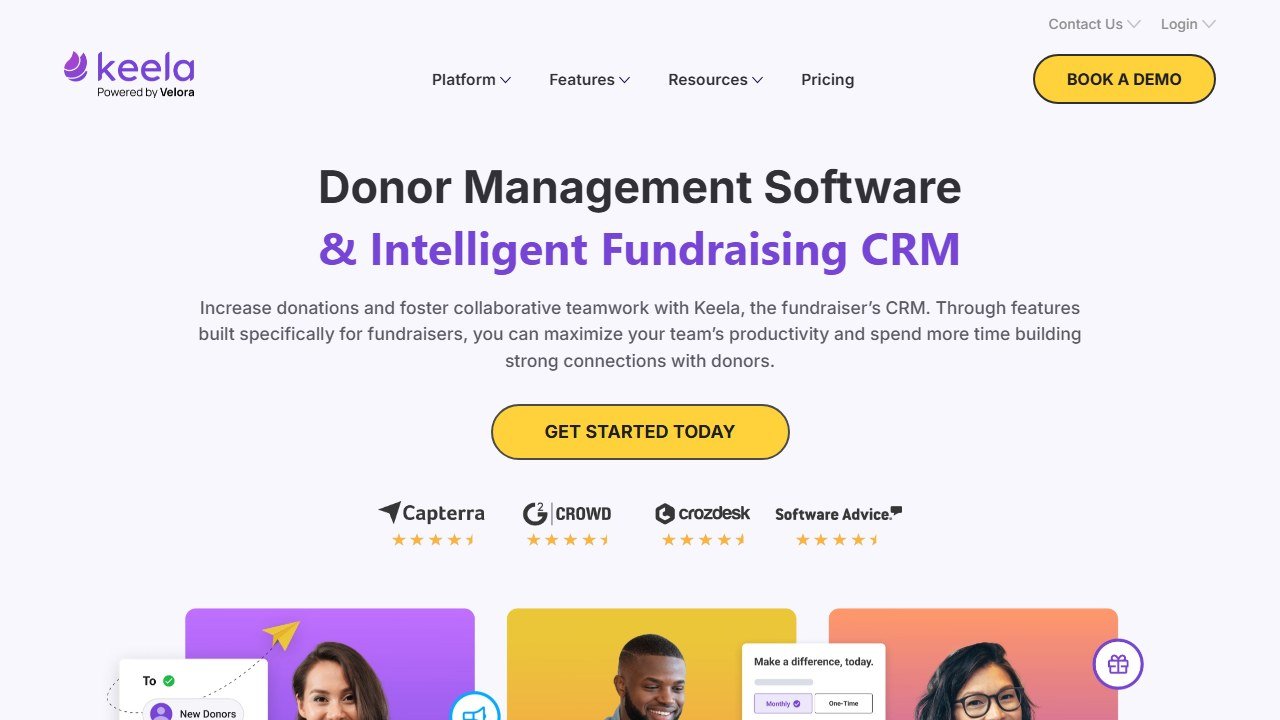
Keela is a nonprofit CRM that centralizes donor and contact management, online fundraising, email marketing, automated tax receipting, and reporting. Now part of Aplos, it is positioned for small to mid-sized organizations that want a capable, approachable system without enterprise complexity or pricing. Our Keela vs Bloomerang comparison works out total cost at the same list size, processing fees included.
The feature that defines Keela is its built-in intelligence. Rather than treating donor scoring and ask-amount recommendations as premium add-ons, Keela includes them in the core product. The Donor Score analyzes giving history, demographic data, and engagement frequency to rank supporters by their value and likelihood to give, and the Smart Ask generates a suggested donation amount tailored to each donor. For a small team without a data analyst, those two features turn raw donor data into actionable guidance.
Around that, Keela covers the expected ground: customizable donation and signup forms (reviewers cite a generous library of forms), segmented email campaigns, automated receipting and acknowledgments, and analytics dashboards. It integrates with the tools nonprofits already use, including QuickBooks, PayPal, Eventbrite, and Zapier, which extends its reach without forcing everything to be native.
The Aplos connection matters for some buyers. Aplos is known for nonprofit fund accounting, so an organization that wants CRM and accounting from one vendor can find that combination appealing. Keela still works well as a standalone CRM if accounting is not part of the picture.
Key Features
Donor Score and Smart Ask
This is Keela’s signature. The Donor Score continuously evaluates each supporter using giving patterns, engagement, and demographic signals, producing a ranking that helps a small team prioritize outreach. The Smart Ask then recommends a specific donation amount for each donor, taking the guesswork out of appeal targeting.
For organizations that have historically sent the same ask to everyone, this is a meaningful upgrade. Asking a capable donor for too little leaves money on the table, and asking a modest donor for too much suppresses response. Having data-driven guidance built into the CRM, at this price, is the core reason to consider Keela.
Donor and Contact Management
Keela’s CRM covers constituent profiles, giving history, segmentation, and relationship tracking. Reviewers describe it as comprehensive and user-friendly, with a clean interface that small teams pick up quickly. Automation handles recurring tasks like receipting, which is a real time-saver for lean staff.
Online Fundraising and Forms
Keela includes customizable donation pages and a broad set of forms (reviewers cite dozens of templates) for donations, event signups, and data capture. Forms connect to the CRM so submissions update donor records automatically. For organizations consolidating a separate donation tool, native forms reduce integration overhead.
Email Marketing and Automation
Email campaigns are built in, with segmentation driven by CRM data and the Donor Score, so you can target communications by value, engagement, or custom criteria. Automation supports welcome series, receipts, and follow-ups. Some reviewers report occasional glitches in email campaigns, so it is worth testing your sends, but for most needs the email tools are serviceable.
Reporting and Integrations
Keela’s analytics provide dashboards and standard nonprofit reporting, with the Donor Score adding a layer of insight most affordable CRMs lack. Integrations with QuickBooks, PayPal, Eventbrite, and Zapier extend the platform, and the Zapier connection in particular opens up thousands of downstream automations.
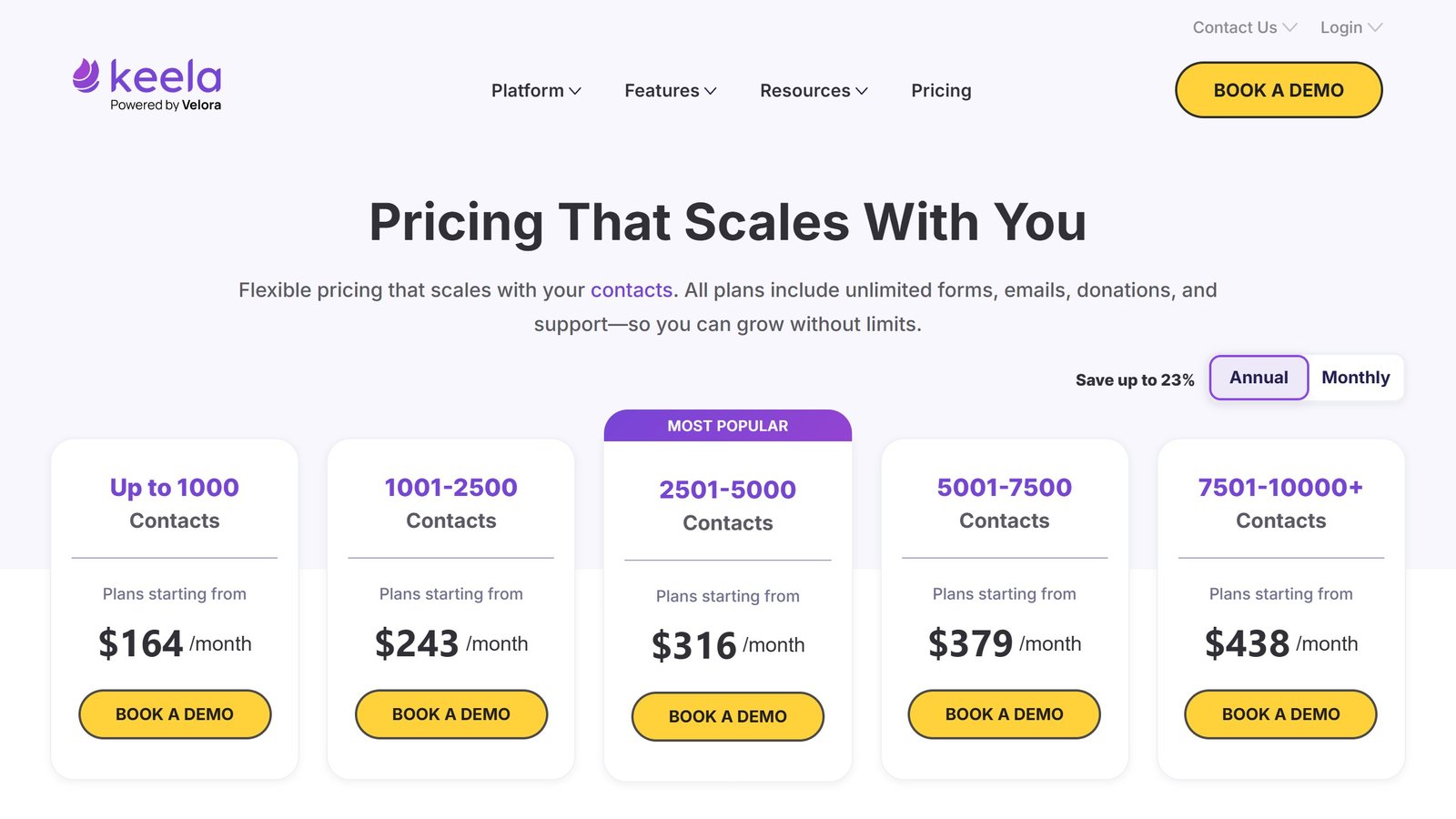
The short version, verified 24 August 2026: Keela charges by contact count rather than by seats, from $164 a month up to 1,000 contacts to $379 at 7,501 and above when billed annually. Adding staff costs nothing; adding contacts is the meter. Full band table, both billing cycles, and the arithmetic on Keela’s advertised annual discount in Keela pricing.
Pricing Breakdown
| Aspect | Detail | Notes |
|---|---|---|
| Starting price | From ~$134/month | Based on number of contacts |
| Support and training | Included | Email support and online training, no extra fee |
| Scaling | Rises with contacts | Larger lists increase the monthly cost |
| Add-ons | Minimal | Reviewers note no complicated add-ons or hidden fees |
Keela’s pricing is contact-based, which is transparent but means the cost grows with your database. For a small org with a focused list, the entry price is reasonable for the intelligence you get. For a fast-growing organization, model the cost at your projected contact count, not today’s.
Saru’s Pricing Analysis
At around $134/month to start, Keela sits just above the cheapest CRMs but below the AI-forward mid-market. For context:
• Little Green Light: from $45/month, cheaper but no built-in donor scoring
• Neon CRM: from $99/month, broader but lighter on intelligence
• DonorPerfect: no published price, quote only, deeper and with a mobile app
• Virtuous: no published price, quote only, far more AI but a bigger commitment
Keela’s value case is intelligence per dollar. The Donor Score and Smart Ask are features you would normally pay much more for, bundled into an affordable tool. The risk is the contact-based model: what looks cheap at 1,000 contacts looks different at 25,000. The honest test: if the donor intelligence will change how you fundraise, Keela is strong value. If you will not use the scoring, a cheaper CRM does the basics for less.
Donor Score and Smart Ask made Keela an early AI mover, but the rest of the category has caught up fast. Our comparison of nonprofit CRMs with AI features shows where Keela ranks now.
Who This Is For
Keela is well-suited for:
Small to mid-sized nonprofits that want intelligence without enterprise cost. If you have a real donor file but no data analyst, the Donor Score and Smart Ask deliver guidance that punches above the price.
Teams upgrading from a basic tool. Organizations moving off spreadsheets or an entry-level donation tool get a meaningful step up in capability and insight.
Orgs that value transparent pricing and included support. The contact-based model is predictable, and support and training come bundled rather than as paid extras.
Aplos users or accounting-conscious orgs. If you want CRM and nonprofit accounting from one vendor, the Aplos connection is a real plus.
Keela is not well-suited for:
Large organizations with huge contact lists. The contact-based pricing scales up, and very large files can make Keela less cost-effective than flat-tier alternatives.
Teams that need a mobile app. There is no native app, so field staff doing donor visits will feel the gap.
Organizations needing deep customization. Keela favors approachability over deep configurability, so highly specific workflows can hit a ceiling.
Orgs that need the broadest feature set. If you want native memberships, complex events, and heavy customization in one tool, a broader platform like Neon CRM may fit better.
Pros
- Genuinely useful built-in intelligence: Donor Score and Smart Ask turn raw data into actionable guidance, rare at this price.
- Affordable and transparent: contact-based pricing with no complicated add-ons, and support and training included.
- User-friendly interface: reviewers consistently describe it as clean and easy for small teams to adopt.
- Strong integrations: QuickBooks, PayPal, Eventbrite, and Zapier extend the platform meaningfully.
- Generous forms library: dozens of customizable forms for donations, events, and data capture.
- Responsive product team: reviewers note frequent feature updates and a reliable, quick platform.
Cons
- Contact merging is clunky and irreversible: merging duplicates is cumbersome and cannot be undone, which demands caution.
- No mobile app: only mobile-web access, a real gap for field and event staff.
- Costs climb with contacts: the contact-based model gets more expensive as your list grows.
- Limited advanced features and customization: approachable, but not the tool for highly specific or complex workflows.
- Occasional email campaign glitches: some reviewers report issues, so test sends before big campaigns.
- Fewer native modules than broad suites: lighter on memberships and complex events than all-in-one platforms.
Faz’s Honest Verdict
My litmus test for Keela: would built-in donor scoring and suggested ask amounts actually change how your team fundraises? If yes, Keela is a smart buy, because you are getting intelligence that normally costs far more, inside an affordable, approachable CRM. For a small shop trying to fundraise smarter without hiring an analyst, that is a genuine edge.
If you will not use the intelligence, or if you have a very large list, a flat-priced or broader CRM may serve you better. And go in clear-eyed about the rough edges: be careful with contact merging since it cannot be undone, and do not expect a mobile app. Buy Keela for the brains, not for breadth, and it earns its place.
Final Verdict
Keela earns a 4.1/5. Its built-in Donor Score and Smart Ask deliver genuinely useful intelligence at a price most small and mid-sized nonprofits can afford, wrapped in an interface teams find easy to adopt. For an organization that wants to fundraise smarter without an analyst or an enterprise budget, that combination is the reason to shortlist it.
The score reflects real limitations: clunky and irreversible contact merging, no mobile app, a customization ceiling, and contact-based pricing that climbs as you grow. Those keep it from the top tier for large or highly specialized organizations.
But for its target buyer, Keela offers something distinctive: data-driven donor guidance baked in rather than bolted on, at a price that respects a nonprofit budget. Used for its intelligence, it is a strong, sensible pick in 2026.
For the broader nonprofit CRM landscape, see the best AI fundraising tools for nonprofits guide and the best AI tools for nonprofits pillar.
Rating: 4.1/5
Saru’s Data Verdict
The review data paints a clear picture: praise concentrates on value for money, ease of use, and the usefulness of the built-in scoring, while criticism concentrates on contact merging, the missing mobile app, and occasional email glitches. That is the profile of a focused product that does its core job well and has not yet smoothed every edge.
The verdict follows the data. Keela is a buy when donor intelligence will change your fundraising and your list is small-to-mid, and a pass when you need breadth, a mobile app, or flat pricing at large scale. The Donor Score is the quiet differentiator that a feature checklist understates.
Rating: 4.1/5
References & further reading
For deeper data and primary sources on nonprofit technology and fundraising:
- Candid (Foundation Center + GuideStar). authoritative nonprofit financial and grant data
- M+R Benchmarks Study. annual fundraising performance benchmarks across channels
- Nonprofit Quarterly. reporting on nonprofit operations, governance, and fundraising
Tools mentioned in this review
What you are actually signing, beyond the monthly figure
A published rate card tells you the list price. The contract decides what you pay, and four terms do most of the work.
Term length and the annual-billing discount
Nearly every figure quoted in this market, Keela included, assumes annual billing. Monthly billing is routinely 20 to 30% higher, so the headline you compare against a rival may be a different commitment entirely. Check which basis each number is on before putting two of them in the same sentence, because vendors do not always label it.
Mid-term expansion, priced now or priced later
The band you cross, the seat you add, the module you switch on: agree what each costs before you sign, and specifically whether the discount you negotiated applies to anything added mid-term. It very often does not. Discovering that at the moment you need to grow is how a good first-year deal becomes an expensive second year.
The renewal cap is the term worth most and asked for least
At renewal the vendor knows your usage, your dependency and your switching cost, and in a market where most rivals publish nothing you have no rate card to anchor against. Blackbaud publishes no figures at all, and Virtuous publishes none while banding its tiers at $5 million in fundraising revenue. Against that, a capped uplift stated as a percentage is worth more than a larger first-year discount, and it is only negotiable while you still have a choice.
What happens to your data at the end
Ask what a full export contains, in what format, how long after termination you can request one, and whether live recurring gift schedules and their payment tokens transfer. Tokens are the ones that usually do not, and if they cannot move, every monthly donor has to re-enter card details and a share will not. Get the answer in writing during procurement, not during the exit.
Published does not mean fixed
Keela raised every band between late August and early September 2026, entry moving from $134 to $164, a rise of roughly 15 to 22% across the range in under two weeks. Neon retired an entire tier structure. A published price is a snapshot with a date on it, and if the figure you are comparing does not carry one, you do not know what you are looking at.
The exit costs nobody quotes you
Switching cost is the reason organisations stay on platforms they have outgrown, and it is almost never discussed during procurement. Three things determine how trapped you are.
Recurring gifts and payment tokens
Donor records and giving history export cleanly from almost any platform. Live recurring schedules and the payment tokens behind them frequently do not. If tokens cannot transfer, every monthly donor has to re-enter card details and a meaningful share will not, so the real cost of leaving is a slice of your most reliable income. Ask about token portability during procurement, in writing, when you still have leverage.
Custom fields and history
Ask what a full export actually contains. Standard fields usually come out fine; custom fields, soft credits, relationship links between households and the audit trail of who changed what often do not. Losing the relationship structure means rebuilding institutional knowledge that took years to accumulate.
Integrations you will have to rebuild
Every connected system, email platform, giving forms, accounting, event tools, is work to reconnect elsewhere. Count them before signing rather than after, because the number is usually higher than anyone remembers and it is the part that turns a two-week migration into a six-month one.
Why nonprofit software pricing works the way it does
Understanding the mechanics makes a quote easier to read and much easier to challenge.
Revenue banding is means testing
Several vendors band by annual fundraising revenue, and Virtuous splits its tiers at $5 million. That is means testing: the same software costs more if you raise more, on the reasoning that a larger organisation gets more value from it. It is defensible, and it also means your public filings are doing the negotiating before you arrive. Know your own figures before the call.
Why a quote form asks for an EIN
An EIN lets a vendor look up your filed revenue before quoting. If a pricing page asks for one before showing anything, assume the number you are offered has been sized against your accounts rather than drawn from a rate card.
Transaction fees are the line that scales fastest
Where a platform takes a percentage of donations, that line grows with your success and usually overtakes the subscription. On $500,000 raised online, a single percentage point is $5,000 a year, more than the entire annual cost of several CRMs. Most nonprofit CRMs take nothing from donations, so a percentage model needs a specific justification.
Published prices are snapshots, including ours
Keela raised every band by 15 to 22% in under two weeks. Neon retired an entire tier structure. Artisan removed its figures altogether. Any pricing article without a verification date is describing a market that may no longer exist, which is why every figure here carries one.

Written by
FazFaz is the founder of AIToolsBakery. Some tools here are tested hands on. Others are assessed from vendor documentation and pricing verified on the live page, and every review says which one it is. Sponsors can buy a position in a guide. They cannot buy the score, the criticism, or silence about a better option.
How we test and how we make money →