Planned giving has an identification problem shaped unlike any other part of fundraising. The gift is large, the timeline is long, and the strongest predictor is not wealth.
It is loyalty. The donor most likely to leave you a bequest is often someone who has given modestly and consistently for a decade, has never been on a major gifts list, and has never been asked. Meanwhile the wealthy donor your screening flagged has given twice and has no particular attachment.
This guide is about planned giving prospect identification inside your own file, finding the first group, who are already in your database, using tools that look inward at your own records rather than outward at wealth data. Both approaches matter, and we will be clear about which does what.
Top pick: Gratefully is our pick for surfacing planned giving signals inside your own file, reading tenure, loyalty and quiet engagement across CRM, email and notes. DonorSearch and iWave lead on external wealth and age screening, which answers a different and complementary question.
The two questions, and why you need both
Question one: who in the world has capacity? Answered by external screening. Wealth markers like real estate, stock holdings and business ownership, plus age, plus philanthropic history elsewhere. This is what DonorSearch, iWave and Altrata sell and they are good at it.
Question two: who among our own supporters is likely to consider a bequest? Answered by signals inside your file. Tenure, consistency, engagement depth, life stage and behaviour.
For planned giving specifically, question two is the more predictive of the two, which is the opposite of major gifts. A bequest is not constrained by disposable income, which is why the modest lifetime giver is a serious prospect and the standard capacity-first approach systematically overlooks them.
Our AI donor research tools guide covers question one in depth, the external screening layer. This guide covers question two.
The signals that actually predict a bequest
Tenure above everything. Consecutive years of giving is the strongest single indicator in most files. Someone who has given every year for twelve years has demonstrated an attachment that no capacity score captures. A loyalty score built on depth of connection rather than depth of wallet is the mechanism that finds these hidden gems.
Consistency over amount. Twelve gifts of $50 outperforms two gifts of $5,000 as a bequest predictor.
Age and life stage. Genuinely relevant here in a way it is not elsewhere, and one of the few places external data helps directly with question two.
Quiet, sustained engagement. Opens your email, reads it, rarely responds, never attends. This donor looks disengaged on any activity dashboard and is often deeply committed.
Behavioural intent signals. Website behaviour is unusually predictive here. A constituent who visits your planned giving page three times in a month is signalling interest in a legacy gift about as clearly as it is possible to do without telling you.
Handraisers. Someone who has openly signalled intent through a survey, a form or an informal conversation. These are the highest-value names in your file and they are frequently lost, because the conversation happened once, four years ago, with someone who has since left. That is a records problem before it is a prospecting problem, and we cover it in donor portfolio handover.
No children, or no obvious heirs. Real predictor, uncomfortable to source, usually only known through relationship rather than data.
The tools
1. Gratefully, best for signals inside your own file
Gratefully monitors planned giving signals from long-tenured supporters as one of its named signal categories, surfacing them in a daily action list with the reasoning attached.
What makes it fit this job specifically is that it reads across your CRM, email, documents and notes rather than the CRM alone. The handraiser conversation that lives in an old email thread, the note about a donor’s circumstances buried in a contact report, the twelve-year giving pattern nobody has looked at: those are exactly the inputs that identify a legacy prospect, and exactly the ones a CRM report cannot reach.
It also cites its sources for every statement, which matters more here than in most fundraising work. A planned giving conversation is delicate and long, and going into it on the strength of an unexplained score is a bad idea.
Where it does not lead. It holds no external data whatsoever. It will not tell you about property, or wealth, or that someone sits on three other boards. If your planned giving programme needs capacity confirmation or you are prospecting beyond your own file, you need a screening product alongside it. It is also dependent on what your records contain, which for older donors is often thin. Our Gratefully review covers this properly.
2. DonorSearch, best external screening for planned giving
DonorSearch combines wealth markers with philanthropic history and age data, which is the combination planned giving actually needs from external data.
Age is the part people forget. For most fundraising, capacity is the question. For planned giving, capacity plus life stage is the question, and few databases handle the second well.
Where it does not lead. External data does not know that someone has given every year since 1998 and replies personally to every acknowledgement. Screening produces capacity-ranked lists, and capacity is not the leading predictor of a bequest. Gratefully vs DonorSearch covers why these two are complementary rather than competing.
3. Dataro, best predictive modelling on large files
Dataro builds machine learning propensity models across your file, including for major and planned giving specifically.
For a large file, tens of thousands of donors, a trained bequest propensity model is a legitimate and efficient approach. Organisations adopting propensity scoring for major gift identification report portfolio conversion improvements in the range of 15 to 30%, though that figure covers major gifts broadly rather than planned giving alone.
Where it does not lead. A score without a reason is hard to act on in a conversation this sensitive, and small files do not contain enough bequest events to train a good model. See Gratefully vs Dataro.
4. iWave, best deep capacity database
iWave is the depth option for wealth and capacity research, useful once you have a name and need to qualify it thoroughly.
Where it does not lead. Same structural point as DonorSearch. It is a research database, not a signal detector inside your own file. Our iWave vs DonorSearch comparison covers the choice between them.
Which to buy, by situation
| Your situation | Start with |
|---|---|
| Small file, long-tenured donors, no programme yet | Signals in your own file |
| Established programme, needs qualification depth | External screening |
| Very large file, direct-response heritage | Predictive modelling |
| Records scattered across CRM, email and drives | Signals, once records are usable |
| Prospecting beyond your existing supporters | External screening, unavoidably |
Most small and mid-sized organisations should start inward. You almost certainly have unworked legacy prospects already giving to you, and finding them costs less than screening for strangers.
After identification: what actually happens
Identification is the easy half. Three practical notes.
Ask, gently and early. A bequest that is never discussed is a bequest that depends entirely on the donor thinking of it unprompted. Raising it costs you very little and it is the step most commonly skipped, usually because it feels awkward rather than because anyone decided against it.
Do not treat it as a gift conversation. It is a values conversation about legacy and what someone wants to be remembered for. Approaching it as a solicitation with a large number attached is how it goes wrong.
Steward the intention for years. A confirmed bequest is a relationship that continues for a decade or more. It needs recording somewhere durable, because the person who took the commitment will almost certainly have left before it matures. That is the handover problem again, and it is more acute in planned giving than anywhere else in fundraising.
Why planned giving breaks most prediction tools
Planned giving is the hardest thing in this category to model, and understanding why protects you from a vendor claim that sounds impressive and is not.
The outcome is decades away and rarely observed
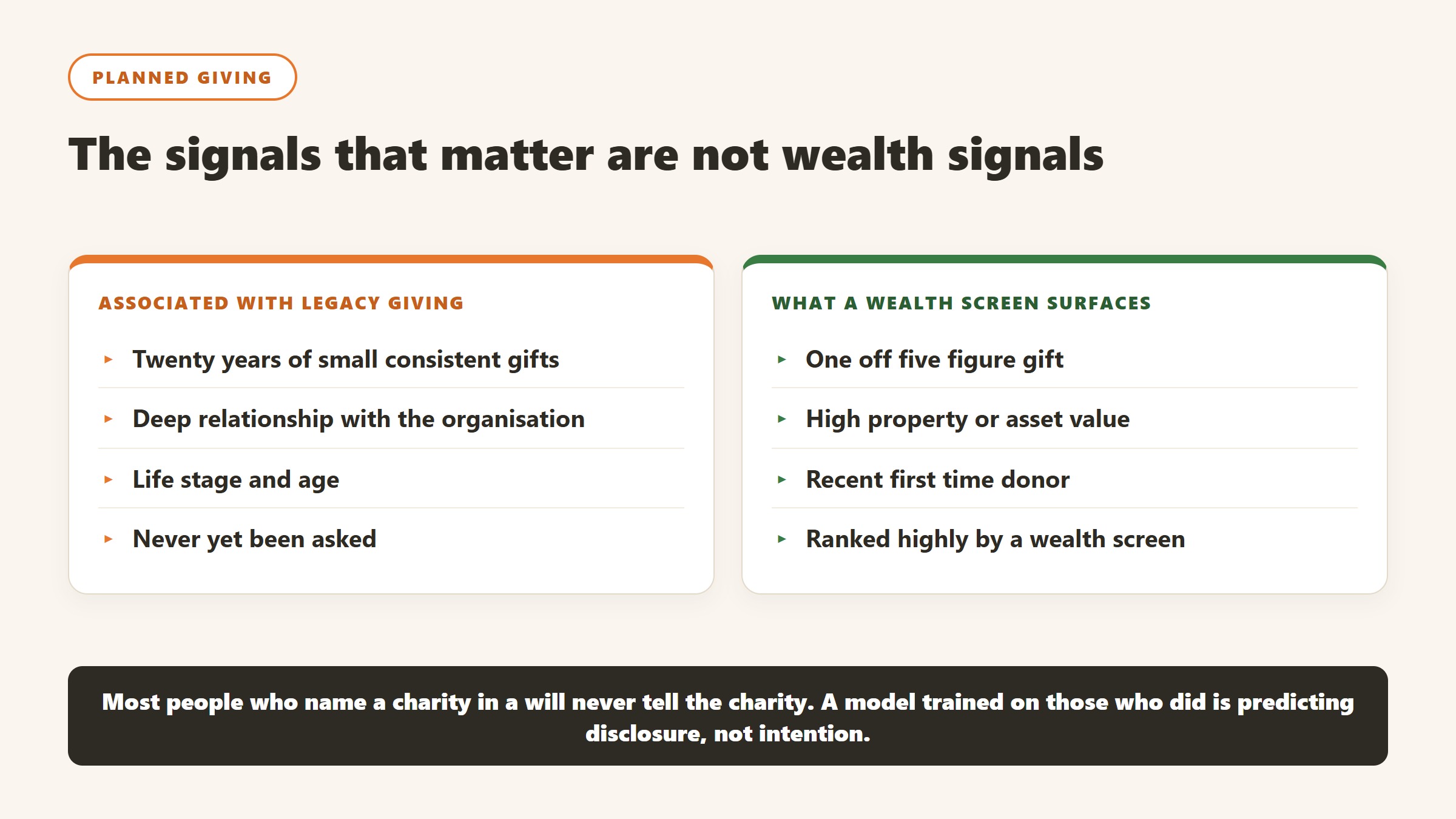
A model learns from labelled examples. For planned giving the label is a bequest that may arrive twenty years after the decision, and the decision itself is usually invisible: most people who name a charity in a will never tell the charity. So the training data is a small, biased sample of the people who did tell you, and a model built on it is predicting disclosure rather than intention. That is a real distinction and it is almost never stated.
The strongest signals are not wealth signals
Capacity dominates major gift modelling and matters much less here. The markers that actually associate with legacy giving are longevity and consistency of support, relationship depth with the organisation, and life stage. A twenty year donor of small consistent gifts is a stronger planned giving prospect than a one-off five figure donor, which is the opposite of what a wealth screen surfaces.
What a tool can honestly do for you
It can find the people with long, consistent giving histories that your reporting does not surface, because that query is genuinely hard in most CRMs and genuinely useful. It can flag the cohort whose giving has been steady for fifteen years and who have never been asked. That is a list worth having, and it does not require predicting anybody’s intentions.
What to ask a vendor selling planned giving scores
Ask what the model was trained on and how many confirmed bequests are in the training data. Ask whether it is predicting a bequest or predicting disclosure of one. Ask how it handles a donor with a long history and a small average gift. If the answers are vague, you are buying a wealth screen with a different label on it, and you should price it accordingly.
The measurement problem, stated honestly
You will not know whether this worked for many years, which means the usual proof does not exist. The workable substitute is a process measure: how many long-standing donors had a legacy conversation this year that would not otherwise have happened. Agree that measure before you buy, because otherwise the renewal conversation has nothing in it but faith.
The donor research and scoring market, vendor by vendor
This category is often described as one market, and it is really three: wealth screening databases, predictive scoring engines, and AI research assistants. They are bought for different reasons and priced on different meters. Here is where each alternative to a planned giving tool actually sits.
Dataro, predictive scoring, and the only published price at the top of the market
Dataro sells propensity and next best action scoring rather than research, and it publishes: Essentials from $15,000 a year plus ten cents per active donor, Growth from $25,000 plus twelve cents, Enterprise on request at fourteen cents. Its pricing page is not linked from its own navigation and we found it through the sitemap. Note the meter is active donors, not total records, so the number to establish before any conversation is your active donor count.
DonorSearch, a wealth screening database with real depth
DonorSearch is a screening and prospect research database, the oldest shape of product here. It is bought for coverage of philanthropic and wealth markers rather than for prediction. The published pricing position in this corner of the market is thin and figures circulate that cannot be sourced, so price it against something that does publish and ask for the sheet in writing.
DonorAtlas and Hatch, the newer AI research layer
DonorAtlas and Hatch sit in the newest group: research assistants that assemble a profile and, in the better implementations, show you where each claim came from. Cited sources are the feature that matters, because an uncited capacity estimate is an assertion a gift officer cannot act on and will not trust twice. Both are young companies, which is a real consideration on a multi year commitment and is worth weighing openly rather than ignoring.
What the three groups cost relative to a CRM
For scale, verified 4 September 2026: Little Green Light from $45 a month, Salesforce Nonprofit Cloud at $60 per user with ten licences free, Bloomerang from $125, Keela from $164. Dataro’s floor is $15,000 a year. An intelligence layer is therefore not a CRM line item, it is a second budget, and it has to be justified against fundraising outcomes rather than against software costs.
Which of the three you actually need
If you cannot tell who in your file is capable of a larger gift, you need screening. If you know who is capable but not who is ready, you need scoring. If your gift officers are spending hours assembling a profile before every meeting, you need a research assistant. Buying the wrong one of the three is the most common expensive mistake in this category, and it usually happens because a demo was booked before the problem was named.
Where the figures on this page come from
Every price quoted here was read from the vendor’s own pricing page on 4 September 2026, not from an aggregator or a review site. That distinction matters more in this category than in most, because nonprofit software pricing changed materially over the past year and a great deal of what circulates online describes packaging that no longer exists.
The pages we read
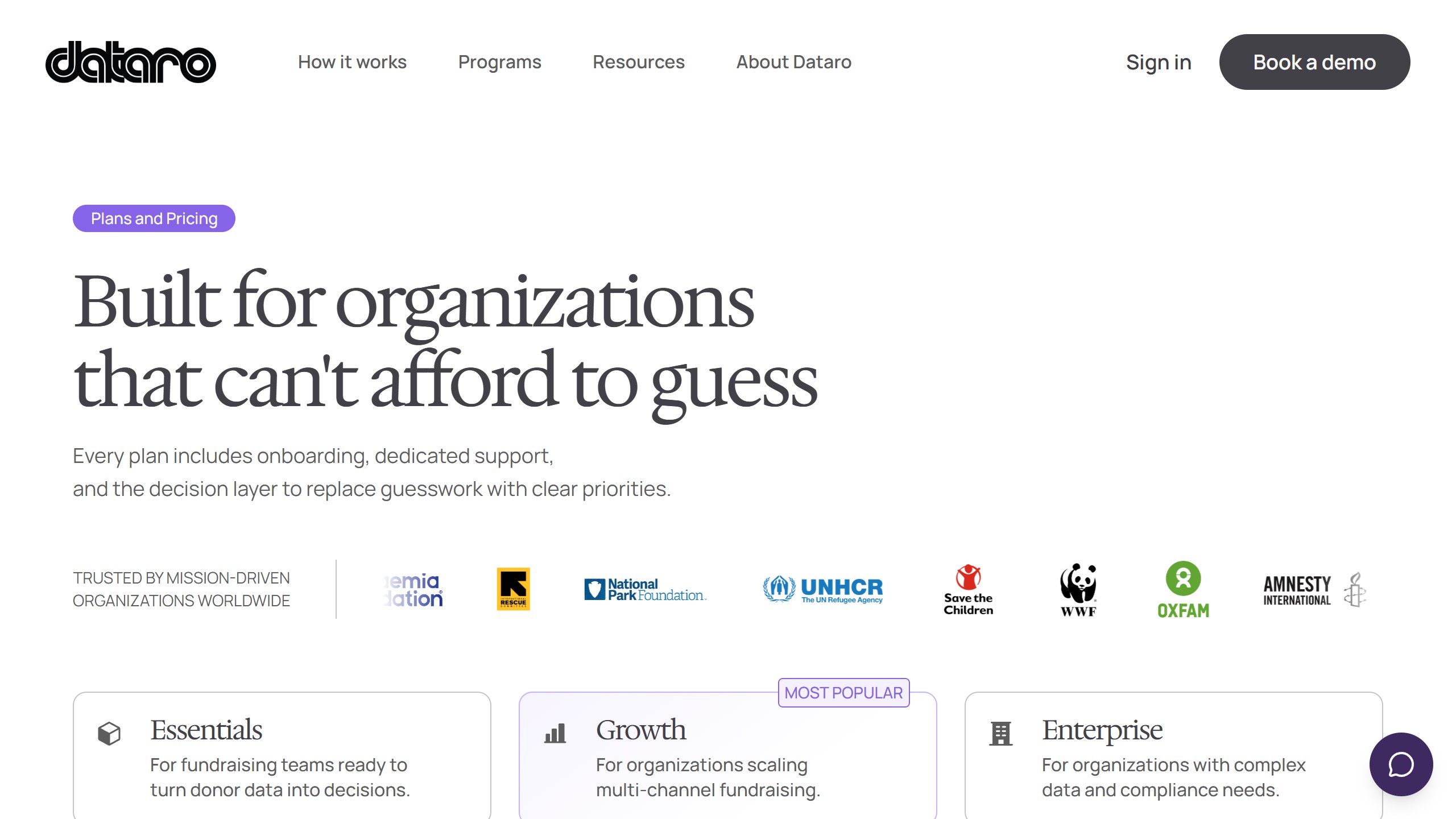
Little Green Light publishes every constituent band from $45 a month. Salesforce Nonprofit Cloud publishes $60 per user per month with ten licences free under Power of Us. Bloomerang publishes $125 a month for the CRM with other products priced separately. Keela publishes every contact band from $164 a month. Dataro publishes $15,000 a year plus ten cents per active donor on a page that is not linked from its own navigation. Blackbaud and Virtuous publish no figures at all.
What we do not do
We do not carry a figure we cannot source to the vendor. Where a number circulates widely and cannot be traced to a vendor page, we say so and withdraw it rather than repeating it with a hedge, and we have withdrawn our own published figures on that basis more than once. Where a vendor confirms an unpublished price directly to us, it is attributed as confirmed by the company rather than presented as a public rate.
Why every figure carries a date
Keela raised every band by roughly 15 to 22% in under two weeks in late August 2026. Neon retired an entire tier structure. A pricing claim without a verification date is not checkable, and in this market it is usually wrong within a year.
The bottom line
Your best legacy prospects are probably already giving to you and have been for years. They do not look impressive on a capacity screen, they do not attend events, and they are easy to scroll past.
Start inward. Find the long-tenured, consistent, quietly engaged donors and the handraisers whose intent was recorded once and forgotten. Use external screening to qualify and size, not to identify.
Then have the conversation, which is the part no software touches, and record it somewhere that will survive the next three people who hold the relationship.

Written by
FazFaz is the founder of AIToolsBakery. Some tools here are tested hands on. Others are assessed from vendor documentation and pricing verified on the live page, and every review says which one it is. Sponsors can buy a position in a guide. They cannot buy the score, the criticism, or silence about a better option.
How we test and how we make money →