Search for iWave vs DonorSearch and the top results are the two vendors arguing about each other. Kindsight (which now owns iWave) hosts a comparison page scoring itself 96 against DonorSearch’s 66. DonorSearch returns the favor with its own attack page. Neither tells you the thing that actually changed this comparison: iWave is not a standalone company anymore.
Since the February 2024 merger with UC Innovation, iWave is the prospect-research module of the Kindsight platform, sitting alongside the ascend CRM and the Engage generative AI layer. DonorSearch is still what it has always been: a standalone screening database with a predictive scoring product bolted on top. So in 2026 you are not comparing two similar tools. You are comparing a platform module against an independent specialist, and which one fits depends heavily on your org size and what CRM you already run.
We spent time in both, read the fine print on both vendor pages, and built the decision matrix we wished existed. Here is the honest version.
One note before the comparison, because it changes the answer for some readers. Both platforms here are screening tools: they find capacity in names you do not have. The separate category that works the donors already in your database, ranking who to contact and why, is donor intelligence, and it is neither a substitute nor a competitor. A thin prospect pipeline needs the first. A long unworked file needs the second, often sooner. If you are unsure which describes you, read what donor intelligence is first.
iWave vs DonorSearch at a glance
| Factor | iWave (Kindsight) | DonorSearch |
|---|---|---|
| What it is in 2026 | Prospect-research module of the Kindsight platform (with ascend CRM and Engage AI) | Standalone prospect screening and wealth data platform |
| Company status | Merged with UC Innovation into Kindsight, Feb 2024 | Independent, founded 2007 |
| Published pricing | Starter from $4,500, no period stated (live Kindsight page) | None. Quote-only |
| AI layer | Engage, generative AI from the NonprofitOS acquisition (Oct 2023) | DonorSearch Ai, predictive ML with MLR scoring |
| Headline AI claim | AI-assisted profiles and donor outreach content | 81% repeat-donor accuracy, up to 85% response lift (vendor-claimed) |
| Data scale claim | Billions of wealth and philanthropy records (vendor-claimed) | 1B+ philanthropic data points, 13,000+ customers (vendor-claimed) |
| Scoring approach | Configurable propensity, affinity, and capacity scores you can tune | Pre-built philanthropy-first scores plus ML-driven MLR |
| CRM situation | Strong pull toward the ascend CRM (built on Salesforce) | CRM-agnostic, integrates widely |
| Best fit | Mid-size to large orgs open to platform consolidation | Orgs of any size keeping their existing CRM |
Both data-scale rows above are vendor-claimed, and we have not found an independent audit of either database. Keep that in mind whenever a rep quotes record counts at you.
The merger context: what buying iWave actually means now
This is the part both vendor comparison pages underplay, so let us spell it out.
In October 2023, iWave acquired NonprofitOS, a generative AI startup, and rebranded it as Engage. Four months later, in February 2024, iWave and UC Innovation (the company behind the ascend CRM, built on Salesforce) merged to form Kindsight. iwave.com now 301-redirects to kindsight.io. iWave the product survived, but iWave the company did not.
Practically, that changes three things for a buyer:
- The sales conversation is a platform conversation. You may come in asking about wealth screening and leave with a pitch deck covering ascend CRM migration and Engage AI content generation. That is not sinister, it is just what platform companies do. Budget your evaluation time accordingly.
- The roadmap serves the platform. Kindsight’s stated direction is an integrated intelligence-CRM-AI suite. If you only ever want the screening module, you are buying a slice of something bigger, and future development effort follows the suite strategy.
- The upside is real if you want consolidation. If you are shopping for a CRM anyway, or your current donor database is a spreadsheet held together with hope, getting research, CRM, and AI generation from one vendor has genuine appeal. We cover how that stack fits together in our guide to AI for major gift fundraising.
DonorSearch, meanwhile, made the opposite bet: stay independent, stay CRM-agnostic, and go deep on predictive modeling. Neither strategy is wrong. They just suit different buyers.
Kindsight iWave: the prospect-research module
What it does
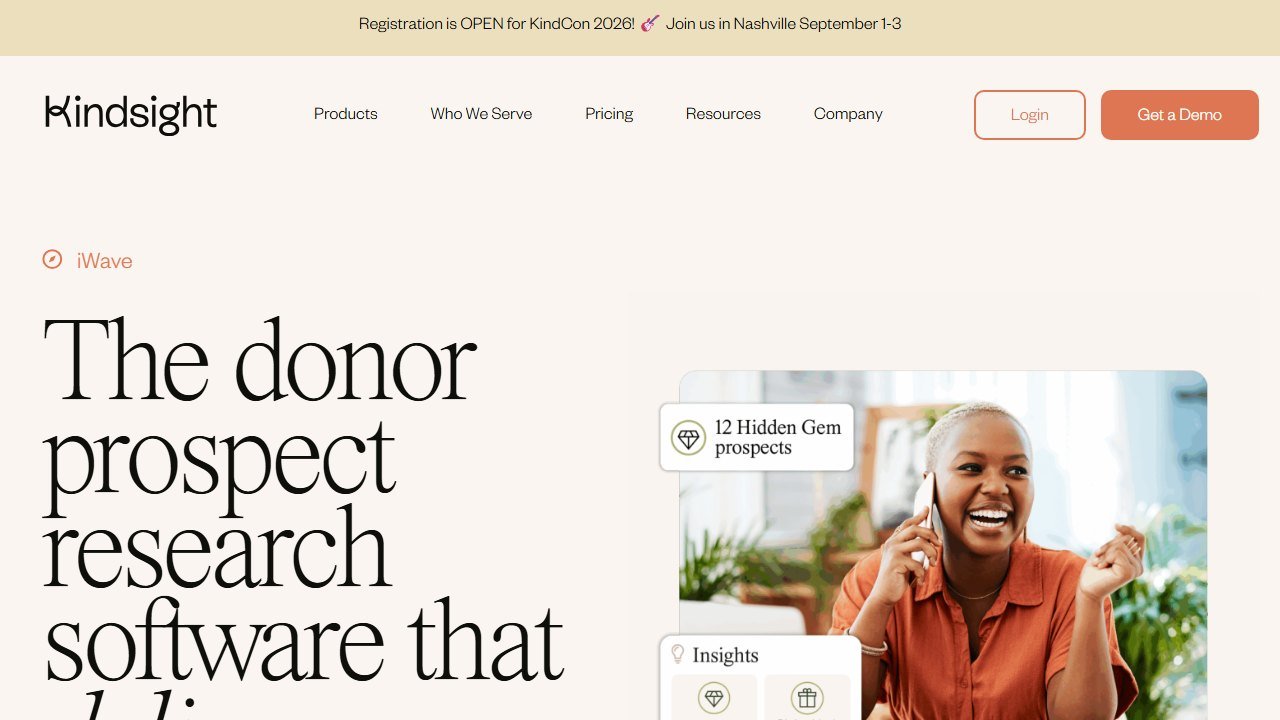
iWave inside Kindsight is still the research analyst’s tool it built its reputation on: wealth screening, prospect profiles, and capacity ratings across public wealth records, real estate, securities filings, and philanthropic giving history. You can screen a list in batch or build a profile on one person, and the output is a scored, sourced dossier.
The two things that distinguish it in 2026:
- Configurable scoring. iWave lets you tune how propensity, affinity, and capacity weight into the final score. A hospital foundation that cares about grateful-patient affinity can weight differently than a university chasing alumni capacity. Most competitors hand you a fixed formula.
- Engage, the gen AI layer. Born as NonprofitOS and acquired in October 2023, Engage drafts donor-facing content and summarizes research profiles. In practice, it was a competent first-draft machine: fine for a profile summary you will edit, not something we would send to a major donor unreviewed.
Hands-on observations
The profile depth is the standout. Give it a real prospect and you get securities holdings, property records, foundation ties, and giving history in one view, with sources cited so your researcher can verify. The interface assumes a trained user; a volunteer coordinator dropped into iWave cold will drown in tabs. Batch screening worked as advertised, though de-duplicating messy CRM exports before upload remains on you.
Pricing
This is the rare corner of the category with a published number: Kindsight’s live pricing page lists the iWave Starter tier from $4,500. It prints no billing period against the iWave tiers at all, unlike its Engage tiers, which are explicitly per year, so treat $4,500 as an annual floor we have inferred rather than a period Kindsight has stated. Worth knowing: several aggregator sites still circulate $4,150, a stale figure that contradicts the live vendor page. If a reseller or a roundup quotes you $4,150, they are working from old data. Full tier-by-tier math, seat costs, and what to negotiate are in our iWave pricing breakdown.
Who it’s for
Mid-size and large nonprofits, universities, and healthcare foundations with at least one person who does prospect research as a real part of their job, especially orgs open to (or actively shopping for) the wider Kindsight platform.
One honest limitation
The platform gravity. Standalone iWave buyers are now a secondary audience by structure: the merger exists to sell an integrated suite, and if you have zero interest in ascend or Engage, you are paying attention tax on features you will decline in every renewal conversation.
DonorSearch: the standalone screening specialist
What it does
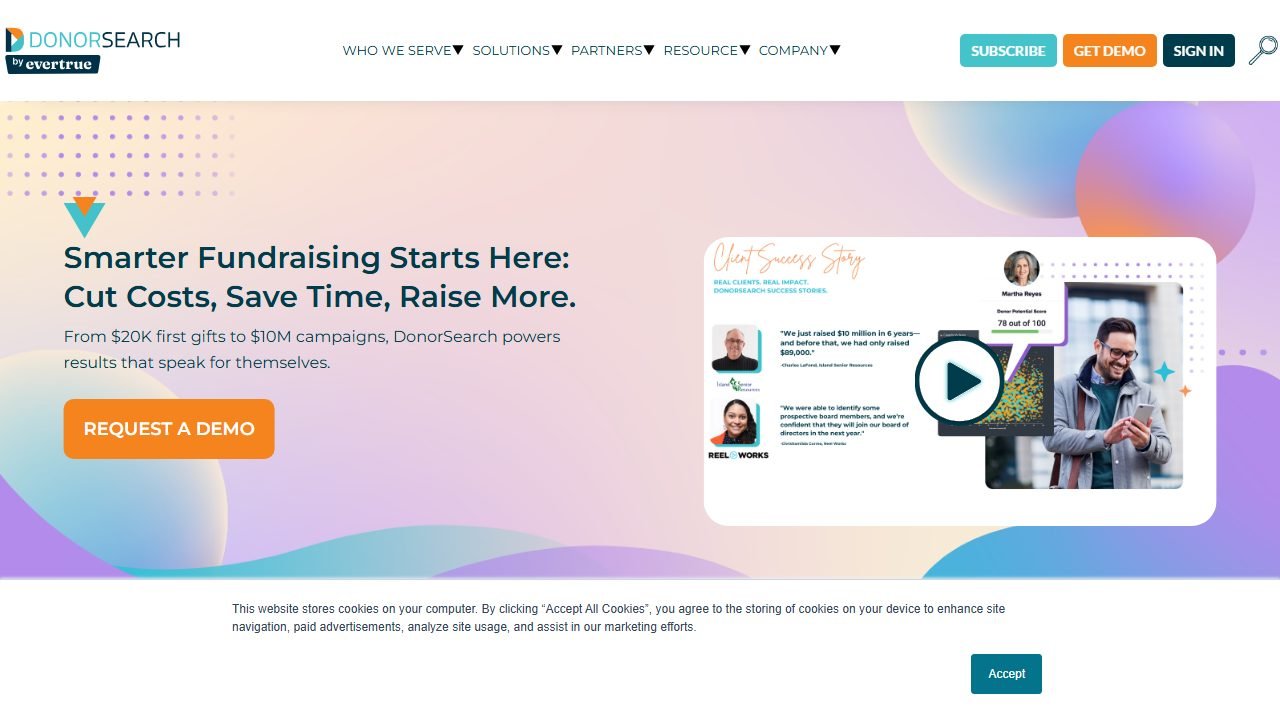
DonorSearch is a prospect screening platform built on a philanthropy-first thesis: past giving predicts future giving better than wealth alone. The company claims more than 1 billion philanthropic data points and 13,000+ nonprofit customers (both vendor-claimed figures). Screens return capacity markers plus deep charitable-giving history: who gave, to what, and how often.
The differentiator is DonorSearch Ai, the machine-learning product on top of the database. Its flagship output is MLR, a Most Likely to Respond score that ranks your file by who will actually answer an appeal. DonorSearch claims 81% accuracy at predicting repeat donors and up to an 85% lift in response rates. Both numbers are vendor-claimed, and we have not seen an independent validation, but the underlying approach (training models on your donor file plus their giving database) is sound and mirrors what expensive consultants used to do by hand.
Hands-on observations
The giving-history data is the best we have seen in this category; where iWave profiles shine on wealth breadth, DonorSearch profiles shine on philanthropic depth. The interface is dated in places, and some workflows feel like enterprise software from a previous decade. Integration coverage is wide because CRM-agnosticism is the whole strategy: DonorSearch has to play nicely with everyone’s CRM, and it largely does. Our full DonorSearch review covers the feature set and verdict in depth; this page stays focused on the head-to-head.
Pricing
Quote-only, full stop. DonorSearch publishes no pricing, and any specific figure you see on an aggregator is reported, not official. Do not assume quote-only means cheaper than iWave’s $4,500 floor; in our experience it usually signals the opposite for full-platform deals. What is known, what is reported, and how to structure the sales call are in our DonorSearch pricing guide.
Who it’s for
Organizations that like their current CRM and want the deepest philanthropy-first screening layered on top, plus annual-fund teams who can act on MLR scoring, which is genuinely more actionable for appeal segmentation than a raw capacity number.
One honest limitation
Pricing opacity. You cannot budget for DonorSearch without a sales call, you cannot benchmark your quote against a public rate card, and renewal negotiations happen in the dark. For a category-defining vendor, that is a deliberate choice, and it costs buyers real leverage.
How the scoring engines actually differ
Both vendors will tell you they have AI. The word hides two very different machines, and the difference matters more than the marketing.
iWave’s scoring is fundamentally configurable analytics. Propensity, affinity, and capacity are computed from wealth and giving records, and you control the weights. That makes it a researcher’s instrument: the score means what your team decides it means, which is powerful if you have someone who understands the levers and noise if you do not. Engage, the generative layer, sits apart from scoring entirely. It writes and summarizes; it does not predict.
DonorSearch Ai is the reverse shape: predictive first, generative nowhere. MLR is a trained model output, not a weighted formula, so you cannot tune it, but you also cannot mis-tune it. You hand it your file, it hands back a ranked list. For an annual-fund manager without a research department, that opacity is a feature. For a major-gifts researcher who wants to know why a prospect scored high, it can frustrate, since model reasoning is not something you can audit line by line.
The practical test we suggest: ask each vendor to score the same 200 records from your file during the pilot, then check the top 20 against what your gift officers already know. In our experience that one exercise exposes more about fit than every feature grid combined. It also surfaces data hygiene problems on your side before they become billable ones.
Decision matrix: which one fits your org
Same question, four different answers depending on where you sit. Find your row.
| Your situation | Lean iWave (Kindsight) | Lean DonorSearch | Why |
|---|---|---|---|
| Small shop, under ~$1M raised, no dedicated researcher | ✓ | Neither is cheap, but DonorSearch screening plus your existing CRM beats paying platform gravity you will not use. Also consider lighter tools first. | |
| Mid-size org, happy with Bloomerang, Neon, DonorPerfect, or Virtuous | ✓ | CRM-agnostic by design. You keep your stack and add the screening layer that integrates with it. | |
| Mid-size to large org, CRM shopping or CRM pain | ✓ | The Kindsight bundle (iWave + ascend + Engage) turns two procurement projects into one, and consolidation discounts are negotiable. | |
| University or hospital foundation with a research team | ✓ | Configurable scoring and profile depth suit trained researchers, and ascend’s Salesforce base fits advancement-office IT standards. | |
| Annual fund team optimizing appeals, not major gifts | ✓ | MLR scoring is built for exactly this: rank the file by response likelihood and mail smarter (81% accuracy claim is vendor-claimed). | |
| Salesforce-native org | ✓ | ascend is built on Salesforce, so the platform story is coherent rather than bolted on. Still evaluate DonorSearch’s Salesforce integration as the counterfactual. |
What we would negotiate with either vendor
Both of these are annual contracts with real money attached, so treat the sales call like the negotiation it is.
- With Kindsight: ask what the standalone iWave price is with zero platform components, then ask what the bundle costs. The gap is your leverage. Push back on multi-year lock-ins until you have run one real screening cycle.
- With DonorSearch: get the quote itemized (base screening, DonorSearch Ai, integrations, records volume) so you can cut modules instead of haggling on a blob. Ask directly what happens to per-record pricing at renewal.
- With both: demand a pilot on your actual file, not a demo on theirs. Screening quality on 200 of your real donors tells you more than any comparison page, including this one.
Disclosure: Zilwaris, the consultancy run by AI Tools Bakery’s founder, does paid advisory work for Gratefully, which did not pay for any placement on this page and is assessed on the same criteria as everything else on this site.
If you are earlier in the journey and not sure you need enterprise screening at all, start with our overview of AI donor research tools and the broader donor intelligence explainer. And note the scope line: this page compares screening platforms. The donor-intelligence overlay category (led by our editorial pick there, Gratefully) is covered separately in our best AI donor intelligence tools roundup.
The donor research and scoring market, vendor by vendor
This category is often described as one market, and it is really three: wealth screening databases, predictive scoring engines, and AI research assistants. They are bought for different reasons and priced on different meters. Here is where each alternative to both vendors actually sits.
Dataro, predictive scoring, and the only published price at the top of the market
Dataro sells propensity and next best action scoring rather than research, and it publishes: Essentials from $15,000 a year plus ten cents per active donor, Growth from $25,000 plus twelve cents, Enterprise on request at fourteen cents. Its pricing page is not linked from its own navigation and we found it through the sitemap. Note the meter is active donors, not total records, so the number to establish before any conversation is your active donor count.
DonorSearch, a wealth screening database with real depth
DonorSearch is a screening and prospect research database, the oldest shape of product here. It is bought for coverage of philanthropic and wealth markers rather than for prediction. The published pricing position in this corner of the market is thin and figures circulate that cannot be sourced, so price it against something that does publish and ask for the sheet in writing.
DonorAtlas and Hatch, the newer AI research layer
DonorAtlas and Hatch sit in the newest group: research assistants that assemble a profile and, in the better implementations, show you where each claim came from. Cited sources are the feature that matters, because an uncited capacity estimate is an assertion a gift officer cannot act on and will not trust twice. Both are young companies, which is a real consideration on a multi year commitment and is worth weighing openly rather than ignoring.
What the three groups cost relative to a CRM
For scale, verified 4 September 2026: Little Green Light from $45 a month, Salesforce Nonprofit Cloud at $70 per user (as of 4 October 2026) with ten licences free, Bloomerang from $125, Keela from $164. Dataro’s floor is $15,000 a year. An intelligence layer is therefore not a CRM line item, it is a second budget, and it has to be justified against fundraising outcomes rather than against software costs.
Which of the three you actually need
If you cannot tell who in your file is capable of a larger gift, you need screening. If you know who is capable but not who is ready, you need scoring. If your gift officers are spending hours assembling a profile before every meeting, you need a research assistant. Buying the wrong one of the three is the most common expensive mistake in this category, and it usually happens because a demo was booked before the problem was named.
Where the figures on this page come from
Every price quoted here was read from the vendor’s own pricing page on 4 September 2026, not from an aggregator or a review site. That distinction matters more in this category than in most, because nonprofit software pricing changed materially over the past year and a great deal of what circulates online describes packaging that no longer exists.
The pages we read
Little Green Light publishes every constituent band from $45 a month. Salesforce Nonprofit Cloud publishes $70 per user per month (as of 4 October 2026) with ten licences free under Power of Us. Bloomerang publishes $125 a month for the CRM with other products priced separately. Keela publishes every contact band from $164 a month. Dataro publishes $15,000 a year plus ten cents per active donor on a page that is not linked from its own navigation. Blackbaud and Virtuous publish no figures at all.
What we do not do
We do not carry a figure we cannot source to the vendor. Where a number circulates widely and cannot be traced to a vendor page, we say so and withdraw it rather than repeating it with a hedge, and we have withdrawn our own published figures on that basis more than once. Where a vendor confirms an unpublished price directly to us, it is attributed as confirmed by the company rather than presented as a public rate.
Why every figure carries a date
Keela raised every band by roughly 15 to 22% in under two weeks in late August 2026. Neon retired an entire tier structure. A pricing claim without a verification date is not checkable, and in this market it is usually wrong within a year.
Verdict
There is no single winner, and anyone declaring one without asking about your CRM is selling something.
Choose iWave (Kindsight) if you want platform consolidation, have trained researchers who will exploit configurable scoring, or are Salesforce-native and CRM shopping anyway. You get a published $4,500 starting price, real profile depth, and a gen AI layer, at the cost of platform gravity pulling every conversation toward the full suite.
Choose DonorSearch if you are keeping your CRM and want the deepest philanthropic-giving data plus ML scoring aimed at response behavior. You get CRM-agnostic flexibility and the MLR score annual-fund teams actually use, at the cost of quote-only pricing and a dated interface in spots.
Whichever way you lean, read the money pages before the sales call: iWave pricing and DonorSearch pricing. Walking in knowing the published floor and the reported ranges is the cheapest advantage you will get in this category.

Written by
FazFaz is the founder of AIToolsBakery. Some tools here are tested hands on. Others are assessed from vendor documentation and pricing verified on the live page, and every review says which one it is. Sponsors can buy a position in a guide. They cannot buy the score, the criticism, or silence about a better option.
How we test and how we make money →