Performance management stopped being an annual event a while ago, and 2026 is the year the tooling finally caught up. Modern performance management is a continuous loop: ongoing feedback captured as work happens, goals and OKRs that stay visible instead of dying in a spreadsheet, structured reviews and 1:1s, calibration that keeps ratings fair across managers, and a layer of talent intelligence sitting on top of all of it. The best platforms now do the connective work that used to fall on HR, and AI has quietly become the most useful part of the stack.
The AI that matters here is specific. It reads the feedback, check-ins, and goal progress a team has already documented over a review cycle and drafts a first-pass review from that evidence, so a manager edits instead of staring at a blank box. It summarizes months of 1:1 notes into themes. It surfaces patterns a human would miss, like an engagement dip that tends to precede attrition, or a manager whose ratings run consistently high. That is real work, and it is the difference between a platform that saves managers hours and one that just adds another survey. This ranking weights AI substance and fit first, with honest notes on where each tool falls short.
Top pick: Lattice is the best AI performance management software overall in 2026, uniting performance, engagement, growth, and compensation in one loop, with AI that drafts reviews from documented feedback. Culture Amp is the best for pairing performance with engagement analytics, and 15Five is the best for continuous performance and manager enablement.
Faz says: The fastest way to shop this category is to decide what you want the platform to be the system of record for. If it is reviews and ratings, almost anything here works. If it is the whole talent loop, feedback feeding reviews feeding growth plans feeding comp decisions, you want a connected suite like Lattice or Leapsome, because the value is in the handoffs, not the modules. And treat every AI claim as a demo request, not a feature you believe. Ask the vendor to draft a real review from a real cycle’s feedback while you watch. A genuine tool produces something a manager would actually keep. A weak one produces generic filler you would delete.
Saru says: This ranking draws on each vendor’s official product and pricing pages, published AI documentation, and aggregated user feedback, current to 2026. Most platforms in this category price per employee per month and rarely publish full numbers, so every figure here is a starting point as of 2026. Get a written quote that includes the specific modules you need and any implementation cost before you commit, and confirm current per-seat pricing with the vendor.
How We Ranked These
A performance platform earns its place by making feedback, reviews, and goals a continuous habit that managers actually keep, not by shipping the longest feature list. We weighted six things:
1. Continuous performance depth. Ongoing feedback, check-ins, and 1:1s matter more than a polished annual review form. We favored tools that make performance a running conversation.
2. AI substance. Every vendor advertises AI. We separated tools where AI does real work, drafting reviews from documented feedback, summarizing 1:1s, surfacing talent patterns, from tools where “AI” rewrites a sentence and calls it innovation.
3. Goals and OKRs. Goal-setting, cascading alignment, and calibration decide whether strategy actually reaches individual work. We noted how rigorous each platform’s goal engine is.
4. Engagement and talent intelligence. The strongest platforms connect performance to engagement and development, so a review is informed by more than one manager’s memory.
5. Manager enablement. Software that coaches managers and builds a 1:1 habit beats a system only HR opens. Adoption is where the value is won or lost.
6. Fit and total cost. We placed each tool where it is genuinely the best answer by company size and need, and flagged pricing model realities, since per-employee costs scale with headcount.
The Best AI Performance Management Software at a Glance
| Platform | Best for | Core strength | AI depth | Pricing model |
|---|---|---|---|---|
| Lattice | Best overall, connected talent loop | Performance plus engagement plus comp | High | Per employee, modular |
| Culture Amp | Performance plus engagement analytics | People science and surveys | High | Per employee, quote-based |
| 15Five | Continuous performance and manager enablement | Check-ins, 1:1s, coaching | Medium to high | Per employee, tiered |
| Leapsome | All-in-one people enablement | Reviews, goals, learning, comp | High | Per employee, modular |
| Betterworks | OKRs and enterprise alignment | Goal-setting and calibration | Medium to high | Quote-based |
| Peoplebox | AI-native, Slack and HRIS integration | OKR and review AI in the flow of work | Very high | Per employee, quote-based |
| Workday | Large enterprise inside a full HCM | Performance embedded in core HR | Medium to high | Enterprise quote |
1. Lattice: Best Overall
Lattice is the clearest example of performance management done as a connected loop rather than a set of disconnected forms, and it is the platform to beat in 2026. The whole product is built around a single idea: performance, engagement, growth, and compensation are one continuous conversation, and the data from each feeds the others. Feedback and praise captured during a quarter inform the review, the review informs the growth plan, and engagement signals inform where a manager should focus.
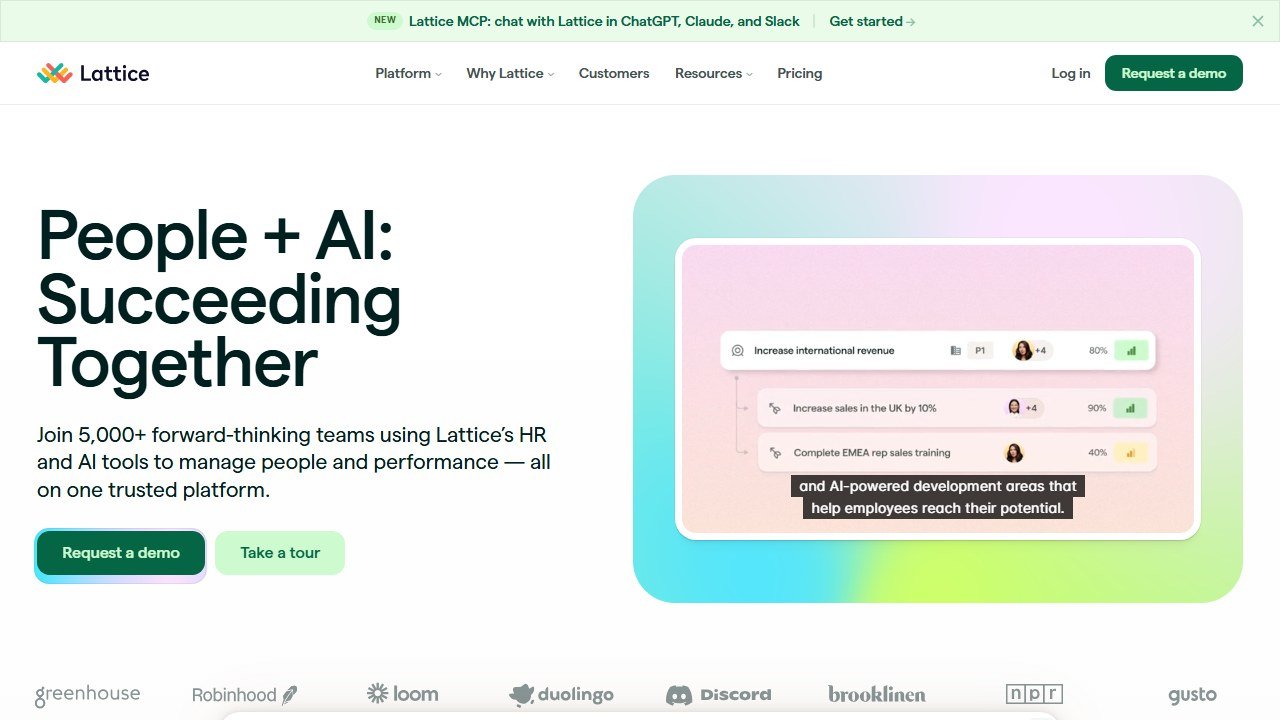
How it works. Managers and reports run regular 1:1s and check-ins inside Lattice, log feedback and goal progress as work happens, and then, at review time, the platform pulls that documented history together. Its AI assists by drafting review summaries from that accumulated feedback and check-in data, so a manager starts from a grounded first draft instead of a blank page. Goals and OKRs stay visible year-round, and calibration tools keep ratings consistent across managers.
Standout strength. Breadth that actually connects. Lattice is not just a review tool with an engagement survey bolted on. Performance, engagement analytics, growth and career development, and its newer compensation management module share one data model, so talent intelligence is real rather than a dashboard of exports. The AI drafting is grounded in documented feedback, which is what makes it save managers meaningful time rather than produce filler.
Pricing. Per employee per month, sold in modules, so the price scales with both your headcount and how much of the suite you turn on. A performance-only deployment costs less than the full performance-plus-engagement-plus-comp stack. Expect the usual per-employee escalation as you grow, and get the module mix priced in writing.
Best for. Growing companies and mid-market teams, roughly 50 to a few thousand employees, that want one connected system for the entire talent loop rather than stitching a review tool to a separate survey tool to a separate comp tool.
Where it falls short. The breadth that makes Lattice powerful is more than a very small team needs, and buying several modules adds up. Organizations that only want lightweight check-ins may find it heavier and pricier than a focused tool. Very large enterprises already committed to a full HCM may prefer performance embedded in that system.
2. Culture Amp: Best for Combining Performance With Engagement Analytics
Culture Amp built its reputation on employee engagement and people science, and that heritage is exactly why it is the best choice for teams that want performance and engagement analytics under one roof. Where most performance tools treat engagement as an add-on survey, Culture Amp treats measurement as the core discipline and layers performance on top of it.
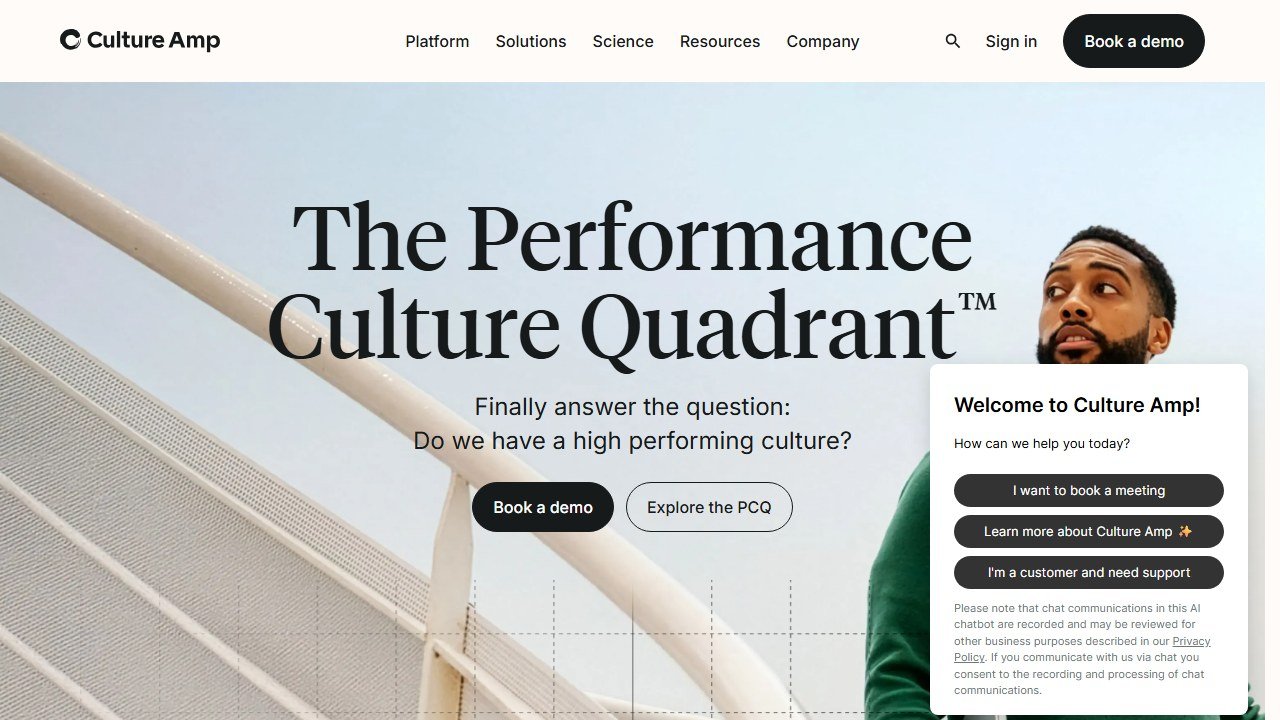
How it works. The platform runs science-backed engagement and lifecycle surveys, then connects that sentiment data to performance reviews, goal tracking, and development. Its people analytics turn survey and performance data into patterns, so a leader can see how engagement correlates with performance or where attrition risk is concentrated. AI assists with drafting and summarizing feedback and with surfacing themes across large volumes of survey comments.
Standout strength. Analytics and people science. Culture Amp’s survey methodology and benchmarking are among the most respected in the category, and its strength is turning qualitative feedback into signal a leadership team can act on. For an organization that cares as much about why performance is trending a certain way as about the ratings themselves, that analytical depth is the draw.
Pricing. Per employee per month and generally quote-based, scaling with headcount and the modules selected. Culture Amp positions toward mid-market and enterprise, and the engagement heritage means the survey and analytics side is fully realized even on lighter configurations.
Best for. Mid-market and enterprise organizations that lead with engagement and culture measurement and want performance reviews and development connected to that data, especially people teams that value rigorous analytics.
Where it falls short. Because it grew from engagement, its pure performance and goal-management tooling, while solid, is less specialized than a performance-first platform like Lattice or an OKR-first one like Betterworks. Teams whose primary need is rigorous OKR cascading may find the goal engine lighter than a dedicated tool.
3. 15Five: Best for Continuous Performance and Manager Enablement
15Five is named after a simple ritual, fifteen minutes for an employee to write a weekly check-in, five for a manager to read it, and that ethos runs through the whole product. It is the best pick for organizations whose real goal is to build a continuous-feedback and coaching habit rather than run a slicker annual review.
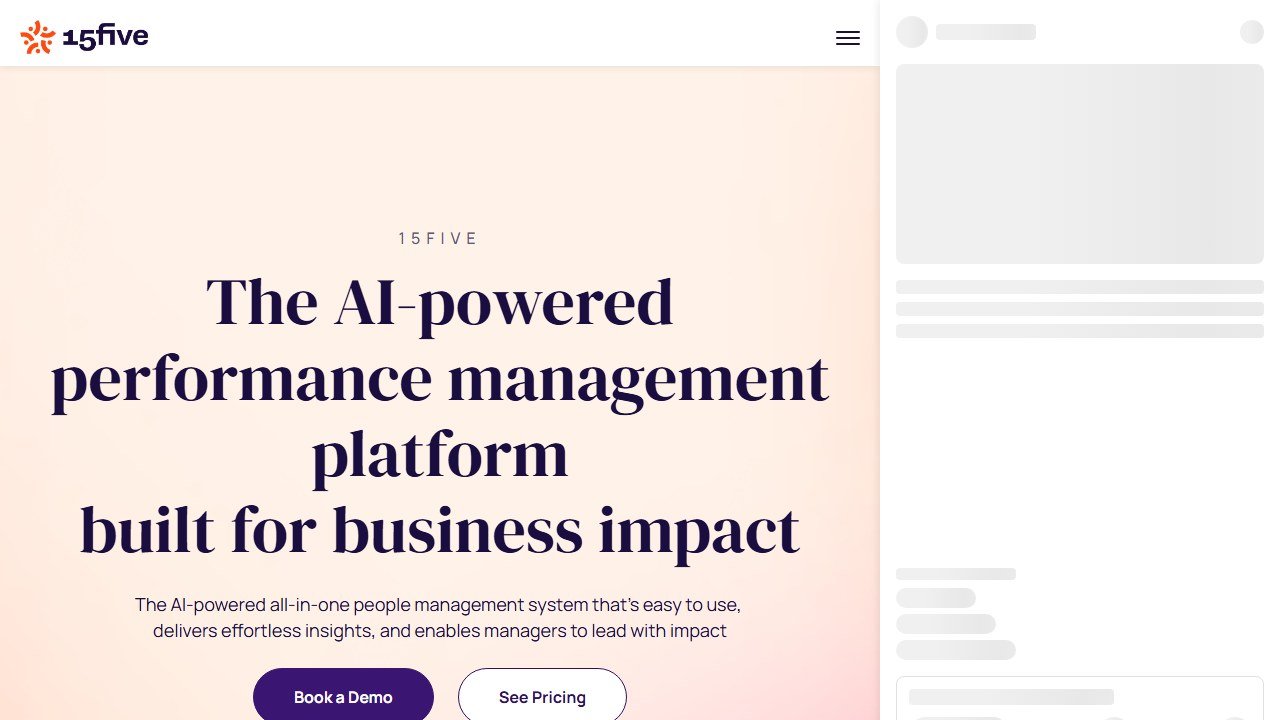
How it works. Employees submit lightweight weekly check-ins, managers run structured 1:1s with shared agendas and action items, and peers exchange recognition, all feeding a running record that makes review season a summary of documented reality rather than a memory test. Its AI assists managers by summarizing check-ins and drafting review content from the feedback trail, and 15Five layers in manager coaching and training to actually change behavior.
Standout strength. Manager enablement. 15Five does not just give managers a review form, it coaches them, with built-in training, question prompts, and a cadence that turns a checkbox exercise into a habit. For companies where the bottleneck is inconsistent, undertrained managers rather than missing software, that focus is genuinely differentiating.
Pricing. Per employee per month, sold in tiers that range from lightweight engagement and check-ins up to the full performance, engagement, and manager-development suite. It is generally positioned as an accessible entry into continuous performance for small and mid-sized teams.
Best for. Small to mid-sized companies that want to establish a continuous-feedback culture and invest in making their managers better, not just digitize an annual review.
Where it falls short. Its OKR and goal-cascading tooling is lighter than an enterprise-grade platform like Betterworks, and very large organizations with complex alignment needs may outgrow it. It is a manager-habit and continuous-performance tool first, an enterprise goal engine second.
4. Leapsome: Best All-in-One People Enablement
Leapsome is the strongest all-in-one for teams that want reviews, goals, learning, engagement, and compensation in a single modular platform. Its pitch is enablement across the whole employee lifecycle, and it backs it with unusually broad module coverage for a product at its price point.
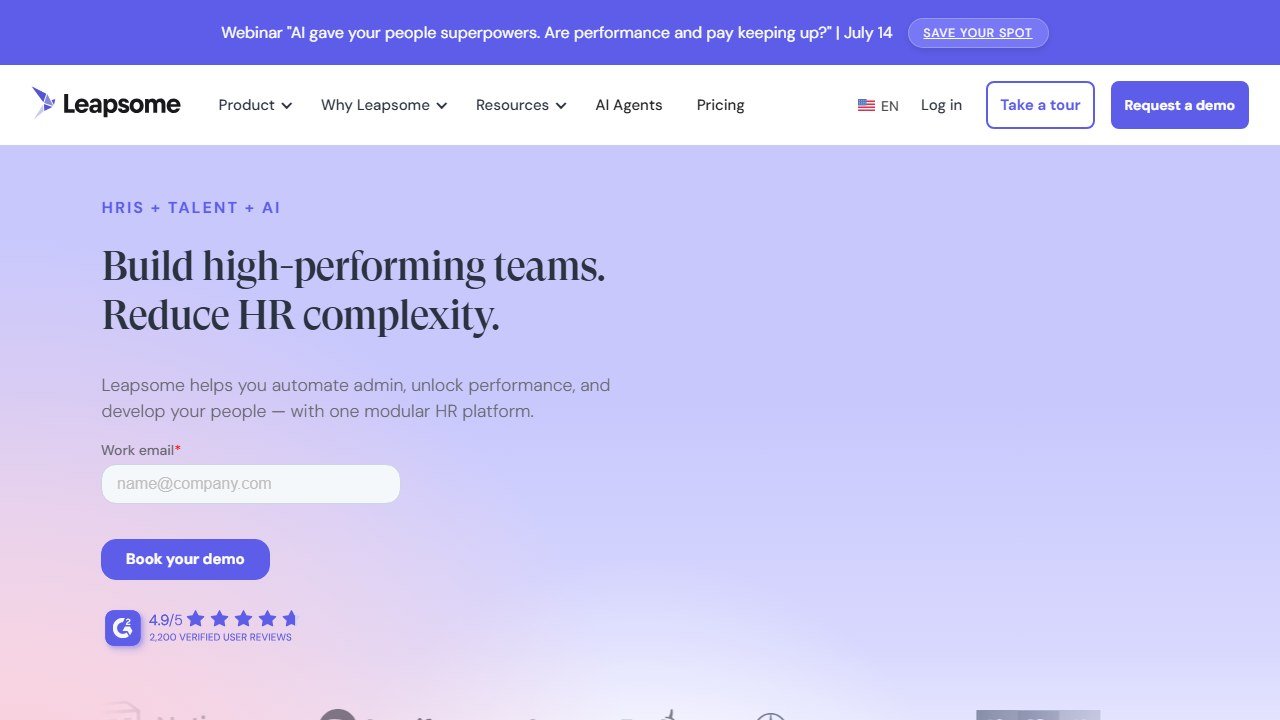
How it works. Leapsome connects performance reviews and 360s, goal and OKR tracking, engagement surveys, a learning and development module, and compensation into one system, so the same data flows from feedback to development plan to pay decision. Its AI is threaded throughout, drafting review text, summarizing feedback, and suggesting content, so managers spend less time writing and more time deciding.
Standout strength. Modular breadth with a built-in learning layer. The learning and development module is a genuine differentiator, few competitors fold real L&D into the same platform as reviews and goals, which lets a growth plan flow directly into assigned learning. For a company that wants one enablement system rather than a stack, Leapsome covers more of the lifecycle than most.
Pricing. Per employee per month, sold by module, so you assemble the combination you need and the price scales with headcount and scope. It is generally regarded as competitively priced for the breadth on offer, which makes it a common Lattice alternative for mid-market buyers.
Best for. Mid-market and scaling companies that want a genuinely all-in-one people-enablement platform, especially those that value connecting development and learning to performance.
Where it falls short. Covering so much means individual modules are strong rather than category-leading against the best single-purpose tools. A team that needs the deepest engagement analytics may still prefer Culture Amp, and one that needs the most rigorous OKRs may prefer Betterworks.
5. Betterworks: Best for OKRs and Enterprise Goal Alignment
Betterworks is the pick when goals and OKRs are the point. Where other platforms treat goal-setting as one module among many, Betterworks is built around rigorous, cascading goal alignment, and that focus makes it the strongest choice for large organizations trying to connect company strategy to individual work.
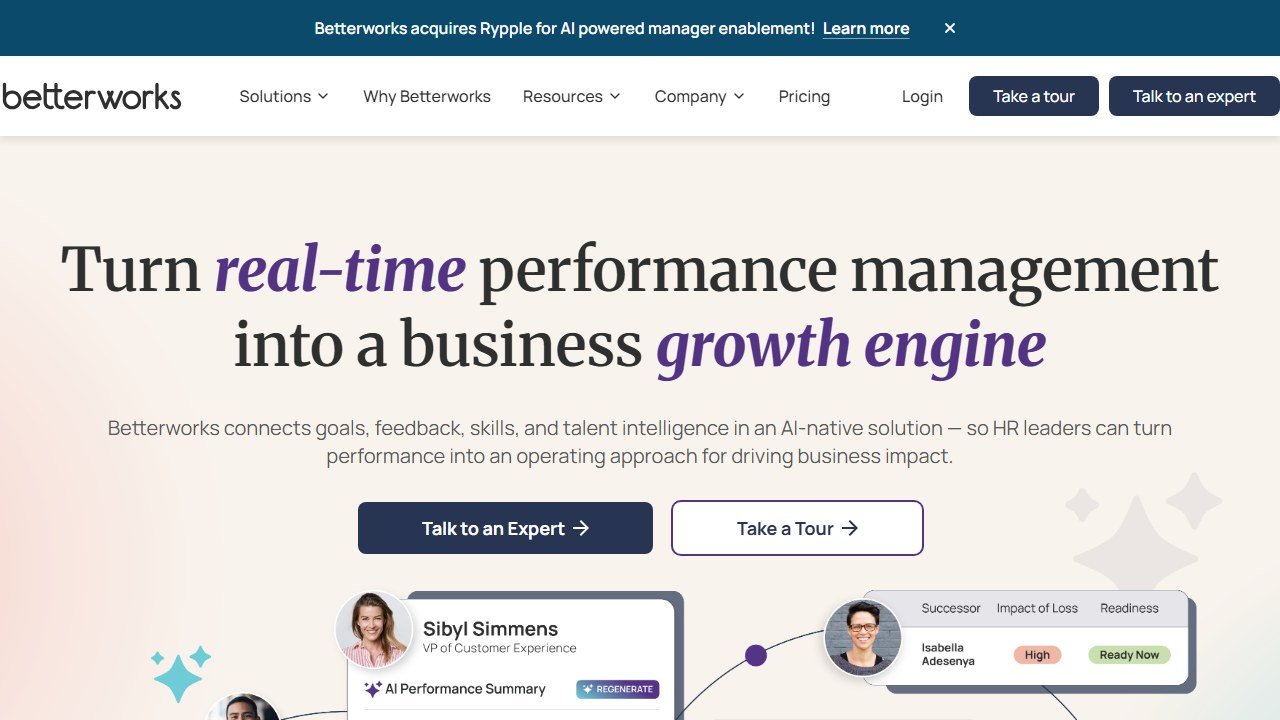
How it works. Teams set OKRs that cascade from company objectives down through departments to individuals, so everyone can see how their work ladders up to the strategy. Continuous check-ins track progress against those goals, calibration keeps performance ratings fair across a large manager population, and its AI assists with goal drafting, feedback summarization, and surfacing progress insights across the organization.
Standout strength. Enterprise goal rigor and calibration. Betterworks handles the hard problem of alignment at scale, keeping thousands of goals coherent and visible, and its calibration tooling is built for the reality of many managers rating on different curves. For a large company where strategy execution and fair, consistent ratings are the core challenge, that depth is the reason to choose it.
Pricing. Quote-based and oriented to mid-market and enterprise, priced by headcount and configuration. It is not aimed at small teams, and pricing reflects the enterprise-alignment focus.
Best for. Larger organizations and enterprises whose primary goal is disciplined OKR execution and cross-organization alignment, with performance reviews and calibration built around that goal engine.
Where it falls short. Its engagement and development tooling is less of a headline than at Culture Amp or Leapsome, and it is heavier than a small or mid-sized team focused on continuous feedback needs. If OKRs are not your central problem, a broader suite may fit better.
6. Peoplebox: Best AI-Native Pick
Peoplebox is the most AI-native platform on this list, and its defining choice is to meet employees where work already happens rather than in yet another tab. It combines OKR management, performance reviews, and 1:1s with deep Slack and HRIS integration and an AI layer that does real work across all of it.
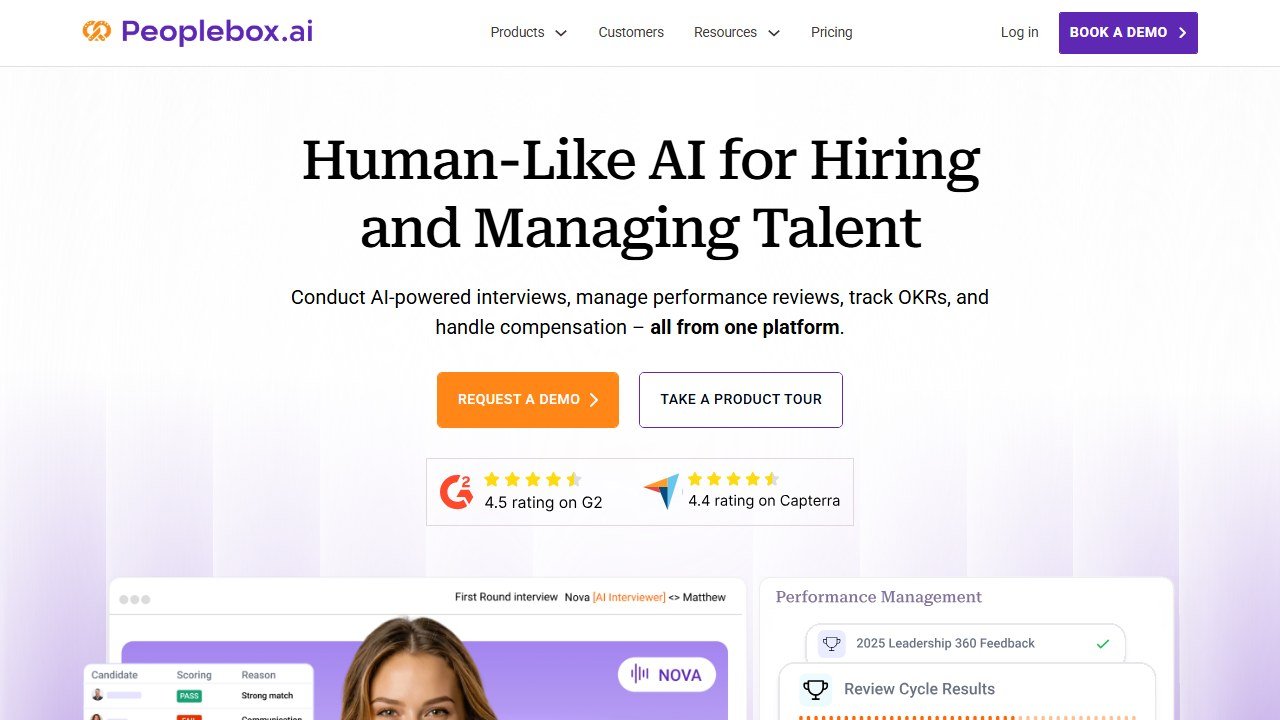
How it works. Peoplebox runs OKRs, reviews, and check-ins directly inside Slack (and Microsoft Teams), syncing with your HRIS so the org structure and data stay current without manual upkeep. Its AI drafts performance reviews from documented feedback and goal data, summarizes 1:1s, and surfaces alignment and progress insights, and because it lives in the tools people already use, adoption tends to be higher than a standalone system.
Standout strength. AI in the flow of work. The combination of genuine AI review drafting, OKR management, and native Slack and HRIS integration means the platform runs where employees are rather than asking them to log in somewhere new. For an organization frustrated by low adoption of a separate performance tool, that in-the-flow design is the differentiator.
Pricing. Per employee per month and generally quote-based, scaling with headcount and modules. It positions as a modern, AI-forward option for tech-oriented and fast-scaling companies.
Best for. Slack-centric, fast-scaling, and AI-forward companies that want OKRs, reviews, and 1:1s automated in the flow of work with strong HRIS sync.
Where it falls short. It is newer and less broadly recognized than the incumbents, so its engagement and development breadth is not as deep as a Culture Amp or Leapsome, and enterprises with heavy compliance requirements may still prefer an established suite. Its heritage is OKRs and AI first, wider talent modules second.
7. Workday: Best for Large Enterprise
Workday is not a standalone performance tool, it is performance management embedded inside a full human capital management suite, and that is exactly why it belongs here for one specific buyer. For a large enterprise that already runs core HR, payroll, and workforce planning on Workday, keeping performance in the same system is a powerful advantage.
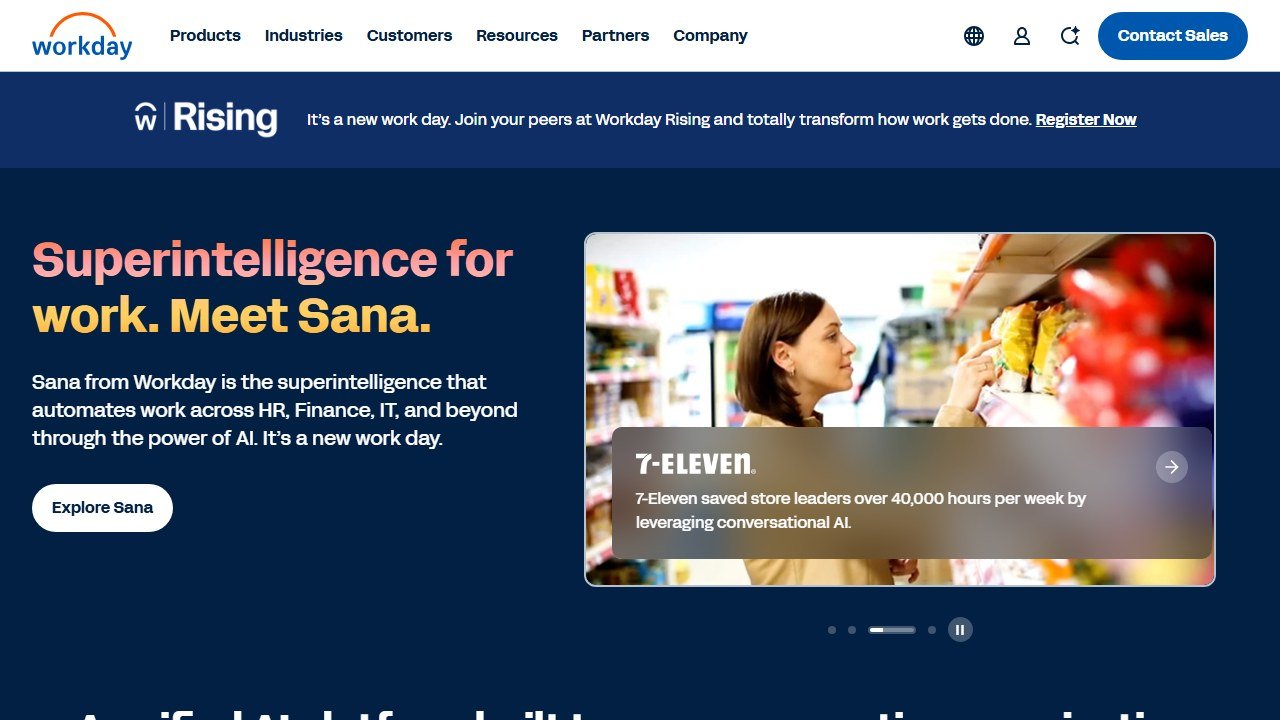
How it works. Workday folds goal-setting, performance and talent reviews, calibration, and succession planning into the same platform that holds employee records, compensation, and payroll. Because performance data lives alongside the full HCM, talent decisions draw on a single source of truth, and its AI and analytics operate across that unified dataset to surface skills, performance, and workforce insights.
Standout strength. Unification at enterprise scale. The whole point is that there is no integration seam between performance and the rest of HR, reviews, ratings, comp, and succession all share one system and one dataset. For a large, complex organization, that single-source-of-truth benefit and the analytics it enables are difficult for a point solution to match.
Pricing. Enterprise quote-based, and a significant commitment, since performance typically comes as part of a broader Workday HCM deployment rather than a standalone purchase. This is not a tool a small or mid-sized company buys just for reviews.
Best for. Large enterprises already running, or planning to run, Workday HCM, that want performance management native to their core HR system rather than a separate platform to integrate.
Where it falls short. For continuous-feedback agility and modern manager-enablement polish, dedicated platforms like Lattice or 15Five often feel lighter and more purpose-built. Workday’s strength is enterprise breadth and integration, not being the nimblest continuous-performance experience, and it is overkill for anyone not already invested in the wider suite.
How to Choose the Right Performance Platform
Ignore the feature checklists for a minute and answer four questions. They will narrow seven options to two.
How big is your organization, and how complex is your alignment problem? Small to mid-sized teams building a feedback habit: 15Five or Lattice. Mid-market wanting a connected suite: Lattice or Leapsome. Large enterprise with hard cross-org alignment: Betterworks, or Workday if you already run its HCM.
What should be the center of gravity? If it is the whole talent loop, feedback to review to growth to comp, choose a connected suite like Lattice or Leapsome. If it is engagement and people analytics, Culture Amp. If it is OKRs, Betterworks. If it is AI automation in the flow of work, Peoplebox.
How much does real AI matter, and where? If you want AI that drafts reviews from documented feedback and summarizes 1:1s, Lattice, Leapsome, and Peoplebox lead. Whatever the shortlist, make the vendor draft a real review from a real cycle’s feedback live. A genuine tool produces something a manager keeps.
Do you need it embedded in core HR? If performance must live inside your HCM alongside payroll and records, Workday is the natural answer. If you would rather have a best-of-breed performance experience that integrates with your HRIS, a dedicated platform will feel more modern and move faster.
One more thing that applies to every option: get a written quote that lists the specific modules you need and any implementation cost. Per-employee pricing scales with headcount, and a multi-module suite costs meaningfully more than a performance-only deployment, so the base per-seat figure is the beginning of the math, not the end.
Verdict
The best AI performance management software in 2026 is the one that matches your size and centers on your real problem. Lattice is the overall standard, because it unites performance, engagement, growth, and compensation into one loop and uses AI to draft reviews from documented feedback, which is where the hours actually get saved. Culture Amp is the sharpest choice when engagement analytics lead, 15Five when the goal is a manager and continuous-feedback habit, and Leapsome when you want genuine all-in-one enablement with learning built in.
For the biggest alignment problems, Betterworks owns enterprise OKRs and calibration, Peoplebox is the AI-native pick that runs in the flow of work, and Workday is the answer when performance must live inside a full HCM. Name your center of gravity, size your organization, and make every vendor draft a real review live before you commit. For where this fits in the wider people stack, see our best employee engagement software guide, our best AI tools for HR pillar, and our best HRIS software roundup.

Written by
FazFaz is the founder of AIToolsBakery. Some tools here are tested hands on. Others are assessed from vendor documentation and pricing verified on the live page, and every review says which one it is. Sponsors can buy a position in a guide. They cannot buy the score, the criticism, or silence about a better option.
How we test and how we make money →