Estate planning is having its AI moment, and three 2026 events reshaped the buyer’s map in a single quarter. On June 12, 2026, Relativity acquired Gavel, the document automation platform most estate planning content recommends first. On January 12, 2026, Trust & Will crossed from the consumer will market into attorney software with EstateOS, free during beta, with more than 500 attorneys joining at launch per the company. And in April 2026, Wealth.com raised a $65M Series B that is flooding the financial advisor side of estate planning with AI, which tells you something important: attorney-facing tools are still the underserved niche.
We spent the past two weeks testing and re-verifying pricing across eight platforms, because most of what ranks on page one is vendor content marketing, plus one competitor roundup still quoting Gavel at a stale $99 per month price that no longer matches its published rate card. This roundup ranks tools by the actual jobs in an estate planning practice: trust and will drafting, existing-plan analysis, client intake, plan visualization, and drafting assist inside Word.
One scope note before the rankings. This page is for attorneys. Consumer will-makers (Trust & Will’s consumer product, LegalZoom, FreeWill, Willful) are not ranked here, and neither are advisor-only platforms like Vanilla, which reaches attorneys only through its Attorney Network, or EncorEstate, which is advisor-facing with no AI feature we could verify on its site.
The 2026 estate planning AI stack at a glance
| Tool | Best for | AI capability | Pricing | Publishes pricing? |
|---|---|---|---|---|
| Gavel | Drafting automation + intake | Gavel Exec AI in Word, workflow automation | From $83/mo; Exec $160/user/mo (official) | Yes |
| Trust & Will EstateOS | Existing-plan analysis | Plan analysis, document ingestion | Free during attorney beta (official) | Yes (beta) |
| WealthCounsel | Trust/will drafting library | LawY AI research assistant | Membership, quote-gated | No |
| Wealth.com | Plan analysis + visualization | Ester Intelligence extraction and summaries | Quote-gated | No |
| Luminary | Plan visualization | Doc digitization, flowcharts, what-if modeling | Quote-gated (Go/Pro/Enterprise) | No |
| Relaw.ai | Intake + practice AI | AI drafting, notetaker, smart intake | Quote-gated | No |
| Spellbook | Drafting assist in Word | Will/trust first drafts, inconsistency flags | Reported $99 to $350/mo range | No |
| Paxton AI | Research + drafting assist | 50-state research, drafting | $499/user/mo or $2,999/yr (official) | Yes |
Only two of eight vendors publish full pricing, which is why we label every dollar figure in this post as official or reported. Where a vendor gates pricing behind a demo, we say so instead of inventing a number.
Trust and will drafting
Drafting is the core billable work, and the tools here split into two philosophies: curated template libraries with AI layered on (WealthCounsel) and build-your-own automation engines (Gavel).
1. WealthCounsel: the drafting library standard

WealthCounsel is the incumbent for a reason. Wealth Docx, its trust and will drafting system, sits on a library of more than 1,000 documents maintained by an in-house legal team, which matters in a practice area where a stale provision can surface years later in probate. In our walkthrough, the interview-driven drafting flow felt dated next to newer UIs but produced the most defensible output of anything we reviewed: every clause traces back to a maintained template, not a language model’s best guess.
The AI layer arrived in February 2025, when WealthCounsel integrated LawY, an AI legal research assistant, into all memberships at no extra charge (official announcement). LawY handles research questions inside the drafting workflow, so you are not tabbing out to a general chatbot mid-draft, and answers come with attorney verification built into the workflow rather than raw model output. It is a conservative way to add AI, which matches the WealthCounsel buyer: the value is that the AI never touches the document assembly itself.
Pricing: membership-based and quote-gated. WealthCounsel publishes no membership figures, so budget for a sales conversation and ask specifically what the membership tier includes for your state.
Who it’s for: established estate planning practices that draft trusts weekly and want document integrity above all.
Honest limitation: this is a membership commitment, not a tool subscription, and the AI is a research assistant bolted onto a traditional drafting system rather than a generative drafting engine.
2. Gavel: drafting automation plus the acquisition question
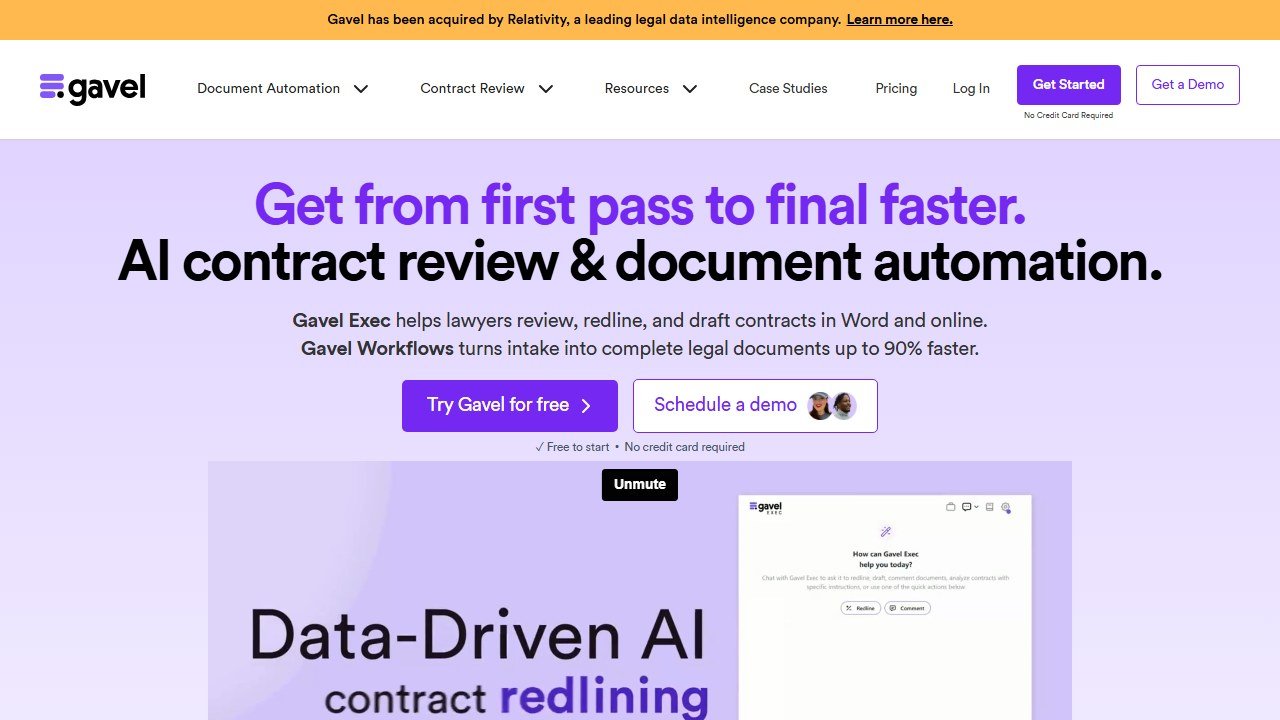
Gavel is the tool we would start with in a smaller practice, and it is also the tool with the biggest news attached. Relativity, the ediscovery giant, acquired Gavel on June 12, 2026. Terms were undisclosed, operations continue, and the product is still sold and supported on its own site, but Relativity has said Gavel’s capabilities will fold into RelativityOne over time (official announcement, plus LawSites and Law.com coverage). If you are buying today, buy on current capability and get roadmap commitments in writing.
The product itself earns the ranking. Gavel Workflows turns your trust and will templates into guided questionnaires that generate finished documents, and Gavel Exec puts an AI drafting and review assistant inside Microsoft Word. In practice, building a revocable living trust workflow took an afternoon, and reusing it cut drafting time on the second matter to minutes of review rather than hours of assembly.
Pricing is published, which is rare in this roundup: Workflows Lite $83 per month, Standard $165, Pro $290, Enterprise custom, with a 7-day trial (official, gavel.io, July 2026). Gavel Exec runs $160 per user per month for 1,000 AI completions, with a free tier of 25 queries to test it (official). If you have seen Gavel quoted at $99 per month elsewhere, that figure is stale and no longer matches the published rate card.
Who it’s for: solo and small-firm estate planners who want drafting automation and intake in one tool at a published price.
Honest limitation: the Relativity acquisition adds genuine roadmap uncertainty, and unlike WealthCounsel, Gavel ships no estate planning content library. You automate your own templates, which is a feature if your documents are good and a project if they are not.
A note on Lawgic
Lawgic, sold as Lawgic by Estateworks, still appears in estate planning software lists, but it deserves an accuracy flag: it is a legacy rules-based document assembly system, not generative AI. Rules-based assembly is predictable and consistent, which some drafters prefer, but do not buy it expecting the AI capabilities in this roundup. Pricing is quote-gated (reported via Legaltech Hub). If you want deterministic assembly engines compared properly, our legal document automation software guide covers that category.
Existing-plan analysis and summarization
The fastest-growing EP job in 2026 is not drafting new plans, it is making sense of old ones: the shoebox of prior trusts, amendments, and deeds every new client brings in.
3. Trust & Will EstateOS for Attorneys: free while the beta lasts
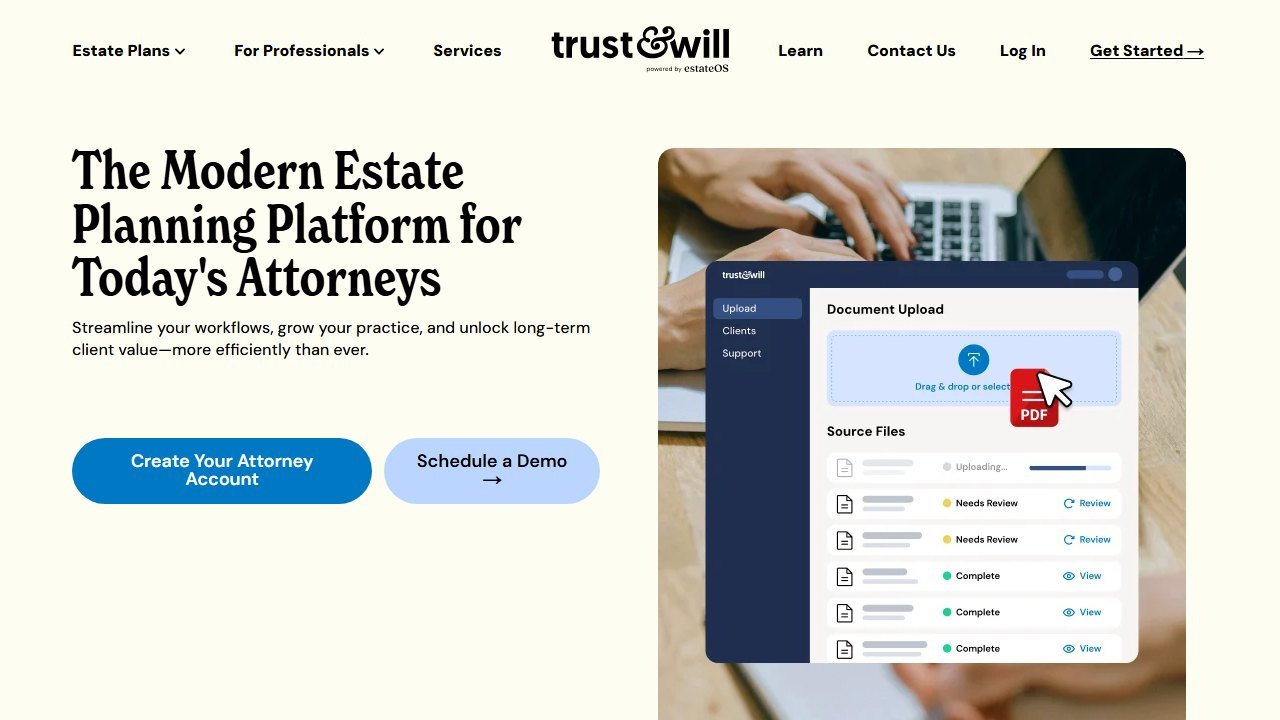
First, the disambiguation, because Trust & Will made this genuinely confusing: EstateOS names both the consumer platform Trust & Will launched in 2025 and the separate attorney platform launched January 12, 2026. This entry is about the attorney platform at trustandwill.com/attorneys. If you have seen EstateOS described as a consumer will-maker, that is the other product.
The attorney platform does plan analysis, document ingestion, and client engagement: upload a client’s existing documents and it extracts the structure, summarizes provisions, and flags what exists and what is missing. In practice, ingestion of a prior trust package produced a usable summary in minutes, the kind of first-pass review that normally eats an associate’s morning. The client engagement layer is the sleeper feature: it gives clients a portal view of their plan status, which cuts the where-are-we emails that clog an EP inbox between signing ceremonies.
Pricing: free during beta (official, PRNewswire launch announcement), with more than 500 attorneys joined at launch per the company. Trust & Will has raised $83M in total funding including a $34M Series C (reported), so this is a funded land-grab into the attorney market, and the free beta is the land-grab pricing.
Who it’s for: any estate planning attorney who reviews existing plans. At free, the evaluation cost is your time.
Honest limitation: beta pricing means unknown future pricing, and the elephant in the room is that your plan-analysis vendor also runs one of the biggest consumer will platforms in the country. Decide how you feel about that before building your intake around it.
4. Wealth.com Ester: powerful, but built for advisors first

Wealth.com has the most impressive raw AI in this category. Ester Intelligence extracts, summarizes, and visualizes estate documents, and the company says Ester processed more than 100,000 estate documents in 2025 with 664% year-over-year growth in AI workflow usage (official press materials, vendor-claimed figures). The April 16, 2026 Series B, $65M led by Titanium Ventures with Schwab, GV, and Citi Ventures participating, is the largest raise in the space.
Here is the caveat that belongs in every attorney’s evaluation: Wealth.com is advisor-first. The product, the go-to-market, and now the Series B war chest all target financial advisors and wealth platforms, with attorney and trust solutions as the secondary line. In our demo walkthrough, the workflow assumptions (client households, advisor books) were visible in the seams.
Pricing: quote-gated, no published figures.
Who it’s for: estate planning attorneys embedded in wealth management ecosystems, or firms that share clients with advisory teams already on Wealth.com.
Honest limitation: you are the secondary customer. Feature priorities will follow the advisor market, and pricing conversations start from enterprise-advisory expectations.
Plan visualization
Clients do not read trusts, they read pictures. Visualization tools turn a plan into flowcharts a client can actually follow in a review meeting.
5. Luminary: the visualization specialist
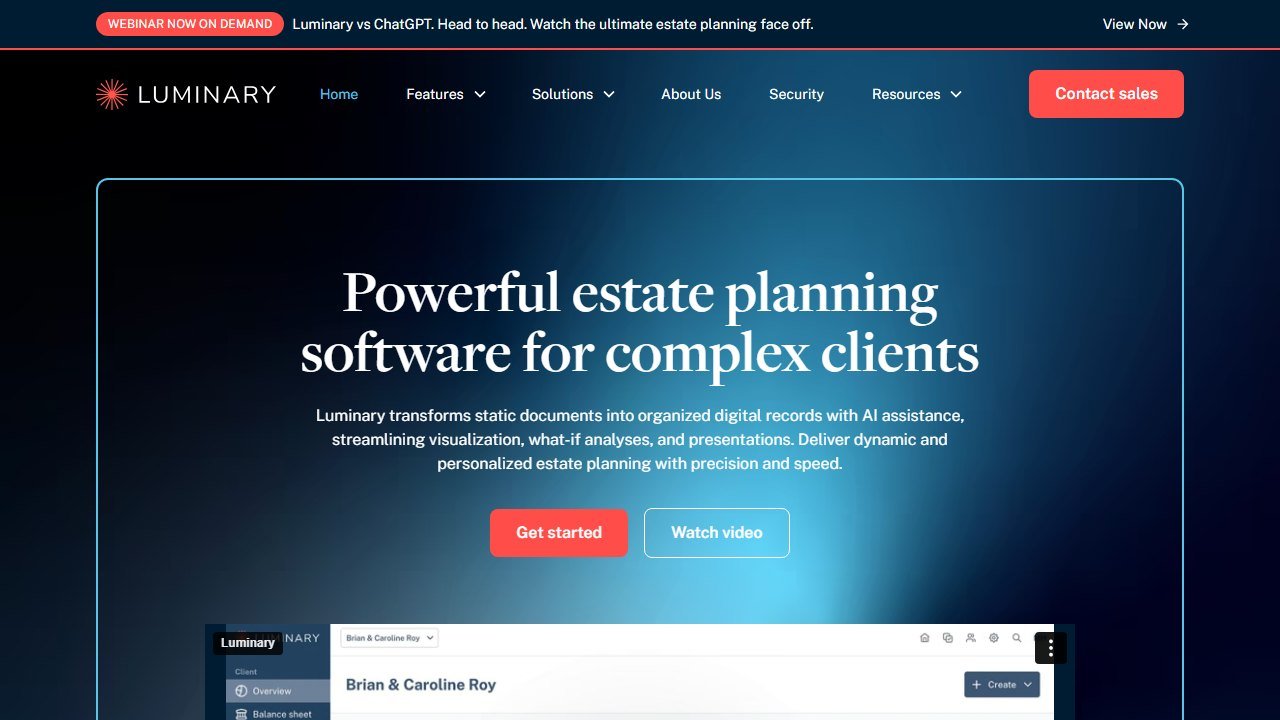
Luminary is the tool we recommend when the job is showing a client how their plan works. It digitizes estate documents, generates estate flowcharts, and runs what-if modeling: change the marital deduction assumption or a beneficiary, and watch the distribution map redraw. It serves estate attorneys, advisors, and trust companies, and the attorney fit felt more native to us than Wealth.com’s.
The company claims better than 90% summary accuracy on document digitization and holds SOC 2 Type II certification (official site claims). On funding: Luminary raised a $9.5M Series A in February 2023 and had announced no Series B as of mid-2026 (reported), which is worth knowing in a category where its main visualization rival just banked $65M.
Pricing: quote-gated across Go, Pro, and Enterprise tiers, no published figures.
Who it’s for: firms where client-facing plan reviews drive engagements and referrals.
Honest limitation: the funding gap against Wealth.com is real, and with no published pricing you cannot budget without a sales call. Wealth.com’s Ester also visualizes plans, so if you already have it through an advisory relationship, run both demos before paying for a second tool.
Client intake
Intake is where estate planning practices leak the most hours: the family tree, the asset schedule, the beneficiary details, all collected by email and retyped.
6. Relaw.ai: the EP-native intake play
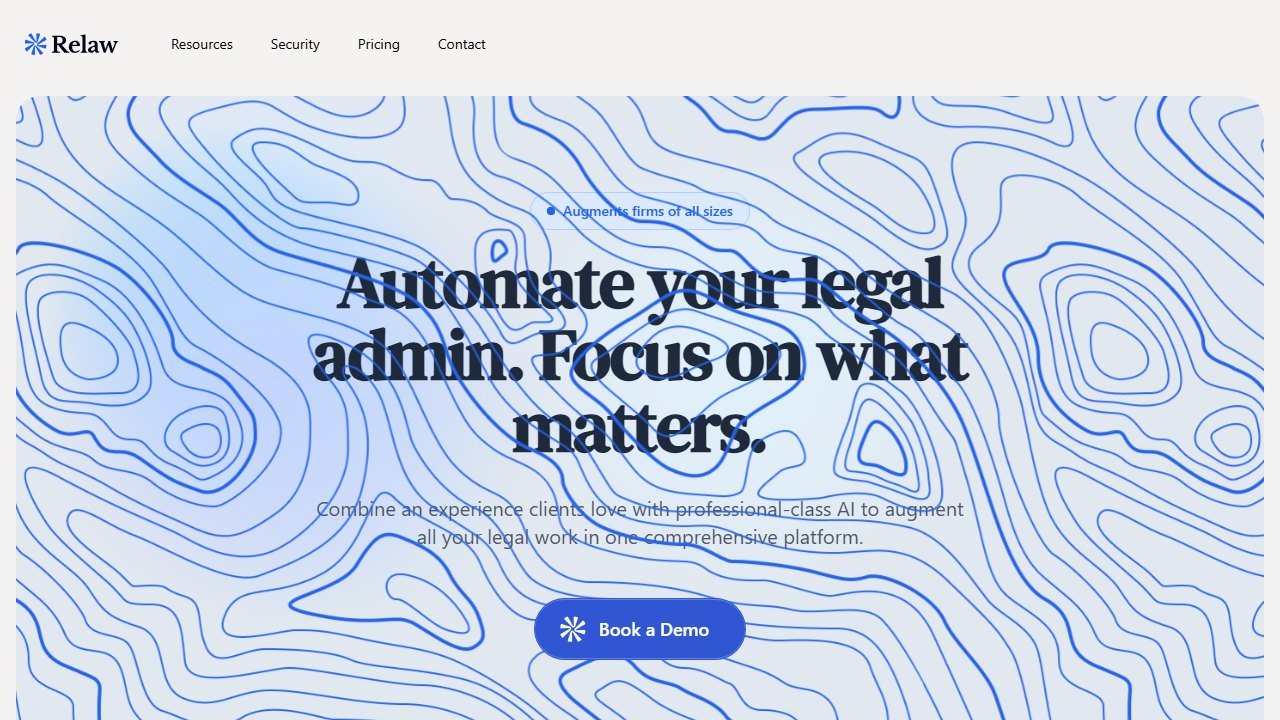
Relaw.ai was founded in 2024 as an estate-planning-native AI platform and has since broadened to all-practice positioning, but its EP roots still show in the right way: smart intake that collects family and asset information conversationally, an AI notetaker for client meetings, and AI drafting on top. In our intake test, the structured family-and-assets capture beat generic form builders comfortably, because the questions branch the way an EP interview actually branches.
The company claims SOC 2 Type II certification (official site, July 2026). Pricing: quote-gated, no published figures.
Who it’s for: practices that want AI-assisted intake and meeting capture without assembling it from parts.
Honest limitation: a 2024-founded company with gated pricing and a recent pivot to all-practice marketing is a bet on execution. Trial it on live intakes before moving your pipeline.
Worth repeating from the drafting section: Gavel also does intake well. Its questionnaire workflows double as client-facing intake forms that feed directly into document generation, so if you buy Gavel for drafting, test its intake before adding a second tool.
Drafting assist inside Word
If your practice lives in Microsoft Word and you want AI in the margin rather than a new platform, this lane is for you. These are general legal AI tools with estate planning chops, not EP-native platforms; for the full category rankings, see our best AI tools for lawyers pillar.
7. Spellbook: first drafts and inconsistency flags in Word

Spellbook earns its slot here because it treats estate planning as a real use case, with a dedicated EP landing page, will and trust first drafts, and inconsistency flagging that catches the classic EP drafting wound: the beneficiary named one way in Article III and another way in the schedule. In practice, it flagged exactly that class of mismatch in a test trust.
Pricing: quote-gated with a 7-day trial (official). Reported tiers run roughly $99 to $350 per month depending on seat count and package (reported, third-party). We break the tiers and negotiation levers down in our Spellbook pricing guide.
Who it’s for: attorneys who draft in Word all day and want AI review without changing how they work.
Honest limitation: Spellbook is a generalist contract tool at heart. It will not manage your EP matter flow, your intake, or your plan visualizations, and the gated pricing means the real number depends on your negotiation.
8. Paxton AI: research-heavy drafting support
Paxton AI is the pick when the drafting question is really a research question: 50-state coverage matters in estate planning every time a client owns property across state lines or a trust migrates situs. Paxton combines legal research with drafting assistance and carries SOC 2, ISO 27001, and HIPAA attestations (official site).
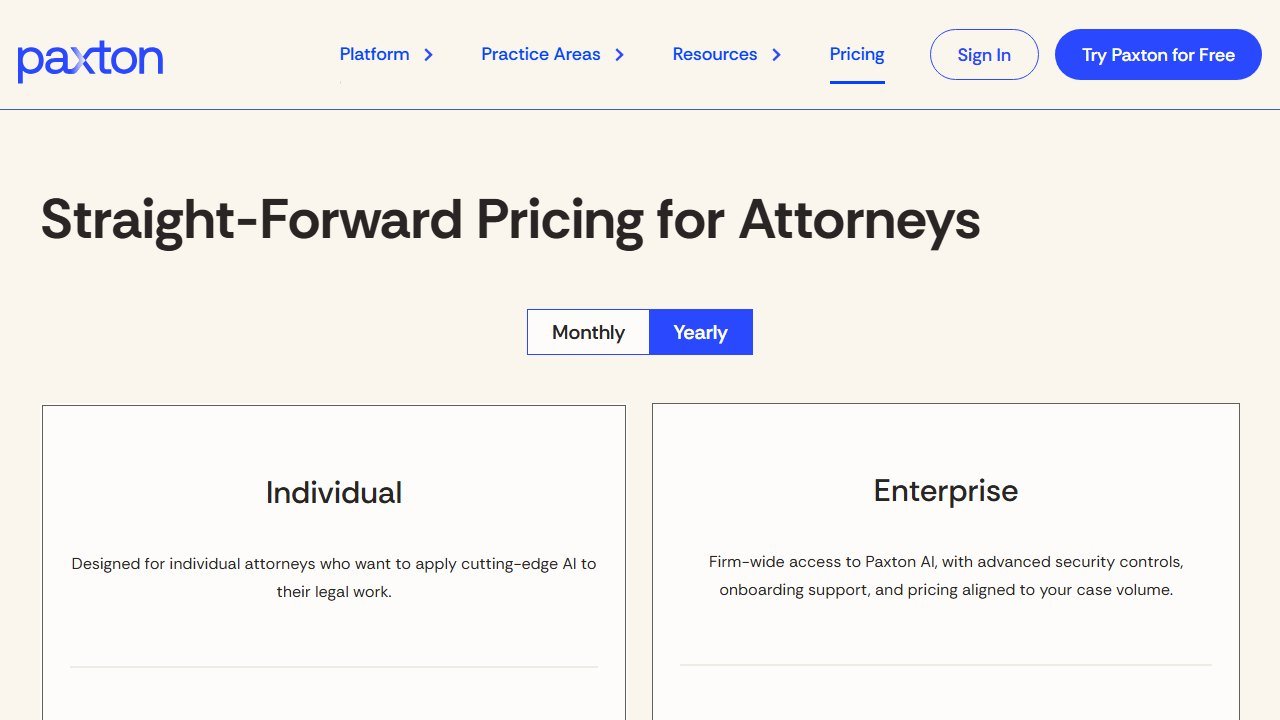
Pricing is published and current: Individual at $499 per user per month, or $2,999 per year, with Enterprise custom (official, paxton.ai/pricing, July 2026). Note that older coverage still floats a roughly $199 per month figure; that is stale, and the official rate card is the one above.
Who it’s for: practices where multi-state research drives the drafting, and firms that want one tool for research plus first drafts.
Honest limitation: at $499 per user per month (official), Paxton costs more than Gavel and Spellbook combined at reported rates, and none of it is EP-specific. You are paying for research breadth, not estate planning depth.
Where CoCounsel fits
Thomson Reuters CoCounsel deserves exactly one paragraph here: it is the heavyweight general legal AI, rebuilt on Claude, and it handles document review and drafting support that estate planning work can absolutely use, but it is a firm-wide platform decision rather than an EP tool purchase. We cover it fully in our CoCounsel review and break down the cost in the CoCounsel pricing guide. If your firm already runs it, use it for EP document review before buying overlap; if not, do not buy it for estate planning alone.
How to choose: match the tool to the leak
Buy against the job that leaks the most hours in your practice, not against the flashiest demo. Six of the eight tools on this page gate pricing behind a demo call, so before you book any of them, write down your hour leak in numbers: how long a new trust takes to draft, how long a shoebox review takes, how many intake emails a new matter generates. Vendors negotiate differently when you arrive with the math done.
Start with intake and drafting if you are solo or small-firm: Gavel at $83 to $290 per month (official) covers both, and its published pricing makes it the easiest first commitment on this page. Add the Trust & Will EstateOS attorney beta at free (official) for plan analysis while the beta pricing lasts, with the caveat that beta pricing always ends.
Choose WealthCounsel if drafting integrity is the whole game and you want a maintained library behind every clause, and accept the membership economics. Choose Luminary if client-facing plan reviews win you engagements, and demo Wealth.com against it if you already live in an advisory ecosystem, remembering that Wealth.com builds for advisors first.
In Word, Spellbook (reported $99 to $350 per month) is the pragmatic pick and Paxton ($499 per user per month, official) is the research-heavy one. And whatever you buy, hold the vendor to attorney-grade answers on data handling: client estate documents are as sensitive as legal data gets, so SOC 2 claims, retention policies, and training-data commitments belong in writing before your first upload. Smaller practices weighing broader stacks should also see our best AI tools for small law firms guide, and drafters who want prose-level AI help will find the right tools in our AI tools for legal writing roundup.
The 2026 signal is unmistakable: Relativity buying Gavel, Trust & Will spending venture money to win attorneys, and $65M flowing into the advisor side all say estate planning is the next legal AI battleground. The tools above are the ones that earn a place in an attorney’s stack today, at prices you now have labeled honestly.

Written by
FazFaz is the founder of AIToolsBakery. Some tools here are tested hands on. Others are assessed from vendor documentation and pricing verified on the live page, and every review says which one it is. Sponsors can buy a position in a guide. They cannot buy the score, the criticism, or silence about a better option.
How we test and how we make money →