At the June 2026 AILA Annual Conference, Mitratech unveiled a full immigration AI ecosystem for INSZoom: Visalaw AI research, Candle AI email intelligence, Lawfully case tracking, and a native tool that reads incoming government notices automatically. That announcement was the loudest signal yet that immigration practice is getting its own AI stack, separate from the generic legal AI wave we mapped in our best AI tools for lawyers pillar.
Here is the problem with researching that stack: the search results are wall-to-wall vendor blogs. Every list is written by a company ranking itself first, and “AI-powered” gets stamped on everything from genuine document extraction engines to a chatbot bolted onto a 20-year-old case management database.
So we did the sorting ourselves. We looked at what each tool has actually shipped, matched it to the six jobs an immigration practice needs done, and ranked accordingly. Where a vendor publishes pricing we quote it with the date we checked. Where they hide it behind a demo, we say so plainly.
Real AI vs the AI badge: what each tool actually ships
This table is the core of the page. The middle column names the specific feature each vendor has shipped, not the marketing phrase on the homepage.
| Tool | Actual shipped AI feature | Real AI or AI badge? | Primary job | Pricing published? |
|---|---|---|---|---|
| Docketwise | IQ document assistant: auto-extracts data from passports, green cards, EADs, and I-94s into forms; plus a writing assistant | Real AI on a PM backbone | Form data capture, case management | Yes, $69 to $119/user/mo |
| Visalaw AI | GEN platform: immigration research chat grounded in a curated library with AILA secondary sources and 10M+ cases, plus credit-based Drafts | Real AI, research-first | Immigration research, drafting | Yes, Core $220/mo |
| CaseBlink | Drafts support letters, cover letters, RFE responses, and briefs that cite to your uploaded case documents; packet assembly and AI forms | Real AI, drafting-first | Petition and RFE drafting | No, treat as quote-based |
| Drafty AI | Immigration-specific brief drafting, evidence review, circuit-specific research | Real AI, narrow and young | Briefs, evidence review | No |
| Parley | O-1A Writer drafting petitions inside Word, expanding to H-1B, TN, EB-1, EB-2 NIW, L-1 | Real AI, single-category depth | Petition drafting in Word | No |
| INSZoom | Native GovNoticeIDP government-notice intake, plus Visalaw AI, Candle AI, and Lawfully integrations announced June 2026 | Partly shipped, partly roadmap | Notice and case tracking at volume | No, quote-based |
| ChatGPT | General-purpose drafting and summarization, zero immigration grounding | Real AI, wrong specialty | Scaffolding and summaries only | Yes, Plus $20/mo |
How we ranked these tools
Immigration practice is not one job, it is at least six. We scored every tool against them:
- Form data capture: pulling names, numbers, and dates from passports, green cards, EADs, and I-94s into USCIS forms without retyping.
- Petition and support letter drafting: first drafts of the narrative documents that eat associate hours.
- RFE response drafting: building a response that actually engages the evidence in the file.
- Immigration-specific research: answers grounded in immigration authority, not general case law. For general research tools, see our best AI legal research tools roundup.
- Government notice and case tracking: catching receipt notices, RFEs, and approvals across hundreds of open matters.
- Client portals and email workflows: intake, status updates, and the inbox triage that immigration volume creates.
One scope note: we are not re-ranking general practice management here. If you want the full PM market map, that lives in our best legal practice management software guide. This page ranks tools by immigration job only.
1. Docketwise: best overall for immigration firms
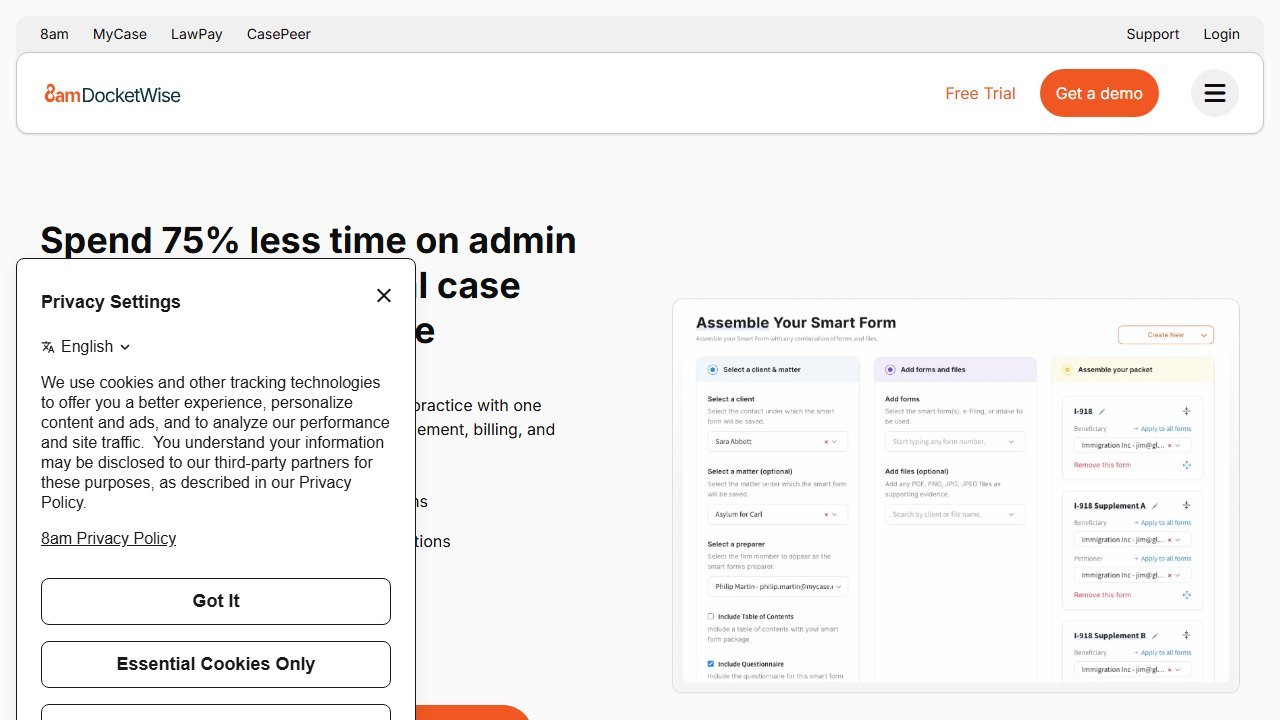
Docketwise is immigration-specific practice management with a genuine AI layer on top, which is exactly the combination most firms need first. The platform covers the immigration form library, case tracking, invoicing, and client intake, and the IQ layer adds two shipped AI features: a document assistant that auto-extracts data from passports, green cards, EADs, and I-94s, and a writing assistant for correspondence and case narratives.
In practice, the document extraction is the feature that pays the subscription. Form data capture is the single most repetitive task in an immigration shop, and IQ turns a stack of identity documents into populated fields instead of an afternoon of retyping. The writing assistant is more ordinary, closer to a competent drafting aid than a petition engine, but it lives inside the case file, so it starts with context that a standalone chatbot never has.
Pricing (verified on docketwise.com, July 2026): Basic from $69, Pro from $99, and Advanced from $119 per user per month on annual billing, with the monthly toggle at roughly $79, $109, and $129. The catch: IQ AI is included on Pro and up, so the realistic AI-inclusive floor is $99 per user per month.
Who it is for: solo and small immigration firms that want case management and AI in one bill, and larger firms tired of duct-taping a generic PM tool to immigration forms. If you are a small general practice comparing budgets across categories, our best AI tools for small law firms page has the per-seat cost table.
Honest limitation: the drafting side is thin compared to the dedicated drafting tools below. Docketwise wins on extraction and workflow, not on writing an EB-1 petition narrative.
2. Visalaw AI: best for immigration research
Visalaw AI comes out of the Siskind Susser lineage, which matters: this is a platform built by people who have practiced immigration law at a high level for decades. The GEN platform combines research, summarization, and AI chat grounded in a curated immigration library that includes AILA secondary sources and more than 10 million cases. A Drafts module is available as a usage-based credits add-on. The platform holds SOC 2 Type II certification.
The curated library is the differentiator. General legal research AI treats immigration as one practice area among fifty. Visalaw AI’s grounding means questions about consular processing quirks or adjustment eligibility get answered against immigration authority specifically, including the secondary sources immigration lawyers actually rely on. In practice across legal research tools, grounding quality predicts answer quality more than model choice does, and this is the best immigration grounding we have seen.
Note the naming carefully: the company is Visalaw.ai. You will occasionally see it garbled in third-party lists, and there are lookalike names floating around the category. This is the real entity.
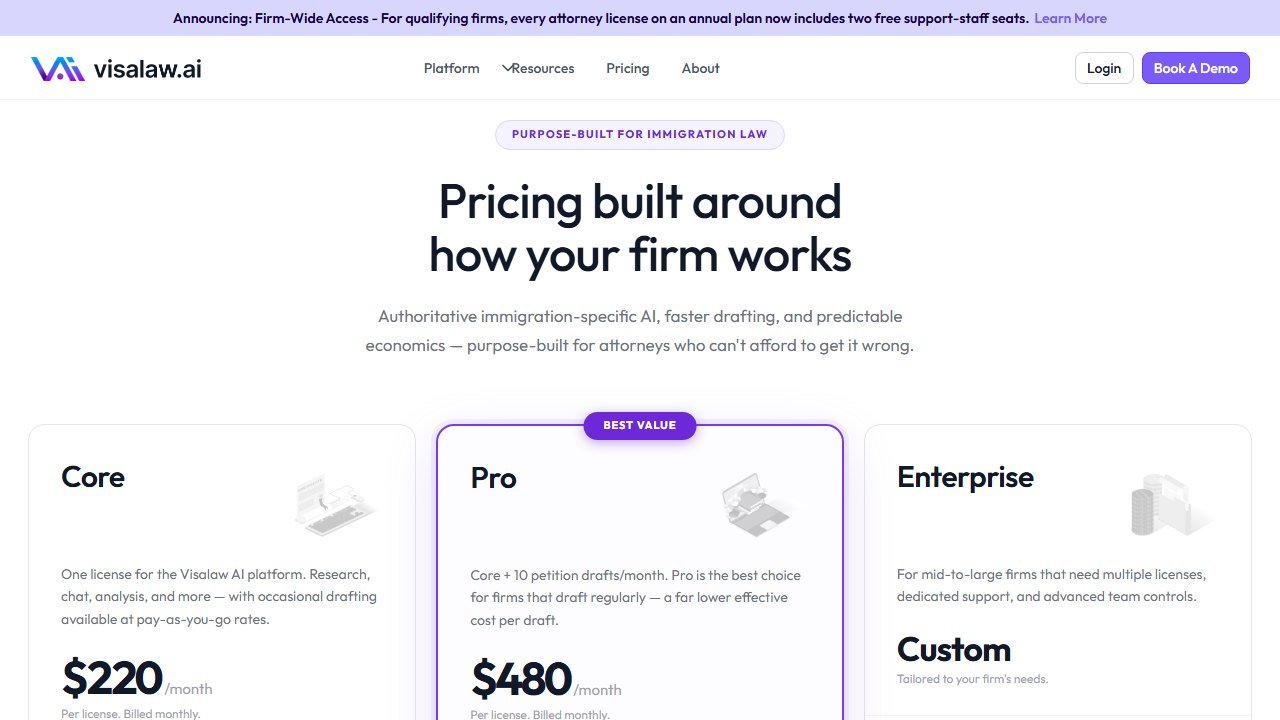
Pricing (verified on visalaw.ai, July 2026): the Core plan is $220 per license per month billed monthly, covering research, chat, and analysis with occasional drafting at pay-as-you-go rates. Pro is $480 per month and folds in 10 petition drafts a month, which works out cheaper per draft for firms that draft regularly. Enterprise is custom for mid-to-large firms that need multiple licenses and team controls.
Who it is for: firms where research depth drives outcomes: removal defense, complex employment-based work, appeals. At $220 a month per license it prices like the professional research tool it is, not like a utility add-on.
Honest limitation: cost structure. The credit-based Drafts add-on means heavy drafting months cost more than heavy research months, and a solo doing mostly family-based filings may struggle to justify the Core price against Docketwise plus a drafting tool.
3. CaseBlink: best for petition and RFE drafting
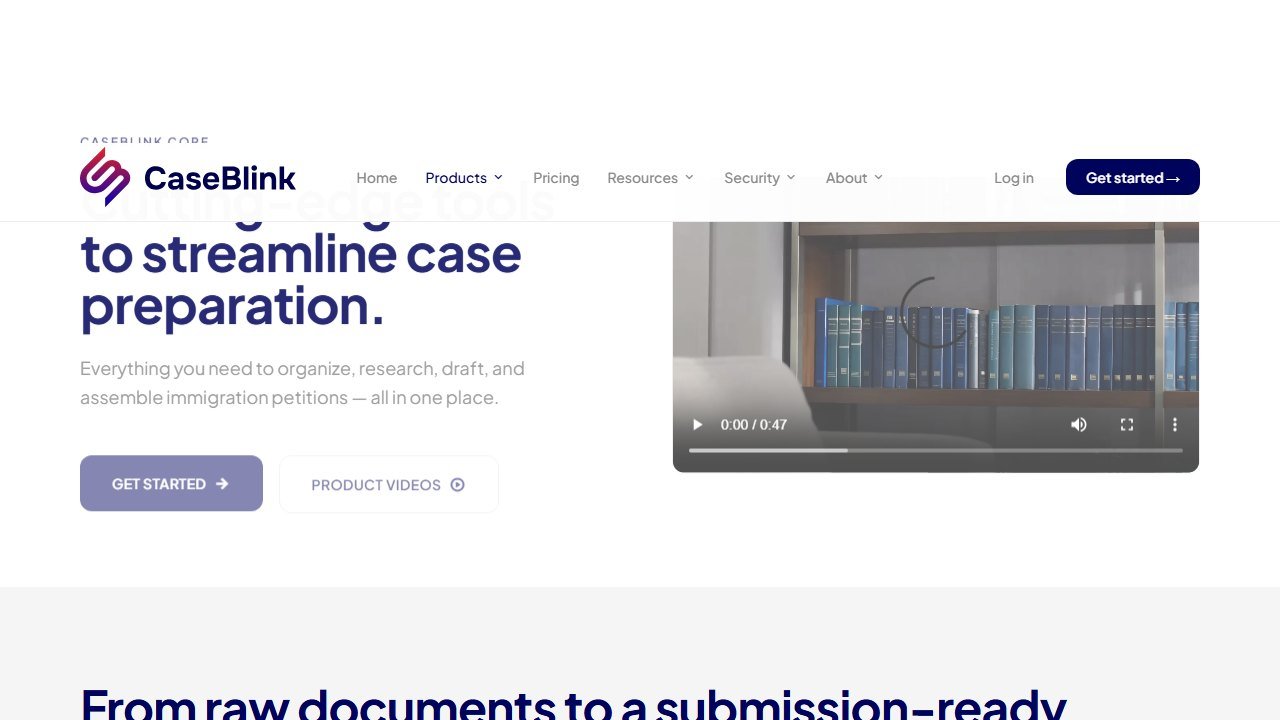
CaseBlink is the drafting specialist of this list. It generates support letters, cover letters, RFE responses, and briefs, and the design choice that separates it from generic AI writing is that drafts cite to the case documents you upload. It also handles packet assembly and AI-assisted forms.
That grounding decision is the whole game for RFE work. An RFE response that does not engage the specific evidence in the record is worthless, and a generic chatbot cannot engage evidence it has never seen. CaseBlink’s uploaded-documents approach means the draft references your client’s actual exhibits, which turns AI from a liability into a real first-pass drafter. The attorney still owns the legal theory and the evidence selection, but the assembly hours drop.
The company raised a $2 million pre-seed led by Tower Research Ventures with immigration firms participating, which is a useful signal: practicing immigration lawyers put money into it.
Pricing: CaseBlink has a pricing page, but we could not verify current figures at draft time, so treat it as quote-based and confirm numbers on the call.
Who it is for: firms whose bottleneck is drafting volume: high-throughput employment-based practices, shops drowning in RFEs, anyone paying associates to assemble packets.
Honest limitation: it is an early-stage company on pre-seed funding. The product thesis is right, but you are betting on a young vendor, so keep your documents exportable and your workflow portable.
4. Drafty AI: immigration briefs and evidence review
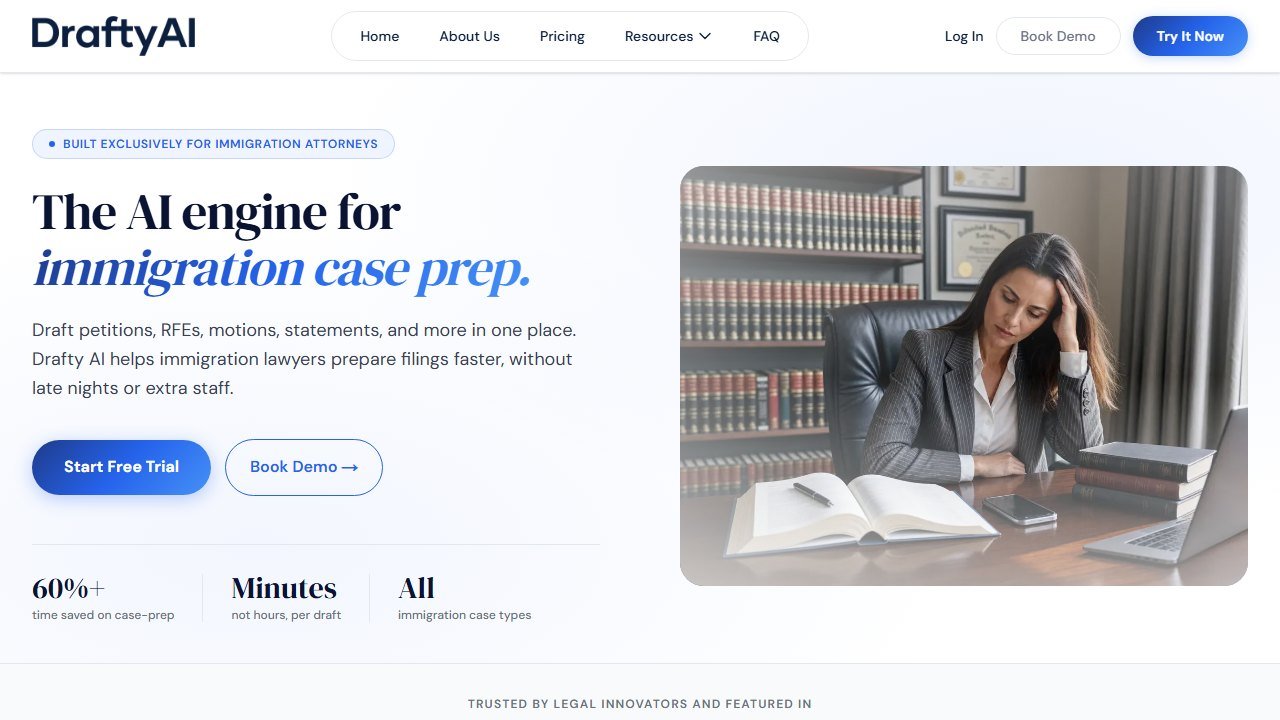
Drafty AI focuses on the litigation-adjacent end of immigration work: brief drafting, evidence review, and research that accounts for circuit-specific law. That last part deserves emphasis, because immigration outcomes genuinely diverge by circuit, and a drafting tool that knows the Ninth Circuit treats a question differently than the Fifth is solving a real problem that generic tools ignore.
For removal defense and appellate work, evidence review is the quiet time sink: hundreds of pages of country conditions, medical records, and declarations that need to become a coherent narrative. A tool that structures that review before drafting begins earns its place even if the final brief is heavily rewritten.
Pricing: not published. Budget for a demo conversation.
Who it is for: removal defense and appellate practitioners, and firms doing brief-heavy work where circuit awareness matters more than form-filling speed. Pair it with the drafting techniques in our AI tools for legal writing guide.
Honest limitation: it is a narrow tool from a young company, and without published pricing we cannot tell you whether the math works for your volume. Ask hard questions in the demo about grounding sources and citation verification.
5. Parley: O-1 and extraordinary-ability petitions in Word
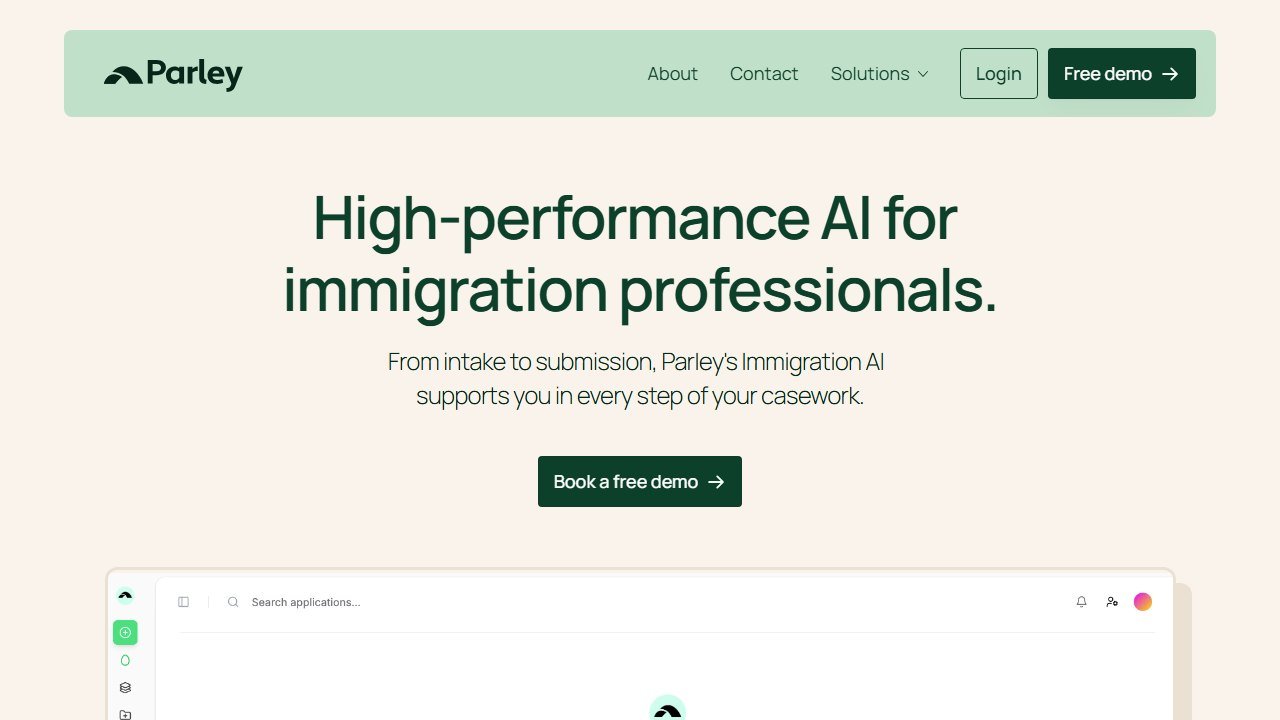
Parley is a Y Combinator company founded in 2024 that took the opposite bet from everyone else on this list: go extremely deep on one petition type before expanding. Its O-1A Writer drafts extraordinary-ability petitions inside Microsoft Word, and the company is expanding into H-1B, TN, EB-1, EB-2 NIW, and L-1 work.
The depth-first approach shows. O-1A petitions are long, criteria-driven narrative documents where the drafting pattern is learnable: map the evidence to the regulatory criteria, argue each one, assemble. A tool trained on exactly that pattern produces noticeably better first drafts than a generalist, and living inside Word means it fits how petition drafting already happens rather than forcing a new platform.
Pricing: not published.
Who it is for: firms with real O-1 and extraordinary-ability volume, especially those serving founders, researchers, and athletes, where petition quality is the product.
Honest limitation: this is a three-person team that has raised about $500K. We flag that not to dismiss them, small teams ship fast, but a firm building its petition workflow on Parley should have a fallback plan. Vendor maturity risk is real at this stage.
6. INSZoom: enterprise case tracking gets an AI ecosystem

INSZoom by Mitratech is the enterprise-volume incumbent: the case management system behind many of the largest corporate immigration operations. For years its AI story was thin. That changed at AILA’s June 2026 Annual Conference, where Mitratech announced an immigration AI ecosystem under its ARIES banner: integrations with Visalaw AI for research and drafting, Candle AI for email intelligence in Outlook and Gmail, and Lawfully for case tracking, plus a native feature called GovNoticeIDP that automatically ingests and processes incoming government notices, and a preview of an AI client portal.
GovNoticeIDP is the piece we rate most highly, because it attacks the highest-volume pain point in corporate immigration: hundreds of receipt notices, RFEs, and approvals arriving as paper and PDFs that someone has to open, classify, and log against the right matter. Automating notice intake at INSZoom’s scale is a real, specific win.
The honest framing: this is partly shipped and partly roadmap. GovNoticeIDP is native; the rest of the ecosystem is integrations and previews announced in June 2026. Buyers should ask exactly what is live in their contract, not what was on the conference slide.
Pricing: quote-based, as it has always been.
Who it is for: high-volume corporate immigration practices and firms already running INSZoom, for whom the ecosystem turns an aging platform decision into a defensible one.
Honest limitation: if you are not already an INSZoom shop, the AI announcements alone are not a reason to become one. The ecosystem’s best research component (Visalaw AI) can be bought directly, and smaller firms will find Docketwise faster to run.
7. ChatGPT: useful, generic, and risky if you get sloppy
We include ChatGPT because most immigration lawyers already use it, and pretending otherwise would make this list less honest than the vendor blogs we are correcting. At $20 per month for ChatGPT Plus, it is the cheapest drafting aid here, and for the right jobs it is genuinely good: outlining a support letter structure, summarizing a long policy memo, rewriting a client email into plain English, translating intake questions.
The rules that keep it safe:
- Confidentiality first. Do not paste client-identifying information into a consumer chatbot. If you use ChatGPT (or Claude) for client work at all, use a paid workspace plan with training on your data disabled, and check your bar’s guidance on generative AI. The same applies to any general-purpose model.
- Never trust its citations. ChatGPT has no immigration-specific grounding and will confidently produce plausible-looking authority that does not exist. Every cite gets verified against primary sources, no exceptions.
- Never let it answer form questions. Form fields are legal determinations. Extraction tools like Docketwise IQ move data; they do not decide admissibility questions, and neither should a chatbot.
Who it is for: everyone, for scaffolding and summarization. No one, for citations, form answers, or unredacted client data.
Honest limitation: it does not know immigration law is different this circuit, this month. The specialist tools above exist precisely because general models lack the grounding this practice area punishes you for skipping.
Tools we excluded, and why
A credible ranking is defined as much by what it leaves out. These names show up constantly in immigration AI searches and do not belong in a lawyer’s stack:
- Boundless: a consumer-facing immigration service for applicants, not software for attorneys.
- LawLogix Edge: Equifax-owned I-9 and immigration compliance software (not Hyland, despite what stale lists say) with no shipped AI features we could verify.
- “Prodigy” immigration software: we could not find that this product exists. If a list ranks it, question the list.
- Generic practice management and research tools: Clio, MyCase, CoCounsel and friends are covered in our practice management and research roundups; re-ranking them here would waste your time.
Sidebar: Casium and the employer-side shift
Casium raised a $5 million seed in October 2025 building AI-driven immigration workflows for employers and candidates, working alongside attorneys rather than selling to them. It is not lawyer software, which is why it is not ranked, but it is worth watching: when employer-side platforms automate case preparation, the attorney’s role concentrates on strategy, review, and representation. That shift will shape what firms buy over the next few years.
Verdict: build the stack by job, not by badge
For most immigration firms in 2026, the stack starts with Docketwise at $99 per user per month on Pro, because form data capture inside your case management system is the highest-leverage automation in the practice. Research-heavy firms add Visalaw AI at $380 per month for the only immigration-grounded research platform of its kind. Drafting-bottlenecked firms trial CaseBlink for evidence-grounded RFE and petition drafts, and O-1 specialists should look at Parley despite its youth.
High-volume corporate practices should press Mitratech on exactly which pieces of the June 2026 INSZoom ecosystem are live today. And everyone can keep ChatGPT for the cheap jobs, as long as client data stays out of it.
The one-line test for any tool that crosses your desk: ask the vendor to name the specific AI feature that has shipped, then ask what it was grounded on. Real answers sound like “extracts I-94 data into the form library” or “cites to your uploaded exhibits.” If the answer is a paragraph about innovation, you have found another AI badge.

Written by
FazFaz is the founder of AIToolsBakery. Some tools here are tested hands on. Others are assessed from vendor documentation and pricing verified on the live page, and every review says which one it is. Sponsors can buy a position in a guide. They cannot buy the score, the criticism, or silence about a better option.
How we test and how we make money →