Search for Spellbook alternatives and you will find a strange genre of content: alternatives pages written by the alternatives themselves, each one ranking itself first. That is not analysis, it is a sales page with a table.
There is a bigger problem with the older lists, though. The 2025 to 2026 legal AI shakeout quietly killed or absorbed half the tools they recommend. Robin AI collapsed into receivership. LawGeex stopped selling to new customers. Henchman became Lexis Create under LexisNexis. Gavel was acquired by Relativity in June 2026. Meanwhile Spellbook itself raised a $40M debt facility specifically to buy competitors, so the vendor you are trying to leave is actively shopping for the vendors you might leave it for.
We reviewed the tools that are still standing and organized them the way buyers actually think: by the job you need done. Word drafting and redlining, in-house review at scale, full contract lifecycle management, or a generalist in-house AI. Pick your job, then pick your tool.
The 8 alternatives at a glance
| Tool | Job it does | Where it lives | Publishes pricing? | Best for |
|---|---|---|---|---|
| Gavel Exec | Drafting and redlining | Word add-in | Partially (Workflows plans public, Exec reported ~$145/user/mo) | Firms wanting playbook-driven markup in Word |
| Definely | Drafting, proofing, navigation | Word add-in | No | Transactional teams tired of definition-chasing |
| DraftWise | Precedent-based drafting and markup | Word add-in | No | Law firms with deep precedent banks |
| Ivo | Contract review and redlining at scale | Web + Word | No | In-house teams with high contract volume |
| LEGALFLY | Multi-document review with playbooks | Web platform | No | In-house teams with strict governance needs |
| Luminance | Enterprise contract review and negotiation | Web platform | No | Large enterprises and diligence-heavy work |
| Ironclad | Full contract lifecycle management | Web platform | No (reported $30K-150K+/yr) | Companies whose problem is process, not prose |
| GC AI | Generalist in-house legal AI | Web + Word | Yes ($500/seat/mo, 14 day trial) | Solo GCs and small legal departments |
Note the pricing column. Only Gavel and GC AI put real numbers on a public page. That matters when the tool you are leaving, Spellbook, is itself unpublished (reported estimates run roughly $99 to $350 per user per month, and we break down why sources disagree so wildly in our Spellbook pricing guide).
What you are actually replacing
A quick baseline, since we do not have a standalone Spellbook review to point you to. Spellbook is a drafting-first Microsoft Word add-in. The suite covers Review, Draft, Ask, Benchmarks, and Playbooks, plus Associate, a multi-document agent. It offers a 7 day self-serve trial, which is genuinely rare in legal AI, and its Ask feature is limited to the contracts you upload rather than open-ended research.
Two things changed the alternatives math in the past year. First, Spellbook raised a $50M Series B in October 2025 and then a $40M debt facility from RBCx in March 2026 earmarked for roughly five acquisitions. You are no longer comparing against a scrappy startup; you are comparing against a consolidator. Second, that same consolidation wave gutted the competitive field, which is why the graveyard section below exists.
If your real question is “what is the best contract review tool overall,” that is a different page: our best AI contract review software roundup owns the category ranking. This page maps who fits which job when Spellbook specifically is not the fit.
Job 1: Drafting and redlining inside Word
This is Spellbook’s home turf, so these three are the closest like-for-like swaps.
Gavel Exec
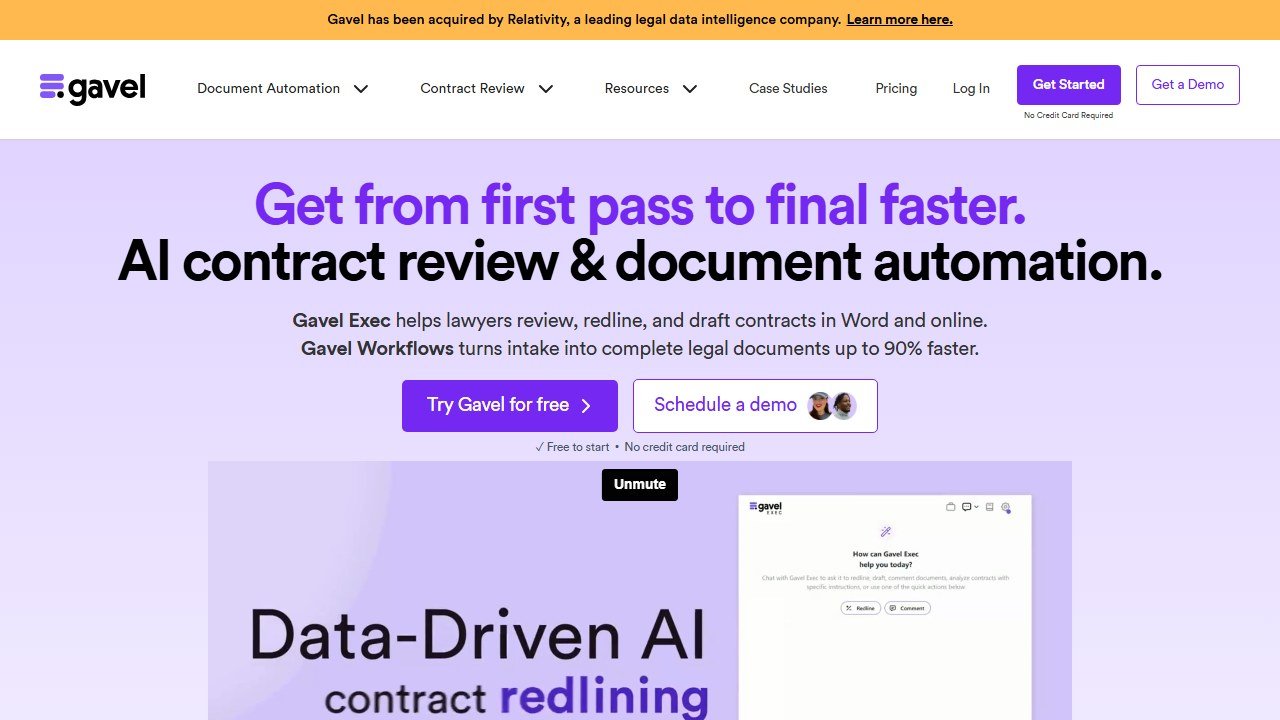
Gavel built its name on document automation workflows, and Gavel Exec is its Word add-in for AI drafting and redlining: playbook-based markup, clause suggestions, and edits that stay inside the document you are working on.
The big news: Relativity acquired Gavel on June 12, 2026. Operations are continuing and the product is still fully buyable, but if you are signing a multi-year deal, ask directly how the roadmap changes under an ediscovery-focused parent.
In practice, Gavel Exec’s playbook redlining felt the most Spellbook-like of anything we reviewed. Load your negotiation positions, run a third-party paper through it, and it marks up against your standards with explanations you can accept or reject clause by clause.
Pricing is the standout. Gavel publishes its Workflows plans: Lite at $83 per month, Standard at $165, and Pro at $290, with a 7 day trial and no card required. Gavel Exec itself is priced separately and not published; it is reported at around $145 per user per month on annual billing, and GC AI cites $160, so treat any Exec figure as reported until you get a quote.
Who it is for: firms that want playbook-driven redlining in Word and value a vendor that shows at least some of its prices.
Honest limitation: the Relativity acquisition is a real unknown. Continuity is promised, but acquired point solutions have a habit of drifting toward the parent’s ecosystem priorities.
Definely

Definely attacks a narrower and very real pain: drafting accuracy. Its Word add-in lets you view defined terms and cross-references without leaving your spot in the document, proofs for broken references and inconsistent definitions, and adds AI drafting assistance on top.
We found it the least flashy tool in this list and possibly the most immediately useful for heavy transactional drafters. The definition-in-context view alone saves the endless scroll-up, scroll-down dance that eats an hour of every long agreement.
Pricing is not published; expect a demo and a quote.
Who it is for: transactional lawyers whose daily pain is navigating and proofing long, definition-dense agreements rather than negotiating third-party paper.
Honest limitation: it is a precision instrument, not a full review suite. If you want playbook-based markup of counterparty contracts, Definely alone will not cover that job.
DraftWise

DraftWise takes a different bet: your firm’s own precedent is the best training data. It connects to your document management system, indexes your past deals, and surfaces your firm’s best language for drafting and markup inside Word. The company raised a $20M Series A in March 2024, with $28M raised in total.
In practice this means the suggestions sound like your firm, not like a generic model. For law firms with a deep precedent bank, that is the whole point. For a two-person in-house team with no precedent library, the advantage largely evaporates.
Pricing is custom and not published, with an enterprise-leaning sales motion.
Who it is for: transactional law firms with years of deal documents and a DMS worth mining.
Honest limitation: the value scales with your precedent volume. Thin document history means thin results, and the setup involves real integration work with your DMS.
Job 2: In-house contract review at scale
Spellbook handles review, but one contract at a time in Word. If your problem is volume, these three are built for the pile, not the page. For a broader look at this persona, our best AI tools for in-house counsel guide covers the full stack.
Ivo

Ivo is contract review and redlining aimed squarely at in-house teams. Set your playbook once, then run incoming contracts through it: Ivo flags deviations, suggests redlines in your voice, and pushes clean markup back to Word. It closed a large Series B in early 2026, which puts real runway behind the roadmap.
In practice the playbook setup was quicker than most enterprise tools, and the redline quality on standard commercial agreements (NDAs, MSAs, DPAs) was consistently usable rather than merely directional.
Pricing is not published. Expect a demo-led sales process sized to your contract volume and seat count.
Who it is for: in-house teams reviewing dozens to hundreds of third-party contracts a month who want consistency without hiring.
Honest limitation: no published pricing means no quick budget check, and like every playbook tool, output quality tracks how much effort you put into playbook setup.
LEGALFLY
LEGALFLY covers multi-document review with playbooks, plus a governance layer that security teams notice: anonymization of sensitive data before it touches a model, admin controls, and audit trails. It is a web platform rather than a Word-native tool.
That governance posture is the differentiator. If your infosec team has already killed one AI tool procurement, LEGALFLY’s anonymization-first architecture is the kind of answer that gets deals unstuck.
Pricing is not published; it is an enterprise sales conversation.
Who it is for: in-house teams in regulated industries, or any legal department whose security review is the hardest step of buying software.
Honest limitation: living outside Word means a workflow change for lawyers who draft in Word all day. Budget for adoption friction, not just licenses.
Luminance
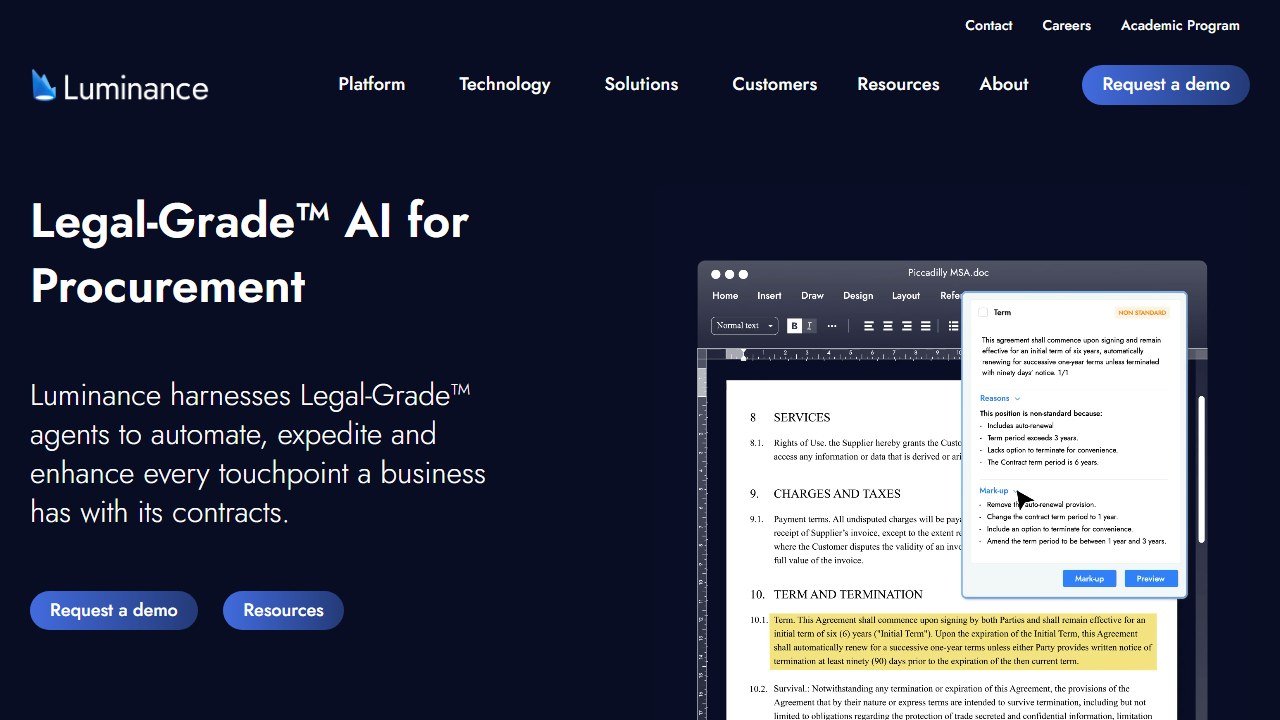
Luminance is the enterprise heavyweight of this trio: AI contract review and negotiation with a lineage in M&A due diligence, where it made its name churning through data rooms. Today it spans first-pass review, autonomous negotiation of routine paper, and large-scale repository analysis.
It is genuinely impressive at volume. Pointing it at a thousand-contract repository and asking structured questions is where it earns its keep. Using it to redline one NDA is like renting a combine harvester to mow a lawn.
Pricing is custom, unpublished, and enterprise-scaled.
Who it is for: large enterprises and firms with diligence-heavy workloads or big contract estates to analyze.
Honest limitation: the price and deployment weight only make sense at enterprise scale. Small teams will pay for capacity they never touch.
Job 3: Full contract lifecycle management
Ironclad
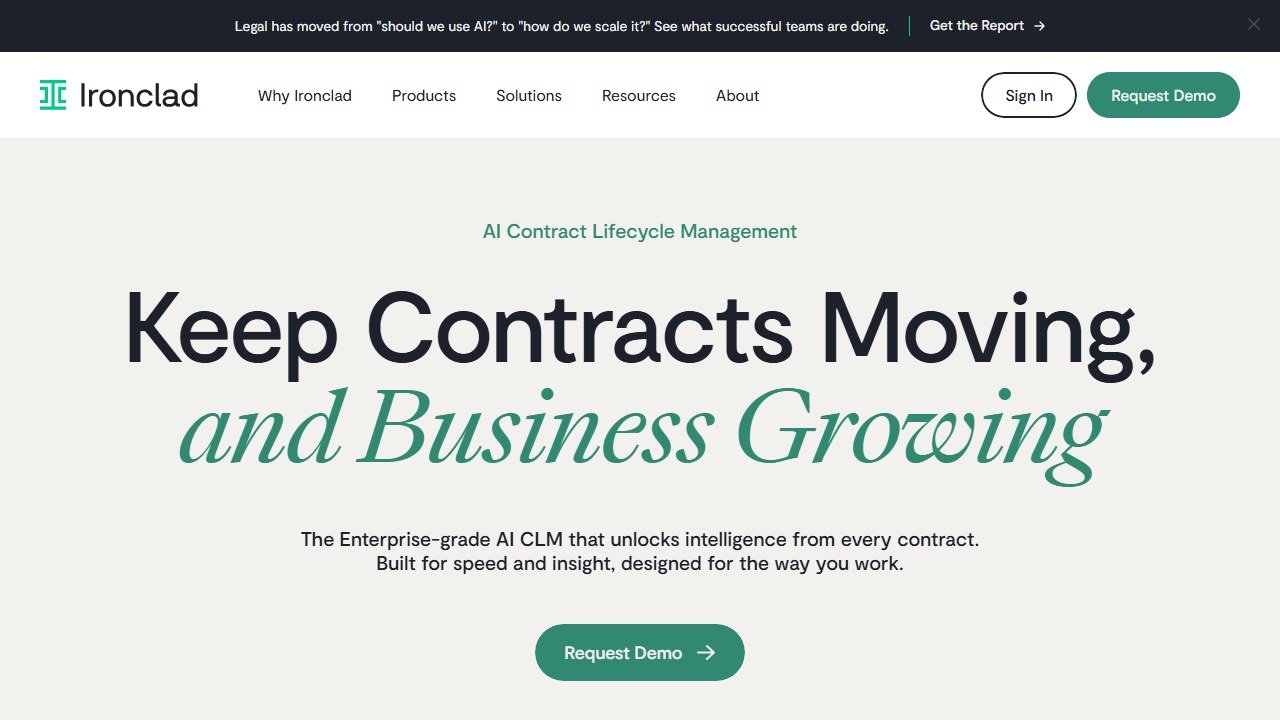
Ironclad is not really a Spellbook competitor, and that is exactly why it belongs here. Spellbook improves the document in front of you. Ironclad manages the entire life of every contract: intake, workflow routing, approvals, negotiation, signature, repository, and reporting, with AI woven through each stage.
The right question is not “is Ironclad better than Spellbook” but “is my problem prose or process?” If contracts stall between sales and legal, if nobody knows which version got signed, if renewals lapse unnoticed, that is a process problem, and no Word add-in fixes it.
Pricing is sales-gated. Third-party reporting (Vaquill, July 2026) puts typical contracts at $30K to $150K+ per year; treat that as a reported range, not an official one.
Who it is for: companies whose contract pain is operational: volume, routing, visibility, and post-signature management.
Honest limitation: it is a platform implementation, not an install. Expect a real deployment project, change management, and a five-to-six-figure annual commitment.
Job 4: Generalist in-house legal AI
GC AI
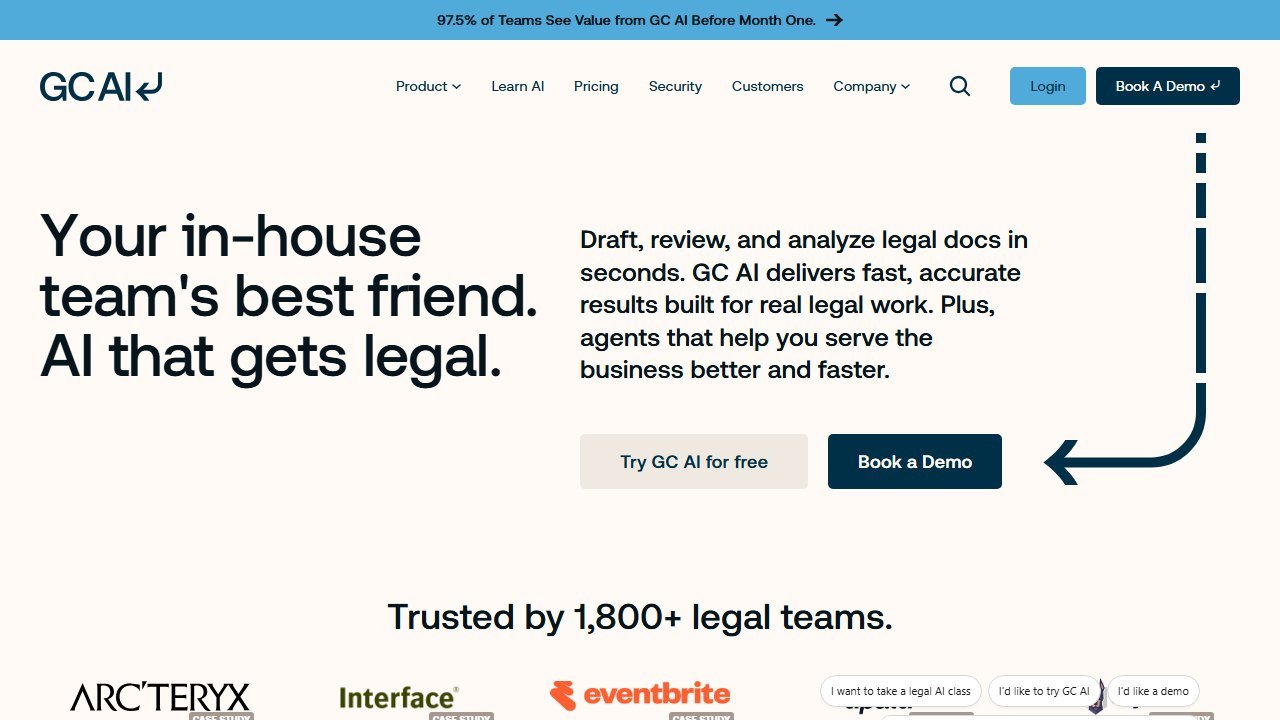
GC AI is built for the reality that in-house work is mostly not contracts. Policy questions, employment issues, marketing review, board minutes, vendor emails: GC AI is a purpose-built legal AI that handles the whole generalist workload, with Word integration for the drafting parts.
It is also the pricing-transparency champion of this entire list: $500 per seat per month, published on the site, with a 14 day trial and no seat minimum. After a week of demo-gated vendors, a public number and a self-serve trial feel almost radical.
In practice, it performed best as a daily thinking partner for a solo GC: summarizing agreements, drafting policies, answering “can we do this” questions with appropriate hedging. It reviews contracts competently, but playbook-driven redlining specialists like Ivo go deeper on that single job.
Who it is for: solo GCs and small legal departments that want one AI across the whole job, not just contracts.
Honest limitation: $500 per seat is real money for a generalist tool, and one caveat on sourcing: GC AI also publishes its own alternatives content ranking itself first, so calibrate its comparison claims accordingly. We ranked it here on merit.
The graveyard: alternatives you will still see recommended that you should not buy
This is the section that separates a 2026 list from a reheated 2024 one. The legal AI consolidation wave removed four names that still litter older roundups.
Robin AI: collapsed. Once Spellbook’s most direct rival, Robin AI failed to close a roughly $50M raise, cut staff in October 2025, faced an HMRC winding-up petition, and entered receivership. Its managed services business went to Scissero in December 2025, and its engineering team was reportedly absorbed by Microsoft in early 2026. Any page still listing Robin AI as an alternative was written before the collapse. Do not shortlist it, and if you are a stranded Robin AI customer, the in-house review tools in Job 2 are your natural landing spots.
LawGeex: not selling. A pioneer of AI contract review, LawGeex is no longer selling to new customers. Its enterprise assets were sold and its founders moved on to Superlegal. Existing customers should have an exit plan; new buyers should look elsewhere.
Henchman: now Lexis Create, owned by LexisNexis. Here is the fact half the internet gets wrong: Henchman was acquired by LexisNexis, with the deal closing in July 2024, and was rebranded Lexis Create in December 2024. DocuSign was never the buyer; DocuSign was only an integration partner. The clause-library technology lives on inside the LexisNexis ecosystem, so if you want it, you are buying into Lexis, not a standalone tool.
Gavel: acquired but alive. Covered above, and worth repeating in the ledger: Relativity acquired Gavel on June 12, 2026, and unlike the other three, Gavel remains fully buyable with operations continuing. It sits in the graveyard section only as an ownership-change flag, not a tombstone.
The pattern behind all four: legal AI is consolidating fast, and Spellbook’s own $40M acquisition war chest means this list will shrink again. When you shortlist any vendor in this space, ask about runway, ownership, and what happens to your data and contracts if they are acquired.
Verdict: match the tool to the job
If you are leaving Spellbook, or never started with it, the decision comes down to which job dominates your week:
- Redlining and drafting in Word: Gavel Exec is the closest swap, Definely if your pain is drafting precision, DraftWise if you are a firm with a deep precedent bank.
- In-house review at volume: Ivo for playbook redlining speed, LEGALFLY if governance is your gatekeeper, Luminance at enterprise scale.
- Contract process, not prose: Ironclad, budgeted as a platform project.
- The whole in-house job: GC AI, with the only self-serve published price in the category.
Two of eight publish pricing. Six require a demo. Whatever you pick, get contract terms on data portability and acquisition scenarios in writing, because if 2025 and 2026 taught legal tech buyers anything, it is that the vendor list you buy from today will not be the vendor list that exists in eighteen months.
For the wider map beyond contracts, start with our best AI tools for lawyers pillar, and if you are weighing Spellbook against the enterprise end of the market instead, our Spellbook vs Harvey breakdown covers that decision.

Written by
FazFaz is the founder of AIToolsBakery. Some tools here are tested hands on. Others are assessed from vendor documentation and pricing verified on the live page, and every review says which one it is. Sponsors can buy a position in a guide. They cannot buy the score, the criticism, or silence about a better option.
How we test and how we make money →