Half the “best legal AI” roundups on page one of Google still list Evisort as a tool you can buy. You cannot. Workday acquired it in October 2024 for $311 million, and it now ships as Workday Contract Intelligence. Meanwhile one vendor, GC AI, owns roughly 40 percent of page one for this exact query by ranking itself #1 in its own listicles.
So this page does two jobs. First, it gives you the corrected 2026 vendor map: who is still independent, who got absorbed, and who actually publishes a price. Second, it organizes the tools by the job your legal department needs done, because “AI for in-house counsel” is really four different purchases: intake and triage, contract lifecycle management, contract review at scale, and research and drafting.
The timing matters. Industry coverage of Association of Corporate Counsel research reports that in-house AI adoption jumped from 23 percent to 52 percent in one year. If you are a GC or legal ops lead evaluating this market right now, you are the majority, not the early adopter.
The 2026 in-house legal AI map at a glance
Almost nobody in this category publishes pricing, which is why we added a pricing-publication status column. It tells you, before you book a single demo, whether you can budget from the vendor’s own website or whether you are walking into a quote-only sales cycle.
| Tool | Primary job | Best for | Pricing publication status | Independent in 2026? |
|---|---|---|---|---|
| Ironclad | Full CLM | Mid-size to large legal departments | Quote-only (reported $30K-150K+/yr) | Yes |
| LinkSquares | Post-signature CLM + risk scoring | Teams cleaning up an existing contract estate | Quote-only | Yes |
| Workday Contract Intelligence | CLM inside Workday | Workday-standardized enterprises | Quote-only | No (Workday, ex-Evisort) |
| ContractPodAi | End-to-end CLM | Microsoft 365 shops, UK and EU teams | Quote-only | Yes |
| SpotDraft | Mid-market CLM | Lean teams that want budget clarity | Partial ($5,000-$50,000+/yr published ranges) | Yes |
| Luminance | Contract review and diligence at scale | High-volume review, M&A | Quote-only | Yes |
| LegalOn | Pre-signature contract review | Fast playbook-driven review | Quote-only (reported $550/mo individual) | Yes |
| Streamline AI | Legal intake and triage | Departments drowning in requests | Quote-only | Yes |
| Harvey | Research, drafting, agents | Large in-house teams, 15+ lawyers | Quote-only (reported $50K+ contracts) | Yes |
| GC AI | Generalist in-house AI | Any size team, in Word | Full ($500/seat/mo published) | Yes |
Quick scope note before we rank anything: this is a persona page for corporate legal departments. Contract review gets one section here because that is one of the four jobs, but the full category ranking lives in our best AI contract review software roundup. And if you sit on the other side of the table, at a small firm advising in-house clients, our best AI tools for small law firms guide is the budget-first version of this page.
Job 1: Legal intake and triage
Before any contract gets reviewed, the request has to reach the right lawyer with the right context. In our conversations with legal ops teams, intake chaos, not contract volume, is the most common complaint: requests arriving via Slack, email, hallway ambush and a shared inbox nobody owns.
Streamline AI
Streamline AI is purpose-built legal front-door software: intake forms, automatic triage, routing rules, approvals and status tracking, with AI layered on to classify and prioritize inbound requests. Founded in 2020 by Kathy Zhu, a former DoorDash legal leader who lived the intake problem firsthand, it raised an $8.6 million Series A led by Blumberg Capital and has $14 million in total funding as of July 2025. Customers include Gusto, 8×8 and Acorns.
In practice, the difference from a generic ticketing tool showed up in the routing logic. Legal requests are not IT tickets: a sales contract above a dollar threshold needs different eyes than a marketing claim review, and Streamline’s conditional intake forms captured that nuance without engineering help. Business users submit through Slack or a web form, and the legal team gets a queue that actually reflects urgency.
Pricing is custom and not published, so budget for a sales conversation. For a rough anchor, comparable workflow tools land in the low five figures annually for small teams, but treat that as our observation of the market, not a Streamline number.
Who it’s for: legal departments of roughly 3 to 50 lawyers where request volume has outgrown the shared inbox.
The honest limitation: Streamline AI does one job. It will not review a contract or draft a clause, so it is an addition to your stack, not a consolidation of it.
Job 2: Contract lifecycle management
CLM is the biggest line item in most in-house legal tech budgets and the category where the 2024-2026 consolidation hit hardest. Here is who is still standing.
Ironclad
Ironclad is the strongest independent full-lifecycle CLM in 2026: workflow designer, repository, AI-assisted review, negotiation and reporting in one platform. Sacra estimates Ironclad reached roughly $200 million in ARR by January 2026, up 34 percent year over year, and in March 2026 it launched an agentic Ironclad Assistant suite that moves the AI from suggest-a-redline to execute-a-workflow. Both figures are analyst and vendor claims respectively, but they match the momentum we see in the field.
Hands on, the workflow designer is still the best in the category. We rebuilt a two-stage NDA approval flow in under an hour without documentation, and the new Assistant handled a batch metadata-extraction task across a folder of legacy agreements that would have been a paralegal’s afternoon.
Pricing is sales-gated. Third parties report contracts from around $30,000 to over $150,000 per year depending on modules and volume. Treat every figure as reported, not official: Ironclad publishes nothing.
Who it’s for: legal departments at companies of roughly 200+ employees where contracts touch many teams.
The honest limitation: overkill for small teams. If you sign 20 contracts a month, Ironclad’s implementation lift and reported entry price are hard to justify against SpotDraft.
Workday Contract Intelligence (formerly Evisort)
Let’s lead with the correction, because half the internet still gets it wrong: Evisort no longer exists as a buyable standalone product. Workday acquired the company in a deal that closed on October 8, 2024, for $311 million in cash, and the technology now ships as Workday Contract Intelligence and Workday CLM. If a roundup you are reading ranks “Evisort” as an independent option, close the tab: its vendor map is at least two years stale.
The absorbed product is still genuinely good. Evisort’s AI-native document intelligence, the ability to ingest a messy contract estate and extract obligations, dates and clauses at scale, is now wired into Workday’s finance and HR data. In our evaluation, that integration is the whole pitch: contract data flowing into the same system that runs procurement and headcount planning is something no independent CLM can offer.
Pricing is quote-only through Workday’s enterprise sales process, typically as part of a broader Workday agreement. Gartner named Workday a Visionary in its 2025 Magic Quadrant for CLM, notable for a first-time entrant.
Who it’s for: enterprises already standardized on Workday. If your CFO lives in Workday dashboards, this is the path of least resistance.
The honest limitation: buying it means buying into Workday. As a standalone legal purchase for a non-Workday company, it makes little sense, and that is precisely why the Evisort correction matters.
LinkSquares
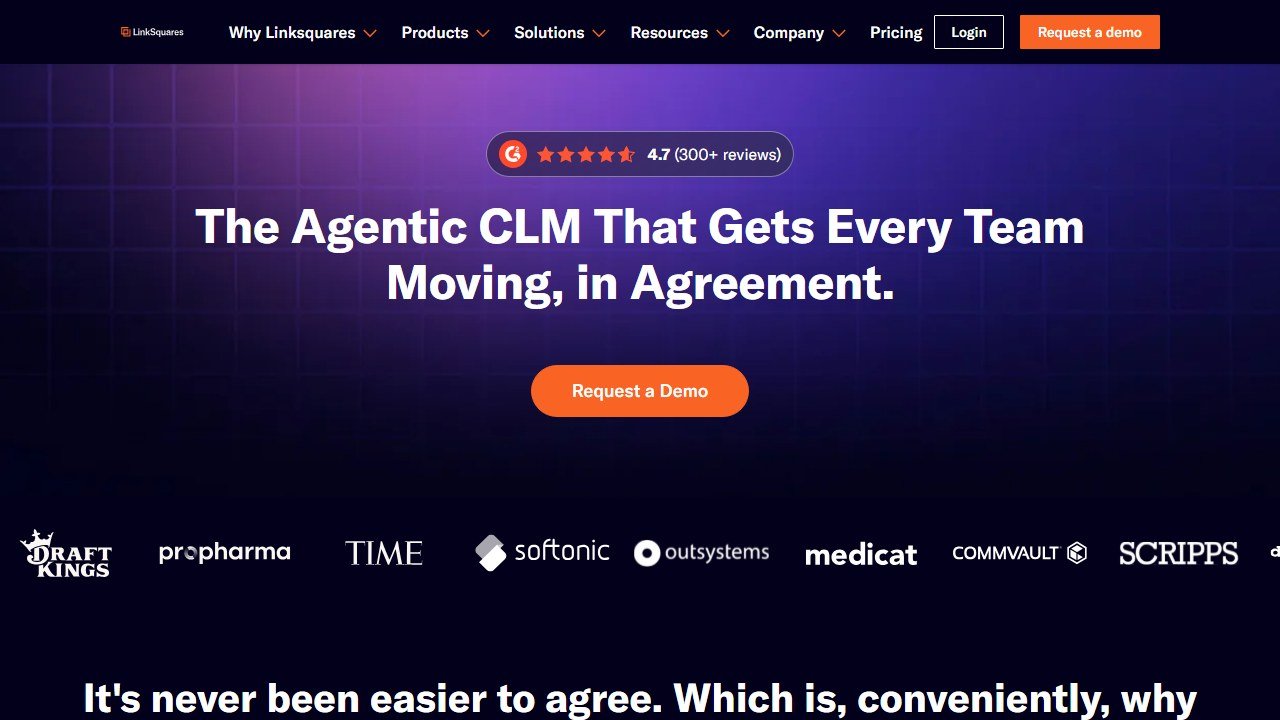
LinkSquares built its reputation post-signature: ingest your existing contract estate, extract the data, score the risk, answer “which of our 4,000 agreements have a change-of-control clause” in minutes. It has since expanded into a full CLM with drafting and workflow, but the analyze-what-you-already-signed engine with AI risk scoring remains the differentiator, and it stays independent as of our July 2026 check.
In practice, the extraction quality on scanned legacy PDFs was the standout. This matters more than demo-stage buyers realize: most legal departments inherit a decade of contracts signed before any CLM existed, and a tool that only manages go-forward paper leaves the archaeology to you.
Pricing is custom and not published. Expect a per-document or estate-size component in the quote alongside seats.
Who it’s for: legal teams whose first problem is visibility into what is already signed: renewals sneaking up, obligations nobody tracked, diligence prep.
The honest limitation: the front-of-funnel workflow tooling is younger than Ironclad’s. Teams that need heavy pre-signature negotiation workflows usually pair it or pick the rival.
ContractPodAi
ContractPodAi is the end-to-end CLM that fits most naturally into a Microsoft shop: deep Microsoft 365 integration, and a strong footprint with UK and EU legal departments, which also makes it a common shortlist entry for European data-residency requirements. Its Leah AI layer spans review, extraction and a legal assistant across the platform.
Testing the Word-side experience, the round-trip between a negotiation in Teams, a redline in Word and the contract record in the platform was smoother than we expected from a suite this broad. Breadth is the strategy here: intake, authoring, negotiation, repository, obligations and reporting in one contract.
Pricing is custom, quote-only, and typically positioned at enterprise level.
Who it’s for: larger legal departments, particularly UK and EU based or Microsoft-standardized, that want one throat to choke across the whole lifecycle.
The honest limitation: doing everything means the individual modules face sharper single-purpose rivals. Review specialists beat it on review depth; Ironclad beats it on workflow design.
SpotDraft
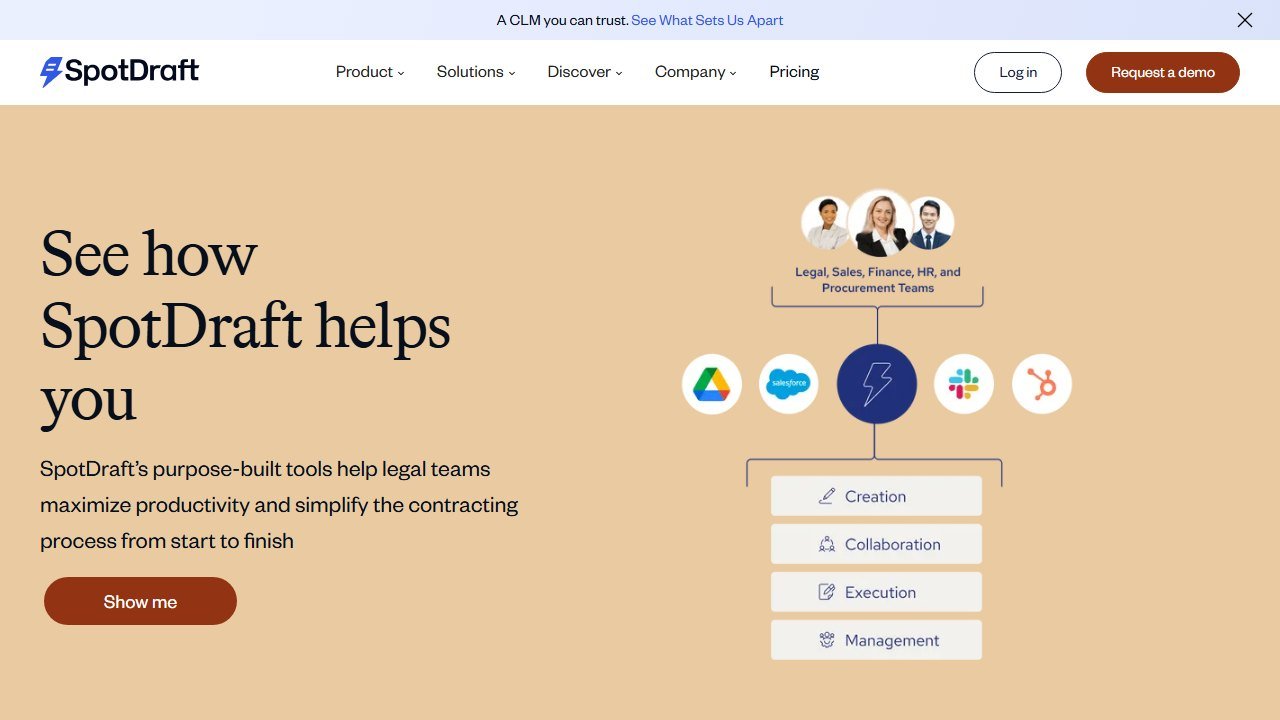
SpotDraft is the mid-market CLM pick, and it earns a special mention for doing what almost nobody else on this page does: publishing pricing information. SpotDraft’s published ranges run roughly $5,000 to $50,000+ per year depending on team size, with the VerifAI AI-review add-on reported at an additional $5,000 to $15,000 per year. That is partial transparency rather than a full public rate card, but in a quote-only category it is a meaningful signal about how the company sells.
In our evaluation, SpotDraft covered the core lifecycle, templates, approvals, e-signature, repository, reminders, with far less implementation ceremony than the enterprise platforms. A lean legal team can realistically self-drive the setup.
Who it’s for: legal departments of 1 to 10 lawyers at mid-market companies who need real CLM without an enterprise procurement cycle, and who want to see a budget number before the first sales call.
The honest limitation: at high volume and high complexity, multi-entity structures, heavy conditional workflows, it runs out of road where Ironclad keeps going.
Job 3: Contract review at scale
One scope sentence first: this section covers the two review engines most relevant to in-house teams specifically. The full ranking of the category, including the Word add-in drafting tools, lives in our best AI contract review software guide, and if you are replacing a specific tool, our Spellbook alternatives breakdown maps that market by job.
Luminance
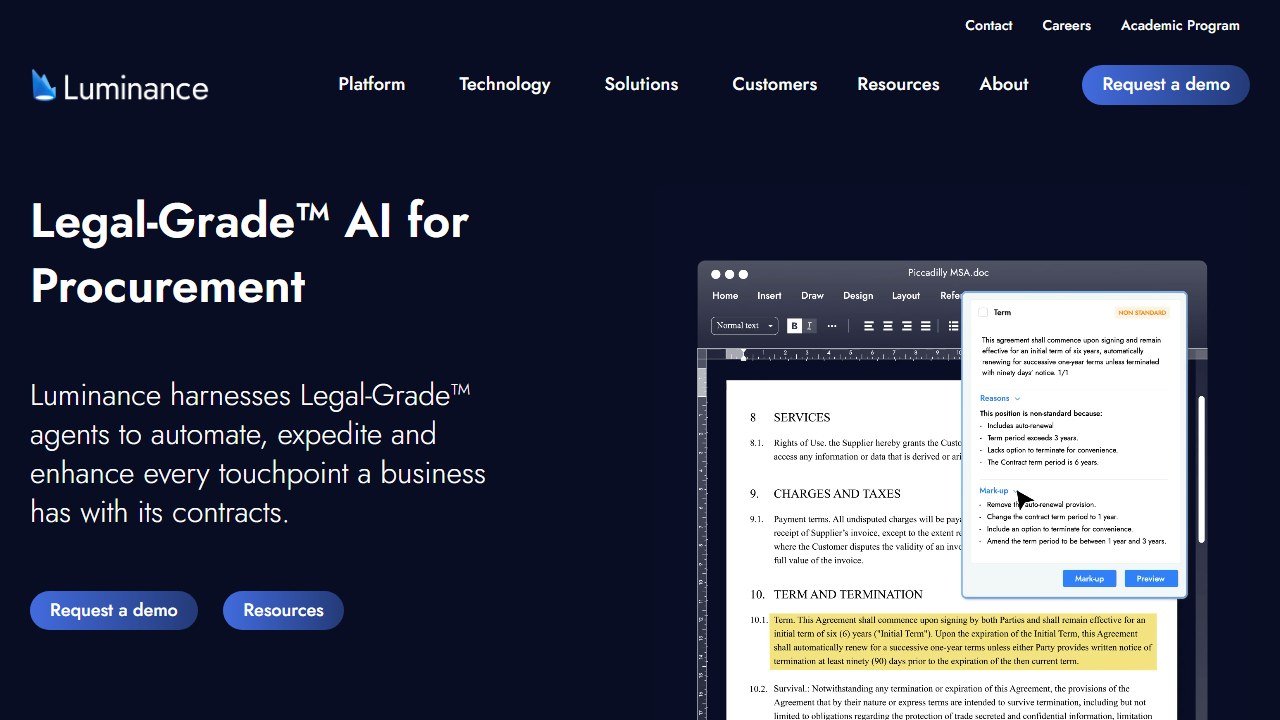
Luminance is the enterprise review heavyweight: contract review, negotiation AI and M&A diligence built on a legal-specialized model the company says was trained on more than 150 million documents (a vendor claim, but consistent with the depth we observed). Where the Word add-in generation reviews one contract well, Luminance is built to chew through thousands.
In our diligence-style test, batch-processing a virtual data room’s worth of agreements, the clustering and anomaly detection were the standout: it surfaced the three agreements with non-standard indemnities out of a pile of hundreds without being told what “standard” looked like. Its autonomous negotiation module, which redlines low-risk paper against your playbook with minimal human touch, is the feature in-house teams asked us about most.
Pricing is custom and quote-only, positioned firmly at enterprise level. It remains independent as of July 2026.
Who it’s for: legal departments with genuine volume, hundreds of contracts a month or recurring M&A diligence, where per-document review economics dominate.
The honest limitation: the price-to-value math collapses at low volume. A ten-contract-a-month team is buying a combine harvester for a window box.
LegalOn
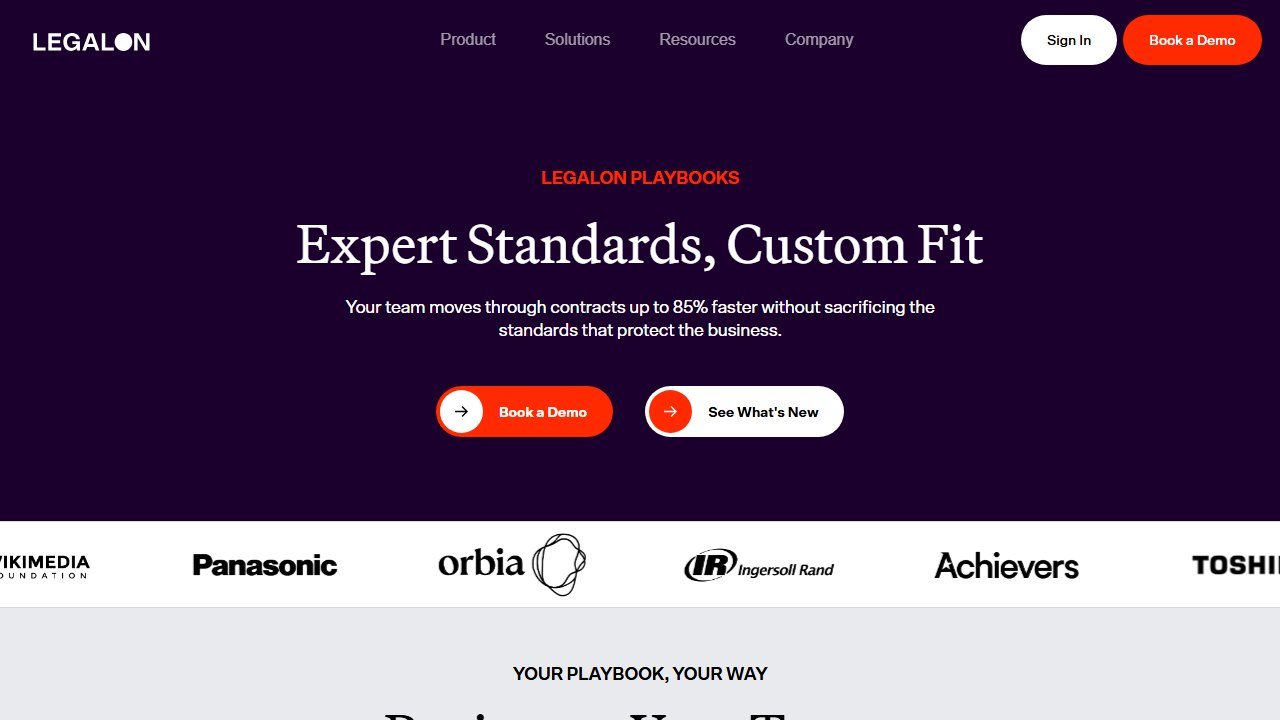
LegalOn attacks pre-signature review with a different philosophy: expert-built playbooks out of the box. Instead of training the AI on your positions from scratch, LegalOn ships with attorney-authored review standards for common contract types, so a lean team gets consistent first-pass review from day one.
In practice, on NDAs and services agreements, the out-of-box playbooks caught the issues a mid-level associate would catch, and the explanations attached to each flag made the review defensible rather than oracular. That playbooks-included approach is exactly right for in-house teams with no time to configure.
Pricing is sales-led. Third parties report an individual plan at $550 per month billed annually, roughly $6,600 per year, with team pricing custom. Treat those figures as reported, not official.
Who it’s for: small to mid-size in-house teams doing steady pre-signature review who want speed and consistency without a CLM-scale project.
The honest limitation: it is a review specialist. No lifecycle management, no repository play, and drafting is not the core strength, so it slots alongside a CLM rather than replacing one.
Job 4: Research and drafting
The generalist layer: the tools your lawyers open for everything that is not a contract workflow, from regulatory questions to board-memo first drafts.
Harvey
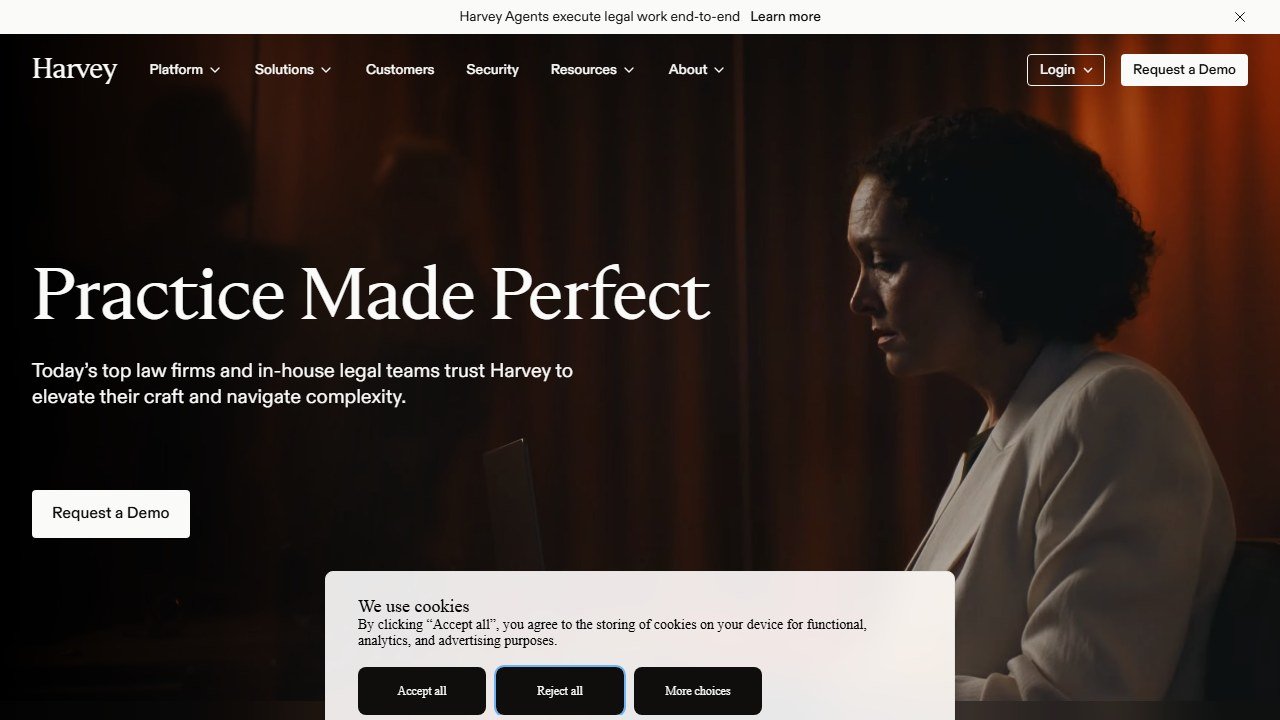
Harvey is the enterprise legal AI platform, valued at $11 billion as of March 2026, and while its reputation was built in BigLaw, large in-house teams are now a core segment. The module set, Assistant, Vault, Knowledge, Agents and Contract Intelligence, covers research, multi-document analysis, knowledge search across your own precedent, and custom agent workflows.
For in-house use specifically, Vault and Knowledge are the draw: pointing Harvey at your own contract estate and policy library and getting grounded answers is a different product than a general chatbot. Our full hands-on verdict lives in our Harvey AI review, and the budgeting math has its own page in our Harvey AI pricing breakdown.
On cost: Harvey publishes no pricing at all. Contracts are reported to start above $50,000 per year with meaningful seat minimums, and every figure in circulation is third-party reported, not official.
Who it’s for: legal departments of roughly 15+ lawyers with heavy research, diligence and drafting volume, especially those that want to build custom agent workflows.
The honest limitation: the buying process. Quote-only, sales-gated, reported seat minimums: a five-lawyer team cannot realistically buy it, and should not try.
GC AI
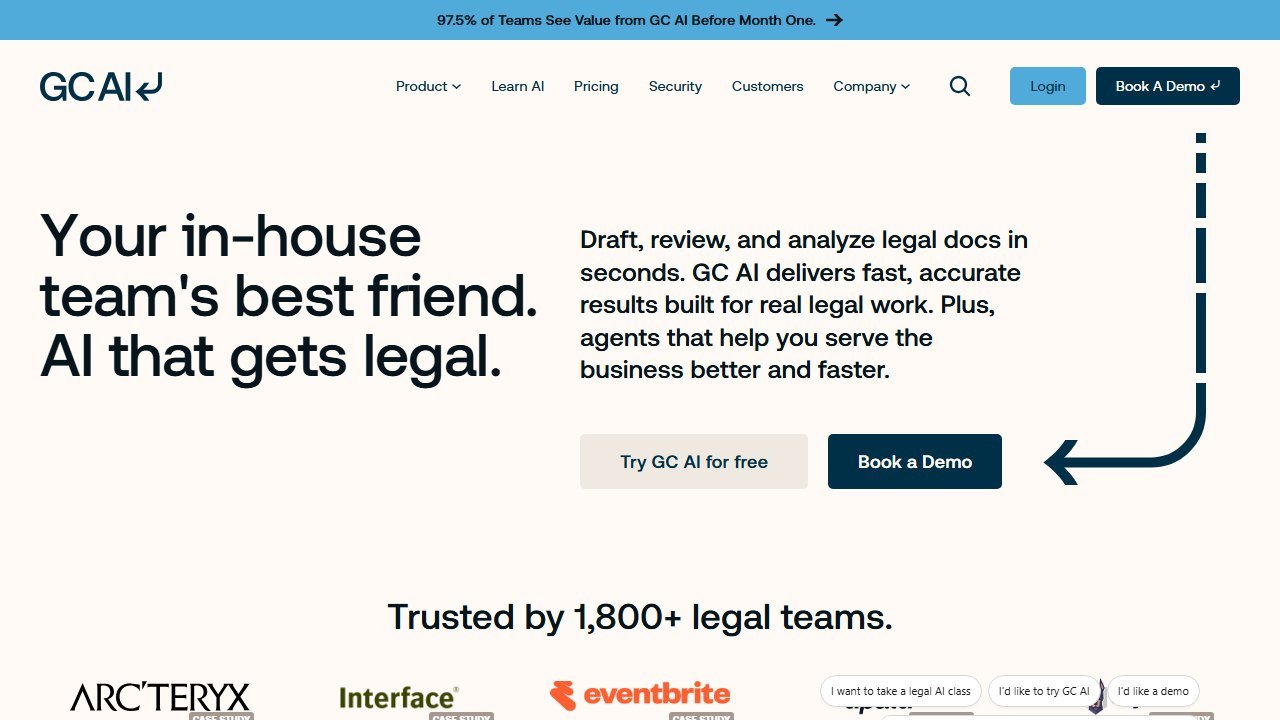
GC AI is the tool this page’s SERP problem is named after: it ranks itself #1 in its own listicles across roughly 40 percent of page one. So let’s be clear that it earns its place here on merit, ranked by us, not by itself. It is a purpose-built generalist AI for in-house counsel, living where in-house lawyers actually work, in Word and the browser, covering contract review, drafting, research and policy questions with legal-specific guardrails.
Two things stood out in practice. First, the in-Word experience is genuinely native: redlines and comments in your own document, not a copy-paste round-trip through a chat window. Second, and almost unique in this entire category, GC AI publishes its pricing: $500 per seat per month, a 14-day trial, and no seat minimum. You can be running it this afternoon without talking to a salesperson, which for a one-lawyer legal department is not a convenience but the whole ballgame.
Who it’s for: any size of in-house team, and it is the obvious first tool for departments of one to five lawyers who need leverage today.
The honest limitation: it is an assistant, not infrastructure. No CLM, no intake queue, no repository, so mid-size teams will still buy those systems separately.
Our verdict
Build the stack by job, not by brand. For most corporate legal departments in 2026 the shortlist looks like this: Streamline AI for intake if requests are drowning you, Ironclad for full CLM at mid-size and up (SpotDraft if you are lean and want a published range, Workday Contract Intelligence if you are a Workday shop), Luminance or LegalOn for review at scale depending on volume, and GC AI as the generalist layer every lawyer gets on day one, with Harvey replacing it only at 15+ lawyers with enterprise budget.
And carry the two facts most of this SERP gets wrong: Evisort is not buyable, it is Workday Contract Intelligence after a $311 million acquisition that closed in October 2024, and in-house AI adoption has, per industry coverage of ACC research, jumped from 23 to 52 percent in a year. The question is no longer whether your legal department adopts AI. It is whether you buy the corrected 2026 map or a roundup written for the 2024 market. For the full market across every practice setting, start with our best AI tools for lawyers pillar.

Written by
FazFaz is the founder of AIToolsBakery. Some tools here are tested hands on. Others are assessed from vendor documentation and pricing verified on the live page, and every review says which one it is. Sponsors can buy a position in a guide. They cannot buy the score, the criticism, or silence about a better option.
How we test and how we make money →