Search “Innago vs TurboTenant” and the top results are the two companies reviewing themselves. Innago runs a comparison page that declares Innago the winner. TurboTenant runs a comparison page that declares TurboTenant the winner. Neither discloses the obvious conflict, and one of them is printing a price that has not existed for years: Innago’s page, live as of July 25, 2026, still lists a “TurboTenant Premium plan for $8.25 per month.” There is no Premium plan. There is no $8.25 price. The aggregators are not much better: SelectHub’s comparison, stamped “Last Updated July 13, 2026,” prints TurboTenant at $12.42 a month and a stray $9.92 on the same page.
So this is a referee post. We loaded both vendors’ comparison pages and both live pricing pages on July 25, 2026, labeled every figure OFFICIAL or REPORTED with a date, and split every fee by who actually pays it, because “free” in this category almost always means “your tenant pays.” Neither vendor gets the whistle.
Innago vs TurboTenant at a glance
| Dimension | Innago | TurboTenant | Source, dated |
|---|---|---|---|
| Landlord cost | $0. No plans, no setup fee, no contract, no unit limits | Free tier $0; Essentials $149/yr ($12.42/mo eq.); Pro $199/yr ($16.58/mo eq.), “starting at,” annual only | OFFICIAL: innago.com Jul 25, 2026; AITB browser verification Jul 2026 (turbotenant.com blocks scrapers) |
| Tenant ACH fee | $2 per payment, always | $2 per payment; waived on Pro only | OFFICIAL, both, Jul 2026 |
| Tenant card fee | 2.99% | 3.49% (REPORTED, user reviews 2026) | Innago OFFICIAL Jul 25, 2026; TT REPORTED |
| Screening cost + who pays | $30 credit + criminal, $35 with eviction; applicant-paid, landlord can absorb | $45 to $55, applicant-paid | OFFICIAL both, Jul 2026 (TT via browser) |
| Listing syndication | Limited network | 50+ listing sites | OFFICIAL, Jul 2026 |
| Leases and forms | Lease templates, e-sign included free | State-specific leases for all 50 states, 32-form library | OFFICIAL, Jul 2026 |
| Accounting | Built-in income/expense tracking, automated invoicing, free | REI Hub add-on integration | OFFICIAL, Jul 2026 |
| AI features | None as of Jul 2026 | Free AI lease audit, listing generator, maintenance assistant | OFFICIAL, Jul 2026 |
| Ownership | Independent (Dave Spooner, 2017) | VC-backed; acquired Azibo May 2025; “1M+ landlords” vendor-claimed | Public record; azibo.com banner verified Jul 25, 2026 |
| Trustpilot | 4.7 (AITB browser-verified Jul 2026) | See our TurboTenant review | AITB verification |
Every OFFICIAL label above means we pulled the number from the vendor’s live page ourselves; every REPORTED label means it comes from a named outside source and you should weight it accordingly.
Exhibit A, B, and C: the SERP grading its own homework
Exhibit A: Innago’s comparison page. Live on July 25, 2026, and stamped “Last Updated on: Sep 25, 2025,” it prints a “TurboTenant Premium plan for $8.25 per month.” That means the page was touched within the last year and the dead price survived the edit. TurboTenant’s actual lineup is Essentials at $149 a year and Pro at $199 a year; there is no Premium plan and no monthly billing at all. The same page leans on Capterra sub-scores that flatter Innago: value for money 5.0 vs 4.6, customer service 4.9 vs 4.2, likelihood to recommend 97.4% vs 91.5%. Those Capterra figures may well be accurate as snapshots, but cherry-picked sub-scores next to a dead competitor price is not a comparison, it is a brochure. The page also lists Innago features like automated invoicing, a maintenance portal, and dedicated account reps while quietly omitting them from TurboTenant’s column, an implication-by-absence we could not fully confirm either way.
Exhibit B: TurboTenant’s comparison page. TurboTenant runs its own vs-Innago page, freshly dated July 24, 2026, and it declares TurboTenant the winner, which will not shock you. Its Innago column claims “a limited number of landlord forms, no ability to automatically check-in with tenants, and no customizable rental application,” none of which carries a date or a source. And it commits the same sin as Innago’s page, just pointed elsewhere: it dismisses Innago’s QuickBooks integration by quoting QuickBooks at “$30/month,” a price that is itself stale (Simple Start is reported at $38 a month after Intuit’s 2025 increases). A comparison page updated the day before we checked it, still running a dead price for a third-party product. That is the state of vendor comparisons in this category.
Exhibit C: SelectHub. The most-updated aggregator in the SERP, “Last Updated July 13, 2026,” manages to print TurboTenant at both $12.42 a month and $9.92 a month on the same page. The $12.42 is at least real arithmetic ($149 divided by 12); the $9.92 corresponds to nothing currently for sale.
What Innago actually costs in 2026

Innago’s pricing model fits in one sentence, which is its whole pitch: landlords pay $0, with no setup fee, no contract, and no unit limits, verified on innago.com on July 25, 2026. There is no paid tier to upsell you into. Rent collection, tenant screening, lease e-signing, maintenance ticketing, automated invoicing, and income/expense tracking are all in the free product.
The money comes from tenant-side transaction fees:
- ACH rent payments: $2 per payment, tenant-paid. Flat, always, no plan changes it.
- Card payments: 2.99%, tenant-paid.
- Screening: $30 for credit plus criminal, $35 with eviction history, applicant-paid, and the landlord can choose to absorb the cost, a toggle TurboTenant does not match at these prices.
- Income verification: $10, tenant-paid (REPORTED, RenPro, July 2026; Innago’s own pages load this pricing via script, so we label it until we can confirm in a browser).
Company context in one line: Innago is independent, founded by Dave Spooner in 2017, with no acquisition or portal parent behind the free tier. Its Trustpilot score really is 4.7, which we browser-verified ourselves in July 2026 after catching three straight weeks of stale third-party score snippets in this category.
Where Innago is weakest, per the user record rather than our opinion: payment processing speed. A BiggerPockets thread (topic 1115538) collects reports of rent payouts taking over a week and of bank-setup lockouts. That is pattern-level complaint data from a named forum, not a universal experience, but if cash-flow timing is tight for you it is the Innago risk to weigh. Our Innago review covers the full picture and owns the 4.1 verdict.
What TurboTenant actually costs in 2026
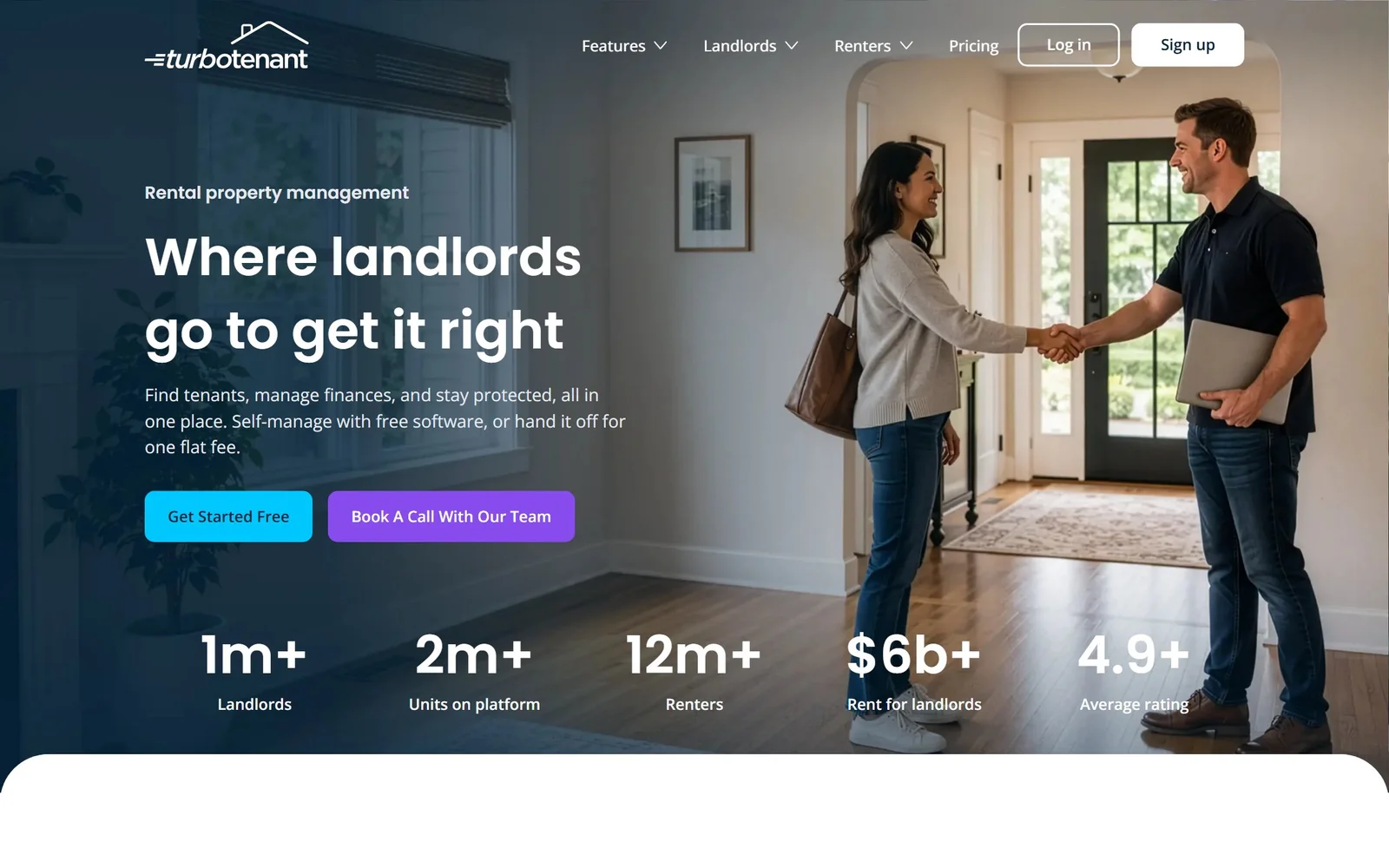
A sourcing note first: turbotenant.com blocks automated fetchers, so TurboTenant’s figures come from our own real-browser verification in July 2026. The lineup:
- Free: $0. Unlimited units. Marketing, applications, screening, rent collection, and the AI toolset are all included. The fees move to the tenant.
- Essentials: $149 a year ($12.42 a month equivalent), “starting at” pricing, annual only.
- Pro: $199 a year ($16.58 a month equivalent). The tier that waives the tenant’s $2 ACH fee.
The tenant-side stack: screening $45 to $55, applicant-paid. ACH $2 per payment unless the landlord holds Pro. Card payments about 3.49% (REPORTED from 2026 user reviews; TurboTenant does not print the card rate where we could verify it). User reports also describe payouts taking up to 10 days (REPORTED), so neither platform escapes the payment-speed complaint entirely.
What the money buys is reach and paperwork. TurboTenant syndicates listings to 50 plus sites, ships state-specific lease agreements for all 50 states plus a 32-document landlord forms library, and integrates REI Hub as a proper accounting add-on. It acquired Azibo in May 2025 (the “now part of TurboTenant” banner was live on azibo.com when we checked on July 25, 2026) and claims over 1 million landlords, a vendor figure we cite as such. It also ships free AI tools, a lease audit, a listing description generator, and a maintenance assistant, that Innago simply does not have.
Its complaint file, from the same user-report corpus: the card fee surprising tenants at checkout, slow payouts, and support reachability. Our TurboTenant review owns the 4.2 verdict, and our TurboTenant pricing guide owns the complete fee math; this post stays on the head-to-head.
Who really pays: the math both vendor pages skip
This is the section neither comparison page will write, because it prices the products from the tenant’s side of the table.
The screening gap. Innago screening costs the applicant $30 to $35. TurboTenant screening costs the applicant $45 to $55. Run that through the reality of applying for housing: a rejected applicant is out up to $20 more applying to a TurboTenant unit than an Innago unit, for the same credit and background data. Multiply by three or four applications per vacancy and your listing’s screening price is quietly shaping who bothers to apply. Innago also lets the landlord absorb the fee entirely, which at $30 is a plausible courtesy and at $55 mostly is not.
The ACH asymmetry. On Innago, the tenant pays $2 per rent payment, period, and there is no way for the landlord to buy that away. On TurboTenant, the tenant pays the same $2 unless the landlord holds Pro at $199 a year. Frame that purchase honestly: on a single-unit lease, the landlord pays $199 a year so the tenant can avoid $24 a year in fees. It only starts resembling value math at several doors, and even then you are buying Pro for its whole feature set, not the waiver. A free platform where removing a $2 fee costs $199 is a pricing model with a personality.
Cards. Innago 2.99% vs TurboTenant’s reported 3.49%. On $1,500 rent that is $44.85 vs roughly $52.35 a month. The real advice is the same on both platforms: tenants should pay by ACH and eat the $2, because the card fee is a wealth transfer to no one’s benefit.
Features beyond the fee table
Where Innago leads: nothing is paywalled. Automated invoicing, maintenance ticketing with a tenant portal, income and expense tracking, unlimited units, unlimited leases, e-signatures, all in the $0 product. TurboTenant’s free tier is real but shaped like a funnel; Innago’s free tier is the whole product. Innago’s support reputation is also the stronger one in the review corpus, consistent with those Capterra service sub-scores its own page quotes (4.9 vs 4.2), which, self-serving placement aside, we found no evidence against.
Where TurboTenant leads: getting units filled. Syndication to 50 plus listing sites is the single biggest functional gap between these products. Innago cannot match that reach, and for a landlord whose main pain is vacancy rather than administration, it may decide the whole comparison. Add the all-50-states lease library, the 32-form stack, the REI Hub accounting integration for landlords who want real books, and the free AI toolset (lease audit, listing generator, maintenance triage), and TurboTenant is the more complete marketing-to-move-in pipeline. It is also the bigger company by claimed scale, 1M+ landlords vendor-claimed, with Azibo’s fintech stack now in the family.
Where both stop. Neither is a full property management suite: no trust accounting, no owner statements, no team workflows at scale. Landlords crossing roughly the 20-unit line usually graduate to the DoorLoop and Buildium weight class; our best AI tools for landlords roundup maps the 1-to-20-unit toolbox these two actually compete in, and if you are considering leaving TurboTenant specifically, our TurboTenant alternatives guide owns that question.
TurboTenant’s other referee match is live: our RentRedi vs TurboTenant comparison, where the vendor’s own two vs-pages disagree with each other about its rival’s screening price.
The legal side of screening and automated pricing
Tenant screening and algorithmic rent setting are the two places where real estate software touches regulated activity directly, and where getting it wrong is expensive rather than embarrassing.
A screening report is a consumer report, with obligations attached
If you take an adverse action based on a screening report, in the United States that triggers notice obligations to the applicant, including telling them which agency supplied the report and that the agency did not make the decision. Ask any platform how it handles adverse action notices, whether it generates them automatically, and what record it keeps. A tool that produces a score but no notice workflow leaves the obligation with you.
Consistency is your best defence
Fair housing exposure comes from treating applicants differently, and inconsistency is much easier to demonstrate than intent. Written criteria applied identically to every applicant, with the decision and its reason recorded, is worth more than any feature on a vendor page. Software helps here by making the process uniform, which is a genuinely good reason to buy one, and it does not transfer the responsibility.
Automated rent pricing is under active scrutiny
Algorithmic rent setting, particularly where a tool draws on non-public competitor data, has attracted significant legal attention, and this is a live area rather than a settled one. Before adopting one, ask what data the recommendation is built on, whether it includes non-public data from other landlords, and whether you can see and override every recommendation. Keep the override log. If a vendor cannot answer those three, that is your answer.
Know what the tool is deciding and what you are deciding
The safest posture with any of this is that the software recommends and a named person decides, with the decision recorded. That is slower than full automation and it is the difference between a defensible process and one you cannot explain. Write down who that person is before you switch anything on, because the question only ever gets asked afterwards.
Verdict: an honest lane split
Neither vendor’s self-declared win survives contact with the fee ledger, but neither product loses this comparison outright either. The honest answer is a lane split:
- Fee-sensitive landlords, and landlords who care what their tenants pay: Innago. $0 landlord cost with no upsell tier, cheaper screening by $15 to $20 per applicant, cheaper cards, and no $199 toll to waive a $2 fee. If your units fill from local demand and you mostly need collection, screening, and maintenance handled, Innago’s free product does more than TurboTenant’s free product.
- Vacancy-driven landlords: TurboTenant. The 50-plus-site syndication network, state-specific leases everywhere, and the forms library make it the stronger listing-to-lease machine, and the free AI tools are a real daily convenience Innago has no answer to as of July 2026.
- Landlords who want real accounting: TurboTenant, via the REI Hub integration, unless you are content with Innago’s built-in income and expense tracking.
- Cash-flow-timing sensitive landlords: check the payout complaints on both before committing. Innago’s over-a-week reports and TurboTenant’s up-to-10-day reports are both REPORTED-tier, both pattern-level, and both worth a small first-month test with a single unit.
The one-line takeaway: Innago wins the money, TurboTenant wins the marketing, and the only comparison pages telling you one product wins everything are the ones the vendors wrote about themselves. For the full single-product verdicts, our Innago review (4.1) and TurboTenant review (4.2) each get a whole post to make the case.
Also in this guide series: Yardi Breeze Review (2026): The $1 Per Unit Price Is Real. The Minimums Make It Fiction. and Stessa Review (2026): Great Books, But the Free Tool Charges for the Schedule E.

Written by
FazFaz is the founder of AIToolsBakery. Some tools here are tested hands on. Others are assessed from vendor documentation and pricing verified on the live page, and every review says which one it is. Sponsors can buy a position in a guide. They cannot buy the score, the criticism, or silence about a better option.
How we test and how we make money →Frequently Asked Questions