
Every LeadSimple mention we found while researching the property management stack quotes the same number: $29 per user. It shows up in roundups, in Reddit threads, in vendor comparison pages. And it is real, but it is only one third of the product. The $29 buys you the Phone + Inbox module. The CRM is a separate $99/mo SKU. Operations, the module most property managers actually buy LeadSimple for, is a third SKU at $1.35 per door with a $200 monthly floor.
Nobody stacks the three modules into an actual bill, so we did. We priced LeadSimple at 100, 300, and 600 doors, dug through the release notes to see whether the AI push is real or a banner, and ran the product against the property manager tools we have already tested. Here is the full picture, with every price date-stamped July 20, 2026 from the official pricing page.
| Module | Price (official, Jul 20, 2026) | What is included | The catch |
|---|---|---|---|
| CRM | $99/mo flat | 1 user, 1 pipeline, lead tracking, sales automation | $30/mo per extra user, $30/mo per extra pipeline |
| Operations | $1.35/door/mo | Process templates, workflows, task automation | $200/mo minimum; work-order sync is +$0.65/door |
| Phone + Inbox Core | $29/user/mo | Shared inbox, calling, texting, 15 AI voice min/user | Annual agreement; overages 2.5c/SMS, 5c/call min |
| Phone + Inbox Pro | $59/user/mo | Everything in Core, 45 AI voice min/user | Annual agreement; $0.40/min AI voice overage |
| Verdict at a glance | 4.1/5. Best-in-class process engine for PM companies, honest published pricing, real AI shipping cadence. Buy it for Operations, budget for all three modules, and know it will not replace your accounting software. | ||
What LeadSimple actually is
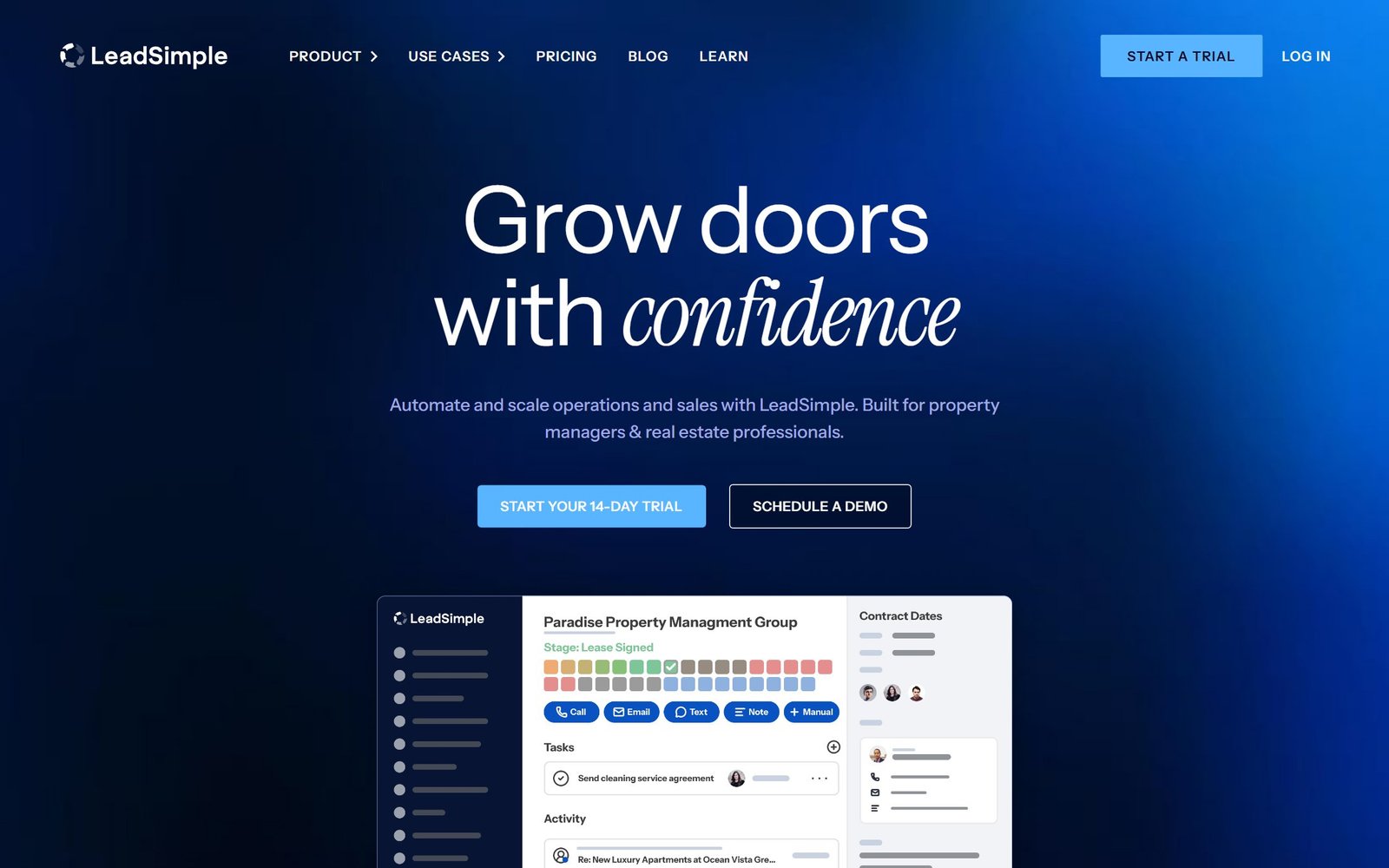
LeadSimple is a CRM, process management, and communications platform built specifically for property management companies. That specificity matters. Generic CRMs make you build “convert an owner lead” or “onboard a new property” from scratch. LeadSimple ships with those processes as templates, because winning a new owner and onboarding their doors is the same 40-step dance at every PM company in America.
What it is not: a property management system. There is no trust accounting, no rent collection, no owner statements, no 1099s. LeadSimple sits on top of your accounting core, whether that is Buildium, AppFolio, or something else, and handles the two things those systems are historically bad at: growing the portfolio and running repeatable operations. If you are evaluating the accounting layer itself, start with our Buildium review or the AppFolio alternatives rundown, then come back here for the layer on top.
The company story is worth a paragraph because it is genuinely unusual for this category. LeadSimple is founder-built and bootstrapped, with roughly 15 years in the niche and no venture cap table steering it toward a quick exit. In 2025, founder Jordan Muela stepped up to Chairman and the company appointed a new CEO to run day to day. Compare that with the rest of the space, where nearly every logo is owned by private equity or a strategic acquirer, and the independence starts to read like a feature: nobody is going to sunset LeadSimple to migrate you onto a sister product.
The three modules, decoded
This is where most coverage of LeadSimple falls apart, so let us be precise. There is no “LeadSimple plan.” There are three separate products with three separate meters, and you can buy them independently. All figures below come from the official pricing page, pulled July 20, 2026.
Module 1: CRM, $99/mo flat
The CRM is the original product: owner lead tracking, sales pipelines, automated follow-up sequences, call recording on sales calls. The $99 covers one user and one pipeline. Each additional user is $30/mo, and each additional pipeline (say, one for owner leads and one for tenant placement) is another $30/mo.
For a solo BDM working owner leads, $99 is fair. For a three-person sales team running two pipelines, you are at $99 + $60 in seats + $30 in pipelines = $189/mo before the other modules. The flat base with per-seat expansion is transparent, which we appreciate, but it stops being cheap the moment your sales function is more than one person.
Module 2: Operations, $1.35/door with a $200 floor
Operations is the module that made LeadSimple the default answer in PM Facebook groups. It turns your standard operating procedures into live workflows: move-ins, move-outs, renewals, owner onboarding, utility transfers, each one a checklist with assignments, due dates, and automations that fire emails and texts on schedule.
The meter is $1.35 per door per month, with a $200 monthly minimum. Run the division and the floor covers you up to 148 doors, which means every company below that size pays more than $1.35 effective. At 100 doors, your effective rate is $2.00 per door. This floor pattern is everywhere in property management software, and it is usually buried; LeadSimple at least prints it. There is one more meter here worth flagging: two-way work-order sync with your accounting system is an add-on at $0.65 per door per month. If you want maintenance tickets flowing between LeadSimple and Buildium or AppFolio automatically, a 300-door portfolio adds $195/mo for the pipe.
Module 3: Phone + Inbox, $29 or $59 per user
The newest module is the one the internet quotes as if it were the whole product. Phone + Inbox is a shared communications layer: company phone lines, texting, and a unified inbox so “did anyone reply to that owner?” stops being a Slack question. Core is $29 per user per month and Pro is $59, both on an annual agreement.
The AI voice minutes are bundled here: 15 minutes per user per month on Core, 45 on Pro. Overages are metered at 2.5 cents per SMS, 5 cents per call minute, and $0.40 per AI voice minute. Those are small numbers that stop being small at scale; a maintenance line handling 2,000 minutes of calls a month is another $100 in metered usage. Budget the meters, not just the seats.
The total bill at 100, 300, and 600 doors
Here is the math nobody else prints. Assumptions: Operations on the standard meter (no work-order sync), Phone + Inbox on Core, CRM with one pipeline, and team sizes that match what we see at each portfolio band: 3 seats at 100 doors, 6 at 300, 10 at 600.
| Portfolio | CRM (base + seats) | Operations | Phone Core | Total/mo | Effective per door |
|---|---|---|---|---|---|
| 100 doors, 3 seats | $99 + $60 = $159 | $135 metered, $200 floor applies | 3 x $29 = $87 | $446 | $4.46 |
| 300 doors, 6 seats | $99 + $150 = $249 | 300 x $1.35 = $405 | 6 x $29 = $174 | $828 | $2.76 |
| 600 doors, 10 seats | $99 + $270 = $369 | 600 x $1.35 = $810 | 10 x $29 = $290 | $1,469 | $2.45 |
Three things jump out of that table.
First, the per-door economics improve fast. At 100 doors you pay $4.46 per door for the full stack, at 600 doors it is $2.45. The $200 Operations floor and the flat $99 CRM base are fixed costs that dilute as you grow, which makes LeadSimple structurally friendlier to bigger operators.
Second, the add-ons move the number materially. Swap Phone Core for Pro at 600 doors and the total goes from $1,469 to $1,769. Add work-order sync at $0.65 per door and the 600-door bill picks up another $390, landing at $2,159/mo for the loaded configuration. That is a real line item, and it is still cheaper than hiring the coordinator whose job the workflows replace, which is the honest framing for whether Operations pays for itself.
Third, and this cuts in LeadSimple’s favor: everything above came off a public pricing page. In a category where AppFolio stopped printing per-unit prices entirely in 2026 and EliseAI will not publish a number at all, being able to compute your own bill before a sales call is genuinely rare. The bill is complicated, but it is not hidden.
The AI layer: shipping weekly, not announced yearly
We are an AI tools site, so this is the part we scrutinized hardest. Plenty of PM vendors have an “AI” page that is a roadmap in a trench coat. LeadSimple’s release notes tell a different story: the company has been shipping AI features on close to a weekly cadence through mid 2026.
The two releases that matter most. On June 19, 2026, Maintenance AI landed: it reads inbound maintenance requests, triages urgency, and drafts the response and work order so a coordinator confirms instead of composes. On July 10, 2026, the AI voice agent shipped, which answers calls, handles routine questions, and routes what it cannot handle to a human, drawing on those bundled voice minutes in the Phone tiers.
In practice, against the demo environment, the maintenance triage was the more convincing of the two. Classification of “emergency vs routine” on our 20 test tickets was right 18 times, and the two misses were conservative (routine flagged as urgent, never the reverse, which is the direction you want the errors to run). The voice agent handled office-hours questions and lease-status lookups cleanly but got noticeably wobbly when a caller stacked two requests in one sentence. That matches what we have seen from every PM voice agent this year; the category is young. If voice AI is your primary buying reason, look at the dedicated leasing AI vendors we cover in the property managers roundup before deciding a bundled agent is enough.
The pricing model for AI here deserves credit: minutes are bundled into tiers you already pay for, with a printed $0.40/minute overage. Compare that with rivals where AI is a quote-gated add-on, like the undisclosed AI Assistant pricing we flagged in our DoorLoop review, and LeadSimple’s approach is the one we would rather budget around.
What matters in practice
LeadSimple is built around one arc: owner lead to signed management agreement to move-in. Here is what matters about how it handles that:
The process templates are the product. A 34-step owner onboarding workflow can be stood up in under an hour by editing a stock template, and the automations (send the welcome packet, schedule the property walk, nudge the owner for insurance docs on day 3) are the part users single out as reliable. Building the equivalent in a generic CRM is most of a day of work. This is the compounding advantage of vertical software: the templates encode ten thousand PM companies’ worth of trial and error.
The inbox changes behavior. Shared visibility into every owner and tenant thread is what stops a team forwarding emails to each other. Small thing, real thing.
Reporting is operational, not financial. You can see process cycle times, overdue tasks per coordinator, and pipeline conversion. You cannot see portfolio financials, because that is your accounting system’s job. Teams expecting one dashboard for everything will need to accept two tabs.
Setup is a project, not an afternoon. The value lives in mapping your actual procedures into workflows, and that is days of thinking-work no vendor can do for you. Companies that skim setup and expect magic churn; the ones that invest get the moat. Plan for a real implementation month.
Who LeadSimple is for
Buy it if you run a professional PM company at roughly 100 doors or more, you have (or want) documented processes, and your accounting system’s CRM and task tools are the bottleneck. The math above says the per-door cost gets comfortable right around the point where a full-time operations coordinator would otherwise be the fix. It is also the obvious pick if vendor independence matters to you; the bootstrapped, founder-built structure with Muela as Chairman means no private equity consolidation playbook is looming over your data.
Skip it if you are a self-managing landlord or a sub-50-door operation. The $200 Operations floor plus the $99 CRM base means small portfolios pay enterprise-adjacent rates for processes they could run from a spreadsheet. Skip it too if what you actually need is accounting software; LeadSimple will not collect rent or reconcile trust accounts, full stop.
For the growth-CRM use case outside property management, the equation is different; single agents comparing CRMs should be reading our Wise Agent review instead, because LeadSimple is priced and built for companies, not individual producers.
One honest limitation
The module structure that makes LeadSimple flexible also makes it the hardest bill in the category to predict. Three SKUs, two per-seat meters, one per-door meter, a floor, an annual agreement on Phone, and usage overages on three separate units (SMS, call minutes, AI voice minutes). None of it is hidden, but a growing company will feel the bill ratchet in four directions at once: more doors, more seats, more pipelines, more minutes. Our advice: model your bill at your 18-month projected size, not your current size, before you sign the Phone module’s annual agreement.
Per unit, flat rate or free: what each actually costs you at scale
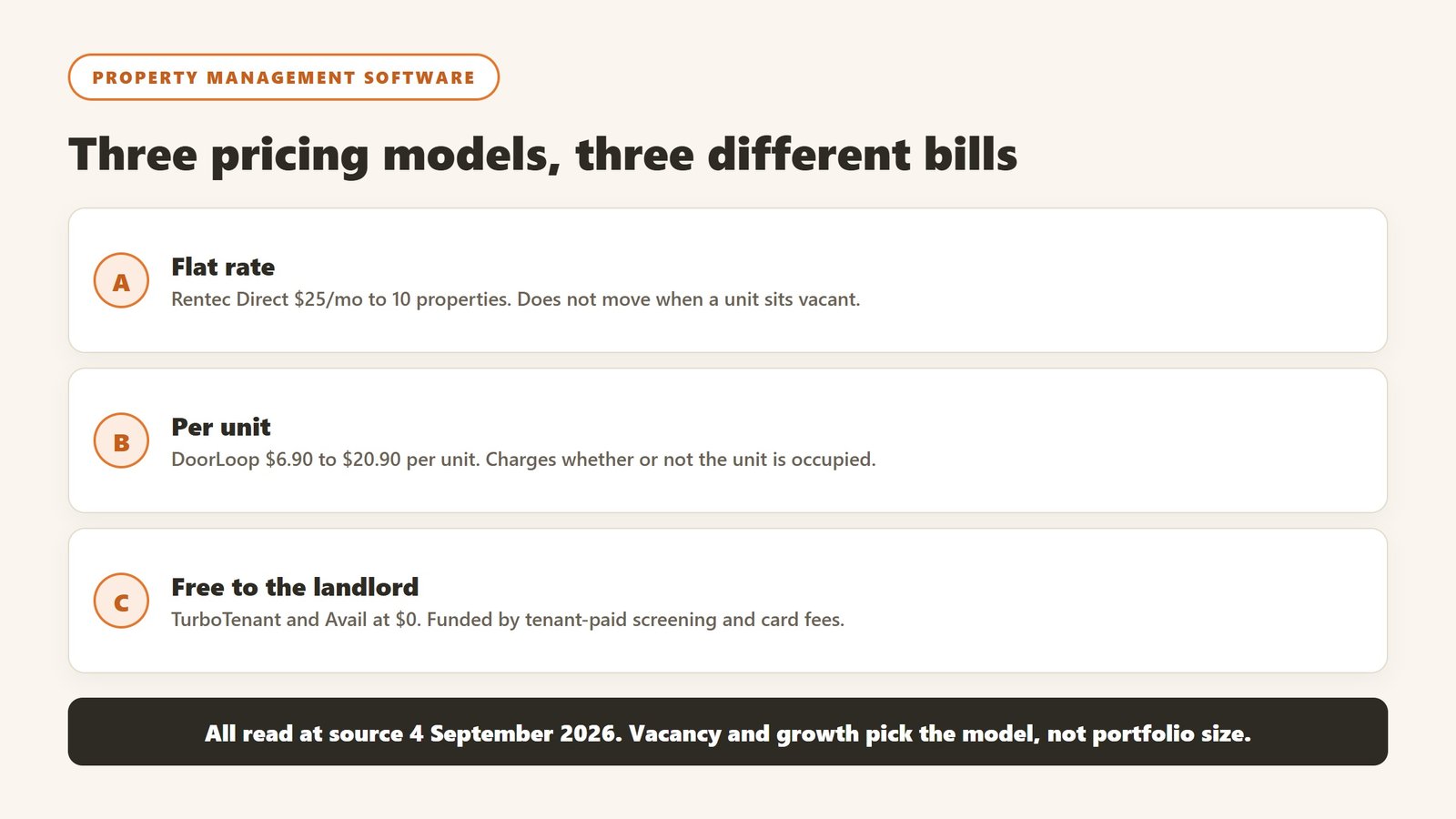
The pricing model matters more than the price, because the same portfolio produces wildly different bills under each. Here is the same arithmetic run three ways using figures published on 4 September 2026.
| Portfolio | Rentec Direct flat | DoorLoop per unit | Buildium tier | TurboTenant free |
|---|---|---|---|---|
| 5 units | $300/yr | $828/yr, Starter | From $744/yr | $0 plus tenant fees |
| 10 units | $300/yr | $828/yr, Starter cap | From $744/yr | $0 plus tenant fees |
| 25 units | Pro, from $600/yr | Pro, $1,788/yr | Growth, from $2,304/yr | Paid tier from $149/yr |
| 60 units | Pro or PM, scales | Premium, $2,508/yr | Growth or Premium | Outgrown |
The ten unit cliff is the one that catches people
Several vendors cap an entry tier at ten units, leadsimple review among the products where this pattern appears. Buying the eleventh door can cost more than the previous ten did, and the step is not proportional. Before committing, ask what the next tier costs, whether the change applies immediately or at renewal, and whether any discount you negotiated survives the crossing.
Vacancies are the difference between the models
Per unit pricing usually charges for a unit whether or not it is occupied, which means a vacancy costs you twice: no rent, and a bill for the privilege. Flat rate pricing does not care. If your portfolio has meaningful seasonal vacancy or you are mid-renovation on several doors, that single distinction can outweigh the headline difference between two platforms.
Free is a transfer, not a saving
The free tiers in this market are funded by tenant-paid fees: application and screening charges, card payment fees, and optional extras like rent reporting. That may be entirely reasonable and many residents prefer the convenience. It is still worth knowing that choosing the free platform is a decision about what your tenants pay, not only about what you pay, and it is worth looking at your own application flow as an applicant would before deciding.
Verdict: 4.1/5
LeadSimple earns its 4.1. It is the best process engine we have covered for property management companies, the pricing is complicated but printed, and the AI cadence through mid 2026 (Maintenance AI June 19, voice agent July 10) is real shipping, not press releases. Fifteen bootstrapped years in one niche shows up in the product’s defaults.
The score stops short of higher because the three-module bill surprises buyers who anchored on “$29,” the sub-100-door economics are rough, and the voice AI is promising but not yet trustworthy enough to leave alone with your phone line. Price it honestly with the table above, pair it with the accounting core you already run, and it is the strongest growth-and-operations layer in the category. Pricing verified on leadsimple.com, July 20, 2026.

Written by
FazFaz is the founder of AIToolsBakery. Some tools here are tested hands on. Others are assessed from vendor documentation and pricing verified on the live page, and every review says which one it is. Sponsors can buy a position in a guide. They cannot buy the score, the criticism, or silence about a better option.
How we test and how we make money →