Monthly donors are the most valuable people in most nonprofits’ files. They give without being asked each time, they stay for years, and their gifts arrive on a schedule you can plan around. According to the M+R Benchmarks 2026 report, monthly giving accounted for 27% of all online revenue for the average nonprofit in 2025. Yet many organisations still treat recurring giving as a checkbox on the donation form rather than a programme with its own welcome, stewardship and recovery process.
This guide covers what the data says about recurring donors, how to set up a monthly giving programme step by step, and the part most guides skip: what each donation platform and CRM does when a monthly card payment fails, because that is how many recurring donors quietly disappear. If you want an early warning when that happens, Gratefully flags stalled recurring gifts from your CRM data and has a free plan.
About the data. Benchmarks come from reports read on 18 September 2026, with the year and source of each. Some of the best recurring-giving data is published by software vendors from their own customers, and we label it as vendor research. Platform behaviour comes from each vendor’s help centre on the same date. We have not run a recurring programme on these systems ourselves.
What the data says about monthly donors
They stay much longer
Two large datasets agree on the direction, even though their numbers differ:
- Neon One’s 2026 Recurring Donor Report, built on three years of transaction data from 4,107 nonprofits and a survey of 718 recurring donors, found recurring donor retention between 78% and 80% from 2023 to 2025, with 79.11% in 2025. Non-recurring donor retention fell from 35.75% to 32.41% over the same period. This is vendor research on Neon customers’ data, summarised on Neon’s blog.
- The Blackbaud Institute’s donorCentrics data, presented at its Sustainer Summit and covering 19.4 million donors from fiscal 2020 to 2024, put overall retention for recurring donors at 81% in fiscal 2024, against 46% for single-gift-only donors. It also found that 55% of donors acquired through recurring giving in fiscal 2022 were still giving in fiscal 2024, against 15% of those acquired with a single gift, according to Blackbaud’s summary.
The Fundraising Effectiveness Project does not publish a recurring-donor retention figure, so be wary of any page attributing one to it. For context, its full-year 2025 figure for all donors was 43.3%.
Lifetime value depends on what is measured
Vendor figures for recurring donor lifetime value vary enormously. Neon reports an average lifetime value of $7,288.26 for recurring donors in 2025, against $3,606.90 for non-recurring donors, with an average donor lifetime of 7.5 to 8 years for recurring donors. Blackbaud reports $405 for donors acquired through recurring giving against $161 for single-gift acquisitions, but that figure measures the fiscal 2022 cohort only up to fiscal 2024, about two years. The two are not contradictory; they measure different things over different periods. What both show is that recurring donors are worth roughly two to two and a half times one-time donors. Our donor lifetime value guide shows how to calculate your own.
The typical gift is small
Neon’s report puts the average initial recurring gift at $84.38 and the median at $30.00, and says 94.5% of recurring donors give less than $5,000 a year. The median is the better guide for a default ask; a handful of large monthly gifts pulls the average up. Neon’s survey also found that 58.6% of recurring donors started giving without being asked, and just 25% said they gave because a nonprofit asked them to. That suggests many organisations are leaving monthly donors on the table simply by not asking.
Attrition is slow but steady
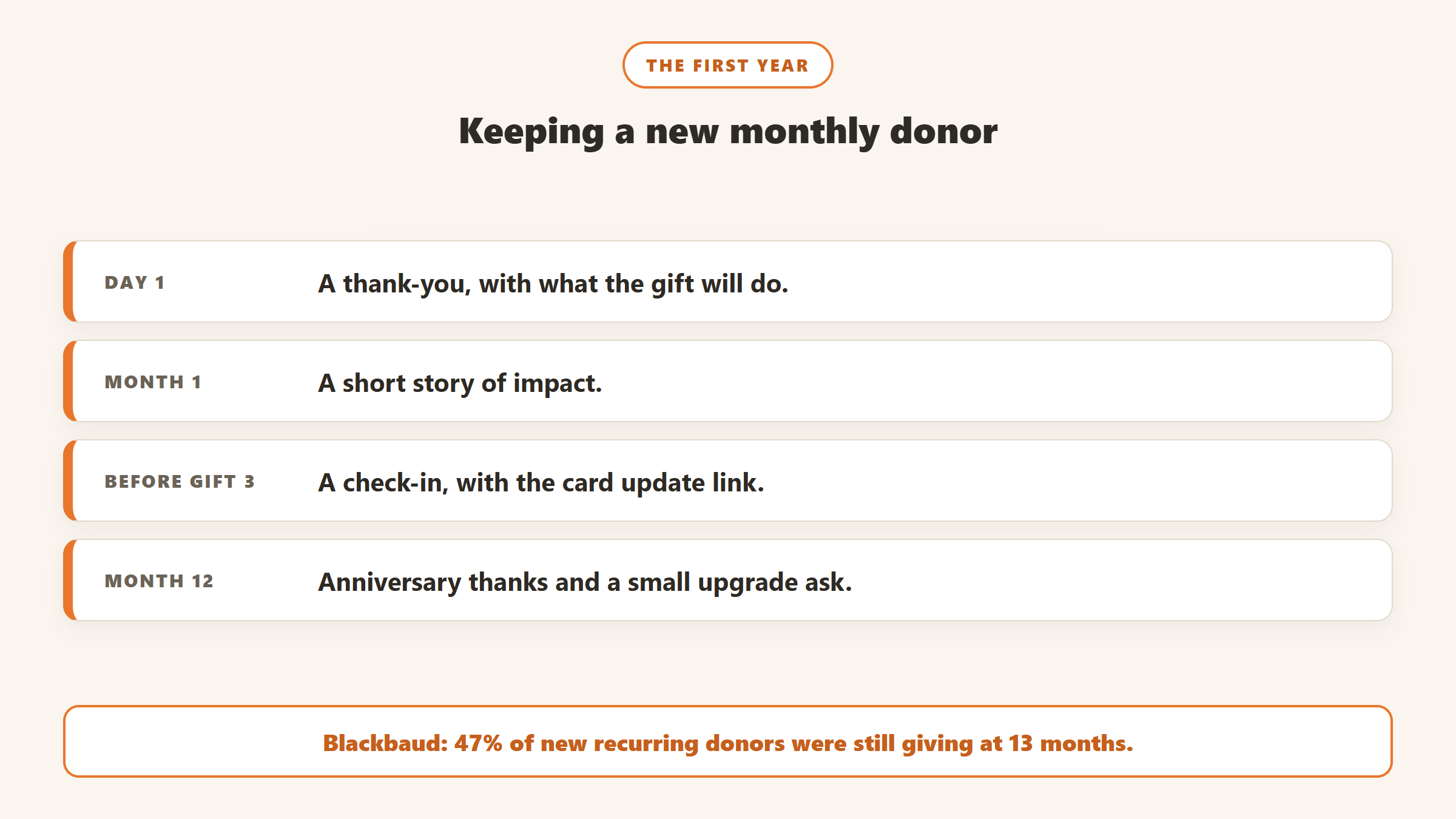
M+R says that after a year, nonprofits can expect to lose one or two percent of sustainers each month, and that a little more than half of monthly gifts are still active after two full years. Blackbaud’s data puts 13-month retention of new recurring donors at 47% in fiscal 2024. The first year is where most losses happen, which is why the welcome period and failed-payment recovery matter so much.
How to build a monthly giving program, step by step
- Give it a name and a purpose. A named programme, such as a “Circle” or “Partners” group, gives donors something to join and gives you a way to talk to them as a group. Tie it to something concrete the monthly gift sustains.
- Set a sensible default. With a median first recurring gift of $30 in Neon’s data, offer a range around that, and show what each amount does over a year.
- Put monthly on the form, prominently. Offer a monthly option on every donation form and test making it the first choice. Keep the one-time option easy; forcing monthly frustrates donors.
- Ask your one-time donors. Your best prospects are people who have already given two or three times. A short, specific email or call inviting them to join is the cheapest acquisition you will do. Our donor segmentation guide shows how to build that list.
- Run a welcome series. Send a thank-you within a day, a short story of impact in the first month, and a check-in before the third gift. Most attrition is early.
- Plan the upgrade ask. Once a year, around the anniversary of joining, ask established monthly donors to increase their gift by a small, specific amount.
- Handle failed payments on purpose. Know what your platform does automatically, and assign someone to follow up the rest. The next section compares the tools.
- Report on it monthly. Track active sustainers, new joins, cancellations, failed payments recovered, and average monthly gift.
What happens when a monthly payment fails
Cards expire, get replaced or hit limits, and each one is a monthly gift at risk. Neon’s blog puts it plainly: the most common reason recurring donors lapse “isn’t disengagement”, it is “a failed payment that nobody caught in time”. That is a vendor view rather than a measured figure, but it matches experience. Each platform handles the problem differently, and the differences matter:
| Tool | Automatic retries | After the last failure | Source |
|---|---|---|---|
| Bloomerang | 3 days, 7 days and 15 days after the first failure | Gift paused | Help centre, “Manage Recurring Payments”, 26 May 2026 |
| Givebutter | Three retries, 48 hours apart | Plan paused until the card is updated; admin and donor emailed | Help centre, recurring plans |
| Donorbox | Two retries, two days apart (three attempts in all) | Charging stops; donor has 10 days from the first attempt to update the card | Help centre, failed recurring payments |
| Little Green Light forms | Staff resubmit from the submission summary | Only Stripe card details can be updated; ACH and PayPal cannot | Help centre, editing recurring donations |
| Neon CRM | Not verified (help centre behind a login) | Pre-built email to donors 10 days before a gift if the card has expired | Neon blog |
Two points stand out. A paused plan, as on Bloomerang and Givebutter, can be resumed once the card is updated; a stopped one, as on Donorbox after the 10-day window, is charged again the following month only if the donor updates the card later. And on some systems recovery is manual, so it only happens if someone owns it.
Card updaters
Card networks can update stored card details automatically when a donor’s card is replaced. Stripe’s documentation says it “automatically attempts to update saved card details whenever a customer receives a new card”, with wide support in the United States for American Express, Visa, Mastercard and Discover, but varying support elsewhere and no way to tell in advance which cards are covered. Givebutter says Stripe updates cards this way for its donors. DonorPerfect sells a credit card updater that it says runs nightly for participating US and Canadian Visa, Mastercard and Discover cards, with no monthly fee and $0.99 per updated card. Ask your processor whether an updater is on, because it prevents failures rather than recovering them.
Let donors fix it themselves
A donor portal turns a failed payment into a two-minute fix. Donorbox gives every recurring donor a donor profile, claimed by setting a password, from which they can manage recurring donations and update settings. Givebutter donors manage plans through a link in any recurring receipt or their user profile. Neon’s card-expiry email links straight to its Constituent Login Portal. Include the update link in every failed-payment email, and follow up by phone for your longest-standing donors.
Keep the failed-payment message short and warm. Thank the donor for their support so far, say plainly that the last payment did not go through, often because a card was replaced, and give one link to fix it. Avoid language that sounds like a debt notice. If there is no response within a week, a personal email or call from a named staff member is worth trying before a second automated reminder.
What attrition costs: a worked example
Take a programme of 200 monthly donors giving $30 each, $6,000 a month or $72,000 a year. If you lose 1.5% of them each month, the middle of M+R’s one to two percent range, you keep about 83% after twelve months: 1 minus 0.985 to the power of 12 is roughly 16.6% lost, or about 33 donors and $11,900 a year in recurring revenue. That is our arithmetic on M+R’s range, not a forecast.
Now suppose a third of those losses are failed cards that nobody followed up. Recovering them keeps roughly 11 donors and about $4,000 a year, before counting the extra one-time gifts those donors would have made. For a small team, that is often the cheapest revenue available: no acquisition spend, just a report and a few phone calls each month. It is also why the recovery rate belongs in your monthly report next to new sign-ups.
Choosing a platform for monthly giving
If you are choosing or changing a donation platform, recurring features deserve more weight than they usually get. Check these before you sign:
- Retries and pausing. Does it retry failed charges automatically, how often, and does it pause or stop the plan afterwards? The table above shows how much this varies.
- Card updater. Is an automatic updater on through the processor, and does it cost extra per card?
- Payment methods. Donorbox’s help centre notes that PayPal recurring donations require the donor to log in to PayPal, and that Stripe supports ACH, Apple Pay and Google Pay, which PayPal does not. Little Green Light can only update Stripe card details, not ACH or PayPal.
- Donor self-service. Can donors update a card, change an amount or pause without calling you?
- Fees on recurring gifts. Some fee arrangements treat recurring gifts differently. Givebutter’s fee guarantee, for example, excludes recurring plans that began before 9 September 2025 and imported plans until they are edited.
- Portability. A monthly gift is an authorisation held by the processor against a stored card. Ask how you would move those authorisations if you left, and what it costs.
Stewarding and upgrading monthly donors
Monthly donors do not need to be asked every month, but they do need to hear from you. Send a year-end summary of their giving, share results a few times a year, and invite them to things one-time donors do not get. Many also give extra: Neon’s statistics page says about half of recurring donors made additional one-time gifts, so include them in major appeals with language that acknowledges their monthly support.
For upgrades, choose donors who have given steadily for a year or more, ask for a specific increase, and explain what it adds. A small increase across a large group is often worth more than a campaign to find new monthly donors. Our donor stewardship software guide covers tools that help schedule these touches, and recovering lapsed donors after failed recurring gifts covers win-back once a plan has ended.
The numbers to report every month
- Active monthly donors and the net change from last month.
- Monthly recurring revenue, the sum of active monthly gifts.
- Cancellations and failures, counted separately, because the fixes are different.
- Recovery rate: failed payments that were successfully charged within 30 days.
- Average and median monthly gift, and upgrades in the month.
- Conversion rate of one-time donors invited to join.
Our nonprofit fundraising metrics guide covers the programme-wide numbers these sit alongside.
Catching stalled recurring gifts early
Platform emails go to donors, and failure reports need someone to read them. Gratefully adds a layer on top of your CRM that watches for this. Its Action Center page lists “stalled recurring gifts” among the giving-trajectory shifts it looks for, and describes flagging at-risk donors early with the reasons. It also shows an example of identifying recurring donors ready for an upgrade ask. It connects live to Salesforce, Bloomerang and Little Green Light and takes other systems by CSV import. It is not a CRM or a payment processor, and it does not retry payments itself.
Gratefully’s pricing page, read on 18 September 2026, has a Free plan, and new accounts start with a 14-day trial of its Advanced plan with no card required before moving to Free. Paid plans start at $79 a month billed yearly. Our Gratefully review covers the rest.

Disclosure: Zilwaris, the consultancy run by AI Tools Bakery’s founder, does paid advisory work for Gratefully. Gratefully did not pay for this placement, and it is assessed on the same criteria as everything else on this site.
Where the facts on this page come from
- M+R Benchmarks 2026 (2025 data), fundraising page.
- Neon One: 2026 Recurring Donor Report summary, fundraising statistics page, and blog post on automated reminders for recurring donors (vendor research on its customers’ data).
- Blackbaud Institute: donorCentrics Sustainer Summit takeaways, 6 August 2025.
- Help centres of Bloomerang, Givebutter, Donorbox and Little Green Light; DonorPerfect’s account updater factsheet; Stripe’s documentation on automatic card updates. All read 18 September 2026.
- Fundraising Effectiveness Project: full-year 2025 retention.
- Gratefully: Action Center and pricing pages, read 18 September 2026.
The bottom line
Recurring donors retain at around 80% in both Neon’s and Blackbaud’s data, against 32% to 46% for one-time donors, and monthly giving already makes up 27% of online revenue for the average nonprofit. Build a named programme with a default around the $30 median, ask your repeat one-time donors directly, welcome new members quickly, and ask for upgrades once a year. Above all, know what your platform does when a card fails, turn on a card updater, give donors a self-service link, and make someone responsible for the failures the system does not recover.

Written by
FazFaz is the founder of AIToolsBakery. Some tools here are tested hands on. Others are assessed from vendor documentation and pricing verified on the live page, and every review says which one it is. Sponsors can buy a position in a guide. They cannot buy the score, the criticism, or silence about a better option.
How we test and how we make money →Frequently Asked Questions