Most “donor management software” roundups rank whole CRMs on everything at once. Stewardship is a narrower job, and it is the one that decides whether a first gift becomes a second. It covers three things: thanking people well, showing them what their gift did, and noticing, before it is too late, which relationships need attention.
This page compares eight tools on that job alone. Some are full CRMs with stewardship built in. Others are layers that sit on top of the CRM you already run. We say which is which, because the answer decides whether you are looking at a migration or a subscription. A migration takes weeks of planning at minimum; a subscription can be running this week.
How we put this together. Every feature and price comes from the vendor’s own pages, read on 16 and 17 September 2026. We have not run these tools on a live donor file, so this is a comparison of what each vendor documents rather than a hands-on test.
Why stewardship is where retention is won or lost
Retention is the number that compounds, and it is low. The Fundraising Effectiveness Project reported overall donor retention of 18.0% year to date in the first quarter of 2026. That is a year-to-date figure measured early in the year, not a full-year rate, but the direction it describes is familiar: most donors who gave last year have not yet given again.
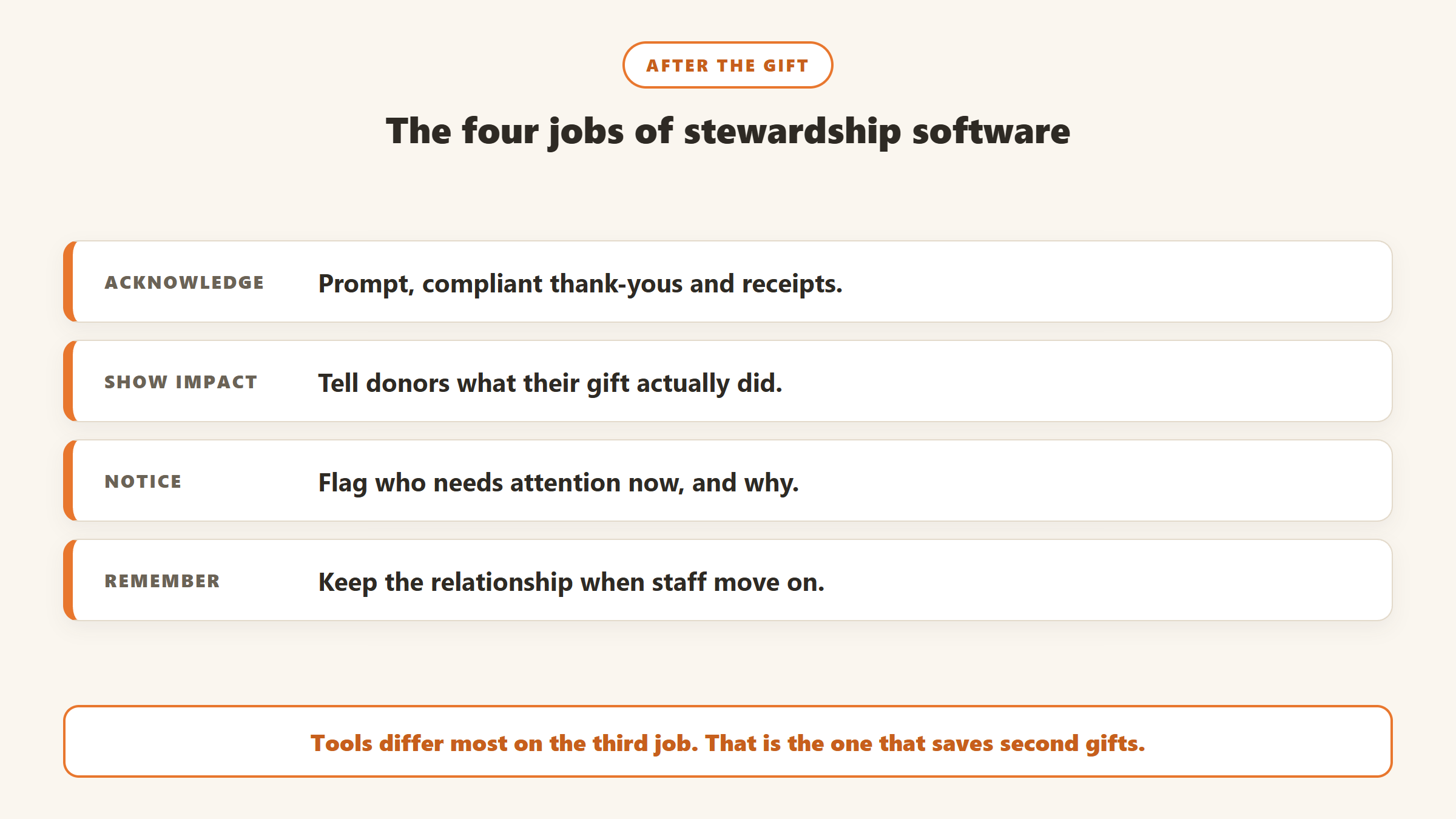
Stewardship software cannot make a donor give. What it can do is make sure nobody slips through because a thank-you was late, an anniversary was missed, or the one person who knew the donor has left.
How we judged these tools
We looked at four things, all of them about what happens after a gift arrives:
- Acknowledgment. Can it send prompt, compliant thank-yous and receipts, and help you personalise them?
- Attention. Does it tell you which donors need contact now, and why?
- Continuity. Does the relationship history survive staff turnover?
- Cost and effort. What does it cost, and does it require replacing your CRM?
What we deliberately did not weigh: online donation forms, event ticketing, peer-to-peer campaigns and volunteer management. They matter, but they are about acquiring and processing gifts rather than looking after the people who made them. A CRM that is excellent at stewardship but average at donation pages still belongs near the top of this list, because stewardship is what we ranked on. If you are comparing whole platforms on price, our nonprofit CRM pricing comparison covers that wider question, and it will change the order for some readers.
The 8 best donor stewardship tools at a glance
| Tool | Type | Stewardship strength | Published starting price |
|---|---|---|---|
| Gratefully | Layer on your CRM | Ranked daily list with reasons, drafted thank-yous | Free; paid from $79 a month billed yearly |
| Bloomerang | CRM | Real-time engagement scores, automated journeys | $125 a month billed annually |
| DonorDock | CRM | Stewardship journeys, anniversary reminders | $500 a month billed annually |
| Virtuous CRM+ | CRM | Automated touchpoints, AI-drafted emails | Not published |
| Keela | CRM | Automated acknowledgments, donor scoring | $164 a month billed annually |
| Little Green Light | CRM | Thank-yous, tasks, LYBUNT dashboard widget | $45 a month |
| Dataro | Layer on your CRM | Lapse and upgrade predictions | From $15,000 a year plus a per-donor fee |
| Kindsight engage | AI writing tool | Guided prompts for thank-yous and updates | $545 a year |
The tools in detail
1. Gratefully: best overall for stewardship
Gratefully is a donor intelligence layer rather than a CRM. It connects to Salesforce for Nonprofits, both Nonprofit Cloud and NPSP, and to Bloomerang and Little Green Light, and it reads email tools such as Mailchimp, Constant Contact and HubSpot as extra signals. Every morning its Action Center presents a ranked list of the donors who need attention, with the reason attached and, where it helps, a drafted note to review. Its stewardship page describes a nightly portfolio review that watches for lapse risk, stewardship moments and deadlines pulled from documents, and it offers handover dossiers for when a gift officer leaves.
Pricing is published: a free plan for one person, then $79, $399 and $799 a month billed yearly, with all integrations included on every plan. Two honest caveats. It does not replace your CRM, so you still need one, and its pages describe syncing as real-time in one place and overnight in another, so ask which applies to your system. Our full review covers the rest.
Best for: teams whose CRM holds the data but cannot tell them who to call today.
Disclosure: Zilwaris, the consultancy run by AI Tools Bakery’s founder, does paid advisory work for Gratefully. Gratefully did not pay for this placement, and it is assessed on the same criteria as everything else on this site.
2. Bloomerang: best CRM with stewardship built in
Bloomerang has built its reputation on retention. Its engagement features include engagement scores that update in real time from email clicks, volunteer hours and event attendance, alongside automated thank-yous and follow-ups. Its pricing page lists automated supporter journeys, tribute tracking and acknowledgements, donor sentiment tracking and predictive donor insights.
The CRM starts at $125 a month billed annually, priced by the number of records you hold, and the full Giving Platform starts at $242 a month. The fundraising module cannot be bought without the CRM, and billing is annual. Its FAQ gives a standard conversion timeline of 12 to 14 weeks. See our Bloomerang review.
Best for: small and mid-sized organisations ready to move to a retention-focused CRM.
3. DonorDock: best for automated stewardship journeys
DonorDock’s stewardship page describes automated thank-you emails, milestone acknowledgments and giving anniversary reminders, organised into stewardship journeys with tasks and touchpoints. Its built-in assistant, Otto, suggests next actions and flags lapsed givers.
It sells one plan at $500 a month billed annually, with five users, unlimited contacts and a 2% platform fee on its giving pages, a 90-day money-back guarantee and an optional $3,800 onboarding programme. That is a higher entry price than most CRMs here, with more included.
Best for: teams that want stewardship automation working from day one and have the budget for it.
4. Virtuous CRM+: best for responsive, multi-channel journeys
Virtuous builds its CRM around moving donors through journeys with automated tasks, emails, texts and letters, and it describes AI drafting of personal emails from the donor record for a fundraiser to review. Its separate Momentum product gives major and mid-level gift officers a prioritised donor inbox and works with Blackbaud and Bloomerang as well as Virtuous.
Virtuous does not publish prices. Its CRM comes in two tiers split at $5 million in annual fundraising revenue, both with unlimited users. See our Virtuous review.
Best for: growing organisations with enough volume to justify journey automation and a sales conversation.
5. Keela: best for automated acknowledgments
Keela documents automated gift acknowledgment emails and tax receipts, customisable thank-you letters, donor scoring and a Smart Ask feature that suggests gift amounts. Pricing is by contact count, from $164 a month for up to 1,000 contacts when billed annually, which Keela says saves up to 23% against monthly billing. Keela’s page does not name a currency, so check the figure shown in your region. See our Keela review.
Best for: small teams that want receipts and thank-yous to run themselves.
6. Little Green Light: best budget option
Little Green Light keeps stewardship simple: thank-yous produced inside the system, mail merge, tasks and major gift tracking. Its dashboard includes a Stewardship Opportunities widget that shows LYBUNT donors, those who gave last year but not yet this year. It starts at $45 a month for up to 2,500 records, with unlimited users, every feature on every tier and a 30-day free trial. It has no AI drafting. See our Little Green Light review.
Best for: small organisations that need solid basics at the lowest published price.
7. Dataro: best predictive layer for larger files
Dataro sits on top of CRMs including Salesforce, Raiser’s Edge NXT and Virtuous and ranks donors by likelihood to give, upgrade or lapse, surfacing lapse risk before it shows up in your reports. Its pricing starts at $15,000 a year plus $0.10 per active donor, which puts it out of reach for small organisations and squarely in range for large direct-response programmes. See our Dataro review.
Best for: large organisations with big files and an analytics budget.
8. Kindsight engage: best low-cost writing help
Kindsight‘s engage offers more than 80 guided prompts for thank-you letters, appeals and other donor content. It is priced at $545, $1,095 or $3,295 a year and sits inside a wider Kindsight suite that includes iWave prospect research from $4,500. It helps you write stewardship content rather than telling you who needs it.
Best for: teams that know who to thank and want help writing well, quickly. It works best alongside a CRM that already tells you who needs attention, since engage itself does not rank donors or watch for lapses.
Also worth a look
- Givebutter. Free fundraising platform with a CRM; automated thank-you workflows need Givebutter Plus, from $29 a month.
- Gravyty Raise. AI-drafted outreach and portfolio management on top of Raiser’s Edge NXT or Salesforce; pricing not published.
- Raiser’s Edge NXT. Tracks donors through stewardship stages and offers AI assistants for drafting; pricing not published.
- Neon CRM. Not assessed: Neon One’s website was down for maintenance when we checked on 17 September 2026.
How to choose
If your CRM is fine but nobody knows who to call
Do not migrate. A layer such as our top pick or, for larger budgets, Dataro, works on the data you already have. A migration takes months and moves the same problem to a new system. Our guide to choosing between a CRM and donor intelligence has a quick test.
If your CRM itself is the problem
Pick a CRM with stewardship built in. Bloomerang is the established retention-first choice, DonorDock includes more automation for a higher flat price, and Little Green Light covers the basics for the least money.
If you mainly need help writing
An AI writing tool such as Kindsight engage, or the drafting built into your CRM, may be enough. Our guide to AI donor thank-you letters covers the tools and the IRS rules they need to respect.
A stewardship plan by donor type
Software only helps if you know what you want it to do for each group. A simple plan that most small teams can run, and that any of the tools above can support:
First-time donors
The second gift is the hardest one to earn, so this group gets the most care. Send the acknowledgment promptly, follow with a personal note that says what the gift is doing, and schedule one more touch within a couple of months that asks for nothing. Set a task to review each first-time donor before your next appeal, so nobody receives a generic ask as their second contact.
Recurring donors
Monthly donors are easy to take for granted because the money keeps arriving. Thank them properly at sign-up, send an annual summary that doubles as their tax record, and watch closely for failed payments, because a declined card can end a monthly gift without the donor deciding to stop. A tool that flags a stalled recurring gift is worth more here than any writing assistant.
Major and mid-level donors
These relationships need a named owner, a plan and a record of every conversation. The risk is concentration: if the owner leaves, the history leaves too. Look for tools that keep contact reports in the system and can summarise a relationship for the next person, and read our guide to handing over a donor portfolio.
Lapsing donors
Donors who gave last year but not yet this year are your cheapest source of revenue, because they already know you. Run a LYBUNT list well before year-end, contact them personally rather than with the general appeal, and ask what changed. Our donor retention guide covers the tools that spot them earliest.
Questions to ask in a demo
- Show me how your system decides which donor I should contact today, and where the reason is shown.
- What happens to a donor’s history and notes when the staff member who owns them leaves?
- Can anything be sent to a donor without a person approving it? Can I turn that off?
- Which of these features are in the plan you are quoting, and which are add-ons?
- If I leave, can I export every note, task and gift, and in what format?
The last question matters more than it sounds. Stewardship history is the part of your data that is hardest to rebuild, and vendors vary widely in what their exports include.
What stewardship software cannot do
No tool on this list builds the relationship for you. It can tell you a donor is at risk and draft a note, but the call still has to happen, and a note nobody personalises reads like software. Every tool is also limited by your data: duplicate records split a donor’s history and make them look less engaged than they are, so clean those first. Our guide to cleaning up duplicate donor records explains how.
Finally, watch for automation that sends without a person. Several vendors, including Virtuous and Gratefully, stress that drafts are reviewed before anything goes out. That should be your default with any tool.
Where the facts on this page come from
- Vendor pages read on 16 and 17 September 2026: Gratefully (product, pricing, stewardship, action centre, how it works), Bloomerang (pricing, features, FAQ), DonorDock (pricing, stewardship), Virtuous (pricing, CRM, Momentum), Keela (pricing, features), Little Green Light (pricing, features, dashboard help), Dataro (pricing, integrations), Kindsight (pricing, engage), Givebutter (pricing) and Gravyty (Raise).
- The Fundraising Effectiveness Project retention time series, first quarter 2026.
- Not assessed: Neon CRM, whose website was down for maintenance on 17 September 2026.
The bottom line
Donor stewardship software earns its keep by making sure no relationship slips through unnoticed. If your CRM already holds good data, a layer on top of it is the cheapest and fastest fix, and our top-ranked tool above is built for exactly that. If your CRM is the problem, Bloomerang and DonorDock lead on built-in stewardship, and Little Green Light covers the basics for the least money. Whatever you choose, keep a person reviewing every message before it goes out.

Written by
FazFaz is the founder of AIToolsBakery. Some tools here are tested hands on. Others are assessed from vendor documentation and pricing verified on the live page, and every review says which one it is. Sponsors can buy a position in a guide. They cannot buy the score, the criticism, or silence about a better option.
How we test and how we make money →Frequently Asked Questions