Research Rabbit built its reputation as the free literature mapping tool that students recommended to each other. You gave it a paper you liked, it showed you the papers around it, and you followed the trail. Many of the reviews that still rank for its name were written in that era, and they describe a product with no paid plan at all.
That product changed in October 2025. Research Rabbit relaunched with a new interface, a bigger database, a paid tier called RR+ and a new owner in the background. A year of releases since then has moved some features onto the free plan and put others behind the paywall. This review sets out what the tool does in November 2026, what is still free, what costs money, and where the alternatives fit.
How we put this review together. We have not used Research Rabbit ourselves. Everything below comes from Research Rabbit’s own pricing page, release notes and help centre, the alternatives’ own pricing and about pages, and two named third-party write-ups, all read on 10 November 2026. Research Rabbit has not paid us and is not a sponsor. Nothing below is a test result.
Research Rabbit at a Glance
| Rating | 4.2/5 |
|---|---|
| Best for | Students and researchers who start from a few known papers and want to find what surrounds them |
| Price | Free; RR+ $10 a month on the annual plan or $12.50 month to month (country discounts available) |
| Free plan | Unlimited searches, up to 50 seed papers, unlimited collections, shared collections, Zotero importer, BibTeX import and export |
| Database | 310+ million articles from Crossref, Semantic Scholar and OpenAlex (the homepage says over 320 million) |
| Owner | Litmap Limited, the company behind Litmaps |
| Key strength | A free tier that still handles a full literature review |
| Key weakness | Two-way Zotero sync and filters such as excluding retracted papers now sit on RR+ |
What Research Rabbit Actually Does
Research Rabbit starts from seed papers rather than from keywords. You find one or more papers you already trust, by keyword, DOI or title, and the tool builds the network of work connected to them. Its algorithm explainer describes what “connected” means: most often one paper cites the other, but connection can also mean a shared reference or citation, shared authors, or, in its own words, “Sometimes we’ll infer a connection between articles based on semantic similarity of their titles and/or abstracts”. The candidates are then ranked by how connected they are to your whole set of seeds, not to one paper.
That ranking is why seed choice matters so much. Three good seeds from the centre of your topic produce a tight, relevant map. Three seeds from different corners of a field produce a sprawling one, because the tool is doing exactly what you asked and looking for work that connects all of them.
The 5 November 2026 Release
The latest major release, on 5 November 2026, changed the core screen. The map is now live: each time you add or remove a seed, the citation network is rebuilt straight away, and you can control how much of the network is visible, which kinds of connection are added and how results are ranked. A new feature called Rabbit-holes lets you step off the main map into one article’s author network, citations or references, then bring anything useful back into your main map.
The same release added Search History, kept for 7 days on the free plan and without limit on RR+, a monthly Personal Digest email of recommended papers for anyone who explored papers in the past month, and a choice of keyword engine. Lookup searches use OpenAlex by default, and you can switch to Google Scholar in your preferences. An April 2026 minor release had already added AND, OR and NOT operators and exact-phrase quotes to keyword search.
Collections, Sharing and Reading Lists
Saved papers live in collections, and collections can now nest several layers deep. The February 2026 release brought back two things users had missed since the relaunch: shared collections, with viewers or editors and an optional public link, and the ability to put one article into several collections with its notes attached. Research Rabbit said in that release that sharing returns “as part of the free forever tier”. The same update added a Recently Found folder so you do not have to save every paper to keep track of a search, and it began showing papers with incomplete metadata, flagged as incomplete, rather than hiding them.
A July 2026 release added a reading list and let you set the map to show 10, 20 or 40 results instead of the default 20.
Is Research Rabbit Still Free?
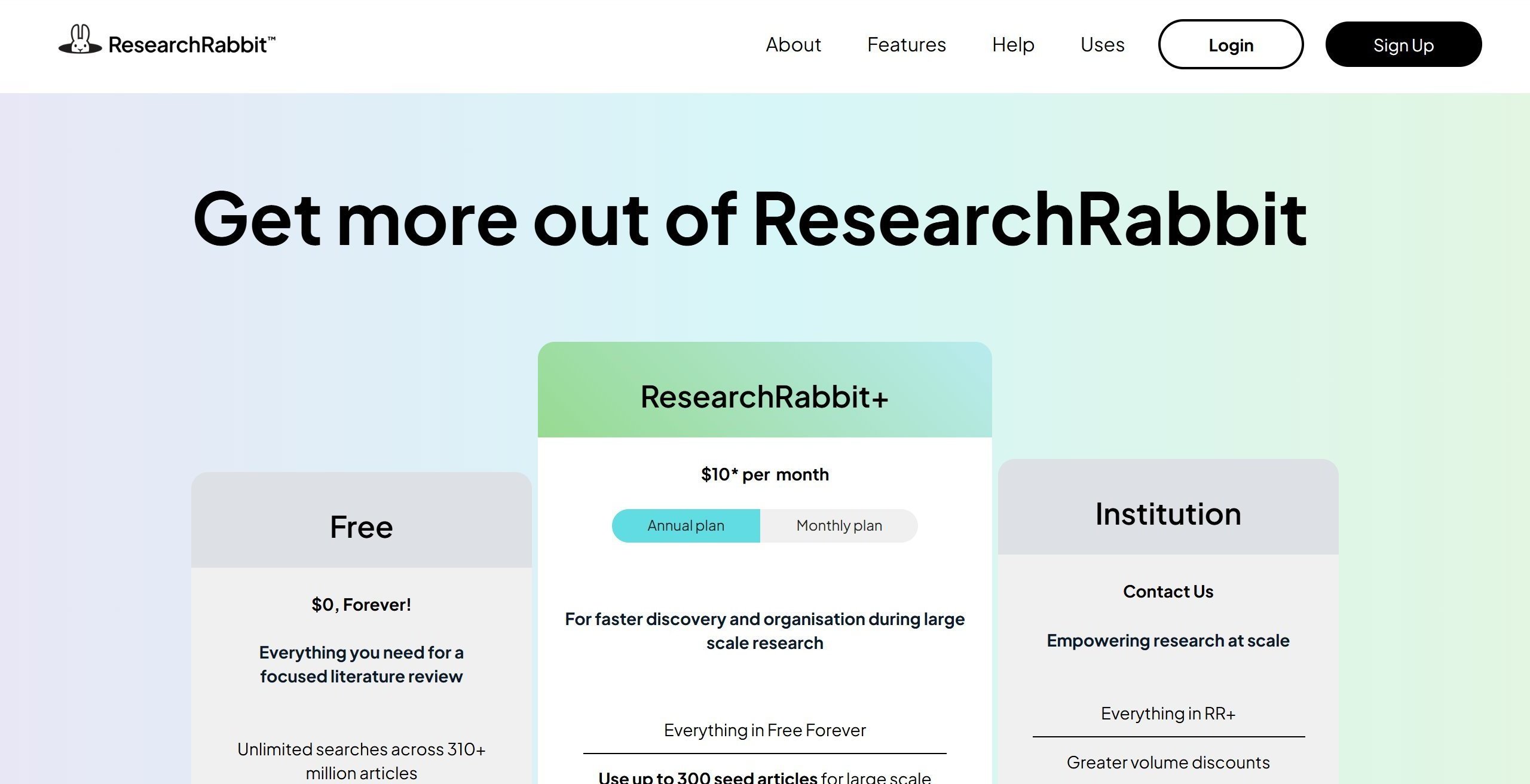
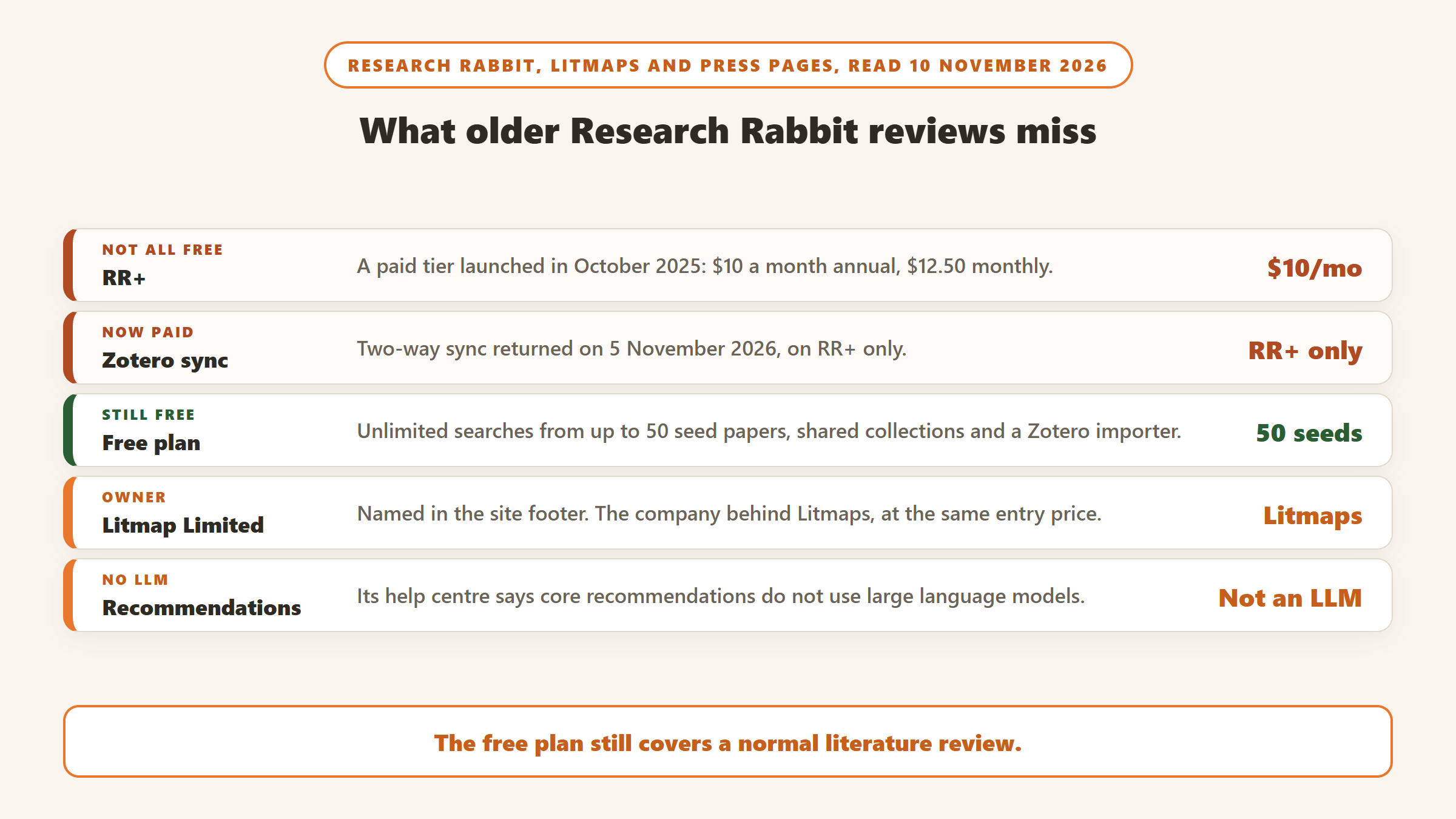
Yes, with a real paid tier now sitting above it. The pricing page lists the free plan as “$0, Forever!” and its own FAQ is direct about the change: “As of 2025, we also have a premium tier”. If you read an older review that calls Research Rabbit completely free with nothing to upgrade to, that was accurate when it was written and is not accurate now.
The free tier help article, updated in May 2026, lists what stays free: article search from up to 50 starting papers, browsing of citations, references and similar work, citation maps, collections and subcollections, the Zotero Importer, shared collections and public links, BibTeX import and export, and notes, stickers and colours. The pricing page adds unlimited searches and unlimited library and collections. For a student writing one dissertation chapter or a single review article, that is a complete workflow.
What RR+ Adds and What It Costs
RR+ was $10 a month on the annual plan and $12.50 a month on the monthly plan when we read the price toggle on 10 November 2026. The pricing card lists up to 300 seed articles, advanced search controls, multiple projects, Signals alerts, which flag high-risk papers based on their citation behaviour, and faster support. The 5 November release added more to RR+: an Analyze tab for spotting where topics overlap and how that overlap has grown, a Filter panel covering keywords, publication date, journal quality, retractions and open access, Project Alerts for new papers that build on your library, and two-way Zotero sync.
One detail on the pricing page is inconsistent. The card shows two prices, but the FAQ further down says the default price “is USD$10 per month” and describes RR+ as “a premium subscription with monthly payments”. Check the price at checkout rather than relying on either line. Cancelling is self-service, and the help centre says access continues until the end of the paid period and your data stays when you drop back to the free plan.
Research Rabbit also runs country discounts for over 100 countries. If your country qualifies, the Upgrade menu inside the app shows a promo code. The code cannot be combined with another promotion, and the company says it cannot currently handle individual hardship requests.
The Zotero Catch
Zotero is where many students keep their references, so this is the change most likely to surprise a returning user. Aaron Tay, a librarian who covers discovery tools, noted in November 2025 that the old Research Rabbit’s two-way Zotero folder sync had not made it into the relaunched version. It came back in the 5 November 2026 release, and the sync help article says plainly: “Two way sync is part of RR+”.
Two-way sync does what the name says. Papers and notes you add in either app appear in the other, removing a paper from a synced collection removes it from the matching Zotero collection, and deleting it in Research Rabbit sends it to the Zotero trash. Group libraries sync too, which suits a lab or a supervisor who wants to see the same up-to-date list.
Free users keep a one-way route. The Zotero Importer pulls any number of papers from your Zotero collections into Research Rabbit, and you send finds back by exporting a BibTeX file and importing it into Zotero. That works. It is a manual step each time, and it is the clearest example of a workflow that used to be free in sync form and is now a paid convenience.
Who Owns Research Rabbit Now
Every page on researchrabbit.ai carries a copyright footer naming Litmap Limited. Litmap Limited is the New Zealand company behind Litmaps, a competing literature mapping tool. Research Rabbit’s own relaunch article credits “our partnership with Litmaps” for the new version, while IT Brief reported on 8 May 2025 that Litmaps had acquired Research Rabbit alongside the first close of a USD 1 million funding round. The Research Rabbit about page lists Axton Pitt as CEO, the same person IT Brief quoted as Litmaps co-founder.
For a user this matters in two practical ways. The two products now have the same entry price, as the alternatives section shows, and Aaron Tay read the relaunch’s configurable citation map and colour-coded collections as Litmaps influence. So when you choose between them, you are choosing an interface and a feature split, not a company.
How Much “AI” Is in It
Research Rabbit’s homepage title calls it an “AI Tool for Smarter, Faster Literature Reviews”. Its own help article on AI use, updated in October 2026, is more precise: “ResearchRabbit does not use large language models to power its core recommendation algorithms.” Recommendations come from network algorithms over citations, co-citations and authorship, with semantic similarity of titles and abstracts used as one extra signal.
For a researcher that is mostly good news. A network method is explainable: a paper appears because it cites, is cited by or shares authors with your seeds, and you can see that on the map. It does not write summaries that might misstate a finding, and it does not invent papers. What it will not do is answer a question in prose, extract data from PDFs or tell you what a paper concluded. For that you need an LLM tool such as Elicit or Consensus, covered below, and you then need to check its output against the papers.
On data, Research Rabbit’s data summary states “We don’t train AI models using your articles or notes” and that it does not sell or expose your articles or notes to third parties.
Where the Papers Come From
The database help article names three providers: Crossref, Semantic Scholar and OpenAlex, refreshed weekly. The size is quoted three ways on Research Rabbit’s own pages: “over 280 million” in the October 2025 relaunch article, 310+ million on the pricing page and in the database article, and over 320 million on the homepage. The direction is clearly up; treat the exact number as approximate.
The limitation that matters is metadata. Research Rabbit says it can only index papers whose metadata, meaning title, authors, date, abstract and reference list, has been made openly available. Paywalled papers can still appear, but if a publisher has not released a paper’s references, those links are missing from the network. The help article lists the usual reasons a paper looks thin: no open metadata, not yet indexed by the three providers, or too new. For a very recent or closed-metadata field, run a keyword search in Google Scholar or your library database alongside it.
This is also why Research Rabbit is a discovery tool and not a systematic search. It finds what is connected to your seeds. A paper in your topic that nobody in your seed network has cited will not surface, however relevant it is.
Research Rabbit Alternatives
Each alternative below gets the same treatment: what it does, what it costs on 10 November 2026, and where it beats or loses to Research Rabbit.
1. Litmaps
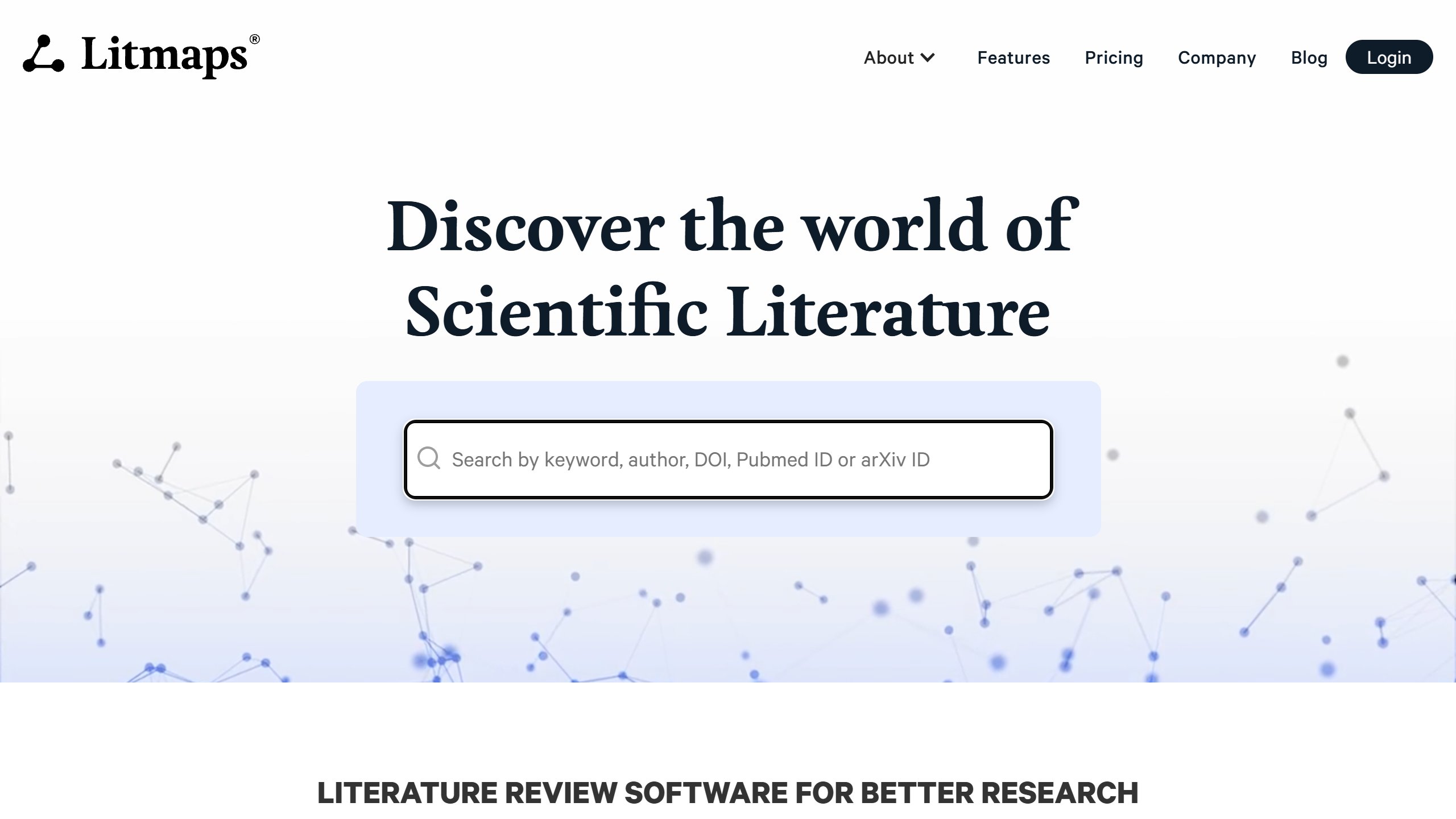
What it does. Litmaps is Research Rabbit’s sister product, also from Litmap Limited. It finds related papers from the ones you give it, shows them as a visual map you can share with colleagues, and monitors your topic for new papers. Its homepage says it is used by 900,000+ researchers.
Price. The pricing page shows a free plan with up to 20 inputs, 2 Litmaps and 100 articles per map, with monthly alerts. Pro on the Education toggle is $10 a month billed annually or $12.50 monthly, the same as RR+, and $40 a month annually or $50 monthly on the Commercial toggle, with unlimited inputs, articles and maps.
Against Research Rabbit. The free tier is tighter, with 20 inputs against Research Rabbit’s 50 seeds. Pick Litmaps if you prefer its map layout or you already pay for it. For a free user, Research Rabbit is the more generous of the two siblings.
2. Connected Papers
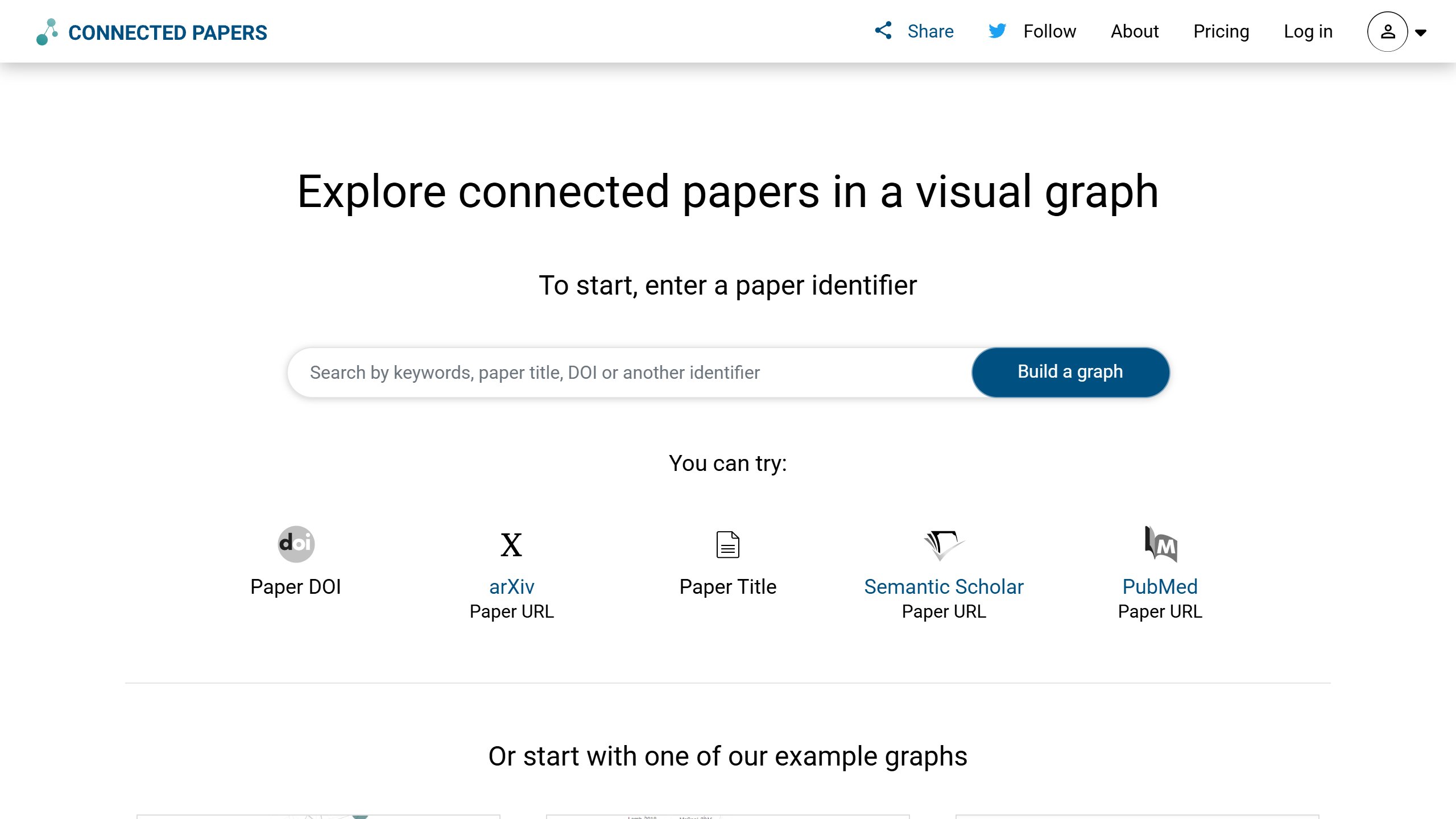
What it does. Connected Papers builds a single similarity graph around one origin paper. Its about page says each graph analyses around 50,000 papers and keeps the few dozen with the strongest connections, using co-citation and bibliographic coupling, so related papers can sit close together even if neither cites the other. In its words, “Connected Papers is not a citation tree”. Its data comes from the Semantic Scholar Paper Corpus.
Price. The pricing page gives 5 free graphs a month. Academic is USD 3 a month billed USD 36 a year, or USD 5 a month billed USD 15 a quarter. Business is USD 10 a month billed USD 120 a year, or USD 15 a month billed quarterly.
Against Research Rabbit. Connected Papers is quicker to read for one paper and cheap to upgrade. It has no collections or Zotero sync, and 5 graphs a month runs out fast in an active review. Use it for a first look at a new area; use Research Rabbit to build the reading list.
3. Inciteful
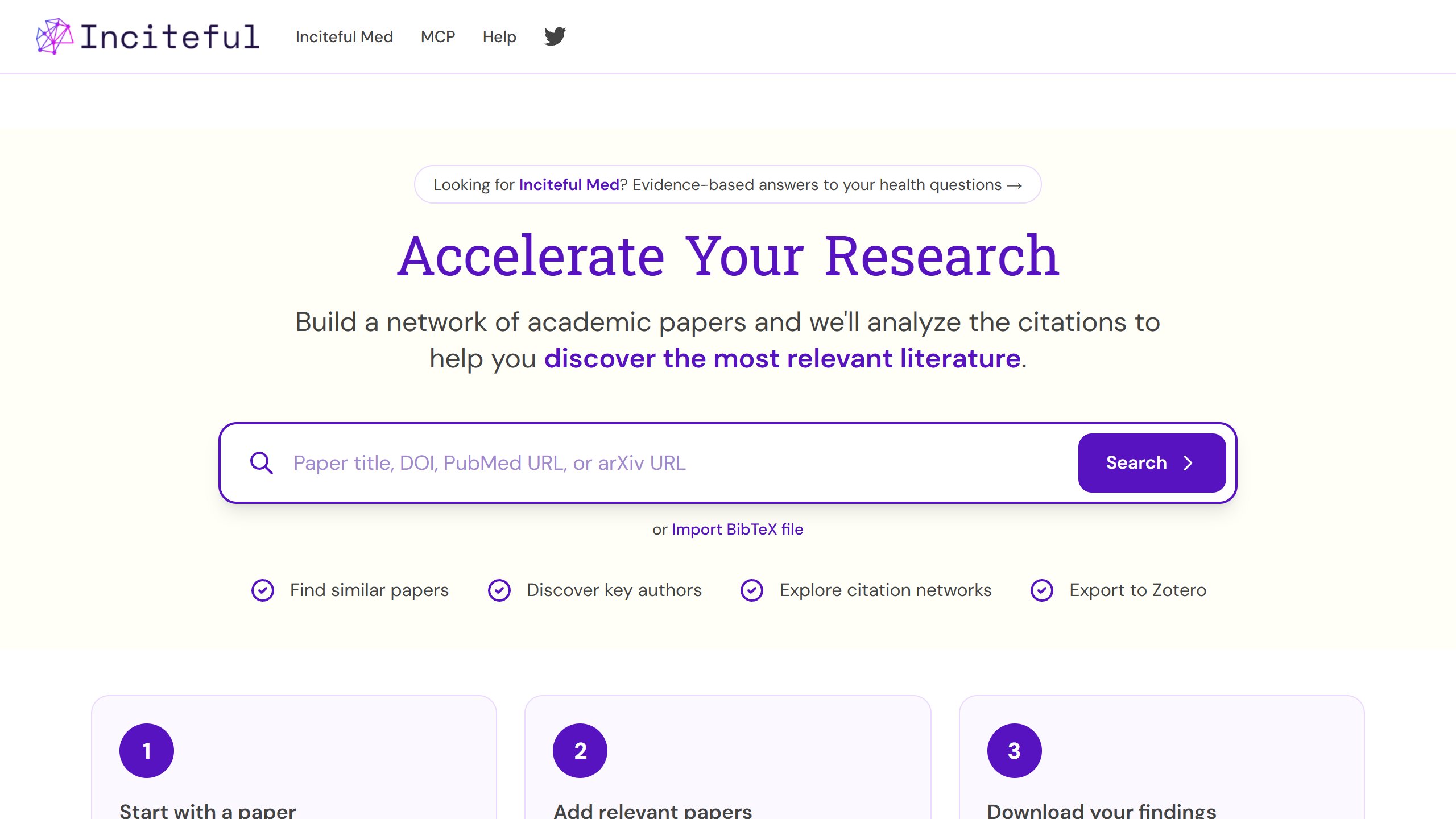
What it does. Inciteful builds a citation network around one or more papers and uses link prediction, the method social networks use to suggest friends, to surface similar and recent work. A second tool, Literature Connector, finds the papers that link two papers you name. The old inciteful.xyz address now redirects to incitefulmed.com/academic.
Price. Free. The site says “Our core tools are free to use and always will be.” It reports 240M+ papers and 2B+ indexed citations from OpenAlex, Semantic Scholar, Crossref and OpenCitations.
Against Research Rabbit. No paywall, plus export to Zotero, Mendeley or your reference manager of choice. Its homepage describes search, network building and export, with no library or sharing features listed. It is a strong free complement for a single question, and the Literature Connector does something Research Rabbit does not.
4. Semantic Scholar
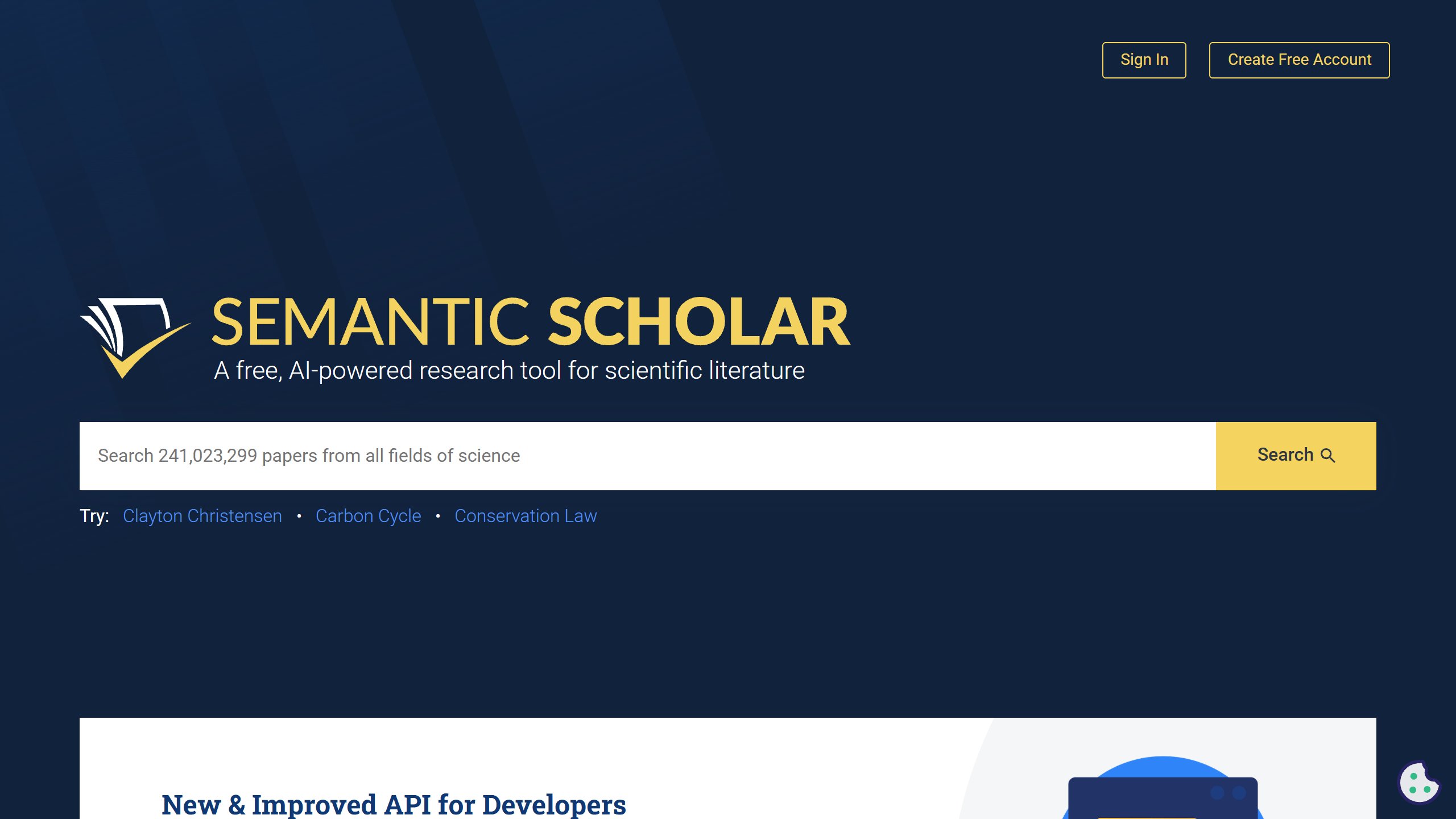
What it does. Semantic Scholar is a free search engine for scientific literature built by Ai2, the Allen Institute for AI. Its homepage said it searches 241,023,192 papers when we read it. It is also one of the three data providers behind Research Rabbit.
Price. Free, with a free account.
Against Research Rabbit. Semantic Scholar is the better keyword search engine and a sensible place to find your first seeds. It does not give you a live citation map built from several seeds at once. Most researchers will use both rather than choose.
5. Elicit
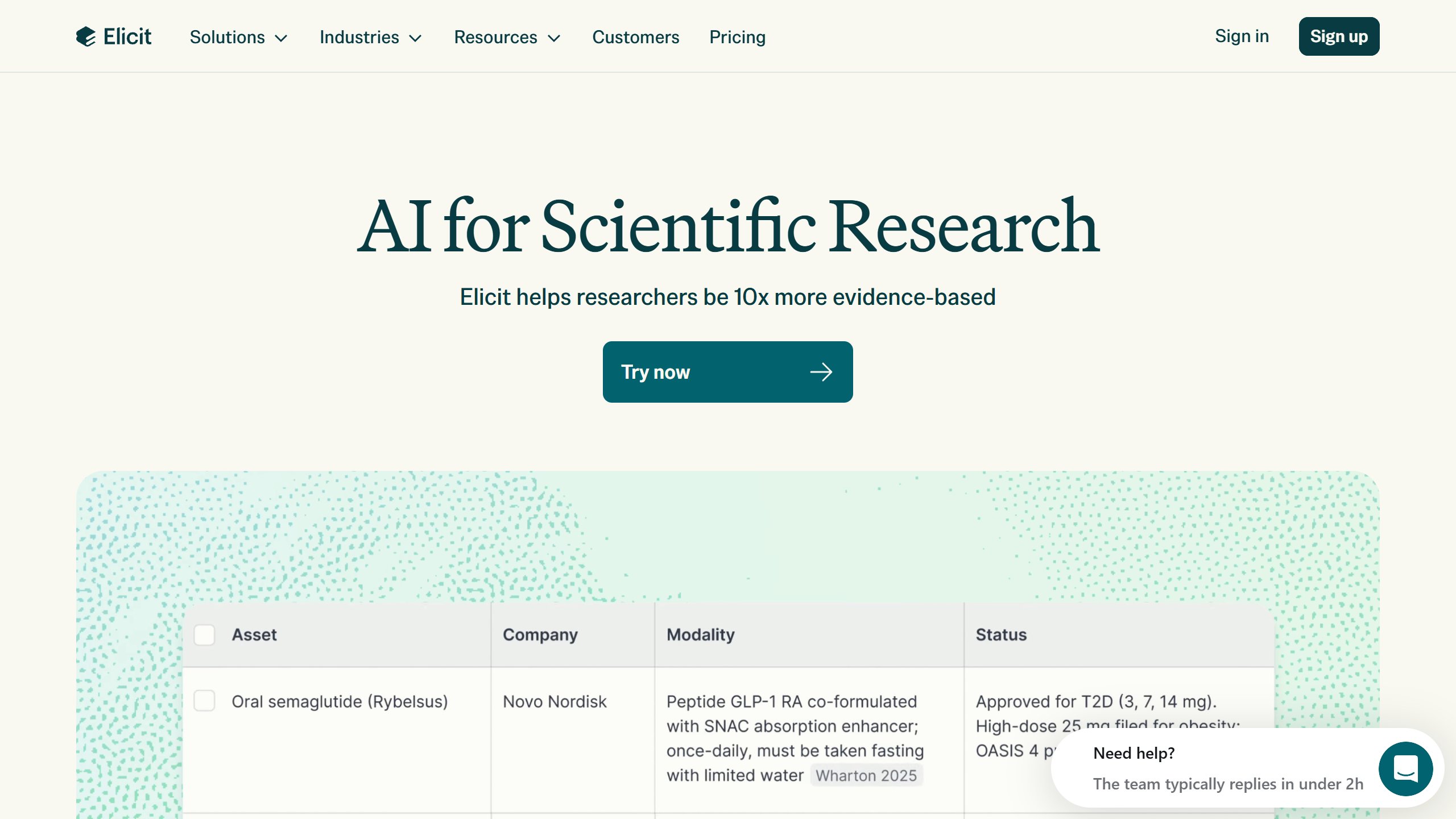
What it does. Elicit is an LLM research assistant. It searches over 138 million papers, summarises them, lets you chat with full-text papers, extracts data into tables and runs a systematic review workflow on paid plans. It imports from Zotero on the free plan.
Price. The pricing page on the Academic toggle shows Basic free, Plus $11 a month billed $132 a year, Pro $39 a month billed $468 a year, and Scale $89 a month billed $1,068 a year. The Industry toggle is higher, with Pro at $49 and Scale at $229 a month billed annually.
Against Research Rabbit. Elicit answers questions and extracts findings; Research Rabbit maps connections. If you need to know what twenty papers concluded, Elicit is the tool, and you should check its extractions against the PDFs. If you need to know which papers you are missing, Research Rabbit is.
6. Consensus
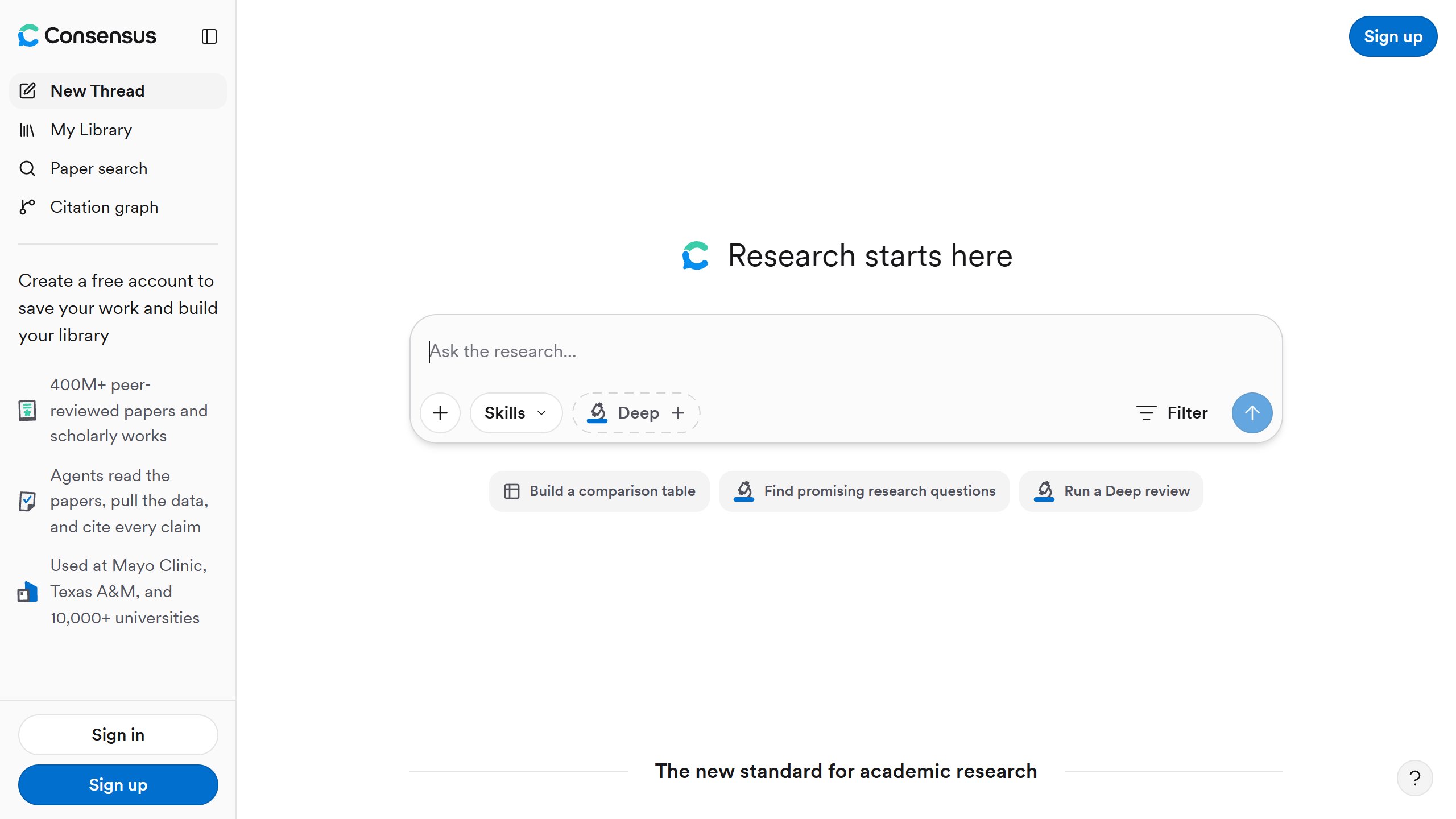
What it does. Consensus is an AI research search engine. Its plans are built around Papers searches, Pro messages, Study Snapshots and Deep reviews, with more Deep reviews on higher plans.
Price. Its subscription plans article, dated 12 September 2026, lists a free tier with unlimited Papers searches, 10 Pro messages, 3 Deep reviews and 10 Study Snapshots a month. Pro is $20 a month or $144 a year; the Deep plan is $65 a month or $540 a year.
Against Research Rabbit. Consensus is built around asking questions of the literature through messages and reports. It is not a mapping tool, and like any AI-written answer it needs checking against the cited papers. It pairs well with Research Rabbit rather than replacing it.
7. scite
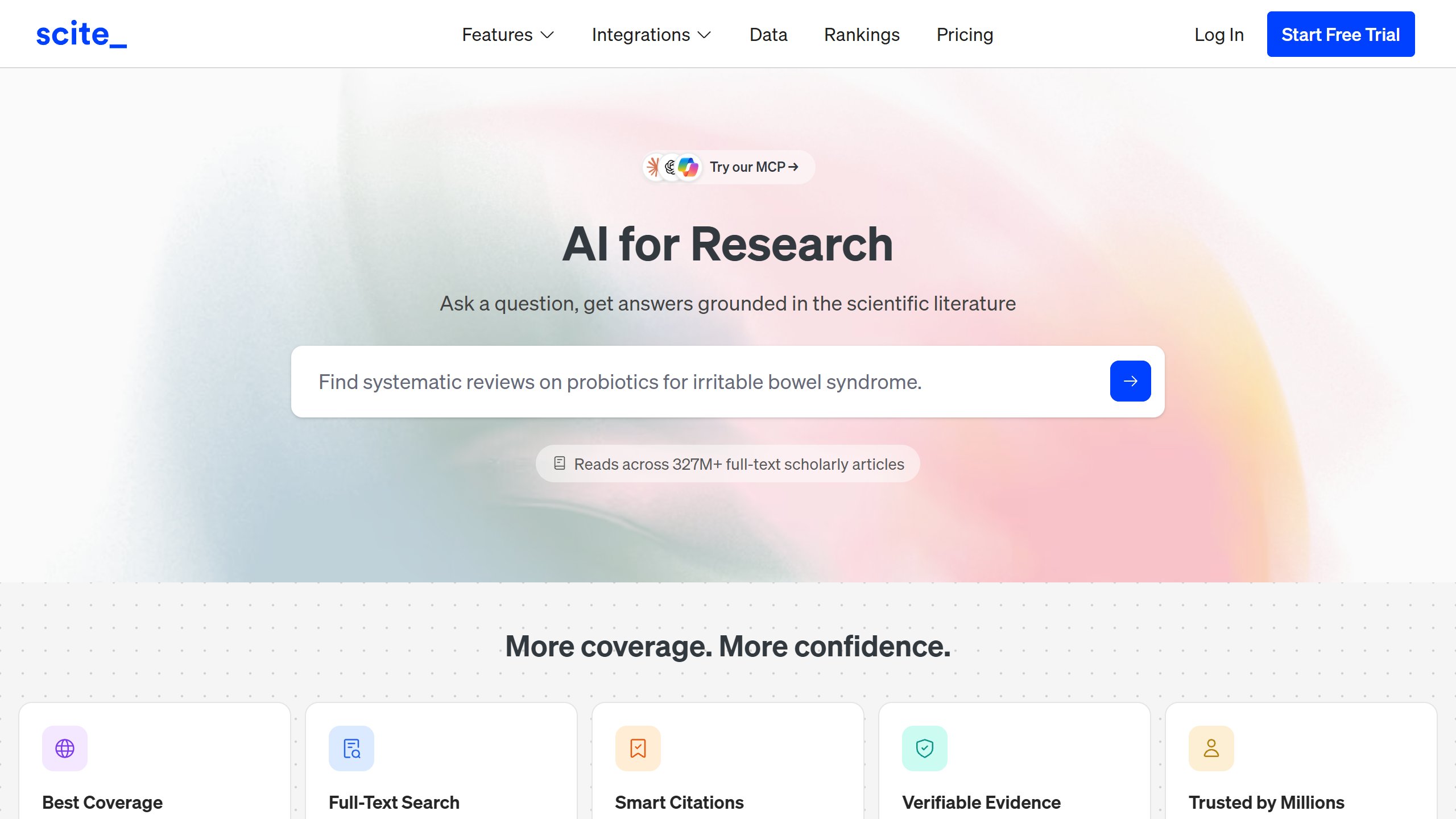
What it does. scite shows how a paper has been cited by others, including whether it has been supported or contradicted. It reports 1.6B+ citations and 300M+ scholarly sources, and adds an AI assistant, collections and citation alerts.
Price. The pricing page lists Basic at $12 a month and Pro at $40 a month, both billed yearly, with a 7-day free trial. Its FAQ says that after the trial you are automatically enrolled in the plan you picked unless you cancel first.
Against Research Rabbit. scite tells you whether a paper’s claim held up; Research Rabbit tells you which papers exist around it. There is no ongoing free plan, so set a reminder before the trial ends.
How It Compares
| Tool | Approach | Free plan | Paid from (10 Nov 2026) | Zotero |
|---|---|---|---|---|
| Research Rabbit | Citation network from many seeds | Unlimited searches, 50 seeds | $10/mo annual, $12.50 monthly | Importer free, two-way sync on RR+ |
| Litmaps | Citation maps and alerts | 20 inputs, 2 maps | $10/mo annual (Education) | Not stated on pricing page |
| Connected Papers | Similarity graph from one paper | 5 graphs a month | USD 3/mo billed annually (Academic) | No sync |
| Inciteful | Citation network, link prediction | All core tools | Free | Export |
| Semantic Scholar | Keyword search engine | All | Free | Export |
| Elicit | LLM search, summaries, extraction | Basic, limited agent use | $11/mo billed annually (Academic Plus) | Import |
| Consensus | LLM answer engine | 10 Pro messages a month | $12/mo billed annually | Not covered here |
| scite | Citation context, AI assistant | 7-day trial only | $12/mo billed yearly | Not covered here |
The table splits the field into two families. Research Rabbit, Litmaps, Connected Papers and Inciteful work from the citation network and help you find papers. Elicit, Consensus and scite use language models or citation classification to help you read and judge them. A literature review needs both jobs done, which is why the practical answer is usually one tool from each family rather than one tool for everything.
Within the network family, Research Rabbit has the most generous free tier of the three mapping tools with paid plans: unlimited searches from up to 50 seeds against Litmaps’ 20 inputs and Connected Papers’ 5 graphs a month. Inciteful is free outright but has no library. That free tier is the main reason to choose Research Rabbit, and it is worth knowing which features sit outside it before you build a workflow around them.
How to Choose
Start with your stage. If you are new to a topic and have no papers yet, begin with keyword search in Semantic Scholar, Google Scholar or your library database to find two or three central papers. Research Rabbit needs seeds, and it is only as good as the seeds you give it.
Then decide between free and RR+. Stay on the free plan if your searches use fewer than 50 seeds, you work on one project at a time, and a BibTeX export into Zotero is fine. Consider RR+ if you are running a systematic or scoping review with hundreds of included papers, you want retracted papers filtered out of your map automatically, or you want your Zotero library and Research Rabbit kept in step without manual exports. Check your country discount before paying.
Add a reading tool if you need one. Research Rabbit will not summarise or extract. If your bottleneck is reading rather than finding, add Elicit or Consensus and verify their summaries against the papers. Our guide to AI for academic writing covers where those tools help with the writing stage and where they create risk, and the wider list of AI tools for students covers note-taking and study tools around them.
Do not treat it as a systematic search. Research Rabbit finds connected work. A formal systematic review still needs documented database searches, and many supervisors and journals will expect them. Use Research Rabbit for citation chasing alongside that search, which is the job it does well.
If summarising is the real job, our roundup of AI tools for studying and summarizing is the better starting point.
Who Should Use It
Use it if you are a student or researcher with a handful of key papers and you need to find what surrounds them: earlier foundations, later work that builds on them, and the authors who keep appearing. The free tier covers a full dissertation literature review for most people, and shared collections make it easy to show a supervisor your reading list.
Pay for RR+ if you regularly work with more than 50 seed papers, you run several projects at once, or two-way Zotero sync and retraction filtering would save you real time. At $10 a month on the annual plan it is priced like Litmaps Pro, so choose between the two on interface and features rather than cost.
Look elsewhere if you want answers rather than papers, in which case Elicit or Consensus fit better, or if you only need a quick picture of one paper’s neighbourhood, where Connected Papers’ free graphs or Inciteful will do.
The Verdict
Research Rabbit remains one of the strongest free starting points for literature discovery. Its free tier still gives unlimited searches from up to 50 seeds, shared collections and a Zotero importer, and its network method is transparent about why each paper appears. The 2026 releases added live maps, Rabbit-holes and boolean keyword search, all on the free plan.
It loses marks on three things. Two-way Zotero sync, which older users remember as standard, is now an RR+ feature, as are retraction and journal-quality filters. Its marketing calls it an AI tool while its help centre says, accurately, that the core recommendations do not use large language models. And its own pages disagree on the database size and on how RR+ is billed. We score it 4.2 out of 5.
Sources
- ResearchRabbit pricing, release notes and 5 November 2026 release, read 10 November 2026.
- ResearchRabbit help centre: Zotero sync, Zotero Importer, database, AI use, search algorithm, free tier, data use and country discounts, read 10 November 2026.
- IT Brief NZ, Litmaps acquires ResearchRabbit (8 May 2025) and Aaron Tay, ResearchRabbit’s 2025 revamp (2 November 2025), read 10 November 2026.
- Litmaps pricing, Connected Papers pricing and about, Inciteful data sources, Semantic Scholar, read 10 November 2026.
- Elicit pricing, Consensus subscription plans and scite pricing, read 10 November 2026.

Written by
FazFaz is the founder of AIToolsBakery. Some tools here are tested hands on. Others are assessed from vendor documentation and pricing verified on the live page, and every review says which one it is. Sponsors can buy a position in a guide. They cannot buy the score, the criticism, or silence about a better option.
How we test and how we make money →