“Virtual staging AI cost” is a query with a split personality, so let’s split it cleanly. Virtual Staging AI is a specific product: the app at virtualstagingai.app that two founders, Michael Bonacina and Mikhail Andreev, built at Harvard and grew into one of the best-known names in the space. It is also, confusingly, a perfectly good description of an entire category of tools that use generative AI to furnish empty listing photos. If you searched for the brand, the first half of this page prices its plans down to the photo. If you meant the category, the second half benchmarks what AI staging costs against human-edited and physical staging in 2026.
One more thing worth knowing before you subscribe: Virtual Staging AI is no longer a scrappy startup. Zillow Group acquired the company in October 2024 for an undisclosed amount, and the nine-person team joined Zillow’s AI group (reported by GeekWire and Zillow’s own Front Porch blog, October 2024). By September 2025, the same technology was baked into Zillow Showcase, where shoppers can restyle or clear out rooms themselves (reported by realestatenews.com, September 10, 2025). The standalone app still sells subscriptions, but you are now buying from Zillow. To be clear about what this page is not: it is a cost breakdown, not a review, and we rank nothing here. Our tested rankings live in our best AI virtual staging software guide.
Virtual Staging AI plans: the full price list
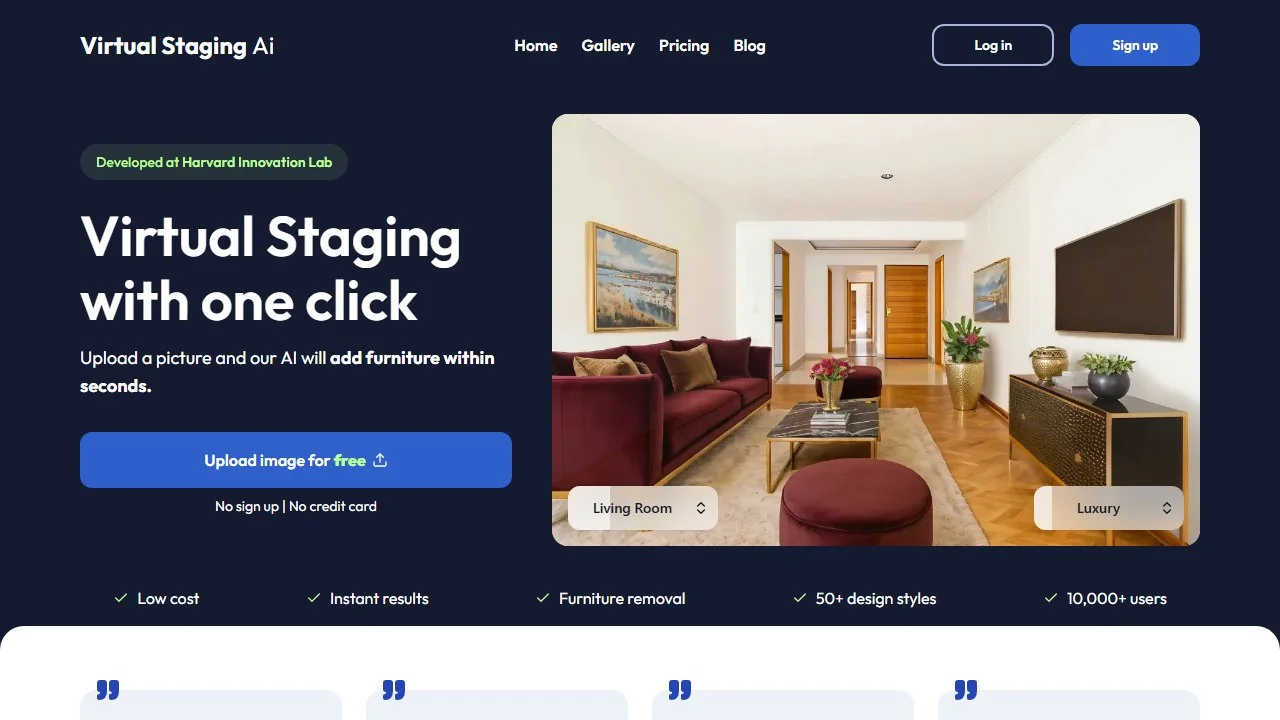
Credit where due: unlike most of the real estate software we price, Virtual Staging AI publishes everything. These figures are official from virtualstagingai.app/prices, checked July 17, 2026.
| Plan | Monthly price | Photos/month | Effective per photo | Status |
|---|---|---|---|---|
| Basic | $16/mo | 6 | $2.67 | Official (2026-07-17) |
| Standard | $19/mo | 20 | $0.95 | Official (2026-07-17) |
| Professional | $39/mo | 60 | $0.65 | Official (2026-07-17) |
| Enterprise | $79/mo | 150 | $0.53 | Official (2026-07-17) |
Four details in the fine print matter more than the headline numbers.
Unlimited renders per photo. A “photo” is one uploaded image, and every plan lets you re-render and download that image as many times as you want. If the first pass puts a sofa somewhere strange, regenerating costs nothing against your quota. That makes the per-photo math above honest in a way per-render pricing would not be, because in our staging runs across the category, one usable result routinely takes three to five generations.
No annual discount. Yearly billing is simply 12 times the monthly price. That is unusual (most SaaS shaves 15 to 20 percent for annual) and it means there is zero reason to prepay. Stay monthly, cancel in the months you have no listings.
No unlimited tier. The ceiling is Enterprise at 150 photos for $79. Past that you are buying a second subscription or looking at competitors that sell unlimited plans. If you run a photography business staging hundreds of images a month, this is the number that disqualifies the brand, not quality.
Everything is included on every plan. Furniture removal, no watermark, roughly 10-second turnaround, and a free editing trial come with all four tiers. Enterprise adds API access, which only matters if you are wiring staging into your own pipeline. You are paying for volume, not features.
The per-photo math for a real agent
Translate the table into listings. A typical listing needs 6 to 10 staged photos, so on the Standard plan at $19 you can fully stage two to three listings a month. On Professional at $39 you cover six to ten. If you close the average agent’s ten to twelve transactions a year, Standard likely never caps out, and your annual staging spend is $228, less if you pause during dry months. Compare that with what a single month of physical staging costs on one listing (we will get to that below) and you see why this category exists.
The Zillow angle cuts both ways for buyers of the standalone app. Upside: the product is backed by Zillow’s AI team rather than a nine-person startup, so it is unlikely to vanish. Downside: the same technology now ships inside Zillow Showcase, so the standalone app’s long-term positioning is genuinely uncertain, and Zillow has not published a roadmap either way. At $19 a month with no contract, that uncertainty costs you nothing today, but we would not prepay a year even if a discount existed.
What AI virtual staging costs as a category
Now the second reading of the query. If you searched “virtual staging AI cost” meaning “what does it cost to stage listings with AI,” the market in 2026 breaks into four cost models, and the spread between them is enormous: roughly $20 to $150 per image across the full category, with the AI service tier at $5 to $25 per image and subscription AI working out to $0.25 to $3 per photo (reported, Styldod February 2025 and StageHQ 2026). A RoomLift study puts the US median at $39 per room as of 2025 (reported). Which model fits you depends almost entirely on volume.
We are pricing models here, not picking winners. Every tool below appears as a cost benchmark only; for output quality, MLS-compliance handling, and our actual recommendations, use our best AI virtual staging software rankings.
| Cost model | Example services | Typical price | Effective per photo | Status |
|---|---|---|---|---|
| Subscription AI | Virtual Staging AI, Collov AI, REimagineHome, InstantDecoAI | $14-$79/mo | $0.25-$3 | Official vendor pages (2026-07-17) |
| Pay-per-image AI | StagedByAI | $2/credit, bulk discounts to 45% | ~$1.10-$2 | Official stagedbyai.com (2026-07-17) |
| Human-edited virtual staging | Styldod, BoxBrownie, roOomy | $16-$39/image | $16-$39 | Styldod official blog (2025-02); others reported (StageHQ 2026) |
| Physical staging | Local staging companies | $2,000-$6,000/room/mo rental | n/a | Reported (Styldod 2025-02, StageHQ 2026) |
Subscription AI: the volume play
This is the model Virtual Staging AI uses, and its main rivals price the same way with different credit math. Collov AI runs $19 per month for 60 credits (about $0.32 per photo), then $49 for 150, $79 for 263, and $127 for 526 with a $0.24 per photo overage; note its trial credits are watermarked (official collov.ai/pricing, July 17, 2026). REimagineHome starts at $14 for 30 credits, then $49 for 200, $74 for 400, and $99 for 900, with 5 free full-quality designs and no card required (official, July 17, 2026); we cover it hands-on in our REimagineHome review and put it head to head in REimagineHome vs Collov. InstantDecoAI is the budget outlier we verified at draft time: Basic is $14 per month for 8 photos and Pro is $49 per month (or $35 per month billed annually) for unlimited photos, both with unlimited generations (official instantdeco.ai/pricing, July 17, 2026). That Pro tier is a true unlimited plan, the thing Virtual Staging AI does not sell.
Subscriptions win when you stage every month. They quietly lose when you do not: a $19 plan you forget to cancel across a slow quarter costs more than pay-per-image would have.
Pay-per-image AI: the occasional-listing play
StagedByAI sells credits with no subscription at all: $2 per credit standard, a 12-credit pack at $23.20, 20 credits at $36, and bulk discounts scaling to 45 percent at 400+ credits, which floors the per-image cost around $1.10, plus 3 free trial credits (official stagedbyai.com, July 17, 2026). Worth flagging: SERP snippets round this to “$1 per image,” but the verified standard rate is $2, so budget on that. One reported entry we could not confirm: VirtualStaging.ai (a different company from the Zillow-owned virtualstagingai.app, despite the nearly identical name) advertises staging from $0.28 per image, but its pricing page blocked our verification at draft time, so treat that figure as unverified vendor marketing.
Human-edited virtual staging: the quality-control play
Before generative AI, virtual staging meant a human designer compositing furniture into your photo over 24 to 48 hours, and that market still exists because it solves the failure cases. Styldod publishes $16 to $23 per image (official Styldod blog, February 2025). Reported rates put BoxBrownie around $24 to $30, Apply Design around $25 to $35, roOomy around $29 to $39, and premium interior designers at $75 to $300 or more per room (reported, StageHQ 2026). You are paying 10 to 40 times the AI per-photo rate for a human who will not put a floating lamp in front of a doorway, will match your brief exactly, and hands you someone to blame on revisions. For luxury listings where one bad render in the MLS costs credibility, that trade can be rational.
Physical staging: the different-universe play
For scale: physically staging a home runs about $3,000 for a $300K property, with furniture rental at $2,000 to $6,000 per room per month, every month the listing sits (reported, Styldod February 2025 and StageHQ 2026). The same home staged virtually typically comes in under $300 even human-edited. Physical staging is not really competing with AI on price; you buy it for in-person showings, not photos. But when a seller asks why your marketing plan says “virtual,” these are the numbers to show them.
The worked comparison: one typical listing, 6 to 10 photos
Here is the whole page in one scenario. You have a vacant three-bed listing and want the living room, kitchen, primary bedroom, and a few secondary spaces staged: call it 6 to 10 photos.
- Subscription AI: roughly $2 to $10. On Virtual Staging AI’s Standard plan the listing consumes half your monthly 20-photo quota, so it is about $9.50 of your $19; on Enterprise, under $6. Turnaround: minutes, including re-rolls.
- Pay-per-image AI: $12 to $20 at StagedByAI’s verified $2 standard credit, with no subscription hanging around afterward.
- Human-edited: roughly $150 to $350 at published and reported per-image rates, delivered in a day or two with revision rounds.
- Physical: $2,000 to $12,000+ depending on rooms and months on market (reported, StageHQ 2026).
That is a three-orders-of-magnitude spread on the same listing. The honest read of the math: AI staging has made the marginal cost of a staged photo effectively zero, so the real decision is no longer “can I afford to stage” but “which failure modes can I afford”: occasional AI weirdness at $1, human turnaround at $25, or furniture trucks at $3,000. Whichever model you land on, disclose staged images in your listing remarks; MLS rules and plain honesty both require it, and it is the one cost line no vendor will invoice you for. Staged photos also pair naturally with better listing copy, which is its own cheap win; see our AI listing description generators guide.
Price is only half the decision. If you are weighing it against the obvious rival, our Virtual Staging AI vs Collov comparison puts the two side by side on output and turnaround, and our Collov AI review covers the wider feature set Collov sells around staging.
Virtual staging and AI imagery, and the disclosure rules that come with them
AI staging is one of the few genuinely transformative tools in this industry, and also the one most likely to create a complaint if handled carelessly.
Disclose it, every time, on every image
Most MLS rules and state regulations require virtually staged photographs to be labelled as such, and the requirement is usually about the image itself rather than a note elsewhere in the listing. Label every staged image visibly. This is not a grey area worth exploring, the cost of compliance is a caption, and the cost of non-compliance is a complaint that follows the agent rather than the software.
Never alter what cannot be changed
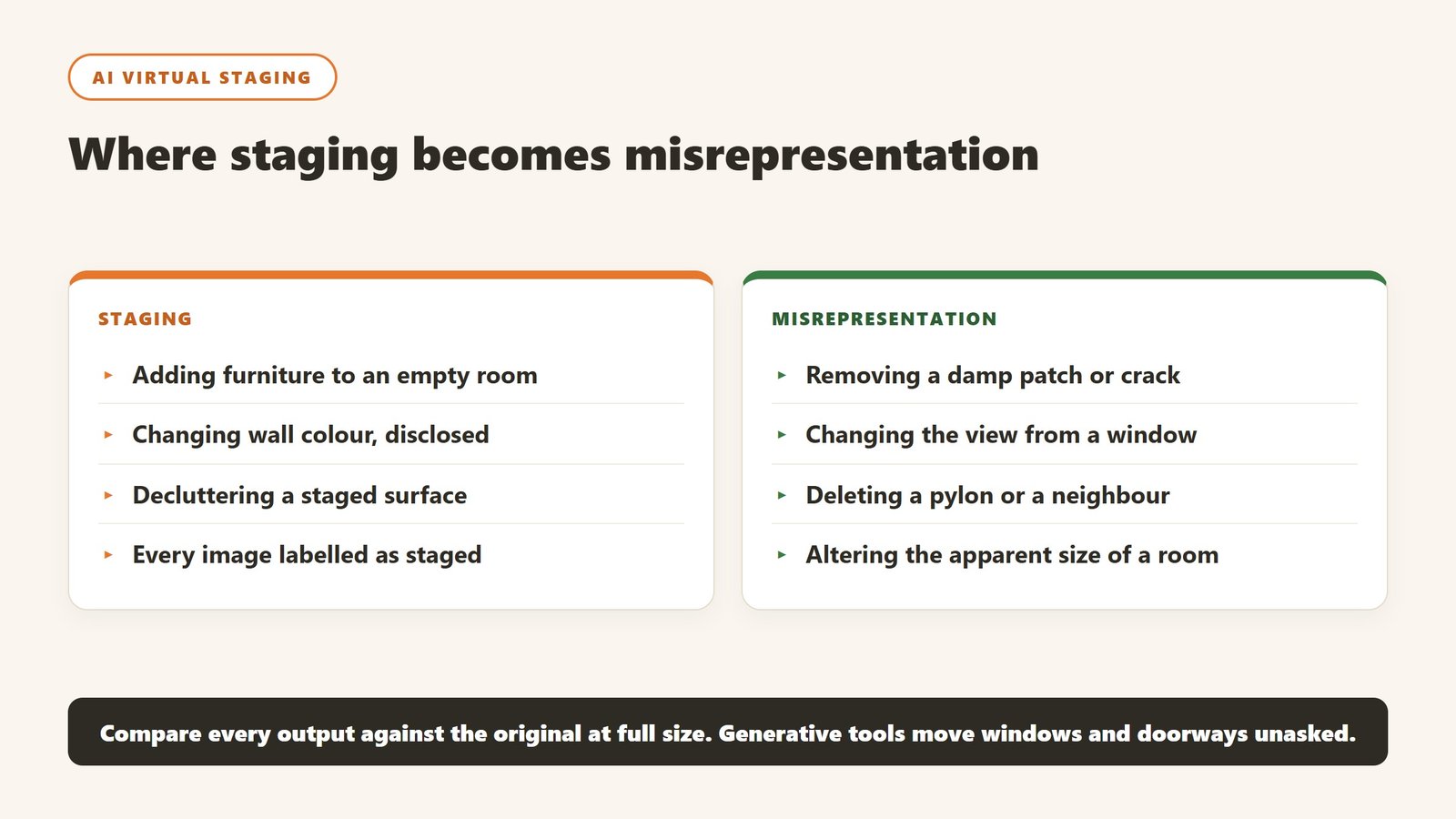
The line that matters is between furnishing an empty room and misrepresenting the property. Adding a sofa is staging. Removing a damp patch, straightening a subsiding wall, changing the view from the window, deleting a pylon or altering the apparent size of a room is misrepresentation, whichever tool produced it. Write that distinction into your process, because a generative tool will happily do all of them if asked.
Check what the model quietly changed
Generative staging frequently alters things nobody asked it to: a window becomes larger, a doorway moves, a radiator disappears, the floor changes material. Compare every output against the original at full size before publishing. This is the single most common failure in practice, it is entirely avoidable, and it is far more likely to cause a problem than the staging itself.
Price it against the alternative honestly
The comparison for AI staging is not another AI tool, it is what you were doing before: physical staging at a scale most listings never justify, a human virtual stager per image, or empty rooms. For a mid-market listing the honest question is whether the images shorten time on market or lift the price enough to notice. Track that on your own listings for a quarter rather than accepting a vendor case study, because your market is the only sample that matters.
How to tell whether the tool paid for itself
Real estate software is unusually easy to evaluate honestly, because the outcomes are countable. Most teams still do not do it, and the renewal conversation becomes an argument about impressions.
Pick the metric the tool is supposed to move
For a lead platform it is cost per closed transaction. For property management software it is hours of admin per unit per month, and days to fill a vacancy. For staging it is days on market and list-to-sale ratio. For screening it is time to approve and the rate of problem tenancies. Each of those is available from records you already keep, and each needs a figure from before you started.
Take the baseline before you switch anything on
You need last year of the metric from a source the project did not touch. This is the step that gets skipped and it is the reason most of these purchases can never be evaluated. It costs an hour. Ask the two or three people whose work will change to record how long the target task takes them this month, because time saved is measurable in advance and unprovable afterwards.
Give it a full cycle before judging
Leasing and transactions are seasonal, so a six week read tells you very little. Judge lead tooling over at least two quarters, and property management tooling over a full turnover cycle, because the value shows up at move-out and move-in rather than in the quiet middle. Say that at the outset so an unremarkable month one is understood as expected.
Write the stop condition down first
Before purchase, name the result at twelve months that would mean you do not renew. It converts renewal from a default into a decision and it is the most effective discipline against a subscription that quietly becomes permanent. If nobody can name a result that would end it, the evaluation was never real.
Verdict: what to actually budget
If you came here for the brand: Virtual Staging AI costs $16 to $79 per month, the Standard plan at $19 for 20 photos is the sensible default, there is no annual discount so stay monthly, and you are buying from Zillow now, which is a stability upside and a roadmap question mark. If you came here for the category: budget $0.25 to $3 per photo for subscription AI, about $2 per image pay-as-you-go, $16 to $39 for human editors, and thousands for physical. For a typical agent doing a listing or two a month, total annual staging spend with AI lands under $250, which used to be the cost of staging one room for one month. For which tool deserves that $250, our best AI virtual staging software guide is the page with the rankings; the broader toolkit lives in our AI tools for real estate agents pillar.

Written by
FazFaz is the founder of AIToolsBakery. Some tools here are tested hands on. Others are assessed from vendor documentation and pricing verified on the live page, and every review says which one it is. Sponsors can buy a position in a guide. They cannot buy the score, the criticism, or silence about a better option.
How we test and how we make money →