Quick answer: Bloomerang wins for small and mid-sized nonprofits that want a usable, retention-focused CRM with transparent pricing. DonorPerfect wins for teams that need deep gift handling, custom reporting, and longevity. Match the tool to your size and reporting reality and either serves you for years.
Bloomerang vs DonorPerfect 2026: Which Nonprofit CRM Wins for Your Size?
Bloomerang wins for small nonprofits and retention-focused teams that want transparent pricing and a gentle learning curve. DonorPerfect wins for mid-size and complex organizations that need deep customization, planned giving, and heavy reporting. Your donor count and reporting needs decide it, not the brand name.
Worth ruling out first: both of these are systems of record. They store what happened and report on it, and both do that well. Neither decides who your team should contact on Monday morning. If your gift data is already tidy and the gap is that nobody is working it, switching CRM will not close that gap, and a migration is an expensive way to discover it. Our Gratefully vs Bloomerang comparison covers the layer that sits on top of either.
If you are still shortlisting rather than down to these two, the wider field prices in ways that are hard to compare directly: per user, per contact, or on what you raise. Nonprofit CRM pricing compared covers six vendors including Salesforce, Keela, Neon and Virtuous, and shows which unit each one meters.
The short version
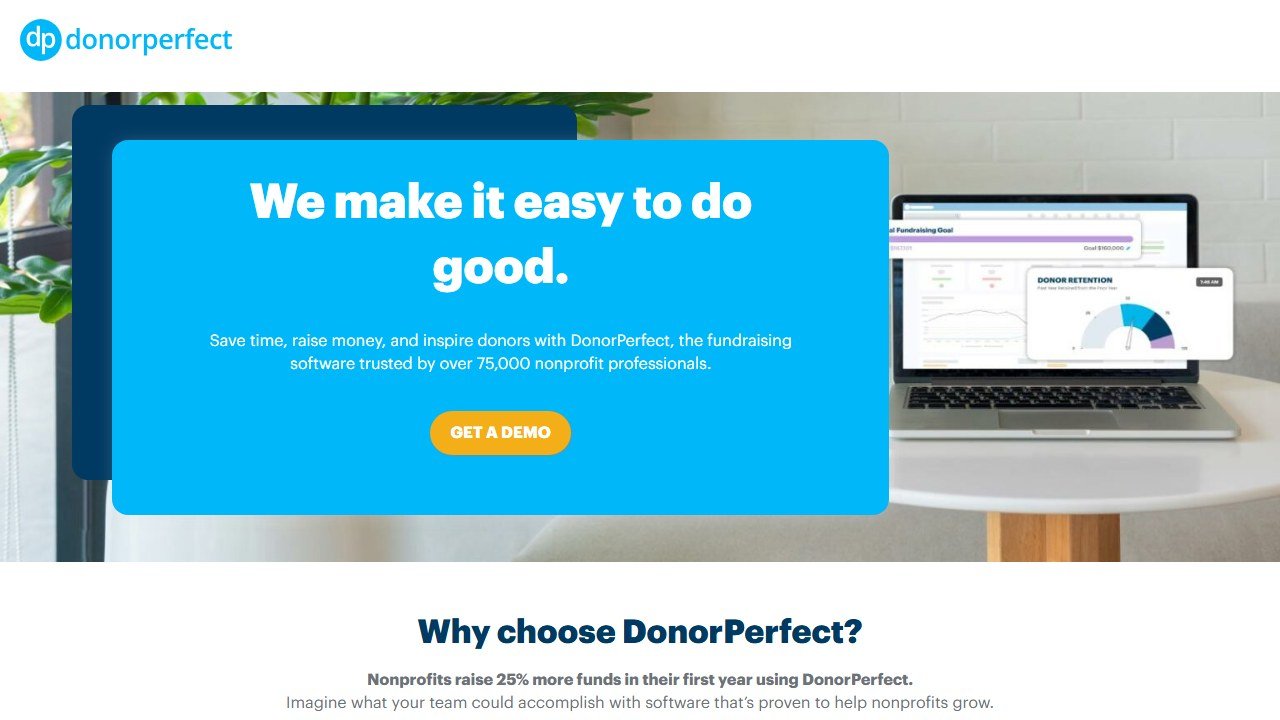
Both Bloomerang and DonorPerfect are mature, well-reviewed nonprofit CRMs that price by the number of constituent records in your database rather than per user seat. That shared model means the real difference is not headline cost. It is how each platform feels to use day to day, how far the reporting and customization stretch, and how well the software fits the way your team actually works.
If you run a small shop with one or two people wearing every hat, Bloomerang’s clarity and self-serve pricing usually win. If you are a growing or established organization with messy gift types, planned giving, and board members who demand custom reports, DonorPerfect’s depth tends to pay off. The rest of this comparison shows exactly where each line falls.
Pricing: transparent tiers vs custom quotes
This is the cleanest dividing line between the two.
Bloomerang publishes its pricing openly. CRM plans run roughly $125 per month for up to 1,000 records, about $166 per month for up to 5,000, and around $249 per month for up to 15,000, with all plans including unlimited users. A very small organization can see the number, sign up, and start that same week without a sales call. For a deeper breakdown of the tiers and add-ons, see our Bloomerang pricing guide.
DonorPerfect does not publish firm prices. Entry-level plans are frequently cited around $89 to $119 per month when billed annually, but every tier requires a custom quote based on your constituent count. Like Bloomerang, DonorPerfect includes unlimited user accounts, so adding your whole development team, volunteer coordinators, and executive staff does not raise the bill. The catch is that you have to talk to sales to learn your real number, which our DonorPerfect pricing breakdown covers in detail.
Both scale with database size, so a fast-growing donor file will push either platform’s cost up over time. Budget for the jump before you grow into it.
Ease of use: Bloomerang’s edge
Ease of use is where small teams feel the difference fastest.
Bloomerang was built around a clean, visual interface and is widely praised for being approachable. New users get to a working dashboard quickly, the donor timeline reads like a story rather than a spreadsheet, and the famous retention dashboard surfaces who is lapsing without you building a report. For a solo development officer or a tiny team, that low friction means the CRM actually gets used instead of ignored.
DonorPerfect is also rated easy to navigate, with most reviewers calling the interface clear and the dashboards customizable. The difference is depth versus simplicity. DonorPerfect exposes more settings, more fields, and more configuration, which is powerful once you learn it but heavier on day one. Teams with an admin who enjoys tailoring the system thrive. Teams who just want to log a gift and move on may find it busier than they need.
The honest read: Bloomerang feels lighter out of the box, DonorPerfect rewards the organization willing to invest in setup. If you want more of the lightweight, retention-first approach, our roundup of the best AI tools for small nonprofits pairs well with a Bloomerang stack.
Reporting and customization: DonorPerfect’s edge
When the conversation turns to reporting, DonorPerfect pulls ahead.
DonorPerfect handles complex gift processing, tribute and memorial giving, planned giving tracking, and LYBUNT and SYBUNT segmentation out of the box. Its reporting engine is deeper, its custom fields are more flexible, and it includes basic grant tracking. For an organization with varied revenue streams, a demanding board, or a grants pipeline, that breadth removes the need for workarounds and spreadsheets.
Bloomerang covers the essentials well: email marketing, online giving, donor surveys, data segmentation, dashboards, and grant tracking, all wrapped in that retention-focused view. Its analytics are genuinely useful, and the retention dashboard gives small teams insight that cheaper platforms simply do not. But once your reporting questions get specific and layered, you can hit the ceiling of what Bloomerang’s simpler model is designed to answer.
So the trade is real. Bloomerang gives you the reports most small orgs actually need, beautifully. DonorPerfect gives you the reports a complex org eventually demands, with more work to configure them.
Support and integrations
Both vendors are known for solid customer support. Bloomerang earns repeated praise for responsive chat help and a strong knowledge base, which matters when a small team has no in-house IT. DonorPerfect is likewise rated highly for training and ongoing support, fitting its more configurable nature.
On integrations, Bloomerang leans on Mailchimp for email and Stripe for payments, a familiar small-business stack. DonorPerfect integrates with Constant Contact and a broad set of fundraising add-ons. Neither is a dealbreaker, but check that your existing email and payment tools connect cleanly before you commit.
Head to head at a glance
Across the dimensions that decide most purchases, the pattern is consistent. Bloomerang optimizes for transparency, speed to value, and donor retention. DonorPerfect optimizes for depth, customization, and complex giving. Pricing model is nearly identical (both scale by records, both include unlimited users), so the decision rides on ease of use versus reporting power.
| Dimension | Bloomerang | DonorPerfect |
|---|---|---|
| Pricing model | Published tiers, scales by records, unlimited users | Custom quote, scales by records, unlimited users |
| Records (entry tier) | Up to 1,000 around $125/mo | Quoted by constituent count, often cited from $89 to $119/mo |
| Ease of use | Lightest out of the box, fast to learn | Clear but deeper, rewards setup time |
| Reporting | Strong essentials plus retention dashboard | Deeper reports, planned giving, grant tracking |
| Support | Responsive chat, strong knowledge base | Strong training and ongoing support |
| Best for | Small, retention-focused nonprofits | Mid-size, complex, report-heavy nonprofits |
Which one should you pick?
Pick Bloomerang if you are a small or growing nonprofit, you want to see and pay your price without a sales call, your team is small enough that ease of use makes or breaks adoption, and donor retention is a metric you actually track. The published tiers and gentle learning curve mean you are live and getting value quickly. Our full Bloomerang review walks through the day-to-day experience.
Pick DonorPerfect if you are mid-size or established, you juggle complex gift types, tributes, or planned giving, you need flexible custom reports for a demanding board or grant funders, and you have an admin who will invest in configuring the system properly. The depth that feels heavy to a tiny team becomes a genuine advantage at scale. Our DonorPerfect review digs into where that depth shines.
A simple rule of thumb: under a few thousand records with a lean team, start with Bloomerang. Several thousand records, multiple revenue streams, and a reporting wishlist, lean DonorPerfect. Both offer demos, so shortlist the one that matches your size and book a walkthrough of the workflows you run most. You can check current plans directly at bloomerang.com and donorperfect.com.
The winner is the one that fits the way your organization already works. Match the tool to your size and your reporting reality, and either platform will serve you well for years.
Which nonprofit vendors publish a price, and which will not
This is the most useful single fact about the market and it is rarely stated plainly. Roughly half the category publishes a rate card you can read without speaking to anyone; the other half runs a quote form. That split, not the software, decides how your evaluation has to be run.
| Vendor | Publishes a figure | Entry price, verified 4 Sep 2026 | What it meters on |
|---|---|---|---|
| Little Green Light | Yes, every band | $45/mo | Constituents |
| Salesforce Nonprofit Cloud | Yes | $60/user/mo, 10 free | Users |
| Neon CRM | Model yes, full list no | $99/mo | Fundraising revenue |
| Bloomerang | Yes, by product | $125/mo | Product mix |
| Keela | Yes, every band | $164/mo | Contacts |
| Dataro | Yes, but unlinked page | $15,000/yr + $0.10/donor | Active donors |
| Blackbaud | No | Quote form only | Not disclosed |
| Virtuous | No | Quote form only | Bands at $5m revenue |
| GoFundMe Pro | Model only | Subscription + transaction fee | Donations |
Why the split matters more than the prices
If three of your shortlist publish and three do not, you cannot run a like-for-like comparison, and the quote-only vendors know that. The practical move is to price a published alternative precisely at your own seat count and list size, then make that the number every quote has to justify itself against. It is the only figure in the room that both sides can verify.
Nine different meters, which is the real problem
Constituents, users, fundraising revenue, product mix, contacts, active donors, donation volume. Seven distinct meters across nine vendors means the cheapest platform is a property of your organisation, not of the market. Whichever of your numbers, people or records or revenue, is growing fastest should decide which pricing model you buy into, and that question is almost never asked before a shortlist is drawn.
How to run the procurement so a quote means something
Get every quote onto the same basis before comparing
Ask each vendor, including both platforms, for the same seat count, the same contract length, implementation quoted separately from subscription, every add-on itemised, and payment processing stated as inside or outside the platform fee. A single blended annual number cannot be compared against anything, and vendors know it.
Establish the total first-year cost, not the subscription
Onboarding, data migration, integration work and training are frequently larger than the first year of licence fees in this category and are rarely in the headline figure. Ask for the all-in number, then ask which parts of it are one-off and which recur.
Negotiate the renewal before you sign the first contract
This is the single most valuable term and the one most often left out. A capped renewal uplift, stated as a percentage, is worth more than a bigger first-year discount, because at renewal the vendor knows your usage, your dependency and your switching cost while you have no public rate card to argue against.
Insist on a trial with your own data
A demo runs on a dataset chosen because the product handles it well. Ask to load a sample of your own records, including the messy ones: duplicate households, lapsed donors with old addresses, a recurring gift that failed. How a platform handles your actual data quality is the thing that decides whether staff use it, and it is invisible in a scripted walkthrough.
Name the person who will own it
Every platform in this category rewards an owner and punishes shared responsibility. Before signing, name the person whose job description includes this system and check they have the hours. Software does not create that role, and its absence is the most common reason a nonprofit CRM purchase disappoints.
The exit costs nobody quotes you
Switching cost is the reason organisations stay on platforms they have outgrown, and it is almost never discussed during procurement. Three things determine how trapped you are.
Recurring gifts and payment tokens
Donor records and giving history export cleanly from almost any platform. Live recurring schedules and the payment tokens behind them frequently do not. If tokens cannot transfer, every monthly donor has to re-enter card details and a meaningful share will not, so the real cost of leaving is a slice of your most reliable income. Ask about token portability during procurement, in writing, when you still have leverage.
Custom fields and history
Ask what a full export actually contains. Standard fields usually come out fine; custom fields, soft credits, relationship links between households and the audit trail of who changed what often do not. Losing the relationship structure means rebuilding institutional knowledge that took years to accumulate.
Integrations you will have to rebuild
Every connected system, email platform, giving forms, accounting, event tools, is work to reconnect elsewhere. Count them before signing rather than after, because the number is usually higher than anyone remembers and it is the part that turns a two-week migration into a six-month one.
Why nonprofit software pricing works the way it does
Understanding the mechanics makes a quote easier to read and much easier to challenge.
Revenue banding is means testing
Several vendors band by annual fundraising revenue, and Virtuous splits its tiers at $5 million. That is means testing: the same software costs more if you raise more, on the reasoning that a larger organisation gets more value from it. It is defensible, and it also means your public filings are doing the negotiating before you arrive. Know your own figures before the call.
Why a quote form asks for an EIN
An EIN lets a vendor look up your filed revenue before quoting. If a pricing page asks for one before showing anything, assume the number you are offered has been sized against your accounts rather than drawn from a rate card.
Transaction fees are the line that scales fastest
Where a platform takes a percentage of donations, that line grows with your success and usually overtakes the subscription. On $500,000 raised online, a single percentage point is $5,000 a year, more than the entire annual cost of several CRMs. Most nonprofit CRMs take nothing from donations, so a percentage model needs a specific justification.
Published prices are snapshots, including ours
Keela raised every band by 15 to 22% in under two weeks. Neon retired an entire tier structure. Artisan removed its figures altogether. Any pricing article without a verification date is describing a market that may no longer exist, which is why every figure here carries one.
Where the figures on this page come from
Every price quoted here was read from the vendor’s own pricing page on 4 September 2026, not from an aggregator or a review site. That distinction matters more in this category than in most, because nonprofit software pricing changed materially over the past year and a great deal of what circulates online describes packaging that no longer exists.
The pages we read
Little Green Light publishes every constituent band from $45 a month. Salesforce Nonprofit Cloud publishes $60 per user per month with ten licences free under Power of Us. Bloomerang publishes $125 a month for the CRM with other products priced separately. Keela publishes every contact band from $164 a month. Dataro publishes $15,000 a year plus ten cents per active donor on a page that is not linked from its own navigation. Blackbaud and Virtuous publish no figures at all.
What we do not do
We do not carry a figure we cannot source to the vendor. Where a number circulates widely and cannot be traced to a vendor page, we say so and withdraw it rather than repeating it with a hedge, and we have withdrawn our own published figures on that basis more than once. Where a vendor confirms an unpublished price directly to us, it is attributed as confirmed by the company rather than presented as a public rate.
Why every figure carries a date
Keela raised every band by roughly 15 to 22% in under two weeks in late August 2026. Neon retired an entire tier structure. A pricing claim without a verification date is not checkable, and in this market it is usually wrong within a year.

Written by
FazFaz is the founder of AIToolsBakery. Some tools here are tested hands on. Others are assessed from vendor documentation and pricing verified on the live page, and every review says which one it is. Sponsors can buy a position in a guide. They cannot buy the score, the criticism, or silence about a better option.
How we test and how we make money →Frequently Asked Questions