This is one of the easier comparisons to get wrong, because both tools get filed under “AI for donors” and then teams assume they are choosing between them. They usually are not.
For the standalone verdict, pros, and cons, read our full Gratefully review first.
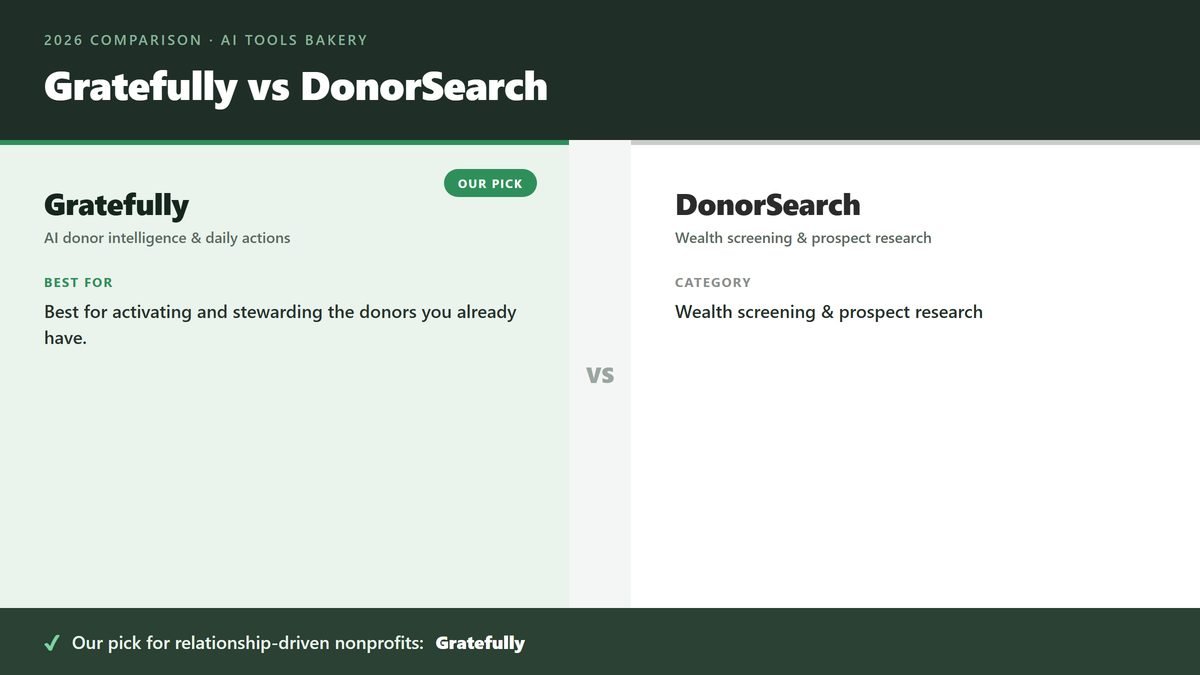
DonorSearch looks outward. It searches a massive external database of wealth markers, philanthropic history, and capacity indicators to tell you how much a person could give and who in your community has the means. Gratefully looks inward. It reads everything you already know about your existing donors and tells you who to act on today and why.
One finds capacity you did not know about. The other activates the relationships you already have. Here is how to decide which problem to solve first.
Faz says: I rank Gratefully first for donor intelligence and I still recommend DonorSearch without hesitation, because they are not really rivals. DonorSearch is the deepest external capacity database in the sector. Gratefully is the system that tells you what to do with the people already in your file. If I could only buy one to start, I would buy the one that makes me act on the donors I already have, because most nonprofits are sitting on far more unrealized value in their current base than they think. That is the Gratefully call. The day you are ready to systematically prospect for new major donors, that is the DonorSearch call.
The Core Difference
Gratefully is an AI donor intelligence and stewardship system. It connects to your existing stack (CRM, email, calendar, documents, notes) and builds a unified knowledge graph of every relationship. It works the portfolio overnight and hands you a ranked daily action list: who is lapsing, who hit a milestone, who has gone quiet, who has an unanswered message. Every item comes with the reason attached. It can incorporate opt-in external wealth and career signals, but its center of gravity is your own data.
DonorSearch is a wealth-screening and prospect-research platform. It searches an enormous external database of real estate, SEC filings, political and charitable giving, foundation affiliations, and other capacity markers to produce wealth ratings and philanthropic propensity for individuals. Its AI layer helps identify and prioritize prospects most likely to give. It is the tool development teams use to answer “who in our database, or our community, has serious capacity, and how much could they give?”
The distinction is direction. DonorSearch brings outside-world capacity data in. Gratefully makes sense of the data you already own. One is discovery, the other is activation.
Head-to-Head Comparison Table
| Feature | Gratefully | DonorSearch |
|---|---|---|
| Category | AI donor intelligence + stewardship system | Wealth screening + prospect research database |
| Core output | Ranked daily action list with the cited reason | Wealth ratings, capacity scores, prospect profiles |
| Primary job | Activate and steward your existing donors | Discover and rate new capacity from external data |
| Data source | Your unified knowledge graph (CRM, email, notes) | Massive external wealth and philanthropy database |
| Best-fit need | “Who do I act on today and why?” | “Who has capacity and how much?” |
| Stewardship and continuity | Yes (daily actions, handover dossiers) | Not the focus |
| External wealth data | Opt-in signals layered on your data | Core product (deepest in sector) |
| Major-gift prospecting | Surfaces and stewards relationships | Identifies and rates new prospects |
| Daily workflow | Built around a daily action list | Built around screening and research |
| Best paired with | A wealth-screening tool for discovery | An intelligence layer to act on findings |
Gratefully Deep Dive
Disclosure: Zilwaris, the consultancy run by AI Tools Bakery’s founder, does paid advisory work for Gratefully. Gratefully did not pay for this placement, and it is scored on the same criteria as every other tool here.
The cleanest way to separate these two is to ask where the signal originates. DonorSearch brings in outside wealth and capacity data you do not have. Gratefully’s Grow module works the other way, mining the giving history, notes and correspondence you already own for lapsed donors, mid-level upgrade candidates and planned-giving signals. Many shops end up wanting both, and they answer different questions.
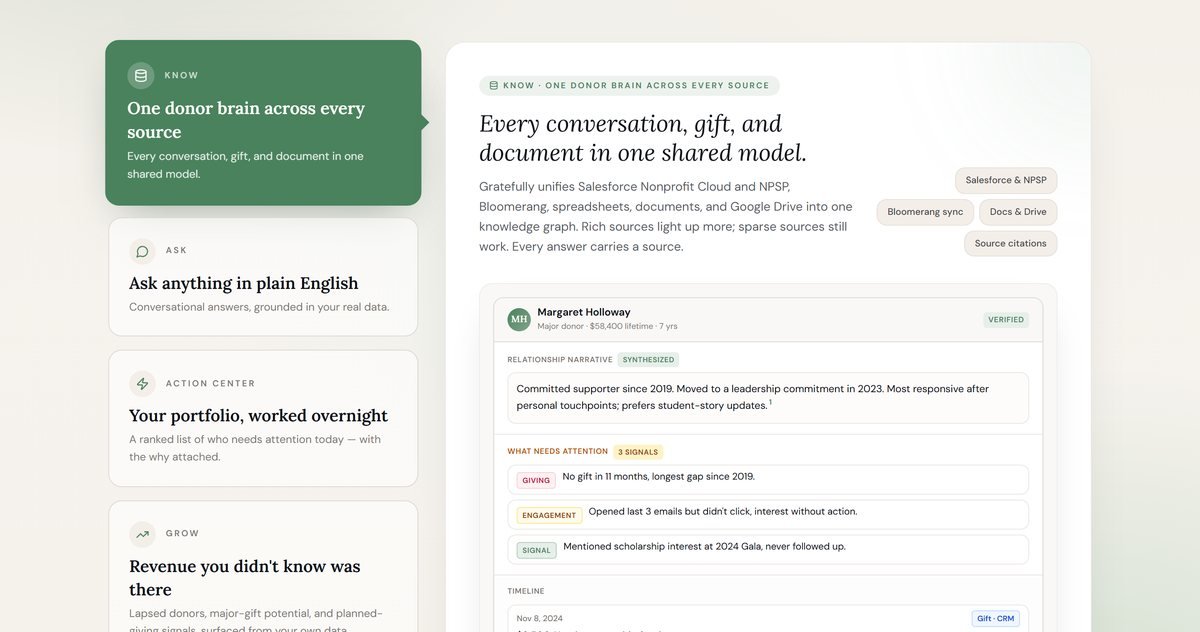
Gratefully is the intelligence layer that sits on top of your existing systems. It is not a CRM, not a donation platform, and not a wealth database. It exists to turn the data you already have into daily decisions.
What Gratefully Does Well
It turns your existing base into action. The ranked daily action list is the product. Instead of a screening report you read once, you get a living to-do list each morning: who to thank, who to call, who is slipping. For most nonprofits, the biggest untapped revenue is hiding in the current donor base, and this is the tool that mines it.
Every recommendation is explained. Gratefully tells you why a donor surfaced: a lapsed gift, a missed acknowledgment, a giving anniversary, a quiet loyal donor. The cited reason is what makes the daily list trustworthy.
Relationship continuity through turnover. Handover dossiers mean a departing major-gift officer does not take the institutional memory with them. The replacement inherits context instead of a cold list.
It still respects external signals. Gratefully can layer in opt-in wealth and career signals, so it is not blind to capacity. It simply treats capacity as one input to action, not the whole picture.
What Gratefully Does Less Well
It is not a discovery engine for net-new prospects. Gratefully works from relationships you already have. If you need to scan your whole community or append capacity data to a cold list of names, that is screening, and DonorSearch does it far more deeply.
Its external data is not a substitute for a full wealth database. The opt-in signals are useful context, not the exhaustive capacity research a dedicated screening platform provides.
It is premium and quote-based. Gratefully is built for teams ready to work their base seriously, not for an all-volunteer org seeking a free entry point.
DonorSearch Deep Dive
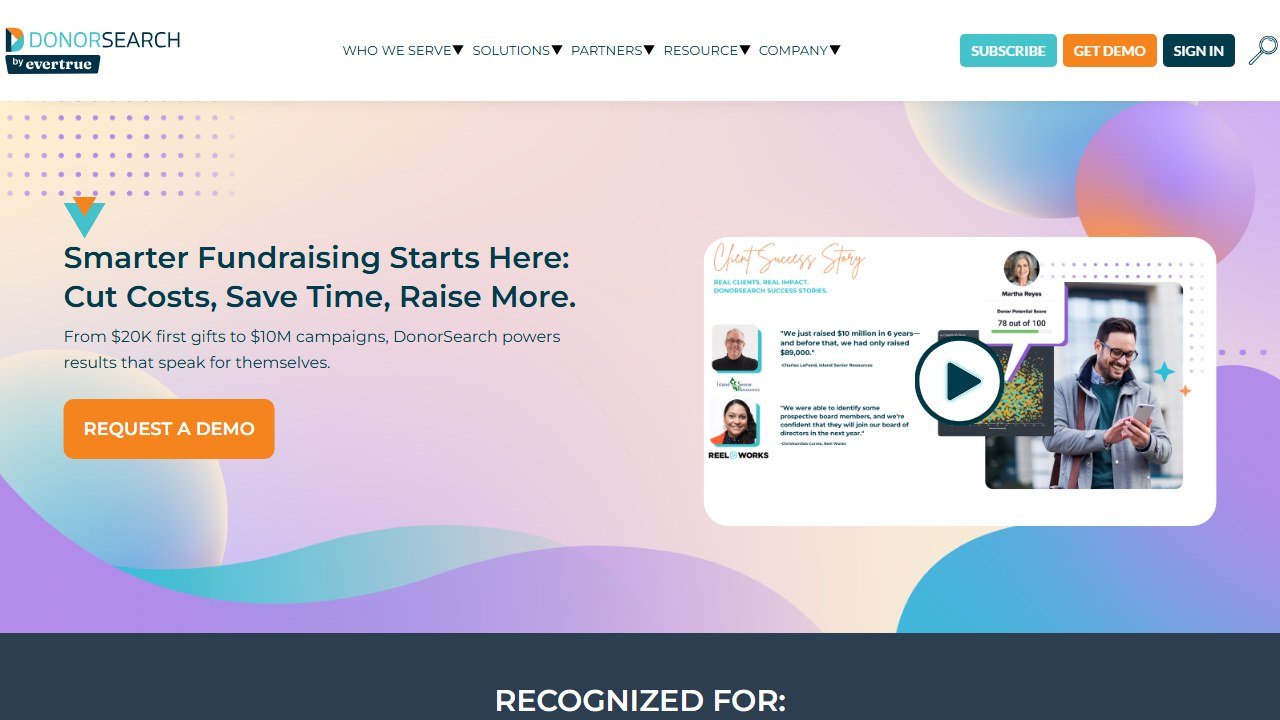
DonorSearch is one of the most established names in prospect research, and its database depth is genuinely hard to match.
What DonorSearch Does Well
Database depth. DonorSearch aggregates real estate records, SEC data, political and charitable giving, foundation affiliations, and more into capacity and propensity ratings. For major-gift discovery, this breadth is the core value and it is best in class.
Prospect identification. Its AI layer helps surface and prioritize the prospects in your database most likely to give a major gift, which focuses limited major-gift-officer time on the right names.
Batch screening. You can screen an entire database or event list and get capacity ratings back across thousands of records, which is exactly the discovery job Gratefully is not built for.
Integrations. DonorSearch connects with major CRMs so ratings flow into the records your team already works in.
What DonorSearch Does Less Well
Capacity is not action. A wealth rating tells you what someone could give, not whether now is the moment or what to say. The rating still needs a human, and increasingly an intelligence layer, to convert it into a stewarded relationship.
Less focused on the existing-donor daily workflow. DonorSearch shines at discovery and research, not at handing you a ranked list of today’s stewardship actions across your current base.
Screening fatigue. Teams often run a big screen, get hundreds of high-capacity names, and then stall because there is no system turning those names into a daily plan. That gap is precisely where an intelligence layer earns its place.
Saru’s breakdown: Picture a development director who runs a DonorSearch screen and gets back 300 high-capacity names. Great. Now what? Without a system, those 300 names sit in a spreadsheet and most are never worked. That is the screening-to-action gap.
Gratefully is built for the other side of that gap. It takes the relationships you have, including the high-capacity ones a screen surfaced, and tells you who to move forward today and why. The strongest major-gift programs use both: DonorSearch to find and rate capacity, then an intelligence layer like Gratefully to make sure that capacity actually gets stewarded instead of filed away.
If you have to sequence the spend, ask which gap is costing you more: not knowing who has money, or not acting on the donors you already know. For most small and mid shops, it is the second one.
Who Wins on Donor Intelligence
Gratefully wins as a donor intelligence system. Intelligence is data turned into decisions, and the daily action list with the cited reason is the clearest example of that in this comparison. It tells you what to do, not just what is true.
DonorSearch wins on external capacity data. If your definition of intelligence is knowing how much a person could give, DonorSearch’s database is the deepest answer in the sector. The two tools simply define the word differently.
Who Wins on Prospecting
DonorSearch wins on net-new discovery. Finding and rating capacity you did not know existed is its entire reason to exist, and nothing in Gratefully replaces a real wealth-screening database.
Gratefully wins on activating known relationships. For converting the donors and prospects already in your orbit into stewarded, moving relationships, the daily-action model is the stronger engine.
Faz’s honest pick by situation:
You want to get more from the donors you already have: Gratefully. This is most nonprofits, most of the time. The unrealized value in your current base is almost always larger than you assume.
You are launching or scaling a major-gift program and need to find capacity: DonorSearch. You cannot steward prospects you have not identified, and screening is the discovery engine.
You have a serious major-gift operation: Both. Use DonorSearch to find and rate capacity, then Gratefully to make sure that capacity gets stewarded daily instead of filed away after the screen.
If you can only buy one to start: Gratefully, because activating your existing base usually returns faster than discovering new prospects you are not yet staffed to work.
Reading DonorSearch honestly, price first
What DonorSearch actually publishes
DonorSearch is a wealth screening database rather than a CRM, and its published pricing is thin. Be careful with circulating figures here. The only published sheet we could trace sits at DonorPerfect and dates from January 2025, and the widely repeated “$1 to $2 per record” is wrong by a factor of four to twenty against it. Worse for planning, batch bundles cost more per record above ten thousand rather than less, which is the opposite of the volume discount most people assume. Get the current sheet in writing before modelling anything.
Why the published-or-not split decides your evaluation
Roughly half of this market publishes a rate card you can read without speaking to anyone, and half runs a quote form. That split, rather than the software, decides how your comparison has to be run. If one side of your shortlist publishes and the other does not, you cannot compare like for like until a quote arrives, and the quote-only vendor knows it. Price the published option precisely at your own team size and list size, then make that the number the other has to justify itself against. It is the only figure in the room both sides can verify.
The three questions that separate them in practice
First, what is the meter: seats, contacts, constituents, fundraising revenue or donations. Whichever of your numbers is growing fastest should pick the model, and that question is almost never asked before a shortlist is drawn. Second, what is not in the subscription: migration, configuration, training and payment processing sit outside almost every quote in this category, and the last of those grows with your success. Third, what does leaving cost, specifically whether live recurring gift schedules and their payment tokens transfer, because if they do not then every monthly donor must re-enter card details and a share will not.
What to do with a quote once you have one
Normalise it before comparing: same seat count, same term, implementation quoted separately, every add-on itemised, and any usage meter stated with its included allowance and top-up rate. A blended annual figure is not comparable to anything. Then negotiate the renewal cap in the first contract rather than the discount, because at renewal the vendor knows your usage, your dependency and your switching cost, and with no public rate card you have nothing to anchor against.
A note on how we treat prices here
Every figure on this page carries the date we read it at source, because this market moves. Keela raised every band by roughly 15 to 22% in under two weeks in late August 2026. Neon retired an entire tier structure. Fundraise Up withdrew its published percentage altogether between July and September. A pricing claim without a verification date is not checkable, and we withdraw our own figures when we cannot source them rather than repeating them with a hedge.
Where the figures on this page come from
Every price quoted here was read from the vendor’s own pricing page on 4 September 2026, not from an aggregator or a review site. That distinction matters more in this category than in most, because nonprofit software pricing changed materially over the past year and a great deal of what circulates online describes packaging that no longer exists.
The pages we read
Little Green Light publishes every constituent band from $45 a month. Salesforce Nonprofit Cloud publishes $60 per user per month with ten licences free under Power of Us. Bloomerang publishes $125 a month for the CRM with other products priced separately. Keela publishes every contact band from $164 a month. Dataro publishes $15,000 a year plus ten cents per active donor on a page that is not linked from its own navigation. Blackbaud and Virtuous publish no figures at all.
What we do not do
We do not carry a figure we cannot source to the vendor. Where a number circulates widely and cannot be traced to a vendor page, we say so and withdraw it rather than repeating it with a hedge, and we have withdrawn our own published figures on that basis more than once. Where a vendor confirms an unpublished price directly to us, it is attributed as confirmed by the company rather than presented as a public rate.
Why every figure carries a date
Keela raised every band by roughly 15 to 22% in under two weeks in late August 2026. Neon retired an entire tier structure. A pricing claim without a verification date is not checkable, and in this market it is usually wrong within a year.
Verdict
Gratefully is the stronger AI donor intelligence system for activating the donors you already have. It unifies your data, works the portfolio overnight, and hands you a ranked daily action list with the reason behind each recommendation. For most nonprofits, the fastest return is hiding in the current base, and that is exactly what Gratefully is built to mine.
DonorSearch is the stronger tool for discovery. Its external wealth and philanthropy database is the deepest in the sector, and for identifying and rating new major-gift capacity, nothing in Gratefully replaces it.
These are not either-or for a mature major-gift program. Use DonorSearch to find and rate capacity, then Gratefully to make sure that capacity gets stewarded daily instead of sitting in a spreadsheet. If you have to sequence the spend, start with Gratefully to activate what you already have, and add DonorSearch when you are ready to systematically prospect.
For more, see our DonorSearch review, our AI donor research tools roundup, and our best AI tools for nonprofits guide.
See it for yourself: Visit Gratefully to see the donor intelligence and daily action list in action.

Written by
FazFaz is the founder of AIToolsBakery. Some tools here are tested hands on. Others are assessed from vendor documentation and pricing verified on the live page, and every review says which one it is. Sponsors can buy a position in a guide. They cannot buy the score, the criticism, or silence about a better option.
How we test and how we make money →