Most AI writing tools treat citations as an afterthought, which makes them nearly useless for the one kind of writing where sources are the whole point: academic work. Jenni AI is built around that gap. It drafts with research awareness, suggests and inserts inline citations in the formats papers require, and works paragraph by paragraph so you stay in control of the argument. This review looks at whether that focus makes it genuinely useful for students and researchers, and where the real cautions are.
This review looks at Jenni across the work it is actually bought for: drafting sections, pulling and inserting citations, and how much of the thinking it leaves to you. Here is the honest take.
Faz says: I want to be careful here, because “AI for essays” is exactly where students get themselves in trouble. Jenni is genuinely good at the mechanical friction of academic writing, citations, structure, momentum, but it does not know whether your university allows it, and it can suggest sources that need verifying. Used as an assistant you steer and fact-check, it is a real time saver. Used to dodge the actual work, it is a risk to your grade and your integrity. Check your institution’s policy first.
What Jenni AI Does
Jenni AI is an AI writing assistant built for academic and research writing: essays, theses, dissertations, literature reviews, and papers. Its defining features are citation support, it suggests relevant sources and inserts inline citations in styles like APA, MLA, and others, and research-aware drafting that pulls from academic material rather than writing from a blank slate. It works through an autocomplete-style flow: you write, and Jenni offers to continue the next sentence or paragraph, so you stay in the driver’s seat of the argument.
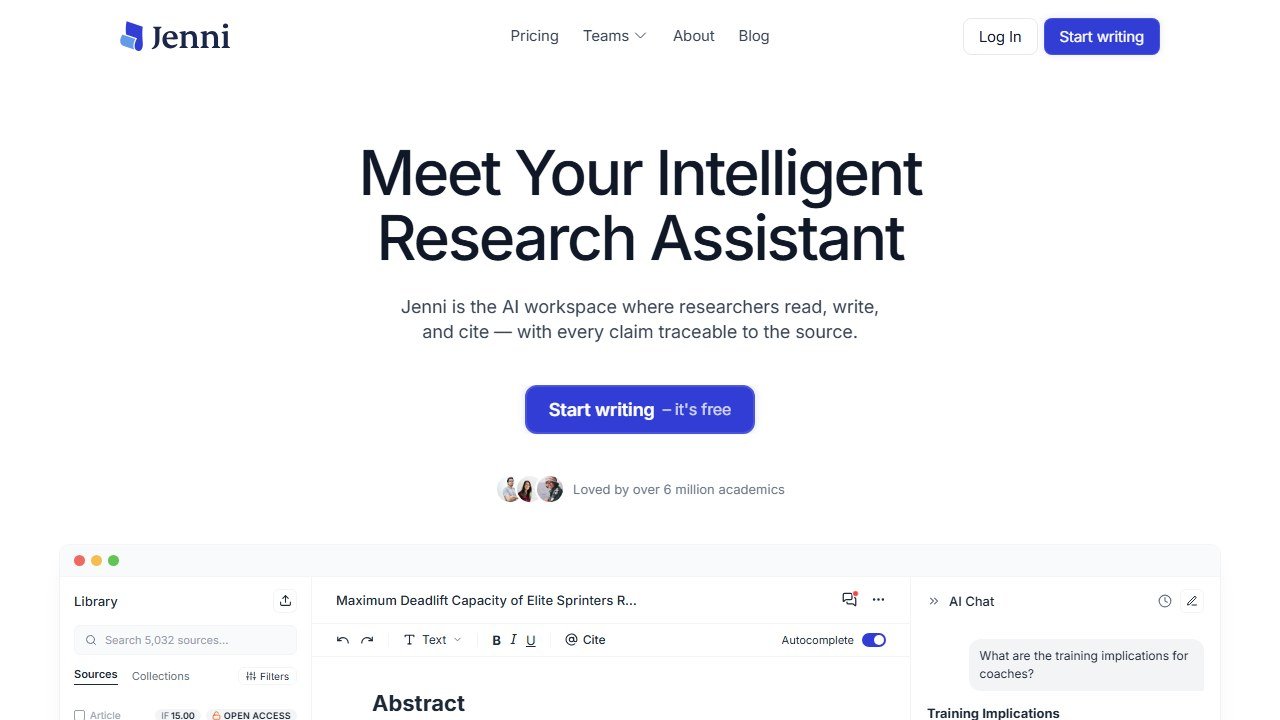
Website: Jenni AI
Around that core it adds an editor, paraphrasing and rephrasing tools, a PDF and source upload so it can write with your reading material in context, and export to the formats academic work needs. The whole product is shaped by the reality that academic writing lives or dies on sources and structure, which is what sets it apart from marketing-first tools.
How We Evaluated Jenni AI
We assess Jenni against the demands of real academic writing, drawing on documented features, current pricing, published output samples, and verified user reports. Four things matter. Citation accuracy and convenience, including whether suggested sources are real and relevant, which is the failure mode students get burned by. Whether the drafting stays on-argument. How much control the paragraph-level flow preserves. And where a careful student still needs to verify the output.
We scored Jenni against its purpose, academic writing, not marketing or fiction.
Key Features
Inline Citations
Jenni’s headline feature. As you write, it can suggest relevant sources and insert formatted inline citations in the style you choose, building your reference list as you go. In testing, the insertion workflow was a real convenience and the formatting was reliable. The essential caution: always verify that each suggested source genuinely exists, says what the citation implies, and is appropriate for your work. AI can surface plausible-looking references that do not hold up, and in academic writing that is a serious problem you, not the tool, are responsible for.
Research-Aware Drafting and Source Upload
You can upload PDFs and sources so Jenni writes with your actual reading material in context, rather than inventing from nothing. This noticeably improved relevance and kept drafts closer to the literature. It is the feature that makes Jenni feel built for research rather than generic generation.
Autocomplete Writing Flow
Jenni works sentence by sentence and paragraph by paragraph: you write, it offers a continuation, you accept, edit, or ignore. This keeps you in control of the argument instead of accepting a black-box essay, which is both better for the work and more defensible academically. It is the right interaction model for this kind of writing.
Editor, Paraphrasing, and Export
A built-in editor, rephrasing tools, and export to academic formats round out the workflow. The paraphrasing is useful for tightening, and export saves the usual reformatting hassle.
Pricing Breakdown
| Plan | Roughly | What you get |
|---|---|---|
| Free | $0 | A limited number of AI words per day to test the core flow |
| Unlimited | From ~$12/mo | Unlimited AI words, citations, and full features |
Jenni’s free tier is a daily word allowance, enough to evaluate the experience but not to write a paper. The Unlimited plan is cheaper billed annually and is the realistic option for anyone with a deadline. Confirm current pricing on Jenni’s site.
Who This Is For
Buy Jenni AI if you:
- Write academic or research-heavy work that needs proper citations
- Want research-aware drafting that uses your uploaded sources
- Prefer a paragraph-level flow that keeps you in control of the argument
- Will verify every source and follow your institution’s AI policy
Skip Jenni AI if you:
- Are at an institution that prohibits AI writing assistance (check first)
- Write marketing or SEO content (Jasper or Writesonic)
- Write fiction (Sudowrite)
- Mainly need paraphrasing or a grammar checker (QuillBot or Grammarly)
Pros and Cons
Pros
- Inline citation workflow is genuinely useful and a real differentiator
- Research-aware drafting from uploaded sources improves relevance
- Paragraph-level autocomplete keeps you in control of the argument
- Built specifically for academic structure and formats
- Usable free tier to test before paying
Cons
- Suggested sources must be verified; AI can produce unreliable references
- Academic integrity rules vary, and misuse carries real consequences
- Narrow: outside academic writing, a general tool serves better
- Free tier too limited for real paper-length work
- Output still needs your own editing and critical judgment
Saru’s breakdown: Jenni scores a 4.0, and the gap from a higher score is about responsibility, not capability. For the mechanics of academic writing, citations, structure, research-aware drafting, it is the best tool available, and the paragraph-level flow is the right way to keep a student in control. It loses points because the stakes are high and partly outside the tool’s hands: you must verify every source, and you must know your institution’s policy, because the tool cannot. Used correctly it is a strong assistant. Used carelessly it is a liability. That tension is built into the category, and Jenni handles it about as responsibly as a tool can.
How Jenni AI Compares
For students, the realistic stack is Jenni for longer academic drafting and citations plus QuillBot for paraphrasing and quick summaries, since the two cover different parts of the workflow. A general grammar pass with Grammarly fits on top. If your writing is not academic, Jenni is the wrong tool: use Jasper or Writesonic for marketing and SEO, or Sudowrite for fiction. Students should also see our best AI tools for students guide.
Academic writing: what these tools can safely do, and where the line is
Academic use is the highest-stakes application in this category and the one where a wrong answer costs the most. Here is a practical read on where jenni ai and its alternatives fit.
What the academic-facing tools price and meter
Jenni AI publishes Free at $0 a month with 10 AI autocompletes and 10 PDF uploads a day, Plus at $12 a month on annual billing with 5,000 autocompletes, unlimited PDF uploads, 500 AI edits and 500 AI chats a month, and Pro at $29 on annual billing with unlimited autocompletes. Billed monthly those two are $30 and $73, and the page opens on the annual view. It states on the page that prices are in USD with local currency available in the app. The free tier includes citation styles and unlimited citations, which is more generous than the category norm.
Citation generation is the feature that needs checking, every time
A language model can produce a reference that is correctly formatted, plausibly titled, attributed to real authors who work in the field, and does not exist. This failure is well documented and it is the specific thing that ends careers. Every reference a tool generates must be opened and read before it goes in a bibliography. A tool that pulls citations from an uploaded PDF you already have is materially safer than one generating them from a prompt, which is why the PDF upload limit on the free tier is worth more attention than the autocomplete count.
The line most institutions actually draw
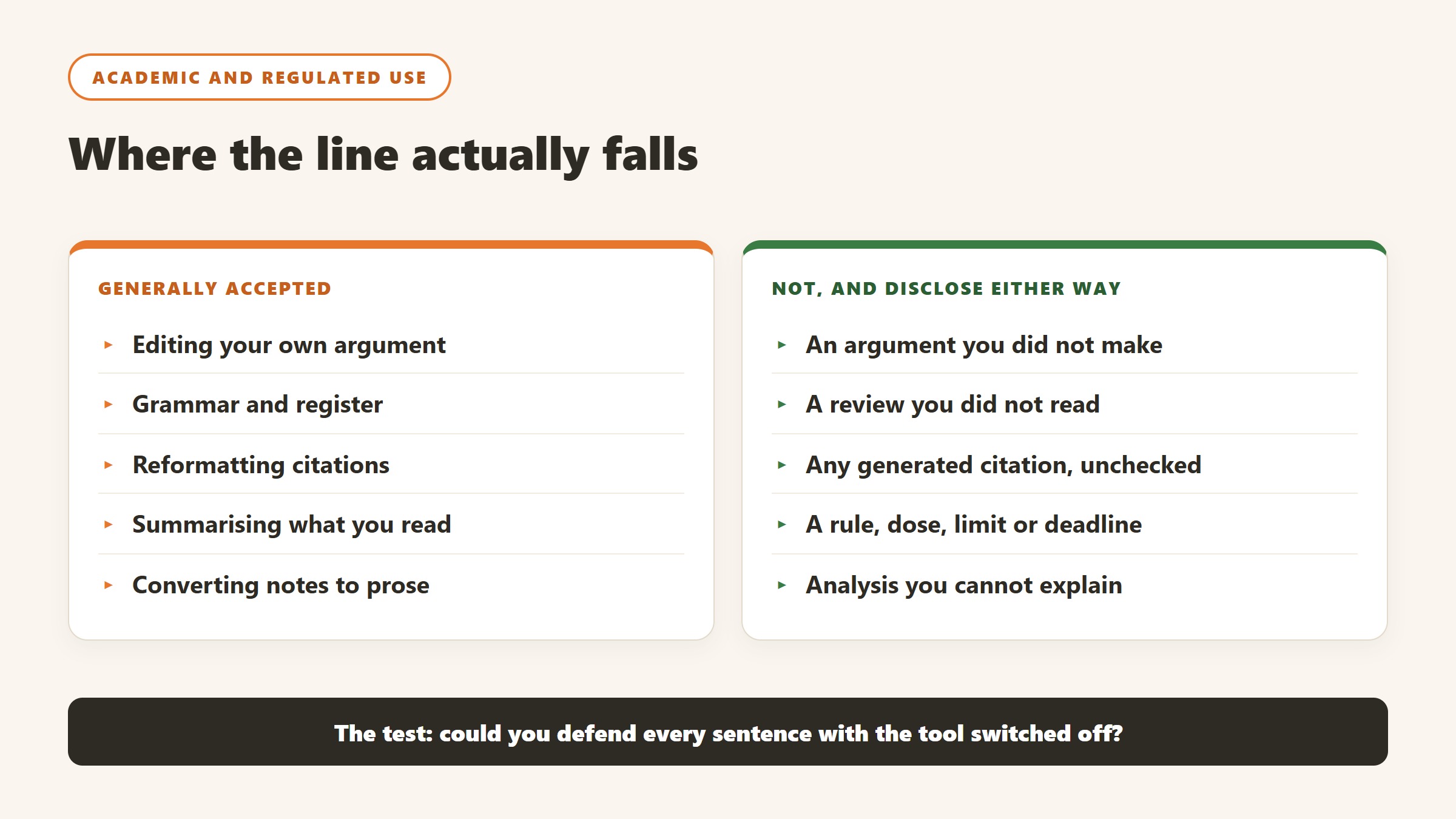
In practice the distinction is between assistance with expression and substitution for thought. Editing your own argument for clarity, checking grammar, reformatting citations and summarising a paper you have read are generally accepted. Generating an argument you have not made, a literature review you have not read, or an analysis you cannot explain is not. The reliable test is whether you could defend every sentence in a viva without the tool present.
Say what you used
Disclosure requirements vary by institution, journal and even by supervisor, and they change faster than the guidance documents do. Read your own institution’s current policy rather than a general summary, including this one, and when it is ambiguous, ask and keep the answer in writing. The cost of asking is a short email. The cost of assuming is your degree.
One practical safeguard
Keep the machine draft and your edited version as separate files. If a question is ever raised, being able to show what the tool produced and what you changed is a far better position than reconstructing it afterwards, and it takes no effort at the time.
AI detection and humanising, described honestly
This is the part of the category where the marketing and the evidence disagree most, so here is what can and cannot be said.
Detectors produce probabilities, not proof
An AI detector returns a likelihood score derived from statistical properties of the text, typically how predictable each word is given the ones before it. That is not the same thing as knowing who or what wrote something. Human writing that is unusually plain, or written by someone composing in a second language, scores as machine-written more often than fluent idiosyncratic prose does. Any process that treats a detector score as a finding rather than as a prompt to look closer will produce false accusations, and it will produce them unevenly across the people it is applied to.
What the humanising tools actually do
NetusAI and tools like it publish an AI detector alongside a bypasser and a paraphraser, and price them together by credits: $0, $14, $30, $59 and $99 a month for 50 through 100,000 credits. Mechanically these rewrite text to raise its unpredictability, which is what the detectors measure. The arms race between the two is real and neither side wins permanently, so a specific claim about a specific detector has a shelf life measured in months.
The legitimate uses, which are not the ones in the ads
There are honest jobs here. Reworking machine-drafted text so it reads in your own voice is ordinary editing. Checking your own writing before submitting it somewhere that screens with a detector is defensive, not deceptive. Rewriting a first draft to remove the tells of a model is what a good editor does anyway. What none of this changes is whether the underlying claim is true, cited and yours to make.
Where it becomes a genuine problem
Passing off machine text as your own where the reader is entitled to assume otherwise is misconduct regardless of whether a detector catches it, and that includes coursework, disclosures and anything with a professional attestation attached. The tool does not change the obligation. It only changes the probability of being noticed, which is a different question from whether it is acceptable.
If you have to make a policy about this
Write the policy about disclosure and verification rather than about detection. Ask people to say what assistance they used, and check the substance of the work rather than its statistical texture. A rule you can enforce fairly with a five minute conversation beats a rule that depends on a score you cannot explain or defend.
Credits, words and articles: the meter decides your bill, not the tier
Almost every tool here charges a monthly subscription, and almost none of them charge for the same unit. That is the reason two people with the same plan report wildly different costs. Here is how each meter behaves, checked on 5 September 2026, and how it compares to jenni ai.
Credits per month, which are not words
Sudowrite publishes $10, $22 and $44 a month with 225,000, 450,000 and 2,000,000 credits a month, and says unused credits roll over for twelve months. Worth flagging: its middle card displayed two credit figures at once, 1,000,000 and 450,000, which is a promotional allowance shown against a base. Confirm which applies at checkout. NetusAI publishes $0, $14, $30, $59 and $99 a month for 50, 1,500, 10,000, 40,000 and 100,000 credits respectively, or $97, $215, $419 and $710 a year, which it displays as $8.08, $17.91, $34.91 and $59.16 a month.
Why rollover changes the maths more than the rate
Writing is bursty. You draft nothing for three weeks and then produce forty thousand words in four days. A plan that expires unused credits every month prices you for your peak while charging you all year; a plan that rolls them over prices you for your average. Sudowrite’s twelve month rollover is worth more than a small difference in headline rate to anyone whose output is uneven, which is most people who write.
Workflow credits are a third unit again
Copy.ai meters workflow credits at the business tiers, 20,000 a month at $1,000, 45,000 at $2,000 and 75,000 at $3,000, alongside unlimited words in chat. That distinction matters: unlimited chat and metered workflows means the cost lands on automation rather than on writing. If your use case is a person typing, that plan is mispriced for you. If it is a pipeline running unattended, the credit number is the only figure on the page that matters.
The one meter you can budget against directly
SEOWriting AI prices per article, up to 50, 250, 500 and 1,000 a year at its four tiers. That is the only unit in this category that maps onto a plan you would actually write down, and it lets you calculate a true cost per piece before you buy. Everything else requires you to estimate a conversion between the vendor’s unit and your work.
The question to ask before subscribing
Ask what happens when you run out mid-month. Some vendors throttle, some stop, some sell a top-up, and some quietly degrade to a smaller model. That answer, not the headline rate, determines what the tool costs you on the week you actually need it.
Verdict
Jenni AI is the best AI tool for academic writing in 2026 because it solves the friction general writers ignore: citations, structure, and research-aware drafting, all through a paragraph-level flow that keeps you in control of the argument. For students and researchers who use it responsibly, it is a real time saver.
The score sits at 4.0 rather than higher because the category carries genuine risk. You must verify every source, since AI can produce unreliable references, and you must know your institution’s stance on AI assistance, because the tool cannot tell you. Used as an assistant you direct and fact-check, Jenni is excellent for its job. Pair it with QuillBot for paraphrasing, check the best AI tools for students guide, and for the full field see our best AI writing tools roundup.
Rating: 4.0/5

Written by
FazFaz is the founder of AIToolsBakery. Some tools here are tested hands on. Others are assessed from vendor documentation and pricing verified on the live page, and every review says which one it is. Sponsors can buy a position in a guide. They cannot buy the score, the criticism, or silence about a better option.
How we test and how we make money →