
Most AI sales coaching rollouts die for the same reason: the tool gets switched on for the whole team in week one, reps decide the robot is grading them for their manager, and within a month nobody logs in. The technology was never the problem. The rollout was.
A 30-day window is not enough to transform a sales org, but it is exactly enough to run a disciplined pilot that earns the right to expand. This playbook is tool-agnostic on purpose. Whether you land on call-intelligence coaching like Gong and Mindtickle, or AI roleplay like Second Nature, Hyperbound, and Yoodli, the sequence below is the same. Pick your lane, then follow the weeks.
Before day one: decide what you are actually coaching
Do not open a vendor demo until you can finish this sentence: “Reps are losing deals because they ___.” Bad discovery. Weak multithreading. Fumbled pricing objections. Talking 70% of the call. Whatever it is, that gap is your rollout’s north star, and it decides which category of tool you need.
There are two broad families, and confusing them wastes your 30 days.
Call intelligence records and analyzes real calls after they happen. Tools like Gong, Mindtickle, and Allego transcribe conversations, score them against your criteria, and surface moments a manager should review. This is coaching on reality.
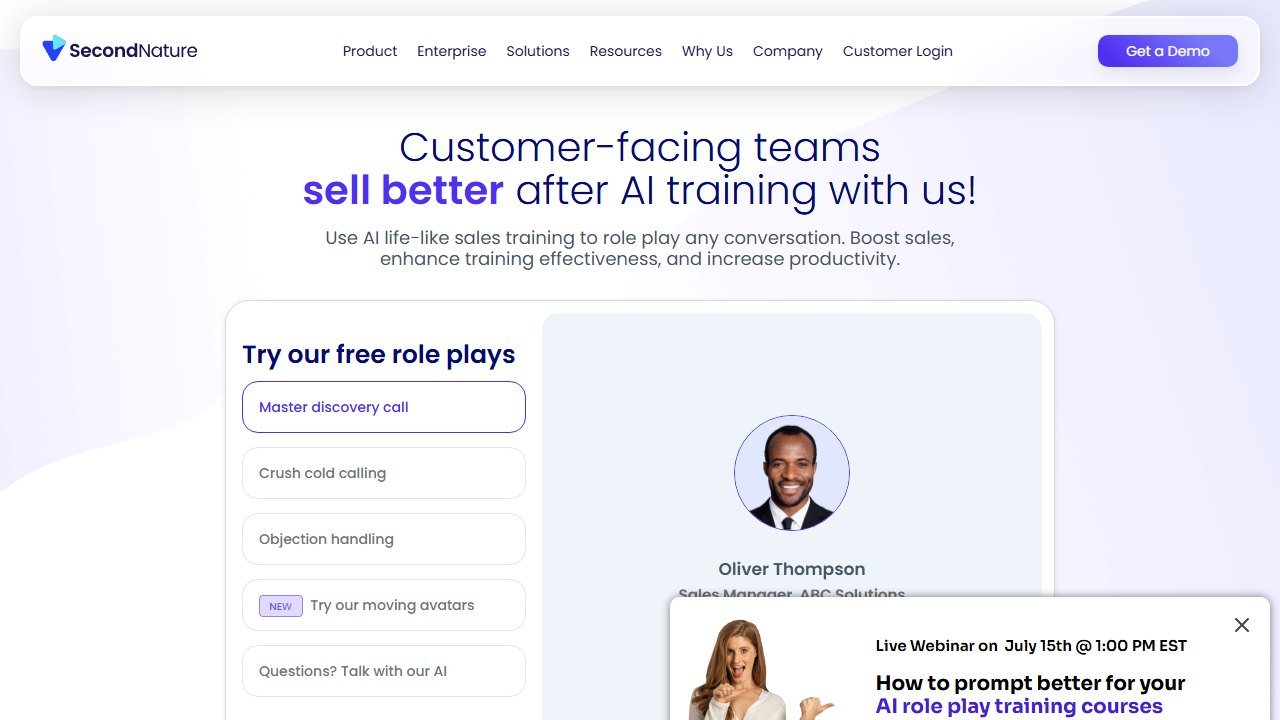
AI roleplay lets reps rehearse against a simulated buyer before the real call. Second Nature, Hyperbound, Yoodli, and Quantified spin up an AI persona that pushes back, objects, and reacts, then scores the rep. This is coaching on repetition.
You can run both eventually. You should not launch both in the same 30 days. Pick the one that maps to your gap. Slow ramp and reps who freeze on objections point to roleplay. Inconsistent discovery and deals dying in the middle point to call intelligence. If you are still deciding between platforms, our roundup of the best AI sales training software breaks the categories down further, and the best AI sales roleplay tools guide covers the practice side specifically.
**Faz says:** I have watched teams buy a $40k call-intelligence contract to fix a problem that was really about reps never practicing objection handling. Wrong lane. Write the “reps are losing deals because they ___” sentence first. It saves you a quarter.
Week 1: Baseline everything and pick your pilot
You cannot prove lift if you never measured the starting line. Week one is measurement and setup, not coaching.
Lock your baseline metrics. Pull the last 90 days on the numbers that matter for your gap: win rate, average sales cycle length, ramp time for new reps, and a conversation metric like talk-to-listen ratio if your tool captures it. Write them down somewhere permanent. According to Bridge Group research, the average B2B rep takes roughly nine months to reach full productivity, so ramp time is often the most persuasive number to move.
Choose 3 to 5 pilot reps, and make them volunteers. Do not draft your weakest performers or your loudest skeptics. Pick a mix of one strong rep, two solid middle-of-the-pack reps, and one newer rep. Volunteers protect you from the “this is surveillance” narrative that kills adoption, and a strong rep in the pilot gives the AI a benchmark of what good sounds like.
Connect the plumbing. For call intelligence, that means integrating the tool with your dialer, conferencing, and CRM so calls flow in automatically. For roleplay, it means confirming SSO and getting scenario authoring access. Feed a call-intelligence tool 50 to 100 historical calls if it supports upload, split between closed-won and closed-lost, so it has a corpus to learn your patterns from.
Tell the whole team what is happening. Even though only a handful are piloting, announce it openly. Say what the tool is, why you are testing it, and the one rule that matters most: scores are for coaching, never for comp or reviews. Transparency in week one is cheaper than rebuilding trust in month three.
Week 2: Calibrate the scoring so reps trust it
An AI coach that scores a great call as mediocre will be ignored forever. Week two is about making the tool’s judgment match your team’s reality before a single rep is told to act on it.
Define 3 to 5 custom criteria. Out-of-the-box scorecards are generic. Replace or supplement them with the behaviors tied to your gap and your methodology, whether that is MEDDIC qualification, a specific discovery framework, or the two objections your ICP always raises. Fewer, sharper criteria beat a 20-line rubric nobody reads.
Run the tool in observation mode. Let it score your pilot reps’ real or practice calls without anyone being coached on the output yet. Then sit with a sales manager and compare: where the AI and the human agree, you have a trustworthy signal. Where they diverge, tune the criteria or the difficulty. This calibration step is the one most teams skip, and it is why their rollout feels arbitrary.
Use your top rep as the yardstick. Whatever the AI scores your strongest performer becomes the informal “this is what good looks like” line. If the tool ranks your best closer in the middle of the pack, the model is miscalibrated, not the closer.
**Saru says:** The teams that get real lift surface specific moments and coach 3 to 5 behaviors at a time. Using AI purely to hand reps a grade creates defensiveness, not improvement. Calibration in week two is what turns a scoreboard into a coach.
Week 3: Run the pilot for real
Now the pilot reps get coached on the output. This is where you find out whether the thing works in the hands of actual humans.
Set a light cadence. For roleplay, ask each pilot rep to complete two to three scenarios a week during the pilot. Second Nature, Hyperbound, and Yoodli all let you assign scenarios and set a passing threshold, so define what “passed” means, for example a 70% score on objection handling. For call intelligence, have each rep and their manager review one flagged call per week together.
Coach behaviors, not scores. The manager’s job is to pick 3 to 5 specific moments the AI surfaced (“here is where you talked over the buyer’s budget concern”) and work on those. Dumping a full 15-metric scorecard on a rep produces defensiveness and nothing else. Small, specific, repeated beats comprehensive.
Capture the first quick win publicly. Most teams see something usable inside two weeks: a rep who cut filler words in half, a discovery question that started landing, a practiced objection that closed a real deal. Get that story in front of the wider team. Nothing sells a rollout like a peer saying it helped.
Log friction as you go. Every “the AI misread this” or “the persona was unrealistic” complaint is data. Keep a running list. Half will be calibration fixes, and half will be the honest limitations you need to set expectations around before you scale.
Week 4: Measure, decide, and plan the expansion
The final week converts a month of activity into a go or no-go decision and a rollout plan leadership will fund.
Compare against your week-one baseline. Thirty days is too short to move win rate meaningfully, so lean on leading indicators: practice frequency, coaching-action completion, talk-to-listen ratio on live calls, and pilot reps’ self-reported confidence. These move first. The lagging outcomes like win rate and cycle length are what you commit to re-measuring at 90 and 180 days.
Write a one-page business case. State the gap you targeted, the tool you piloted, the cost, the leading-indicator movement, and the pilot reps’ verbatim feedback. This is the artifact that unlocks the wider budget. If you want a fuller framework for building the program around this pilot, our guide on how to build an AI training program walks through the KPI mapping in detail.
Plan the phased expansion. Do not flip it on company-wide the day the pilot ends. Expand by team, recruit the pilot reps as champions who train the next cohort, and keep the “coaching not comp” rule non-negotiable. A realistic timeline is pilot in month one, first team expansion in month two, and broader rollout in month three once managers are comfortable owning the dashboards.
**Faz says:** The single best predictor of whether AI coaching sticks is whether the direct manager spends five minutes a week in the dashboard. Not the tool’s features. Not the AI’s accuracy. The manager. Budget your rollout energy accordingly.
The specific-picks cheat sheet
Tool-agnostic does not mean tool-blind. Here is where each option tends to fit a 30-day rollout, so you can shortlist fast.
| Tool | Coaching type | Best for in a 30-day pilot | Pricing model |
|---|---|---|---|
| Gong | Call intelligence | Teams with call volume that want deal and conversation analytics on real calls | Per-seat, quote-based |
| Mindtickle | Readiness + call intelligence | Structured enablement programs with scorecards and certification | Per-seat, quote-based |
| Allego | Call intelligence + coaching | Async video coaching and content-driven enablement | Per-seat, quote-based |
| Second Nature | AI roleplay | Structured, conversational practice with scored simulations | Per-seat, quote-based |
| Hyperbound | AI roleplay | Fast, realistic cold-call and discovery buyer bots for ramping reps | Per-seat, quote-based |
| Yoodli | AI roleplay + speech coaching | Low-friction start, free tier, communication and filler-word coaching | Free tier, paid per-seat |
| Quantified | AI roleplay + simulation | Data-rich behavioral scoring across large rep populations | Per-seat, quote-based |
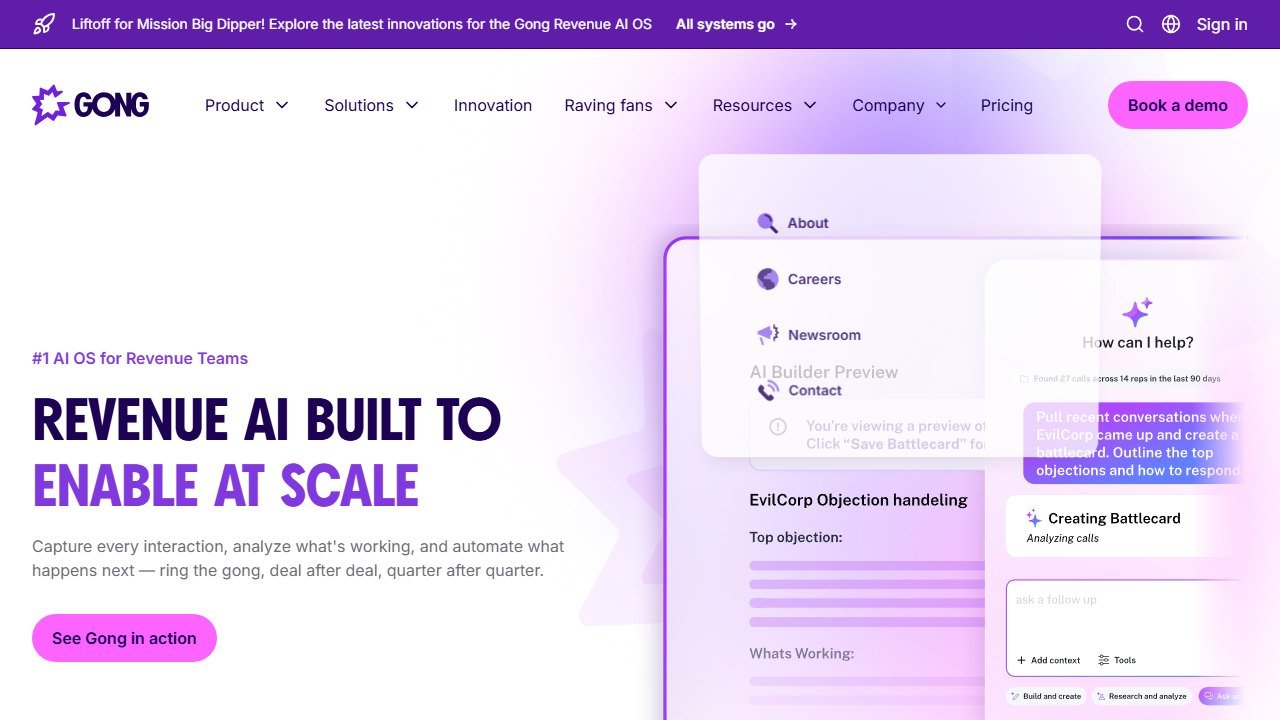
For call-intelligence-led rollouts, Gong and Mindtickle are the two most common enterprise picks, and our Mindtickle review covers where its readiness scoring earns the price. For roleplay-led rollouts, the choice usually comes down to Second Nature versus Hyperbound versus Yoodli. We compare the first two philosophies in Hyperbound vs Second Nature, and if you want the lowest-friction on-ramp, the Yoodli review and Second Nature review both cover free and paid tiers.
The three mistakes that sink 30-day rollouts
Even a well-sequenced rollout fails on the same avoidable errors. Watch for these.
Tying scores to comp. The fastest way to teach reps to game or ignore the AI is to let its scores leak into reviews or bonuses. Keep it in the coaching lane. This is the rule you repeat in week one and never break.
Coaching the whole scorecard at once. A rep who gets 15 metrics dumped on them fixes none of them. Three to five behaviors, coached repeatedly, is how change actually happens.
Skipping calibration. If you go straight from purchase to team-wide launch without the week-two calibration, reps will hit one wrong score, decide the tool is dumb, and never trust it again. The two hours you spend calibrating buy you the credibility the whole rollout depends on.
Get those three right, follow the weeks, and 30 days is genuinely enough to prove AI sales coaching works for your team, and to walk into the budget conversation with data instead of a hunch. For the full landscape of platforms across every training use case, start with our pillar on the best AI corporate training tools.
Why the price you see may not be the price we saw
This deserves its own section because it affects several tools in this category and almost no comparison article accounts for it.
What we actually observed
When we read Synthesia’s pricing page on 4 September 2026, every plan figure was in rupees, because our captures run from an Indian IP address and the site served local pricing automatically. HeyGen went further: a request to heygen.com/pricing redirected to its /en-in/ locale even when we sent a United States language header, meaning the routing is by IP rather than by browser preference.
Why this breaks most price comparisons
An article quoting a single global figure for a geo-priced tool is describing one country’s rate card and presenting it as the price. Regional pricing is not usually a straight currency conversion either; vendors set local rates deliberately, so the ratio between two markets can differ considerably from the exchange rate. That means you cannot fix the problem by converting, and we do not attempt to.
How to check your own number in thirty seconds
Open the vendor’s pricing page yourself, from the country where the contract will sit, and look at the currency symbol before you look at the number. If the URL contains a locale segment such as /en-in/ or /en-gb/, you are on a regional page. Where a vendor offers a currency selector, note that changing it sometimes changes the plan structure and not merely the symbol.
What to ask when the contract is cross-border
If your company is registered in one country and the team is in another, ask which entity is billed, in which currency, and whether the rate is fixed for the term or moves with a published exchange rate. Ask whether taxes are included, because several vendors here publish figures excluding tax. These questions are dull and they are the difference between a budget that holds and one that drifts by a fifth.
Where the figures on this page come from
Every price here was read from the vendor’s own pricing page on 4 September 2026 and carries that date. Where a page served us regional pricing we say so rather than converting it, because regional rates are set deliberately and are not a currency conversion.
The pages we read
Yoodli publishes $8 and $20 a month billed annually plus a free tier. Colossyan publishes a free plan and Professional at $59 a month annually with $30 per additional member. HeyGen publishes $0, $29, $49 and $149 a month with team seats at $20. iSpring publishes $970, $1,290 and $720 USD per author per year. Deputy publishes $5, $6.50 and $9 per user per month excluding tax. Synthesia served us rupee pricing, reported as such above.
The ones that publish no figure
Second Nature, Hyperbound, Mindtickle, Highspot and Visier all declined to show us a price, and Allego publishes a pricing page with no currency figure on it at all. Articulate publishes only a limited-time offer, currently $1,198 per user per year against a struck-through $1,749. Treat any other figure for those seven as unverified.
What we do not do
We do not convert currencies, and we do not carry a figure we cannot source to the vendor. Where a number circulates and cannot be traced, we say so and withdraw it rather than repeating it with a hedge.
What sales training and roleplay platforms actually charge
This is one of the least transparent categories we cover. Most vendors quote rather than publish, which changes how the evaluation has to be run. Here is each alternative to how to, read at source on 4 September 2026.
Yoodli, the only one here with a published individual rate
Yoodli publishes $8 a month billed annually for its Pro individual plan, which includes up to ten roleplays a week and live AI coaching, and $20 a month billed annually above that. It also runs a free tier. That makes it the only platform in this comparison a single person can price without speaking to anyone, which matters if you want to test the category before committing a team budget.
The five that publish no figure at all
We could not read a price from Second Nature, Hyperbound, Mindtickle, Highspot or Visier on 4 September 2026. Hyperbound and Highspot both render a pricing page carrying no currency figure. That is a commercial choice rather than an oversight, and it is the norm at the enterprise end of sales enablement.
Allego publishes a pricing page with no price on it
Allego is worth calling out separately. It has a real pricing page, headed “Simple Sales Enablement Pricing. Clear Results.”, and there is not a single currency figure anywhere on it. It does publish something useful though: a contract buyout programme for customers switching from a competitor mid-term. If you are locked into a rival, that is worth asking about specifically, because it is the kind of term that rarely appears in a comparison table.
What to do when almost nobody publishes
Price a published alternative precisely at your seat count and make it the number every quote has to justify itself against. Yoodli at $20 a month billed annually across 40 reps is $9,600 a year. That is not a like-for-like substitute for an enterprise enablement platform, and it is a real figure in the room that both sides can verify, which is more than you will otherwise have.
Ask what the platform fee is separate from the seats
Several vendors in this category price as per-user licences plus a platform fee that scales with the number of users supported. That means the cost does not fall as neatly with a smaller pilot as you might expect, and a 10-seat pilot can carry most of the platform cost of a 50-seat deployment. Ask for both components separately before modelling a phased rollout.

Written by
FazFaz is the founder of AIToolsBakery. Some tools here are tested hands on. Others are assessed from vendor documentation and pricing verified on the live page, and every review says which one it is. Sponsors can buy a position in a guide. They cannot buy the score, the criticism, or silence about a better option.
How we test and how we make money →