
Fundraise Up used to be the easiest pricing page in this category to summarise: 4% per transaction, nothing else. No subscription, no setup fee, no contract, no tiers. We verified all of that on Fundraise Up’s pricing page on 14 July 2026.
It is not there any more. We read the same page again on 4 September 2026, with every accordion opened, and there is no percentage on it at all. The headings now read “Performance-based pricing. Zero risk.” and the call to action is “Request a demo”. Fundraise Up has joined the majority of this market in quoting rather than publishing, and that is the single most useful thing to know before you budget.
Simple was not the same as cheap, though, and the arithmetic is still worth having. A 4% platform fee sat on top of payment processing, and depending on how your donors behave, the real cost landed anywhere between about 1.2% and 6.5% of every card gift. That spread is the whole story, and it is the math this page exists to run. If you want the feature verdict, our full Fundraise Up review owns that. This page is fee math only: what you actually pay per donation, what donor fee coverage does to that number, and the exact volume where a subscription platform starts to win.
What changed, and how we know
On 14 July 2026 we read a single figure on fundraiseup.com/pricing: 4% per transaction, one plan, no subscription and no contract. On 4 September 2026 we read the same URL again and there is no percentage on the page.
We checked properly before saying that
A page that renders as an empty shell in a headless browser will report a price as absent when it is merely unloaded, which is a mistake we have made before and will not repeat. So we waited for the page to hydrate, scrolled it end to end, opened every accordion and expandable element on it, then read the rendered source rather than the visible text, because a collapsed answer sits in the HTML where the visible text cannot see it. That produced 15,294 characters of content and nine percentages, every one of which is a conversion rate, a retention rate or a case study result. None is a fee.
What the page publishes instead
The headings are now “Performance-based pricing. Zero risk.” and “Pricing that’s simple”, with a “Request a demo” call to action. It publishes a claim rather than a rate: that 80% of donors cover transaction costs. It also publishes what you will never get, listing lock in contracts, implementation fees and upgrade pushes. That is genuinely useful packaging information, and it is not a price.
Why we have kept the 4% on this page
Because it is dateable. We read it at source on a stated day, and the arithmetic built on it still tells you what a percentage-of-donations model does to a fundraising budget, which is the thing this page is for. Everything below is labelled as the July 2026 published rate. Treat it as the number a current quote should be checked against, not as the price today. If Fundraise Up quotes you something different, that is the story, and we would like to hear it.
What to ask them now
Ask for the percentage in writing, ask whether it varies by volume, channel or payment method, and ask what it was for organisations your size in the last quarter. Then ask the question the removal makes unavoidable: if the rate is the same for everyone, why is it no longer on the page? A vendor that is comfortable with its pricing usually publishes it, and several of its rivals still do.
Fundraise Up fees at a glance
| Fee component | Amount | Notes |
|---|---|---|
| Platform fee | 4% per transaction withdrawn from the pricing page by 4 Sep 2026 | Single plan, verified 14 July 2026, no longer published |
| Monthly subscription | $0 | No subscription on any volume |
| Setup fee | $0 | None listed |
| Contract | None | No term commitment |
| Card processing (Stripe) | 2.2% + $0.30 per transaction | Charged on top of the platform fee |
| PayPal processing | Billed separately | PayPal’s own fees apply |
| Users, donors, features | Unlimited, all included | No tiers, no enterprise upsell listed |
| All-in cost, $100 card gift | $6.50 (6.5%) | Before donor fee coverage |
| Modeled net cost with 80% donor coverage | ~1.2 to 1.5% of volume | Our model using the vendor’s coverage claim |
How the 4% model works
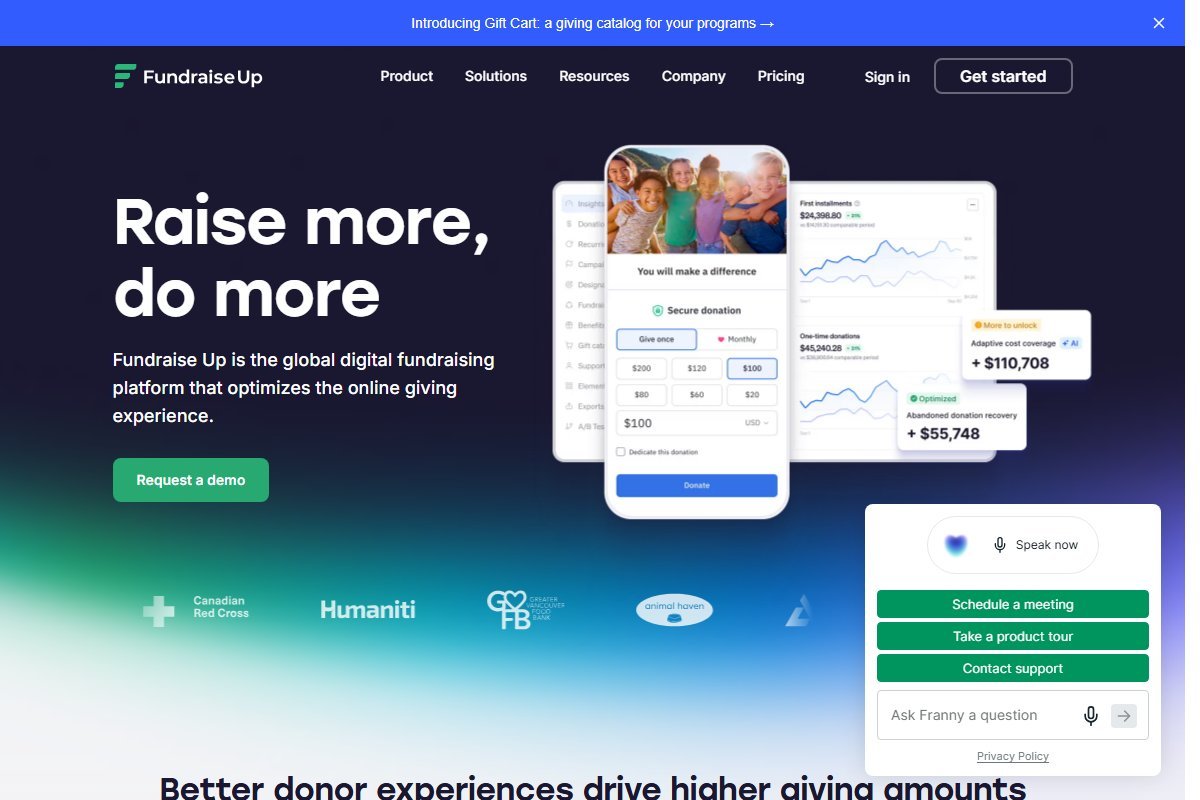
There is exactly one plan. It includes unlimited users, unlimited donors, and every feature the platform ships, from the AI-optimized checkout to recurring gift management. There are no tiers to compare, no per-seat charges, and no enterprise plan lurking behind a “contact sales” button. The pricing page we checked lists no volume thresholds and no feature gates at all.
That matters for budgeting because your Fundraise Up line item is a pure percentage of what you raise. Raise nothing in a slow month, pay nothing. Triple your volume in December, and the fee triples with it, but so did the revenue funding it. For small teams that have been burned by paying a platform subscription through a dead summer, this structure is the appeal.
The catch is that 4% is a headline number, not the whole number. Payment processing is separate, and that is where the real per-donation math starts.
The worked math: what one card donation actually costs
Here is the full stack on a card gift processed through Stripe:
- Platform fee: 4% of the donation
- Stripe processing: 2.2% of the donation, plus $0.30 flat
That is roughly 6.2% plus $0.30 per card donation before anyone covers anything. Run it on real gift sizes and the flat $0.30 makes small gifts proportionally more expensive:
- $25 gift: $1.00 platform + $0.85 Stripe = $1.85 total, a 7.4% effective rate
- $100 gift: $4.00 platform + $2.50 Stripe = $6.50 total, a 6.5% effective rate
- $500 gift: $20.00 platform + $11.30 Stripe = $31.30 total, a 6.3% effective rate
So the honest pre-coverage answer is: expect to give up between 6.3% and 7.4% of a typical card donation, with the rate drifting down as gift size goes up. PayPal donations carry PayPal’s own fees instead of Stripe’s, billed separately, so model those independently if PayPal is a meaningful slice of your volume.
If 6.5% just made you flinch, hold on. The next section is where Fundraise Up’s model either earns its keep or does not.
Donor fee coverage: the number that changes everything
Fundraise Up’s checkout asks donors to cover transaction costs, and the vendor states that 80% of donors do so automatically. It cites UNICEF USA seeing 82% coverage. Both figures are vendor-claimed, so treat them as a best case rather than a guarantee, but they are also the entire economic argument for this platform, so let’s model them.
If 80% of your donation volume arrives with fees covered by the donor, your organization only absorbs fees on the remaining 20%. Take the $100 gift’s 6.5% all-in cost:
- 20% of volume at 6.5% cost = 1.3% net cost across all volume
Run the same model across the gift sizes above and the modeled net cost lands near 1.2 to 1.5% of total donation volume. On $100,000 raised, that is roughly $1,200 to $1,500 out of pocket instead of $6,300 to $6,500. That is the difference between Fundraise Up being one of the most expensive options on the market and one of the cheapest.
Two cautions on the model. First, coverage rates vary by audience: a young, digital-native donor base behaves differently from a direct-mail-converted major gift file. Second, some organizations see coverage dip on very large gifts, where a donor happily covers $2 on a $50 gift but balks at covering $130 on a $2,000 gift. Neither pattern is published data, which is exactly why we would pressure-test the claim on your own donor file before budgeting around 1.3%.
Break-even vs a subscription platform
The alternative structure is a platform that charges a flat subscription and a lower (or zero) platform fee per transaction. Our DonorPerfect pricing breakdown and Bloomerang pricing breakdown cover two real examples of subscription-style pricing in this category. For the break-even math here, we will use a deliberately generic model rather than any specific vendor’s rates: a hypothetical platform charging $1,800 per year (about $150 per month) with a 0% platform fee, where both platforms pay identical card processing.
Since processing costs are the same on both sides, the comparison reduces to: Fundraise Up’s platform fee vs the $1,800 subscription.
Scenario 1: no donor coverage. You absorb the full 4%. Break-even volume is $1,800 divided by 0.04, which is $45,000 per year. Below $45,000 raised annually, Fundraise Up costs less. Above it, the subscription platform wins on fees alone.
Scenario 2: 80% donor coverage. You absorb 4% on only a fifth of your volume, an effective platform cost of 0.8%. Break-even becomes $1,800 divided by 0.008, which is $225,000 per year. Now Fundraise Up stays cheaper until you are processing nearly a quarter million dollars in online donations annually.
Scenario 3: coverage somewhere in between. At 50% coverage (effective 2%), break-even is $90,000 per year.
The pattern is clear: donor coverage does not just lower your cost, it moves the break-even point by a factor of five. A nonprofit raising $150,000 online per year pays about $6,000 in platform fees with no coverage (subscription wins easily) or about $1,200 with 80% coverage (Fundraise Up wins easily). Same organization, same volume, opposite conclusion.
One more thing subscriptions buy that percentages do not: predictability. A finance committee that wants a fixed line item will prefer $150 a month over a fee that spikes every December. That is a governance preference, not a math one, but it is real.
What to check before the sales call
The published pricing is refreshingly complete, but a few things still belong on your pre-call checklist:
- Your realistic coverage rate. Ask for coverage data from organizations your size, in your vertical, with your donor demographics. This one number swings your effective cost from 1.2% to 6.5%.
- PayPal volume. PayPal fees are billed separately at PayPal’s rates. If a third of your donors pay through PayPal, model that lane on its own.
- Average gift size. The $0.30 flat fee punishes small gifts. Orgs with $15 average gifts should run the math at $15, not $100.
- Whether 4% is negotiable at volume. The public page lists a single rate with no volume tiers. We have no verified evidence of negotiated discounts, so assume the 4% is the 4% unless a sales conversation says otherwise in writing.
- Migration and integration effort. There is no setup fee, but your team’s time wiring it into your CRM is not free. Our Fundraise Up review covers the integration surface in detail.
Who the 4% model fits
Great fit: small and mid-sized nonprofits with unpredictable or seasonal online revenue, teams that cannot justify a fixed platform cost, and organizations with digitally engaged donor bases likely to cover fees. If you raise under $100,000 online per year, it is genuinely hard to construct a scenario where a subscription platform beats a well-covered 4%.
Worth running the numbers: organizations between roughly $100,000 and $250,000 in annual online volume. Your coverage rate decides this bracket, so test it before committing either way.
Probably look elsewhere: high-volume shops processing $250,000+ online annually with mediocre donor coverage, and micro-donation-heavy programs where the flat $0.30 stacks up. At that scale, platforms with flat pricing or lower percentage fees deserve a serious look. Our Fundraise Up vs Donorbox comparison and Givebutter vs Fundraise Up matchup walk through the closest structural alternatives, and Givebutter’s free-plus-tips model is the most aggressive counter-pitch on price in this category.
One honest limitation
Fundraise Up’s cost is structurally unhedgeable. With a subscription platform, a blowout December costs you the same $150 that August did. With Fundraise Up, your best fundraising month is also your highest-fee month, forever, and there is no published volume tier to grow into. The single-plan simplicity that makes it easy to adopt at $50,000 a year is the same thing that gives your CFO nothing to negotiate at $500,000 a year. If your growth plan takes online revenue past the quarter-million mark, build the platform switch (or the rate conversation) into the plan now rather than discovering the ceiling later.
What the rest of the giving platforms charge, and what they meter on
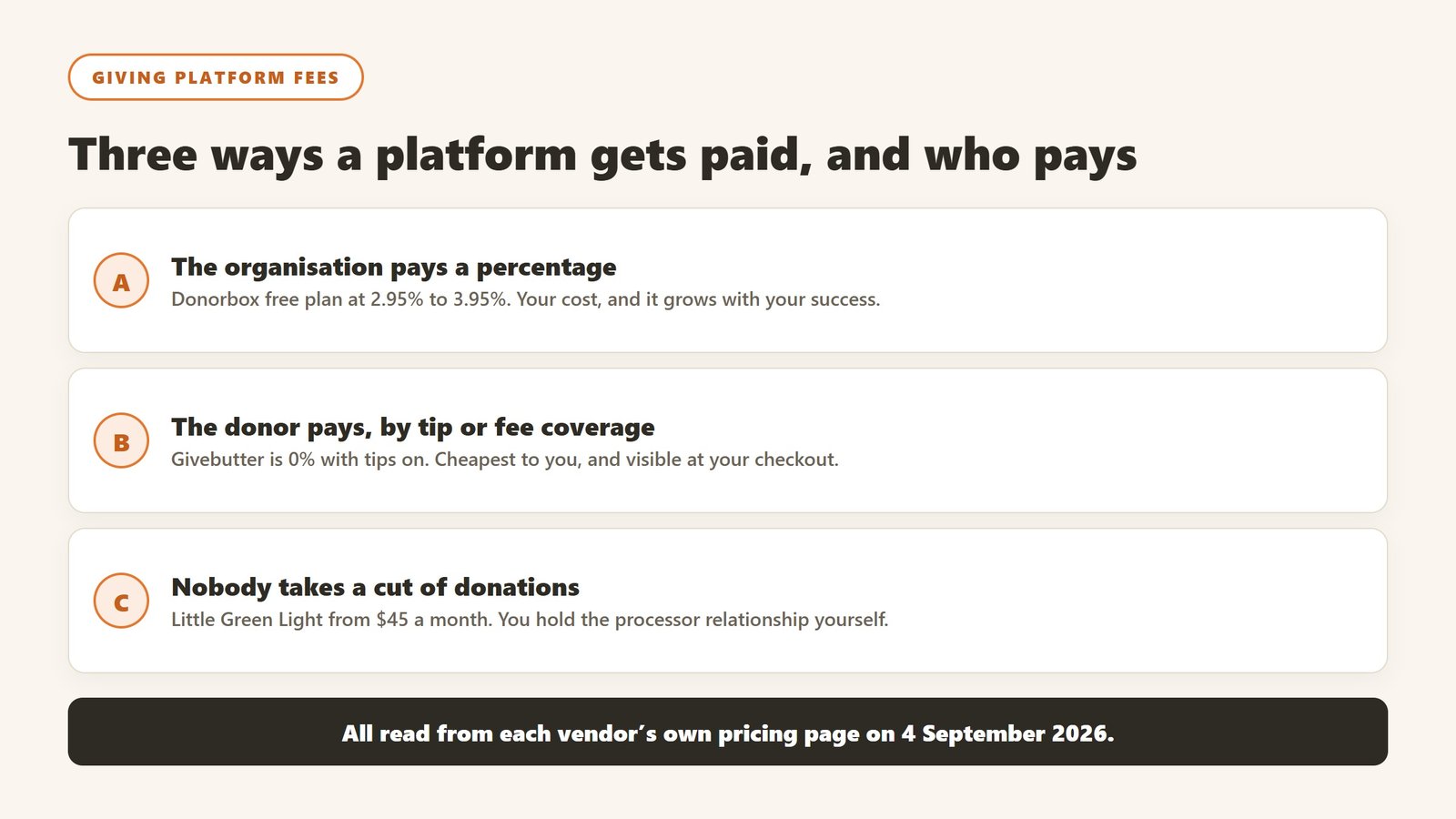
Every platform here takes a cut of donations, which means the bill grows with the thing you are trying to grow. What separates them is where the cut sits and who is asked to pay it. Here is each alternative to Fundraise Up, read from its own pricing page on 4 September 2026.
Donorbox, free to start, and the fee falls as you pay more
Donorbox publishes the clearest ladder in the category. Standard is free with a platform fee of 2.95% to 3.95%. Pro is $150 a month and drops the fee to 1.75% to 2%. Premium is quote only at 1.6% to 2%. Because the subscription buys a lower rate, there is a crossover volume below which paying is a loss: on $100,000 raised the fee saving is roughly $1,575 against an $1,800 subscription, so the free plan wins. On $200,000 the same shift is a clear gain. Work out your own crossover before upgrading, because the sales conversation will not.
Givebutter, 0% if your donors tip, 3% if they do not
Givebutter charges no platform fee at all when donor tips are enabled, and a flat 3% when they are switched off. Its paid tier, Plus, starts at $29 a month or $348 a year. The model is genuinely free to the organisation, but it is not free in the room: the form suggests a tip by default, so a supporter giving $100 can be charged noticeably more than $100. Whether that is a fair trade is a decision about your donors rather than your budget, and it is worth making deliberately rather than by leaving a default alone.
Fundraise Up, which has stopped publishing a rate
Fundraise Up published a single flat 4% per transaction when we read it on 14 July 2026. On 4 September 2026 the percentage is gone. We loaded the page, waited for it to render, opened every accordion and read the source: nine percentages remain and every one is a conversion rate or a case study result. The page now says “performance-based pricing” and asks for a demo. Treat any 4% you see quoted elsewhere, including our own dated figure, as the number a current quote should be checked against.
The processors underneath, which nobody escapes
Whatever the platform charges, a card processor charges too, and Donorbox publishes the nonprofit rates plainly: Stripe at 2.2% plus 30 cents and PayPal at 1.99% plus 49 cents for eligible organisations. The fixed component is the part that hurts small gifts. On a $20 donation, 30 cents is another 1.5 percentage points on top of whatever rate was quoted, so a platform that looks competitive on a $250 gift can be expensive on your actual median.
The line that is missing from almost every comparison
International giving. Donorbox states that its currency conversion defaults to 2% above the optimal rate. On a $1,000 gift from overseas that is $20, on top of the platform band and the card processing, and it appears in no comparison table we have seen. If any meaningful share of your donors give from abroad, ask every platform on your shortlist for its FX markup in writing and add it to the model.
Donor fee coverage, the single variable that decides the answer
Every percentage model in this category lives or dies on one number: the share of donors who choose to cover fees at checkout. It swings the effective cost by a factor of five, and it is the number vendors quote most confidently and evidence least.
What the vendors claim
Fundraise Up publishes that 80% of donors cover transaction costs, having previously claimed 87%. Givebutter states that 92% of donors leave a tip. Donorbox says donors can be asked to cover over 90% of processing fees. Those are averages across every customer the vendor has, weighted towards the large and sophisticated ones, and none of them is a commitment to you.
Why your number will be different
Coverage depends on things the vendor cannot control and you can: how the option is worded, whether it is pre-ticked, where it sits in the flow, your median gift size, and above all who your donors are. A digitally engaged urban donor base behaves nothing like a rural mail-acquired file. Two organisations on the same platform can sit thirty points apart, which is the difference between a 1.3% effective cost and a 6.5% one.
Model both ends, not the vendor average
Take a percentage model and run it twice: once at zero coverage and once at the vendor’s claimed rate. If the decision holds at both ends, buy with confidence. If it only works at the claimed rate, you are betting your budget on a number you have never observed. Then run the subscription alternative alongside, because a fixed fee is the option that does not care how your donors behave.
The ethical question nobody puts in the table
Fee coverage and tipping both work by moving your cost onto the person giving you money. That may be entirely reasonable, and many donors genuinely prefer that the full gift reaches the cause. It becomes a problem when the default does the deciding, when the amount is not obvious, or when a $100 gift quietly becomes a $115 charge. Look at your own checkout as a donor would, on a phone, and decide whether you are comfortable with what you see. That is a board level question, not a finance one.
What you are actually signing, beyond the monthly figure
A published rate card tells you the list price. The contract decides what you pay, and four terms do most of the work.
Term length and the annual-billing discount
Nearly every figure quoted in this market, Fundraise Up included, assumes annual billing. Monthly billing is routinely 20 to 30% higher, so the headline you compare against a rival may be a different commitment entirely. Check which basis each number is on before putting two of them in the same sentence, because vendors do not always label it.
Mid-term expansion, priced now or priced later
The band you cross, the seat you add, the module you switch on: agree what each costs before you sign, and specifically whether the discount you negotiated applies to anything added mid-term. It very often does not. Discovering that at the moment you need to grow is how a good first-year deal becomes an expensive second year.
The renewal cap is the term worth most and asked for least
At renewal the vendor knows your usage, your dependency and your switching cost, and in a market where most rivals publish nothing you have no rate card to anchor against. Blackbaud publishes no figures at all, and Virtuous publishes none while banding its tiers at $5 million in fundraising revenue. Against that, a capped uplift stated as a percentage is worth more than a larger first-year discount, and it is only negotiable while you still have a choice.
What happens to your data at the end
Ask what a full export contains, in what format, how long after termination you can request one, and whether live recurring gift schedules and their payment tokens transfer. Tokens are the ones that usually do not, and if they cannot move, every monthly donor has to re-enter card details and a share will not. Get the answer in writing during procurement, not during the exit.
Published does not mean fixed
Keela raised every band between late August and early September 2026, entry moving from $134 to $164, a rise of roughly 15 to 22% across the range in under two weeks. Neon retired an entire tier structure. A published price is a snapshot with a date on it, and if the figure you are comparing does not carry one, you do not know what you are looking at.
Verdict: cheap if your donors cooperate, expensive if they do not
Fundraise Up’s pricing was the most transparent in the category until it was withdrawn: 4% per transaction, Stripe’s 2.2% + $0.30 on top, nothing else, verified on the live pricing page in July 2026. Before donor coverage, that is a real 6.3 to 7.4% per card gift, which is not cheap. With the vendor’s claimed 80% coverage rate, the modeled net cost of 1.2 to 1.5% makes it one of the least expensive serious platforms a nonprofit can run, and the break-even against a $1,800-a-year subscription platform does not arrive until roughly $225,000 in annual online volume.
So the budgeting question is not “can we afford 4%”. It is “what will our donors actually cover”. Get that number from your own data or a comparable reference customer, plug it into the break-even math above, and the decision mostly makes itself. For whether the product deserves the fee at all, our Fundraise Up review has the hands-on verdict, and the wider field is ranked in our best AI fundraising tools for nonprofits roundup.

Written by
FazFaz is the founder of AIToolsBakery. Some tools here are tested hands on. Others are assessed from vendor documentation and pricing verified on the live page, and every review says which one it is. Sponsors can buy a position in a guide. They cannot buy the score, the criticism, or silence about a better option.
How we test and how we make money →