December is not a month. For most nonprofits it is the year.
Roughly 37% of all annual online giving arrives in December, according to the M+R Benchmarks 2026 report. GivingTuesday, which falls on Tuesday 1 December 2026, opens the run and raised $3.6 billion in the United States alone in 2024. Everything your organisation does between late November and 31 December is compressed into about five weeks, and it is handled by the same people who are also trying to close the year, file reports and take some leave.
There is no shortage of year-end fundraising calendars. There is a shortage of honest ones written for a team of two.
This year-end giving campaign guide is a week-by-week plan built around a constraint most guides ignore: you do not have time to do everything, so the question is not what to do but what to cut. AI helps with a narrower slice of that than the marketing suggests, and we will be specific about which slice.
Quick answer: Start planning in October, not November. GivingTuesday 2026 is 1 December. December carries about 37% of annual online revenue. Use AI for triage and drafting, not strategy. A minimum viable campaign is one goal, one match, one clean donation page, three emails and a handful of social posts.
The honest version of what AI does for year-end
Let us clear this up before the calendar, because it decides how you spend the next eight weeks.
AI is good at two things here. The first is triage: looking at a file of several thousand donors and telling you which two hundred deserve a personal touch rather than a mass email, and why. The second is drafting: producing the first version of an email, a thank-you, a social caption or a board update in your voice, which you then edit. Our guide to AI donor thank-you letters covers the IRS acknowledgment rules every draft has to meet.
AI is bad at the thing people hope it is good at. It will not tell you what your campaign should be about. It cannot decide whether this year’s story is the new programme or the funding cliff. It does not know which board member will actually make the calls. Those are judgement calls that come from knowing your organisation, and no tool has that context.
October: the month that decides how December goes
Most year-end campaigns fail in October, quietly, by not existing yet. Nonprofits typically start planning around now, and the ones who start later spend December reacting.
Set one number and one story. Not three campaign themes and a stretch goal. One number you are asking for and one reason it matters this year. If you cannot say it in a sentence, your donors will not repeat it.
Secure your match now. A match offer is the single highest-leverage thing in a year-end campaign, and matches are negotiated in October, not November. One board member or major donor underwriting a match changes the maths on every email you send afterwards.
Fix your donation page while you have time. In December you will not touch it. Check it on a phone. Count the fields. Confirm recurring giving is offered and not buried. If you use Givebutter, Fundraise Up or Donorbox, this is the month to turn on the features you have been meaning to try, not 28 November.
Run your data readiness check. Every AI tool you point at your file in December will be limited by what is in that file. If your addresses are stale and half your gifts are uncoded, no amount of intelligence rescues it. We wrote a separate piece on what your donor data needs to look like first, and October is when you act on it.
What to hand to AI in October
Ask it to segment, not to write. Specifically:
- Which donors gave last year in December but have not given this year
- Which recurring gifts have failed in the last six months and were never recovered
- Which lapsed donors are still opening email
- Which mid-level donors have increased their gift two years running
Those four lists are your December campaign. Everything else is a mass email.
November, weeks one and two: build the assets
You are building a small, finite set of things. Resist the urge to expand it.
The minimum viable campaign is a goal, a match, a clean donation page, three emails and a handful of social posts. That is genuinely enough, and it can be built in about three weeks if you start in early November. Everything beyond it is optional and should be treated as optional when time runs short.
The three emails are not three drafts of the same email. One announces the campaign and the match. One is sent mid-December to people who have not yet given. One goes on 30 or 31 December to everyone still unconverted. If you only manage two, drop the middle one.
This is where drafting AI earns its keep. Give it your case for support, last year’s best-performing appeal and the segment definition, then ask for the first version of each email. You will rewrite the opening and the ask. It will save you the blank page and about a day of work.
November, weeks three and four: GivingTuesday and the personal list
GivingTuesday is 1 December, so this is the fortnight it is won or lost.
Decide what GivingTuesday is for. For a small organisation it is often the single biggest revenue day of the year, but its more useful function is as the starting gun for the December run. Treat it as acquisition and reactivation, and save your major donor asks for the quieter weeks after.
Build the personal list, and make it short. This is the list from October, cut to the number of conversations your team can genuinely have. If two people can make fifteen calls a week for three weeks, the list is ninety names, not four hundred. A shorter list actually worked beats a longer list half worked, every time.
Brief whoever is making the calls. This is another place AI is genuinely useful: a one-page brief per donor pulling together their giving history, last contact, what they care about and what changed this year. Doing that by hand takes twenty minutes a donor. Done well, it takes two.
December: run the plan, do not rebuild it
The single most common December failure is redesigning the campaign mid-flight because early numbers look soft. Early numbers always look soft, and the concentration at the end is extreme: roughly 10% of all annual giving arrives in the last three days of the year, and 31 December alone accounted for 5% of online revenue in the 2025 M+R Benchmarks.
Weeks one and two. GivingTuesday, then the announcement email, then the personal calls begin. Watch for failed recurring payments, which spike whenever card details expire, and fix them the same week. Most organisations lose somewhere between 10 and 15% of monthly recurring revenue to failed payments that nobody recovers, and December is the worst possible month to be leaking it.
Week three. The mid-campaign email to non-givers. Continue calls. Thank everyone who has given already, immediately and personally, because a December donor thanked well in December is a January recurring donor.
Week four. The final push, 29 to 31 December. Those three days carry about 10% of annual giving on their own, which is why a campaign that runs out of energy on 20 December leaves real money behind. Keep the messages short and factual. The people giving on 31 December have decided already and are looking for the link.
Which tools actually help, by job
Year-end needs three different kinds of software and they are not interchangeable.
Taking the money. A donation platform. Givebutter for small organisations wanting a free, complete stack, Fundraise Up if your online volume is high enough that conversion optimisation pays for itself, Donorbox as a straightforward middle option. This is the non-negotiable one. Get it right in October.
Knowing who to call. A donor intelligence layer. This is the newer category and the one most teams do not have. Gratefully is our pick here, because it reads your CRM, email and notes overnight and hands each fundraiser a ranked list with the reason attached, which is exactly the December problem. It is an intelligence layer rather than a CRM or a donation platform, so it sits on top of what you already run. Our full Gratefully review covers where it fits and where it does not.
Writing the words. Any competent general-purpose AI assistant, plus your own judgement. You do not need to buy specialist fundraising copy software for three emails.
For the wider picture, our best AI tools for nonprofits guide covers the full stack, and best AI fundraising tools goes deeper on the platform layer.
What to cut when you run out of time
You will run out of time. Here is the order we would cut in, most expendable first.
- Social content beyond a handful of posts. Low return, high effort, endless.
- The mid-December email. Painful to lose, but the first and last emails do most of the work.
- Segmented versions of the mass email. One good general email beats four rushed segments.
- The campaign landing page. Your normal donation page with the campaign message on it is fine.
Do not cut, in any circumstances: the match, the personal calls to your top list, and same-week thank-yous. Those three produce most of the money and nearly all of the retention.
The bottom line
Year-end rewards preparation and punishes improvisation. Decide your number and your story in October, lock the match early, fix the donation page while you still can, and build one short personal list you will genuinely work.
Use AI where it is genuinely strong, which is deciding who deserves a human conversation and drafting the first version of everything. Do not use it to decide what your campaign is about, and do not let a fluent draft ship without you putting the specifics back in.
Then run the plan you built. December is not the month to have new ideas.
Where this goes wrong
Automating a message that should be personal
The failure mode specific to AI in fundraising is scaling something whose value came from not being scaled. A major donor who receives an obviously templated note referencing their giving history has learned something about how you see them. Set an explicit line for which segments never receive automated communication, and put a person’s name against enforcing it.
Confusing a prediction with a decision
A propensity score is a ranking, not an instruction. Treated as an instruction it becomes self-fulfilling: donors the model ranks low get no contact, therefore do not give, therefore confirm the model. Keep a proportion of outreach deliberately outside the model’s recommendation so you can see what it is missing.
Letting the tool set the strategy
Software encodes assumptions about how fundraising works, and those assumptions become your process by default. If the platform is built around monthly appeals and your programme is relationship-led major gifts, you will drift toward the appeals because that is the path of least resistance. Decide the motion first and buy something that fits it.
Not telling donors what you are doing
If you use donor data to predict behaviour, your privacy notice should say so in language a supporter would understand. That is both a compliance position and a trust one, and the organisations that handle it well treat it as a statement of values rather than a legal formality. Our vendor questions on donor data covers what to ask before data goes in.
How to tell whether it worked
The hardest part of a year-end campaign is not doing it, it is knowing afterwards whether it helped. Three measurement mistakes account for most of the confusion.
Measure against a holdout, not against last year
Comparing this year to last year measures the year, not the intervention. Anything that moved in your sector, your economy or your programme moves that number too. Hold back a random ten percent of the eligible group, treat them normally, and compare. It feels wasteful and it is the only way to know.
Pick the metric before you start, and write it down
For this work the honest metric is revenue per donor contacted, against the same segment last cycle and a holdout. Choosing it afterwards from whatever moved is how organisations convince themselves that things worked. Write the number and the target down before the first send, with a date to check it.
Give it long enough, and no longer
Fundraising interventions take a full giving cycle to read properly, because donor behaviour is seasonal and lumpy. A single month tells you almost nothing. Equally, an intervention that has produced nothing after a full cycle is not going to start working in the second one, and continuing is a sunk cost decision rather than a strategic one.
Count the staff time honestly
The cost of any of this is mostly hours, not licences. If a workflow saves an hour a week and takes three hours a week to maintain, it is a loss even when the fundraising metric improves. Track the time for the first two months, because that is the number nobody records and everyone underestimates.
What the tooling for this actually costs
Advice about a year-end campaign is worth little without the price of doing it. Every figure here was read from the vendor’s own pricing page on 4 September 2026.
| Platform | Entry price | Metered on |
|---|---|---|
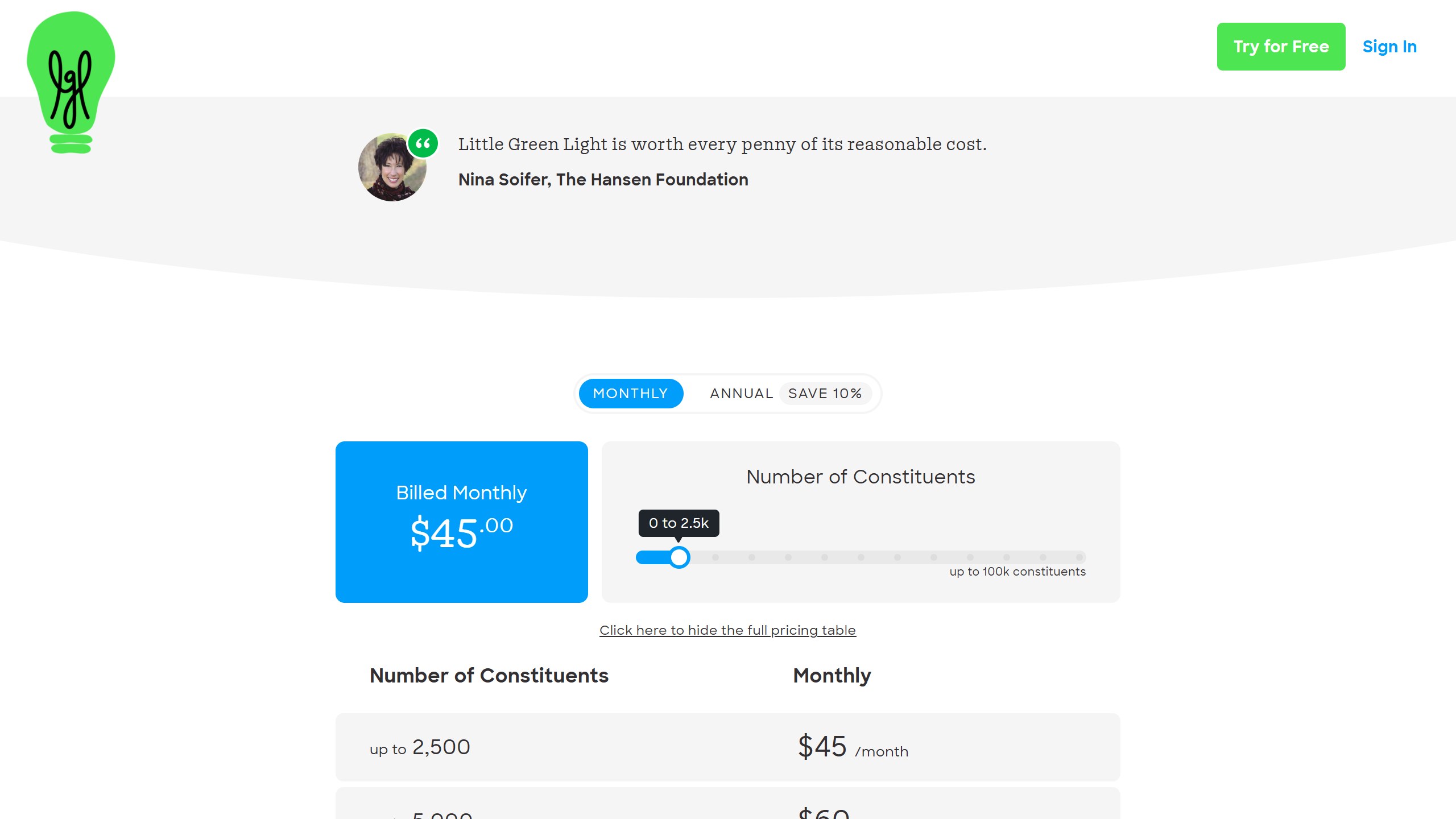
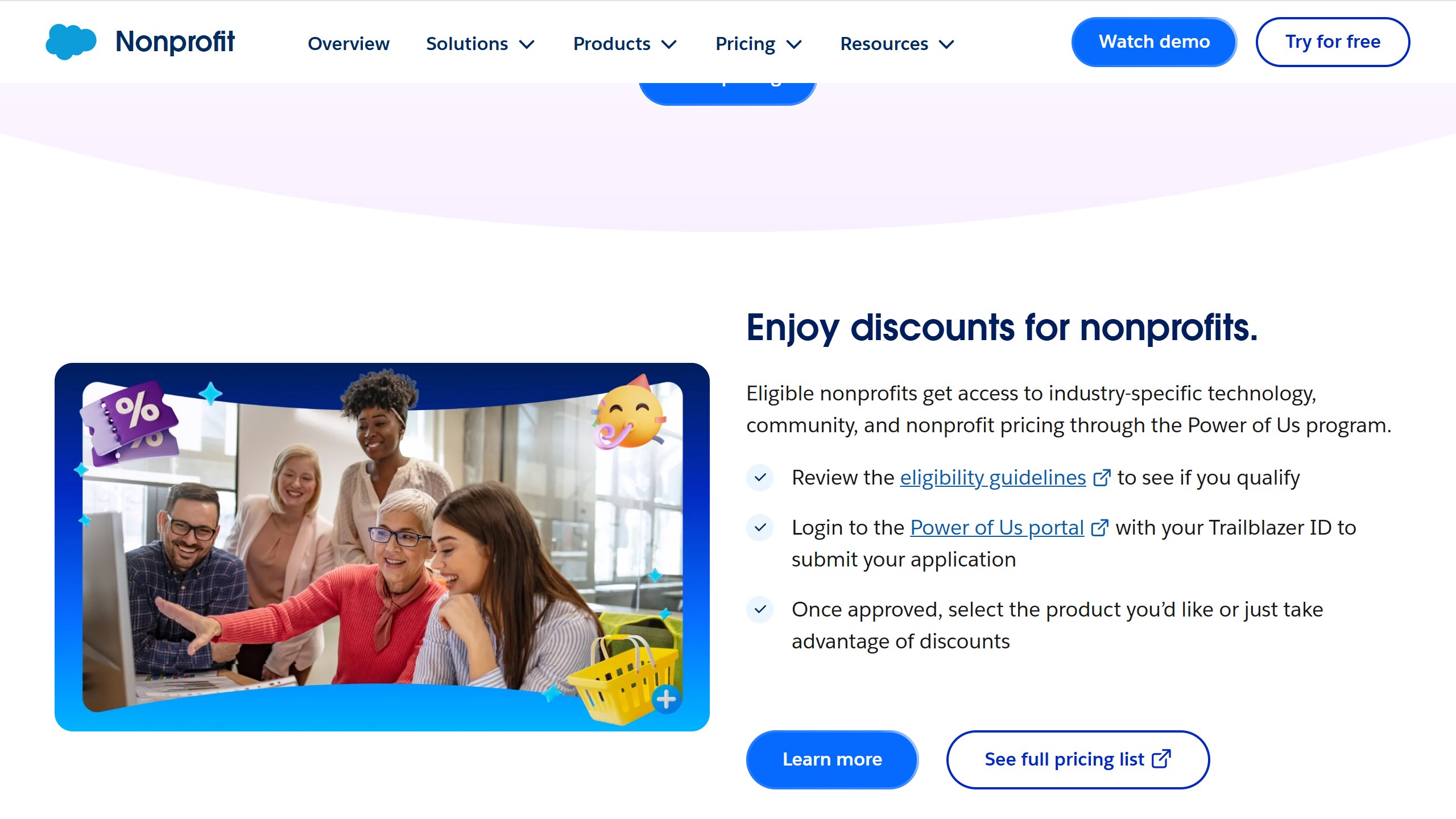
| Salesforce Nonprofit Cloud | $0 for 10 licences, then $60/user/mo | Seats |
| Little Green Light | $45/mo | Constituents |
| Neon CRM | $99/mo | Annual revenue |
| Bloomerang | $125/mo | Product |
| Keela | $164/mo | Contacts |
| Dataro | $15,000/yr + $0.10/donor | Platform + donors |
You can do most of this on what you already own
The important thing that table shows is the floor. A nonprofit with ten or fewer CRM users pays nothing for Salesforce licences under the Power of Us programme, and Little Green Light starts at $45 a month. Almost none of the work described on this page requires the $15,000 tier. Predictive scoring is a genuine capability, but it is an accelerant for organisations already doing the basics well, not a substitute for doing them.
Spend the budget on the data before the model
Every AI capability in this category degrades to guesswork on poor data. If your addresses are stale, your soft credits missing and your household links broken, a model trained on that will confidently rank the wrong people. Cleaning the file is unglamorous, cheap and the highest-return work available. Our donor data readiness checklist sets out what to fix first.

Written by
FazFaz is the founder of AIToolsBakery. Some tools here are tested hands on. Others are assessed from vendor documentation and pricing verified on the live page, and every review says which one it is. Sponsors can buy a position in a guide. They cannot buy the score, the criticism, or silence about a better option.
How we test and how we make money →