Who actually publishes a price
| CRM | Publishes a price | What it charges for |
|---|---|---|
| Salesforce Nonprofit Cloud | Yes, in full | Per user, per month |
| Keela | Yes, in full | Per contact band |
| Neon CRM | A starting price only | Your annual fundraising revenue |
| Virtuous | No | Quote, banded by your revenue |
| Bonterra | No | Quote, “customized pricing” |
| Blackbaud Raiser’s Edge NXT | No | Quote |
Read from each vendor’s own pricing page on 24 August 2026, reached by following their navigation rather than guessing URLs. For the full field, our guide to the best donor management software compares fifteen systems on price, pricing unit, contract and card fees.
The problem with every comparison you have read
Half the nonprofit CRM comparisons online put these vendors in one table with a dollar figure next to each. That table cannot be built honestly, because the six vendors are not selling the same unit.
- Salesforce sells you seats. Five staff costs five times one.
- Keela sells you contacts. Your team size is irrelevant; your list size is everything.
- Neon sells you a share of what you raise, in its own words: “you only pay more as you raise more”.
Put those in one column and you have compared nothing. The right question is not which is cheapest. It is which unit punishes the way your organisation is about to grow.
Same organisation, three bills
Take a nonprofit with 5 staff who need logins and 3,000 donor contacts. Here is what the three vendors that publish a price would charge, using their own published figures.
| CRM | Published rate | Annual cost | What makes it go up |
|---|---|---|---|
| Keela | $316/mo, 2,501 to 5,000 contacts, billed annually | $3,792 | Adding contacts |
| Salesforce Nonprofit Cloud Core | $70 (4 Oct 2026) per user/mo, billed annually | $4,200 | Adding staff |
| Neon CRM | From $99/mo | $1,188 at the published floor | Raising more money |
Within a few hundred dollars of each other. Now change one thing at a time.
Hire a sixth fundraiser. Salesforce goes to $4,320. Keela does not move, because it does not charge for seats. Neon does not move either.
Add 2,000 contacts from a campaign. Keela crosses into the 5,001 to 7,500 band and goes to $4,548. Salesforce does not move. Neon does not move.
Have a very good year. Neon moves, by design. The other two do not.
That is the entire decision, and no feature matrix will tell you it.
Keela: the only complete published list
Keela is the one vendor here that publishes every band, both billing cycles, with no gate.
| Contacts | Billed annually | Billed monthly |
|---|---|---|
| Up to 1,000 | $134/mo | $160/mo |
| 1,001 to 2,500 | $209/mo | $225/mo |
| 2,501 to 5,000 | $274/mo | $315/mo |
| 5,001 to 7,500 | $329/mo | $370/mo |
| 7,501 to 10,000+ | $379/mo | $430/mo |
Above 10,000 contacts is custom, via a form. Every figure is printed as “Plans starting from”, so treat them as floors.
One thing on that page does not add up. Keela advertises “Save up to 23% when you pay annually”. Work the published bands and the largest actual saving is 16.3%, on the smallest plan. The other four bands save between 7.1% and 13.0%. There is no band on the page where annual billing saves 23%.
Full breakdown in Keela pricing.
Salesforce: the only per-seat model, published in full
| Edition | Price | Billing |
|---|---|---|
| Nonprofit Cloud Sales & Service Core | $70 per user/month | Billed annually |
| Nonprofit Cloud Sales & Service Advanced | $125 per user/month | Billed annually |
| Nonprofit Cloud Sales Max | $285 per user/month | Billed annually |
| Nonprofit Cloud Service Max | $285 per user/month | Billed annually |
Salesforce states these cards reflect nonprofit pricing (read 4 October 2026, when the old Enterprise, Unlimited and Agentforce 1 editions had been replaced), and that for-profit organisations should speak to an account executive.
Per-seat is the model most likely to surprise a growing team. At Core, every new login is another $840 a year. A ten-person development office is $8,400 a year before a single add-on, which is more than double what Keela charges the same organisation at any contact volume under 10,000.
Neon CRM: publishes the model, gates the list
Neon is the most interesting of the six, because it publishes something none of the others do: how it decides what to charge you.
- Starts at $99 a month
- Priced on revenue, not record count, explicitly
- Unlimited users and unlimited records on every plan
- Add-on modules priced as a percentage of your subscription: +10% Memberships, +10% Volunteers, +20% Events
That last line is genuinely useful and almost unique in this category. It means you can calculate what a module costs before you know what your plan costs. All three modules together add 40%, so a $99 plan becomes $138.60 a month.
What Neon does not publish is the actual list. The revenue bands you will see referenced elsewhere, $0 to $15K, $16K to $125K, $126K to $3M, $3M to $10M and $10M+, are not a price table. They are the dropdown on the form you fill in to download the pricing guide. We nearly reported them as tiers, which is exactly the mistake a text-only reading of that page produces.
Detail in Neon CRM pricing.
The three that publish nothing
Virtuous has a pricing page with six Contact Us buttons and no prices. The only two dollar figures on it are the thresholds that split its tiers: up to $5 million in annual fundraising revenue, and over $5 million. So Virtuous decides which conversation to have with you based on how much you raise, before quoting anything. See Virtuous pricing.
Bonterra splits pricing across three product pages and publishes, in its own words, “customized pricing”. Its fundraising and engagement page runs to nearly 53,000 characters and contains a complete feature matrix marking each item Included or Additional cost, with no figure anywhere. You can learn exactly what costs extra without ever learning what anything costs.
Blackbaud Raiser’s Edge NXT has one pricing link on its product page, labelled “Ask About Pricing”, and it leads to a generic quote form. Worth noting how we got there: the obvious URL, blackbaud.com/products/blackbaud-raisers-edge-nxt/pricing, redirects to the Financial Edge NXT pricing page, which is a different product. Anyone checking quickly would report on the wrong thing.
What to do with this
If you are comparing on price, compare on your own numbers. Take your actual staff count, your actual contact count and your actual annual revenue, and run all three published models against them. The cheapest vendor changes depending on which of those three is largest.
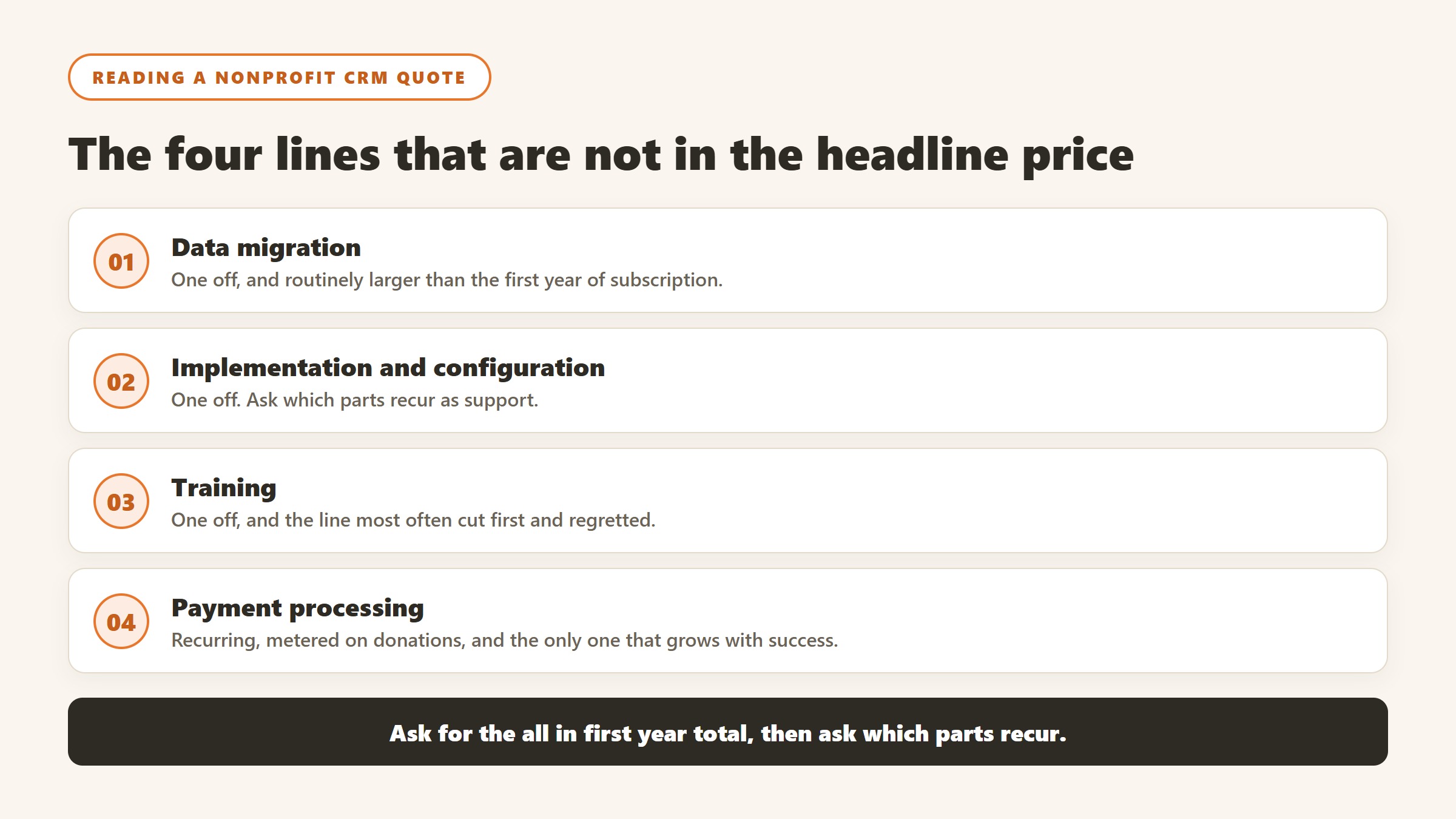
If a vendor will not publish, make the first call a pricing call. Virtuous, Bonterra and Blackbaud will all quote you. The question worth asking each is not “what does it cost” but “what is the unit, and what makes it go up”, because that is the part that determines your bill in year three.
Check the CRM is even the problem. All six of these are systems of record. None of them decides who your team should contact on Monday. If your data is fine and nobody is working it, see nonprofit CRM vs donor intelligence before you migrate anything.
Payment processing, the line that usually costs more than the software
Almost every comparison of each of these platforms against its rivals stops at the subscription. For most nonprofits the larger number is what comes off each donation, and it is metered on the one thing you are trying to grow.
The arithmetic that decides this
A single percentage point on $500,000 raised online is $5,000 a year. That is more than the entire annual subscription to several nonprofit CRMs. So a platform that is $600 a year cheaper but takes half a point more of your online giving is not cheaper at any organisation raising more than $120,000 online, and the crossover point moves against you every year you grow.
Two different models, and they are not comparable
Some platforms charge a subscription and take nothing from donations, leaving you to hold a processor relationship directly. Little Green Light states plainly that it takes nothing from your donations. Others bundle processing into the platform, which is simpler to run and structurally more expensive at volume. GoFundMe Pro, formerly Classy, publishes that its model is an annual subscription plus a transaction fee per donation, and that second half is the part that scales.
Ask for the effective rate, not the headline rate
Processing quotes are usually given as a percentage plus a fixed amount per transaction, and the fixed component dominates at small gift sizes. On a $20 donation, 30 cents is another 1.5% on top of whatever percentage was quoted. If your median online gift is small, and for most community organisations it is, your effective rate is materially higher than the number on the page. Work it out on your own median gift before comparing anything.
Covered fees change the picture and are worth asking about
Where a platform offers donors the option to cover processing fees, take-up is the variable that decides your real cost, and it varies enormously by audience and by how the prompt is worded. Ask any vendor quoting you a bundled rate what their observed cover rate is across comparable organisations, and treat a refusal to answer as information. A model that looks expensive at 0% cover can be the cheapest option at 60%.
Get processing out of the subscription line in every quote
Insist that every vendor states processing separately from the platform fee, with the percentage, the fixed per-transaction amount, and whether ACH and card are priced differently. A blended annual figure hides exactly the line that grows with your success, and it is the single most common reason a nonprofit software budget is wrong in year two.
What you are actually signing, beyond the monthly figure
A published rate card tells you the list price. The contract decides what you pay, and four terms do most of the work.
Term length and the annual-billing discount
Nearly every figure quoted in this market, each of these platforms included, assumes annual billing. Monthly billing is routinely 20 to 30% higher, so the headline you compare against a rival may be a different commitment entirely. Check which basis each number is on before putting two of them in the same sentence, because vendors do not always label it.
Mid-term expansion, priced now or priced later
The band you cross, the seat you add, the module you switch on: agree what each costs before you sign, and specifically whether the discount you negotiated applies to anything added mid-term. It very often does not. Discovering that at the moment you need to grow is how a good first-year deal becomes an expensive second year.
The renewal cap is the term worth most and asked for least
At renewal the vendor knows your usage, your dependency and your switching cost, and in a market where most rivals publish nothing you have no rate card to anchor against. Blackbaud publishes no figures at all, and Virtuous publishes none while banding its tiers at $5 million in fundraising revenue. Against that, a capped uplift stated as a percentage is worth more than a larger first-year discount, and it is only negotiable while you still have a choice.
What happens to your data at the end
Ask what a full export contains, in what format, how long after termination you can request one, and whether live recurring gift schedules and their payment tokens transfer. Tokens are the ones that usually do not, and if they cannot move, every monthly donor has to re-enter card details and a share will not. Get the answer in writing during procurement, not during the exit.
Published does not mean fixed
Keela raised every band between late August and early September 2026, entry moving from $134 to $164, a rise of roughly 15 to 22% across the range in under two weeks. Neon retired an entire tier structure. A published price is a snapshot with a date on it, and if the figure you are comparing does not carry one, you do not know what you are looking at.
The exit costs nobody quotes you
Switching cost is the reason organisations stay on platforms they have outgrown, and it is almost never discussed during procurement. Three things determine how trapped you are.
Recurring gifts and payment tokens
Donor records and giving history export cleanly from almost any platform. Live recurring schedules and the payment tokens behind them frequently do not. If tokens cannot transfer, every monthly donor has to re-enter card details and a meaningful share will not, so the real cost of leaving is a slice of your most reliable income. Ask about token portability during procurement, in writing, when you still have leverage.
Custom fields and history
Ask what a full export actually contains. Standard fields usually come out fine; custom fields, soft credits, relationship links between households and the audit trail of who changed what often do not. Losing the relationship structure means rebuilding institutional knowledge that took years to accumulate.
Integrations you will have to rebuild
Every connected system, email platform, giving forms, accounting, event tools, is work to reconnect elsewhere. Count them before signing rather than after, because the number is usually higher than anyone remembers and it is the part that turns a two-week migration into a six-month one.
Where the figures on this page come from
Every price quoted here was read from the vendor’s own pricing page on 4 September 2026, not from an aggregator or a review site. That distinction matters more in this category than in most, because nonprofit software pricing changed materially over the past year and a great deal of what circulates online describes packaging that no longer exists.
The pages we read
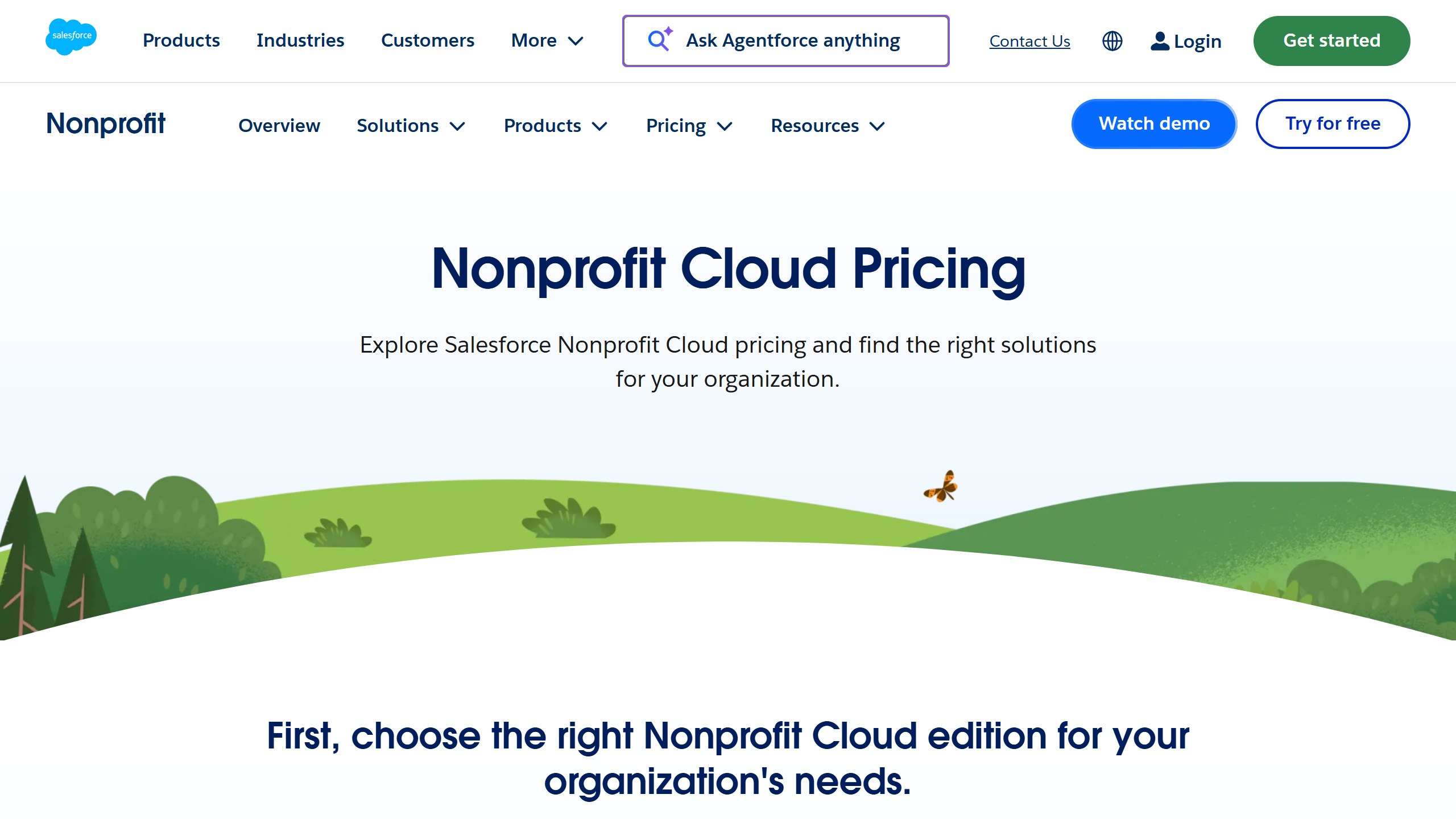
Little Green Light publishes every constituent band from $45 a month. Salesforce Nonprofit Cloud publishes $70 per user per month (as of 4 October 2026) with ten licences free under Power of Us. Bloomerang publishes $125 a month for the CRM with other products priced separately. Keela publishes every contact band from $164 a month. Dataro publishes $15,000 a year plus ten cents per active donor on a page that is not linked from its own navigation. Blackbaud and Virtuous publish no figures at all.
What we do not do
We do not carry a figure we cannot source to the vendor. Where a number circulates widely and cannot be traced to a vendor page, we say so and withdraw it rather than repeating it with a hedge, and we have withdrawn our own published figures on that basis more than once. Where a vendor confirms an unpublished price directly to us, it is attributed as confirmed by the company rather than presented as a public rate.
Why every figure carries a date
Keela raised every band by roughly 15 to 22% in under two weeks in late August 2026. Neon retired an entire tier structure. A pricing claim without a verification date is not checkable, and in this market it is usually wrong within a year.
How we verified this
For each vendor we started at the homepage and followed its own navigation to pricing, rather than guessing a URL. Billing toggles and accordions were expanded before reading. Every final URL was recorded, which is how we caught both the Blackbaud redirect to a different product and the fact that Neon’s pricing URL lands on an overview page.
Three vendors needed a second or third attempt. Neon’s primary domain returns HTTP 522 to automated requests and only its legacy domain responds. Salesforce returns 403 on its homepage, so its pricing path has to be requested directly. Bonterra’s first “Pricing” nav link is a bare anchor rather than a page. In every case we treated a failed read as “not checked” rather than as evidence the vendor publishes nothing, because those are not the same claim.
We have not used any of these products and make no claim about which is better. This page reports what each vendor publishes, and what their own arithmetic implies. Prices in this category move, so check before you sign.

Written by
FazFaz is the founder of AIToolsBakery. Some tools here are tested hands on. Others are assessed from vendor documentation and pricing verified on the live page, and every review says which one it is. Sponsors can buy a position in a guide. They cannot buy the score, the criticism, or silence about a better option.
How we test and how we make money →