Disclosure: Zilwaris, the consultancy run by AI Tools Bakery’s founder, does paid advisory work for Gratefully, which did not pay for any placement on this page and is assessed on the same criteria as everything else on this site.
Many nonprofits are already using AI, and most still have no written policy for it. Forvis Mazars’ 2026 Q2 State of the Nonprofit Sector report, citing TechSoup’s 2025 benchmark, puts the share of nonprofits without an AI acceptable use policy at 80%, and the share citing data security and privacy as a primary concern at 67%. The same report says fundraising is often the entry point: 61% of adopters use AI for donor-facing content and donor analytics and outreach.
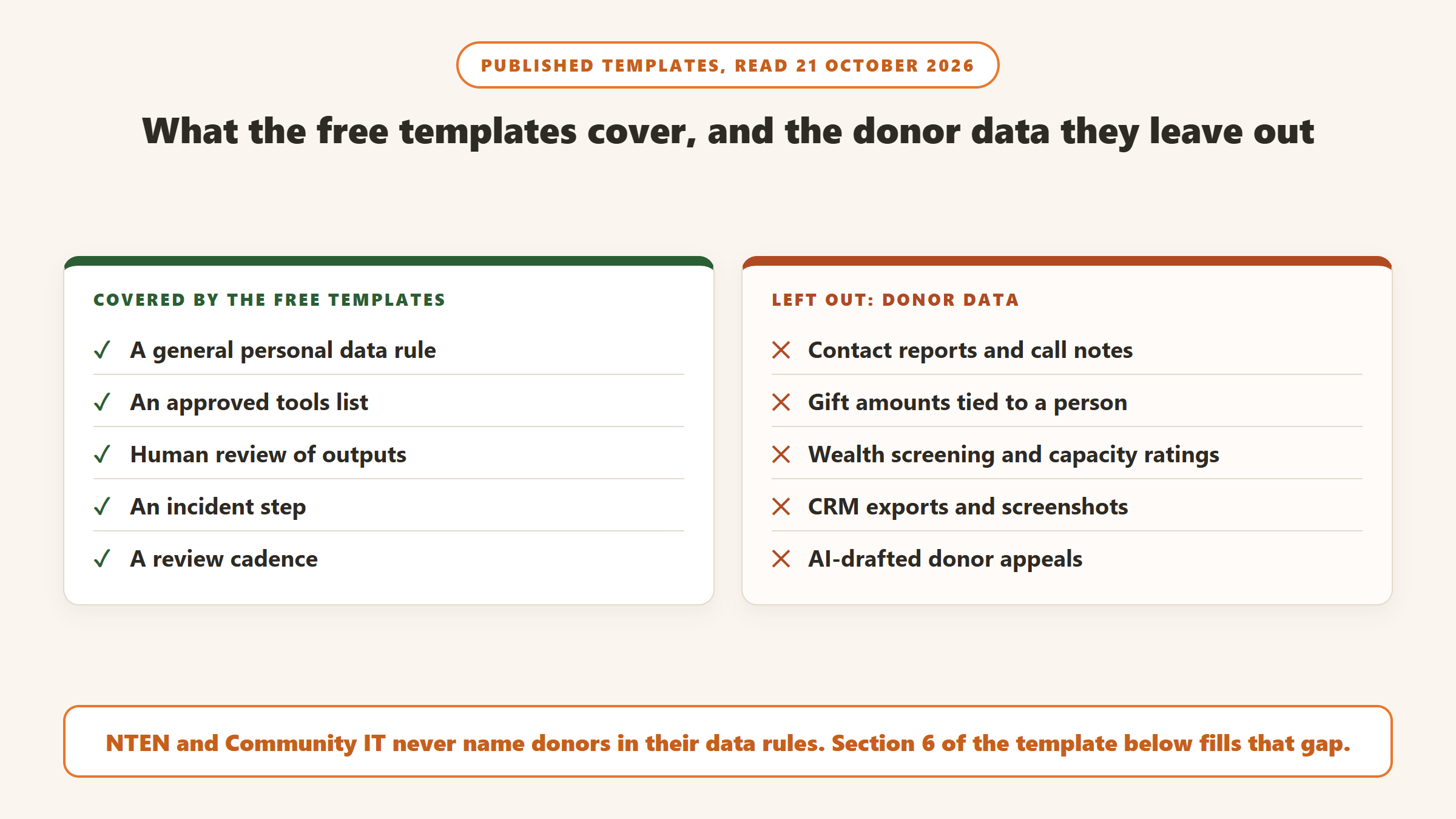
That is the gap this page fills. The free templates that rank for this search are good workplace AI policies, but they are written, in NTEN’s words, for “clients, employees, contractors”. None of the association templates we read has a single rule about donor data. Yet the data a development team pastes into a chatbot is donor data: names, gift amounts, contact reports, wealth screening scores. Below you will find a coverage table of the published templates, a full policy you can copy, a one-page staff version, and a short section on what an AI tool that touches donor records should commit to in writing. Free vendor resources exist too, such as the Safe AI Policy Pack from Gratefully, which we compare alongside the association templates.
How we researched this. This is a research-based guide. We read each published template and guide in full where it was public, downloaded the PDF versions and extracted their text, and read the vendor pages through their own site navigation, all on 21 October 2026. We have not adopted any of these templates or used any of these tools inside a nonprofit. Where a template is behind a member login or a form, we say so rather than guess at its contents. This is not legal advice; have counsel review your final policy, as NTEN’s template also advises. Fast Forward asks you to have someone on your team review any draft its builder produces.
What the published templates cover, and what they leave out
We checked each template against the ten things a nonprofit AI policy needs. “Yes” means the template says it in its own words. “General only” means it covers personal data but never names donors, gift records or prospect research.
| Template | Access | Donor data rules | Personal data rule | Vendor no-training rule | Approved tools list | Human review | Incident step | Review cadence |
|---|---|---|---|---|---|---|---|---|
| NTEN Generative AI Use Policy Template (July 2024) | Free PDF | No | Yes, needs Legal sign-off | Yes, in Exhibit A | Yes, Exhibit A | Yes | One line | At least annually |
| Community IT Acceptable Use of AI Tools (revised May 2026) | Free download via a form, reuse allowed | No | Yes, general only | Yes, contract must protect data from the vendor’s LLM | Yes | Yes | Managers report violations | “Periodically” |
| Candid responsible AI use guide (January 2026) | Free article, no template | No | Yes, general only | Not covered | Not covered | As a value | A “learning loop” | “Regular check-ins” |
| Fast Forward AI Policy Builder | Free, no sign-up | Names donor information in its data privacy area | Depends on your answers | Not mentioned | Depends on your answers | Depends on your answers | Depends on your answers | Depends on your answers |
| NC Center for Nonprofits sample policies | Link list | No | Links out | Links out | Links out | Links out | Links out | Links out |
| AICPA not-for-profit generative AI policy (July 2025) | Members and subscribers only | Not checked: the Word file is reserved for NFP Section members and subscribers | ||||||
| Gratefully Safe AI Policy Pack (vendor resource) | Policy free on the page; Word and PDF pack via email form | Yes, explicitly | Yes, remove identifiers first on any plan | Via a 12-question vendor questionnaire | Yes, held by the policy owner | Yes, before output reaches a donor or the public | Report the same day | Every six months |
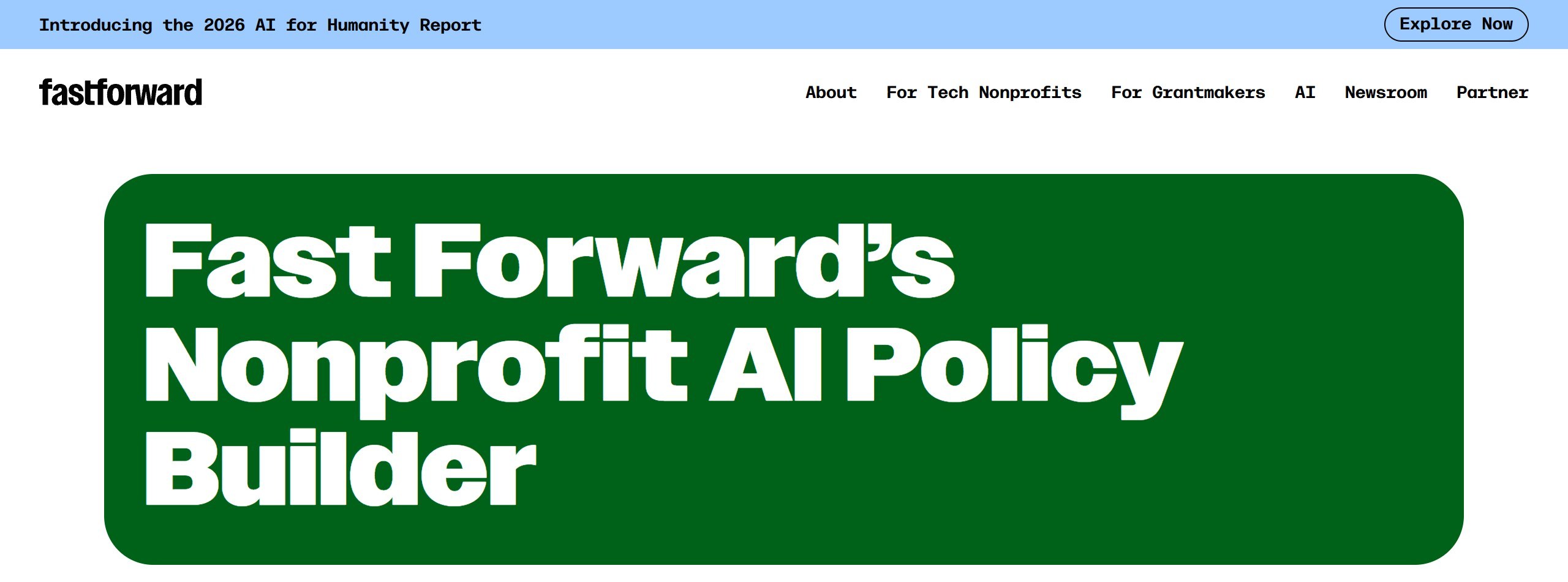
Three things stand out. First, the two full free templates, NTEN’s and Community IT’s, are solid on the basics. NTEN’s is the more complete of the two: seven named risks, an approved tools exhibit with a “No model training” clause for each vendor, and a call to publish the policy on your website. Community IT’s adds a useful low, moderate and high risk classification, with “decisions affecting people, constituents, finances or security” in the high band.
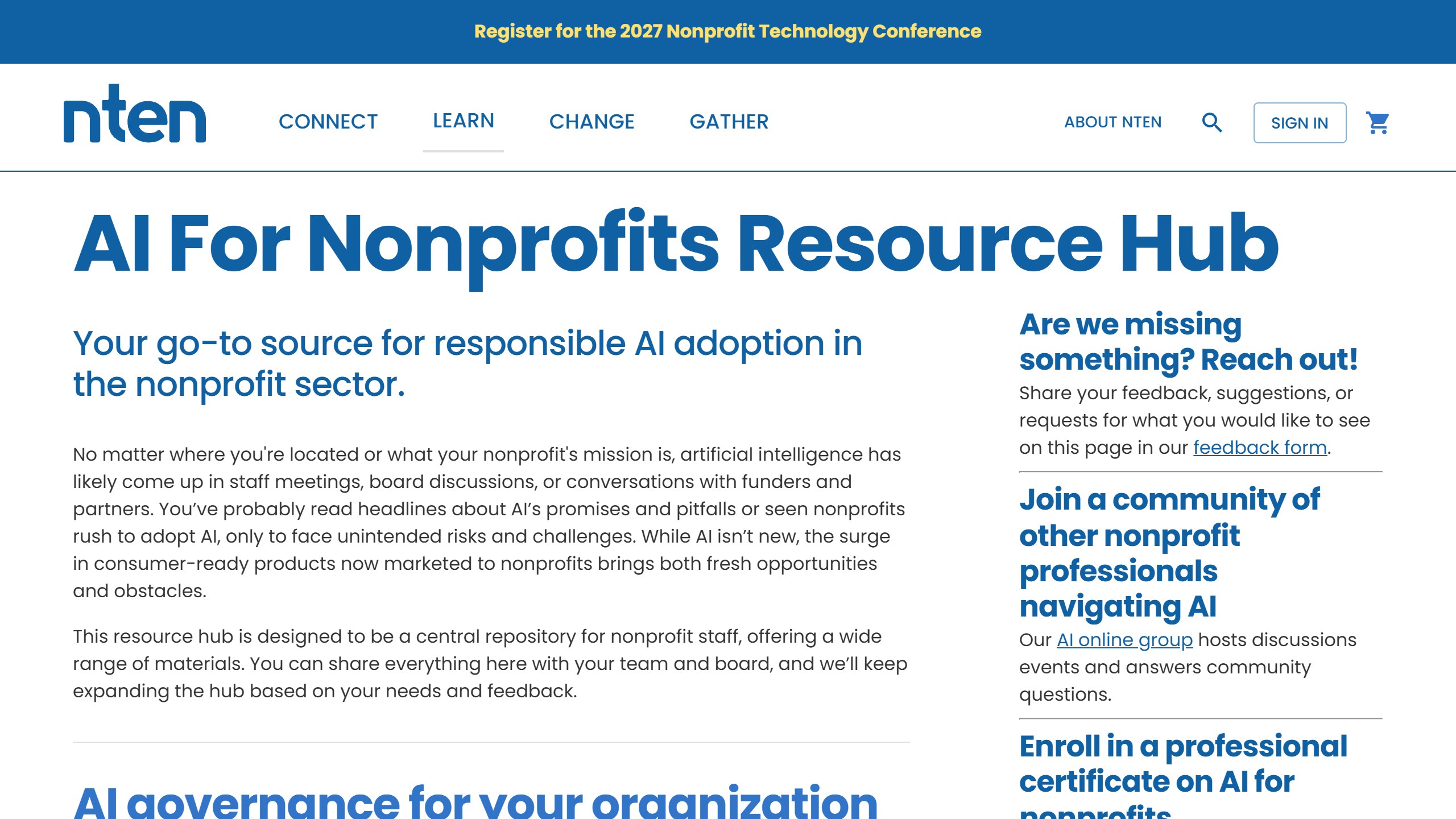
Second, neither policy has a donor data rule. NTEN’s policy text never uses the word “donor”; it appears once, as an example in its Exhibit C vendor questions. NTEN’s personal data rule covers “employee, client, or vendor personal data”. Community IT’s covers “employees, clients, or partners”. A gift officer reading either policy could reasonably conclude that pasting a donor’s contact report into a chatbot is fine, because donors are not on the list.
Third, the only resources in the table that name donor data in their data rules are a builder and a vendor. Fast Forward’s builder covers protecting “donor, client, and staff information” in the policy it drafts, but what you get depends on what you type in. The vendor pack is explicit about donor names, contact details, giving histories and staff notes, and its one-page policy is free to read on the page, while the Word and PDF pack sits behind an email form. It comes from a company that sells donor AI, so read it as one vendor’s view.
Why donor data needs its own section
Donors have been told something specific about their information. The Donor Bill of Rights, which AFP co-developed with other sector bodies, promises donors “that information about their donation is handled with respect and with confidentiality to the extent provided by law.” Donors also say they are watching. In the 2025 Donor Perceptions of AI report from Cherian Koshy and Nathan Chappell, published by Kindsight, two-thirds of 1,031 donors named data privacy and security as their top worry, and 92% wanted clear explanations of how AI is used. In the same authors’ 2024 study of 1,006 US donors, reported by the Chronicle of Philanthropy, 31% said they would be less likely to give to a charity that used AI.
The law is moving too. A Wagenmaker & Oberly review from April 2025 notes that “Colorado, Oregon, and New Jersey provide no exemption from their data privacy laws for nonprofits”, and that the exemptions in Delaware and Minnesota are quite narrow. Foundations that raise funds with patient information from a HIPAA covered entity also face the fundraising rule at 45 CFR 164.514(f), which lists the categories of patient information that may be used for fundraising without the patient’s authorization and requires a clear opt-out in every fundraising communication. Ask your privacy officer or counsel how it applies to you. A generic “do not share PII” line does not tell staff any of this.
Why the plan you are on matters
Whether a chatbot can learn from your prompts depends on the account type, not the brand. Anthropic’s consumer terms update of 28 August 2025 applies to Claude Free, Pro and Max: users choose whether chats train the model, and choosing yes extends retention to five years. It states that the update does not apply to its commercial terms, such as Claude for Work and the API. OpenAI’s enterprise privacy page, read 21 October 2026, says data from ChatGPT Business, Enterprise, Edu and the API Platform is not used for training by default, unless the customer has opted in to share it. That default is stated for business accounts. A staff member’s personal account is outside it, which is why the policy below bans donor data in personal accounts even when the same brand is approved at work.
The nonprofit AI policy template
Copy everything in this section into your own document. Replace the bracketed text. Sections 6 and 7 are the donor data rules that the general templates leave out; if you already have an AI policy, you can paste just those two sections into it.
1. Purpose
[Organization name] uses artificial intelligence (AI) tools to save staff time and serve our mission better. This policy sets out how we choose those tools, what information may go into them, and how we check what comes out. It exists to protect the people who trust us with their information: donors, clients, volunteers, staff and partners.
2. Scope
This policy applies to all employees, volunteers, board members, interns and contractors who use AI for [Organization name] work, on any device, in any account. It covers standalone tools (such as chat assistants and image generators), AI features inside software we already use (such as a CRM, email platform or word processor), and AI tools that connect to our data.
3. Definitions
- Public AI tool: any AI tool used through a personal or free account, or any tool [Organization name] has no written agreement with.
- Approved AI tool: a tool on the approved list in Appendix A, used through an account [Organization name] controls.
- Donor data: any information about a current, past or prospective donor, including names, contact details, giving history, pledges, notes of conversations, relationships, wealth or capacity estimates, and interests.
- Sensitive data: donor data, client and beneficiary data, health information, payment and bank details, staff records, passwords, and anything we hold under a confidentiality agreement.
4. Roles
- Policy owner: [role, for example Director of Operations] keeps this policy and the approved list current.
- Donor data owner: [role, for example Director of Development or Database Manager] approves any AI use that touches donor records.
- Managers: make sure their teams know this policy and report breaches.
- Every user: follows this policy and asks before acting when unsure.
5. Approved tools and how a tool gets approved
- Use only tools on the approved list in Appendix A, through the work account named there.
- To request a new tool, send the policy owner the tool name, what you want to use it for, and what data it would see.
- Before any tool may see sensitive data, the vendor must confirm in writing: that our data is not used to train its models or any shared model; how long prompts, files and outputs are kept; which subprocessors and model providers receive our data; that we can export and delete our data; how and when it notifies us of a breach; and what independent security assurance it holds, such as a SOC 2 Type II report.
- Tools that connect directly to our CRM or donor database also need sign-off from the donor data owner, and must show which staff can see which records.
- AI features switched on inside existing software count as new tools and follow the same steps.
Our list of questions to ask an AI vendor about donor data turns step 3 into a full questionnaire.
6. Donor data rules
- Never in a public AI tool. Do not enter any of the following into a public AI tool, ever: donor names; contact details; gift amounts or dates tied to a person; pledge or bequest details; contact reports or call notes; wealth screening, prospect research or capacity ratings; family, health or life event details; or exports, screenshots or files from our CRM.
- Remove identifiers before you paste. If you want AI help with a real donor situation in a public tool, remove everything that could identify the person first. That means more than the name: initials plus a town, an employer, a gift amount with a date, or a family detail can identify someone, especially in a small community. Write “a long-time mid-level donor who lapsed after a bereavement”, not the facts of the record.
- Approved tools follow the minimum rule. Even in an approved tool, share only the fields the task needs. Drafting a thank-you letter needs a first name and a gift purpose, not the full giving history.
- Gift officer notes stay in the CRM. Contact reports and portfolio notes may be summarized only inside an approved tool that reads them where they are stored. Do not copy notes into a separate AI chat to summarize them.
- Wealth and prospect data. Before any prospect research data or wealth screening results go into an AI tool, the donor data owner checks that our contract with the data provider allows it. AI may suggest who to research; it may not create a capacity rating, net worth estimate or personal detail that is then recorded as fact. Never ask AI to infer a person’s religion, health, sexual orientation, ethnicity or immigration status.
- No AI-only decisions about people. AI may rank, flag or suggest donors for attention. A person decides whether to contact, upgrade, downgrade or stop contacting any donor, and the reason is recorded in the CRM.
- Figures come from the record. Any gift amount, total, date or count in a donor communication or board report is taken from the CRM and checked against it. Never use a figure that an AI tool produced without a source record.
- AI-drafted donor messages are human-reviewed. A named staff member reads and approves every AI-drafted letter, email, text or social message before it reaches a donor, and checks names, amounts, tone and promises.
- Donor requests win. If a donor asks us not to use their information with AI tools, or asks what we hold, the request goes to the donor data owner and is recorded on the record.
- [If you raise funds with patient information from a HIPAA covered entity] Patient information. Patient information is used for fundraising only as our privacy officer or counsel has confirmed the HIPAA fundraising rule (45 CFR 164.514(f)) allows, and never enters an AI tool that is not covered by a business associate agreement.
- Staff departures. When a fundraiser leaves, any donor data in AI tools they used through a work account stays with [Organization name], and their access to all AI tools ends on their last day.
7. Other sensitive data
The same “never in a public AI tool” rule applies to client and beneficiary case information, eligibility or service decisions, staff and volunteer records, payment details, passwords and access codes, unpublished financials, board confidential papers, and any information shared with us under a confidentiality agreement.
8. Acceptable uses by team
- Development: first drafts of appeals and thank-you letters from a brief with no personal data; grant narrative drafts; event copy; research on public companies and foundations; summaries of published reports.
- Programs: drafting outreach materials, translating published materials (checked by a fluent speaker), summarizing public research. Not case notes, assessments or eligibility.
- Marketing and communications: headline options, social post drafts, alt text, editing for plain language.
- Finance and operations: formula help, summaries of public guidance, draft procedures. Not payment data or unpublished accounts in public tools.
- Leadership and board: agenda drafts, summaries of public sector research, preparing questions.
9. Prohibited uses
- Entering sensitive data into a public AI tool.
- Using AI to make, or to be the only basis for, decisions about a person’s eligibility, employment, pay or services.
- Creating images, audio or video of real people, including donors, clients and staff, without their written consent.
- Presenting AI-generated stories, quotes, photos or statistics as real.
- Using personal AI accounts for work involving any [Organization name] data.
10. Accuracy and human review
AI tools can produce confident, wrong answers. The person who uses an AI output is responsible for it. Check facts, figures, names and quotes against a source you can name before anything is published, sent or filed. Code and formulas are tested before use.
11. Transparency
We tell people when AI shaped what they receive where it would matter to them, for example a chat assistant on our website, or an image that is AI-generated. We publish a short statement on our website about how we use AI and donor data, and we update it when this policy changes. Our guide to donor data privacy and AI has sample public wording.
12. Fairness and bias
AI outputs can reflect bias in the data behind them. Staff check outputs for stereotypes and unfair assumptions, especially in images of the communities we serve and in any list that ranks people. Concerns go to the policy owner, who decides whether the tool stays on the approved list.
13. Intellectual property
Do not upload material we do not own or have a licence to use. Check AI images and text for third-party content before publishing. All work produced for [Organization name] with AI belongs to [Organization name].
14. If something goes wrong
- If you put sensitive data into the wrong tool, tell [policy owner] the same day. Reporting quickly is never a disciplinary matter in itself.
- Delete the conversation or file in the tool if you can, and record what was shared, when and in which tool.
- The policy owner, with the donor data owner where donor data is involved, decides whether any donor, funder, regulator or insurer must be told.
- We review what happened and update this policy or our training.
15. Training
Everyone covered by this policy reads it and signs Appendix B before using AI for work. Teams that handle donor data get a short practical session on Section 6 each year.
16. Review
The policy owner reviews this policy every [six or twelve] months, and whenever we approve a tool that connects to donor or client data. Last reviewed: [date]. Next review: [date].
Appendix A: approved tools
| Tool | Account type | Approved for | May see sensitive data? | Written no-training commitment on file | Approved by and date |
|---|---|---|---|---|---|
| [Tool name] | [Work account, plan name] | [Drafting, summarizing] | [No, or which fields] | [Yes, link to terms] | [Name, date] |
| [Tool name] | [Work account, plan name] | [Donor portfolio prioritization] | [Donor data, read access] | [Yes, link to terms] | [Name, date] |
Appendix B: acknowledgement
I have read the [Organization name] AI Policy, understand it, and will follow it. Name: [ ] Role: [ ] Date: [ ]
The one-page staff version
Long policies get signed and forgotten. Give staff this page, and keep the full policy for reference.
- Use AI only through the work accounts on our approved list. Never use a personal account for work.
- Never put a donor’s name, contact details, gifts, notes or wealth data into a public AI tool.
- Strip out anything that could identify a person before you ask for help. A first name and a gift amount can be enough.
- In approved tools, share only what the task needs.
- Gift officer notes and contact reports stay in the CRM.
- Every figure in a donor message or report comes from the CRM, not from the AI.
- A person reads and approves every AI-drafted message before a donor sees it.
- AI can suggest who to contact. A person decides, and records why.
- No AI images or voices of real people without written consent.
- Made a mistake? Tell [name] today. Fast reporting is never the problem.
What an AI tool that touches donor data should commit to
Section 5 of the template asks vendors to confirm six things in writing. Here is what a good answer looks like for each, so you can tell a real commitment from a marketing line.
- No training: your data does not train the vendor’s models or any shared model, stated in the contract or terms, not only on a web page.
- Redaction before the model: names and other identifiers are removed or replaced with tokens before any prompt reaches a third-party model provider, and the vendor can explain where that happens.
- Retention in days: how long prompts, files and outputs are kept, by the vendor and by its model provider.
- Named subprocessors: the model providers and hosting companies that receive your data.
- Audit trail: a log of who asked what, and which records each answer used, that you can export.
- Exit: export and deletion on request and at the end of the contract, with a date.
How Gratefully describes its own controls
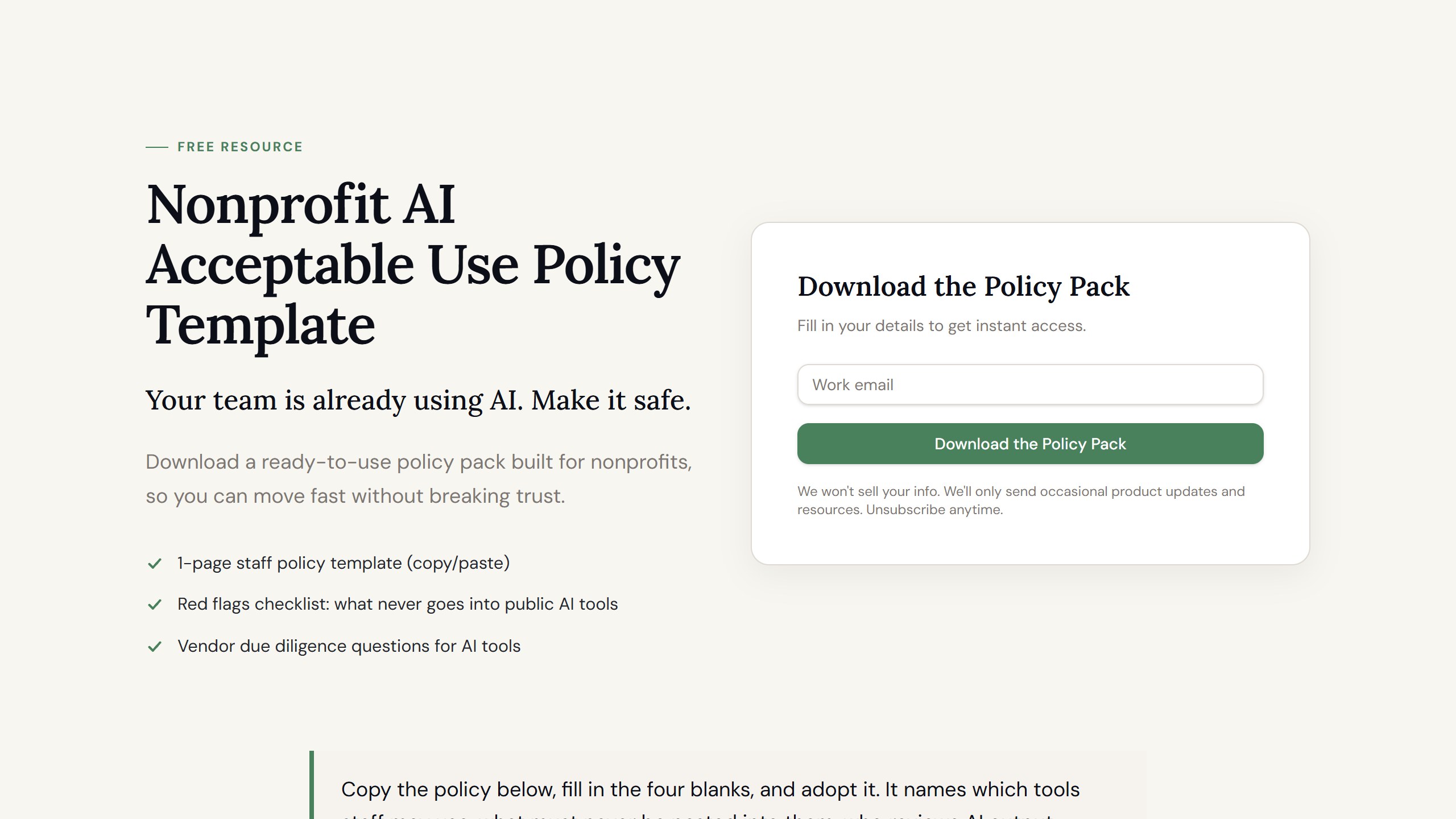
Gratefully, an AI donor intelligence layer that sits on top of your CRM, publishes two free resources that map onto the template above. Its Safe AI Policy Pack includes a one-page staff policy in Word and PDF, a red flags checklist of what must never go into public AI tools, a twelve-question vendor questionnaire, and guidance for development, programs, marketing, leadership and IT. The page says you can “Copy it, adapt it, put your name on it” with no attribution requirement. Its PII redaction whitepaper, version 2.0, published in May 2026 and updated in July 2026, covers a threat model, PII categories for nonprofit data, a detection pipeline, audit trail requirements and a scored eight-question vendor checklist. Both are written by a vendor and end with its product, so weigh them as such.
On the commitments above, the vendor’s own pages say that names, gifts, contact information, family and health details are “tokenized before any prompt leaves your tenant”, that your data never trains AI models, and, on its security page, that it keeps a “Per-interaction span-level audit trail, exportable by the nonprofit”. Two gaps to note: its SOC 2 Type II report is listed as “ETA Q4 2026”, so it is not available yet, and its pages do not name the model providers it uses. Its how it works page says Salesforce for Nonprofits, Bloomerang and Little Green Light sync automatically overnight, and its homepage also lists HubSpot. Other systems come in through CSV import or document upload. Its pricing page lists a free plan for one person, read 21 October 2026.
It is the wrong pick in some cases. If your gap is external wealth and capacity data, you need a screening database, and our guide to AI donor research tools covers DonorSearch, iWave and others. Large university advancement offices with their own data teams usually need enterprise platforms. If your board requires a current SOC 2 report today, it does not meet that bar yet. And you do not need any vendor to adopt a policy: the NTEN and Community IT templates are free and reusable.
How to adopt this policy in 30 days
Week 1: find out what is already happening
Ask every team, without blame, which AI tools they use and for what. Include AI features inside your CRM, email platform and office suite. You may find personal accounts in use for work, which is the first thing the policy fixes.
Week 2: decide the approved list
Pick one general assistant on a business plan, and list the AI features you will allow inside existing software. Ask each vendor the six questions above and file the answers.
Week 3: fill in the template and brief the board
Fill in the bracketed parts, name the policy owner and donor data owner, and take the policy to the board or its relevant committee. Expect board questions on Section 6 and Section 14.
Week 4: train and sign
Run a 30-minute session using the one-page version, with three real examples from your own team, anonymized. Collect signed acknowledgements and set the review date. Our guide to using AI for nonprofit fundraising has safe first tasks to start with, and our page on donor portfolio handover covers the staff departure rule in more depth.
Sources
- Templates and guides: NTEN Generative AI Use Policy Template, Exhibit A, Exhibit C and AI resource hub; Community IT Acceptable Use of AI Tools template; Candid responsible AI use policy guide; Fast Forward Nonprofit AI Policy Builder; NC Center for Nonprofits Sample AI Policies; AICPA & CIMA Not-for-Profit Generative AI Policy.
- Vendor resources: Safe AI Policy Pack, PII redaction whitepaper, security and PII redaction page and pricing.
- Research and law: Forvis Mazars 2026 Q2 State of the Nonprofit Sector: AI Adoption and Governance; Kindsight 2025 Donor Perceptions of AI report; Chronicle of Philanthropy report on the 2024 donor study; AFP Donor Bill of Rights; Anthropic consumer terms update; OpenAI enterprise privacy; 45 CFR 164.514(f) via Cornell LII; Wagenmaker & Oberly state privacy laws and nonprofits.
- All pages read 21 October 2026.

Written by
FazFaz is the founder of AIToolsBakery. Some tools here are tested hands on. Others are assessed from vendor documentation and pricing verified on the live page, and every review says which one it is. Sponsors can buy a position in a guide. They cannot buy the score, the criticism, or silence about a better option.
How we test and how we make money →