Quick verdict: Hypotenuse AI is built for ecommerce product descriptions and bulk content workflows. Its Shopify and BigCommerce integrations let you generate hundreds of SEO-optimized product pages in minutes. Starts at $24/month for 25 articles. Weakness: not great for general blog content or marketing copy outside ecommerce. Best for store owners with 200+ SKUs needing quick descriptions.
Faz says: If you run a content team where multiple writers need to sound like the same brand, your options used to be expensive enterprise platforms or endless style guides nobody reads. Hypotenuse AI sits in the middle: real-time collaboration, brand voice training, and AI rewriting at roughly half the price of the big names. But there’s a twist: Hypotenuse has been pivoting hard toward e-commerce, repositioning itself as an “AI agent platform for ecommerce product data and content.” We reviewed it as part of our best AI rewriting tools roundup. Here’s what we found.
What Hypotenuse AI Does
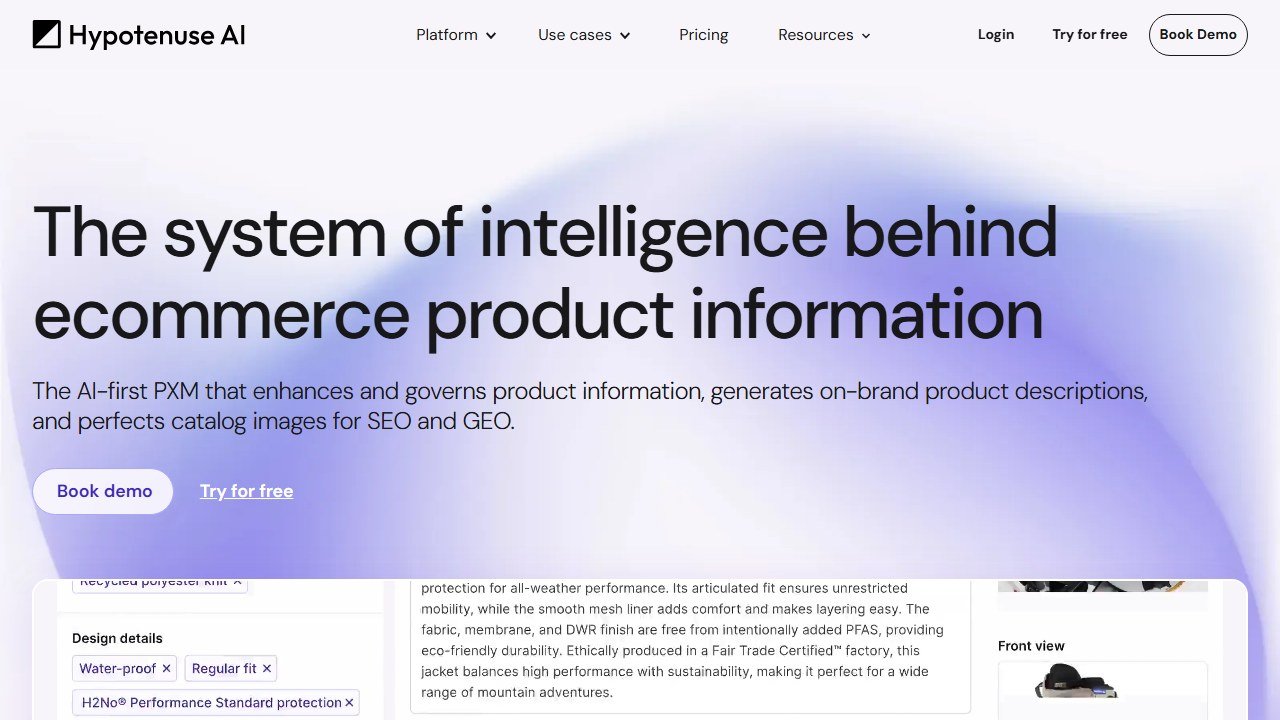
Website: Hypotenuse AI
Quick comparison at a glance. Full breakdown for each option below.
Pricing Breakdown
Hypotenuse AI is a content platform built around team collaboration and brand consistency. Founded by Joshua Wong (Y Combinator backed, based in Singapore), the platform has grown to 500,000+ users globally. Its rewriting features sit inside a larger suite that includes content generation, brand voice profiles, and real-time collaboration where multiple team members can work on the same document.

You can train it on your existing content so rewrites match your brand’s tone. The collaboration angle is what sets it apart from solo-focused tools like QuillBot or Wordtune. This isn’t a paste-and-rewrite box. It’s a workspace where your team produces consistent content together.
In 2025-2026, Hypotenuse has leaned heavily into e-commerce, adding AI agents for product data enrichment, bulk product descriptions, AI image editing, and SEO monitoring across Google, Amazon, and Walmart. If you’re an e-commerce brand managing a large product catalog, this is where Hypotenuse is putting its development focus.
Key Features
Brand Voice Training
Feed Hypotenuse samples of your existing content (blog posts, marketing copy, brand guidelines) and it learns your writing style. Every rewrite and generation after that matches your brand’s tone, vocabulary, and structure. The more samples you provide, the more accurate it gets. This is the feature that justifies Hypotenuse over simpler rewriting tools.
Real-Time Collaboration
Multiple team members can work on the same document simultaneously, similar to Google Docs but with AI rewriting built in. You can see edits in real time, leave comments, and maintain a shared workflow. This is rare among AI writing tools. Most are designed for solo use.

AI Content Generation
Beyond rewriting, Hypotenuse can generate content from scratch: blog posts, product descriptions, ad copy, social media posts. The generation respects your brand voice profile, so output sounds consistent with your existing content. Useful for teams that need to scale content production without losing voice consistency.
Content Rewriting
The core rewriting feature takes existing text and rewrites it in your brand voice. You can adjust tone, length, and style. The rewrites are clean and professional, with less aggressive restructuring than QuillBot but better brand consistency than any other tool we reviewed.
Batch Content Generation
Upload a CSV of product names, descriptions, or topics and Hypotenuse generates content for all of them at once. This is built for e-commerce teams that need hundreds of product descriptions or agencies producing content across multiple clients.
AI Agents (New in 2025-2026)
Hypotenuse has introduced an “AI agent” architecture with specialized agents for different tasks:
- Product Data AI Agent. structures product data, fills missing attributes, auto-categorizes products
- Product Content AI Agent. generates SEO-optimized titles, bullet points, and descriptions at scale
- Product Image AI Agent. enhances and standardizes product visuals in bulk
- SEO AI Agent. monitors product page SEO across Google, Amazon, and Walmart
These agents are targeted squarely at e-commerce teams managing large product catalogs.
Content Detective
A fact-finding tool that helps verify claims and find supporting data for your content. Useful for reducing hallucinations in AI-generated text.
Plagiarism Checker
Built-in plagiarism detection checks generated and rewritten content against web sources. Included in all paid plans.
Integrations
- Shopify. product descriptions direct to your store
- Amazon. product listing optimization
- Walmart. marketplace content
- WordPress. content publishing
- Klaviyo. email marketing content
- Salsify. PIM integration
- API access. available on Enterprise plans
- Wix. website content
How we evaluated Hypotenuse AI
We reviewed Hypotenuse AI’s team plan for two weeks, focusing on its rewriting workflows, brand voice features, and team collaboration tools.
- Content generation quality. We generated 15 pieces of content (blog posts, product descriptions, social media posts) and evaluated each for accuracy, readability, and how much editing was needed before publishing.
- Brand voice consistency. We configured a custom brand voice profile with specific tone guidelines, then generated 10 pieces of content to check whether the output consistently matched the configured voice.
- Rewriting and paraphrasing.
- Team features. We set up two team member accounts and tested the content approval workflow, shared brand voice settings, and content library organization.
- Batch processing. We reviewed bulk generation of product descriptions (20 products) and measured consistency across the batch.
User Experience and Interface
Hypotenuse AI’s interface is organized around content workflows rather than a single text editor. When you log in, you see a dashboard with templates: Blog Post, Product Description, Social Media Caption, Rewrite, and more. Each template walks you through a guided process. For a blog post, you enter a topic, target keywords, tone preferences, and outline points. Hypotenuse then generates a full draft.
The brand voice feature is what sets Hypotenuse apart from simpler rewriting tools. You can upload sample content that represents your desired voice, and Hypotenuse analyzes it to create a voice profile. In practice, this worked well for maintaining consistency across multiple pieces of content, though it occasionally drifted toward generic marketing language when the source material was too short.
The content editor itself is clean and functional. Generated text appears in a Google Docs-style editor where you can manually edit, regenerate specific paragraphs, or ask the AI to expand or shorten sections. The regeneration feature is handy since if one paragraph feels off, you can regenerate just that section without losing the rest.
For teams, there’s a shared workspace where content drafts live. Team members can leave comments, suggest edits, and move content through an approval pipeline. It’s not as strong as a full CMS workflow, but for small teams (2-5 people) it covers the basics without needing a separate project management tool.
Hidden limits to know about:
- The 7-day trial gives you full access with no credit card required. But once it ends there is no free tier to fall back on, and Hypotenuse no longer publishes what the paid plans cost: reading its own pricing page on 5 September 2026, both tiers read “Custom” and the page carries no currency figure anywhere. The $29 a month figure quoted in most articles, including earlier versions of this one, can no longer be sourced to the vendor, so we have withdrawn it.
- The Individual plan caps you at 50K words per month. For a single writer producing daily content, that’s roughly 2,000 words per business day. Tight if you’re generating and rewriting heavily.
- Brand voice training needs enough sample content to work well. One blog post isn’t enough. Plan to feed it at least 5-10 pieces of existing content for accurate results.
- The e-commerce plans have separate pricing via the sales team and include PIM integrations (Salsify, etc.) and marketplace SEO monitoring.
- G2 rating: 4.7/5 (73 reviews). Users praise ease of use and content quality.
Who This Is For
Use Hypotenuse AI if you:
- Run a content team where 2+ writers need to produce brand-consistent output
- Need real-time collaboration on AI-assisted content
- Want brand voice training that learns from your existing content
- Manage multiple clients or brands and need voice switching
- Run an e-commerce operation that needs bulk product descriptions at scale
Skip Hypotenuse AI if you:
- Are a solo writer (you’re paying for team features you won’t use)
- Just need quick paraphrasing (QuillBot is cheaper and faster for that)
- Want a free tool with no time limit (ProWritingAid has a forever-free plan)
- Need sentence-level tone control (Wordtune is better for that)
- Cannot get a price without a sales conversation, since Hypotenuse no longer publishes one
Pros and Cons
Pros
- No credit card required for the 7-day trial
- Brand voice profiles learn and replicate your writing style
- Real-time team collaboration is rare among AI writing tools
- E-commerce AI agents are a genuine differentiator for product catalog management
- Batch generation is powerful for e-commerce and agencies
- G2 rating of 4.7/5 reflects strong user satisfaction
Cons
- No permanent free plan after the trial ends
- Brand voice needs 5-10 content samples to work accurately
- Growth plan jumped to $87/mo (was $59/mo)
- 50K word/month cap on Individual can feel tight for heavy users
- E-commerce pivot may leave general content teams behind over time
- Smaller user base means fewer tutorials and community resources
Faz says: Hypotenuse is pulling a smart move by going deep on e-commerce. While Jasper and Copy.ai fight over the “general marketing AI” space, Hypotenuse is building specialized AI agents for product data, images, and marketplace SEO. If you run an e-commerce operation, that specificity is valuable. For general content teams, the brand voice training and collaboration features are still solid, but know that the product roadmap is heading toward e-commerce. What it costs is now a sales conversation: on 5 September 2026 its pricing page published no figure at all, with both tiers reading “Custom”. The $29 Individual and $87 Growth figures that circulate, including in earlier versions of this review, can no longer be sourced to Hypotenuse and we have withdrawn them. Solo writers should look elsewhere, but e-commerce teams and small content teams should give the free trial a spin.
Saru says: 4.0/5. Readability (4.5/5) is strong because Hypotenuse produces clean, professional output. Meaning preservation (3.5/5) shows that brand voice rewrites sometimes drift from the original meaning to match tone. That’s a feature for brand work, but worth knowing if you need faithful rewrites. Originality (4.0/5) and tone consistency (4.0/5) are solid. The e-commerce AI agents are a new differentiator that our standard rewriting metrics don’t fully capture.
Alternatives Worth Considering
- Copy.ai was the closest competitor for team-oriented content generation, but after being acquired by Fullcast in October 2025 (now “Fullcast Propel”), it has pivoted entirely toward GTM/sales workflows. Hypotenuse’s brand voice feature is more content-focused.
- Writesonic is stronger on SEO-focused content. If search rankings are your priority, Writesonic‘s Surfer SEO integration and GEO features give it an edge. Hypotenuse is better for brand consistency and e-commerce.
- QuillBot is better if you only need rewriting. QuillBot is cheaper, faster, and gives more granular control over rewrites. Choose Hypotenuse when you need full content generation with team features, not just rewriting.
See our full rankings for a detailed comparison.
For where Hypotenuse AI fits among every option, see our best AI writing tools guide.
Final Verdict
Hypotenuse AI fills a specific gap in the market: AI rewriting and content generation with real team collaboration and brand voice training, at a price point that small teams can actually afford. The e-commerce pivot (AI agents for product data, images, and marketplace SEO) gives it a clear niche that competitors like Jasper and the now-acquired Copy.ai don’t serve as well. It’s not the best tool for solo writers (QuillBot, Grammarly, and Wordtune all serve that audience better). But for e-commerce teams managing product catalogs and content teams of 2-5 people who need consistent brand voice, Hypotenuse delivers genuine value.
Rating: 4.0/5
References & further reading
For deeper editorial standards and writing-quality research:
- Chicago Manual of Style. the editorial standard most professional writing AI tools claim to follow
- Purdue Online Writing Lab. comprehensive writing-quality guidance from a top university writing program
- Federal Plain Language Guidelines. official US government standards for clear, accessible writing
Two tools in this category are no longer selling what the roundups say they sell
Software categories move faster than the articles describing them. Two vendors that appear in almost every AI writing roundup, including older versions of ours, have changed what they sell. If you are comparing hypotenuse ai against either, this is the first thing to know.
Writesonic is now an AI search visibility platform
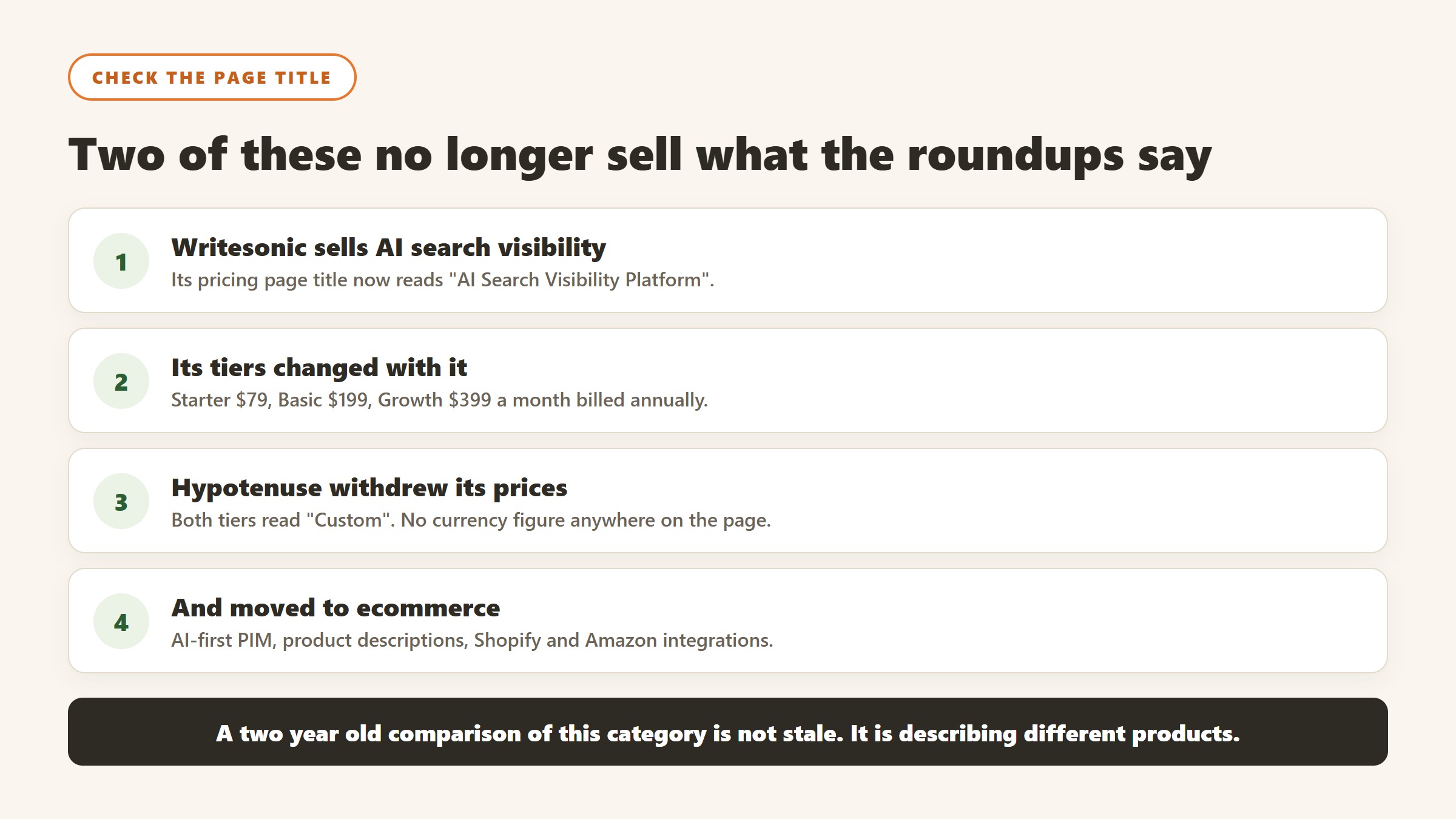
The title of Writesonic’s own pricing page on 5 September 2026 reads “Pricing | Writesonic AI Search Visibility Platform”. Its page headline is “Find which prompts recommend your competitors instead of you”, and its meta description promises tracking of AI visibility across ten AI platforms including ChatGPT, Perplexity and Google AI. The plans are Starter at $79, Basic at $199 and Growth at $399 per month billed annually, with an Enterprise tier quoted on request.
What its plans now meter
Articles per month, at 15, 25 and 50, are still there, but they sit alongside brand tracking and prompt monitoring rather than being the point. Extra users cost $50 per user per month, capped at three more on Basic and two more on Growth, and extra articles cost $100 per twenty. Its meta description also advertises self-serve “from $99/mo” while the page shows $79, which is the usual gap between a monthly rate and an annual one, so check which you are being quoted.
Hypotenuse AI has withdrawn its published pricing entirely
Hypotenuse AI’s pricing page rendered fully for us, 8,484 characters of it, and contains no currency figure anywhere. Both published tiers, Basic and Ecommerce Enterprise, read “Custom”. The product has moved with it: the page now describes an AI-first PIM, product descriptions, bulk workflows and digital shelves, with integrations listed for Amazon, Walmart, Target, Shopify, Salsify, Salesforce Commerce Cloud, NetSuite, Akeneo and Plytix. It is an ecommerce catalogue tool now, not a general writing assistant.
Why this keeps happening, and what to do about it
Generic AI writing is being absorbed into the models themselves, so the vendors that built a business on it are moving to a job the model cannot do alone: tracking your brand across AI answers, or managing a product catalogue with your data in it. Expect more of this. Practically, it means a two year old comparison of this category is not slightly stale, it is describing different products. Before you shortlist anything from a roundup, open the vendor’s own pricing page and read the page title. If the title has changed, the product has.
Three of these tools quoted us rupees, and almost no comparison mentions it
This is the single most useful thing we can tell you about pricing in this category, and it is the thing every roundup gets wrong. On 5 September 2026 we read each vendor’s own pricing page from one connection on one day. Three of the biggest names served us a rate card in Indian rupees without being asked.
Grammarly shows an India flag and prices in INR
Grammarly’s plans page displayed a country flag at the top and then quoted Free at ₹0 INR a month and Plus at ₹392 INR per member per month billed annually, or ₹1,000 when billed monthly. The currency code is written out on the page. This is not an artefact of our reading: Grammarly is deliberately serving a local rate card, and the dollar figure quoted in most articles is the United States one. The monthly-to-annual gap here is unusually wide, close to two and a half times, which makes the annual commitment more consequential than at a vendor offering a flat twenty percent.
QuillBot does the same, behind a URL that does not exist
QuillBot is harder to research than it should be. The obvious address, quillbot.com/pricing, returns a 404, and hitting it repeatedly returns a 429. Its own footer link labelled “Pricing” points at /upgrade and its header button at /premium, which is where the plans actually sit. There we were shown Free at ₹0 a month and Premium at ₹200 against a struck-through ₹334 per month billed annually, under a “Get 40% off” banner. A struck-through list price is a promotional display, so ask what it renews at rather than what it costs today.
ProWritingAid prices its free tier in dollars and its paid tiers in rupees
ProWritingAid showed us Free at $0 per month, in dollars, and then quoted Premium and Premium Pro in rupees across three separate billing views: monthly, yearly and a one-time lifetime payment. The two figures we could read cleanly, without digits being split across page elements, were annual totals of ₹4,950 and ₹5,940. Because we cannot separate the per-month rupee figures reliably, we do not publish them. It also gives premium features free to K-12 educational organisations, which none of the others here publish.
What this means for you, practically
Regional rates are set deliberately. They are not a currency conversion, so you cannot recover your own price with an exchange rate, and the ratio between two markets often differs from the ratio between the currencies. Three things follow. Check the page yourself from the country the subscription will be billed in. Treat any article quoting a single global figure for these three as having described one country. And if you are buying for a distributed team, ask the vendor which market the billing entity sits in, because that, not where the user sits, is usually what sets the rate.
Not everyone does this
Jenni AI takes the opposite approach and says so on the page: its plans are listed at $0, $12 and $29 a month with a note reading “Prices in USD. Local currency available in app.” That is the honest version of the same practice, because you can compare it against anything else without first working out which country you are looking at.
Tools mentioned in this guide
How we reached this verdict: this guide is research-based. We compare each tool against its published documentation, pricing pages and terms, and we do not claim hands-on testing we have not done.

Written by
FazFaz is the founder of AIToolsBakery. Some tools here are tested hands on. Others are assessed from vendor documentation and pricing verified on the live page, and every review says which one it is. Sponsors can buy a position in a guide. They cannot buy the score, the criticism, or silence about a better option.
How we test and how we make money →- Strong brand voice training keeps outputs consistent across team members
- Batch content generation for e-commerce product descriptions at scale
- Team collaboration features that most AI writing tools lack
- SEO-aware content generation with keyword integration
- Clean interface with low learning curve
- Less effective for pure paraphrasing compared to dedicated tools like QuillBot
- Free plan is limited in output volume
- Smaller user base means fewer community resources and integrations
- Long-form content quality can be inconsistent on complex topics
- Premium pricing targets teams, less accessible for solo users