Quick answer: The best AI SDR tool of 2026 is AiSDR for teams that want a fully autonomous outreach agent, Apollo for cost-conscious teams that already own a database, and Artisan for enterprise outbound at scale. Our picks are based on vendor documentation, verified pricing, and aggregated customer reviews across G2, Capterra, and Reddit.
Best AI SDR tools at a glance (2026):
- AiSDR, best autonomous AI SDR agent, from $750/mo
- Apollo.io, best value with built-in database, from $59/mo
- Artisan (Ava), best for enterprise outbound, from $750/seat/mo
- Reply.io (Jason AI), best for multichannel SDR sequences, from $69/mo
- Salesforge, best for personalization at high volume, from $96/mo
How we evaluated these AI SDR tools
Building rather than buying? This guide covers the platforms that do the outreach for you. If you need the data layer underneath instead, our comparison of SDR APIs works out what one call actually costs at each vendor, what a credit buys, and which ones publish a rate limit.
This roundup is a research-based editorial guide, not a live campaign benchmark. We did not run outbound sends through these tools. Instead, we evaluated each one on the material a buyer can actually verify: official vendor documentation and product demos, the pricing published on each vendor’s site (or reported by customers where pricing is quote-only), and aggregated customer reviews across G2, Capterra, and Reddit.
What we compared: the scope of each tool’s autonomy (list building, personalization, sequencing, reply handling, meeting booking), its disclosed integrations and workflow design, entry pricing and seat minimums, and the recurring praise and complaints that show up across customer reviews. The rankings below are our editorial judgment based on that research.
Which of these five expose an API, and what you can actually build on it
If you are wiring an SDR tool into your own stack rather than living in its dashboard, the API is the product. It is also the thing these vendors are least consistent about, so we loaded each one’s developer documentation directly on 1 September 2026 rather than trusting a features grid.
| Tool | Public API docs | Auth | Worth knowing |
|---|---|---|---|
| Apollo.io | Yes, docs.apollo.io | API key | Publishes an OpenAPI spec, so you can generate a client rather than hand-rolling one |
| Reply.io | Yes, docs.reply.io (v3) | API key | Documents rate limits, ships OpenAPI and Postman, and exposes an MCP interface with agent-facing docs |
| Salesforge | API plus Zapier and webhooks | Not documented publicly | Its own site lists Slack, Salesforce, Clay and HubSpot as native connections |
| AiSDR | None found | n/a | aisdr.com/api redirects to the homepage and no docs subdomain resolves |
| Artisan | None found | n/a | No developer documentation we could locate publicly |
One trap if you are integrating Reply.io. Its older documentation at apidocs.reply.io still works and still ranks, and plenty of tutorials point at it. Reply states on that page that V1 and V2 are outdated, no longer supported, and will be deprecated. Build against v3 at docs.reply.io instead, or you will ship an integration onto a version the vendor has already written off.
Reply.io is also the only one of the five with an agent-facing surface. Alongside the REST API it publishes an MCP server, agent safety rules and drop-in system prompts. If your plan is to let an AI agent operate the outbound tool rather than a rep, that is a materially different starting point from a plain REST endpoint, and no other tool in this comparison offers it.
On AiSDR and Artisan, be precise about what this means: we could not find public API documentation, which is not the same as confirming none exists. Both sell through a sales conversation, and an enterprise contract may well include integration access that is never advertised. If the API matters to you, make it a question on the call and get the answer in writing.
1. AiSDR: the best autonomous AI SDR agent of 2026
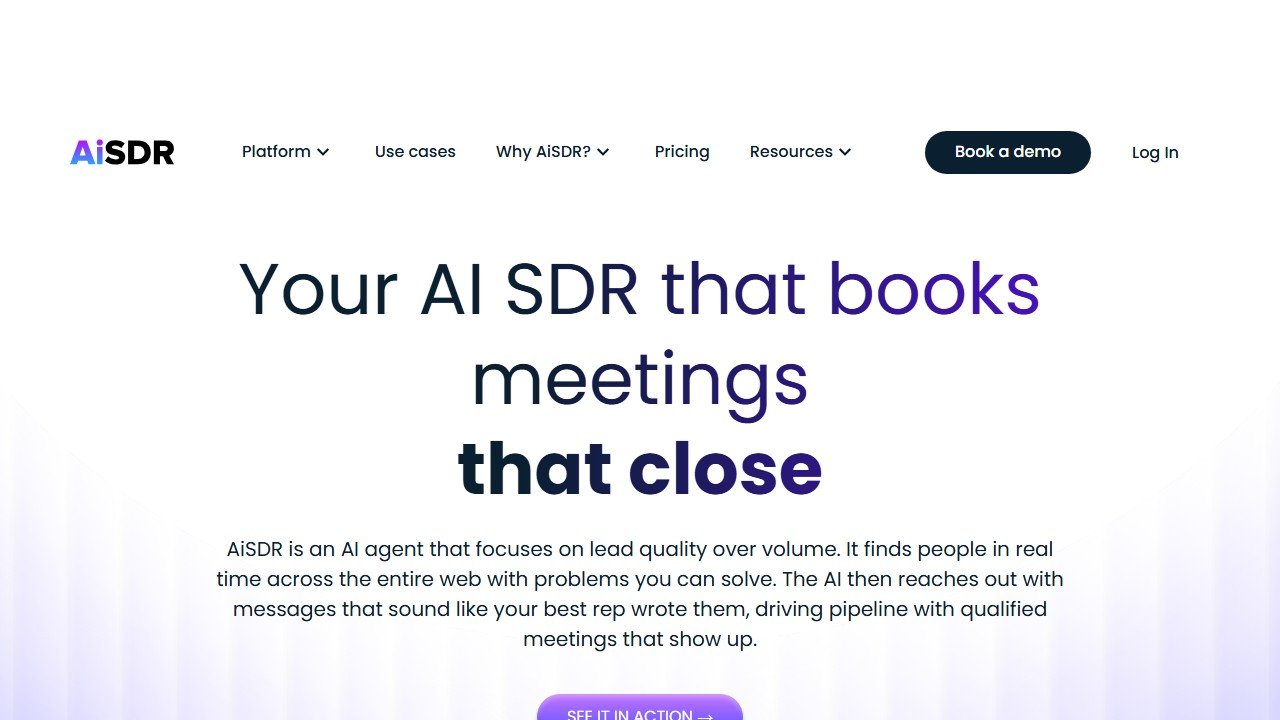
AiSDR is what most people imagine when they hear “AI SDR.” A fully autonomous outbound agent that takes a list (or builds one), generates personalized openers, manages a sequence, replies to inbound, and books meetings on a calendar. The human SDR is removed from the workflow almost entirely.
AiSDR earns the top spot in this guide on the strength of its autonomy and its personalization engine. Per the vendor’s documentation and demo flow, the AI pulls context from LinkedIn profiles, recent funding announcements, and the company website to generate openers, and customer reviews on G2 consistently call out the personalization quality as the standout feature.
Where AiSDR wins: The personalization approach. Reviewers repeatedly describe openers that reference specific, real facts about the prospect rather than generic templates. The fully autonomous mode means the tool is designed to run without daily attention, which is the actual sell on “AI SDR” tools.
Where AiSDR falls short: The price. $750/month for the starter plan is steep for early-stage teams. The free trial is short (7 days) and limited to 50 emails, not enough to validate. Customer reviews also suggest AiSDR shines on warm prospects (recent activity, fundraising news) and is less impressive on cold-cold lists without enrichment signals.
Pricing (official): Starter $750/mo (500 contacts), Pro $1,250/mo (1,500 contacts), Enterprise custom.
2. Apollo.io: the best value AI SDR for cost-conscious teams
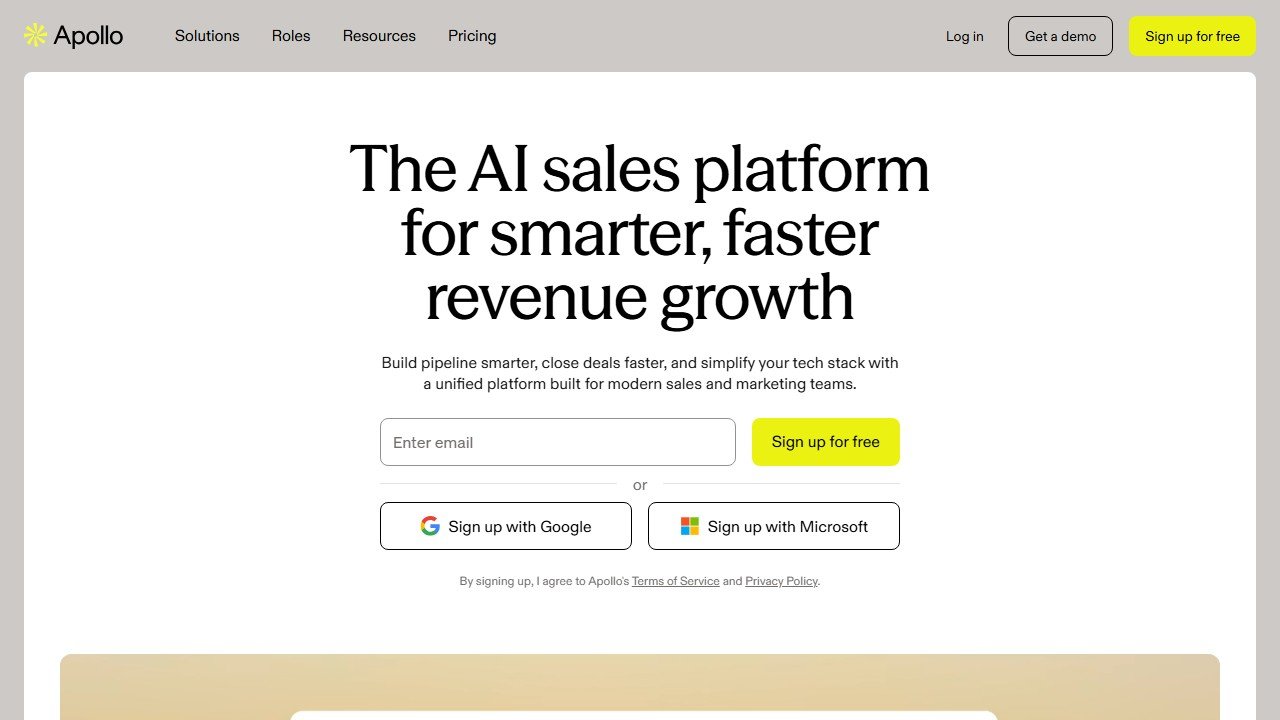
Apollo is not a pure AI SDR tool. It is a full sales engagement platform that has added AI features (Jaden AI for email generation, AI-powered scoring, AI workflow suggestions). For teams that already need Apollo for the database, the AI SDR features are effectively free.
Apollo takes the value slot because of what the entry price includes. At $59/month, you get access to the database, sequencing, and the AI email features in one subscription, and customer reviews consistently rank Apollo among the best price-to-capability ratios in the category.
Where Apollo wins: Price, full stop. You get a 275M-contact B2B database (vendor’s published figure), sequencing, dialer, AI email generation, and CRM sync for $59/month. That bundle is hard to beat for anyone running outbound under 5,000 sends per month.
Where Apollo falls short: Reviewers describe the AI as less sophisticated than dedicated agents like AiSDR or Artisan, with personalization that defaults to “researched paragraph” templates AI veterans will spot. The sequencing also caps at 30 emails per mailbox per day in the lower tiers, which throttles agencies fast.
Pricing (official): Free (limited), Basic $59/mo, Professional $99/mo, Organization $149/mo.
3. Artisan (Ava): the best AI SDR for enterprise outbound
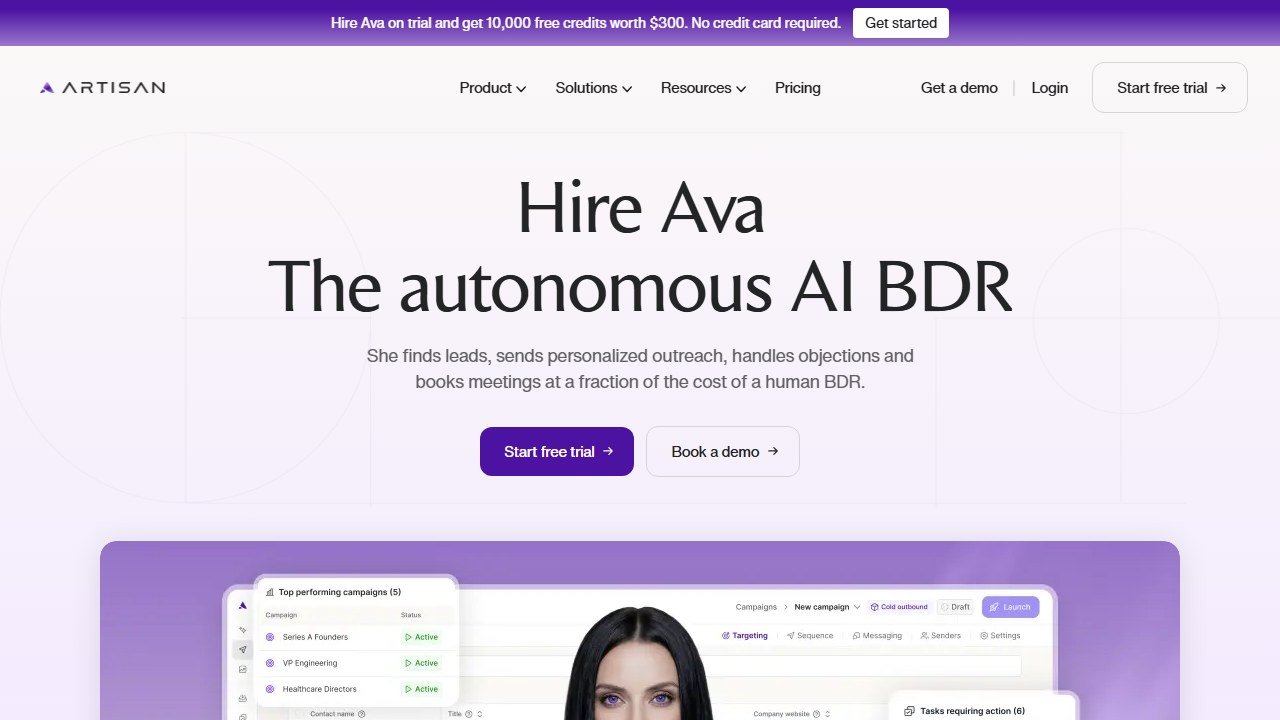
Artisan’s AI SDR is named Ava, and the marketing is famously aggressive (“stop hiring humans”). Setting the branding aside, the actual product is genuinely solid for enterprise outbound. Ava handles list building, personalization, sequence management, and meeting booking inside a single workflow.
The major differentiator versus AiSDR, based on each vendor’s disclosed integrations: deeper CRM integration (Salesforce, HubSpot, Outreach native), and a workflow designed around BDRs working a named-account list rather than a broad ICP.
Where Artisan wins: Enterprise workflows. If you sell into Fortune 1000 accounts with named-account assignments, Artisan’s account-based motion is built for that. Customer reviews frequently praise the data quality on senior executives at large companies.
Where Artisan falls short: Price and lock-in. $750 per seat per month is the entry point, and the annual commitment is non-negotiable. Also, Ava’s autonomy is more constrained than AiSDR’s. You configure more, the AI decides less. That is good for enterprise control, bad for “set it and forget it” simplicity.
Pricing (official): starts at $750/seat/mo, annual contracts only, custom enterprise tiers above 20 seats.
4. Reply.io (Jason AI): the best AI SDR for multichannel sequences
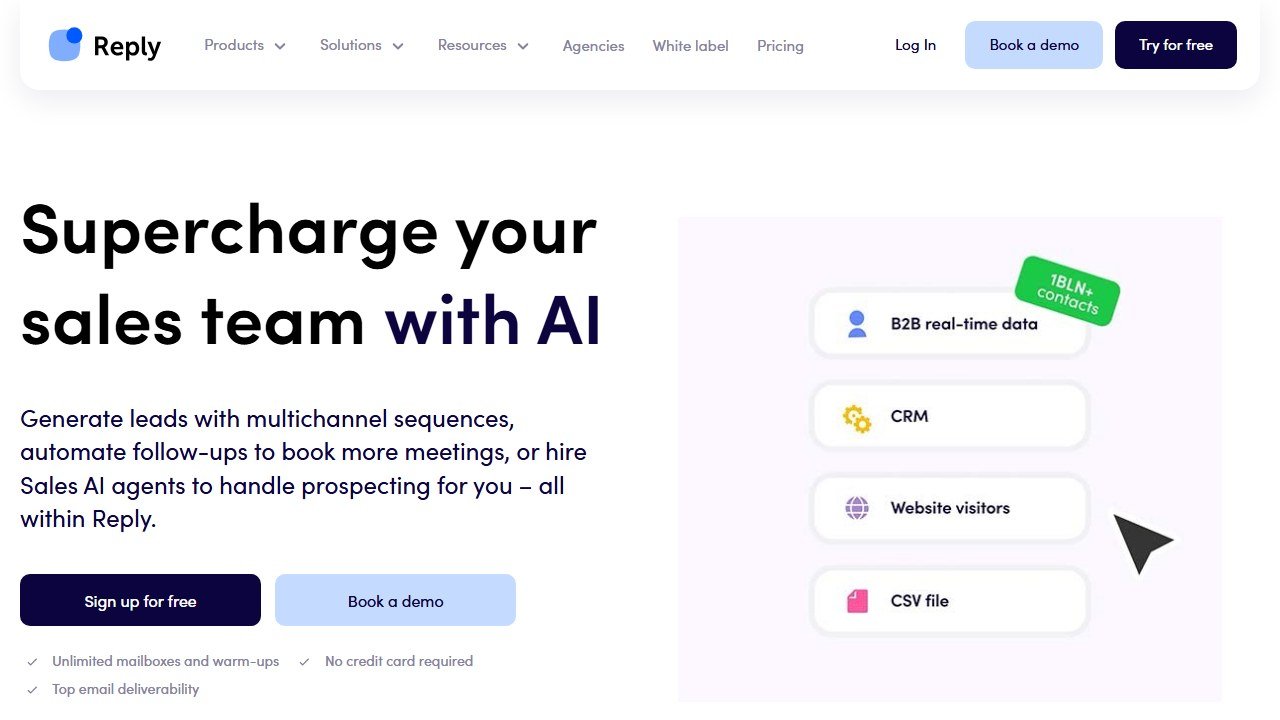
Reply.io is a long-running sales engagement platform that has reinvented itself around Jason AI, an AI agent that handles email, LinkedIn, calls, and SMS in a single cadence. Reply is the only tool in this roundup that treats non-email channels as first-class citizens rather than add-ons.
The standout, per the vendor’s documentation and customer reviews, is the LinkedIn integration: Jason AI generates personalized connection requests and follow-up DMs, and Reply’s own published material and independent industry studies both argue that multichannel cadences (email + LinkedIn + SMS) outperform email-only outreach.
Where Reply wins: Multichannel. If your ICP responds to LinkedIn DMs more than cold email (true for many enterprise segments), Reply’s multichannel cadence is the right primitive. The mid-tier price ($69-99/month) also keeps it accessible for SMB teams.
Where Reply falls short: Reviewers commonly describe the UI as dated and the learning curve as steeper than Apollo’s or AiSDR’s, with setup taking hours rather than minutes. Also, the LinkedIn automation requires a dedicated proxy and there is real risk of LinkedIn account flags if you push volume too aggressively.
Pricing (official): Email Only $69/mo, Multichannel $99/mo, Agency $166/mo.
5. Salesforge: the best AI personalization layer for high volume
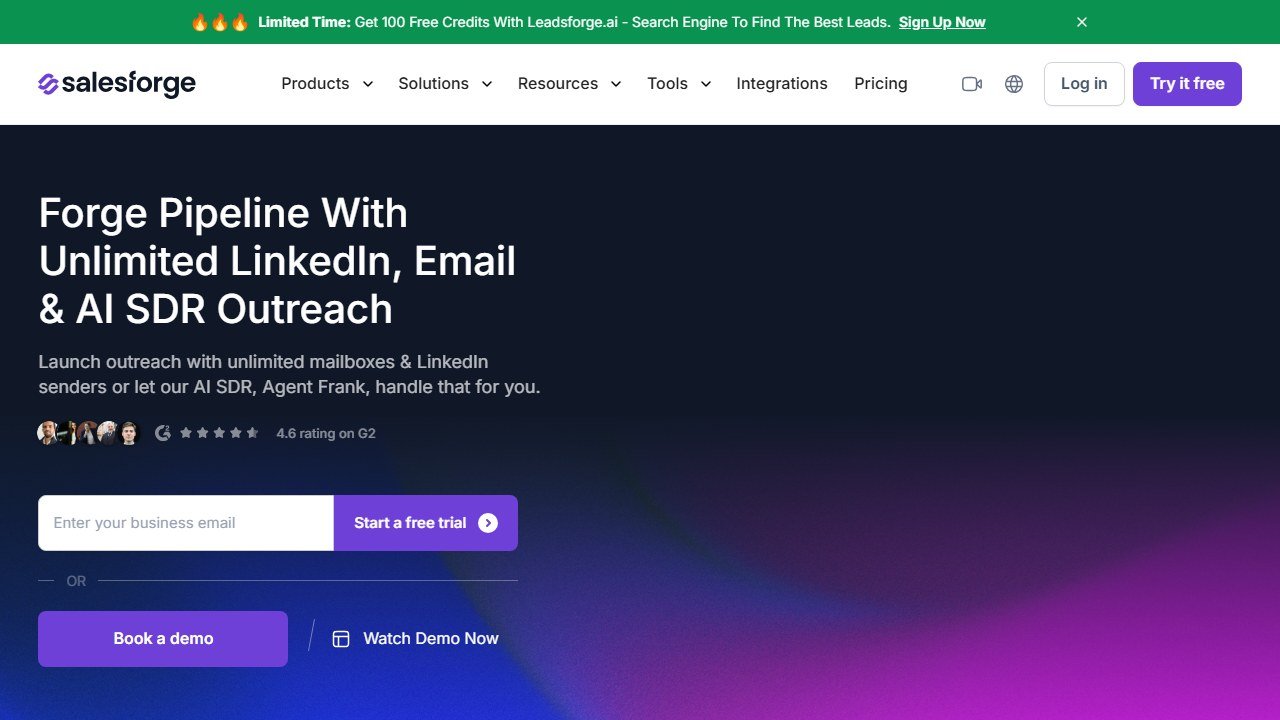
Salesforge is positioned differently from the others. It is not a full AI SDR platform but an AI personalization layer that sits on top of your existing cold email tool (Smartlead, Instantly, etc.). It generates AI personalization at the variable level (first sentence, mid-email value prop, P.S. line) at scale.
The differentiator is cost per email, which is dramatically lower than running a full AI SDR platform. Salesforge plus a sender like Smartlead comes out to roughly $96/month in combined entry pricing, against AiSDR’s $750, based on each vendor’s published plans.
Where Salesforge wins: Cost at high volume. If you are sending over 5,000 emails per month, Salesforge plus a cold email tool is the cheapest way to get genuine AI personalization. At published prices, even very high-volume agency stacks stay in the low hundreds of dollars per month.
Where Salesforge falls short: It is not a full SDR. You still need to build lists (Apollo, Clay), run a sender (Smartlead, Instantly), and handle replies (yourself or a VA). Salesforge solves one specific problem: personalization at the variable level. For everything else, you stack other tools.
Pricing (official): starts at $96/mo for 8,000 personalizations.
For AiSDR specifically, see our AiSDR review with the full feature and pricing breakdown.
For Artisan specifically, see our Artisan review with the Ava feature and enterprise-workflow breakdown.
How to pick the right AI SDR tool for your team
The decision tree is simpler than the marketing pages suggest. Map your team to one of these buckets:
Solo founder or pre-revenue startup: Apollo at $59/month. Full stop. You do not need an AI SDR yet. You need a database and a sequencing tool, and Apollo gives you both at a price that does not hurt. Add AI personalization later when you have product-market fit.
1-3 SDRs in a Series A startup: AiSDR at $750/month. The AI is designed to do the work of a junior SDR at a fraction of the cost. The math works above 50 meetings per quarter. Below that, hire a contract SDR instead.
Established SDR team (5-15 reps): Reply.io with Jason AI at $99/seat per month. The multichannel cadence (email + LinkedIn + SMS) is the right primitive for reaching prospects where they actually respond. Pair with Lavender for coaching.
Agency running cold email at scale (10K+ sends/month): Salesforge + Smartlead at roughly $250/month combined. The unit economics break any all-in-one AI SDR at that volume.
Enterprise sales org (20+ reps, Salesforce shop): Artisan. The account-based motion and native Salesforce integration are built for named-account teams. It requires an annual commitment.
What an AI SDR actually is, and what it costs
This is the newest and least standardised category in sales software, and the label covers products that do very different things. Before comparing these tools to anything, work out which of the three you are being sold.
Three products, one label
Some are copy generators bolted to a sequencer. Some are full outbound systems that source the list, write the message, send it and book the meeting. Some are essentially a managed service with software attached, where a human runs the campaign and the AI drafts. The third can be a perfectly good purchase, but it is an agency retainer wearing a software price tag and it should be compared to agencies.
What the published figures look like
AiSDR publishes from $250 a month, then $900 and $2,500, with a managed service at an extra $149 per campaign or $2,500 a month, and a quarterly commitment on most plans. Warmly publishes $10,000, $20,000 and $30,000 a year, each starting from 10,000 credits a month, and note its pricing URL redirects. Artisan has removed its figures entirely, its cards now reading that pricing is scoped on your plan. All read 4 September 2026.
The commitment is the thing to negotiate
Quarterly and annual minimums are common here and they exist because these tools take time to produce anything measurable. That is a fair argument, and it is also a lock-in on an unproven category. If you cannot get a monthly term, get a defined exit at the first review point in writing, and agree in advance what result at that point would mean you stop.
The disclosure question your brand has to answer
Decide before launch whether a recipient can tell they are corresponding with software, and what happens when they reply and ask. This is a positioning decision rather than a legal one in most jurisdictions, and getting it wrong is a brand problem you cannot unwind. The teams that handle it well decide the policy first and configure the tool to match; the ones that do not find out when a prospect posts the exchange publicly.
Compare it to the honest alternative
The real comparison for an AI SDR is not another AI SDR, it is a junior SDR plus a stack. At $2,500 a month you are at $30,000 a year, which in many markets is a meaningful share of a real salary, and a person also handles the conversation after the reply. Price both, including the stack the human would need, and be honest about which part of the job you are actually trying to fill.
How to tell whether the tool actually worked
The failure mode in sales tooling is not a product that breaks. It is one that runs for a year while nobody can say whether it changed anything, and by renewal the argument is about anecdotes.
Take the baseline before you install
Whatever you intend to measure, you need last quarter of it from a source the project did not touch. Meetings booked per rep, reply rate by segment, average cycle length, and the hours the target task consumes. That last one is the most commonly skipped and the easiest to capture: ask two or three people to record how long it takes them this month. Time saved is measurable in advance and unprovable afterwards.
Measure the decision, not the output
A tool that generated 40,000 personalised emails has produced activity. What matters is whether the accounts your reps worked were different from the ones they would have worked anyway, and whether that difference showed up in pipeline. The clean version is a holdout: give half the team the tool and leave half on the existing process for a quarter. It is unfashionable and it is the only evidence that survives a hostile question.
Watch the metric that moves against you
Volume tools improve the numbers they are measured on and quietly degrade others. More sends usually means a worse reply rate, more meetings often means worse meeting quality, and a rising bounce rate can hide behind a healthy looking campaign until a domain is burned. Pick one counter-metric per tool and report it beside the headline, or you will optimise the wrong thing very efficiently.
Agree the stop condition in advance
Write down, before purchase, the result at the end of the first term that would mean you do not renew. Naming it converts renewal from a default into a decision, and it is the single most effective discipline against a pilot that becomes permanent. If nobody can state a result that would end it, the evaluation was never real.
undefined
The verdict for 2026
The honest summary: there is no single “best” AI SDR tool. The right buy depends entirely on your team size, budget, and outbound motion. The consistent theme across customer reviews of every tool in this guide: AI SDR tools are now genuinely productive, but the value depends on how well your inputs (list quality, ICP, value prop) are dialed in. Bad inputs into a great AI SDR still produce bad outputs.
One trend worth watching: the personalization gap between tools is closing fast as the underlying models (GPT-4o, Claude 3.5, Sonnet 4) improve. Tools that overpromise on personalization and deliver template-style emails get called out quickly in reviews, and the leaders differentiate on real per-prospect research. By the end of 2026, we expect the personalization gap between tools to narrow enough that choice will be driven by price, integrations, and workflow fit, not AI quality.
For more on the broader sales stack, see our Best AI Sales Tools 2026 guide. For pure cold email infrastructure (not full SDR agents), the Best AI Cold Email Tools 2026 covers Smartlead, Instantly, Lemlist, and others. For data quality on enrichment, see Best AI Lead Enrichment Tools.
New to the category? Start with our explainer on what an AI SDR is, then see the best AI dialer software for the calling side.
More AI tool guides worth reading: Seamless.AI Review, Salesloft Review 2026 and Best Conversation Intelligence Software in 2026.

Written by
FazFaz is the founder of AIToolsBakery. Some tools here are tested hands on. Others are assessed from vendor documentation and pricing verified on the live page, and every review says which one it is. Sponsors can buy a position in a guide. They cannot buy the score, the criticism, or silence about a better option.
How we test and how we make money →